www.jped.com.br
ORIGINAL ARTICLE
Oxidative and antioxidative status of children with acute
bronchiolitis
夽
Rusen Dundaroz
a, Ufuk Erenberk
a, Ozden Turel
a,∗, Aysegul Dogan Demir
a,
Emin Ozkaya
a, Ozcan Erel
baDepartment of Pediatrics, Bezmialem Vakif University Faculty of Medicine, Istanbul, Turkey
bDepartment of Medical Biochemistry, Yıldırım Beyazıt University Faculty of Medicine, Istanbul, Turkey
Received 6 September 2012; accepted 5 December 2012 Available online 21 June 2013
KEYWORDS Bronchiolitis; Infant; Oxidative; Stress
Abstract
Objective: Oxidative stress has been shown to contribute to the pathogenesis of acute and chronic lung inflammatory diseases. This article aimed to evaluate the oxidant/antioxidant status of children with acute bronchiolitis through the measurement of plasma total antioxidant capacity, total oxidant status, and oxidative stress index.
Methods: Children with acute bronchiolitis admitted to the pediatric emergency department of a university hospital between January and April of 2012 were compared with age-matched healthy controls. Patients with acute bronchiolitis were classified as mild and moderate bron-chiolitis. Oxidative and antioxidative status were assessed by measurement of plasma total antioxidant capacity, total oxidant status, and oxidative stress index.
Results: Thirty-one children with acute bronchiolitis aged between 3 months and 2 years, and 39 healthy children were included. Total oxidative status (TOS) was higher in patients with acute bronchiolitis than the control group (5.16±1.99mol H2O2versus3.78±1.78mol H2O2 [p = 0.004]). Total antioxidant capacity (TAC) was lower in children with bronchiolitis
than the control group (2.51±0.37mol Trolox eqv/Lversus2.75±0.39mol Trolox eqv/L [p = 0.013]). Patients with moderate bronchiolitis presented higher TOS levels than those with mild bronchiolitis and the control group (p = 0.03, p < 0.001, respectively). Patients with mod-erate bronchiolitis had higher oxidative stress index levels than the control group (p = 0.015). Oxygen saturation level of bronchiolitis patients was inversely correlated with TOS (r =−0.476, p < 0.05).
Conclusion: The balance between oxidant and antioxidant systems is disrupted in children with moderate bronchiolitis, which indicates that this stress factor may have a role in the pathogenesis of the disease.
© 2013 Sociedade Brasileira de Pediatria. Published by Elsevier Editora Ltda. All rights reserved.
夽 Please cite this article as: Dundaroz R, Erenberk U, Turel O, Demir AD, Ozkaya E, Erel O. Oxidative and antioxidative status of children with acute bronchiolitis. J Pediatr (Rio J). 2013;89:407---11.
∗Corresponding author.
E-mail:[email protected] (O. Turel).
PALAVRAS-CHAVE Bronquiolite; Neonato; Oxidante; Estresse
Estado oxidante e antioxidante de crianc¸as com bronquiolite aguda
Resumo
Objetivo: O estresse oxidativo demonstrou contribuir para a patogênese de doenc¸as pulmonares inflamatórias agudas e crônicas. Nosso objetivo foi avaliar o estado oxidante/antioxidante de crianc¸as com bronquiolite aguda por meio de mensurac¸ão da capacidade antioxidante total do plasma, estado oxidante total e índice de estresse oxidativo.
Métodos: As crianc¸as com bronquiolite aguda encaminhadas para o Departamento de Emergên-cia Pediátrica do hospital universitário entre janeiro e abril 2012 foram comparadas a controles saudáveis de mesma idade. Os pacientes com bronquiolite aguda tiveram essa doenc¸a classifi-cada como leve e moderada. O estado oxidante e antioxidante foi avaliado pela mensurac¸ão da capacidade antioxidante total do plasma, estado oxidante total e índice de estresse oxidativo.
Resultados: Foram incluídas 31 crianc¸as com bronquiolite aguda com idade de três meses a dois anos e 37 crianc¸as saudáveis. O estado oxidante total (EOT) foi maior em pacientes com bronquiolite aguda do que no grupo de controle (5,16±1,99mol H2O2em comparac¸ão
a 3,78±1,78mol H2O2 [p = 0,004]). A capacidade antioxidante total (CAT) foi significativa-mente menor em crianc¸as com bronquiolite que no grupo de controle (2,51±0,37mol Trolox equivalente/L em comparac¸ão a 2,75±0,39mol Trolox Eqv/L) (p = 0,013). Os pacientes com bronquiolite moderada apresentaram níveis de EOT mais elevados que os com bronquiolite leve e os do grupo de controle (p = 0,03, p < 0,001). Os pacientes com bronquiolite moderada apresentaram níveis de IEO mais elevados que os do grupo de controle (p = 0,015). O nível de saturac¸ão de oxigênio de pacientes com bronquiolite foi inversamente correlacionado ao nível de EOT (r = -0,476, p < 0,05).
Conclusão: O equilíbrio entre os sistemas oxidante e antioxidante é interrompido em crianc¸as com bronquiolite moderada, indicando que o fator de estresse poderá ter um papel na patogê-nese da doenc¸a.
© 2013 Sociedade Brasileira de Pediatria. Publicado por Elsevier Editora Ltda. Todos os direitos reservados.
Introduction
Acute respiratory tract infections are important causes of morbidity and mortality in children, with a disease bur-den estimated at 112,900,000 disability-adjusted life years (DALYs), and 3.5 million deaths worldwide.1In Turkey,
respi-ratory tract infections were found to be the second most common cause of mortality among children between 0 and14 years of age.2Due to its environmental interface, the lung
is a major target organ for injury by exogenous oxidants such as environmental pollutants and endogenous reactive oxygen species (ROS) generated by inflammatory cells.3The
organism has enzymatic and non-enzymatic antioxidant sys-tems to neutralize the harmful effects of the endogenous ROS products. Under certain conditions, the oxidative and anti-oxidative balance shifts towards the oxidative status, leading to a condition termed oxidative stress. Increased oxidative stress has been shown to contribute in the patho-genesis of many conditions, including acute and chronic airway diseases.4,5 Measurement of individual oxidant and
antioxidant molecules have been used by researchers in several diseases including respiratory tract infections, but this requires a complex and costly procedure. Total oxida-tive status (TOS) and total antioxidaoxida-tive capacity (TAC) have more value than assessment of one part of these systems, and have shown good correlation with other oxidant stress markers.6,7The present study aimed to define the oxidative
and antioxidative status of children with acute bronchitis by measuring plasma TAC, TOS, and oxidative stress index (OSI).
Methods
Study groups
The study population comprised 31 children aged between 3 months and 2 years diagnosed with acute bronchiolitis at the pediatric emergency department of the Bezmialem Vakıf University between January and April of 2012. Acute bronchiolitis was defined as first episode of acute wheezing or rhonchi, tachypnoea, and chest retraction, preceded by or associated with cough, coryza, rhinorrhoea, and axillary temperature > 37.5◦C.8 Patients were excluded from the
study if they had an underlying disease that might affect the cardiopulmonary status (e.g. bronchopulmonary dyspla-sia, prematurity, assisted ventilation during the neonatal period, congenital heart disease, or immunodefficiency); asthma diagnosed by a physician; wheezing or cough previ-ously treated with bronchodilators or corticosteroids within the preceding two weeks; or recurrent wheezing or his-tory of chronic lung disease. A clinical illness grading scale for acute bronchiolitis patients was used to estab-lish the severity of infection (scores 0 to 12 calculated according to general appearance, wheezing, retraction, and respiratory rate).913 (42%) patients were classified as
mild, and 18 (58%) patients were classified as moderately severe.
signs of septicemia, pulmonary, metabolic, rheumatologic, or autoimmune diseases.
The study was approved by local ethics committee (December 13, 2011, No. 5,172).
Samples
Serum samples collected from patients and control group were immediately separated from the cells by centrifugation at 3,000gfor 10 min, and then stored at−80◦C until further
analysis of TOS, TAC, and OSI.
Measurement of total antioxidant status
Total oxidant status (TOS) was measured with the assay based on the oxidation of ferrous ion to ferric ion in the presence of various oxidant species in acidic medium, and the measurement of ferric ion by xylenol orange. The assay was calibrated with hydrogen peroxide, and the results were expressed in terms of micromolar hydrogen peroxide equiv-alents per liter (mol H2O2eqv/L).10
Measurement of TAC of plasma
TAC was measured through a method developed by Erel.11
In this method, the antioxidative effect of the sample against potent free radical reactions that are initiated by the hydroxyl radical produced are measured. The results are expressed asmol Trolox eqv/L.
Measurement of plasma oxidative stress index
Oxidative stress index (OSI) was determined by the ratio of TOS to TAC.12
OSI (arbitrary unit) = TOS (mol H2O2 eqv/L)/TAC (mol Trolox eqv/L).
Statistical analysis
The statistical analysis was performed using the Statistical Package for Social Sciences (SPSS) 15.0 for Windows. Stu-dent’s t-test was used for comparing mean values of age among acute bronchiolitis and control groups. Plasma TAC, TOS, and OSI levels were compared with one-way ANOVA test among mild bronchiolitis, moderate bronchiolitis, and con-trol subjects. Multiple comparisons were analysed through Tukey’s HSD post hoc test. Correlation analysis was per-formed between oxygen saturation and oxidative state.
Results
The male to female ratio was 1.2 in patients with bronchi-olitis (17 male and 14 female) and 0.94 in the control group (18 male and 19 female) (p = 0.61). Mean ages of patients with bronchiolitis and the control group were 9.93±3.96 and 9.83±4.51, respectively (p = 0.92). Total oxidative sta-tus was higher in patients with bronchiolitis than the control group (5.16±1.99mol H2O2eqv/Lversus3.78±1.78mol H2O2 eqv/L [p = 0.004]). Total antioxidant capacity was
Mild bronchiolitis
TO
S
(µ
mol H
2
O2
eqv/L)
8.00 10.00
6.00
4.00
2.00
0.00
−2.00
Control group Moderately severe bronchiolitis
p<0.05
Groups
+ , ∗: ∗
+ +
Fig. 1 Boxplot presentation of total oxidative status (TOS) value among patients with mild bronchiolitis, moderate bron-chiolitis, and control group.
significantly lower in children with acute bronchiolitis than the control group (2.51±0.37mol Trolox eqv/L versus 2.75±0.39mol Trolox eqv/L [p = 0.013]). Oxidative stress index of patients with bronchiolitis was higher than control group, but the difference was not statistically significant (0.20±0.88 unitsversus0.15±0.12 units [p = 0.085]).
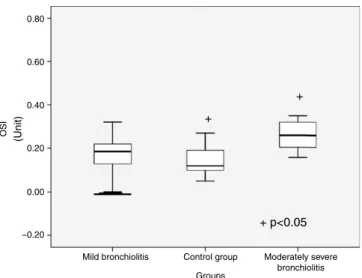
TOS level significantly differed between subgroups (p < 0.001) (Table 1). Patients with moderate bronchioli-tis had higher TOS levels than mild bronchiolibronchioli-tis and control group (p = 0.03, p < 0.001, respectively) (Fig. 1). Although the TAC level was higher in patients with moder-ate bronchiolitis than in those with mild bronchiolitis and the control group, there was not a significant difference (p = 0.88, p = 0.08, respectively). OSI was significantly dif-ferent between subgroups (p = 0.019) (Fig. 2). Patients with moderate bronchiolitis had higher OSI levels than the control group (p = 0.015).
0.80
0.60
0.40
0.20
0.00
Mild bronchiolitis Control group Moderately severe bronchiolitis
+ p<0.05 +
+
Groups
(Unit)
−0.20
OSI
Table 1 Comparisons of demographic characteristics and oxidative and antioxidative parameters among mild bronchiolitis, moderate bronchiolitis, and control group.
Variables Mild bronchiolitis (n = 13) (1)
Control group (n = 37) (2)
Moderate bronchiolitis (n = 18) (3)
p-value Tukey
TOS,mol H2O2eqv/La 4.48±1.92 3.78±1.78 6.22±1.68 <0.001 1, 2vs 3b
TAC,mol Trolox eqv/La 2.54±0.38 2.75±0.39 2.47±0.37 0.043 NS
OSI, unitsa 0.16
± 0.08 0.15±0.12 0.25±0.06 0.019 2vs3c
OSI, oxidative stress index; TAC, total antioxidant capacity; TOS, total oxidative status.
aMean±SD.
b TOS levels of moderate bronchiolitis patients were significantly higher than those of mild bronchiolitis patients and the control group. c OSI of patients with moderate bronchiolitis was significantly higher than the control group.
Oxygen saturation level of bronchiolitis patients was inversely correlated with TOS (r =−0.476, p < 0.05) (Fig. 3).
Discussion
Oxidative stress can contribute to the pathogenesis of sev-eral lung diseases in children, such as asthma, cystic fibrosis, and chronic neonatal lung disease.3,4,13---15Increased
oxida-tive stress has also been found in infants and preschool children passively exposed to tobacco smoke.16,17Infections
with viruses such as HIV, hepatitis B, influenza, and rhi-novirus have been shown to stimulate ROS generation.18 In
this study, the oxidative state of children during acute bron-chiolitis, which is a common illness during childhood, was evaluated. To the best of the authors’ knowledge, there are no published reports on serum oxidative/antioxidative markers of TAC, TOS, and OSI in children with acute bron-chiolitis. Various antioxidants in plasma have an additive effect, protecting the organism from free radicals.19In this
respect, measurement of TAC provides information about the antioxidant capacity of the organism.11 In addition,
OSI, the ratio of total plasma TOS level to TAC, is an indicator of oxidative stress, reflecting the redox balance between oxidation and antioxidation.10,12The present study
demonstrated that TAC was lower in patients with acute
10.00
8.00
6.00
4.00
2.00
0.00
87.50 90.00 92.50
Oxygen saturation level (%) 95.00
r = −0.476, p<0.05
97.50 −2.00
TO
S
(µ
mol H
2
O2
eqv/L)
Fig. 3 Correlation graphic and regression line. Oxygen satu-ration level of bronchiolitis patients was inversely correlated with total oxidative status (TOS) (r =−0.476, p < 0.05).
bronchiolitis than the control group. TOS and OSI were increased in moderate bronchiolitis patients in comparison with the control group.
Reduction in antioxidant enzyme (AOE) expression has been observed in the lungs of mice previously infected with respiratory syncytial virus (RSV) and human metap-neumovirus (hMPV).20,21 Impairment or decrease in the
expression and/or activity of superoxide dismutase (SOD), catalase, glutathione S-tranferase, and glutathione perox-idase have been shown in nasopharyngeal secretions of children with severe RSV bronchiolitis.5 Recently, Mallol
et al. measured the oxidant and antioxidant activity in bronchoalveolar fluid of 21 children with post-infectious bronchiolitis obliterans.22 They found an increased level
of oxidative stress markers with a differential activity of antioxidant enzyme levels (normal catalase and increased glutathione peroxidase). Despite the marked airway nar-rowing found in all patients, their pulmonary function parameters were unrelated to oxidative stress markers suggesting that OS could be more related to airway inflam-mation and airway hyperresponsiveness (AHR) than to airway calibre.
The present study also investigated whether oxidative stress could play a role in bronchiolitis severity. TOS was increased in moderate bronchiolitis in comparison to mild cases. An increase in OSI was also significant in moder-ate bronchiolitis. Oxygen saturation levels of patients were inversely correlated with TOS. Zeyrek et al. investigated the association of oxidative stress with DNA damage in 42 chil-dren with asthma bronchiale.23Plasma TAC, TOS, and total
peroxide concentrations (LOOH) were higher in patients than in healthy controls, and DNA damage correlated with increased TOS.
Antioxidant treatment blocks transcription factor acti-vation and chemokine gene expression in vitro.24,25
Castro et al. showed that antioxidant treatment reduced RSV-induced clinical illness and body weight loss in exper-imentally infected mice.20 In an animal model of influenza
infection, inhibition of oxygen radicals through administra-tion of antioxidants or increased lung superoxide dismutase levels significantly reduced lung injury and improved the survival rate of infected animals, suggesting that oxidative stress can play a significant role in the pathogenesis of viral pneumonia.26,27 Gurkan et al. investigated the relationship
increased MDA levels and impaired Se status in comparison to control subjects. They concluded that antioxidant supple-mentation with Se might provide a beneficial effect against bronchiolitis.
Conflicts of interest
The authors declare no conflicts of interest.
References
1. Murray CJ, Lopez AD. Global mortality, disability, and the contri-bution of risk factors: Global Burden of Disease Study. Lancet. 1997;349:1436---42.
2. Ünüvar N, Mollahalilo˘glu S, Yardım N, editors. Türkiye Hastalık Yükü C¸alıs¸ması 2004. T. C. Sa˘glık Bakanlı˘gı, Refık Saydam Hıfzıssıhha Merkezı Bas¸kanlı˘gı, Hıfzıssıhha Mektebi Müdürlü˘gü. 1Basım. Ankara: Aydo˘gdu Ofset Matbaacılık San. ve Tic.Ltd.S¸ti; 2006. p. 1---56.
3. Ciencewicki J, Trivedi S, Kleeberger SR. Oxidants and the pathogenesis of lung diseases. J Allergy Clin Immunol. 2008;122:456---70.
4. Park HS, Kim SR, Lee YC. Impact of oxidative stress on lung diseases. Respirology. 2009;14:27---38.
5. Hosakote YM, Jantzi PD, Esham DL, Spratt H, Kurosky A, Casola A, et al. Viral-mediated inhibition of antioxidant enzymes con-tributes to the pathogenesis of severe respiratory syncytial virus bronchiolitis. Am J Respir Crit Care Med. 2011;183:1550---60. 6. Emin O, Hasan A, Aysegul D, Rusen D. Total antioxidant status
and oxidative stress and their relationship to total IgE levels and eosinophil counts in children with allergic rhinitis. J Investig Allergol Clin Immunol. 2012;22:188---92.
7. Ercan S, Cakmak A, Kösecik M, Erel O. The oxidative state of children with cyanotic and acyanotic congenital heart disease. Anadolu Kardiyol Derg. 2009;9:486---90.
8. Lakhanpaul M, Armon K, Eccleston P, MacFaul R, Smith S, Vyas H, et al. An evidence based guideline for the management of children presenting with acute breathing difficulty. Nottingham: University of Nottingham; 2002.
9. Wang EE, Milner RA, Navas S, Maj H. Observer agreement for respiratory signs and oximetry in infants hospitalized with lower respiratory infections. Am Rev Respir Dis. 1992;145:106---9. 10. Erel O. A new automated colorimetric method for measuring
total oxidant status. Clin Biochem. 2005;38:1103---11.
11. Erel O. A novel automated direct measurement method for total antioxidant capacity using a new generation, more stable ABTS radical cation. Clin Biochem. 2004;37:277---85.
12. Demirbag R, Gur M, Yilmaz R, Kunt AS, Erel O, Andac MH. Influence of oxidative stress on the development of collat-eral circulation in total coronary occlusions. Int J Cardiol. 2007;116:14---9.
13. Ercan H, Birben E, Dizdar EA, Keskin O, Karaaslan C, Soyer OU, et al. Oxidative stress and genetic and epidemiologic
determinants of oxidant injury in childhood asthma. J Allergy Clin Immunol. 2006;118:1097---104.
14. Hull J, Vervaart P, Grimwood K, Phelan P. Pulmonary oxidative stress response in young children with cystic fibrosis. Thorax. 1997;52:557---60.
15. Ballard PL, Truog WE, Merrill JD, Gow A, Posencheg M, Golombek SG, et al. Plasma biomarkers of oxidative stress: relationship to lung disease and inhaled nitric oxide therapy in premature infants. Pediatrics. 2008;121:555---61.
16. Aycicek A, Erel O, Kocyigit A. Increased oxidative stress in infants exposed to passive smoking. Eur J Pediatr. 2005;164:775---8.
17. Yıldırım F, Sermetow K, Aycicek A, Kocyigit A, Erel O. Increased oxidative stress in preschool children exposed to passive smok-ing. J Pediatr (Rio J). 2011;87:523---8.
18. Schwarz KB. Oxidative stress during viral infection: a review. Free Radic Biol Med. 1996;21:641---9.
19. Wayner DD, Burton GW, Ingold KU, Barclay LR, Locke SJ. The relative contributions of vitamin E, urate, ascorbate and pro-teins to the total peroxyl radical-trapping antioxidant activity of human blood plasma. Biochim Biophys Acta. 1987;924:408---19. 20. Castro SM, Guerrero-Plata A, Suarez-Real G, Adegboyega PA, Colasurdo GN, Khan AM, et al. Antioxidant treatment ame-liorates respiratory syncytial virus-induced disease and lung inflammation. Am J Respir Crit Care Med. 2006;174:1361---9. 21. Bao X, Sinha M, Liu T, Hong C, Luxon BA, Garofalo RP,
et al. Identification of human metapneumovirus-induced gene networks in airway epithelial cells bymicroarray analysis. Virol-ogy. 2008;374:114---27.
22. Mallol J, Aguirre V, Espinosa V. Increased oxidative stress in children with post infectious Bronchiolitis Obliterans. Allergol Immunopathol (Madr). 2011;39:253---8.
23. Zeyrek D, Cakmak A, Atas A, Kocyigit A, Erel O. DNA damage in children with asthma bronchiale and its association with oxida-tive and antioxidaoxida-tive measurements. Pediatr Allergy Immunol. 2009;20:370---6.
24. Casola A, Burger N, Liu T, Jamaluddin M, Brasier AR, Garofalo RP. Oxidant tone regulates RANTES gene expression in airway epithelial cells infected with respiratory syncytial virus. Role in viral-induced interferon regulatory factor activation. J Biol Chem. 2001;276:19715---22.
25. Liu T, Castro S, Brasier AR, Jamaluddin M, Garofalo RP, Casola A. Reactive oxygen species mediate virus-induced STAT activation: role of tyrosine phosphatases. J Biol Chem. 2004;279:2461---9. 26. Suliman HB, Ryan LK, Bishop L, Folz RJ. Prevention of
influenza induced lung injury in mice overexpressing extracel-lular superoxide dismutase. Am J Physiol Lung Cell Mol Physiol. 2001;280:L69---78.
27. Ghezzi P, Ungheri D. Synergistic combination of N-acetylcysteine and ribavirin to protect from lethal influenza viral infection in a mouse model. Int J Immunopathol Pharmacol. 2004;17:99---102.