Pulmonary function tests in asthmatic children and
adolescents: Comparison between a microspirometer and
a conventional spirometer*
LÚCIA BARTMANN WILD, ALEXANDRE SIMÕES DIAS, GILBERTO BUENO FISCHER, DANIELE RUZZANTE RECH
J Bras Pneumol 2005; 31(2): 97-102.
* Rede Metodista de Educação, Curso de Fisioterapia, Porto Alegre, RS
Correspondence to: Rua Monsenhor Armando Teixeira, 81. Bairro Frota. Cachoeira do Sul, RS, Brasil. CEP: 96508-780. Tel: (51) 37224537 / 91911629.E-mail: [email protected] ou [email protected]
Key words: Asthma. Spirometry. Micro spirometer. Puomonary ventilation.
Background: Spirometry is widely used in the diagnosis and quantification of respiratory disorders such as asthma. A microspirometer is a portable and easily used apparatus that can substitute for a regular spirometer, although there is little evidence of its accuracy.
Objective: Tocompare the microspirometer to a regular spirometer for use in asthmatic children and adolescents.
Methods: The instruments used were a Micro Spirometer, manufactured by Micro Medical, and a conventional Cosmed Pony Graphic 3.5spirometer, both with turbinometers (flow sensors). The study sample consisted of 62 children and adolescents, of both genders, clinically diagnosed with asthma and under treatment at a pulmonology clinic. Ages ranged from 5 and 16 years. All spirometric tests were carried out according to the guidelines established by the American Thoracic Society and by the Associacão Brasileira de Normas Técnicas (Brazilian Technical Standards Association). For each patient, microspirometry was performed first, followed by conventional spirometry. The parameters analyzed in both devices were forced vital capacity, forced expiratory volume in one second and peak expiratory flow. Data were analyzed using the Student’s t-test and Pearson’s correlation test.
Results: Strong correlations were found between the two devices in the parameters analyzed: forced expiratory volume in one second: r = 0.97; forced vital capacity: r = 0.97; and peak expiratory flow: r = 0.91.
Conclusion: These results demonstrate that the microspirometer is a useful diagnostic tool that can be used when a conventional spirometer is unavailable.
INTRODUCTION
Asthma is a disease that causes airway narrowing and is characterized by inflammation and hyperresponsiveness of the airways, triggered by several stimuli. In childhood, it presents a clinical profile with varied characteristics, which are generally difficult to differentiate from other causes of lower airway obstruction. Most children with asthma present recurrent wheezing, together with cough or dyspnea, or both. These problems generally result from viral infections or from exposure to environmental factors such as allergens, cold air, cigarette smoke, etc. Many of the alterations that occur in the asthmatic child airways are due to a local inflammatory response(1-5).
According to the 2002 Consenso Brasileiro no Manejo da Asma (Brazilian Consensus on Asthma Management), there are 350,000 annual hospital admissions due to asthma in Brazil. This disease constitutes the fourth leading cause of hospitalization under the Sistema Único de Saúde (Unified Health System) – 2.3% of the total number – and the third leading cause among children and young adults(1, 2).
In order to plan and implement a suitable program for the treatment of asthma, a system including patient clinical and function tests is needed(5). Among
the most widely-used tests in the diagnosis of asthma, spirometry has been proven to be an effective method for assessing pulmonary function. It aids prevention, confirms diagnoses and allows the quantification of respiratory disorders(6-8).
The test results are compared to predicted values of normality proceeding from tables or equations obtained through the evaluation of a sizable number of individuals within a representative population stratum: nonsmokers with no lung disease. Predicted values vary according to gender (20% higher in males), age (increasing in the growth phase and decreasing between 20 and 25 years of age) and height (higher in taller individuals)(7, 8).
Although spirometry is ideally suited for use in a fully-equipped pulmonary function laboratory, it may also be performed in an office with relatively simple equipment(9,10). A microspirometer is an apparatus
developed with the objective of performing basic spirometric tests in diverse environments. Patients may take one home and perform daily expiratory maneuvers aimed at early detection of possible alterations of pulmonary function. Those patients who are on a waiting list for lung transplant or who are in a
postoperative phase are prime candidates for its use. A microspirometer is an apparatus that uses a flow sensor to measure forced vital capacity (FVC), forced expiratory volume in one second (FEV1) and peak
expiratory flow (PEF). However, it does not generate the graph of the flow-volume curve, which is important for the detection of poorly-performed expiratory maneuvers that may produce incorrect results, especially regarding FVC values, thereby partially limiting its usefulness. In addition, there is little evidence in the literature that the apparatus provides accurate results when used in children and adolescents, and there have been few studies comparing these results to those obtained using a regular spirometer. The present study aims to compare the microspirometer to a regular spirometer for use in asthmatic children and adolescents.
METHODS
The study sample consisted of children and adolescents of both genders, clinically diagnosed with asthma and under treatment at the pulmonology clinic of the Hospital Materno-Infantil Presidente Vargas (HMIPV, President Vargas Hospital for Mothers and Children) in the city of Porto Alegre, in the state of Rio Grande do Sul (RS). Ages ranged from 5 to 16.
Patients with limited capacity to perform expiratory maneuvers, as well as those who presented any type of neurological damage or asthma attack, were excluded from the study sample. The study, involving patients who had medical appointments and spirometry scheduled for the same day, was carried out in the spirometry room of the hospital pulmonology clinic beginning at 1:00 p.m. Room temperature was maintained at approximately 20 oC.
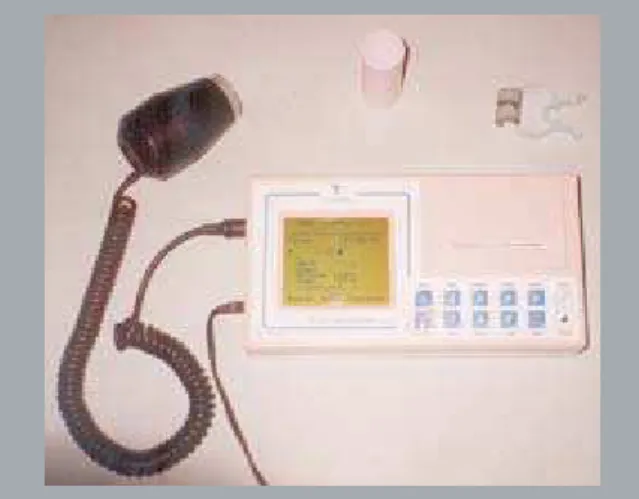
All spirometric tests were carried out according to the guidelines established by the American Thoracic Society (ATS), by the Consenso Brasileiro sobre Espirometria (Brazilian Consensus on Spirometry) and by the Associação Brasileira de Normas Técnicas (ABTN, Brazilian Technical Standards Association). The instruments used were a portable Micro Spirometer, manufactured by Micro Medical (Figure 1), and a conventional Cosmed Pony Graphic 3.5 spirometer (Figure 2), both with flow sensors.
Figura 1 - Microspirometer Figura 2 - Conventional spirometer
or adolescent gave written informed consent. All invited patients agreed to participate in the study. The design of the present study was approved by the Ethics Committee of the Instituto Porto Alegre da Igreja Metodista da Faculdade de Ciências da Saúde (School of Health Sciences Porto Alegre Institute of the Methodist Church) and by the Ethics in Research Committee of the HMIPV.
Initially, patients were asked to fill out a form eliciting information regarding age, gender, height, weight, race, time since diagnosis of the disease, previous physiotherapy treatments and prior spirometry testing. Subsequently, patients were instructed in the correct performance of spirometry techniques. Microspirometry was performed first, followed by conventional spirometry. In both techniques, individuals were initially at rest. Each spirometric test was performed three times in sequence, and the highest value was recorded. If the difference among the three measurements was greater than 5%, the test was repeated. Only those spirometric tests performed prior to the use of the bronchodilator were compared.
The verbal encouragement given to adolescents and children during microspirometry was similar to that used during conventional spirometry. They were not allowed to look at the graph formed in the conventional spirometer during its application in order to avoid possible differences among the values obtained.
The parameters analyzed were FVC, FEV1 and PEF. The data collected were added to the evaluation chart for each child.
All stages of data collection were performed exclusively by the same person. Similarly, the interpretation of the spirometric results was made
by the pulmonologist responsible for the team of the pediatric pulmonology clinic of the hospital. The spirometry interpretation and the quantification of respiratory disorders were carried out according to standards established by the Brazilian Society of Pulmonology and Phthisiology, both in the Brazilian Consensus on Spirometry(7) and in the Guidelines for
Pulmonary Function Tests(12).
It is important to mention that no measurement
or calculation is valid if the equipment used is not
carefully calibrated. The devices used in the present
study were inspected by reliable technicians prior
to initiation of the measurements. The conventional
spirometer was calibrated using a three-liter
syringe, and the microspirometer was also tested
prior to the verifications using expiratory
maneuvers performed by a researcher.
Statistical analysis of the data collected was carried out using the Statistical Package for Social Sciences (SPSS) software program, in which data were stored and analyzed using the Student’s t-test (paired) and Pearson’s correlation t-test. The level of significance adopted was 5% (p < 0.05).
RESULTS
Heights ranged from 1.03 to 1.70 m (mean, 1.397 m; standard deviation, 0.146). Minimum weight was 15 kg and maximum weight was 83 kg (mean, 37.95 kg; standard deviation, 13.52). Polgar equations, which are routinely used in the clinic, were used to calculate the spirometric variables/predicted values ratio, thereby allowing the differentiation between normal and altered respiratory function. The minimum time since asthma diagnosis was 0.33 years (4 months), and the maximum was 16 years (mean, 8.53; standard deviation, 3.68) (Table 2). A total of 45 patients (72.6%) in this sample had previously undergone spirometry, whereas 17 (27.4%) were undergoing the test for the first time.
The following were the diagnoses made using spirometry: 19 patients (30.6%) presented mild obstructive respiratory disorder; 1 (1.6%) presented moderate obstructive respiratory disorder; 1 (1.6%) presented severe obstructive respiratory disorder; and 2 (3.2%) presented mixed respiratory disorder. Three patients (4.8%), aged 5, 6 and 9, did not manage to generate sufficient respiratory effort to fully complete the examination. It is important to note that, despite having been clinically diagnosed with bronchial asthma, 36 patients (58.1%) presented normal pulmonary function.
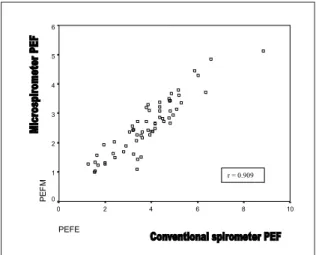
The graph in Figure 3 shows the correlation between the FEV1 values obtained using the microspirometer and those obtained using the conventional spirometer. Data comparison revealed a strong correlation (r = 0.973), which demonstrates the closeness of the FEV1 results obtained using the two devices. The difference between thetwo FEV1 values was approximately 0.03 liters, which is clinically insignificant. The strongest correlation was found between FVC values obtained using the microspirometer and those obtained using the conventional spirometer (r = 0.974) (Figure 4). The weakest correlation found between the two devices was in the PEF parameter (Figure 5). However, it is still
considered good (r = 0.909) and presents a statistically significant value, in which p < 0.01.
DISCUSSION
Currently, the use of spirometry in asthmatic children and adolescents is being increasingly valued due to its importance as a way to assess pulmonary function. Repeated objective measurement of pulmonary function is recommended because the assessment of the symptoms and of the physical examination results often does not reflect the severity of the airway obstruction. It is important that objective measurement of pulmonary function may be periodically performed in asthmatics as a way to quantify disease control(13).
In our study, analysis of the spirometric tests performed showed that most asthmatic patients (58.1%) presented normal pulmonary function. This finding shows that asthma was under control in these patients. The most common alteration was
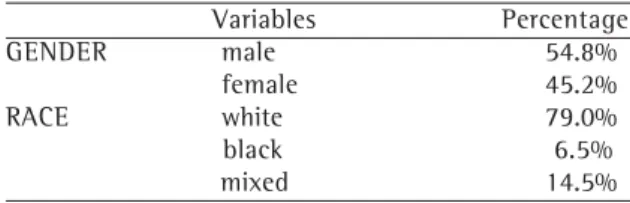
Variables Percentage GENDER male 54.8%
female 45.2% RACE white 79.0% black 6.5% mixed 14.5%
TABLE 1
Asthmatic population evaluated in the study, by gender and race
TABLE 2
Asthmatic population evaluated in the study according to age, height, weight and length of disease Variables Mean Standard deviation Age (years) 10.24 2.97 Height (meters) 1.397 0.146 Weight (kilograms) 37.95 13.52 Length of disease (years) 8.53 3.68
Figure 3. Correlations and coefficients between FEV1 values obtained using a microspirometer and those obtained using a conventional spirometer
VEF1C
3,5 3,0 2,5 2,0 1,5 1,0 ,5
VEF
1
M
3,5
3,0
2,5
2,0
1,5
1,0
,5
mild respiratory disorder (30.6%). This finding corroborates that of the study carried out by Moraes(14), in which 69.5% of asthmatic children
presented mild respiratory disorder.
According to Ladosky(15), Polgar and Weng
extensively reviewed the spirometric equations available and proposed the most coherent ones for clinical use in children. These equations proposed are commonly used in our milieu. They analyzed a population with clearly Caucasian racial characteristics in Michigan (USA), whereas Mallozi (who proposed another equation that is commonly used for children) studied a small multi-racial population sample in the state of São Paulo (Brazil). It is of note that, although they worked with two isolated and distinct groups, both studies presented equivalent results in all age brackets, in both genders(15)
.
Some authors suggest that spirometry should be performed in children over the age of six(15,16),
whereas others state that children over the age of
five(11,17) are fully capable of understanding the
respiratory maneuvers. In the present study, we chose to include asthmatic children over the age of five. Three 5-year-olds were examined and only one was unable to perform the spirometric test.
There are several types of devices that can be used to perform spirometry. Microspirometers are among the most modern. However, according to Rodrigues(18), the
accuracy of these portable spirometers needs to be determined. According to Ferguson(19), there have been
few studies and there is little information on the amount of instruction needed in order to obtain acceptable levels of quality and on the degree of precision, exactitude,
reliability, durability, frequency of calibration necessary and sensitivity of the devices.
In the present study, comparison between a microspirometer and a conventional spirometer revealed that, when the same individual performed the test using both devices, there was an excellent correlation between FVC values (r = 0.974), a very good correlation between FEV1 values (r = 0.973) and a good correlation between PEF values (r = 0.909). Therefore, strong correlations were found between the two devices in the parameters analyzed.
To date, there has been little research on this subject. However, two studies presented results that are comparable to those of the present study. Jones(20)
compared a pocket turbine spirometer (similar to the one used in the present study) to a new spirometer (pneumotachograph) called Escort and found an excellent correlation between the FEV1 values obtained using the two devices, a very good correlation between the FVC values and a weaker correlation between the flow peaks. A strong similarity was found between the two devices.
In his study, Mortimer(17) also compared a portable
turbine spirometer to a conventional laboratory (gold standard) spirometer. An excellent correlation was found between the FEV1 and PEF results obtained using the two devices, and a good correlation was found between the two FVC values, as well as between those for forced expiratory flow between 25 and 75% of FVC (FEF25-75%). The author concluded that there is a strong concordance between the values obtained using the two devices, and that the portable turbine spirometer is of high quality.
CVFE
5 4 3 2 1 0
CV
F
M
5
4
3
2
1
0
PEFE
10 8 6 4 2 0
PEF
M
6
5
4
3
2
1
0
r = 0.909
Figure 5. Correlations and coefficients between PEF values obtained using a microspirometer and those obtained using a conventional spirometer
Mortimer(17) used a mechanism that allowed the
simultaneous measurement of each effort in both devices (microspirometer and conventional spirometer) and, probably due to that, he obtained PEF values that were nearly equal. Since PEF is dependent upon the effort put forth(17), the lower correlation between
PEF values in our study may have been due to the fact that spirometric tests were performed using the two devices separately (microspirometry followed by conventional spirometry).
Ferguson(19) and Jones(20) point out that the
microspirometer should always be checked prior to its use in patients in order to ensure that it is the functioning properly. An individual with no alterations in pulmonary function should be chosen as a control and should perform spirometric tests for ten days using the microspirometer, calculating the means of the values obtained(19). Before using the device in any test, this
individual performs three spirometric tests in sequence, and these three tests should present a variation of less than 5% among the three values obtained for a given variable(20) and should deviate no more than 10% from
the ten-day mean for that variable(19). If the variation is
greater than 10% after replacing or cleaning the flow sensor, the device may not be used until it has been repaired(19). This policy was adopted in the present study.
The study carried out by Mortimer(17) confirmed
that the use of microspirometry at home is as efficient as the use of a portable device for measuring peak flow. However, spirometry increases the range of measurements of pulmonary function (more useful both clinically and epidemiologically) in studies that were formerly limited to measuring only peak flow. In addition, the measurements obtained through spirometry (especially FEV1 and FVC) are more sensitive
to the changes in the functional status of asthma patients(17). Although a microspirometer is substantially
more expensive than a device for measuring peak flow alone, it presents more complex parameters and is less expensive than a conventional spirometer.
The use of a microspirometer provides greater dynamism in spirometric tests. It is inexpensive in comparison to a conventional spirometer, it may be used in several environments, and it is easy to transport (portable). Therefore, it facilitates the use of spirometry in research fieldwork, clinics, physician offices and pulmonology outpatient clinics. However, it is important to emphasize that, in order to carry out a more detailed analysis of pulmonary function, it is essential that conventional spirometry be performed in specialized laboratories, in which spirometric curves can be generated.
The results of the present study demonstrate that a microspirometer is a useful device for determining basic pulmonary function variables in asthmatic children and adolescents. It may be a very good option for assessing pulmonary function when a conventional spirometer is unavailable.
REFERÊNCES
1. Sociedade Brasileira de Pneumologia e Tisiologia. Consenso Brasileiro no Manejo da Asma. J Pneumol 2002; 28. 2. Corrêa da Silva LC. Condutas em pneumologia. Rio de
Janeiro: Revinter; 2001; v1-2: 263-323, 901-37. 3. Allen DB. Safety of inhaled corticosteroids in children.
Pediatr Pulmonol March 2002; 33: 208-20. 4. Irwin S, Tecklin JS. Fisioterapia cardiopulmonar. 2a
ed. São Paulo: Manole; 1994; 246-7.
5. Thomson A, Skinner A, Piercy J. Fisioterapia de Tidy. 12a
ed. São Paulo: Santos; 1994; 169-70, 185-97. 6. Castro Pereira CA, Oliveira RCC, Ribeiro M, Fuzi C.
Aplicações Clínicas dos testes funcionais na asma. J Pneumol 1993; 19: 129-36.
7. Sociedade Brasileira de Pneumologia e Tisiologia. Consenso Brasileiro sobre Espirometria. J Pneumol 1996; 22: 105-64.
8. Corrêa da Silva LC, Sperb Rubin A, Muller Corrêa da Silva L. Avaliação Funcional pulmonar. Rio de Janeiro: Revinter; 2000; 11-31.
9. Costa D, Jamani M. Bases fundamentais da espirometria. Rev Bras Fisioter 2001; 5: 95-102.
1 0 . B a s t i a n - L e e Y, C a va s s e R , R i c h t e r H , S e d d o n P. Assessment of a Low-Cost Home Monitoring Spirometer for children. Pediatr Pulmonol 2002; 33: 388-94. 11. Almeida CCB, Zeferindo AMB, Barros Filho AA. Crescimento
e Função Pulmonar. Rev Ciênc Méd 1999; 13:85-92. 1 2 . Sociedade Brasileira de Pneumologia e Tisiologia.
Diretrizes para Testes de Função Pulmonar. J Pneumol 2002; 28: 1-221.
1 3 . Bye MR, Kerstein D, Barsm E. The importance of spirometry in the assessment of childhood asthma. Chest 1992; 146: 977-8.
1 4 . Moraes LSL, Barros MD, Takano OA, Assami NMC. Fatores de risco, aspectos clínicos e laboratoriais da asma em crianças. J Pediatr 2001; 77: 447-54.
15. Ladosky W, Andrade RT, Loureiro NG, Botelho MAM. Comparação entre os valores teóricos para alguns dados espirométricos em crianças determinados pelas equações de Mallozi e de Polgar. J Pneumol 2002; 28: 125-30. 1 6 . Patrocinio DA, Malek DB. Espirometria na infância. Rev
Ciênc Méd 1997; 6: 81-4.
1 7 . Mortiner KM, Fallot A, Balmes JR, Targer IB. Evaluating the Use of a portable spirometer in a study of pediatric asthma. Chest 2003; 123: 1899-907.
1 8 . Rodrigues RJ, Pereira CAC. Resposta a Broncodilatador n a E s p i r o m e t r i a : Q u e p a r â m e t r o s e v a l o r e s s ã o clinicamente relevantes em doenças obstrutivas? J Pneumol 2001; 27: 35-47.
1 9 . Ferguson GT, Enright PL, Buisi AS, Higgins MW. Office spirometry for lung health assessment in adults: A consensus statement form the national lung health education program. Chest 2000; 117: 1146-61. 2 0 . Jones KP, Mullet MA. Lung function measurement in