Chronic venous disease as a clinical manifestation
of tibial osteochondroma
Doença venosa crônica como manifestação clínica de osteocondroma tibial
Marcelo Fernandes Lima1, Ilídio Almeida Lima2, Sérgio Luiz Bizerra Oliveira3, Vanessa Heinrich Barbosa de Oliveira Lima4, Carlos Alexandre de Souza Rocha5,6
Abstract
Osteochondromas are the most common type of benign tumor of the skeleton. hey most frequently afect the distal extremity of the femur, with the tibia being the second most commonly afected long bone. Vascular complications of these lesions are rare, but pseudoaneurysm formation is the most frequently reported of them. In this case report, we describe a case of compression of the popliteal neurovascular bundle by a tibial osteochondroma in a diabetic patient who had been admitted to hospital to treat an infected lesion on his left foot and complained of edema and paresthesia of the left lower limb.
Keywords:osteochondroma; venous insuiciency; popliteal vein.
Resumo
Osteocondromas são as lesões tumorais benignas ósseas mais comuns. Acometem especialmente o fêmur em sua extremidade distal, sendo a tíbia o osso longo mais comumente afetado depois do fêmur. As complicações vasculares destas lesões são raras, sendo a formação de pseudoaneurismas a mais comum. Neste relato, descrevemos um caso de compressão do paquete vasculonervoso poplíteo por osteocondroma tibial em paciente diabético, com queixa de edema de perna e parestesia de membro inferior esquerdo, internado para tratamento de lesão infectada em pé esquerdo.
Palavras-chave:osteocondroma; insuiciência venosa; veia poplítea.
1Sociedade Brasileira de Angiologia e Cirurgia Vascular – SBACV/AMB, Instituto Victor Dib, Hospital e Pronto Socorro Municipal “28 de Agosto”, Manaus, AM, Brazil. 2Sociedade Brasileira de Angiologia e Cirurgia Vascular – SBACV/AMB, Instituto Victor Dib, Manaus, AM, Brazil.
3Sociedade Brasileira de Ortopedia e Traumatologia-SBOT, Hospital e Pronto Socorro Municipal “28 de Agosto”, Manaus, AM, Brazil. 4Universidade Federal do Amazonas, Manaus, AM, Brazil.
5Instituto Paulista de Treinamento e Ensino - IPATRE, São Paulo, SP, Brazil. 6Hospital e Pronto Socorro Municipal “28 de Agosto”, Manaus, AM, Brazil.
Conlicts of interest: No conlicts of interest declared concerning the publication of this article. Submitted:04.05.11. Accepted:02.28.13
incision and dissection of the neurovascular bundle between the medial and lateral heads of the gastrocnemius muscle (Figure 6). Once the ibrous periadventitial tissue had been dissected to release the popliteal artery, the popliteal vessels were dissected individually and displaced laterally together with the tibial nerve (Figure 7). An incision was made in the ibrous covering of the osteochondroma, which was then completely resected with the help of a hammer and chisel and the exophytic process was removed from its base on the tibial lateral condyle without technical dificulty (Figures 8 and 9). Left leg ABI was 1.0 by the day of hospital discharge, which
INTRODUCTION
Vascular involvement caused by osteochondroma is observed rarely, occurring most often in young patients at ages compatible with the end of the skeleton’s growth period when the epiphyses of bones are closing1-3. In this paper we describe the
case of a diabetic patient who had been admitted to hospital for an infected lesion of the left foot requiring surgery and parenteral antibiotic therapy. The patient had preexisting edema and paresthesia of the leg. On physical examination a stony mass was palpable in the left popliteal fossa and there were signs of chronic venous disease (CVD) in the same limb.
CASE REPORT
A 49-year-old, male, non-insulin dependent diabetic patient presented with a necrotic and infected plantar lesion of the mid left foot, extending to the calcaneal fat pad, with onset approximately ten days previously. He was admitted to a public hospital for surgical debridement of the lesion and parenteral antibiotic treatment. He complained of chronic edema of the left leg, with paresthesia and burning pain in the lower third of the leg and the plantar surface of the left foot, preventing him from walking for some time. On physical examination the weakness of left foot pulses with the knee fully extended was notable and there was perimalleolar ochre dermatitis and edema of the segment. There were also palpable stony masses in the left popliteal fossa, below the line of the joint, projecting posteromedially. The right leg’s ankle-brachial index (ABI) was 1.1, while left ABI was 1.0, falling to 0.8 with full extension of the left knee.
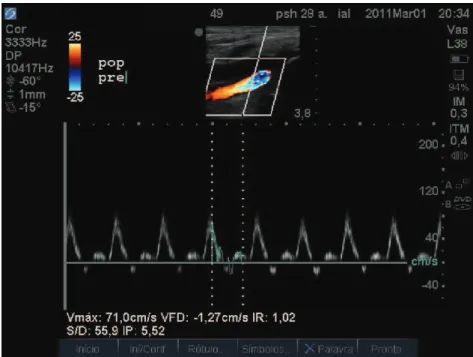
The patient had brought an arteriographic study conducted at a different institution. This showed the popliteal artery displaced posteriorly in the infrapatellar segment by a mass with a bony appearance, but with no obvious stenosis or compression (Figures 1 and 2). An MRI scan of the joints showed a bony protrusion from the medial tibial condyle with posterior displacement of the popliteal neurovascular bundle (Figure 3). We then performed a duplex flow scan which revealed extrinsic compression of the popliteal vein by the bony mass, interrupting venous low and raising systolic arterial low rate from 71 cm/sec to 192.2 cm/sec in the displaced segment when the knee was completely extended; simulating a 70% stenosis process (Figures 4 and 5).
Resection of the osteochondroma was achieved by direct approach to popliteal fossa, with a “Z”
was delayed until 30days after surgery because of the active infection of the left foot. The edema had reduced considerably and the patient was entirely free from paresthesia.
DISCUSSION
Osteochondromas, or exostoses, are the most common type of benign bone tumor and can be found in 1% to 2% of the population. In around 90% of cases they are single lesions. The appearance of multiple lesions is linked with an autosomal dominant pattern of heredity and it has been recently demonstrated that the EXT1, EXT2 and EXT3 genes are involved in its etiology1-5. Osteochondromas are
composed of hyperplastic bone tissue provoked by abnormal development of subperiosteal epiphyseal cartilage, which gives the lesion a “protective cap”. When the growth period comes to an end and the epiphyses close, the cartilaginous cap can calcify, provoking the formation of bony stalks. These lesions most commonly affect the long bones of the legs, predominantly the distal extremity of the femur1. The tibia, ibula and humerus are the next
most commonly observed sites, in decreasing order of frequency2. Osteochondroma rarely present with
vascular complications and arterial lesions are more common of those that do have vascular involvement, accounting for 91%, with pseudoaneurysm the most often described of these, in 64% of cases3,6.The
popliteal artery is most often affected because of the increased incidence of these lesions on the distal femur and proximal tibia and because of the artery’s intimate relationship with the bone structure, since the artery is ixed proximally at the adductor canal by musculofascial compression and distally by its collateral branchings1-4,6,7. Exostosis compromises
the deep venous system by obstructing blood low in around of 5% of complications3.
T h e p o p l i t e a l f o s s a i s l o z e n g e - s h a p e d and is delimited above and medially by the semimembranosus muscle, superolaterally by the biceps femoralis muscle, inferomedially by the medial head of the gastrocnemius muscle and inferolaterally by the plantar muscle and the lateral head of the gastrocnemius muscle. The tibial nerve is the most supericial structure, with the popliteal vein situated laterally and medially to it, while the popliteal artery is positioned deeper and more medially8. In conjunction with the contraction of
muscles inserted into the bone structures that delimit the fossa posteriorly, anomalous structures in the
Figure 2. Proile view with no apparent arterial compression.
and venous2,9,10. Andrikopoulos et al. state that deep vein thrombosis is one of the complications of osteochondroma, but they believe that it is not alone capable of causing thrombosis, which they consider requires additional compression from a pseudoaneurysm before a deep vein thrombosis popliteal fossa can considerably limit the space
available for the vascular and nervous structures contained in this anatomic space.
Compression of the popliteal vessels by the mass of the osteochondroma can cause displacement, stenosis, occlusion and thrombosis, both arterial
Figure 4. Flow rate analysis in a section of artery close to the osteochondroma.
will occur2. We do not agree with this opinion. The
degree of compression demonstrated by the duplex low scan and conirmed during surgery to dissect the neurovascular bundle does not leave us in any doubt that an osteochondroma in the popliteal fossa is suficient, by itself, to provoke a thrombosis in this segment.
Entrapment of the popliteal vein is a recognized medical entity and was irst described by Rich and
Figure 6. Posterior approach and dissection of neurovascular bundle.
Figure 7. Lateral retraction of the popliteal vessels and tibial nerve to expose the tibial osteochondroma.
Figure 8. Resected osteochondroma.
Until this case report have been published, there were only 9 cases of isolated popliteal vein compression, in three of which venous thromboses developed1,14,15,and 30 cases of ischemia due to
extrinsic compression of the popliteal artery by an osteochondroma5,16 related at the literature.
REFERENCES
1. Vasseur MA, Fabre O. Vascular complications of osteochondromas. J Vasc Surg. 2000;31:532-8. http://dx.doi.org/10.1016/ S0741-5214(00)90315-X
2. Andrikopoulos V, Skourtis G, Papacharalambous G, Antoniou I, Tsolias K, Panoussis P. Arterial compromise caused by lower limb osteochondroma. Vasc Endovasc Surg. 2003;37:185-90. http:// dx.doi.org/10.1177/153857440303700305
3. Tornquist FA , Leopardo CC, Segala TC, Hamid AJAA . Complicação vascular de osteocondroma: relato de caso. J Vasc Bras. 2007;6(1):92-96. http://dx.doi.org/10.1590/ S1677-54492007000100014
4. Back M, Blazick E, Keeling WB, Armstrong P, Letson D. Pseudoaneurysm of the Supericial Femoral Artery Associated with Osteochondroma. A Case Report. Vasc Endovasc Surg. 2005;39:355-358. http://dx.doi.org/10.1177/153857440503900409
5. Khan I, West CA Jr, Sangster GP, Heldmann M, Doucet L, Olmedo M. Multiple hereditary exostoses as a rare nonatherosclerotic etiology of chronic lower extremity ischemia. J Vasc Surg. 2010;51(4):1003-1005. http://dx.doi.org/10.1016/j.jvs.2009.10.123
6. Perez-Burkhardt JL, Gomez Castilla JC. Postraumatic popliteal pseudoaneurysm from femoral osteochondroma:case report and review of the literature. J Vasc Surg. 2003;37:669-71. http://dx.doi. org/10.1067/mva.2003.48
7. Canale ST. Campbell´s Operative Orthopaedics. 10th ed. St Louis: Mosby, Inc.; 2003. p. 804-806.
8. Castiglia, V, Almeida MJ. Síndrome do aprisionamento da artéria poplítea. In: Maffei FHA, Lastória S, Yoshida WB, Rollo HA, Giannini M, Moura R. Doenças Vasculares Periféricas. 4. ed. Rio de Janeiro: Guanabara Koogan; 2008. v. 2, p. 1497.
9. Socrate AM, Locati P, Fusco U. Osteochondroma of the tibia and popliteal artery stenosis. Minerva Cardioangiol. 2000;48:317-21.
10. Yunoki J, Ohteki H, Naito K, Sato H. Popliteal artery stenosis secondary to ostheocondroma. J Vasc Surg. 2009;50:667. http:// dx.doi.org/10.1016/j.jvs.2009.01.039
11. Rich NM, Hughes CW. Popliteal artery and vein entrapment. Am J Surg. 1967;113:696-8.
12. Raju S, Neglen P. Popliteal vein entrapment: A benign venographic feature or a pathologic entity? J Vasc Surg. 2000;31(4):631-641. http://dx.doi.org/10.1067/mva.2000.103786
13. Almeida MJ, Yoshida WB, Melo NR. Síndrome do aprisionamento da artéria poplítea. J Vasc Bras. 2003;2:211-19.
14. Eschelman DJ, Gardiner GA, Deely Dm. Osteochondroma: an unusual cause of vascular disease in young adults of the tibia and popliteal artery stenosis. J Vasc Interv Radiol. 1995;6:605-13. http://dx.doi.org/10.1016/S1051-0443(95)71144-7
15. Nelson RM, Hess WE, Lyman JH. Venous obstruction with hypertrophy of an upper extremitie due to osteochondroma. Surgery. 1963;54:871-5.
16. Yunoki J, Ohteki H, Naito K, Sato H. Popliteal artery stenosis secondary to osteochondroma. J Vasc Surg. 2009;50:667. http:// dx.doi.org/10.1016/j.jvs.2009.01.039
Hughes in 196711. There may also be concurrent
arterial entrapment in 10% to 15% of patients. This should be considered an important possible cause, in certain patients with signs and symptoms compatible with CVD, but without other obvious etiologies. Compression of the popliteal vein can not always be implicated as responsible for CVD. In fact, around 27% of the normal population suffer venous compression during foot lexions and extensions. However, in patients with radiological signs of compression of the popliteal vein and clinical signs of CVD, but with no other plausible explanations for the symptoms, obstruction of venous low must be considered as a possible cause12.
When vascular complications do present, the most common presentation is long duration tension edema1.Paresthesia, burning pains and claudication
are other common components of this clinical presentation.
Osteochondroma is diagnosed by simple X-ray which will show anomalous bony structures and can also detect fractured exostoses1-7. In our view,
a duplex flow study of the popliteal vessels is mandatory. Since this is an examination that offers a high degree of sensitivity and speciicity and is also cheap and noninvasive, it should be used whenever there is a suspicion of vascular complications. It can indicate the presence of pseudoaneurysms, arterial and venous thrombi and offers the advantage that it provides real-time assessment of the changing lows through the popliteal vessels as the patient is requested to perform forced extensions of the knee and foot1-4,13. Magnetic resonance can provide
important information on muscular anomalies and extrinsic compressions and can even detect thickening of the cartilaginous cap, with potential degeneration to sarcoma and progression to malignancy, which occurs in 0.6% to 2.8% of cases4,5.
Correspondence Marcelo Fernandes Lima INSTITUTO VICTOR DIB Boulevard Álvaro Maia, 1444, Praça 14 CEP 69020-210 – Manaus (AM), Brazil E-mail: [email protected]
Author information MFL is a vascular surgeon with a Lato Sensu degree from SBACV/AMB IAL is a vascular surgeon with a Lato Sensu degree from SBACV/AMB SLBO is an orthopedist with a Lato Sensu degree from Sociedade Brasileira de Ortopedia e Traumatologia VHBOL is a resident physician at the Service of Gynecology and Obstetrics of Hospital Universitário Getúlio Vargas – Universidade Federal do Amazonas CASR is a physician and a graduate student of Urgency and Emergency Care at Instituto Paulista de Treinamento e Ensino - IPATRE
Author’s contributions Conception and design: MFL, SLBO, IAL, VHBOL, CASR
Analysis and interpretation: MFL, SLBO, IAL Data collection: MFL, CASR Writing the article: MFL, VHBOL Critical revision of the article: MFL, SLBO, IAL, VHBOL, CASR Final approval of the article*: MFL, SLBO, IAL, VHBOL, CASR Statistical analysis: N/A Overall responsibility: MFL *All authors should have read and approved of the inal version of