A prospective randomized controlled multicentre trial
comparing intravesical DMSO and chondroïtin sulphate 2%
for painful bladder syndrome/interstitial cystitis
_______________________________________________
Manuela Tutolo
1, Enrico Ammirati
2, Giulia Castagna
3, Katrien Klockaerts
4, Hendrik Plancke
5, Dieter
Ost
6, Frank Van der Aa
1, Dirk De Ridder
11 Department of Urology, University Hospitals, KU Leuven, Belgium; 2 Division of Urology, Città della Salute
e della Scienza, Molinette Hospital Hospital, University of Studies of Turin, Turin, Italy; 3 Department of
Urological Research Institute, IRCCS Ospedale San Raffaele, Division of Oncology/Unit of Urology, Milan, Italy; 4 Department of Urology, St. Lucas Hospital, Gent, Belgium; 5 Department of Urology, Imelda
Hospital, Bonheiden, Belgium; 6 Urology, St. Blasius Hospital, Dendermonde, Belgium
ABSTRACT
ARTICLE
INFO
______________________________________________________________ ______________________ Objective: To compare effectiveness of intravesical chondroïtin sulphate (CS) 2% and
dimethyl sulphoxide (DMSO) 50% in patients with painful bladder syndrome/intersti-tial cystitis (PBS/IC).
Materials and methods: Patients were randomized to receive either 6 weekly instil-lations of CS 2% or 50% DMSO. Primary endpoint was difference in proportion of patients achieving score 6 (moderately improved) or 7 (markedly improved) in both groups using the Global Response Assessment (GRA) scale. Secondary parameters were mean 24-hours frequency and nocturia on a 3-day micturition dairy, changes from baseline in O’Leary-Sant questionnaire score and visual analog scale (VAS) for supra-pubic pain.
Results: Thirty-six patients were the intention to treat population (22 in CS and 14 in DMSO group). In DMSO group, 57% withdrew consent and only 6 concluded the trial. Major reasons were pain during and after instillation, intolerable garlic odor and lack of efficacy. In CS group, 27% withdrew consent. Compared with DMSO group, more patients in CS group (72.7% vs. 14%) reported moderate or marked improvement (P=0.002, 95% CI 0.05-0.72) and achieved a reduction in VAS scores (20% vs. 8.3%). CS group performed significantly better in pain reduction (-1.2 vs. -0.6) and nocturia (-2.4 vs. -0.7) and better in total O’Leary reduction (-9.8 vs. -7.2). CS was better toler-ated. The trial was stopped due to high number of drop-outs with DMSO.
Conclusions: Intravesical CS 2% is viable treatment for PBS/IC with minimal side ef-fects. DMSO should be used with caution and with active monitoring of side efef-fects. More randomized controlled studies on intravesical treatments are needed.
Keywords:
Cystitis, Interstitial; Dimethyl Sulfoxide; Chondroitin Sulfates
Int Braz J Urol. 2017; 43: 134-41
_____________________ Submitted for publication: May 26, 2016
_____________________ Accepted after revision: August 30, 2016
_____________________ Published as Ahead of Print: October 31, 2016
INTRODUCTION
Because interstitial cystitis (IC) varies so much in symptoms and severity, most experts
symptoms that may not meet the strictest defini-tion of IC. IC can be considered as a subgroup of patients in whom cytoscopic findings can be no-ted. Painful bladder syndrome (PBS) is a chronic bladder condition characterized by chronic pelvic pain, pressure or discomfort perceived to be re-lated to the bladder and accompanied by at least one urinary symptom, such as increased urinary urgency or frequency. The European Society for the Study Interstitial cystitis (ESSIC) decided to refer to the condition with the term “painful blad-der syndrome/interstitial cystitis (PBS/IC)” (1). The American Urological Association (AUA) Guideli-nes Committee refers to an unpleasant sensation (pain, pressure, discomfort) perceived to be related to the urinary bladder, associated with lower uri-nary tract symptoms with a duration of at least 6 weeks, in the absence of any confusable disea-ses that may give rise to the symptoms (2, 3). The etiology of PBS/IC is still not well understood. To date, there is a general agreement on the adminis-tration of some oral or intravesical drugs (4, 5). With regard to intravesical therapy, it has been hypothesized that the urothelial mucin glycosa-minoglycan (GAG) layer which protects the uro-thelial cells is damaged in PBS/IC (6, 7). Intrave-sical treatment with DMSO, chondroïtin sulphate, hyaluronic acid and heparin have been used to repair the GAG layer with variable clinical success (6-8). Dimethyl sulphoxide (DMSO, Rimso-50) is the only drug approved by the U.S. Food and Drug Administration (FDA) for intravesical treatment of PBS/IC. Only one small, short, single-center trial has reported efficacy (9). The EAU Guidelines on chronic pelvic pain updated in April 2014 underli-ne that DMSO has been used in the past but there is insufficient current evidence to recommend its use (10). Chondroïtin sulphate (CS), an important component of the GAG layer seems to be promi-sing, but comparative data with other therapies are lacking (11-13). A 2.0% solution of sodium CS in phosphate buffered saline (chondroïtin sulpha-te, Tribute Pharmaceuticals, Milton, ON) has been approved in Canada and Europe for intravesical treatment of PBS/IC. Assessing the outcome of such treatments is difficult. Objective parameters such as daytime and nighttime frequency may not always reflect the impact of the condition on the
life of the patient. Patient reported outcome para-meters are more frequently used to assess treat-ments in overactive bladder disease and in painful bladder research. Several validated questionnaires can be used to assess patients with PBS/IC. One of the most frequently used is the O’Leary-Sant ques-tionnaire. Next to this questionnaire, the Global Response Assessment can be used. This is a vali-dated 7 point Likert scale comparing the current status of the patient to the pre-intervention status. This scale has been used in several other studies on PBS/IC (11, 14-18). For the assessment of su-prapubic pain the visual analog scale (VAS) was used. The aim of this study was to compare the clinical effectiveness of intravesical chondroïtin sulphate 2% (Uracyst™) and DMSO 50% in the tre-atment of patients with PBS/IC.
MATERIALS AND METHODS
Patients and study design
The study was designed as a prospective randomized multicenter evaluation of PBS/IC pa-tients who were randomized to receive either 6 weekly instillations of CS 2% (treatment arm) or DMSO 50% (control arm). Four centers participa-ted between January 2012 and January 2015, each center enrolling a similar number of patients. To detect a 0.75 difference on the 7 point Likert scale, with 80% power at 0.05% significance, 45 patients were needed in each group.
Candidates for inclusion in the study were men and women aged 18-75 years with a history of symptoms of bladder pain/discomfort descri-bed as suprapubic pain related to bladder filling, accompanied by other symptoms such as dayti-me and/or nighttidayti-me frequency in the absence of infection or other pathology. All patients un-derwent urodynamic evaluation and cystoscopy with an evidence of early bladder sensation and low maximum bladder capacity. We considered in this study also patients with negative macrosco-pic and bioptic findings of interstitial cystitis if a significant symptomatology was present. Patients should be willing and able to complete the neces-sary questionnaires.
tran-sitional cell carcinoma of the bladder or other significant malignancy, pregnant or lactating, suffering from significant bacteriuria, diagnosis of hematuria, neurogenic bladder, indwelling ca-theters, chronic bacterial prostatitis, currently re-ceiving or having received investigational drugs
≤30 days before screening, currently receiving or having had prior therapy with intravesical treat-ment (e.g. Uracyst, Cystistat®, heparin or Bacillus Calmette-Guérin (BCG)), receiving therapy for <3
months with antidepressants, anti-histaminics, hormonal agonists or antagonists; hence patient not stabilized on therapy (stable therapy defined as continuous treatment for ≥3 months), IC symp-toms relieved by antimicrobials, anticholinergics or antispasmodics, functional bladder capacity of >400mL, neurologic disease affecting bladder function; any previous surgery or procedure ha-ving affected bladder function, current diagnosis of chemical, tuberculous or radiation cystitis, bla-dder or lower ureteral calculi, history of cancer within the last 5 years other than adequately tre-ated non-melanoma skin cancers, active sexual transmitted disease, current vaginitis, endometrio-sis, any condition/disease which in the opinion of the investigator could interfere with patient com-pliance and/or interfere with the interpretation of the treatment results.
All patients gave written informed con-sent. Drop-outs and lost to follow-up are im-puted as failures. Appropriate ethical approval was obtained according to national and inter-national guidelines.
No compensation for the study was recei-ved by the patient, but the expense of the medical treatment and the medical consultations were free.
Intervention
Patients were single-blind randomized to receive one intravesical instillation of 2.0% sterile solution of sodium chondroïtin sulfate (Uracyst™) or DMSO 50% once weekly for 6 weeks. Uracyst™ is delivered as a 2% sterile solution in 20mL vials. DMSO is prepared as a 50% solution in 50mL phy-siologic serum. The bladder instillation was per-formed by a trained medical professional. Using a temporary catheter, the bladder is filled with CS 2% or DMSO 50%. The patients were asked to
re-tain the solution in their bladder for at least 15-30 minutes to allow it to work, and then urinate normally.
No antibiotic therapy was administered to the patient, but the catheterization technique was absolutely sterile. Eventual necessity of post-ins-tillation antibiotic therapy was decided on perso-nal decision of the doctor.
Our standard instillation schedule is: one instillation every week for 6 weeks, one instilla-tion every month for 4 months, one instillainstilla-tion every 2 months for 6 months, one instillation every 3 months, if possible, for maintenance.
Outcome assessment and study endpoints
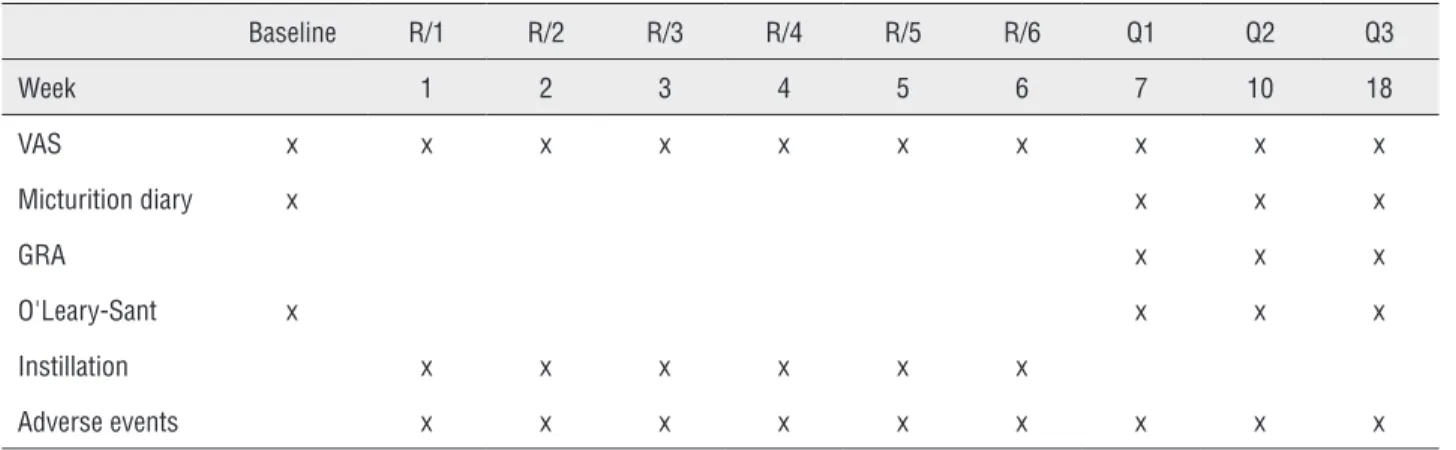
Before and after treatment (at 7, 10 and 18 weeks), all patients were asked to fill in several questionnaires: the Interstitial Cystitis Symptom Index (4 questions) and Problem Index (4 ques-tions) (ICSI/ICPI) (19) the Global Response Asses-sment (GRA) scale, the visual analog scale (VAS) for suprapubic pain, the 3-daily voiding diary, daily urinary frequency and nocturia. Each ques-tion in the O’Leary-Sant quesques-tionnaire was sco-red by the patient. Higher scores in each domain indicate greater symptom severity and impact on daily life. Maximum Symptom and Problem Index scores were 20 and 16, respectively (19). The GRA measures the overall improvement with therapy. The assessment asks: “As compared to when you started the current study (treatment), how would you rate your overall bladder symptoms now?”. The patient was provided with the following se-ven response options: markedly worse, moderately worse, slightly worse, no change, slightly ved, moderately improved and markedly impro-ved. The VAS ranges from zero to 10 with zero representing no pain and 10 maximal pain. Accor-ding to the study protocol the patients underwent 10 medical visits at weekly intervals for the first two months, thereafter at longer intervals. Table-1 presents the study overview.
denotes marked improvement. Secondary parame-ters were the mean 24 hours frequency, nocturia episodes and functional bladder capacity measu-red on a 3-day micturition dairy, changes from baseline in the O’Leary-Sant questionnaire score and the assessment of suprapubic pain by the VAS.
Safety was assessed by monitoring adver-se events at each visit. This publication shows a planned interim analysis for safety. A clinical eva-luation committee evaluated the interim findings.
Statistical analysis
An intention-to-treat analysis was perfor-med. Statistical analysis of the patient question-naire data was performed using Med Calc version 8.1 (Belgium) Statistical analyses were considered significant at a p-value less than 0.05.
RESULTS
The analysis included 22 patients of both sexes (19 women and 3 men) treated with chon-droïtin sulphate 2% and 14 (12 women and 2 men) treated with DMSO 50%. Baseline patient charac-teristics are presented in Table-2. The outcomes are shown in Table-3. For the primary outcome at 12 weeks, 72.7% of patients in the CS group achieved a GRA score of 6 or 7 compared with 14% of patients in the DMSO group (P=0.002, 95% CI 0.05-0.72). Decreases in pain (VAS), O’Leary-Sant nocturia and pain score compared to baseline were observed in both treatment groups and were statistically significant in the CS group. Although changes showed no statistically signifi-cant difference the CS group had a slightly smal-ler decrease in O’Leary-Sant IC total score (-7.2
Table 1 - Study overview.
Baseline R/1 R/2 R/3 R/4 R/5 R/6 Q1 Q2 Q3
Week 1 2 3 4 5 6 7 10 18
VAS x x x x x x x x x x
Micturition diary x x x x
GRA x x x
O'Leary-Sant x x x x
Instillation x x x x x x
Adverse events x x x x x x x x x
Table 2 - Baseline patient characteristics.
O’leary sant questionnaire score All patients Dmso group Chondroitin group
Urgency 3.9 ± 1.9 3.7 ± 2.0 3.8 ± 2.0 ns
Void within 2h 5.1 ± 1.5 5.0 ± 1.7 5.2 ± 1.4 ns
Nocturia 4.6 ± 1.5 4.7 ± 1.5 4.6 ± 1.4 ns
Pain and burning 4.7 ± 1.6 4.3 ± 1.7 4.7 ± 1.6 ns
VAS Pain 6.3 ± 2.3 6.2 ± 2.3 6.4 ± 2.3 ns
VAS urgency 7.5 ± 1.5 7.3 ± 1.5 7.7 ± 1.4 ns
points) compared to the DMSO group (-9.8 points). More than 50% of the patients in the DMSO group dropped-out (57%). The main reasons for treat-ment withdrawal in the DMSO group was the oc-currence of side effects. Several patients reported pain during and after instillation, lack of efficacy, and intolerable garlic odor. Pain while holding DMSO in the bladder disappeared after voiding. By contrast, the drop-out rate in the CS group was only 27%. The main reasons were lack of efficacy or side effects. CS instillation side effects were all classified as Clavien-Dindo 1: urinary tract infec-tion (n=2), urethral pain (n=2), dysuria (n=3).
Of the 16 patients who completed the CS treatment, all of them continued such treatment. We could not identify an ideal maintenance treat-ment schedule, as all patients received instillation cycles at different time intervals, according to the severity and recurrence of symptoms.
DISCUSSION
Several intravesical drugs have been stu-died in the past, including heparin, lidocaine, pen-tosan polysulphate sodium, dimethyl sulfoxide (DMSO), chondroïtin sulphate (CS), hyaluronic acid (HA) (and combination with CS), as well as investi-gational drugs such as GM-0111. Recently, intrave-sical administration of botulinum toxin (BTX) has been studied in patients with PBS/IC (20).
A number of uncontrolled, open-label cli-nical studies have suggested that intravesical CS may have benefit in some PBS/IC patients with
no significant safety issues (12, 21, 22). Steinhoff et al. (2003) showed beneficial effects of CS treat-ment in patients who have positive potassium sti-mulation test (PST) results (22). Daha et al. (2008) demonstrated that in patients who respond symp-tomatically to increased GAG substitution therapy, cystometric bladder capacity is increased, whereas non-responders experience a decrease in bladder capacity (7).
A previously published, prospective, but uncontrolled, multicenter, real-life clinical prac-tice study suggested that intravesical CS 2% may have an important role in the treatment of IC. The study showed a response rate of 47% at 6 weeks, which increased with additional monthly treat-ment sessions to 60% at 24 weeks. In all, 48 of 53 patients (90.6%) had a positive PST. There were no significant safety issues during the study (11).
Two previously published, randomized, placebo controlled studies reported clinical benefit but failed to show statistically significant diffe-rences in improvement for 20mL weekly instilla-tions of CS 2% after 6 and 8 weeks, respectively (16, 17).
Recently, individual participant data from an open-label study (OLS) (11) and 2 small rando-mized placebo controlled studies (RCTs) (16, 17) assessing intravesical CS 2% in PBS/IC were poo-led (similar inclusion/exclusion criteria, treatment and outcome assessment). This meta-analysis in-cluding 213 patients confirms that CS does indeed provide significantly more benefit than placebo. At the end of treatment period (week 10 for OLS,
Table 3 - Drop-outs, Global Response Assessment, parameter changes vs. baseline.
DMSO group Chondroitin sulphate group
Drop-outs 8/14 (57%) 6/22 (27%)
GRA score 6 or 7 14.0% 72.7%
VAS reduction 8.3% 20%*
O'Leary total reduction - 9.8 points - 7.2 points
O'Leary nocturia subscale 4.7 to 4.0 (-0.7) 4.5 to 2.9 (-1.6)*
O'Leary pain subscale 4.3 to 3.7 (-0.6) 5.0 to 3.8 (-1.2)*
week 7 for RCT1 and week 11 for RCT2), the ove-rall GRA response rates were 43.2% (95% CI: 35.0, 51.5) and 27.4% (95% CI: 17.6, 37.2) for the CS and placebo groups, respectively. Pooled RR was 1.55 (P=0.014, 95% CI: 1.09, 2.22). The chance of having response to treatment was 55% significan-tly higher in the CS group than in the placebo group. The small decrease in total ICSI score and daily urine frequency between the two groups was less impressive (-0.8 and-0.5 points respectively) and not statistically significant. This underlines the importance of choosing the right patient for this treatment (23).
DMSO is approved in the U.S.A. as a stan-dard therapy for intravesical treatment for PBS/ IC. This is based on a small and old (1987) cros-sover study including 33 patients. Four intrave-sical treatments of 50mL 50% DMSO were admi-nistered at two-week intervals with 15 minutes retention. Patients were evaluated at one month post-treatment. When assessed subjectively, 53% of DMSO treated patients were markedly improved compared to 18% of the placebo treated patients. When assessed objectively (urodynamic assess-ment), 93% of the DMSO group and 35% of the placebo group were improved. No significant side effects to DMSO were noted (9). A further study conducted in 2000 by Peeker et al. demonstrated the superiority of instillations of DMSO over BCG in the reduction of pain and urinary frequency, but not of maximal functional capacity (24). The same studies are cited by a Cochraine review and by a NICE advice (25, 26). The recently AUA upda-ted guidelines (2014) suggest limiting instillation dwell time to 15-20 minutes. DMSO is quickly ab-sorbed into the bladder wall and longer periods of retaining are associated with significant pain. Side-effects include a garlic-like body odor in some people. This bothersome but relatively in-significant side effect may last up to 7 hours af-ter treatment (27). Considering also a more recent study based on 28 patient that shows common side effects (48% of all the population) even using DMSO once a week for a 15-20 minute instillation (28), AUA guidelines suggest a prudent and con-trolled DMSO use (evidence-strength: grade C). In a recent work, Tomoe demonstrated that the popu-lation of patients with IC/BPS that mostly benefit
from DMSO therapy is that with ulcerative Hunner lesions (29).
Our study is the first study in the litera-ture comparing DMSO and CS for treatment of PBS/IC. The interim analysis of this study showed that CS 2.0% performed better than DMSO 50% in pain reduction and nocturia and in subjective outcome. CS 2.0% was also better tolerated than DMSO. Our data agree with those of a Downey et al. recent study, that found that intravesical CS reduced pain, urgency and O’Leary-Sant symptom and problem scores in patients with IC/PBS. All patients tolerated the treatment and no side effects were reported; a response to treatment was noted in patients who had failed a different intravesical bladder therapy (DMSO) (30). Both studies support the EAU guidelines recent update that do not re-commend the standard DMSO use. We did not use a combined preparation of DMSO and lidocaine, to better identify the real direct benefit from DMSO without a possible confounding effect given by a simultaneous lidocaine instillation.
All patients had been adequately counsel-led and were aware about the possible incidence of side effects. Due to the high number of drop--outs in the DMSO arm caused by the high in-cidence of severe DMSO side effects, the clinical evaluation committee proposed to stop the stu-dy enrolment. Patients suffering of IC/BPS often complain of severe pain and urinary symptoms and come to medical attention to have effective and prompt treatments. It is not easy to achieve their full collaboration in a clinical trial and often do not accept the idea of a random assignment to a treatment option, requiring only the most effec-tive. Patients were enrolled in this study during outpatient evaluation according to medical indi-cation and patient desires. However, we can state that between 40% and 50% of patients declined enrollment because they wanted to choose the tre-atment and not accepting a random allocation.
Our results lead us to the conclusion that CS appears to be superior to DMSO in terms of efficacy and tolerability.
The limitations of this study are mainly the small sample size, the short follow-up and the lack of a placebo control group. On the other hand, randomization of patients to a placebo group may be difficult as PBS/IC patients were in severe pain and desperate for treatment. We did not do a wa-shout period and then a crossover from one tre-atment to the other, this could represent a future implementation for this study.
To date, we have failed to stratify pa-tients according to clinical phenotype because of the lack of proper biomarkers to categorize pa-tients into groups that might respond differently to different interventions. A better approach for selecting patients with bladder-specific clinical phenotype might improve the overall response to intravesical CS 2% treatment (31).
CONCLUSIONS
Intravesical chondroïtin sulphate 2% (Uracyst™) is a viable treatment for patients with PBS/IC with minimal side effects. DMSO, while being considered the gold standard should be used with caution and with active monitoring of side effects. Further large-scale prospective RCTs with long-term follow-up are needed to determine the long-term efficacy and durability of CS 2%.
ACKNOWLEDGEMENTS
This study was provided by EUROCEPT, the Nederlands
CONFLICT OF INTEREST
None declared.
REFERENCES
1. van de Merwe JP, Nordling J, Bouchelouche P, Bouchelouche K, Cervigni M, Daha LK, et al. Diagnostic criteria, classification, and nomenclature for painful bladder syndrome/interstitial cystitis: an ESSIC proposal. Eur Urol. 2008;53:60-7. 2. Hanno P, Nordling J, Fall M. Bladder pain syndrome. Med
Clin North Am. 2011;95:55-73.
3. Nordling J, Fall M, Hanno P. Global concepts of bladder pain syndrome (interstitial cystitis). World J Urol. 2012;30:457-64.
4. Engeler DS, Baranowski AP, Dinis-Oliveira P, Elneil S, Hughes J, Messelink EJ, et al. The 2013 EAU guidelines on chronic pelvic pain: is management of chronic pelvic pain a habit, a philosophy, or a science? 10 years of development. Eur Urol. 2013;64:431-9.
5. Hanno PM, Erickson D, Moldwin R, Faraday MM; American Urological Association. Diagnosis and treatment of interstitial cystitis/bladder pain syndrome: AUA guideline amendment. J Urol. 2015;193:1545-53.
6. Daha LK, Lazar D, Simak R, Pflüger H. The effects of intravesical pentosanpolysulfate treatment on the symptoms of patients with bladder pain syndrome/interstitial cystitis: preliminary results. Int Urogynecol J Pelvic Floor Dysfunct. 2008;19:987-90.
7. Daha LK, Riedl CR, Lazar D, Simak R, Pflüger H. Effect of intravesical glycosaminoglycan substitution therapy on bladder pain syndrome/interstitial cystitis, bladder capacity and potassium sensitivity. Scand J Urol Nephrol. 2008;42:369-72.
8. Riedl CR, Engelhardt PF, Daha KL, Morakis N, Pflüger H. Hyaluronan treatment of interstitial cystitis/painful bladder syndrome. Int Urogynecol J Pelvic Floor Dysfunct. 2008;19:717-21.
9. Perez-Marrero R, Emerson LE, Feltis JT. A controlled study of dimethyl sulfoxide in interstitial cystitis. J Urol. 1988;140:36-9.
10. D. Engeler , A.P. Baranowski, J. Borovicka, A. Cottrell, P. Dinis-Oliveira, S. Elneil, J. Hughes, E.J. Messelink, A. van Ophoven, Y. Reisman, A.C. de C Williams, EAU Guidelines on Chronic Pelvic Pain , Available from: http://uroweb.org/ guideline/chronic-pelvic-pain/
11. Nickel JC, Egerdie B, Downey J, Singh R, Skehan A, Carr L, et al. A real-life multicentre clinical practice study to evaluate the efficacy and safety of intravesical chondroitin sulphate for the treatment of interstitial cystitis. BJU Int. 2009;103:56-60.
12. Nordling J, van Ophoven A. Intravesical glycosaminoglycan replenishment with chondroitin sulphate in chronic forms of cystitis. A multi-national, multi-centre, prospective observational clinical trial. Arzneimittelforschung. 2008;58:328-35.
13. Gauruder-Burmester A, Popken G. [Follow-up at 24 months after treatment of overactive bladder with 0.2 % sodium chondroitin sulfate]. Aktuelle Urol. 2009;40:355-9.
15. Nickel JC, Moldwin R, Lee S, Davis EL, Henry RA, Wyllie MG. Intravesical alkalinized lidocaine (PSD597) offers sustained relief from symptoms of interstitial cystitis and painful bladder syndrome. BJU Int. 2009;103:910-8.
16. Nickel JC, Egerdie RB, Steinhoff G, Palmer B, Hanno P. A multicenter, randomized, double-blind, parallel group pilot evaluation of the efficacy and safety of intravesical sodium chondroitin sulfate versus vehicle control in patients with interstitial cystitis/painful bladder syndrome. Urology. 2010;76:804-9.
17. Nickel JC, Hanno P, Kumar K, Thomas H. Second multicenter, randomized, double-blind, parallel-group evaluation of effectiveness and safety of intravesical sodium chondroitin sulfate compared with inactive vehicle control in subjects with interstitial cystitis/bladder pain syndrome. Urology. 2012;79:1220-4.
18. Kuo HC, Chancellor MB. Comparison of intravesical botulinum toxin type A injections plus hydrodistention with hydrodistention alone for the treatment of refractory interstitial cystitis/painful bladder syndrome. BJU Int. 2009;104:657-61.
19. O’Leary MP, Sant GR, Fowler FJ Jr, Whitmore KE, Spolarich-Kroll J. The interstitial cystitis symptom index and problem index. Urology. 1997;49:58-63.
20. Dellis A, Papatsoris AG. Intravesical treatment of bladder pain syndrome/interstitial cystitis: from the conventional regimens to the novel botulinum toxin injections. Expert Opin Investig Drugs. 2014;23:751-7.
21. Sorensen RB. Chondroïtin sulphate in the treatment of interstitial cystitis and chronic inflammatory disease of the urinary bladder. Eur Urol Suppl. 2003;2:16-8.
22. Steinhoff G, Ittah B, Rowan S. The efficacy of intravesicular sterile sodium chondroitin sulfate 0.2% in potassium tested positive patients with interstitial cystitis. Adv Exp Med Biol. 2003;539:731-9.
23. Thakkinstian A, Nickel JC. Efficacy of intravesical chondroitin sulphate in treatment of interstitial cystitis/bladder pain syndrome (IC/BPS): Individual patient data (IPD) meta-analytical approach. Can Urol Assoc J. 2013;7:195-200.
24. Peeker R, Haghsheno MA, Holmäng S, Fall M. Intravesical bacillus Calmette-Guerin and dimethyl sulfoxide for treatment of classic and nonulcer interstitial cystitis: a prospective, randomized double-blind study. J Urol. 2000;164:1912-5. 25. Dawson TE, Jamison J. Intravesical treatments for painful
bladder syndrome/interstitial cystitis. Cochrane Database Syst Rev. 2007;4:CD006113.
26. NICe advice on Interstitial cystitis: dimethyl sulfoxide bladder Instillation, available at. https://www.nice.org.uk/guidance/ esuom26/resources/interstitial-cystitis-dimethyl-sulfoxide-bladder-instillation-54116459004935365
27. Hanno PM, Burks DA, Clemens JQ, Dmochowski RR, Erickson D, Fitzgerald MP, et al. AUA guideline for the diagnosis and treatment of interstitial cystitis/bladder pain syndrome. J Urol. 2011;185:2162-70.
28. Rössberger J, Fall M, Peeker R. Critical appraisal of dimethyl sulfoxide treatment for interstitial cystitis: discomfort, side-effects and treatment outcome. Scand J Urol Nephrol. 2005;39:73-7.
29. Tomoe H. In what type of interstitial cystitis/bladder pain syndrome is DMSO intravesical instillation therapy effective? Transl Androl Urol. 2015;4:600-4.
30. Downey A, Hennessy DB, Curry D, Cartwright C, Downey P, Pahuja A. Intravesical chondroitin sulphate for interstitial cystitis/painful bladder syndrome. Ulster Med J. 2015;84:161-3.
31. Nickel JC, Shoskes D, Irvine-Bird K. Clinical phenotyping of women with interstitial cystitis/painful bladder syndrome: a key to classification and potentially improved management. J Urol. 2009;182:155-60.