Craniofacial anomalies associated with hypospadias.
Description of a hospital based population in South America
_______________________________________________
Nicolas Fernandez
1, Rebeca Escobar
2, Ignacio Zarante
31 Hospital Universitario San Ignacio Pontificia Universidad Javeriana - Urología - Genética Bogota, Colombia; 2 Universidad del Rosario - Epidemiología, Bogotá, Colombia; 3 Hospital Universitario San Ignacio Pontificia Universidad Javeriana - Genética, Bogotá, Colombia
ABSTRACT
ARTICLE
INFO
______________________________________________________________ ______________________
Introduction: Hypospadias is a congenital abnormality of the penis, in which there is incomplete development of the distal urethra. There are numerous reports showing an increase of prevalence of hypospadias. Association of craniofacial malformations in patients diagnosed with hypospadias is rare. The aim of this study is to describe the association between hypospadias and craniofacial congenital anomalies.
Materials and Methods: A retrospective review of the Latin-American collaborative study of congenital malformations (ECLAMC) data was performed between January 1982 and December 2011. We included children diagnosed with associated hypospa-dias and among them we selected those that were associated with any craniofacial congenital anomaly.
Results: Global prevalence was 11.3 per 10.000 newborns. In this population a total of 809 patients with 1117 associated anomalies were identified. On average there were 1.7 anomalies per patient. Facial anomalies were present in 13.2%. The most commonly major facial anomaly associated to hypospadias was cleft lip/palate with 52 cases. We identified that 18% have an association with other anomalies, and found an associa-tion between craniofacial anomalies and hypospadias in 0.59 cases/10.000 newborns. Discussion: Hypospadias is the most common congenital anomaly affecting the geni-tals. Its association with other anomalies is rare. It has been reported that other malfor-mations occur in 29.3% of the cases with hypospadias. The more proximal the meatus, the higher the risk for having another associated anomaly.
Conclusion: Associated hypospadias are rare, and it is important to identify the con-current occurrence of craniofacial anomalies to better treat patients that might need a multidisciplinary approach.
Keywords:
Hypospadias; Craniofacial Abnormalities; South America; Population Groups
Int Braz J Urol. 2016; 42: 793-7
_____________________
Submitted for publication: January 18, 2016
_____________________
Accepted after revision: January 23, 2016
INTRODUCTION
Hypospadias is one of the most common birth defect among newborn males worldwide. The prevalence rate varies greatly; in Australia it was cal-culated as 35.1 per 10.000 (1). In Colombia it affects around 1.7/1000 male live births (2). It is a congenital abnormality of the penis in which there is an
To date, there have been numerous reports indicating a higher incidence of associated ano-malies in patients diagnosed with hypospadias. These abnormalities can be divided into genital, urinary tract and extra urinary; the latter inclu-ding craniofacial and cardiothoracic alterations (5). Although most of the current data describe as-sociations with urinary tract abnormalities, a stu-dy by Friedman et al. in 2008 showed an increased incidence of facial dysmorphic such as cleft pala-te, microphthalmos and high arched palate that had not been seen before.
Due to the fact that most of the associa-tions of hypospadias reported in the literature have been presented as clinical case reports, it is diffi-cult to establish the clinical repercussions of these associations and their epidemiology. This has cre-ated the need for population-based epidemiologic data in order to have a better understanding of the malformation phenotypes that co-occur with hy-pospadias (3). Furthermore, studies regarding co--occurring malformations can aid in the discovery of risk factors and provide new insight into the etiology of these malformations. The purpose of the present paper is to present the description of a large-scale multicenter study presenting informa-tion about the co-occurrence of hypospadias and craniofacial anomalies.
MATERIALS AND METHODS
Database description
Our study is based on the Latin-American collaborative study of congenital malformations (ECLAMC) initiative which is a multicenter inter-national collaboration designed to identify associa-ted risk factors and potential causes of congenital anomalies (CA). As mentioned on the ECLAMC me-thodology we followed a nested case-control de-sign, analyzing information forwarded from each participating center. A retrospective review of data was performed between January 1982 and Decem-ber 2012. The aim of our search included children diagnosed with associated hypospadias.
Data collection and Quality Management
Data collection followed a standardized methodology for the entire study period. A daily
surveillance was conducted on each participating center looking for detectable CA in all newborns. For every detected case, the following information was collected: mother’s demographic data, prenatal and delivery information, and exposure to medi-cations and toxics during pregnancy. This process was done by trained personnel in the ECLAMC me-thodology. For every enrolled case the immediate next newborn of the same sex was included as a control, collecting the same information.
Inclusion Criteria
Hypospadias (IH) cases were strictly defined as newborns with an ectopic urethral meatus loca-ted along the ventral aspect of the penis. Depen-ding on the location, these were further categorized as glanular (glans), coronal, penile and scrotal (6). Megameatus intact prepuce variants were inclu-ded in the glanular hypospadias. Associated scrotal findings were also recorded. Associated anomalies were separately labeled. Each one of the associa-ted anomalies was described in detail following the ECLAMC protocol for each of the different anoma-lies. Specifically for the craniofacial anomalies, an anatomical classification was followed according to the ECLAMC’s methodology.
Statistical analysis
For all cases we analyzed the distribution of each abnormality and its association to the grade of hypospadias. Also for the demographic information, we compared non-associated cases of hypospadias to co-occurring hypospadias with craniofacial ano-malies. In order to standardize the assessment, we segregated associated anomalies by affected syste-ms: genitourinary tract (GUT), gastrointestinal tract (GIT), limbs, facial anomalies (FA), cardiovascular (CV) and nervous system (CNS), abdominal wall (ABD), and others.
RESULTS
11.3 per 10.000 newborns. A total of 809 patients with 1117 associated anomalies were identified. On average there were 1.38-1.7 anomalies per patient. Facial anomalies were present in 13.2%.
When analyzing and comparing the se-verity of hypospadias and its relation to other anomalies, we found that proximal ones were significantly associated to other anomalies (pe-nile hypospadias RR=1.64 [95%CI=1.33–2.03] and scrotal hypospadias RR=2.49 [95% CI 1.80– 3.47]). The distal cases failed to show association. No differences were identified when comparing non-associated to co-occurring craniofacial – hypospadias cases with regards to mother’s age, gestational age, weight at birth.
In this population, 5128 cases of cleft lip/ palate were identified, with a prevalence 12.2 cases per 10.000 newborns associated to
hypos-padias. For micrognatia a rate of 74 cases per 10.000 newborns was identified. 11% were asso-ciated to other anomalies, and the cases of hy-pospadias were selected.
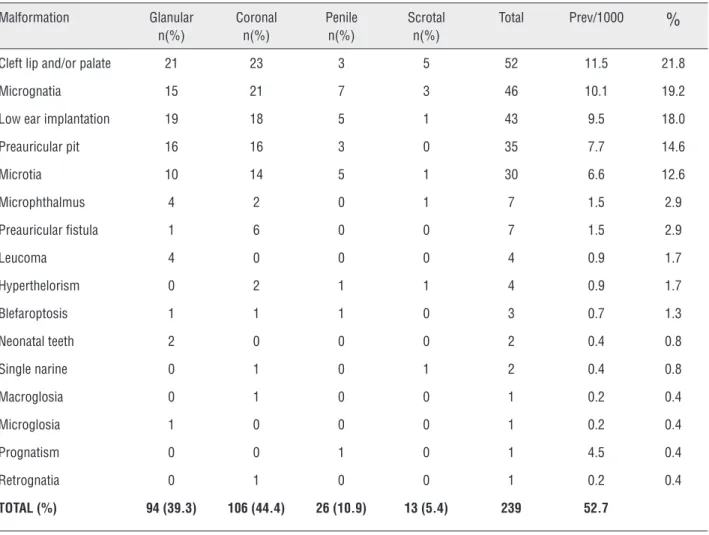
The facial anomalies that were detected and its distribution according to the severity of hypospadias are shown in Table-1. The most commonly major facial anomaly associated to hypospadias was cleft lip/palate with 52 cases.
DISCUSSION
Although hypospadias is the most com-mon congenital anomaly affecting the genitals, its association with other anomalies is rare. It has been previously reported that other malfor-mations can coexist in 29.3% of the cases with hypospadias. In our group we identified that 18%
Table 1 - Associated anomalies and its distribution by severity of hypospadias.
Malformation Glanular n(%)
Coronal n(%)
Penile n(%)
Scrotal n(%)
Total Prev/1000
%
Cleft lip and/or palate 21 23 3 5 52 11.5 21.8
Micrognatia 15 21 7 3 46 10.1 19.2
Low ear implantation 19 18 5 1 43 9.5 18.0
Preauricular pit 16 16 3 0 35 7.7 14.6
Microtia 10 14 5 1 30 6.6 12.6
Microphthalmus 4 2 0 1 7 1.5 2.9
Preauricular fistula 1 6 0 0 7 1.5 2.9
Leucoma 4 0 0 0 4 0.9 1.7
Hyperthelorism 0 2 1 1 4 0.9 1.7
Blefaroptosis 1 1 1 0 3 0.7 1.3
Neonatal teeth 2 0 0 0 2 0.4 0.8
Single narine 0 1 0 1 2 0.4 0.8
Macroglosia 0 1 0 0 1 0.2 0.4
Microglosia 1 0 0 0 1 0.2 0.4
Prognatism 0 0 1 0 1 4.5 0.4
Retrognatia 0 1 0 0 1 0.2 0.4
have an association with other anomalies. There is limited data on malformation phenotypes that coexist with hypospadias (3-7). Associations such as cryptorchidism are common and belong to the gonadal dysgenesis syndrome. Also, as-sociations with urinary tract anomalies as part of the WAGR syndrome are commonly seen. But it has been demonstrated that other affected or-gans or systems in association with hypospadias are rare (3).
After analyzing the severity of hypospa-dias and the different craniofacial anomalies we did not find any significant trends with regar-ds to severity of the craniofacial anomaly and hypospadias severity. The distribution was very homogeneous being most frequently associated with distal hypospadias.
Information about craniofacial anomalies that co-occur with hypospadias is limited. In our population we found an association between cra-niofacial anomalies and hypospadias in 0.52 ca-ses/1000 newborns. Nassar et al. (4) reported 0.3 cases per 10.000 newborns.
Not many syndromes have been descri-bed where the two systems are affected. It can be associated with MID1 gene defects which in-teracts with MID2 (8), and are implicated in mi-dline anomalies (9, 10). The Toriello Carey syn-drome has the co-occurrence of hypospadias and facial anomalies. Others are the Mowat-Wilson Syndrome, the Opitz-Kawegia Syndrome and the hypertelorism-hypospadias syndrome described in 1969 (11-17). In our population we identified 4 cases (1.7%) of patients diagnosed with hyper-telorism whom also had hypospadias. Other au-thors have identified a prevalence of 15.3% of associated cases of hypospadias-hypertelorism (5). Of those, two were proximal. It seems that these cases are inherited as an X-linked or auto-somal dominant trait (18).
Some authors have reported the associa-tion between deleassocia-tion of 13.q33.2 and the pre-sence of hypospadias and craniofacial anomalies. Unfortunately, our database does not include in-formation about karyotype.
With regards to cleft lip, previous reports have shown an association prevalence with hy-pospadias of 5.6/1000 (19). In our population we
identified a prevalence of 11.5/1000 cases of hy-pospadias. Although this is one of the malforma-tions that is easily diagnosed, we do not consider that it can be overestimated in our population.
According to our experience, and many other authors, most of the congenital anomalies if detected and treated appropriately and soon enough, the future disabilities and prognosis will improve significantly. Most of the craniofacial anomalies and hypospadias need to be approa-ched by experienced personal. For that reason, it is important for this patients to be evaluated by a multidisciplinary approach (20-23).
CONCLUSION
Our novel results indicate the importance of evaluating thoroughly all patients diagnosed with hypospadias. The prevalence of craniofacial anomalies is not increased in patients with proxi-mal hypospadias. Or the prevalence of other ano-malies is not increased in hypospadias patients who have craniofacial anomalies. Although syn-dromic hypospadias are rare and represent less than 20% of cases, it is important to identify the co-occurrence of craniofacial anomalies becau-se it might help the identification of syndromic hypospadias in order to give a better care for pa-tients and their families.
CONFLICT OF INTEREST
None declared.
REFERENCES
1. Schneuer FJ, Holland AJ, Pereira G, Bower C, Nassar N. Prevalence, repairs and complications of hypospadias: an Australian population-based study. Arch Dis Child. 2015;100:1038-43.
2. Fernández N, Henao-Mejía J, Monterrey P, Pérez J, Zarante I. Association between maternal prenatal vitamin use and congenital abnormalities of the genitourinary tract in a developing country. J Pediatr Urol. 2012;8:121-6.
4. Nassar N, Bower C, Barker A. Increasing prevalence of hypospadias in Western Australia, 1980-2000. Arch Dis Child. 2007;92:580-4.
5. Friedman T, Shalom A, Hoshen G, Brodovsky S, Tieder M, Westreich M. Detection and incidence of anomalies associated with hypospadias. Pediatr Nephrol. 2008;23:1809-16. 6. Duckett JW. Hypospadias. Clin Plast Surg. 1980;7:149-60. 7. Martínez-Frías ML. Spina bifida and hypospadias: a non
random association or an X-linked recessive condition? Am J Med Genet. 1994;52:5-8.
8. Boding L, Hansen AK, Meroni G, Levring TB, Woetmann A, Ødum N, et al. MID2 can substitute for MID1 and control exocytosis of lytic granules in cytotoxic T cells. APMIS. 2015;123:682-7.
9. Fonseca RF, de Carvalho FM, Poletta FA, Montaner D, Dopazo J, Mereb JC, et al. Family-based genome-wide association study in Patagonia confirms the association of the DMD locus and cleft lip and palate. Eur J Oral Sci. 2015. Epub ahead of print]
10. Spinelli M, Sica C, Dallapiccola B, Novelli A, Di Meglio L, Martinelli P. The Challenge of Prenatal Diagnostic Work-Up of Maternally Inherited X-Linked Opitz G/BBB: Case Report and Literature Review. Case Rep Obstet Gynecol. 2015;2015:830108.
11. Christian J, Bixler D, Blythe S, Merritt A. Familial telecanthus with associated congenital anomalies. Birth Defects. 1969;5:82–5.
12. Opitz JM, Summit RL, Smith DW. The BBB syndrome: Familial telecanthus with associated congenital anomalies. Birth Defects. 1969;5:83.
13. Michaelides M, Aclimandos W. A novel case of hypertelorism, hypospadias, strabismus, and bilateral congenital lacrimal fistulae. J Pediatr Ophthalmol Strabismus. 2002;39:307-9. 14. Aftimos S, McGaughran J. Toriello-Carey syndrome:
case report with additional findings. Am J Med Genet. 2001;98:273-6.
15. Kuhnle U, Bartsch O, Werner W, Schuster T. Penoscrotal inversion, hypospadias, imperforate anus, facial anomalies, and developmental delay: definition of a new clinical syndrome. Pediatr Surg Int. 2000;16:396-9.
16. Garavelli L, Zollino M, Mainardi PC, Gurrieri F, Rivieri F, Soli F, et al. Mowat-Wilson syndrome: facial phenotype changing with age: study of 19 Italian patients and review of the literature. Am J Med Genet A. 2009;149A:417-26.
17. Smith JF, Wayment RO, Cartwright PC, Snow BW, Opitz JM. Genitourinary anomalies of pediatric FG syndrome. J Urol. 2007;178:656-9.
18. Noe HN, Peeden JN, Jerkins GR, Wilroy RS Jr. Hypertelorism-hypospadias syndrome. J Urol. 1984;132:951-2.
19. Stoll C, Alembik Y, Roth MP, Dott B. Genetic and environmental factors in hypospadias. J Med Genet. 1990;27:559-63. 20. Marte A, Pintozzi L, Cavaiuolo S, Borrelli M, Prezioso M.
[Advantages of the anterior and mid-shaft hypospadias repair in the first year of life]. Pediatr Med Chir. 2013;35:281-4.
21. Rynja SP, de Kort LM, de Jong TP. Urinary, sexual, and cosmetic results after puberty in hypospadias repair: current results and trends. Curr Opin Urol. 2012;22:453-6.
22. Tourchi A, Hoebeke P. Long-term outcome of male genital reconstruction in childhood. J Pediatr Urol. 2013;9:980-9. 23. Snodgrass W, Villanueva C, Bush N. Primary and reoperative
hypospadias repair in adults--are results different than in children? J Urol. 2014;192:1730-3.
_______________________ Correspondence address: