Nadia Salem Abdel Jabbar(a) Ana Beatriz Miguel Bueno(b) Patrícia Elaine da Silva(b) Helio Scavone-Junior(b) Rívea Inês Ferreira(b)
(a)Department of Pediatric Dentistry and
Orthodontics, School of Dentistry, University of São Paulo (USP), São Paulo, SP, Brazil.
(b)Department of Pediatric Dentistry and
Orthodontics, University of São Paulo City (UNICID), São Paulo, SP, Brazil.
Corresponding author:
Rívea Inês Ferreira
Email: [email protected]
Received for publication on Feb 10, 2011 Accepted for publication on Jun 09, 2011
Bottle feeding, increased overjet and
Class 2 primary canine relationship:
is there any association?
Abstract: The aim of this study was to investigate the association be-tween bottle feeding and prevalence rates of increased overjet and Class 2 primary canine relationship. The sample consisted of 911 children (461 boys, 450 girls) aged 3 (13.9%), 4 (40.8%), 5 (34%) and 6 (11.3%) years, with complete primary dentition. Information about nutritive and nonnutritive (paciier and/or digit) sucking habits was collected through questionnaires. Three calibrated dentists (κ: 0.9-1.0 and Rs > 0.90) per-formed the clinical assessments. The children were divided into four groups: G1 – not bottle-fed; G2 – exclusively bottle-fed; G3 – breast- and bottle-fed, bottle feeding ceased before 3 years of age; and G4 – breast- and bottle-fed, bottle feeding ceased between 3 and 4 years of age. As-sociations between nutritive and nonnutritive sucking behaviors and the malocclusions studied were analyzed by multiple binary logistic regres-sion (α = 0.05). The frequencies of increased overjet were: 25.3% (G1), 38.8% (G2), 39.2% (G3) and 47.8% (G4). The percentages of Class 2 canine relationship were: 27.9% (G1), 48.8% (G2), 43.4% (G3) and 43% (G4). No signiicant effect of bottle feeding was found. The chances of diagnosing increased overjet (O.R. = 4.42, p < 0.001) and Class 2 canine relationship (O.R. = 4.02, p < 0.001) were greater for children with paci-ier and/or digit-sucking habits, compared to those without a history of nonnutritive sucking behavior. It may be suggested that bottle feeding alone is not directly associated with higher prevalence rates of increased overjet and Class 2 canine relationship in the primary dentition.
Descriptors: Bottle Feeding; Sucking Behavior; Malocclusion; Dentition, Primary.
Introduction
Breast milk provides all the nutrients that newborn children require in the irst six months of life.1,2 Breast-feeding promotes nasal breath-ing from proper use of the suckbreath-ing function, where the lips remain com-pletely in contact with the mother’s breast and the nose is stimulated to initiate inspiration and expiration respiratory movements.3 This kind of breathing stimulates growth of the maxilla, since the air pressure created in the maxillary sinus expands its limits.
Bottle feeding, allergic rhinitis and nonnutritive sucking habits have been associated with malocclusions in the primary dentition.4,5 It was ob-served that 53% of bottle-fed children presented myofunctional altera-Declaration of Interests: The authors
tions from the tongue’s resting on the mandibular arch or between the dental arches, indicating muscle hypotonicity.6 With the use of artiicial nipples, there is lack of palatal support from the tongue and in-creased activity of the cheeks. The dynamic balance between the influence of the tongue and that of the cheeks is upset, resulting in a broader mandibular arch.7 Alteration of the oral motor development brought on by bottle feeding may negatively affect mastication, deglutition, breathing and speech-sound articulation, as well as promote malocclusion.8
Several authors have pointed out that bottle-fed children have a strong tendency to develop a pac-iier-sucking habit.9-12 Nutritive and nonnutritive sucking habits, namely bottle feeding and paciier use, are associated to an atypical swallowing pat-tern, with tongue thrusting, which may be related to the development of malocclusions such as poste-rior crossbite.5,7 However, while some authors have focused on the relationship between paciier use and malocclusion in the primary dentition,13,14 the degree of association between bottle feeding and the prevalence of occlusal alterations in the sagittal plane is still subject to conjecture.Thus, the aim of the present study was to assess a possible associa-tion between bottle feeding duraassocia-tion and the preva-lence of both increased overjet and Class 2 canine relationship, in the primary dentition. The study groups were established based on previous research, which indicated a beneicial influence of breast-feeding without the use of artiicial nipples on oc-clusion;15 which recommended nonnutritive sucking habit cessation at 2 or 3 years of age,13,14 and which demonstrated that bottle feeding is discontinued at a higher frequency between 3 and 4 years of age.9
Methodology
This epidemiological study was conducted in accordance with the ethical principles foreseen in Resolution 196/96 of the Brazilian National Health Council.
Sample
The parents of a total of 2,700 children aged 3 to 6 years, of both genders, attending 11 public schools in São Paulo City, Southeastern region of
Brazil, received a free and informed consent form to participate in the study. The mothers were asked to answer a questionnaire containing items about in-fant feeding methods and nonnutritive sucking hab-its. A pilot study was conducted to test the consis-tency of the information obtained. Thirty mothers answered the questionnaire twice, with an interval of 6 months between the irst and second surveys. The whole study presented variables with a high de-gree of reliability, and the Kappa coeficient values (κ) were approximately 0.93. These questionnaires were not included in the present study sample.
In this study, 1,758 mother-child dyads were excluded because the mothers did not sign the con-sent form, did not return the questionnaires or illed them out incorrectly, or else the children did not allow clinical examination or did not meet the re-search criteria. All of the children included in the sample met the following criteria:
• never underwent orthodontic treatment or speech-language therapy;
• readily accepted clinical examination;
• had complete primary dentition, with no erupted or erupting permanent teeth;
• had no extensive caries lesions, crown destruc-tion or proximal restoradestruc-tions that could compro-mise occlusion;
• had no early primary tooth loss and/or dental anomalies; and
• had no cleft lip or palate, or any other develop-mental anomaly that could preclude breast-feed-ing.
Based on questionnaire data, the demographic and socioeconomic characteristics indicated that the population studied had a low to medium income level and consisted of a culturally homogeneous sample. In general, the families had two or more children at home; most parents were not college graduates and reported relatively low salaries.
Occlusal features
The clinical assessments were conducted in the school environment, with the children seated, un-der an adequate source of artiicial light. During the clinical examinations, the children were in-structed to remain in maximal habitual intercuspa-tion. Overjet was measured directly in the children’s mouth, using millimetric disposable orthodontic rulers (Morelli, Sorocaba, SP, Brazil), and was clas-siied as:16
• Normal (horizontal space between maxillary and mandibular central incisors not exceeding 2 mm, or equal to zero);
• Increased (horizontal space between maxillary and mandibular central incisors in excess of 2 mm);
• Anterior crossbite: the mandibular central inci-sors were positioned anteriorly to the maxillary central incisors, in an inverted relationship.
The primary canine relationships were catego-rized as:16
• Class 1: the cusp of the maxillary canine was on the same plane as that of the distal surface of the mandibular canine;
• Class 2: the cusp of the maxillary canine was positioned anteriorly to the distal surface of the mandibular canine;
• Class 3: the cusp of the maxillary canine was positioned posteriorly to the distal surface of the mandibular canine.
Study groups
After clinical assessments, and based on the in-clusion criteria, the children were divided into 4 groups:
• G1: not bottle-fed children;
• G2: exclusively bottle-fed children;
• G3: children who received breast and bottle feed-ing, bottle feeding discontinued before 3 years of age;
• G4: children who received breast and bottle feeding, bottle feeding discontinued between 3 and 4 years of age.
Statistical methods
For statistical purposes, normal overjet and Class 1 canine relationship were analyzed in rela-tion to increased overjet and Class 2 canine relarela-tion- relation-ship, respectively, since these malocclusions may be associated to sucking behaviors in childhood.14 Mul-tiple binary logistic regression models were adjusted to analyze the effects of bottle feeding and other independent variables, i.e., exclusive breast-feeding (discontinued before 6 months versus sustained for periods equal to or longer than 6 months), gender (male versus female) and nonnutritive sucking hab-its (no history versus a history of paciier and/or digit-sucking habits).1,2,4,9,13,14 The reference catego-ries were: G1 (not bottle-fed), breast-feeding for less than 6 months, male, and no history of nonnutri-tive sucking habits. The signiicance level was set at 0.05.
Results
Reliability of the occlusal assessments Three calibrated dentists, who were unaware of the questionnaire data, performed the clinical ex-aminations. Training and calibration involved oc-clusal examination of 24 children (who were not included in the study sample) on two different oc-casions, with a 15-day interval between the irst and second assessments. Kappa coeficients (κ) ranging from 0.9 to 1.0 were obtained for the three dentists, indicating a good level of intra-examiner agreement. Spearman correlation coeficient values (Rs) greater than 0.90 were obtained for each pair of examin-ers, demonstrating homogeneity of the diagnoses performed.
Study sample distribution
and girls in the study groups presented small varia-tions, except for G1 and G3. The percentage of girls in G1 was higher (22.7% versus 17.6%). The op-posite was observed in G3, since 28.4% were boys and 21.6% were girls. Most of the children were 4 (40.8%) or 5 (34%) years old. Only 11.3% were 6 years old.
Bottle feeding versus increased overjet and Class 2 canine relationship
In the total sample, normal overjet was the most prevalent feature (58.7%), followed by increased overjet (39.5%). Only 16 children (1.8%) had ante-rior crossbite. A Class 1 canine relationship, consid-ered as the satisfactory pattern in the primary denti-tion, also occurred in more than half of the sample (59.4%).
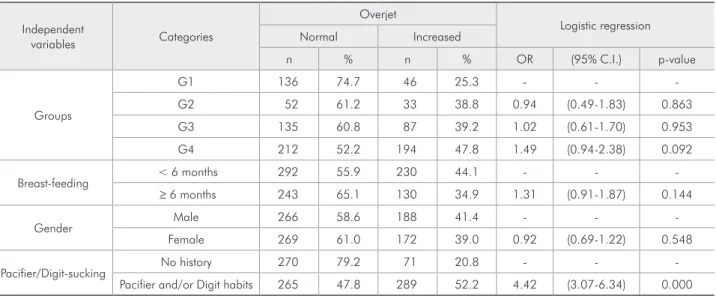
Although the prevalence rates of increased over-jet and Class 2 primary canine relationship were higher in G2, G3 and G4 (bottle-fed children) than in G1 (not bottle-fed children), no signiicant ef-fect of bottle feeding was found (Tables 1 and 2). No signiicant differences were observed between subgroups of children who received exclusive breast-feeding (for periods shorter than, equal to or longer than 6 months) and genders (Tables 1 and 2). None-theless, nonnutritive sucking habits were signiicant-ly associated with higher frequencies of increased overjet and a Class 2 primary canine relationship.
Children with a positive history of paciier use and/or digit-sucking habits were found to have 4.42 times more chance of presenting increased overjet, when compared to those without history of nonnu-tritive sucking behavior (Table 1). A similar inding was observed for Class 2 canine relationship (Table 2). Children with paciier and/or digit-sucking hab-its were found to have a fourfold increased chance of presenting a Class 2 canine relationship, com-pared with those children in the no-such-habits sub-sample.
Discussion
No signiicant associations were demonstrated between bottle feeding and high prevalence rates of the malocclusions studied (Tables 1 and 2). Al-though bottle feeding, even among breast-fed chil-dren, may interfere negatively with orofacial devel-opment,6 this infant feeding method seems not to be directly associated with some types of malocclu-sions. A study conducted in a subsample of children aged 2-6 years with no history of nonnutritive suck-ing habits found no signiicant associations between the presence of an overjet greater than 3 mm and bottle feeding.11
Besides the speciic objective of this study – to investigate the strength of the association among bottle feeding, increased overjet and Class 2 prima-ry canine relationship – other independent and
con-Table 1 - Logistic regression model for the prevalence rates of increased versus normal overjet (n = 895).
Independent
variables Categories
Overjet
Logistic regression
Normal Increased
n % n % OR (95% C.I.) p-value
Groups
G1 136 74.7 46 25.3 - -
-G2 52 61.2 33 38.8 0.94 (0.49-1.83) 0.863
G3 135 60.8 87 39.2 1.02 (0.61-1.70) 0.953
G4 212 52.2 194 47.8 1.49 (0.94-2.38) 0.092
Breast-feeding < 6 months 292 55.9 230 44.1 - -
-≥ 6 months 243 65.1 130 34.9 1.31 (0.91-1.87) 0.144
Gender Male 266 58.6 188 41.4 - -
-Female 269 61.0 172 39.0 0.92 (0.69-1.22) 0.548
Pacifier/Digit-sucking No history 270 79.2 71 20.8 - -
founding variables, such as exclusive breast-feeding duration, gender and a history of nonnutritive suck-ing habits (paciier and/or digit-sucksuck-ing), were as-sessed because they could have some relation with both bottle feeding and malocclusions.4,5,9-11,13-15,17,18 Not surprisingly, no signiicant effects were found for breast-feeding duration and gender. However, children with positive history of paciier and/or dig-it-sucking habits were found to be 4.42 times more susceptible to the development of increased over-jet (95% C.I., 3.07-6.34, p < 0.001) and to have a fourfold greater chance of presenting Class 2 canine relationship (95% C.I., 2.83-5.71, p < 0.001), com-pared to children without any history of nonnutri-tive sucking behavior (Tables 1 and 2).
Exclusive bottle feeding may be related to in-adequate muscular stimuli for proper mandibular development.19 However, as it happens with breast-feeding, the effects of bottle feeding in the develop-ing occlusion are dificult to assess because paciier use intertwines with this artiicial infant feeding method. Bottle feeding was found to be strongly connected to paciier use between 3 and 4 years of age.9 This nonnutritive sucking habit has often been implicated in the etiology of malocclusions diag-nosed in the primary dentition.4,5,13-15
In fact, there is evidence of a complex interplay among breast-feeding, bottle feeding, nonnutri-tive sucking habits (specially paciier use), irregular
orofacial functions and malocclusions.3-7,9-11,13-15,17,18 Prolonged breast-feeding is related to lower frequen-cies of nonnutritive sucking habits.4,9,15 Nevertheless, early weaning has been associated to the introduc-tion of artiicial nipples for nourishment or only for calming the child.1 Regarding occlusal alterations, it has been estimated that bottle-fed children have ive times higher chances of developing malocclusions as compared with those who are breast-fed.10 During breast-feeding, mostly the masseter and temporalis muscles are used, and their activities stimulate facial development favorably, with form and function bal-ance.4,19 Bottle feeding would contribute to the de-velopment of malocclusions through three different mechanisms:
1. alteration of the direction of growth and of the development of the facial bones during child-hood,
2. an increased tendency towards an atypical swal-lowing pattern and
3. higher prevalence rates of nonnutritive sucking habits (digit and paciier-sucking).12
A Danish study17 showed that children with tongue-thrust and teeth-apart swallowing patterns had increased frequencies of extreme maxillary overjet, which was associated with digit-sucking. Many authors agree that nonnutritive sucking hab-its, even of a short duration, may have an indirect
Table 2 - Logistic regression model for Class 2 versus Class 1 primary canine relationships (n = 911).
Independent
variables Categories
Canine Relationship
Logistic regression
Class 1 Class 2
n % n % OR (95% C.I.) p-value
Groups
G1 132 72.1 51 27.9 - -
-G2 44 51.2 42 48.8 1.45 (0.77-2.76) 0.253
G3 129 56.6 99 43.4 1.20 (0.73-1.98) 0.476
G4 236 57.0 178 43.0 1.16 (0.74-1.83) 0.519
Breast-feeding < 6 months 297 56.0 233 44.0 - -
-≥ 6 months 244 64.0 137 36.0 1.41 (0.99-2.00) 0.055
Gender Male 276 59.9 185 40.1 - -
-Female 265 58.9 185 41.1 1.10 (0.83-1.45) 0.510
Pacifier/Digit-sucking No history 271 77.4 79 22.6 - -
effect through their association with an abnormal swallowing pattern, as well as a direct influence in the etiology of malocclusions.17,18 The results of a longitudinal Slovenian study18 demonstrated that sucking behavior (digit or paciier-sucking, bottle feeding) that persisted at 5 years of age was statisti-cally signiicant for an atypical swallowing pattern at 6-9 years of age. Accordingly, an atypical swal-lowing pattern at 6-9 years of age was signiicantly correlated with a morphological malocclusion sever-ity score at 12 years of age. At an older age, maloc-clusion severity is also related to incorrect orofacial functions at an early stage of dental development.18 Therefore, sucking habits may influence morphol-ogy and function in the developing occlusion.
According to Tables 1 and 2, expressive percent-ages of children with histories of bottle feeding and nonnutritive sucking habits were diagnosed with increased overjet (38.8% to 52.2%) and a Class 2 canine relationship (43% to 51.9%). In the primary
dentition, increased overjet may self-correct when nonnutritive sucking and/or artiicial nipple use are discontinued. Nevertheless, a Class 2 canine rela-tionship requires professional follow-up and may need interceptive orthodontic treatment. Although longitudinal studies with large samples are needed to clarify the effect of bottle feeding on the develop-ment of both the stomatognathic system and occlu-sion on the three spatial planes – sagittal, transver-sal and vertical – the results of this study provide evidence for supporting the importance of encour-aging breast-feeding to prevent the establishment of nonnutritive sucking behaviors.
Conclusion
According to the results of this study, it may be suggested that bottle feeding alone is not directly as-sociated with higher prevalence rates of increased overjet and Class 2 canine relationship in the pri-mary dentition.
References
1. Kramer MS, Kakuma R. The optimal duration of exclusive breastfeeding: a systematic review. Geneva: WHO; 2002 [cited 2010 Jan 12]. Available from: http://www.who.int/nutrition/ publications/optimal_duration_of_exc_bfeeding_review_eng. pdf.
2. WHO Multicentre Growth Reference Study Group. Breast-feeding in the WHO Multicentre Growth Reference Study. Acta Paediatr Suppl. 2006 Apr;450:16-26.
3. Trawitzki LVV, Anselmo-Lima WT, Melchior MO, Grechi TH, Valera FCP. Breast-feeding and deleterious oral habits in mouth and nose breathers. Braz J Otorhinolaryngol. 2005 Nov-Dec;71(6):747-51.
4. Melink S, Vagner MV, Hocevar-Boltezar I, Ovsenik M. Pos-terior crossbite in the deciduous dentition period, its relation with sucking habits, irregular orofacial functions, and oto-laryngological findings. Am J Orthod Dentofacial Orthop. 2010 Jul;138(1):32-40.
5. Vázquez-Nava F, Quezada-Castillo JA, Oviedo-Treviño S, Sal-divar-González AH, Sánchez-Nuncio HR, Beltrán-Guzmán FJ, et al. Association between allergic rhinitis, bottle feeding, non-nutritive sucking habits, and malocclusion in the primary dentition. Arch Dis Child. 2006 Oct;91(10):836-40. 6. Carrascoza KC, Possobon RF, Tomita LM, Moraes ABA.
Consequences of bottle-feeding to the oral facial develop-ment of initially breastfed children. J Pediatr (Rio J). 2006 Sep-Oct;82(5):395-7.
7. Ovsenik M. Incorrect orofacial functions until 5 years of age and their association with posterior crossbite. Am J Orthod Dentofacial Orthop. 2009 Sep;136(3):375-81.
8. Neiva FCB, Cattoni DM, Ramos JLA, Issler H. [Early wean-ing: implications to oral motor development]. J Pediatr (Rio J). 2003 Jan-Feb;79(1):7-12. Portuguese.
9. Telles FBA, Ferreira RI, Magalhães LNC, Scavone-Junior H. Effect of breast- and bottle-feeding duration on the age of paci-fier use persistence. Braz Oral Res. 2009 Oct-Dec;23(4):432-8. 10. Leite-Cavalcanti A, Medeiros-Bezerra PK, Moura C. [Breast-feeding, bottle-[Breast-feeding, sucking habits and malocclusion in Brazilian preschool children]. Rev Salud Publica (Bogota). 2007 Apr-Jun;9(2):194-204. Portuguese.
11. Charchut SW, Allred EN, Needleman HL. The effects of infant feeding patterns on the occlusion of the primary dentition. J Dent Child (Chic). 2003 Sep-Dec;70(3):197-203.
12. Meyers A, Hertzberg J. Bottle-feeding and malocclusion: is there an association? Am J Orthod Dentofacial Orthop. 1988 Feb;93(2):149-52.
13. Scavone-JuniorH, Ferreira RI, MendesTE, Ferreira FV. Prevalence of posterior crossbite among pacifier users: a study in the deciduous dentition. Braz Oral Res. 2007 Apr-Jun;21(2):153-8.
myofunc-tional structures of preschool children. Pediatr Dent. 2002 Nov-Dec;24(6):552-60.
15. Kobayashi HM, Scavone Jr H, Ferreira RI, Garib DG. Reta-tionship between breastfeeding duration and prevalence of posterior crossbite in the deciduous dentition. Am J Orthod Dentofacial Orthop. 2010 Jan;137(1):54-8.
16. Foster TD, Hamilton MC. Occlusion in the primary dentition. Study of children at 2 and one-half to 3 years of age. Br Dent J. 1969 Jan 21;126(2):76-9.
17. Melsen B, Stensgaard K, Pedersen J. Sucking habits and their influence on swallowing pattern and prevalence of malocclu-sion. Eur J Orthod. 1979;1(4):271-80.
18. Ovsenik M, Farcnik FM, Korpar M, Verdenik I. Follow-up study of functional and morphological malocclusion trait changes from 3 to 12 years of age. Eur J Orthod. 2007 Oct;29(5):523-9.