ORIGINAL
RES
EAR
janeiro de 2005 a janeiro de 2010 foi investigado retros-pectivamente a partir da coleta de dados em registros médicos. Foram analisados 1320 prontuários, dos quais 63,3% eram do sexo masculino, com média de idade de 47,02±19,60 anos. Os mecanismos de TRM que prevale-ceram foram queda de altura (27,2%), acidente de trân-sito (25,8%) e queda da própria altura (13,2%), e os níveis da coluna vertebral mais acometidos foram lombar (35,6%), torácico (21,9%) e cervical (20,5%). Da amostra total, 10,7% dos indivíduos que sofreram TRM apresen-taram lesão medular (LM), com maior prevalência da lesão incompleta (63,3%). O TRM em Porto Alegre aco-mete principalmente homens na meia-idade, que tive-ram na queda de altura a etiologia mais frequente e no nível lombar o mais acometido. A LM ocorreu mais em indivíduos jovens, sendo o nível cervical o mais lesado. Esses achados são importantes para orientar a aloca-ção eficiente de recursos para o manejo desses agravos e suas repercussões e para prevenir a sua ocorrência nas populações em risco.
Descritores | traumatismos da coluna vertebral; compressão da medula espinal; traumatismos da medula espinal; epidemiologia.
RESUMEN | Este estudio transversal fue desarrollado con el objetivo de trazar el perfil de la población que sufrió trauma raquimedular (TRM) y fue internado en hospitales de emergencia de Puerto Alegre/RS. El perfil de la pobla-ción que sufrió TRM de enero de 2005 a enero de 2010
ABSTRACT | This transversal study aimed at determining the profile of the population who suffered spinal injury (SI) and was admitted to emergency hospitals in Porto Alegre/RS. The profile of the population who had SI between January 2005 and January 2010 was retrospectively investigated through data collected from medical records. A total of 1320 records were analyzed, of which 63.3% were male, with a mean age of 47.02±19.6 years. The most prevalent spinal cord injury (SCI) mechanisms were falls from a height (27.2%), traffic accidents (25.8%) and falls from own height (13.2%) and the spinal levels that are usually affected were lumbar (35, 6%), thoracic (21.9%) and cervical (20.5%). Only 142 (10.7%) individuals who had a SI SCI, with a higher prevalence of incomplete lesion (63.3%). In Porto Alegre SI affects mainly middle aged men, who fell from a height and had the lumbar level as the most affected. The SCI affects younger individuals at the cervical level. These findings are important to guide the efficient allo-cation of resources for the management of these injuries and their repercussions and to prevent this kind of event in the risk population.
Keywords | spinal injuries; spinal cord compression; spinal cord injuries; epidemiology.
RESUMO | Este estudo de coorte retrospectivo foi de-senvolvido com o objetivo de traçar o perfil da popu-lação que sofreu trauma raquimedular (TRM) e foi in-ternada em hospitais de pronto atendimento de Porto Alegre/RS. O perfil da população que sofreu TRM de
Estudo do peril do trauma raquimedular em Porto Alegre
Estudio del peril de trauma raquimedular en Puerto Alegre
Verônica Baptista Frison1, Glaciéle de Oliveira Teixeira2, Thais Fonseca de Oliveira2,
Thais de Lima Resende3, Carlos Alexandre Netto4
Correspondence to: Thais de Lima Resende − Avenida Ipiranga, 6681, pd 12A, 8° andar – FAENFI − CEP: 90619-900 − Porto Alegre (RS), Brasil − E-mail: [email protected] Presentation: Oct. 2012 – Accepted for publication: May 2013 – Financing source: none – Conflict of interest: nothing to declare. – Approval at the Ethics Committee n. 10/04968.
Study conducted at the Physical Therapy course of the Nursing, Nutrition and Physical Therapy Faculty at Pontifícia Universidade Católica do Rio Grande do Sul (PUCRS) − Porto Alegre (RS), Brasil.
1Mestre pelo Programa de pós-graduação em Neurociências da Universidade Federal do Rio Grande do Sul (UFRGS); Professora
Assistente da Faculdade de Enfermagem, Nutrição e Fisioterapia da PUCRS − Porto Alegre (RS), Brasil.
2Physical Therapist – Porto Alegre (RS), Brasil.
3PhD in Health Sciences by the Postgraduate program of the Medical School at PUCRS; Professor at the Nursing, Nutrition and Physical
Therapy Faculty of PUCRS – Porto Alegre (RS), Brasil.
INTRODUCTION
he spinal injury (SI) is described as a lesion of any component of the spine, be it bone, ligament, medullary, disc, vascular or radicular lesions1. In contrast, the spinal
cord injury (SCI) is deined as the decrease or loss of motor and/or sensory and/or anatomic function below the level of the lesion by the American Spinal Injury Association (ASIA), and such lesion can be complete or incomplete due to the impairment of neural elements inside the spinal channel2.
SCI is characterized as one of the most severe dis-abling neurological syndromes, leading to changes in sensitivity, motricity and disorders of the autonomic system in the segments of the body that are located below the lesion3,4. Even though its estimated
world-wide incidence is not so high (15 to 40 cases per mil-lion), its social and economic cost is disproportionally high5, negatively impacting on the quality of life and
self-esteem of those afected by it6.
As reported in literature, in Canada US$ 61.6 mil-lion dollars were spent in a year only with hospital costs for SI7, whereas in the United States the cost of
treat-ment is estimated as US$ 9.7 billion a year8. Considering
2007 as the base year, in Spain it was estimated that the cost of SI for the society ranged from 131 to 302 million US$, depending on the lesion mechanism9. From the
data in these countries, where there are national reg-isters which allow the better evaluation of the impact of SI on public health, it is clear that this condition, even if not so prevalent, is an important item in the public expenses with health. Even though there are not clearly deined numbers in Brazil, it is estimated that approximately R$ 9 billion are destined to treatments for trauma every year, which correspond to almost one third of all the investment in public health in Brazil10.
In Brazil, studies showing the epidemiological pro-ile of SI considering all kinds of trauma mechanisms in São Luís/MA11 and in São Paulo/SP1 were carried out.
In both studies, mostly young men fell from high places or sufered falls, and this proportion was signiicantly higher than that of car accidents, with major thoracic or thoracolumbar impairment. A national study12
con-irms the prevalence among young men at reproductive age, but the distribution of trauma mechanisms follows a diferent order, in which traic accidents appear with the highest number of cases, followed by falls and ire-arm injuries (FAI). In addition, regional diferences are also clear, as observed in the comparison between the South region, which registered the highest number of cases resulting from diving in the country and the second highest level of traic accidents, and the North region, which presented only one register of SI caused by traic accident and one by diving12. Additionally, it
is important to consider that the diferences also hap-pen locally, as observed in a study conducted in Rio de Janeiro from 1996 to 2011, in which hospital admis-sions due to SI were analyzed in the municipal and state public emergency hospitals of the city13. he researchers
compared several indicators and concluded that there were diferences between the two health network, and the state hospitals presented higher values in terms of expenses with hospital admissions and their volume, besides a longer mean permanence, however, a signii-cantly lower mortality rate than the one found in the municipal hospitals.
hus, considering that diferences in the proile of SI can be even local, the use of epidemiological data to plan health actions is very important to guide health promotion strategies, which can result in the prevention of the main etiological causes and in improved quality of life for the population14,15. he results of
the epidemio-logical study also enables the development of a more fue investigado retrospectivamente a partir de la recopilación de
datos en registros médicos. Fueron analizadas 1320 fichas clíni-cas, de las cuales 63,3% eran de sexo masculino, con promedio de edad de 47,02±19,6 años. Los mecanismos de TRM que pre-valecieron fueron caída de gran altura (27,2%), accidente de trán-sito (25,8%) y caída desde la propia altura del sujeto (13,2%) y los niveles de la columna vertebral más lesionados fueron lumbar (35,6%), torácico (21,9%) y cervical (20,5%). De la muestra total, 142 (10,7%) de los individuos que sufrieron TRM presentaron le-sión medular (LM), con mayor prevalencia de lele-sión incompleta
(63,3%). El TRM en Puerto Alegre ocurre principalmente en hom-bres en edad media, que tuvieron una caída de gran altura, la cual constituye la etiología más frecuente y el nivel lumbar es el más lesionado. Estos hallazgos son importantes para orientar la asig-nación eficiente de los recursos para el manejo de estas lesiones y sus consecuencias para prevenir su incidencia en la población en riesgo.
his study was approved by the Research Ethics Committee of Pontifícia Universidade Católica do Rio Grande do Sul, number 10/04968, by the Research Ethics Committee of Grupo Hospitalar Conceição, pro ject number 10-010, and by the Research Eth-ics Committee of the Municipal Health Authority of Porto Alegre, number 001.004651.10.3, registration number 458. According to the resolution 196/96 IX.2 “e” (CONEP – Ministry of Health), data will be stored for 5 years and then destroyed.
Initially data were analyzed through descriptive statis-tics, with the distribution of simple and relative frequen-cies, as well as position (mean and median) and disper-sion (standard deviation and amplitude). he normality of data was investigated by the Kolmogorov-Smirnov test.
Student’s t-test was used to compare quantitative variables. he χ2test was used to compare the
propor-tions of the same variable, considering the theoretical distribution of homogeneity between the compared cat-egories. Data were statistically treated with the software SPSS 17.0 (Statistical Package to Social Sciences for Windows), and the adopted signiicance level (α) was
5% for decision criteria.
RESULTS
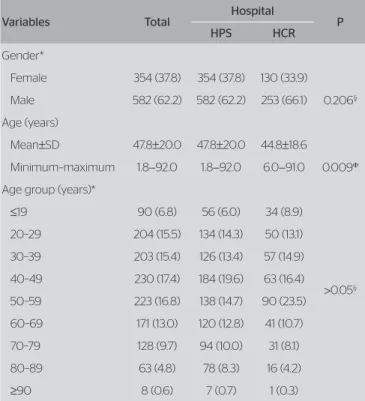
In this study, 1,320 medical records were analyzed; data concerning the absolute and relative distributions for gender, age, and age group are presented in Table 1, also divided by hospital. From the total number of ana-lyzed records, 394 (29.8%) did not present the descrip-tion of trauma mechanism, and 281 did not present the description of the level of trauma (Table 2). herefore, all the analyses concerning the trauma mechanism and the level of trauma were conducted with the total sam-ple of 926 and 1,039 medical records, respectively.
Of the analyzed medical records (Table 1), 63.3% of individuals were male, with mean age of 47.02±19.60
years. In terms of distribution of the sample by age group, no statistically signiicant diferences were found between the two studied institutions. Children and ado-lescents were the least prevalent group (6.8%), followed by the elderly (aged ≥60 years; 28.1%), and the adults
were the most prevalent group (65.1%).
Data regarding the absolute and relative distributions of trauma mechanism and level of injury, according to the presence or absence of lesion for the total of patients, as well as both hospitals, are presented in Table 2. efective and proper treatment for the analyzed
popu-lation. herefore, epidemiological data concerning SI have been used by health professionals, and those of other ields, to improve the quality of life of people with injuries and to help prevent the lesion in populations at risk16. Nonetheless, it is necessary to base the
man-agement and the planning of health actions on more accurate information; thus, it is important to reassess the epidemiology of the SI in regular intervals, and also, data should concern speciic populations, given the spe-ciic features of each people15,17, region12 or location13.
Up until this moment, no study has been found in literature that describes the epidemiological proile of individuals who sufered SI in the city of Porto Alegre/RS. herefore, the objective of this study was to determine the proile of individuals who suf-fered SI in the city of Porto Alegre and surroundings between 2005 and 2010, bearing in mind the need to intervene with preventive programs and public health policies that seek to efectively reduce spinal cord injury in this community, as well as planning the care of those who are injured.
METHODOLOGY
his is a cross-sectional and retrospective study perfor med at the medical records’ archives from Hospital Cristo Redentor (HCR) and Hospital de Pronto Socorro (HPS), both in the city of Porto Alegre/RS. he choice of these hospitals is due to the fact that patients sufering from spinal cord injury in Porto Alegre and Greater Porto Alegre are always taken to one of these two institutions, which are referral cen-ters for this type of injury.
Data collection occurred from May to August 2010. In this study, data from medical records of patients who sufered SI from January 2005 to January 2010 were included, in which there was the corresponding inter-national classiication of diseases (ICD). All medical records were analyzed from the admission due to SI until hospital discharge. herefore, medical records of patients who were not diagnosed with SI from hospital admission to hospital discharge, also through the ICD register, were excluded.
Falling from a high place (27.2%), traic accident (25.8%) and falling from one’s own height (13.2%) were the main trauma mechanisms. he most afected spinal levels were: lumbar (35.6%), thoracic (21.9%), cervical (20.5%), and sacral (0.75%).
Only 142 (10.7%) individuals who sufered SI pre-sented spinal cord injury (SCI), with prevalence of the incomplete lesion (63.3%; χ2 calc=27.586; p<0.001).
he male gender was mostly afected (81.9%), and the mean age was 39.6±17.9 years.
he cervical level was the most afected one (42.2%), followed by the thoracic (37.3%), lumbar (20.4%), and the FAI was the main lesion mechanism.
DISCUSSION
his study shows that the SI afects mostly men (63.3%). his data is in accordance with several studies conducted in the past few years, which show that among the diferent investigated populations, the male gender is always more prevalent1,11,18-22. he mean age of this study was 47.02
years, similar to the indings by Gonçalves et al.18, who
analyzed medical records of patients admitted to a hospi-tal in São Paulo from 2003 to 2006, and also to those by Jiménez-Ávila, Calderón-Granados and Bitar-Alatorre23,
whose study was conducted in Mexico and observed that the population with SI is mainly composed of male indi-viduals, with mean age of 48.9±16.8 years. However, in
the study by Brito et al.11 (33.96±13.56 years), as well as
in that by Vasconcelos and Riberto24 (38±17 years), both
performed in Brazil, the mean age was much lower than that of our sample and the one by Gonçalves et al.18. Both
studies diverge not only from the results in this study, but also from recent reviews, which point to the increase in the age when the SI occurs, partially explained by the aging of the population in developed countries15,17,25 and
by the etiology of the trauma, which ranges from vio-lence in developing regions, such as Africa, Middle East, and Latin America, to falls in Japan and Western Europe, which are developed regions25.
By observing the age and the etiology of SI, it seems clear that the reduction of the prevalence and the incidence of SI will require attention to socioeconomic, anthropolog-ical, and cultural issues13,15,16,26,27. he main trauma
mecha-nisms of this research were falling from high places (27.2%), followed by traic accidents (25.8%), and falling from one’s own height (13.2%). Koch, Graells and Zanielli19 found
that among the 502 studied patients, accidents caused by falls (50.4%) were the main mechanism, followed by traic accidents (25.5%). he similarity between this study and the one by Koch, Graells and Zanielli19, both conducted
in states in the South of Brazil, points to the need for
Table 1. Absolute and relative distribution for gender and age in the two analyzed hospitals
Variables Total
Hospital
P
HPS HCR
Gender*
0.206§
Female 354 (37.8) 354 (37.8) 130 (33.9) Male 582 (62.2) 582 (62.2) 253 (66.1) Age (years)
0.009Φ
Mean±SD 47.8±20.0 47.8±20.0 44.8±18.6 Minimum–maximum 1.8−92.0 1.8−92.0 6.0−91.0 Age group (years)*
>0.05§
≤19 90 (6.8) 56 (6.0) 34 (8.9) 20–29 204 (15.5) 134 (14.3) 50 (13.1) 30–39 203 (15.4) 126 (13.4) 57 (14.9) 40–49 230 (17.4) 184 (19.6) 63 (16.4) 50–59 223 (16.8) 138 (14.7) 90 (23.5) 60–69 171 (13.0) 120 (12.8) 41 (10.7) 70–79 128 (9.7) 94 (10.0) 31 (8.1) 80–89 63 (4.8) 78 (8.3) 16 (4.2)
≥90 8 (0.6) 7 (0.7) 1 (0.3)
HPS: Hospital do Pronto Socorro; HCR: Hospital Cristo Redentor; *Values presented as n (%);
§Pearson’s
χ2 test with continuity correction; ΦStudent’s t-test for independent groups assuming
variance heterogeneity
Table 2. Absolute and relative distribution of the trauma mechanism and level of spinal lesion according to the presence or absence of lesion for the total of patients in both hospitals
Variables Total
(n=1,320)
Spinal Lesion Yes
(n=142)
No (n=1,178)
Trauma mechanism
Fall from high places 359 (27.2%) 29 (8.1%) 330 (91.9%) Trafic accidents 340 (25.8%) 35 (10.3%) 305 (89.7%) Fall from own height 174 (13.2%) 6 (3.4%) 168 (96.6%) Firearm 53 (4.0%) 40 (75.5%) 13 (24.5%) No description* 394 (29.8%) – – Level of trauma
Cervical 271 (20.5%) 60 (42.2%) 211 (57.8%) Thoracic 288 (21.8%) 53 (37.3%) 235 (62.7%) Lumbar 470 (35.6%) 29 (20.4%) 441 (79.6%) Sacral 10 (0.8%) – 10 (100%) No description* 281 (21.3%) – –
improvements in the workplace and traic safety. he need to improve traic safety is corroborated by the indings of Vasconcelos and Riberto24, who showed that half of the
interviewed individuals with SI, about the seriousness of SIs. he preventive aspects of SI most mentioned by the interviewees were the need for more attention, precau-tion and cauprecau-tion, the proper use of individual protecprecau-tion devices and respect for traic rules24.
herefore, while the etiology of trauma mechanisms was similar in two Brazilian states — the one in this study and the one in the study by Koch, Graells and Zan-ielli19 —, Pirouzmand20 shows that, for 10 years, 66% of
the 12,192 patients from an adult trauma center in Can-ada sufered SI from a traic accident. he researcher also points out that falls and violence, second and third causes of SI, respectively, increased during this same period. hese indings are similar to the ones in the study by Jackson et al.16, also conducted in North America, stating
that traic accidents responded for 45.6% of SI cases in the United States from 1973 to 2003, followed by falls (19.6%) and violence (17.8%). In Nigeria, Africa, men (70.1%) sufered SI due to traic accidents (77.4%)27.
Although in this study FAI corresponded to only 4.0% of the causes of SI, they correspond to the main mechanism that leads to spinal cord injury (75.5%), and this is in accordance with the study by Koch et al.19
(2007), which presents FAI as being responsible for 65.91% of spinal lesions. he social and cultural charac-teristics of the country and/or region probably explain this agreement between the indings of the aforemen-tioned studies, which are in accordance with other cul-tures: in the United States, from 2000 to 2003, violence was the third most frequent cause of SCI (17.8%), and in a prior period (1990 to 1999) it was the second most common cause16, which shows that this tendency also
comes from other decades and cultures.
he results in this study indicated the lumbar spine (35.6%) as being the most afected by SI, which is in accordance with the study by Pirouzmand20, who found
this same level as being the most afected one (50%) in a study that documented the epidemiology of SI and spi-nal lesion in the largest adult trauma center in Canada in two decades. A possible explanation for the lumbar region to be the most afected one in our study may be the great percentage of falls from a high place and from one’s own height, since these trauma mechanisms usu-ally lead to lesions in this region28. Changes that come
with aging may be seen as trauma facilitators, such as the worsened proprioception, the presence of tremors which make walking diicult, the slower defense relexes, and
the tissue changes characteristic of the aging process, thus leading to an increased risk of falls in this age group29.
his is in accordance with the fact that 27.5% (n=363)
of the present sample consisted of elderly individuals (71.67±8,33 years old), who also accounted for most of
those who fell from their own height (124/175; 71%). he connection between trauma mechanism, age, and level of trauma is also clear when the results of two Brazilian studies are observed; one was conducted in Curitiba/PR30, and another in Ribeirão Preto/SP24. In
both cases, the sample was mostly composed of young men (mean age: Curitiba=27 years; Ribeirão Preto=
38 years). While the former assessed only SI caused by ire-arm injury, the latter analyzed all the trauma mechanisms, except those caused by irearms. Regardless of the etiology diferences, the thoracic region was the most afected one, or one of the most afected ones. In Ribeirão Preto, traic accidents were responsible for half of the SI cases, out of which half occurred with motorcycles; therefore, the cervi-cal spine was the most afected one (45%), followed by the thoracic and the lumbar spine (27 and 25%).
he president of the Brazilian Society of Neurosur-gery stated that “the experience of other countries shows that the awareness of the population, allied to concrete measures as law proposals, may positively interfere in the trauma rates in Brazil”10. herefore, through the
data presented in this research, as well as the results presented by Vasconcelos and Riberto24, it is possible to
infer that campaigns to prevent workplace accidents and to promote traic education, increasing the population’s awareness, could temporarily help to reduce the rates of falling from high places and traic accidents, which represent the major causes of SI in this region of the country. It is worth remembering that some campaigns have been done, such as: Conte para a gente Conte com a gente (Tell us, Count on Us), launched by the Ministry of Labor in 2006, and Tolerância Zero (Zero Tolerance), also idealized by the government, to decrease the rate of traic accidents caused by drink (drink driving) ou por driving under the inluence of alcohol driving. How-ever, as widely shown by the media, both campaigns lost power with time. herefore, besides the current inten-siied control, there is the need to establish a perma-nent education program related to workplace and traic safety in schools, companies, and driving schools, aim-ing at reducaim-ing and permanently controllaim-ing the rates related to falling from high places and traic accidents.
besides generating high costs for the society31. In the
United States, the economic impact of SI surpasses US$ 4 billion/year8, whereas in the world the
esti-mated cost is US$ 518 billion. Hence, it is necessary to evaluate the responses after a spinal lesion, not only in terms of neurological damage and functional rees-tablishment, but also regarding psychosocial aspects and monetary costs for the subject and the society. his is even more relevant when observing the fact that the severity of the damage is directly correlated to the costs, which are, in the irst year after the lesion, estimated in US$ 682,957 for tetraplegic patients and US$ 249,549 for paraplegic patients31.
It is important to mention that, besides the sequels of the neurological lesion, the duration of hospital stay for individuals who sufer the trauma and SI can be signii-cantly impacted by other impairments. hat is, adverse events with signiicant resulting morbidities are com-mon during the acute phase of hospitalization for these individuals. In a study performed by Cheung et al.32
with 110 people who sufered spinal lesions between 2008 and 2009, in Canada, adverse events occurred in 83.6% of the cases, being mostly with men with mean age of 45.8±19.6 years. hese events occurred in the
intraoperative period (20.0%), as well as in the pre and postoperative periods (79.1%), the urinary tract infec-tion (36.5%) being the most common adverse event, followed by pneumonia (34.6%), neuropathic pain (22.1%), pressure ulcers (19.2%), and delirium (18.3%). herefore, the costs in the initial phase can be higher due to these morbidities, besides delaying the return of these individuals to the society32.
While developing this study, some limitations and diiculties were encountered: (1) it was diicult to locate the SI cases in the system, which made the study longer and harder, as it was necessary to conduct manual searches in the medical records of both hospitals; (2) medical records had insuicient data and/or incomplete data; and (3) inadequate storage of the medical records, in humid and little ventilated places, making them sen-sitive to manipulation.
Besides the aforementioned diiculties, there is also the lack of regularization of the registers of these indi-viduals, which could be classiied according to interna-tionally accepted scales, such as the one proposed by the ASIA, which considers the levels of deiciency in stages of decreasing severity33.
he standardization of the assessment procedures by the public hospitals would improve the prognosis and make treatment plans more eicient, thus
minimiz-ing possible unnecessary interventions, and also jus-tifying, in time for better rehabilitation, the indicated treatments for each type of lesion30.
CONCLUSION
According to the studied population and period, it is possible to conclude that the proile of the SI trauma in Porto Alegre can be described as: male individuals, with mean age of 47 years, being the falls from high places the most prevalent etiology and the lumbar level the most afected one. In contrast, spinal lesion afected younger men, who sufered cervical lesions due to irearm injuries.
he indings from this study can help managers, researchers and professionals involved in the health care of people with SCI to plan future programs of health promotion and disease prevention, as well as for the care and the provision of rehabilitation services.
REFERENCES
1. Campos MF, Ribeiro AT, Listik S, Pereira CAB, Andrade Sobrinho J, Rapoport A. Epidemiologia do traumatismo da coluna vertebral. Ver. Col Bras Cir. 2008;35(2):88-93.
2. Medola FO, Castello GLM, Freitas LNF, Busto RM. Avaliação do alcance funcional de indivíduos com lesão medular espinhal usuários de cadeira de rodas. Revista movimenta. 2009;2(1):12-6.
3. Saraiva RA, Piva Júnior L, Campos da Paz Jr A, Pacheco MAR. As Bases Fisiopatológicas para Anestesia no Paciente com Lesão Medular. Rev Bras Anestesiol. 1995;45(6):387-98.
4. Leal-Filho MB, Borges G, Almeida BR, Aguiar AAX, Vieira MACS, Dantas KS, et al. Spinal Cord Injury: Epidemiological study of 386 cases with emphasis on those patients admitted more than four hours after the trauma. Arq Neuropsiquiatr. 2008;66(2-B):365-8.
5. Sekhon LH, Fehlings MG. Epidemiology, demographics, and pathophysiology of acute spinal cord injury. Spine 2001;26(Suppl 24):S2-12. 6. Blanes L, Carmagnani MIS, Ferreira LM. Quality of life and self-esteem
of persons with paraplegia living in São Paulo, Brazil. Qual Life Res. 2009;18:15–21.
7. CIHI. The Burden of Neurological Diseases, Disorders and Injuries in Canada. Ottawa: Canadian Institute for Health Information; 2007. Disponível em: http://secure.cihi.ca/cihiweb/products/BND_e.pdf. 8. CDC. Spinal Cord Injury (SCI): Fact Sheet. Atlanta, GA: National Center
for Injury Prevention and Control; 2006. Disponível em: http://www. cdc.gov/TraumaticBrainInjury/scifacts.html.
Municipal Mário Pinotti nos anos de 2003 à 2005. Fisioterapia Ser. 2009;4(4):246-9.
22. Siscão MP, Pereira C, Arnal RLC, Foss MHDA, Marino LHC. Trauma raquimedular: caracterização em um Hospital Público. Arq Ciênc Saúde. 2007:14(3):145-7.
23. Jiménez-Ávila JM, Calderón-Granados A, Bitar-Alatorre WE. Direct cost of spinal cord injuries. Cir Cir. 2012;80(5):435-41.
24. Vasconcelos ECLM, Riberto M. Caracterização clínica e das situações de fratura da coluna vertebral no município de Ribeirão Preto, propostas para um programa de prevenção do trauma raquimedular. Coluna/Columna. 2011;10(1):40-3.
25. Burns AS, O’Connell C. The challenge of spinal cord injury care in the developing world. J Spinal Cord Med. 2012;35(1):3-8.
26. Devivo MJ. Epidemiology of traumatic spinal cord injury: trends and future implications. Spinal Cord. 2012;50(5):365-72.
27. Obalum DC, Giwa SO, Adekoya-Cole TO, Enweluzo GO. Profile of spinal injuries in Lagos, Nigeria. Spinal Cord. 2009;47(2):134-7.
28. Parreira JG, Vianna AMF, Cardoso GS, KaraKhanIan WZ, CalIl D, Periingeiro JAG, Soldá SC, Assef JC. Lesões graves em vítimas de queda da própria altura. Rev Assoc Med Bras. 2010;56(6):660-4. 29. Muniz CF, Arnaut AC, Yoshida M, Trelha CS. Caracterização dos idosos
com fratura de fêmur proximal atendidos em hospital escola público. Ver. Espaço para a saúde. 2007;8(2):33-8.
30. Araújo Júnior FA, Heinrich CB, Cunha MLV, Veríssimo DCA, Rehder R, Pinto CAS, Bark SA, Borba LAB. Traumatismo raquimedular por ferimento de projétil de arma de fogo: avaliação epidemiológica. Coluna/Columna [online]. 2011;10(4):290-2.
31. Talu U, Swamy G, Berven S. Spinal cord injury: an update. Semin Spine Surg. 2005;17:73-83.
32. Cheung A, Street J, Noonan V, Cartar L, Dvorak M. Incidence and Impact of Acute Adverse Events in Patients with Traumatic Spinal Cord Injury. Spine J. 2011;11(10, Supplement):S2.
33. ASIA. Normas para a classificação neurológica e funcional das lesões da medula espinhal. Rev Bras Ortop. 1994;29(3):99-106.
10. Sociedade Brasileira de Neurocirurgia. Projeto Pense bem: use a cabeça para proteger seu corpo. 2007. Disponível em: http://www. sbn-neurocirurgia.com.br/site/pense_bem.asp.
11. Brito LMO, Chein MBC, Marinho SC, Duarte TB. Avaliação epidemiológica dos pacientes vítimas de traumatismo raquimedular. Rev Col Bras Cir. 2011; 38(5):304-9.
12. Masini M. Estimativa da incidência e prevalência de lesão medular no Brasil. J Bras Neurocirurg. 2001;12(2):97-100.
13. Santos TSC, Guimarães RM, Boeira SF. Epidemiologia do trauma raquimedular em emergências públicas no município do Rio de Janeiro. Esc Anna Nery. 2012; 16(4):747-53.
14. Castiel LD, Rivera FJU. Planejamento em saúde e epidemiologia no Brasil: casamento ou divórcio? Cad. Saúde Pública. 1985;1(4):447-56. 15. Ning GZ, Wu Q, Li YL, Feng SQ. Epidemiology of traumatic spinal
cord injury in Asia: a systematic review. J Spinal Cord Med. 2012;35(4):229-39.
16. Jackson AB, Dijkers M, Devivo MJ, Poczatek RB. A demographic profile of new traumatic spinal cord injuries: change and stability over 30 years. Arch Phys Med Rehabil. 2004;85(11):1740-8.
17. Hagen EM, Rekand T, Gilhus NE, Grønning M. Traumatic spinal cord injuries--incidence, mechanisms and course. Tidsskr Nor Laegeforen. 2012;17:132(7):831-7.
18. Gonçalves AMT, Rosa LN, D’Ângelo CT, Savordelli CL, Bonin GL, Squarcino IM, et al. Aspectos epidemiológicos da lesão medular traumática na área de referência do Hospital Estadual Mário Covas. Arq Méd ABC. 2007;32(2):64-6.
19. Koch A, Graells XSI, Zaninelli EM. Epidemiologia de fraturas da coluna de acordo com o mecanismo de trauma: análise de 502 casos. COLUNA/COLUMNA. 2007;6(1):18-23.
20. Pirouzmand F. Epidemiological trends of spine and spinal Cord injuries in the largest Canadian adult trauma center from 1986 to 2006. J Neurosug Spine. 2010;12:131-40.