Diseases Subject to the International Health
Regulations
Cholera, yellow fever, and plague cases and deaths reported in
the Region of the Americas as of 30 June 1982.
Yellow fever
Country and Cholera Plague
administrative subdivision cases Cases Deaths cases
BOLIVIA 92 34 1
Beni 1 -
-Cochabamba
2-La Paz 2 2 1
Santa Cruz 87 32
BRAZIL 16 16 30
Ceará - 26
Maranháo 1 1
Mato Grosso 1 1
Mato Grosso do Sul 13 13
Pará 1 1
Pernambuco - 4
PERU
4-Loreto - 3 3
Madre de Dios 1 1
UNITED STATES - 4
Arizona - 2
New Mexico - 1
Texas - - - 1
- None.
Operational Aspects of Leprosy Control Programs1
Leprosy control strategy is based on the early detection of cases and the administration of adequate chemotherapy to interrupt transmission, cure the patient, and prevent the development of disabilities.
The study group convened by WHO in 1981 recom-mended the application of a combined treatment regimen that uses intermittent supervised administration of drugs and is shorter than the traditional treatment. This
sched-1This article continues the discussion begun in Vol. 3, No. 2 (1982) of the Epidemiological Bulletin, "Drug Resistance in the Treatment of Lep-rosy.
ule, duly adapted to local conditions and resources, should be tested in the field. Follow-up of the patients that have completed treatment will make it possible to discover relapses and thus again administer treatment and evalu-ate whether the length of treatment adopted is sufficient to cure most of the cases.
It is recommended that a triple drug combined treat-ment be administered to all multibacillary patients: new previously untreated patients, those that have responded satisfactorily to prior dapsone monotherapy, those that have suffered clinical relapses after receiving dapsone monotherapy, and those with clinical relapses and with resistance confirmed in mouse footpads.
6
The schedule should be applied until the patient is ren-dered bacteriologically negative for a period of not less than two years. Its component drugs are as follows:
* Rifampicin (600 mg once-monthly, supervised adminis-tration).
· Dapsone (100 mg daily, self-administered).
· Clofazimine (300 mg once-monthly, supervised adminis-tration, and 50 mg daily, self-administered).
In paucibacillary patients it is recommended that two drugs be applied for a period of six months:
* Rifampicin (600 mg once a month, supervised administra-tion).
* Dapsone (100 mg daily, self-administered).
The control services staff should promptly identify per-sons with skin lesions as presumed symptomatic patients. Reports received from the general health services, com-munity leaders, and the patients themselves should be in-vestigated. Contacts, especially children living with infec-tious cases, should also be examined and contacts of cases with open lesions should be examined annually.
In all new cases (suspected or confirmed) a bacterio-logical examination of the border of active lesions, the ear lobe, and the nasal mucosa is recommended. The bacte-riological index continues to be the most sensitive and practical method for field work in the programs.
New knowledge of resistance to drugs used in the treat-ment of leprosy has led to the incorporation of more po-tent drug combinations in the treatment of multibacillary and paucibacillary patients and to a review of the opera-tional aspects of leprosy programs.
The intermittent combined treatment regimen calls for uninterrupted and continued supervision by the health services staff. The use of these regimens is full of uncer-tainties because of irregularity in the ingestion of the drugs and the high frequency of abandonment of ment (whether due to the negligent and inhuman treat-ment received by the patient, the services' inconvenient working hours, lack of access to institutions, limited sup-ply of drugs, patients' low educational levels, etc.).
If the program is to be successful, previous measures should be taken to train and guide personnel. The highest priority should be assigned to treatment within the pro-gram, and the development of operations research that will provide new knowledge of the problem and permit it to be applied in each situation should be encouraged.
The approach emphasizes the need to organize health education systems aimed at community leaders, school-teachers, and rural health workers so they can adopt a sensible attitude to the disease and actively cooperate in supervising its treatment. The principal purpose of health education is to provide a knowledge of the characteristics of the disease and its lengthy course, combined treatment regimens, possible resistance due to monotherapy or
in-adequate therapy and the serious disabilities caused by the disease, as well as rehabilitation activities.
Every leprosy control program should have a data col-lection, recording, analysis, and distribution system that will make it possible to plan and evaluate all control mea-sures, especially strategies for combined treatment regimens. Without systematic evaluation it is impossible to know whether the program is operating properly and achieving the objectives proposed, or whether changes and adjustments are required.
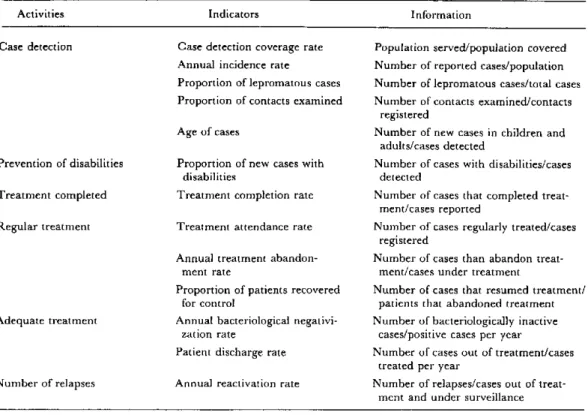
WHO has proposed a leprosy epidemiological informa-tion system that will permit evaluative comparisons of the control measures applied. The system will measure the efficiency and effectiveness of the programs against well-defined standards and strategies and will cover individual (clinical, administrative, socioeconomic aspects), opera-tional (case detection, treatment, relapses, and coverage rates) and epidemiological (incidence and prevalence) in-formation. Table 1 shows the operational indicators pro-posed for evaluating leprosy control programs.
To adopt combined treatment regimens, sufficient amounts of the three drugs recommended (rifampicin, dapsone, and clofazimine) must be available. An ade-quate supply calls for budgets that will ensure their prompt and continuous delivery to the services.
In addition to including the combined treatment regimens into the technical and operational elements of the program, it will be necessary to retrain the personnel to use it. Indeed, control services personnel should be trained to find alternatives in the administration of the treatment. Leprosy control manuals should include infor-mation on the organization and supervision of the treat-ment and the combinations, delivery, and possible side-effects to the drugs. The learning process needs to be continuous and should therefore be incorporated into the existing general health structures.
Likewise, research in new areas will be necessary. For example, more information must be obtained about clofa-zimine and ethionamide/protionamide. The optimum dosage of clofazimine for monthly intermittent adminis-tration or its relationship to skin pigmentation is still not known with certainty. Nor is sufficient information avail-able about the bacteriostatic effect of ethionamide and protionamide on Mycobacterium leprae when administered intermittently. The minimum daily dosage of these toxic and expensive drugs is the same as that used against tu-berculosis (500 mg); the basis for this dosage is that M. leprae is more susceptible to the drug than is M. tuberculosis. The development of new bactericidal drugs that use
dif-ferent attack mechanisms should be promoted.
Since the treatment regimens recommended for the control programs have not yet been used, it would be ad-visable to investigate their practicality and acceptance by the patients. Furthermore, the continuation of research aimed at the preparation of an effective vaccine is of worldwide interest.
Table 1. Operational indicators for the evaluation of leprosy control programs.
Activities Indicators Information
Case detection Case detection coverage rate Population served/population covered Annual incidence rate Number of reported cases/population Proportion of lepromatous cases Number of lepromatous cases/total cases Proportion of contacts examined Number of contacts examined/contacts
registered
Age of cases Number of new cases in children and
adults/cases detected
Prevention of disabilities Proportion of new cases with Number of cases with disabilities/cases
disabilities detected
Treatment completed Treatment completion rate Number of cases that completed treat-ment/cases reported
Regular treatment Treatment attendance rate Number of cases regularly treated/cases registered
Annual treatment abandon- Number of cases than abandon
treat-ment rate ment/cases under treatment
Proportion of patients recovered Number of cases that resumed treatment/
for control patients that abandoned treatment
Adequate treatment Annual bacteriological negativi- Number of bacteriologically inactive
zation rate cases/positive cases per year
Patient discharge rate Number of cases out of treatment/cases treated per year
Number of relapses Annual reactivation rate Number of relapses/cases out of treat-ment and under surveillance
Finally, to provide patients with comprehensive care, the program should include a disability prevention com-ponent. The need to find practical solutions to the pro-blem of disabilities calls for active participation at the primary level of all the pertinent elements so as to ensure that the activity is carefully planned and adapted to the conditions in each country, to the environment, and to
the patients' aptitudes and skills. The early prevention of disabilities is a real problem in Latin America, in partic-ular because of socioeconomic and cultural factors.
(Source: Leprosy Control Program, Division of Disease Prevention and Control, PAHO.)
Dengue in Puerto Rico
Epidemic dengue type 1 occurred in Puerto Rico during the summer and fall of 1978 as part of the pandem-ic whpandem-ich affected most of the Caribbean region between 1977 and 1980. During 1979, 1980, and the first months of 1981, dengue transmission was sporadic with only a few confirmed cases occurring each month. All viruses isolated during that time were dengue 1. Beginning in late July and early August 1981, the number of reported cases of dengue-like illness began to increase, and by early
Sep-tember it was clear that an outbreak of dengue was in progress. The number of cases increased dramatically in September, peaked in October, and began to decline in November 1981 (Fig. 1). By December, few cases were being reported. Approximately 70 paired sera per week were tested for dengue infection by HI, with an average of 48 per cent confirmation. Cases were reported from all over the island, but the area of highest transmission was the southwest coast.