PEST MANAGEMENT
Alternative Control of Tetranychus evansi Baker & Pritchard (Acari:
Tetranychidae) on Tomato Plants Grown in Greenhouses
A
LBERTOS
OTO1, M
ADELAINEV
ENZON2, R
AFAELM O
LIVEIRA3, H
AMILTONG O
LIVEIRA4, A
NGELOP
ALLINI31Depto de Fitotecnia, Univ de Caldas, Calle 65 No 26-10, Manizales, Caldas, Colombia; [email protected] 2Empresa de Pesquisa Agropecuária de Minas Gerais – EPAMIG, Vila Gianetti 46, 36570-000 Viçosa, MG, Brasil;
3Depto Biologia Animal, Univ Federal de Viçosa, 36570-000 Viçosa, MG, Brasil;
[email protected]; [email protected]
4Corporación Colombiana de Investigación Agropecuária, CORPOICA, Colombia; [email protected]
Edited by Jorge B Torres – UFRPE Neotropical Entomology 39(4):638-644 (2010)
ABSTRACT - Tetranychus evansi Baker & Pritchard is an important pest of solanaceous plants, including tomatoes. This mite is characterized by a high reproductive rate, which leads to high population growth in a short period of time causing important economic damage. Control of T. evansi is mainly through synthetic acaricides. In searching for environmentally friendly control measures, we evaluated the effi ciency of alternative products to control T. evansi on tomato plants under greenhouse conditions. The products tested were lime sulphur and neem based products. We fi rst estimated the lethal concentration (LC) and instantaneous rate of increase (ri) of T. evansi exposed to different product concentrations in laboratory conditions, and later tested the effi cacy of LC95 and the concentrations that restrained mite population growth (ri = 0) in greenhouse conditions. The following treatments were repeated three times: NeemPro (81.0 and 71.6 mg a.i./l), Natuneem (31.1 and 20.4 mg ai/l), Organic Neem (39.1 and 30.4 mg a.i./l), lime sulphur (1.0 and 0.6%) and water (control). For all products, control provided by LC95 was higher than provided for lower concentrations (ri = 0) one day after spraying. However, after
fi ve days, for both concentrations, the percentage of T. evansi population reduction was superior to 95% and increased over time. Only plants sprayed with Natuneem (31.1 mg a.i./l) showed symptoms of phytotoxicity. Lime sulphur and neem based products, applied in appropriate concentrations and formulations, bear out as a viable alternative to control T. evansi on tomato plants.
KEY WORDS: Acari, Azadirachta indica, lime sulphur, effi ciency, phytotoxicity
The tomato red spider mite, Tetranychus evansi Baker & Pritchard, is an important pest of solanaceous plants, especially tomatoes (Flechtmann 1983, Bonato 1999, Ferragut & Escudero 2002). This mite is characterized by a high reproductive capacity, which leads to high population levels in a short time, causing important economic damage (Moraes & McMurtry 1986). Additionally, the mite produces large quantities of webs on the infested plants, hampering the action of natural enemies (Gerson 1985, Sabelis & Bakker 1992). The control of T. evansi in tomatois done mainly with application of synthetic pesticides. Despite its relative effi ciency, chemical control has several negative impacts as the selection of resistant individuals due to the continuous use of certain active ingredients, the reduction or elimination of benefi cial species, the high toxicity of products to applicators, and the presence of residues in food (Picanço et al 2007, Maniania et al 2008).
A viable alternative to the problems arising from excessive use of synthetic pesticides in tomato production is the use of methods that provide control with social and environmental
safety. In the search for such methods, natural enemies are being evaluated as biological control agents of T. evansi (Wekesa et al 2005, Furtado et al 2007, Brito et al 2009). Another strategy that has been used where conventional pesticides are not allowed, such as in ecological and organic production systems, is the use of non synthetic products for pest control (Campanhola & Bettiol 2003, Venzon et al 2008a). Lime sulphur is among these products allowed in organic systems, primarily used as a fungicide (Smilanick & Sorenson 2001, Montag et al 2005), but is also employed as insecticide and acaricide (Guerra 1985, Penteado 2000, Afonso et al 2007). The toxic effect of lime sulphur on insects and mites is given by the reaction of its compounds when applied to the plant with water and carbon dioxide, resulting in hydrogen sulfi de (Abbot 1945). Its acaricidal effect has been demonstrated for some mite species (Tuelher 2006, Venzon et al 2006, Andrade et al 2007, Beers et al 2009), but not yet for T. evansi.
Its major active ingredient (azadirachtin) may cause several negative effects on arthropods, such as feeding inhibition, repellency, decreased oviposition, reduced fertility and fecundity, changes in behavior and increased mortality (Schumutterer 1990, Dimetry et al 1993, Mordue & Nisbet 2000, Musabyimana et al 2001). Neem based products were shown to cause deleterious effects on several mites species as well (Mansour et al 1997, Gonçalves et al 2001, Makundi & Kashenge 2002, Venzon et al 2005, 2008b, Brito et al 2006a,b), but no studies have yet been carried out on their effect on T. evansi.
The present work aims to evaluate the potential of lime sulphur and commercial formulations of neem for T. evansi control. The toxicity of these products was fi rst assessed in laboratory by estimating both the lethal concentration (LC) and the instantaneous rate of increase (ri) of T. evansi. This is a direct measure of population growth in a given period of time and can be used to assess lethal and sub-lethal effects of toxic compounds at the population level (Stark et al 2003, Teodoro et al 2005). Subsequently, we evaluated in a greenhouse the effi ciency of LC95 and of the concentration that restrains T. evansi population growth (ri = 0), aiming to control the mite population on tomato plants. Additionally, phytotoxicity of the tested product concentrations was evaluated.
Material and Methods
The tomato red spider mite rearing was initiated with mites collected in the fi eld in the municipality of Tocantins, Minas Gerais, Brazil. The rearing was established using tomato plants variety Santa Clara with 30 days of age as hosts kept in a greenhouse. Potted tomato plants were kept inside wooden framed cages (10 x 50 x 90 cm) covered with organza screens to isolate the rearing and to avoid contamination with other arthropods.
The alternative products evaluated were lime sulphur (31.5o Baume), prepared according to Penteado (2000) and
three neem based commercial products: NeemPro [10 g/l of azadirachtin (AZA)], Natuneem (1.5 g/l of AZA) and Organic Neem (3.3 g/l of AZA).
Lethal toxicity. The concentration-response bioassays were conducted using 3-4 day old females of T. evansi at the beginning of their reproductive stage. Tomato leaf discs (3 cm diameter) were individually placed inside Petri dishes (3.5 cm diameter), and sprayed on a Potter tower (Potter 1952) (Burkard, Rickmansworth, UK). Product spraying was carried out under the pressure of 5 lb/pol2 and the
application of an equal volume of 2.5 ml per concentration, which corresponded to a deposit of 1.70 ± 0.07 mg/cm2
on the treated area. The applied concentration agrees with recommendations of the IOBC/ WPRS (International Organization for Biological Control of Noxious Animals and Plants/West Paleartic Regional Section) (Overmeer & van Zon 1982). To fi x the leaf disc on the Petri dish, a 10% water solution of carrageenan was prepared and the disc was placed before the solution solidifi cation. The concentrations tested were chosen through initial bioassays and were between the
lower (no mortality caused) and upper (100% mortality) limits of response. The tested concentration range for each product was: 0.15-1.80% of lime sulphur, 0.69-157 mg a.i./l of NeemPro, 0.32-57.7 mg a.i./l of Organic Neem, and 0.06-37.4 mg a.i./l of Natuneem.
Sprayed discs were exposed to the environment for 1h for drying out. Subsequently, eight females of T. evansi were placed on each disc. Five replicates were used for each product concentration. Treated discs were kept in a climatic chamber (25 ± 2oC, 60 ± 10% RH and 13h photophase). Mortality was assessed 24h after product application. A control treatment with distilled water was used to correct the data for natural mortality (Abott 1925). The concentration-mortality curves were estimated by probit analysis (Finney 1971).
Instantaneous rate of population increase (r
i). To evaluate the instantaneous rate of population increase of T. evansi (ri) on different product concentrations, we used the same method as described for evaluating lethal toxicity, except for the evaluation time that was fi ve days. The instantaneous rate of increase (ri) was estimated using the following formula (Stark et al 1997): ri = ln (Nf/ N0)/ Δt;
where N0 is the initial number of individuals in the population, and Nt is the number of individuals in the population at end of the time interval, t. The number of days (t) for the experiment runs was fi ve. Positive values of ri indicate a growing population, and ri = 0 indicates a stable population, while a negative ri value indicates population decline and heading towards extinction (Stark et al 1997).
The tested concentrations were based on the concentration-mortality curves obtained from lethal toxicity tests. The control consisted of water-sprayed leaf discs. Each product concentration was replicated fi ve times. Mites were kept in a climatic chamber under the same conditions described in the experiments of lethal toxicity. Regression analyses were used to assess the effect of the product concentrations on the instantaneous rate of population increase of T. evansi. Control of T. evansi in the greenhouse. Tomato plants of the variety Santa Clara with 30 days grown in plastic pots with soil (2 L) were used in the bioassay. They were infested with 100 adult females of T. evansi per plant, and adult mite population was counted eight days after infestation. Subsequently, the products were applied to the plants at concentrations corresponding to the LC95, and at the concentration that stopped T. evansi population growth (ri = 0). Thus, the following concentrations were tested per product: NeemPro (80.1 and 71.6 mg a.i./l), Natuneem (31.1 and 20.4 mg a.i. /l), Organic Neem (39.1 and 30.4 mg a.i./l), and lime sulphur (1.0 and 0.6%). Spraying was done with a hand sprayer Brudden® SS model with a capacity of
fi ve liters, the inlet diameter of 60 mm, equipped with an adjustable cone nozzle of the type and maximum working pressure of 14 kgf/cm2.
inside a plastic tray (60 x 40 x 10 cm). After one, fi ve, seven and 10 days from product application, mite population on plants was assessed by direct counting using a magnifying glass (10x). The mortality of mites was calculated using the formula proposed by Henderson & Tilton (1955).
Visual symptoms of phytotoxicity for each product concentration tested in the greenhouse were evaluated by two observers. The visual scale of phytotoxicity proposed by Vieira et al (2001) was used, with 0: plants with normal leaves and no signs of burns; 1: plants with slightly damaged leaves and/or with small burned areas; 2: plants with medium damaged leaves, yellow with burnt edges and tips; 3: plants with heavily damaged leaves, showing severe defoliation.
Data of mortality and phytotoxicity were arcsen √x / 100 transformed and subjected to repeated measure analysis of variance of the general linear model, using the indicator Wilks’ Lambda (SAS Institute 1989) version 9.0. For the analysis of variance of mite mortality, the concentrations of the four products corresponding to LC95 were grouped as “high concentrations”, and the product concentrations that stopped the population growth (ri = 0) of T. evansi as the “low concentrations”. Averages corresponding to phytotoxicity ranks were compared using the Tukey test at 5% of signifi cance.
Results
Results for the concentration-mortality bioassays showed that LC95 for lime sulphur, NeemPro, Organic Neem and Natuneem were 1.03%, 80.97 mg a.i./l, 39.13 mg a.i./l and 31.14 mg a.i./l, respectively (Table 1).
The instantaneous rate of increase of T. evansi was null, indicating that the population is stable at concentrations of 0.62%, 71.6 mg a.i./l, 30.4 mg a.i./l and 20.4 mg a.i./l, for lime sulphur, NeemPro, Organic Neem and Natuneem, respectively (Fig 1).
In the greenhouse experiment, the analysis of variance for repeated measures showed no differences among products (F3, 16 = 3.00, P = 0.06), but signifi cant effects of concentration (low and high) (F1, 16 = 396.91, P < 0.0001) and of the interaction of product and concentration on the reduction of T. evansi population (F3, 16 = 5.25, P = 0.01). Signifi cant effects of time (Wilks’ Lambda = 0.0780, F = 55.12; DF = 3, 14, P < 0.0001), of the interaction of products and time (Wilks’ Lambda =
0.2138, F = 3.36; DF = 9, 34.22, P = 0.004), of concentration and time (Wilks’ Lambda = 0.2599, F = 13.28; DF = 3, 14, P = 0.0002), and of product, concentration and time (Wilks’ Lambda = 0.1288, F = 5.02; DF = 9, 34.22, P = 0.0002) were found.
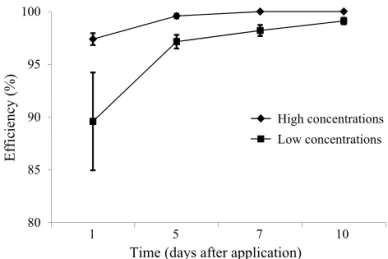
The high concentrations (LC95) resulted in greater effi ciency of control over time, regardless of the product. Moreover, the efficiency of high and of low product concentration on reducing T. evansi population increased with the duration of exposition (Fig 2). Despite the signifi cant difference between “low” and “high concentration” of the products, especially in the beginning of the experiment, the products applied at “low concentration” causes more than 95% of population reduction after fi ve days of application (Fig 2).
Regarding phytotoxicity, the analysis of variance with repeated measures over time showed signifi cant effects of the products (F3, 16 = 46.26, P < 0.0001), of concentrations (F1, 16 = 8.19, P = 0.01) and of the interaction of product and concentration (F3, 16 = 3.66, P = 0.03). No signifi cant effect was found for the time (Wilks’ Lambda = 0.8987, F = 0.53; DF = 3, 14, P = 0.67) and the interactions between product and time (Wilks’ Lambda = 0.3993, F = 1.74; DF = 9, 34.22, P = 0.11), and for the concentration and time (Wilks’ Lambda = 0.9612, F = 0.19; DF = 3, 14, P = 0.90), and the concentration, time and product (Wilks’ Lambda = 0.5606, F = 1,02; DF = 9, 34.22, P = 0.44). Phytotoxicity symptoms were observed only on plants sprayed with Natuneem, especially at higher concentration (31.1 mg a.i./l) (Table 2).
Discussion
Control of T. evansi on tomato plants was achieved with the application of neem based products and of lime sulphur. For all products, the efficiency in reducing T. evansi population was above 95% fi ve days after spraying, independently of using LC95 or lower concentrations at which the instantaneous rate equal to zero. The later concentration represented the LC78 forOrganic Neem (30.4 mg a.i./l), LC94 for NeemPro (71.6 mg a.i./l), and LC71 for Natuneem (20.4 mg a.i/l).
It is important to consider the time needed for the tested products to reduce mite population. By evaluating the population effects of the products over time rather than only
Table 1 Toxicity of lime sulphur and neem based products to Tetranychus evansi.
n =Number of mites tested.
1For lime sulphur, LC
50 and LC95 are expressed as percentage of product (%); for neem based products LC50 and LC95 are
expressed as mg a.i/l.
Product n Slope ± SE1 LC50
1
(50% fiducial limits)
LC951
(95% fiducial limits) X
1 P
Lime sulphur 140 0.17 ± 0.04 0.20 (0.15 -0.27) 1.03 (0.74- 1.57) 0.61 0.43
NeemPro 120 0.23 ± 0.48 16.03 (10.02-39.93) 80.97 (69.43-110.10) 0.68 0.17
Organic Neem 125 0.19 ± 0.31 15.11 (10.79-21.20) 39.13 (25.56-56.40) 0.57 0.36
mortality after a short period it is possible to select reduced concentration of products needed for a satisfactory control. The importance of such reduction is not only economic but mainly by the low impact on natural enemies. For neem based products, it has been demonstrated that selectivity towards natural enemies is related to formulation and concentration (Silva & Martinez 2004, Mourão et al 2004, Brito et al 2006b). For lime sulphur, recent studies showed the same tendency (Tuelher 2006, Soto 2009).
The use of demographic studies together with lethal concentration is recommended to evaluate the toxicity of products (Walthall & Stark 1997, Teodoro et al 2005, Stark et al 2007). For neem based products, this approach is especially important due to their special mode of action and delayed effects on arthropods (Scmutterer 1990). Besides direct mortality (Momen et al 1997, Castiglioni et al 2002), neem causes reduction in fertility (Dimetry et al 1993), longevity and fecundity of mites(Martínez-Villar et al 2005). Thus, subletal effects should be considered when selecting neem concentrations for mite control. In our study, direct mortality after one day of application was responsible for higher reduction of T. evansi at the concentration corresponding to LC95. When lower concentrations were used, averaged mortality at fi rst day was inferior to when LC95 were applied. However, after the product had enough time to act, i.e. after
fi ve days, population reduction was above 95% using either lower or higher concentration. Moreover, the effi ciency in reducing T. evansi increased over time.
The two concentration of lime sulphur tested in this study were effective against T. evansi (0.6 and 1.0%). In most crops were lime sulphur is applied, the commonly used concentrations ranged from 2% to 4% (29o to 32o
Baume) (Penteado 2000, Silva et al 2009). The use of high concentrations of lime sulphur might be unnecessary also for controlling other mite species, as we showed for T. evansi. It is important to consider the use of reduced concentration of lime sulphur in order to decrease negative effects on natural
Fig 1 Instantaneous rate of increase (ri) of Tetranychus evansi exposed to increasing concentrations of lime sulphur (a), NeemPro (b), Organic Neem (c), and Natuneem (d).
Fig 2 Effi ciency (%) of alternative products for control of
Tetranychus evansi in high (LC95) and low concentrations (ri
= 0) over time. Showed signifi cant difference between high and low concentrations of products (F = 396.91, P < 0.0001) and between the time after the application of products (Wilks’ Lambda = 0.780, F = 55.12; DF = 3, 14, P < 0.0001), based on repeated measures analysis of variance.
80 85 90 95 100
1 5 7 10
Efficiency (%)
Time (days after application)
High concentrations Low concentrations y = -0.4398x + 0.2723
R² = 0.7561; F = 117.78**
-0.4 -0.2 0.0 0.2 0.4 0.6 0.8 1.0
0 0,5 1 1,5 2
Concentration (% )
y = -0.007x + 0.560 R² = 0.713, F = 109.31**
-0.4 -0.2 0.0 0.2 0.4 0.6 0.8 1.0
0 20 40 60 80
In
ta
n
tan
eou
s rat
e
of
popu
la
ti
o
n
i
n
creas
e
(ri
)
Concentration (mg a.i./l)
b
y = -0.015x + 0.456 R² = 0.361 F = 21.54**
-0.4 -0.2 0.0 0.2 0.4 0.6 0.8 1.0
0 10 20 30 40
Concentration (mg a.i./l)
c
y = -0.011x + 0.225 R² = 0.401 F = 22.09**
-0.4 -0.2 0.0 0.2 0.4 0.6 0.8 1.0
0 10 20 30 40
Concentration (mg a.i./l)
enemies (Daniel et al 2001, Beers et al 2009). According to Tuelher (2006), lime sulphur caused more negative effects on the instantaneous rate of increase of the predatory mite Iphiseiodes zuluagai Denmark & Muma than on its prey, the coffee red mite Oligonychus ilicis (McGregor). The effects of lime sulphur on natural enemies of T. evansi need further investigation.
Symptoms of toxicity to tomato plants were observed only for Natuneem, especially at high concentration. It is not clear why only this product showed phytotoxicity, as the other two neem based products did not. Probably other compounds used in the formulation might be responsible for plant toxicity. Abbasi et al (2004) reported the absence of neem oil toxicity to tomato plants. For other crops, neem toxicity has been variable (Xuan et al 2004, Carneiro et al 2007, Pinheiro et al 2009).
The application of lime sulphur and neem based products, in appropriate concentrations and formulations, represents a viable alternative to control T. evansi on tomato plants. It is important to consider the time required for the acaricide action for each of the products, especially the neem based products, in order to achieve successful control using reduced concentrations.
Acknowledgments
We thank Dalquim and Quinabra for providing the products Organic Neem and NeemPro, respectively, for the experiments. FAPEMIG (Fundação de Amparo à Pesquisa do Estado de Minas Gerais) and CNPq (Conselho Nacional de Desenvolvimento Científi co e Tecnológico) are thanked for fi nancial support and fellowships for the authors. CAPES (Coordenação de Aperfeiçoamento de Pessoal de Nível Superior) PEC-PG program is thanked for granting the scholarship for the fi rst author.
References
Abbasi P A, Cuppels D A, Lazarovits G (2003) Effect of foliar applications of neem oil and fi sh emulsion on bacterial spot and yield of tomatoes and peppers. Can J Plant Pathol 25: 41-48.
Abbot C E (1945) The toxic gases of lime-sulfur. J Econ Entomol 38: 618-620.
Abbott W S (1925) A method of computing the effectiveness of an insecticide. J Econ Entomol 18: 265-267.
Afonso A P S, Faria J L C, Botton M, Zanardi O Z (2007) Avaliação da calda sulfocálcica e do óleo mineral no controle da cochonilha-parda Parthenolecanium persicae (Hemiptera: Coccidae) na cultura da videira. Arq Inst Biol 74: 167-169.
Andrade D J, Oliveira C A L, Romani G N (2007) Efeito da calda sulfocálcica sobre ácaro Tetranychus mexicanus (McGregor, 1950) em citros. Rev Agricul 82: 161-169.
Beers E H, Martinez-Rocha L, Talley R R, Dunley J E (2009) Lethal, sublethal, and behavioral effects of sulfur-containing products in bioassays of three species of orchard mites. J Econ Entomol 102: 324-335.
Bonato O (1999) The effect of temperature on life history parameters
of Tetranychus evansi (Acari: Tetranychidae). Exp Appl Acarol
23: 11-1999.
Brito H M, Gondim Jr M G C, Oliveira J V, Camara C A G (2006a) Toxicidade de formulações de nim (Azadirachta indica A. Juss.) ao ácaro-rajado e a Euseius alatus De Leon e Phytoseiulus
macropilis (Banks) (Acari: Phytoseiidae). Neotrop Entomol
35: 500-505.
Britto E P J, Gondim, M G C, Torres, J B, Fiaboe K K M, Moraes G J, Knapp M (2009) Predation and reproductive output of the ladybird beetle Stethorus tridens preying on tomato red spider mite Tetranychus evansi. BioControl 54: 363-368.
Table 2 Toxicity of lime sulphur and neem based products to tomato plants in greenhouse.
DAA = Days after application
1Rank 0: plants with normal leaves and no signs of burns; Rank 1: plants with slightly damaged leaves and/or with small burned
areas; Rank 2: plants with medium damaged leaves, yellow with burnt edges and tips; Rank 3: plants with heavily damaged leaves, showing severe defoliation.
Averages followed by the same letter in columns do not differ by Tukey test at 5% signifi cance.
Treatments Phytotoxicity ranks
1
1 DAA 5 DAA 7 DAA 10 DAA
NeemPro (0.08 mg a.i./l) 0.22 ± 0.39 c 0.00 ± 0.00 b 0.00 ± 0.00 b 0.00 ± 0.00 c
NeemPro (0.07 mg a.i./l) 0.11 ± 0.19 c 0.00 ± 0.00 b 0.00 ± 0.00 b 0.00 ± 0.00 c
Natuneem (1.4 mg a.i./l) 2.00 ± 0.00 a 2.00 ± 0.00 a 2.00 ± 0.00 a 3.00 ± 0.00 a
Natuneem (0.87 mg a.i./l) 1.17 ± 0.17 b 1.45 ± 0.51 a 1.23 ± 0.10 a 1.89 ± 0.19 b
Organic Neem (0.37 mg a.i./l) 0.17 ± 0.00 c 0.11 ± 0.20 b 0.11 ± 0.10 b 0.00 ± 0.00 c
Organic Neem (0.28 mg a.i./l) 0.06 ± 0.09 c 0.00 ± 0.00 b 0.00 ± 0.00 b 0.00 ± 0.00 c
Lime sulphur (1.0%) 0.06 ± 0.09 c 0.00 ± 0.00 b 0.00 ± 0.00 b 0.00 ± 0.00 c
Brito H M, Guedes M J, Vargas C, Gómez A (2006b) Toxicidade de natuneem sobre Tetranychus urticae Koch (Acari: Tetranychidae) e ácaros predadores da família Phytoseiidae. Cien Agrotecn 30: 75-78.
Campanhola C, Bettiol W (2003) Panorama sobre o uso de agrotóxicos no Brasil, p.13-51. In Campanhola C, Bettiol W (ed) Métodos alternativos de controle fi tossanitário. Jaguariúna, Embrapa Meio Ambiente, 279p.
Carneiro S M T P G, Pignoni E V, Maria E C, Gomes J C (2007) Efi cácia de extratos de nim para o controle do oídio do feijoeiro. Summa Phytopathol 33: 34-39.
Castiglioni E, Vendramim J D, Tamai M A (2002) Evaluación del efecto tóxico de extractos acuosos y derivados de meliáceas sobre Tetranychus urticae (Koch) (Acari: Tetranychidae). Agrociência 6: 75-82.
Daniel C, Haeseli A, Weibel F (2001) The side effects of lime sulphur on predaceous arthropods, i.e. Typhlodromus pyri, and other leaf occupying arthropods. Plant protection: pest and benefi cials, Frick, Switzerland, Research Institute of Organic Agriculture (FiBL), 8p. Disponível em: <http://orgprints. org/2932/01/daniel-et-al-2001-lime-sulphur.pdf>. Accessed in 18 Sept. 2009.
Dimetry N Z, Amer S A A, Reda A S (1993) Biological activity of two neem seed kernel extracts against the two-spotted spider mite
Tetranychus urticae Koch J Appl Entomol 116: 308- 312.
Ferragut F, Escudero L A (2002) La araña roja del tomate Tetranychus
evansi (Acari: Tetranychidae) en España: distribución, biología
y control. Phyt Espana25:11-113.
Finney D J (1971) Probit analysis. Cambridge,Cambridge University Press, 333p.
Flechtmann C H W (1983) Ácaros de importância agrícola. São Paulo, Nobel 189p.
Furtado I P, Moraes G J, Kreiter S, Tixier M, Knapp M (2007) Potential of a Brazilian population of the predatory mite
Phytoseiulus longipes as a biological control agent of
Tetranychus evansi (Acari: Phytoseiidae, Tetranychidae). Biol
Control 42:139-147.
Gerson U (1985) Other predaceous mites and spiders, p.205-210. In Helle W, Sabelis M W (eds) Spider mites, their biology, natural enemies and control. Elsevier, Amsterdam, v 1B, 190p.
Gonçalves M E C, Oliveira J V, Barros R, Torres J B (2001) Effect of plant extracts on immature stages and adults females
of Mononychellus tanajoa (Bondar) (Acari: Tetranychidae).
Neotrop Entomol 30: 305-309.
Guerra M S (1985) Receituário caseiro: alternativa para o controle de pragas e doenças de plantas cultivadas e seus produtos. Brasília, EMATER, 166p.
Henderson C F, Tilton E W (1955) Tests with acaricides against the brown wheat mite. J Econ Entomol 48: 157-161.
Makundi R H, Kashenge S (2002) Comparative effi cacy of neem,
Azadirachta indica, extract formulations and the synthetic
acaricide, Amitraz (Mitac), against the two spotted spider mites, Tetranychus urticae (Acari: Tetranychidae), on tomatoes,
Lycopersicum esculentum. Z. Pfl anzenk Pfl anzen 109: 57-63.
Maniania N K, Bugeme D M, Wekesa V W, Delalibera Jr I, Knapp M (2008) Role of entomopathogenic fungi in the control of Tetranychus evansi and Tetranychus urticae (Acari: Tetranychidae), pests of horticultural crops. Exp Appl Acarol 46: 259-74.
Mansour F A, Ascher K R S, Omari N (1997) Effects of neem
(Azadirachta indica) seed kernel extracts from different
solvents on the predacious mite Phytoseiulus persimilis and the phytophagous mite Tetranychus cinnabarinus. Phytoparasitica 15: 125-130.
Martínez-Villar E, Sáenz-de-Cabezón F J, Moreno-Grijalba F, Marco V, Pérez-Moreno I (2005) Effects of azadirachtin on the two-spotted spider mite, Tetranychus urticae (Acari: Tetranychidae). Exp Appl Acarol: 35: 215-222.
Montag J, Schreiber L, Schonherr J (2005) An in vitro study on the infection activities of hydrated lime and lime sulphur against apple scab (Venturia inaequalis). J Phytopath 153: 485-491.
Moraes G J, McMurtry J A (1986) Suitability of the spider mite
Tetranychus evansi as prey for Phytoseiulus persimilis. Entomol
Exp Appl 40: 109-115.
Mordue A J, Nisbet A J (2000) Azadirachtin from the neem tree
Azadirachta indica: its action against insects. An Soc Entomol
Brasil 29: 615-632.
Mourão S A, Silva J C T, Guedes R N C, Venzon M, Jham G N, Oliveira C L, Zanuncio J C (2004) Seletividade de extratos de nim (Azadirachta indica A. Juss.) ao ácaro predador Iphiseiodes
zuluagai (Denmark & Muma) (Acari: Phytoseiidae). Neotrop
Entomol 33: 613-617.
Musabyimana T, Saxena R C E, Kairu W, Ogol C P K, Khan Z R (2001) Effects of neem seed derivatives on behavioral and physiological responses of the Cosmopolites sordidus
(Coleoptera: Curculionidae) J Econ Entomol 94: 449-454.
Overmeer W P J, van Zon A Q (1982) A standardized method for testing the side effect of pesticides on the predaceous mite,
Amblyseius potentillae (Acari: Phytoseiidae). Entomophaga
27: 357-364.
Penteado S R (2000) Controle alternativo de pragas e doenças com as caldas bordalesa, sulfocálcica e Viçosa. Campinas, Buena Mendes Gráfi ca e Editora, 95p.
Picanço M C, Soto A, Bacci L, Fidelis E G, Silva G A, De Sena M E (2007) Controle biológico das principais pragas de hortaliças no Brasil, p.505-537. In Zambolim L (ed) Manejo integrado de doenças e pragas hortaliças. Viçosa, UFV, 627p.
Pinheiro P V, Quintela E D, Oliveira J P, Seraphin J C (2009) Toxicity of neem oil to Bemisia tabaci biotype B nymphs reared on dry bean.Pesq Agropec Bras 44: 354-360.
Potter C (1952) An improved laboratory apparatus for applying direct sprays and surface fi lms, with data on the electrostatic charge on atomized spray fi ms. An Appl Biol 39: 1-29.
Sarmento R A, Pallini A, Venzon M, De Souza O F F, Molina-Rugama A J, De Oliveira C L (2007) Functional response of the predator Eriopis connexa (Coleoptera: Coccinellidae) to different prey types. Braz Arch Biol Technol 50: 121-126.
Schmutterer H (1990) Properties and potential of natural pesticides from neem tree. Ann Rev Entomol 35: 271-297.
Silva F A C, Martinez S S (2004) Effects of neem seed oil aqueous solutions on survival and development of the predator Cycloneda
sanguinea (L.) (Coleoptera: Coccinelidae). Neotrop Entomol
33: 751-757.
Silva M Z, Oliveira C A L, Sato M E (2009) Seletividade de produtos fi tossanitários sobre o ácaro predador Agistemus brasiliensis
Matioli, Ueckermann & Oliveira (Acari: Stigmaeidae). Rev Bras Frutic 31: 388-396.
Smilanick J L, Sorenson D (2001) Control of postharvest decay of citrus fruit with calcium polysulfi de. Posth Biol Tech 21: 157-168.
Soto A G (2009) Manejo alternativo de ácaros em morango e tomate. Doctor thesis, Universidade Federal de Viçosa, Viçosa, 128p.
Stark J D, Banks J E (2003) Population – level effects of pesticides and other toxicants on arthropods. Ann Rev Entomol 48: 505-519.
Stark J D, Tanigoshi L, Bounfour M, Antonelli A (1997) Reproductive potential: its infl uence on the susceptibility of a species to pesticides. Ecotox Environ Safe 37: 273-279.
Teodoro A V, Fadini M A M, Lemos W P, Guedes R N C, Pallini A (2005) Lethal and sub-lethal selectivity of fenbutatin oxide and sulfur to the predator Iphiseiodes zuluagai (Acari: Phytoseiidae) and its prey, Oligonychus ilicis (Acari: Tetranychidae), in Brazilian coffee plantations. Exp App Acarol 36: 61-70.
Tuelher E S (2006) Toxicidade de bioprotetores da cafeicultura orgânica sobre o ácaro-vermelho do cafeeiro Oligonychus ilicis
e o ácaro predador Iphiseiodes zuluagai. MSc dissertation, Universidade Federal de Viçosa, Viçosa, 56p.
Venzon M, Oliveira H, Soto A, Oliveira R M, Freitas R C P, Lopes I P C (2008a) Potencial de produtos alternativos para o controle de pragas, 263-287. In Poltronieri L S, Ishida A K N Métodos alternativos de controle de insetos-praga, doenças e plantas daninhas. Belém, Embrapa Amazônia Oriental, 308p.
Venzon M, Rosado M C, Fadini M A M, Ciociola Jr A I, Pallini A (2005) The potential of NeemAzal for the control of coffee leaf pests. Crop Prot 24: 213-219.
Venzon M, Rosado M C, Molina-Rugama A J, Duarte V S, Dias R, Pallini A (2008b) Acaricidal efficacy of neem against
Polyphagotarsonemus latus (Banks) (Acari: Tarsonemidae).
Crop Prot 27: 869 - 872.
Venzon M, Rosado M C, Pinto C M F, Duarte V S, Euzébio D E, Pallini A (2006) Potencial de defensivos alternativos para o controle do ácaro-branco em pimenta “Malagueta”. Hortic Bras 24: 224-227.
Vieira A, Ruggiero C, Marin S L D (2001) Fitotoxicidade de fungicidas, acaricidas e inseticidas, sobre o mamoeiro (Carica
papaya L.) cultivar sunrise solo improved line 72/12 em
condições de campo. Rev Bras Frutic 23: 315-319.
Walthall W K, Stark J D (1997) Comparison of acute mortality and population growth rate as endpoints of toxicological effect. Ecotoxicol Environ Safety 37: 45- 52.
Wekesa V W, Maniania N K, Knapp M, Boga H I (2005) Pathogenicity of Beauveria bassiana and Metarhizium
anisopliae to the tobacco spider mite Tetranychus evansi. Exp
App Acarol 36: 41-50.
Xuan, T D, Eiji T, Hiroyuki T, Mitsuhiro M, Khanh T D, Chung I M (2004) Evaluation on phytotoxicity of neem (Azadirachta indica
A. Juss) to crops and weeds. Crop Prot 23: 335-345.