Preparation and Physicochemical, Structural and Morphological Characterization of
Phosphorylated Starch
Natan da Silva Miranda Sechia*, Patricia Teixeira Marquesa
Received: December 12, 2016; Revised: April 03, 2017; Accepted: May 21, 2017
Phosphorylation of starch has resulted in appreciated material properties for applications in drug matrices. This study aimed to obtain and characterize samples of phosphorylated starch with sodium trimetaphosphate (STMP) and sodium tripolyphosphate (STPP). SEM micrographs allowed evidence that in relation to the starch in natura, the samples showed a loss of grain form in addition to formation
of particle agglomerates. X-ray difractograms of these samples indicated amorphization process, with modiications of the peaks in the region between 15 and 20 º 2θ. FTIR spectra of phosphorylated
samples showed variations and new bands related to phosphorylation. Through of methylene blue adsorption isotherms it was observed better adjustment adsorptions on phosphorylated sample to
Freundlich model. The new biomaterials showed adsorptive capacity of model cationic nature drug,
demonstrate potentiality to application in controlled release systems.
Keywords: solubility, degree substitution, cationic adsorbate
* e-mail: [email protected]
1. Introduction
Starches in natura present some limitations in some types of industrial processes and technological applications. This
can be reversed using chemical modiication methods1,2.
Using microwave radiation with lipases, esteriication with
lipase, formation of hydrogels by photopolymerization in UV
radiation, esteriication with ferulic acid, ozone oxidation, phosphorylation are among the modiication methods used3.
Phosphorylation modiication process, corresponding to insertion of phosphate groups, generate starches with diferentiated properties, such as modiication in solubility, pulp properties
and morphology4-6. The process of phosphorylation of starches
has been realized by diferent methods and phosphorylation
agents. Among the phosphorylation agents, the Sodium Trimetaphosphate (STMP) and Sodium Tripolyphosphate (STPP) salts are characterized by their low cost, capacity to obtain materials with controlled substitution degrees,
modiications in physicochemical properties even with
degrees of low substitution and few changes in the base structure of starch chains. The process of phosphorylation with STMP and STPP can, depending on the reaction
conditions, produce new diferentiated materials such as
monostarch monophosphate or distarch monophosphate, both with anionic character from the phosphate groups7,8. Starch phosphorylation with STMP has been studied and
demonstrated by Sang, Prakash and Seib (2007)9 who
concluded that the products are predominantly diesteriied
and may contain phosphate mono and triesters in lesser amounts. The authors also evaluated starch phosphorylation
with STPP and observed predominance of monoesteriied
products, also with minority presence of phosphate diesters. These observations were obtained by means of 31P nuclear magnetic resonance (NMR) spectroscopy, a technique that also allowed the detection of free inorganic phosphorus residues. The reactions of starch phosphorylation with STMP
and STPP with the major products, based in Sang, Prakash
and Seib (2007)9, are shown in igure 1.
Phosphorylated starches have been shown to be promising
materials for acting as a matrix for controlled drug delivery
systems10,11. Also, various technological applications of the starches can be improved with phosphorylated products,
because the modiication of various properties such as
increase of paste clarity, viscosity and water absorption capacity can be achieved4,12. The objectives of the present
study were to obtain phosphorylated starches with diferent
phosphate reagents, STMP and STPP, and to evaluate their structural, chemical and surface properties, compared with original starch.
2. Materials and Methods
2.1. Materials
In this work, was used comercial soluble starch P.A. A.C.S., labeled solubility of 5 g L-1 (Dinâmica Química Contemporânea - Diadema, Brazil), sodium tripolyphosphate
and sodium trimetaphosphate were obtained from ICL Brazil
(São Paulo, Brazil), anhydrous sodium sulfate (Vetec - Duque
de Caxias, Brazil), sodium hydroxide (Vetec - Duque de Caxias,
Brazil), concentrated hydrochloric acid (Alphatec - Brazil)
and etanol 99% (Alphatec - Brazil). For characterization,
analytical grade reagents were used, anhydrous monobasic potassium phosphate (Synth - Diadema, Brazil), ammonium vanadate and ammonium molybdate (Vetec - Duque de
Caxias, Brazil), nitric acid P.A. 65% (Proquimios - Rio de Janeiro, Brazil) and Methylene Blue (Industrial Chemical Group - Essex, United Kingdom).
2.2. Obtained phosphorylated starches
Samples of modiied starch were obtained based on the methods employed by Cury, Klein and Evangelista (2008)13 and Soares et al. (2013)14, with modiications. 10 g of starch
were dispersed in 200 ml of distilled water, then 0.5 g of
sodium sulfate were dissolved and the pH was adjusted
to 9.0 with addition of sodium hydroxide 1 mol L-1. The
suspension was pre-heated to approximately 70 ºC under
constant stirring. 3 g of modifying agent (STMP or STPP) was added and the pH was again adjusted to 9 with sodium
hydroxide 1 mol L-1. Modiication reaction was conducted under constant stirring at room temperature for 2 hours and terminated by lowering the pH to 6 with addition of
hydrochloric acid 25% (v/v). Washing was performed with
130 ml of ethanol A.P. and then the samples were vacuum
iltered and oven dried at 60 ºC for 48 hours.
The samples were named ST, ST-TP and ST-TM,
corresponding to the in natura starch, STPP-modiied starch and STMP-modiied starch, respectively.
2.3. Characterization by Fourier Transform
Infrared (FTIR) spectroscopy
The (FTIR) spectroscopic analyzes were performed using the KBr pellets method. The pellets were obtained by mixing sample portions and KBr pressed at 80 kgf m-2. Readings were performed in the range of 400 to 4000 cm-1, with resolution of 2 cm-1 and 32 scans in FTIR spectrometer
(Perkin Elmer, Frontier model, USA).
2.4.
31P Nuclear Magnetic Resonance (NMR)
spectroscopy
31P NMR spectra were obtained on NMR spectrometer
(Bruker Avance III HD 400 WB, USA) by solid state
resonance. Pure solid samples were analyzed without any
treatment. The spectrometer was conigured for frequency
analysis of 161.67 MHz at room temperature, using a double
resonance probe with CP/MAS detection system.
2.5. Water Solubility
Solubility of the samples was determined in triplicate,
based on Kagimura et al. (2015)15 with modiications. 20 mg
of sample were added to 20 ml of distilled water, remained
constant stirring for 24 h at 150 rpm and 25 ºC. It was then centrifuged at 18,000 x g for 15 min, the supernatant was
collected and the starch concentration was determined by the phenol-sulfuric method16.
2.6. Degree of Substitution (DS)
Degree of substitution was determined according to
Passauer, Bender and Fischer (2010)17 with modiications.
First the phosphorus contents of the samples were determined
by spectrophotometric colorimetry, according to vanadium-molybdate standard method, using spectrophotometer (Thermo
Scientiic, Evolution 60S model, USA). Samples were calcined at 575 ºC for 4 hours, after cooling 4 mL of hydrochloric acid 16.67% (v/v) were added, the volumes were completed with distilled water up to 100 mL and iltered on ilter paper. In test tubes were added 1 mL of iltered sample, 5 mL of distilled water and 1 mL of vanadium-molybdate reagent (mixture of equal volumes of 25% ammonium molybdate and 25% ammonium vanadate acidiied with 4.3% (v/v) of nitric acid). After 45 minutes of rest, the spectrophotometric readings
were carried out at 420 nm. As a phosphorus standard, the
monobasic potassium phosphate salt was used. The degrees of substitution (DS) were calculated by means of equation A.
2.9. Methylene blue adsorption isotherm
In Falcon plastic tubes, 10 mL of methylene blue solutions were added with concentrations ranging from 0.25 to 4 mg L-1 and then 20 mg of sample was added in each tube.
Under shelter from the light the adsorption experiment was conducted at 30 °C, under agitation of 155 rpm for 24 hours in a rotational incubator. The mixture was centrifuged for 30 minutes at 5000 x g and the supernatant separated for spectrophotometer reading (Thermo Scientiic, model Evolution
60S, USA) at 600 nm wavelength. The calibration curve of methylene blue was constructed with data of concentrations
between 0.1 and 5 mg L-1.
3. Results and Discussion
3.1. FTIR spectroscopy
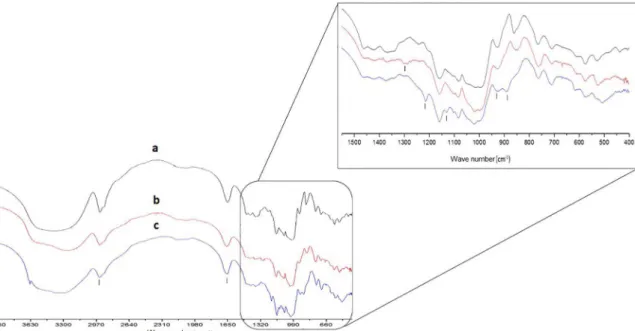
FTIR spectra of the samples ST, ST-TP and ST-TM are shown in igure 2. In the 2800-3000 cm-1 region similar bands were observed in all samples corresponding to the C-H stretch, common of glycosidic structures18.
Also, bands common to all samples in the 1654 cm-1
regions of the O-H lexion were observed by the presence
of water19, at 762 cm-1 attributed to C-C stretch, at 1162 cm-1
and 1085 cm-1 attributed to C-O and C-C bonds, related to
elongation in the C-O-C group of the hexose ring20 and in 993 and 930 cm-1 attributed to the C-OH and CH
2 deformations characteristic of starch molecules18,21.
%
%
( )
A
DS
P
P
3100
102
162
#
#
=
-In equation A, 162 corresponds to the molecular
weight of the monomeric starch unit, P% to the phosphorus content obtained by colorimetry, number 3100 refers to the molecular weight of the phosphorus multiplied by 100 and 102 corresponds to the mass of the monophosphate substituent group.
2.7. Morphological Analysis by Scanning
Electron Microscopy (SEM)
Samples were characterized morphologically by scanning electron microscopy (SEM). The micrographs were captured on a benchtop microscope (Hitachi, model TM3000, Japan),
suitable for analysis of biological samples, conigured at 15 kV, with approximations in the range of 300 to 800 x and with specimens ixed to carbon ribbons and without coating.
2.8. X-Ray difraction
Difraction patterns of the samples were obtained using an X-ray difractometer (Rigaku, model MiniFlex 600, Japan), conigured with copper lamp radiation (CuKα = 1.5418 Å), 40 kV and 15 mA. The difractograms were generated with readings in the range of 10 to 60 ° 2θ, step of 0.02 ° 2θ and velocity of 5 ° 2θ min-1.
In the ST-TM sample spectrum, small intensity variations
were observed in some bands in relation to the ST spectrum, as well as a new low intensity band in the 1300 cm-1 region that can be associated with water present in the material22,
however speciic bands of bound phosphate groups were not
perceptible, probably due to the reduced number of phosphate
introduced, as already reported by Li et al. (2009)23. On the other hand, the spectrum of the ST-TP sample presented, in addition to small variations in intensity, a new band at 3630 cm-1 associated with O-H stretching of unbound water, probably adsorbed on the surface of the sample24,25, a band at 1214 cm-1 assigned to symmetrical stretching P=O19,20, a band at 1129 cm -1 related to symmetrical and asymmetrical stretching of the PO2 group26 and a band at 889 cm-1 may be related with the P-O bond27. Such alterations in the absorption in the infrared region, evidenced the occurrence of the phosphorylation process, especially for the spectra of the ST-TP sample.
3.2.
31P (NMR) spectroscopy
31P NMR spectra of the ST-TP and ST-TM samples are
shown in igure 3, with the respective structures formed, the starch molecule in the igures is represented by (St). Spectrum ST-TM sample (Figure 3a) showed two groups of signals in the range of 15 to -20 ppm. The signals between δ -1.8 and -5 ppm are attributed to the presence of distarch
monophosphate (DSMP)9. The DSP structure derives from the phosphorylation of starch by STMP at pH above 8,
according to the mechanism proposed by Lim e Seib (1993)28.
Other signals between δ -5 and -10 ppm may be attributed
to monostarch diphosphate formation (MSDP), as observed
by Passauer, Bender e Fisher (2010)17.
31P NMR spectrum of the ST-TP sample (Figure 3b)
showed two signals in δ 3.6 and 1.6 ppm related to obtaining
monostarch monophosphate (MSMP) and DSMP structures respectively12,17,29. The MSMP structure is characterized by grouping phosphate bound through ester bond with the C6 carbon of the glycosidic unit of starch9,17. Two signals
presented between δ -5 and -10 ppm in the ST-TP sample
spectrum are attributed to MSDP formation, as observed for the ST-TM sample.
3.3. Water solubility
Table 1 shows the water solubility data of samples ST, ST-TP and ST-TM. The ST sample showed low solubility,
forming a more turbid suspension with ine particles, common
to this type of material30. The ST-TP and ST-TM modiied samples showed increases in solubility which may be related to the greater swelling power, because with certain levels of phosphate insertion the water penetration into the starch granules is increased and consequently the swelling can be facilitated, also may be related to the partial gelatinization
Figura 3. 31P NMR spectra of samples (a) ST-TM and (b) ST-TP.
Table 1. Water Solubility.
Sample Solubility % (w/w)
ST 3,06 ± 1,89
ST-TP 43,47 ± 0,65
ST-TM 39,67 ± 0,89
process of the starch, even though sodium sulphate is used to delay this process30,31.
In phosphorylated starches with crosslinking process, a
direct relation of swelling power and solubility is generally
observed, so that at low crosslinking levels there is an increase in these properties, but at very high crosslinking levels the leaching of starch molecules into water is diicult
and swelling and solubility are reduced31,32.
3.4. Degree of Substution (DS)
The degrees of substitution of the samples are presented in table 2. The ST sample did not present phosphorus content,
which is in agreement with the expected. The TP and
ST-TM samples presented low levels of phosphorus, however,
suicient to cause changes in several starch properties, as
ST-TP showed a higher degree of substitution, which may
justify its greater solubility and larger changes modiications in the absorptions in the infrared region. Wongsagonsup et al. (2005)6 obtained similar results, with phosphorylated starch samples with STPP presenting values much higher of degree of substitution than phosphorylated samples with STMP.
3.5. Scanning Electron Microscopy (SEM)
Morphological characterization of samples ST, ST-TP and ST-TM was performed by means of the micrographs
presented in igure 4.
The ST sample presented elliptical and ellipsoidal grain
morphology, with more homogeneous sizes as expected for this type of material, without modiications in the
granule structure23. The samples ST-TP and ST-TM, in turn, presented loss of grain format. Their surfaces became rough, porous and irregular and agglomerations of granules were observed which provided an increase in particle sizes. Such agglomerations may be related to the phosphorylation process5, whose insertion of the phosphate groups has modiied the intermolecular interactions between the starch chains,
and also the efect of the granule rupture in the fractions
possibly gellled.
3.6. X-Ray difraction
The X-ray difractograms of the samples ST, ST-TP and ST-TM are shown in igure 5. ST presented difraction
pattern similar to those commonly found in type A starches, mostly composed of cereal starches, which have a
three-dimensional coniguration of double helices of amylose
and amylopectin33,34.
The phosphorylated ST-TP and ST-TM samples showed
diferent difraction patterns from the starting sample, ST, evidenced by the suppression of the main ST peaks at 15, 17 and 23 ° 2θ. This characteristic is due to the amorphization
process undergone by the starch, associated to insertion of new groups at non-periodic intervals along the starch chains, which causes a more random spatial distribution, the possible
structural rearrangement resulting from alkalinization in the
previous process to reaction with the phosphates and also the presence of partial gelling14,35.
ST-TP presented small new peaks in the regions of 26, 29 and 31 ° 2θ, which may be related to changes in three-dimensional network of the chains, attributed to formation of DSMP (crosslinking process)35.
3.7. Methylene blue adsorption isotherm
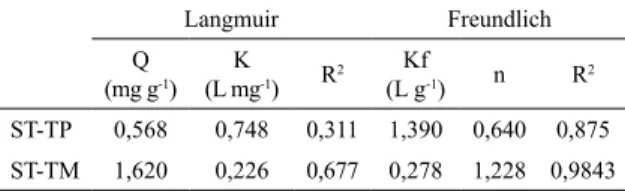
Preliminary methylene blue adsorption tests on the ST-TP and ST-TM samples presented better results for the
Freundlich adsorption model according to the R² coeicients shown in table 3. The Langmuir isotherms data presented a
very large randomness, this non-linear behavior suggests that the adsorption does not behave in a similar way to the model
proposed by Langmuir, at least under the conditions studied.
Table 2. Degree of substitution.
Sample Phosphorous Content (%)
Degree of Substitution Phosphate
ST -
-ST-TP 0,220 0,0115
ST-TM 0,067 0,0035
Figure 5. Difractograms of ST, ST-TM and ST-TP samples.
Table 3. Methylene blue adsorption isotherms data on the
phosphorylated samples, using Langmuir and Freundlich models.
Langmuir Freundlich
Q (mg g-1)
K
(L mg-1) R
2 Kf
(L g-1) n R
2
ST-TP 0,568 0,748 0,311 1,390 0,640 0,875
ST-TM 1,620 0,226 0,677 0,278 1,228 0,9843
Sample ST showed very low, undetectable methylene blue adsorption, therefore, the data were not reported.
A larger study should be carried out to better understand the adsorption mechanism. However, it is possible to observe that the ST-TP sample presented adsorption potential higher
than the ST-TM sample, Which suggests that its structure and
surface were more strongly altered, which is in accordance
with the results of FTIR spectroscopy, solubility and
phosphorus content and that may be related to the increase of the anionic character of the material surface due to the insertion of the phosphate and also to the rupture of granule with an apparent increase in theroughness and porosity of the surfaces observed in micrographs obtained by SEM. This achievement of adsorptive potential in the phosphorylated samples suggests that they are promising for application in drug delivery systems, where they could act as a vehicle for cationic active principles.
4. Conclusions
Starch phosphorylation process has been successfully performed according to the degree of substitution data, 31P NMR
spectra and FTIR absorptions observed. The phosphorylated
materials presented increased solubility, structural and
morphological changes and amorphous difraction patterns.
The adsorptive properties were higher in the phosphorylated starches, with higher adsorption capacity for the sample with higher DS. These data may indicate prospecting in the application as biodegradable adsorbents of cationic adsorbents
as the model adsorbent used, methylene blue. Conirmed their respective modiications, the phosphorylated starches
will be further studied on new properties and applications.
5. Acknowledgements
The authors thank the Araucária Foundation and CAPES for inancial support.
6. References
1. Gao F, Li D, Bi C, Mao Z, Adhikari B. Preparation and characterization of starch crosslinked with sodium trimetaphosphate
and hydrolyzed by enzymes. Carbohydrate Polymers.
2014;103:310-318. DOI: 10.1016/j.carbpol.201 3.12.028
2. Chatakanonda P, Varavinit S, Chinachoti P. Efect of Crosslinking
on Thermal and Microscopic Transitions of Rice Starch. LWT - Food Science and Technology. 2000;33(4):276-284. DOI:
10.1006/fstl.2000.0662
3. Kaur B, Ariin F, Bhat R, Karim AA. Progress in starch modiication
in the last decade. Food Hydrocolloids. 2012;26920:398-404.
DOI: 10.1016/j.foodhyd.2011.02.01 6
4. Stahl JA, Lobato LP, Bochi VC, Kubota EH, Gutkoski LC,
Emanuelli T. Physicochemical properties of Pinhão (Araucaria
angustifolia, Bert, O. Ktze) starch phosphates. LWT - Food Science and Technology. 2007;40(7):1206-1214. DOI: 10.1016/j.
lwt.2006.07.015
5. Singh AV, Nath LK. Synthesis and evaluation of physicochemical properties of cross-linked sago starch. International Journal of Biological Macromolecules. 2012;50(1):14-18. DOI: 10.1016/j.
ijbiomac.2011.09.003
6. Wongsagonsup R, Shobsngob S, Oonkhanond B, Varavinit S. Zeta Potential (ζ) and Pasting Properties of Phosphorylated or Crosslinked Rice Starches. Starch. 2005;57(1):32-37. DOI:
10.1002/star.200400311
7. Manoi K, Rizvi SSH. Physicochemical characteristics of phosphorylated cross-linked starch produced by reactive supercritical luid extrusion. Carbohydrate Polymers. 2010;81(3):687-694.
DOI: 10.1016/j.carbpol.2010.03.042
8. Carmona-Garcia R, Sanchez-Rivera MM, Méndez-Montealvo
G, Garza-Montoya B, Bello-Pèrez LA. Efect of the cross-linked
reagent type on some morphological, physicochemical and functional characteristics of banana starch (Musa paradisiaca).
Carbohydrate Polymers. 2009;76(1):117-122. DOI: 10.1016/j.
carb pol.2008.09.029
9. Sang Y, Prakash O, Seib PA. Characterization of phosphorylated cross-linked resistant starch by 31P nuclear magnetic resonance (31P NMR) spectroscopy. Carbohydrate Polymers.
2007;67(2):201-212. DOI: 10.1016/j.carbpol.2006.05.009
10. O’Brien S, Wang YJ. Efects of shear and pH on starch phosphates prepared by reactive extrusion as a sustained release agent.
Carbohydrate Polymers. 2009;77(3):464-471. DOI: 10.1016/j.
carbpol.2009.01.014
loading and releasing properties. Carbohydrate Polymers.
2008;74(3):379-384. DOI: 10.1016/j.carbpol.2008.03.005 12. Polnaya FJ, Haryadi, Marseno DW, Cahyanto MN. Efects of
phosphorylation and cross-linking on the pasting properties
and molecular structure of sago starch. International Food Research Journal. 2013;20(4):1609-1615.
13. Cury BSF, Klein SI, Evangelista RC. Modeling a system of phosphated cross-linked high amylose for controlled drug release.
Part 1: Synthesis and polymer characterization. Reactive and Functional Polymers. 2008;68(8):1200-1206. DOI: 10.1016/j.
reactfunctpolym.2008.04.003
14. Soares GA, Castro AD, Cury BSF, Evangelista RC. Blends of cross-linked high amylose starch/pectin loaded with diclofenac.
Carbohydrate Polymers. 2013;91(1):135-142. DOI: 10.1016/j.
carbpol.2012.08.014
15. Kagimura FY, Cunha MAA, Theis TV, Malfatti CRM, Dekker RFH, Barbosa AM, et al. Carboxymethylation of (1 → 6)-β-glucan (lasiodiplodan): Preparation, characterization and antioxidant
evaluation. Carbohydrate Polymers. 2015;127:390-399. DOI:
10.1016/j.carbpol.2015.03.045
16. DuBois M, Gilles KA, Hamilton JK, Rebers PA, Smith F.
Colorimetric Method for Determination of Sugars and Related Substances. Analytical Chemistry. 1956;28(3):350-356. DOI:
10.1021/ac60111a017
17. Passauer L, Bender H, Fischer S. Synthesis and characterisation
of starch phosphates. Carbohydrate Polymers.
2010;82(3):809-814. DOI: 10.101 6/j.carbpol.2010. 05.050
18. Lima BNB, Cabral TB, Neto RPC, Tavares MIB, Pierucci APT.
Estudo do amido de farinhas comerciais comestíveis. Polímeros.
2012;22(5):486-490. DOI: 10.1590/S0104-14282012005000062 19. Sulet DM, Nicolescu A, Popescu I, Chitanu GC. Phosphorylated
polysaccharides. 3. Synthesis of phosphorylated curdlan and its polyelectrolyte behaviour compared with other phosphorylated polysaccharides. Carbohydrate Polymers.
2011;84(3):1176-1181. DOI: 10.1016/j.carbpol.2011.01.010
20. Shi A, Li D, Wang L, Zhou Y, Adhikari B. Spray drying of starch
submicron particles prepared by high pressure homogenization
and mini-emulsion cross-linking. Journal of Food Engineering.
2012;113(3):399-407. DOI: 10.1016/j.jfoodeng.2012.06.017
21. Rocha DA, Abreu CMP, Cardoso MG, Corrêa AD, Contado
EWNF. Obtenção e caracterização físico-química e química
do polvilho da fruta-de-lobo (Solanum lycocarpum A. St-Hil).
Scientia Plena. 2012;8(9):099909-1.
22. Luo FX, Huang Q, Fu X, Zhang LX, Yu SJ. Preparation and characterisation of crosslinked waxy potato starch. Food Chemistry.
2009;115(2):563-568. DOI: 10.1016/j.foodchem.2008.12.052 23. Li B, Wang L, Li D, Chiu YL, Zhang Z, Shi J, et al. Physical
properties and loading capacity of starch-based microparticles
crosslinked with trisodium trimetaphosphate. Journal of Food Engineering. 2009;92(3):255-260. DOI: 10.1016/j.
jfoodeng.2008.10.008
24. Hernandez-Soriano MC, Kerré B, Kopittke PM, Horemans B, Smolders E. Biochar afects carbon composition and stability
in soil: a combined spec troscopy-microscopy study. Scientiic
Reports. 2016;6:25127. http://dx.doi.org/10.1038/srep25127
25. Zhang S, Guan Y, Fu GQ, Chen BY, Peng F, Yao CL, et al. Organic/Inorganic Superabsorbent Hydrogels Based on Xylan
and Montmorillonite. Journal of Nanomaterials.
2014;2014;1-11. DOI: 10.1155/2014/675035
26. Dai L, Qi YP, Niu LN, Liu Y, Pucci CR, Looney SW, et al. Inorganic-Organic Nanocomposite Assembly Using Collagen
as a Template and Sodium Tripolyphosphate as a Biomimetic
Analog of Matrix Phosphoprotein. Crystal Growth & Design.
2011;11(8):3504-3511. DOI: 10.1021/cg200663v
27. Shi F, Shi J, Li Y. Mechanochemical Phosphorylation and Solubilisation of β-D-Glucan from Yeast Saccharomyces cerevisiae and Its Biological Activities. PLoS ONE. 2014;9(7):e103494.
DOI: 10.1371/journal.pone.0103494
28. Lim S, Seib PA. Preparation and Pasting Properties of Wheat
and Corn Starch Phosphates. Cereal Chemistry. 1993;70(2):137-144.
29. Zhao J, Chen Z, Jin Z, Waard P, Buwalda P, Gruppen H, et al. Level and position of substituents in cross-linked and hydroxypropylated sweet potato starches using nuclear magnetic
resonance spectroscopy. Carbohydrate Polymers.
2015;131:424-431. DOI: 10.1016/j.carbpol.2015.06.005
30. Singh N, Singh J, Kaur L, Sodhi NS, Gill BS. Morphological, thermal and rheological properties of starches from diferent
botanical sources. Food Chemistry. 2003;81(2):219-231. DOI:
10.1016/S0308-8146(02)00416-8
31. Wongsagonsup R, Pujchakarn T, Jitrakbumrung S, Chaiwat W, Fuongfuchat A, Varavinit S, et al. Efect of cross-linking on
physicochemical properties of tapioca starch and its application in soup product. Carbohydrate Polymers. 2014;101:656-665.
DOI: 10.1016/j.carbpol.2013.09.100
32. Koo SH, Lee KY, Lee HG. Efect of cross-linking on the
physicochemical and physiological properties of corn starch.
Food Hydrocolloids. 2010;24(6-7):619-625. DOI: 10.1016/j.
foodhyd.2010.02.009
33. Hizukuri S. X-Ray Difractometric Studies on Starches. Part VI Crystalline Types of Amylodextrin and Efect of Temperature and Concentration of Mother Liquor on Crystalline Type.
Agricultural and Biological Chemistry. 1961;25(1):45-49.
DOI: 10.1080/00021369.1961.10857772
34. Vazquez A, Cyras VP, Alvarez VA, Moran JI. Starch/Clay Nano-Biocomposites. In: Avérous L, Pollet E, eds. Environmental Silicate Nano-Biocomposites. London: Springer London; 2012.
p. 287-321.DOI: 10.1007/978-1-4471-4108-2_11
35. Carbinatto FM, Castro AD, Cury BSF, Magalhães A, Evangelista RC. Physical properties of pectin-high amylose starch mixtures cross-linked with sodium trimetaphosphate. International Journal of Pharmaceutics. 2012;423(2):281-288. DOI: 10.1016/j.