ISSN 0104-6632 Printed in Brazil
www.abeq.org.br/bjche
Vol. 31, No. 02, pp. 355 - 363, April - June, 2014 dx.doi.org/10.1590/0104-6632.20140312s00002415
Brazilian Journal
of Chemical
Engineering
PRODUCTION OF FERMENTABLE SUGARS BY
COMBINED CHEMO-ENZYMATIC HYDROLYSIS
OF CELLULOSIC MATERIAL FOR BIOETHANOL
PRODUCTION
M. Idrees
1, A. Adnan
1, S. A. Bokhari
2and F. A. Qureshi
3*1Department of Chemistry, GC University, Katchery Road, Lahore 54000, Pakistan.
E-mail: [email protected]; [email protected]
2Department of Biosciences, COMSATS Institute of Information Technology, Park Road,
Chak Shahzad Campus, Islamabad 45600, Pakistan. E-mail: [email protected]
3Office of Research, Innovation and Commercialization, COMSATS, Institute of Information
Technology, Phone: + 923218415890, Chak Shahzad, Park Road, Islamabad 45600, Pakistan.
*E-mail: [email protected]
(Submitted: November 29, 2012 ; Revised: September 10, 2013 ; Accepted: September 16, 2013)
Abstract - To change the recalcitrant nature of the lignocellulosic material for maximum hydrolysis yield, a comprehensive study was done by using sulphuric acid as an exclusive catalyst for the pretreatment process. The enzymatic digestibility of the biomass [Water Hyacinth: Eichhornia crassipes] after pretreatment was determined by measuring the hydrolysis yield of the pretreated material obtained from twenty four different pretreatment conditions. These included different concentrations of sulphuric acid (0.0, 1.0, 2.0 and 3.0%), at two different temperatures (108 and 121 °C) for different residence times (1.0, 2.0 and 3.0h).The highest reducing sugar yield (36.65 g/L) from enzymatic hydrolysis was obtained when plant material was pretreated at 121 °C for 1.0 h residence time using 3.0% (v/v) sulphuric acid and at 1:10 (w/v) solid to liquid ratio. The total reducing sugars obtained from the two-stage process (pretreatment + enzymatic hydrolysis) was 69.6g/L. The resulting sugars were fermented into ethanol by using Saccharomyces cerevisiae. The ethanol yield from the enzymatic hydrolyzate was 95.2% of the theoretical yield (0.51g/g glucose), as determined by GS-MS, and nearly 100% since no reducing sugars were detected in the fermenting media by TLC and DNS analysis. Keywords: Eichhornia crasspies; Lignocellulosic; Water hyacinth; Saccharomyces cerevisiae; Ethanol; Fermentation.
INTRODUCTION
Lignocellulosic biomass is an abundant, inex-pensive and readily available source of fermentable sugars (Ho et al., 1998). For the last few decades, the conversion of these resources into glucose and other reducing sugars has been considered as an attractive route for production of ethanol or other valuable chemi-cals (Curreli et al., 1997; Gaspar et al., 2005). A wide array of biomass sources, including agricultural
can be efficiently converted into fuels, foods, and other valuable chemicals (Huber et al., 2006; Klemm et al., 2005; Fan et al., 1987; Zhang and Lynd, 2004; Ragauskas et al., 2006; Davda and Dumesic, 2005). Cellulosic conversion into glucose therefore is a key process which needs to be further studied.
The selection of the biomass source is of great importance from a technical and economical point of view. Ethically, biomass should not compete with the food crops, and thus waste biomass or crops with low commercial value, such as agricultural waste or weeds, are preferred for such types of processes for producing valuable chemicals. Furthermore, it is im-portant to select a source that requires less fertilizer, has a high growth rate and is preferably available the whole year, as is the case with water hyacinth. Water hyacinth could be an excellent biomass feedstock for further conversions and utilization (Girisuta et al., 2008).
Water hyacinth is a fast growing aquatic weed present in water reservoirs such as large lakes, rivers, shallow ponds, wetlands and marshes (Naseema et al., 2004). It can double its mass within 8-10 days and a single plant can produce up to 3000 offspring in 50 days (Verma et al., 2003). Because of its ca-pacity for exponential increase in the biomass, this weed needs constant vigilance by farmers and canal irrigation personnel. Because of its enormous amount, some uses have been suggested such as composting, cattle feed, biogas plant resources, paper and pulp industry, furniture making, and waste water treat-ments (Gunnersson and Petersen, 2007). However, there is no reported utilization of this weed on a large industrial scale and it still continues to be jeopardy for farmers and water management authorities as it blocks water flow in irrigation and drainage canals, channels and streams. This weed also makes aquatic recreational activity difficult and is potentially un-safe in lakes, thus causing potential hurdles to tourism and related industries. In an attempt to address such problems, we propose to use it as a raw material for the extraction of fermentable sugars for value-added chemicals by optimizing and studying the two-stage hydrolysis process using commercial cellulase enzyme.
MATERIALS AND METHODS
Chemicals
3,5-Dinitrosalicylic acid and analytical grade phenol were received from Fluka Chemie, D(+)-xylose(GPR) was obtained from BDH (England) and
L-(+)-arabinose from Sigma Aldrich. Concentrated sulphuric acid (95–97 wt.%) and D(+)-glucose were
obtained from Panreac and α-naphthol was
pur-chased from Merck (Darmstadt, Germany). Distilled water was used to prepare the various solutions.
AccelleraseTM1500 (Cellulase) having multiple
enzyme activities; exoglucanase, endoglucanase, hemi-cellulase and beta-glucosidase as reported by the manu-facturer, was obtained from Genencore International (U.S.A).
Water Hyacinth
Fresh and healthy water hyacinth plants were col-lected from a natural pond near Shahdrah, Lahore (Punjab, Pakistan), during December. They were thoroughly washed with tap water several times to remove adhering dirt. Samples of stem, petiole and leaf of the fresh plant were selected as the substrate for saccharification. These parts were dried in an oven at 105 °C for 20 min and subsequently chopped into small pieces (~1-2 cm) and blended to small particles (~3-5 mm).
Pretreatment of the Water Hyacinth
The powdered dry plant material was used for pretreatment under different conditions. Twenty five grams of water hyacinth powder were mixed sepa-rately with 0.0, 1.0, 2.0 and 3.0% H2SO4 solution in
1:10 w/v% ratio, in 500 mL flasks. The flasks were autoclaved (CL-40L (ALP Co, Ltd. Tokyo, Japan) at two different temperatures (108 °C and 121 °C at a pressure of 0.11 MPa) for different time intervals (1.0, 2.0 and 3.0h). The solutions in the flasks were cooled and filtered with Whatman filter paper. The residue was washed with distilled water 3-5 times to bring the pH at 4.8. The residue was dried at 105 °C for 20 min and weighed.
Enzymatic Hydrolysis of Pretreated Material
sample was filtered on Whatman filter paper and subsequently analyzed. Each experiment was per-formed in duplicate.
Ethanol Fermentation
Commercial Baker’s yeast (Saccharomyces
cere-visiae) obtained from a local market, was used for
the ethanol fermentation. Inoculum was prepared by transferring yeast cells (1.0g/100mL) into 250 mL flasks containing 50.0 mL of culture medium con-taining 10.0 g/L yeast extract, 20.0 g/L peptone, and 20.0 g/L glucose and subsequently incubating at 30.0 °C for 24.0 h. This was used to inoculate the fermentation medium. Cellulosic hydrolyzate, ob-tained from enzymatic hydrolysis, was supplemented with 1.0 g/L yeast extract, 2.0 g/L (NH4)2SO4 and 1.0
g/L of MgSO4. The inoculum-to-solution ratio of
1:10 was used for fermentation purposes. Samples for glucose and ethanol analysis were taken at the beginning and end of a 24.0 h fermentation process.
Analysis of Reducing Sugars and Ethanol
The amount of the reducing sugars was deter-mined using 3,5-dinitrosalicylic acid (DNS) reagent by the Ghose method (1987). Identification of mono-meric sugars was done with thin layer chromatogra-phy (TLC) by using alpha-naphthol as locating re-agent and a water: acetonitrile mixture (85:15) as eluting solvent, as used by Beom et al. (2009) and outlined in Idrees et al. (2013). The hydrolysis yield was calculated on the basis of pretreated solid bio-mass used for enzymatic hydrolysis. Statistical analy-sis was done with Graph Pad Prism 5.
After centrifuging the liquid from the fermenta-tion media for 10 min, ethanol was quantified in the supernatant with the help of GC-MS (GCMS-QP2010 of Shimadzu) using a DB-5 capillary column (diame-ter 0.25 mm, length 30.0 m and thickness 0.25 µm). Nitrogen was used as carrier gas with flow rate of 1.41 mL/min. The temperature program was: tem-perature maintained at 40 °C for 1.0 min, then raised to 44.0 °C at 15.0 °C/min and at 1.0 °C/min up to 50.0 °C, then continuously increased to 250.0 °C at 25.0 °C/min and finally held at 250.0 °C for 2.0 min. The ion source temperature was 200.0 °C. Data was obtained in the scan mode in the mass range of 30-120 m/z after injecting 2.0 µL of sample. Fragment ions 31 m/z and 45 m/z were used for identification and quantification of ethanol, respectively. The cali-bration curve was obtained from 0.1, 0.2, 0.3 up to 1.0% v/v concentration of ethanol in HPLC grade water and their peak areas. From this, the
concentration of ethanol (v/v) in the sample was de-termined, which was converted to (w/v) by multiply-ing it by 0.79 (specific gravity of ethanol at 20.0 °C).
RESULTS AND DISCUSSION
Water hyacinth has a high cellulosic content (40.0-65.0%) (Malik, 2007; Nigam, 2002) with ex-tremely high growth rate (140 ton/ha. year, dry wt.) and have been considered as a prospective source for production of ethanol and other fuels (Girusta et al., 2008; Abraham et al., 1996; Sherma et al.,1999; Singhal and Rai, 2003). To obtain the maximum enzymatic hydrolysis for the production of ethanol, a pretreatment step which consumes cheap chemicals is necessary for process economy. The pretreatment has the capability to decrease the crystallinity of the cellulose and hemicellulose, remove the lignin con-tent and avoid the production of pocon-tential inhibitors for fermenting organisms. Dilute acid pretreatment using sulphuric acid below 4.0% was considered to be an economical method, providing higher hydroly-sis yield among the different physicochemical pretreatments (Esteghlalian et al., 1997). The process has been conducted in the temperature range of 100 °C - 200 °C with pressure 15Psi to 75Psi for dif-ferent time intervals (Gangulya et al., 2012). We have used sulphuric acid for pretreatment to enhance the hydrolysis yield at different temperatures and pressures for varying times. AccelleraseTM 1500 was used at specific concentrations to investigate the en-zymatic hydrolysis performance of cellulose and hemicellulose present in the treated water hyacinth plant. The conversion of lignocellulosic material into reducing sugars and liquid fuel (ethanol) has been achieved by using three sequential steps: acid pretreat-ment, enzymatic hydrolysis and yeast fermentation.
Effect of Biomass Concentration on Hydrolysis Yield
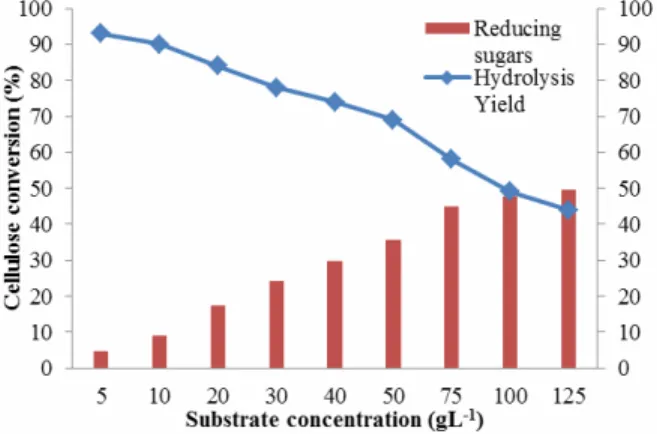
yield at high substrate loading was due to two rea-sons, the lower enzyme to substrate ratio and inhibi-tion of end product feedback caused by the high con-centration of reducing sugar produced during hy-drolysis (Wen et al., 2004). The effect of the substrate on the amount of the reducing sugars and hydrolysis yield was significant (p value<0.0001) with R2 value 0.9909. The optimum biomass concentration was determined from the amount of the reducing sugars and the hydrolysis yield. At 40.0 g/L solid mass the hydrolysis yield is 74.0%, which decreases at 70.8% when the substrate amount increases to 50.0 g/L and 58.0% with 75.0 g/L substrate. So fifty grams per liter substrate is effective for enzymatic hydrolysis.
Figure 1: Effect of substrate concentration on the enzymatic hydrolysis at fixed ratio of enzyme.
Effect of Time and Temperature on Pretreatment
The effect of the time and temperature on the pre-treatment and enzymatic hydrolysis was prominent. The amount of cellulosic residue left after each pre-treatment was different for varying prepre-treatment conditions (Table 1). At high temperature and longer residence time, the maximum hydrolysis of the hemi-cellulose was observed in the pretreatment steps, which resulted in decreasing the remaining polysac-charides in the biomass. After pretreatment with 3.0% acid at low temperature (108 °C), the solid residue left was higher (50.32%) which have more hemicellulose content while at high temperature (121 °C) the residue was less (35.45%), due to maximum hydrolysis of hemicellulose into component sugars. During sulphuric acid pretreatment glucose, arabi-nose and xylose were obtained from the hydrolyzate, which contains glucose as major component as shown by TLC. Previously it was claimed that the acid hydrolyzate of water hyacinth plant contains xylose as major component (Nigam, 2002). At 121 °C
and 3.0 h of pretreatment, the reducing sugars produced from hemicellulose (Ackerson et al., 1981; Taherzadeh and karimi, 2007) were converted into furfural (Fig. 2B). The production of furfural de-pends on the acid concentration and temperature (Gonzales, 1986). During enzymatic hydrolysis, the quantity of reducing sugars increases with increase in time of pretreatment for 1.0% and 2.0% acid and decreases with 3.0% acid due to the lower quantity of hemicellulose present in the pretreated biomass. The maximum amount of reducing sugars (hydroly-sis yield) was obtained from water hyacinth when it was pretreated with 1.0% acid for 3.0 h and 3.0% acid for 1.0 h (Fig. 3(a), (b)).
Effect of Acid Concentration on Hydrolysis
The effect of the acid concentration on the amount of the reducing sugars was significant (P<0.0001)
with R2 value 0.9709 calculated from ANOVA
analysis using Graph PadPrism5. It was clear that the hydrolysis yield increases with the increase in acid concentration with short pretreatment time and
decreases with long pretreatment time. The 3.0% acid pretreatment gave a higher amount of reducing sugars when pretreated for 1.0 h and less when treated for 3.0 h. This was due to the complete hydrolysis of the hemicellulose and charring of the remaining cellulose in the pretreatment step.
Table 1: The reaction conditions, biomass residue and amount of fermentable sugars obtained after enzymatic hydrolysis.
Acid Conc. Pretreatment Time
Temperature Decrease in Biomass
Biomass Residue
Reducing Sugars g/L
Reducing Sugars g/L
Enzymatic Hydrolysis
(%) (h) (°C) (%) (%) (Pretreatment
step)
(Enzymatic Step)
Yield (%)
1 108 2.64 97.36+1.12 0.57+0.23 1.04+0.14 2.1
1 121 16.18 83.82+1.71 2.42+0.58 1.150+.12 2.31
2 108 5.04 94.96+3.78 0.81+0.34 0.95+0.08 1.9
2 121 26.44 73.56+0.88 2.99+2.01 1.62+0.19 3.24
3 108 25.32 74.68+2.46 3.15+1.32 1.45+0.21 2.9
0.0
3 121 35.85 64.15+1.97 5.21+1.28 1.76+0.07 3.55
1 108 47.19 52.81+1.17 23.41+1.37 28.80+0.93 57.61
1 121 57.03 42.97+0.94 31.29+0.96 30.36+0.77 60.77
2 108 50.26 49.74+1.11 21.72+0.89 29.97+1.61 59.8
2 121 59.05 40.95+0.13 29.03+2.14 32.38+1.01 64.72
3 108 51.43 48.57+0.93 25.47+1.22 31.60+0.80 63.48
1.0
3 121 61.37 38.63+0.24 27.25+2.40 35.30+1.40 70.56
1 108 48.84 51.16+1.96 21.83+1.34 29.12+1.13 58.24
1 121 61.33 38.67+0.64 32.76+0.96 31.85+0.85 63.58
2 108 49.12 50.88+0.66 20.12+2.11 30.75+1.40 61.6
2 121 63.33 36.67+1.16 31.31+1.58 29.10+0.90 57.8
3 108 50.15 49.85+0.70 24.38+1.76 29.59+1.19 59.56
2.0
3 121 61.54 38.46+0.86 29.71+2.80 32.03+1.09 63.98
1 108 47.94 52.06+0.45 28.58+1.36 30.75+1.83 61.51
1 121 61.97 38.03+1.96 33.47+2.10 36.68+0.82 73.4
2 108 48.98 51.02+1.26 29.19+1.59 31.30+1.06 62.6
2 121 63.26 36.74+0.24 32.76+1.16 31.67+0.94 63.34
3 108 49.68 50.32+0.84 26.93+2.11 29.25+0.83 58.6
3.0
3 121 64.55 35.45+1.11 29.43+1.73 26.26+1.19 52.7
Experiments were done in duplicate. The average values and standard deviation are shown.
Figure 3: (a), (b). Effect of acid concentration and time of pretreatment on enzymatic hydrolysis (%).
Time Course of Enzymatic Hydrolysis
Enzymatic hydrolysis was done with a fixed amount of the cellulase enzyme and the reaction car-ried out for 48.0 h. The reducing sugar concentra-tions were determined at regular intervals, (12.0 h) starting from 0 h during hydrolysis. The amount of the sugars increased gradually and reached 0.734 g/g of cellulosic material, which corresponds to a 73.4% hydrolysis yield after 48.0 h, as shown in Fig. 4. The percentage of hydrolysis was calculated from the amount of reducing sugars and the amount of pre-treated biomass used in enzymatic hydrolysis. The graph showed that, with the passage of time, the amount of reducing sugars increased and after 48.0 h there was an insignificant increase in the amount of sugars observed in some experiments. During hy-drolysis, in the first 24.0 h more sugars were ob-tained and then sluggishly increased and reached a maximum at 48.0 h. Previously 71.3% enzymatic saccharification efficiency was reported by Aswathy et al., (2010) with NaOH pretreated water hyacinth and 60.2% by Mishima et al., (2008).
Most Effective Pretreatment Condition
Acids such as sulphuric acid, hydrochloric acid or nitric acid (Patel et al., 1993) and bases like NaOH or NH3 (Zhao et al., 2007; Xu, 2007) can be used
ef-ficiently for pretreatment of biomass at different temperatures for maximum enzymatic hydrolysis. Among them, NaOH pretreatment could provide higher enzymatic saccharification as compared to acids (Zhao et al., 2007; Aswathy et al., 2010). During acidic or basic pretreatment, there occurred a loss in the biomass weight (Jiele et al., 2010; Wang et al., 2009) due to hydrolysis of hemicellulose and removal of lignin (Blasi et al., 1999; Lin et al., 2010).
Water hyacinth contains hemicellulose as major component (48.0%) with only 3.5-4.6% of lignin (Nigam, 2002), which was removed during the pretreatment step (decrease in biomass weight Table 1). For obtaining the maximum benefit of pretreat-ment the sugars produced during pretreatpretreat-ment should be stable. The effect of both H2SO4 and NaOH on
pure glucose and xylose at 100 °C was checked. NaOH degraded these sugars, while in acidic media no change was observed for glucose and xylose (Fig. 2D). So the use of H2SO4 at low temperature for
pre-treatment was a better choice for obtaining the maxi-mum amount of fermentable sugars in two steps, pretreatment and enzymatic hydrolysis step. The pretreatment of water hyacinth with 3.0% sulphuric acid at 121 °C for 1.0 h was found to be the most optimal condition as the subsequent enzyme hydroly-sis showed maximum 73.4% yield. This pretreatment also provided 33+2.1 g/L of reducing sugars per 100 gm of biomass during pretreatment step, which is close to the results obtained by Abraham et al. (2006) by using 10.0% sulphuric acid at 121 °C for 30 min, which was also available for fermentation (Masami et al., 2008). Nigam (2002) obtained 0.51 g/g reducing sugars with 3.0% sulphuric acid when the pretreatment time was 1.5 h. The pretreatment with 1.0 and 2.0% sulphuric acid for 3.0 h at 121 °C provided 27.25+ 2.4 and 29.19+2.8 g/L of reducing sugars per 100.0 g of biomass, along with
70.56 and 63.98% enzymatic hydrolysis yields,
respectively.
Ethanol Production
Two types of enzymatic hydrolyzate, one ob-tained from 1.0% acid and other from 3.0% acid treated biomass, were used for ethanol production. These two hydrolyzates have 36.65 g/L and 35.7 g/L fermentable sugars which converted into 18.25 and 17.33 g/L ethanol, equivalent to 95.2% of the theo-retical yield of the glucose, which is 0.51 g ethanol/ g of glucose. After twenty four hours, sugars were entirely fermented into ethanol, which was con-firmed through DNS analysis and TLC results (Fig. 5C). Sornvoraveat and Kongkiattikajorn (2010) ob-tained a 96.07% ethanol yield from fermentation of enzymatic hydrolyzate of water hyacinth and Chen et al. (2007) obtained a 94.0% yield from corncob en-zymatic hydrolyzate in 18.0 h, by using Saccharomyces cerevisiae. Nigam (2002) and Magdum et al., (2012) reported 18.0 g/L and 19.2g/L of ethanol from the acid hydrolyzate of water hyacinth leaves, respec-tively. Sulphuric acid produced pure cellulose after hydrolysis of the hemicellulose during pretreatment. Enzymatic saccharification of this cellulose pro-duced pure glucose (Fig. 5) which converted com-pletely into ethanol through fermentation by using commercial yeast.
CONCLUSIONS
Chemo-enzymatic hydrolysis of the water hya-cinth yielded reducing sugars in two steps: (a) Pretreatment step yielded 33.0% hydrolysis; (b) En-zymatic hydrolysis yielded 73.4%. Multiple enzyme activities of AccelleraseTM1500 converted the cellu-lose and cellubiose completely into pure glucose. The amounts of glucose obtained from enzymatic hydrolysis of pretreated water hyacinth with 3.0% and 1.0% acid were 36.65 and 35.7 g/L, which gave 18.25 and 17.33 g/L of ethanol with commercial baker‘s yeast respectively. The two-step hydrolysis process of water hyacinth, pretreatment with sul-phuric acid followed by Accellrase 1500 hydrolysis, is a suitable method for achieving high recovery of fermentable sugars and high ethanol conversion yield.
ACKNOWLEDGEMENT
We gratefully acknowledge the financial support from the Higher Education Commission Islamabad, Pakistan, and Genencor International Inc. for provid-ing enzyme samples. We also extend our gratitude to Dr. Farooq Anwar for his professional guidance.
REFERENCES
Abraham, M., Kurup, G. M., Bioconversion of tapi-oca (Manihotesculenta) waste and water hyacinth (Eichhorniacrassipes) - Influence of various phys-icochemical factors. Journal of Fermentation Bio-engineering, 82, 259-63 (1996).
Ackerson, M., Ziobro, M., Gaddy, J. L., Two-stage acid hydrolysis of biomass. Biotechnology and Bioengineering Symposium, 11,103-12 (1981). Aswathy, U. S., Sukumaran, R. K., Lalitha Devi, G.,
Rajasree, K. P., Singhania, R. R. and Pandey, A., Bioethanol from water hyacinth biomass. An evaluation of enzymatic saccharification strategy. Bioresource Technology, 101, 925-930 (2010). Blasi, C. D., Signorelli, G., Di Russo, C., Rea, G.,
Product distribution from pyrolysis of wood and agricultural residues. Industrial and Engineering Chemistry Research, 38, 2216-2224 (1999). Chen, M., Xia, L., Xue, P., Enzymatic hydrolysis of
corncob and ethanol production from cellulosic hydrolyzate. International Biodeterioration & Bio-degradation, 59, 85-89 (2007).
Curreli, N., Fadda, M. B., Rescigno, A., Rinaldi, A. C., Soddu, G., Sollai, F., Vaccargiu, S., Sanjust, E., Rinaldi, A., Mild alkaline/oxidative pretreatment
of wheat straw. Process Biochemistry, 32, 665-670 (1997).
Davda, R. R. and Dumesic, J. A., Renewable hydrogen by aqueous-phase reforming of glucose, Chemical Communications, 36-37 (2004); apud Davda, R. R., Shabaker, J. W., Huber, G. W., Cortright, R. D. and Dumesic, J. A., A Review of catalytic issues and process conditions for renewable hydrogen and alkanes by aqueous-phase reforming of oxy-genated hydrocarbons over supported metal cata-lysts. Applied Catalysis B: Environmental, 56, 171-186 (2005).
Esteghlalian, A., Hashimoto, A. G., Fenske, J. J. and Penner, M. H., Modeling and optimization of the dilute-sulfuric-acid pre-treatment of corn stover, poplar and switchgrass. Bioresource Technology, 59, 129-136 (1997).
Fan, L. T., Gharpuray, M. M., Lee, Y-H., Cellulose Hydrolysis, Biotechnology Monograph, 3. Springer-Verlag, Berlin, 1, 76-83 (1987).
Ganguly, A., Chatterjee, P. K. and Dey, A., Studies on ethanol production from water hyacinth – A review. Renewable and Sustainable Energy Reviews, 16, 966-972 (2012).
Gaspar, M., Juhasz, T., Szengyel, Zs., Reczey, K., Fractionation and utilization of corn fibre carbo-hydrates. Process Biochemistry, 40, 1183-1188 (2005).
Ghose, T. K., Measurement of cellulase activities. Pure and Applied Chemistry, 59, 257-268 (1987). Girisuta, B., Danon, B., Manurung, R., Janssen, L. P.
B. M., Heeres, H. J., Experimental and kinetic modelling studies on the acid-catalysed hydroly-sis of the water hyacinth plant to levulinic acid. Bioresource Technology, 99, 8367-8375 (2008). Gonzales, G., Lopes-Santin, J., Caminal, G., Sola,
C., Dilute acid hydrolysis of wheat straw hemi-cellulose at moderate temperature, a simplified kinetic model. Biotechnology Bioengineering, 28 (2), 288-293 (1986).
Gunnarsson, C. C., Petersen, C. M., Water hyacinths as a resource in agriculture and energy produc-tion. A literature review. Waste Management, 27, 117-129 (2007).
Ho, N. W. Y., Chen, Z. D., Brainard, A., Genetically engineered Saccharomyces yeast capable of ef-fective cofermentation of glucose and xylose. Applied and Environmental Microbiology, 64, 1852-1859 (1998).
Huber, G. W., Iborra, S., Corma, A., Synthesis of transportation fuels from biomass: chemistry, catalysts, and engineering. Chemical Reviews, 106, 4044-4098 (2006).
Op-timization of dilute acid pretreatment of water hyacinth biomass for enzymatic hydrolysis and etha-nol production. EXCLI Journal, 12, 30-40 (2013). Ingole, N. W., Bhole, A. G., Utilization of water
hyacinth relevant in water treatment and resource recovery with special reference to India. Journal of Water Supply Research and Technology - Aqua, 51, 283-295 (2002).
Klemm, D., Heublein, B., Fink, H. P. and Bohn, A., Cellulose: Fascinating biopolymer and sustain-able raw material. Angewandte Chemie Interna-tional Edition, 44, 3358-3393 (2005).
Lin, L., Yan, R., Liu, Y., Jiang, W., In-depth investi-gation of enzymatic hydrolysis of biomass wastes based on three major components: Cellulose, hemicellulose and lignin. Bioresource Technol-ogy, 101, 8217-8223 (2010).
Magdum, S. S., More, S. M. and Nadaf, A. A., Bio-chemical conversion of acid-pretreated water hyacinth (Eichhornia crassipes) to alcohol using PichiaStipitis NCIM3497. International Journal of Advanced Biotechnology and Research, 3(2), 585-590 (2012).
Malik, A., Environmental challenge vis a vis oppor-tunity, the case of water hyacinth. Environment International, 33, 122-138 (2007).
Masami, G. O. O., Usui, I. Y., Urano, N., Ethanol production from the water hyacinth Eichhornia
crassipes by yeast isolated from various
hydro-spheres. African Journal of Microbiology Re-search, 2, 110-113 (2008).
Mishima, D., Kuniki, M., Sei, K., Soda, S., Ike, M., Fujitha, M., Ethanolproduction from candidate energy crops. Water hyacinth (Eichhornia cras-sipes) and water lettuce (Pistia stratiotes L.). Bio-resource Technology, 99(7), 2495-2500 (2008). Mukherjee, R., and Nandi, B., Improvement of in
vitro digestibility though biological treatment of water hyacinth biomass by two Pleurotus species. International Biodeterioration and Biodegradation, 53, 7-12 (2004).
Naseema, A., Praveena, R. and Ancy M. Salim, Ecofriendly management of water hyacinth with a mycoherbicide and cashew nut shell liquid. Pakistan Journal of Weed Science Research, 10 (1-2), 93-104 (2004).
Nigam, J. N., Bioconversion of water-hyacinth (Eichhornia crassipes) hemicellulose acid hy-drolysate to motor fuel ethanol by xylose–fer-menting yeast. Journal of Biotechnology, 97, 107-116 (2002).
Patel, V., Desai, M., Madamwar, D., Thermochemi-cal pretreatment of water hyacinth for improved biomethanation. Applied Biochemistry and Bio-technology, 42, 67-74 (1993).
Ragauskas, A. J., Williams, C. K., Davison, B. H., Britovsek, G., Cairney, J., Eckert, C. A., Frederick, W. J., Hallett, P., Leak, D. J., Liotta, C. L., Mielenz, J. R., Murphy, R., Templer, R. and Tschaplinski, T., The path forward for biofuels and biomaterials. Sci-ence, 311, 484-489 (2006).
Seo, H-B., Kim, S., Lee, H-Y., Jung, K-H., Improved bioethanol production using activated carbon-treated acid hydrolysate from corn hull in Pachy-solen tannophilus. The Korean Society of Mycol-ogy, MycobiolMycol-ogy, 37(2), 133-140 (2009). Sharma, A., Unni, B. G., Singh, H. D., A novel
fed-batch digestion system for biomethanation of plant biomasses. Journal Bioscience Bioengi-neering, 87, 678-82 (1999).
Singhal, V. and Rai, J. P. N., Biogas production from water hyacinth and channel grass used for phy-toremediation of industrial effluents. Bioresource Technology, 86, 221-225 (2003).
Sornvoraweat, B. and Kongkiattikajorn, J., Separated hydrolysis and fermentation of water hyacinth leaves for ethanol production. Khon Kaen Re-search Journal, 15(9), 794 -802 (2010).
Taherzadeh, M. J., Karimi, K., Acid-based hydroly-sis processes for ethanol from lignocellulosic materials. A review. BioResources, 2, 472-499 (2007).
Verma, R., Singh, S. P. and Raj, G. K., Assessment of changes in water hyacinth coverage of water bodies in northern parts of Bangalore city using temporal remote sensing data. Current Science, 84(6), 795-804 (2003).
Wang, Z., Keshwani, D. R., Redding, A. P., Cheng, J. J., Sodium hydroxide pretreatment and enzy-matic hydrolysis of coastal Bermuda grass. Biore-source Technology, 101(10), 3583-3585 (2010). Wen, Z. Y., Liao, W. and Chen, S. L., Hydrolysis of
animal manure lignocellulosics for reducing sugar production. Bioresource Technology, 91, 31-39 (2004).
Xu, J., Cheng, J. J., Shivappa, R. R. S. and Burns, J. C., Sodium hydroxide pretreatment of switch-grass for ethanol production. Energy & Fuels, 24, 2113-2119 (2010).
Xu, Z., Wang, Q., Jiang, Z., Yang, X. X., Ji, Y., En-zymatic hydrolysis of pretreated soybean straw. Biomass Bioenergineering, 31, 162-167 (2007). Zhang, Y., Lynd, R., Toward an aggregated
under-standing of enzymatic hydrolysis of cellulose: Noncomplexed cellulase systems. Biotechnology Bioengineering, 88, 797-82 (2004).