• Nenhum resultado encontrado

The effect of acquisition annoucements on stock returns of acquiring firms

N/A
N/A
Protected

Academic year: 2021

Share "The effect of acquisition annoucements on stock returns of acquiring firms"

Copied!
63
0
0

Texto

(1)

A Work Project, presented as part of the requirements for the Award of an

International Master in Finance

from the

NOVA

– School of Business and Economics

and a

Professional Master in Finance

from the

Fundação Getulio Vargas

– São Paulo School of Economics

THE EFFECT OF ACQUISITION ANNOUNCEMENTS ON

STOCK RETURNS OF ACQUIRING FIRMS:

A SHORT- AND LONG-TERM STUDY FOR DEVELOPED AND EMERGING

COUNTRIES FOCUSING ON DOMESTIC AND CROSS-BORDER ACQUISITIONS

AND THE IMPACT OF INSTITUTIONAL ENVIRONMENT

Florian Otto

NOVA SBE Student numbers: 3363 & 29365

FGV-EESP Student number: 338939

A Project carried out on the Double Degree EESP-FGV,

under supervision of:

Professor Rafael Zambrana (NOVA SBE, Lisbon, Portugal)

Professor Joelson Sampaio (EESP-FGV, São Paulo, Brazil)

Date:

10

th

September 2017

(2)

2

Abstract

This paper uses an empirical event-study approach to investigate the effect of acquisition

announcements on the share price of bidding firms. By using a globalised set of acquirers from

14 different markets, this work aims to develop an understanding of the impact of acquisition

announcements on developed- and emerging-market acquirers. The sample contains 624

acquisition announcements with target firms located throughout the world between 1997 and

2015. The results contradict the conventional wisdom that developed-market acquirers

generally experience losses. Both emerging-market and developed-market bidders gain

significantly in the short term. Moreover, for developed-market acquirers, the announcement

of cross-border acquisitions (CBAs) yields higher abnormal returns than the announcement of

domestic acquisitions. On the other hand, emerging-market bidders gain from announcing

domestic acquisitions, and lose substantially when publishing news about CBAs. In addition,

the institutional environment is found to have an impact on acquirer returns.

Keywords

: Acquisitions, Abnormal Returns, Cross-border Acquisitions, Institutional

Environment

(3)

3

Table of Contents

1.

Introduction ... 4

2.

Literature Review and Developed Hypothesis ... 6

2.1 Acquirer Returns in Developed and Emerging Countries ... 6

2.2 Acquirer Returns in Domestic and Cross-Border Acquisitions ... 9

2.3 Institutional Environment and the Impact on Acquirer Returns in CBAs ... 10

3.

Data Collection and Summary Statistics ... 11

4.

Methodology ... 13

4.1 One-Factor Market Model ... 17

4.2 Aggregated Cumulative Abnormal Returns ... 19

4.3 Aggregated Buy-and-hold Abnormal Returns... 19

4.4 Significance Tests ... 20

5.

Empirical Results ... 23

5.1 Empirical Results of the Aggregate Sample ... 23

5.1.1 Aggregate Sample Short-term Event Study ... 23

5.1.2 Aggregate Sample Long-term Event Study ... 25

5.2 Empirical Results of Individual Countries ... 27

5.2.1 Individual Countries Short-term Event Study ... 27

5.2.2 Individual Countries Long-term Event Study ... 29

5.3 Domestic and Cross-border Acquisitions Results ... 33

5.3.1 Domestic and Cross-border Acquisitions Short-term Event Study ... 33

5.3.2 Domestic and Cross-border Acquisitions Long-term Event Study ... 36

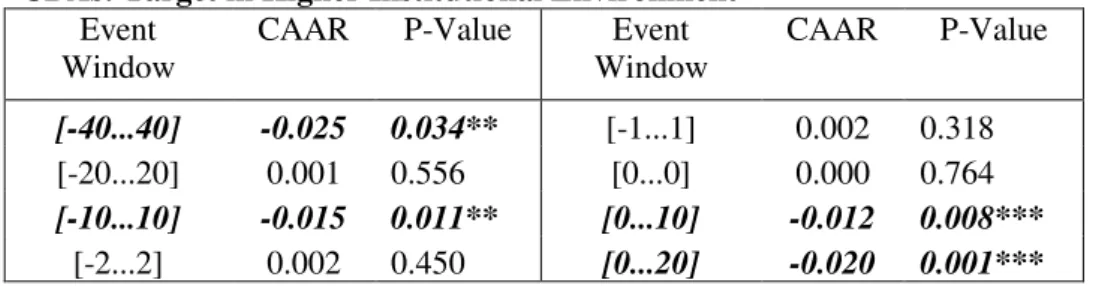
5.4 Impact of Institutional Environment Results ... 39

5.4.1 Impact of Institutional Environment on Short-term Event Study ... 39

5.4.2 Impact of Institutional Environment Long-term Event Study ... 41

6.

Limitations ... 43

7.

Conclusion ... 44

References ... 46

(4)

4

1.

Introduction

Different kinds of mergers and acquisitions (M&As) are present in all industries and across all

countries and continents. In fact, M&A activities have always been an integral part of the

inorganic growth strategies of corporates throughout the world. A record year for the number

of worldwide M&A transactions was marked in 2016, when more than 48,000 deals were

announced, with a corresponding total deal value of above US$3.5 trillion.

1

Most of the deals

are small and mid-size in value and only a fraction of the total deals are considered to be

mega-deals, i.e. M&A transactions with a value higher than US$1billion.

2

Not only has the number of M&A transactions increased in recent decades, but public and

institutional interests, as well as numerous services supporting and consulting parties engaged

in M&As, have become an integral part of this kind of deal-making. Moreover, the impacts of

these events on numerous variables have been discussed in academic research, as well as in

professional information technology circles all over the world. The focus of this research has

been primarily on North American and European markets. Past studies have demonstrated that,

in most cases, announcements of acquisitions tend to destroy value for shareholders of acquiring

firms

– in both short- and long-term perspectives.

3

While public deals of listed companies create

a considerable amount of publicity and press coverage, acquirers are likely not to meet the

public

’s high expectations and fall short in generating shareholder value or synergies. This

paper contributes to the existing literature and research by analysing the stock returns of

acquiring firms at the time of acquisition announcements not only in developed markets, but

also in emerging markets and a frontier market, as noted by the Morgan Stanley Capital

1

https://imaa-institute.org/mergers-and-acquisitions-statistics/

2

https://imaa-institute.org/m-and-a-statistics-transaction-type/

(5)

5

International (MSCI) market classification.

4

The paper identifies the top acquisitions by value

in 14 different markets, and compares the security performance of acquiring firms in the short

term, i.e. around the announcement date, as well as in the long term

– up to 18 months after the

official announcement. The following countries were selected to form part of the study:

Argentina, Australia, Brazil, Canada, China, France, Germany, Hong Kong, India, Japan,

Mexico, South Africa, South Korea, and the United States. The research focuses on the

aggregate sample and on each individual country, while also analysing the impact of domestic

and cross-border acquisitions (CBAs), and the impact of the institutional environment in the

target country on shareholder value creation.

The results indicate show that both developed-market and emerging-market bidders benefit

from announcing acquisitions in the short term. Moreover, when developed-market acquirers

announce cross-border acquisitions, higher abnormal returns are reported than when

announcing domestic acquisitions. For emerging-market bidders the effect is reversed. With

regard to the impact of the institutional environment in the target country, this paper finds that

when announcing CBAs in less developed countries, in terms of institutional environment,

bidders benefit substantially.

The rest of this paper is organised as follows. Chapter 2 examines the relevant literature and its

various findings on the topics being investigated. Thereafter, the method of data collection is

explained and highlights relating to important data summary statistics are provided. Chapter 4

elaborates on the empirical methodology approach. In the following chapter, empirical results

and comments on the contribution to existing literature are presented. Chapter 6 deals with

possible limitations of the study. The paper concludes with a discussion of the implications

of

this study and possibilities for further research.

(6)

6

2.

Literature Review and Developed Hypothesis

The effect of acquisition announcements on the stock prices of acquiring firms and target firms

has already been investigated by several studies and research papers in a number of countries.

This chapter first briefly describes the M&A environment, and goes on to summarise relevant

findings from various countries and the focus topics being investigated. Hypotheses are then

developed based on previous literature and findings.

The purpose of and motivation for this study are to enhance academic research on the

comparison of acquirer returns at the time of acquisition announcements between different

countries and markets. Previous research into these topics has focused primarily on specific

countries. By using a multi-country sample with announcement events from companies listed

in 14 different markets, this paper aims to establish important evidence on the impact of

acquisition announcements on acquirer returns globally. Moreover, the main research question

is then modified to analyse the influence of domestic and cross-border acquisitions and how the

institutional environment of the target country affects acquirer returns.

2.1 Acquirer Returns in Developed and Emerging Countries

Mergers and acquisitions are considered as part of what many refer to as the

‘market for

corporate control

’ (Berk & DeMarzo, 2011). The global M&A market is very active, with an

average transaction value of more than US$1 trillion per annum over the past 20 years (Berk &

DeMarzo, 2011). Considering this enormous transaction value and the publicity and press

coverage being created, it is very probable that M&A announcements have an impact on stock

returns. This impact has been extensively researched in several ways, especially in developed

countries. However, these studies often arrive at different results and contradictory outcomes.

A study by Malatesta (1983) finds significant negative abnormal returns in the long term for

(7)

7

acquiring firms, and significant negative abnormal returns as an immediate effect after M&A

announcements. Agrawel, Jaffe and Mandelker (1992) support the findings by Malatesta, and

conclude that stockholders of acquiring firms suffer a statistically significant wealth loss of

approximately 10% over the first years following an M&A announcement. Betton, Eckbo, and

Thorburn (2008), on the other hand, find that shareholders of acquiring companies realise a

significant positive 0.73% gain on their stock prices shortly after an M&A announcement.

Betton et al. (2008) argue for a small significant gain for acquirers, while Malatesta (1983) finds

significant negative abnormal returns in the short term. On the basis of the findings mentioned

above, it appears that various authors in developed countries arrive at contradictory results, at

least in the short-term. Based on these contradictions and the twenty-year time span of this

study, it is expected that positive and negative abnormal returns counter each other in the short

and long term. The existence of this counter-effect means that there should be no significant

abnormal returns for the data analysed in developed markets.

However, several studies found that in emerging markets, acquiring firms and their

shareholders do experience significant positive abnormal returns in relation to corporate

takeover actions. Simoes, Macedo-Soares, Klotzle and Pinto (2012) investigate the effect of

acquisition announcements on the acquirer

’s stock prices in Latin America. They find that in

Argentina, statistically significant abnormal returns are experienced by acquirers when the

event is announced and in the days subsequent to the acquisition

– whereas this is not the case

in Brazil. The authors identify a more efficient market in Brazil, in terms of the semi-strong

efficient market hypothesis (Simoes et al., 2012). Moreover, Brito, Batistella and Fama (2005)

conclude that in Brazil there are no significant abnormal returns for acquirers at the time of the

announcement. Therefore, Simoes et al. (2012) and Brito et al. (2005) agree that in Brazil,

(8)

8

markets seem to be efficient, with no significant abnormal returns for the acquirer around

acquisitions are announced.

In addition to the research on M&A activities in South America, several studies have also

researched the impact of M&A in Asia. Rani, Yadaf and Jain (2012) analyse share price

performance after M&A announcements in India. Their results indicate that shareholders of

acquiring firms generate a 1.6% statistically significant abnormal return during a five-day event

window. In China, Chi, Sun and Young (2011) investigate a large sample of acquiring firms in

the Chinese stock market. They identify significant positive abnormal returns six months before

the announcement date and in the respective event windows of the acquisitions (Chi et al.,

2011). They claim information leakage as a possible reason for the abnormal returns

experienced before the official announcement date. Therefore, in addition to short-term

abnormal returns in a South American country, significant evidence also exists for abnormal

returns in India and China around the announcement date.

On the basis of the above discussion and the reviewed literature this paper develops the

following three hypotheses:

H1: Using the aggregate sample of acquisition announcement events there are no significant

abnormal returns for acquirers during the respective event windows.

H1a: An analysis of the MSCI

5

sample of announcements made by companies listed in

developed countries leads to the hypothesis that there are no significant abnormal returns for

acquirers during the respective event windows.

(9)

9

H1b: Isolating from the sample those announcements made by firms listed in emerging

countries only, leads to the hypothesis that there are significant positive abnormal returns for

acquirers in emerging countries.

2.2 Acquirer Returns in Domestic and Cross-Border Acquisitions

Over and above studies investigating the general impact of an acquisition announcement on

acquirer returns in developed and emerging countries, there has also been considerable

academic research into CBAs. Cross-border acquisitions have increased to the point where they

constitute one third of the global number of deals, as discussed by Erel, Liao and Weisbach

(2012). However, academic understanding of these deals

– as against domestic M&As – is

limited and often contradictory. In developed countries, research by experts on

internationalisation predicts positive returns from cross-border acquisitions due to the positive

effects of synergies and global expansion;

6

while other experts argue that CBAs result in wealth

destruction, created by asymmetric information when evaluating foreign targets.

7

Similarly,

with regard to emerging countries, Bhagat, Malhotra and Zhu (2011) discuss evidence of a

significant positive market response to emerging-country acquirers in CBAs, while Aybar and

Ficici (2009) identify that equity markets react negatively to emerging-market CBA

announcements. Moreover, other important studies agree that CBAs create more value for

acquiring shareholders than domestic acquisitions do. This finding holds good both for

developed markets and for several emerging economies, as discussed by Moeller and

Schlingemann (2005) and Feito-Ruiz and Menéndez-Requejo (2011). In order to extend the

6

Discussed by Baldwin & Caves (1991) and Morck & Yeung (2003)

(10)

10

research on the impact of CBAs on acquirer returns, this work establishes the following

hypotheses:

H2a: In developed countries, cross-border acquisitions generate higher abnormal returns for the

acquirer than domestic acquisitions do.

H2b: In emerging countries, cross-border acquisitions generate higher abnormal returns for the

acquirer than domestic acquisitions do.

2.3 Institutional Environment and the Impact on Acquirer Returns in CBAs

Additionally, the level of institutional development in the country in which a target firm is

incorporated was found to significantly influence returns for acquiring firms. On the one hand,

a better developed institutional environment in the target country is a positive driver of

cross-border acquisitions, according to Meyer, Estrin, Bhaumik and Peng (2009). On the other hand,

Starks and Wei (2013) find that foreign acquiring firms incorporated in countries with a weaker

institutional environment than the target-firm country, pay higher prices due to the fact that

more risks are incurred with such targets, and that there are higher costs in complying with

regulations. Although CBAs can be associated with higher risks and costs, this paper makes the

following hypothesis:

H3: Cross-border acquisitions in which the target country is located in a better institutional

environment than the acquirer country, generate higher abnormal returns than is usually the

case with CBAs.

(11)

11

So far, this paper has discussed and reviewed several important findings on the impact of

acquisition announcements in developed markets and in four emerging markets. The

subsequent chapters continue with the analysis, and introduce the data collection and summary

statistics, as well as the methodology approach.

3.

Data Collection and Summary Statistics

The sample of acquisition announcements utilized in this study was obtained from Thomson

Reuters Eikon, and specifically from the Mergers and Acquisitions database. It includes

completed deals announced by companies from 14 countries between 1997 and 2015. The

sample covers announcements of acquisition of assets for a 100% target stake acquisition, and

announcements of acquisitions of majority assets. The paper therefore excludes announcements

of partial and minority-stake acquisitions. The acquiring firms are publicly listed in the

respective markets, and private firms are therefore excluded from the sample. A total of 624

announcements satisfy the established criteria and are included in the sample.

Of the total number of events, 336 are from acquirers listed in countries classified as developed

markets according to MSCI

8

, while 255 events were announced by emerging-market

incorporated companies. The remaining 33 announcements were made by companies listed in

Argentina

– a frontier market, according to MSCI. The sample includes 367 events for which

the acquired stake is classified as

‘Acquisition of Assets’, implying the acquisition of a 100%

stake in the target. A total of 257 events were classified as

‘Acquisition of Majority Assets’,

where less than 100% was acquired. The mean deal value of all announcements was US$2.214

billion, while the median deal value amounted to US$1.0 billion. The spread is explained by

the existence of some considerably large deals above US $20 billion, and many mid-size and

(12)

12

small-value deals. A total of 313 events represented a deal value equal to or larger than US$1.0

billion, and were classified as mega-deals. There were 124 acquisition announcements that fell

in a deal-value interval of between US$500 million and US$999 million, while 187 events

represented a deal value of less than US$500 million. In the sample, 320 events were

cross-border acquisitions, while 304 events were domestic acquisitions. For the 320 CBAs, 154

acquisitions targeted companies in countries with a lower quality of institutional environment,

while 150 focused on targets incorporated in an institutional environment of a higher quality

than in the acquiring country.

9

Appendix 1 summarises the described summary statistics.

Figure 1 illustrates the distribution of deal announcements over the sample period. It can be

observed that both deal announcements and deal value declined drastically in 2002 following

the global stock market downturn, and again after the global financial crisis in 2008. Since

2013, deal value per acquisition announcement has increased slightly, illustrating a trend

towards higher-value acquisitions in the recent past. Furthermore, the graphical illustrations

also represent two important merger waves

– namely the fifth and sixth merger waves – as

pointed out by Alexandridis, Mavrovitis and Travlos (2012).

Figure 1

: Distribution of announcements and deal value over the sample period. The figure illustrates

the number of acquisition announcements per year and the corresponding total deal value per year for

the sample presented in the Separate Appendix: Complete List of Acquisition Announcements.

9

http://reports.weforum.org/global-competitiveness-report-2014-2015/rankings/

0

10

20

30

40

50

60

70

1997 1999 2001 2003 2005 2007 2009 2011 2013 2015

20

40

60

80

100

120

140

160

Nu

m

b

er

o

f

Dea

ls

Dea

l V

alu

e

($

b

n

)

(13)

13

For the analysis of stock price returns around announcement dates, daily closing prices of the

respective acquirers and closing prices of implied market indices were downloaded from

Bloomberg. As far back as the early 1980s, Dale (1984) justified the use of daily price data over

monthly data on the basis of the increased statistical power achieved by reducing the sample

interval to daily prices, applying more frequent sampling. In addition, Kothari and Warner

(2008) support Dale

’s view by arguing that the use of daily returns allows for more informative

studies of announcement effects due to improved statistic measurements. Non-trading days

were excluded from the sample events, and prices from Bloomberg were additionally adjusted

for capital changes, specifically for stock dividends, rights offerings/entitlements, stock

splits/consolidations and spin-offs.

4.

Methodology

An event-study approach is used for investigating the data set. Researchers have been using

event studies for many years to examine the effects of economic events on the value of

companies. James Dolley (1933) was one of the first to use a kind of event- study approach

when he analysed the price effects of stock splits. Since then, the level of reliability and

sophistication of this methodology has consistently improved. Fama, Fisher, Jensen, and Roll

(1969) essentially developed the event study model, which is still used today. In general, only

small modifications have been made to overcome certain limitations of the approach developed

by Fama et al. (1969). Widely used today, evidence suggests that event studies are a consistent

and valid research tool, and are common in finance and accounting, as well as economic studies

(Bodie et al., 2009). In general, an event study can be described as a technique of empirical

financial research that enables an observer to assess the impact of an event

on a firm’s stock

price (Bodie et al., 2009).

(14)

14

Although no exclusive format and outline are prescribed for an event study, it is recommended

that the general procedure developed by well-known authors be followed. The seven-step

approach for an event study developed by Campbell and MacKinlay (1997) was applied in

structuring the event study for this paper. In the initial step, it is fundamental to identify the

exact event being investigated, to ensure that all events can be compared with certainty. For

this work, the event is defined as the acquisition announcement by firms acquiring either

majority assets or full-ownership assets in other firms or other assets, e.g. drilling rights from

governments.

Additionally, one should determine the period over which stock prices are examined. As the

title of this paper suggests, the analysis focuses on a short-term and a long-term event study.

Short-term event studies are advantageous when investigating the immediate effect an

announcement has on stock prices

– therefore only a few days or weeks around the event date.

For this type of study, one has to identify the event date, the event window, the estimation

window and the post-event window. The event date, in this particular case, is the announcement

date of the acquisition (Figure 2). In cases where the announcement date falls on a non-trading

day, the event date is the first respective trading day after the announcement was made, as

explained by Boehmer, Broussard and Kallunki (2002).

Figure 2

: Estimation and event windows for event studies with clear separation between pre- and

post-event periods.

(15)

15

As far as the estimation, event and post-event windows are concerned, the challenge is to choose

the optimal number of days to adequately capture the possible impact the announcement may

have on the stock price. In fact, a trade off exists when choosing these optimal number of days

for the respective windows (Boehmer et al., 2002). That is to say, choosing a shorter event

window may not include the full-time span within which investors learn about the event, while

too large an event window, on the other hand, may also capture other information influencing

the stock price (Boehmer et al., 2002). After researching the literature on the optimal window

sizes for event studies, and analysing M&A announcements in research by Boehmer et al.

(2002), Campbell and MacKinlay (1997), and on EventStudyMetrics

10

, the conclusion was

reached that the appropriate time periods to use were 180 days for the estimation window and

81 days for the main event window (40 days before and after the announcement date).

Additionally, seven smaller event windows are considered in this paper for the short-term

analysis of stock returns.

In addition to a short-term analysis, this paper also makes use of long-term event studies.

Khotari and Warner (2008) and Fama (1998) advocate the use of post-event period studies to

obtain information about market inefficiency. As sudden information affects stock prices in the

short term, these effects should revert to their mean level over longer horizons in order for

market efficiency to be present. However, Khotari and Warner (2008) argue that as behavioral

biases can be lasting, and arbitrage forces need prolonged efforts to correct the mispricing, it is

advantageous to study abnormal performance over extended periods of at least one year

following corporate events. In this paper, long-horizon event studies are applied in the

investigation of stock prices of acquirers for up to 18 months of trading, i.e. for 360 trading

days after an M&A announcement date.

(16)

16

The next steps relate to the determination of the selection criteria and the definition of the data

collection. Chapter 3 of this paper has already elaborated in detail on the data used in this

sample, and provides relevant sample statistics for the analysis.

Following the determination of the selection criteria, a measure of the abnormal return of the

stock is required for an assessment of the

announcement’s impact. The objective is to isolate

the stock price change originated by the announcement of the acquisition. In order to achieve

this objective, the abnormal return

– which consists of the difference between the realised return

of the considered share of the acquirer and the expected normal return predicted by a normal

return model

– needs to be estimated. For acquirer i and event announcement date �, the

abnormal return is given by:

�,�

=

�,�

− �[

�,�

|�

]

[Eq. 4.1]

where

�,�

,

�,�

and

�[

�,�

|�

] represent the abnormal, actual, and normal returns for time

period

�, respectively. There are several models available for obtaining the expected (normal)

return. According to MacKinlay (1997), two of the most common approaches used in event

studies are the constant mean return model and the market model. Table 1 briefly illustrates

these two models. Despite the fact that the constant mean return model is one of the simplest

models, evidence suggests that in most cases it leads to results similar to those acquired in more

sophisticated models

11

, and is therefore often used in short-term event studies. Although

commonly applied, the constant mean return model is not utilized in this paper, as the objective

of this research is to conduct a long-term analysis as well.

(17)

17

Table 1

: Most common methods of estimating the expected return benchmark.

Constant Mean Return Model

�,�

= �

+ �

�,�

→ �[

��

|�

] = �

Market Model

�,�

=

+

,�

+ �

�,�

→ �[

��

|

] =

+

,�

There are even more possible alternative models

– for example the capital asset pricing model,

or multi-factor models, such as the three-factor model developed by Fama and French (1993).

However, these models have not been employed in this study due to the lack of an adequate

risk-free asset in all 14 markets at all times. The market model has therefore been chosen for

this paper, and is explained in more detail in the next chapter.

4.1 One-Factor Market Model

As a common statistical model, the market model bases the return of a security on the return of

a matching market portfolio. It therefore assumes a steady linear relation between the return of

the market portfolio and the security return. In terms of the market model, the expected return

of a given security is given by:

�,�

=

+

,�

+ �

�,�

[Eq. 4.1.1]

where

�[�

�,�

] =

[Eq. 4.1.2]

and

� [�

�,�

] = �

[Eq. 4.1.3]

�,

and

,

are the returns of security i and the market portfolio in time

�, respectively, and

�,

is the zero-mean residual term. The model parameters

,

and

are estimated by

ordinary least squares regressions, based on a 180-day estimation window prior to the official

announcement date. MacKinlay (1997) argues for the use of a broad-based and well-known

stock index for the market portfolio. This paper adopts the most common stock indices in the

(18)

18

fourteen respective countries to be used as the market portfolio. Hence, a multi-country version

of the market model is applied in this work. A detailed overview of the stock indices used for

the abnormal return calculations is set out in Appendix 2.

MacKinlay (1997) discusses the advantages of the market Model over other models, e.g. the

constant mean return model. The variance of the abnormal returns is reduced, due to the fact

that the fraction of returns

associated with the variation in the market’s return, namely �

�,

, is

removed. One can therefore achieve a higher probability of detecting event effects. Boehmer et

al. (2002) further justify the use of the market model, on the basis of the argument that it is

probably the most commonly used and sophisticated model in event studies.

Blume (1975) notes that estimated beta coefficients in a sample

– such as the one previously

estimated above on the basis of ordinary least squares

– display a tendency to regress towards

the mean of all betas over time, namely 1. The author demonstrates that this regression tendency

can be explained by nonstationarities in the betas of certain individual securities. Therefore,

betas estimated on the basis of unadjusted historical betas are a poor indicator of the future.

Betas used in the calculation of expected returns in this study are therefore adjusted according

to Blume (1975):

̂

�,

= .33 + .

̂

[Eq. 4.1.4]

Now that the methodology for calculating normal and abnormal returns has been elaborated on,

the paper shifts focus to the aggregation of abnormal returns, which is necessary in order to

draw conclusions for the events of interest. This paper uses two measures of aggregated

abnormal returns: the cumulative abnormal return (CAR) method and the buy-and-hold

abnormal return (BHAR) method.

(19)

19

4.2

Aggregated Cumulative Abnormal Returns

The first measure cumulates abnormal returns across time. The CAR measure is commonly

used in short-term event studies, and it is utilized in this paper for that particular purpose. It is

defined as:

� �

,

= ∑

=�

�,�

[Eq. 4.2.1]

For testing CARs accordingly with a t-statistic, the cross average of the CARs is computed

and is given by the cumulative average abnormal return (CAAR):

,

= ∑

�=

� �

,

[Eq. 4.2.2]

4.3

Aggregated Buy-and-hold Abnormal Returns

The second measure of abnormal returns is the aggregated buy-and-hold abnormal return

metric. This metric is a fundamental choice for any long-run event study. It has been widely

used by many researchers, and is well represented in the literature. Mitchell and Stafford (2000,

p. 296)

describe BHAR as ‘the average multi-year return from a strategy of investing in all

firms that complete an event and selling at the end of a prespecified holding period versus a

comparable strategy using otherwise similar nonevent companies.

’ This description also

illustrates one of the advantages of the BHAR method, in the sense that buy-and-hold returns

more accurately simulate

investors’ investment experience than periodic measures, such as the

CAAR metric. Despite the advantage of bearing a similarity to the actual investor experience,

Fama (1998) and Barber and Lyon (1997) identify certain problems with the use of the BHAR

method, the most important one arising from skewness of the long-term returns of individual

securities. The next chapter, which deals with significance tests, addresses how this study aims

to overcome the identified drawbacks of the BHAR metric.

(20)

20

The BHAR metric is defined as the difference between the realized buy-and-hold return and

the expected (normal) buy-and-hold return:

,

= ∏

=�

( +

�,�

) − ∏

=�

+

�[

�,�

|Ω

�,�

]

[Eq. 4.3.1]

Similarly, as for CARs, the mean buy-and-hold abnormal return is:

̅̅̅̅̅̅̅̅

,

= ∑

�=

� �

,

[Eq. 4.3.2]

4.4

Significance Tests

For the purpose of investigating the CAARs and average buy-and-hold abnormal returns

(ABHARs) for statistical significance, two test statistics are applied. This paper analyses the

CAARs on the basis of a standard time-series t-test, and the ABHARs on the basis of a

skewness-adjusted t-test, in order to overcome the problems associated with long-term

measures, such as the BHAR measure.

Under the null hypothesis, the CAAR and the ABHAR are equal to zero. The t-statistic

measures whether CAARs and ABHARs are significantly different from zero in statistical

terms. It is assumed that the statistic follows the normal distribution asymptomatically.

Equation 4.4.1 depicts the t-statistic computation for the time series of CAARs:

time

=

� −� +

�̂

���

[Eq. 4.4.1]

The variance estimator of the illustrated t-statistic is based on the time series of abnormal

returns included in the estimation window of 180 days prior the announcement, and given by:

�̂

=

[

− ∑

]

(21)

21

where M represents the number of non-missing returns and d represents the degrees of freedom.

In the market model, the degrees of freedom are equal to two. Additionally, to account for the

circumstance that the event-window abnormal returns are out-of-sample predictions, the

standard error is adjusted by the forecast error. For the applied market model, the adjustment

is:

√ + +

,�

−�̅

,�

,�

−�̅

,�

[Eq. 4.4.3]

A skewness-adjusted t-test is applied for testing ABHARs. As referred to in chapter 4.3, Barber

and Lyon (1997) identify a skewness bias in the use of the BHAR measure. The authors argue

that the skewness bias occurs because of the nature of the BHAR measure. The long-term return

of a portfolio is compared to the long-term return of a single security, where the return of the

single security is highly skewed and the return of the portfolio is not

– due its diversified nature.

The BHAR, which represents the difference between the two returns, is consequently also

skewed. Barber and Lyon (1997) identify that BHARs are often positively skewed, implying

that the mean and the median of the data set are both greater than the mode. In fact, the ABHARs

of the aggregate sample in an equally weighted portfolio applied in this study also display a

positive skewness of 2.66, as illustrated in Appendix 2. As the authors note, this positive

skewness tends to cause wrong sizes in standard t-tests, such as the time-series t-test, implying

that the null hypothesis too often rejected, when it is actually true.

12

To overcome the skewness

bias, this paper uses a skewness-adjusted t-test in order to test ABHARs for statistical

significance:

= √� + �̂ +

6

�̂

[Eq. 4.4.4]

with

=

̅̅̅̅̅̅̅̅̅̅

� �

� � �

[Eq. 4.4.5]

(22)

22

and

�̂ =

�=

� �

��

− � �

̅̅̅̅̅̅̅̅̅̅

� � �

[Eq. 4.4.6]

where

�̂ represents the estimate of the coefficient of skewness and √� illustrates the

conventional t-statistic of Equation 4.

To improve the reliability of the results even further, a bootstrapped version of the

skewness-adjusted t-test is also applied. The adjustment ensures the reduced probability of a type-I error,

in cases where the t-statistic is inflated due to a type-I error rate. Lyon, Barber and Tsai (1999)

advocate a bootstrapped version of the skewness-adjusted t-test, as with this adjustment one

obtains well-specified test statistics. The process of bootstrapping involves drawing b resamples

with the size n

b

from the original sample. In this study, 1,000 bootstrapped resamples are drawn

from the original sample of size n

b

= n/4. The resulting test statistic for each bootstrapped

resample is given by:

= √�

+ �̂

+

6

�̂

[Eq. 4.4.7]

with

=

̅̅̅̅̅̅̅̅̅̅− � �

� �

̅̅̅̅̅̅̅̅̅̅

� �

[Eq. 4.4.8]

and

�̂ =

� �

��

− � �

̅̅̅̅̅̅̅̅̅̅

�=

� �

[Eq. 4.4.9]

The variables,

,

and

�̂ are the bootstrapped resample equivalents to � , and �̂.

Thus far, this paper has introduced relevant literature related to the study, elaborated on the

data-collection approach, described important summary statistics, and elaborated on the

empirical methodology to be used in this paper. The next chapter discusses the empirical results

of the various event studies conducted.

(23)

23

5.

Empirical Results

The following chapters discuss the results of the various event studies conducted. For each

research topic being investigated, a short-term CAR event study and a long-term BHAR event

study are conducted. The long-horizon event studies are implemented with two different

portfolios: an equally weighted portfolio in which all events have the same weights, and a value

weighted portfolio, which ranks the events within the portfolio according to their respective

deal value. Consequently, more importance is given to high-value deals in the value weighted

portfolios. In this way, the study aims to overcome the bad model problem identified by Fama

(1998), which is most problematic in equally weighted portfolios.

In addition to tables with output statistics, this paper also plots average abnormal returns

(AARs) and CAARs for the short-term event studies, and ABHARs for the long-term event

studies.

5.1 Empirical Results of the Aggregate Sample

For the first research topic, this work aggregates all data from the sample, and conducts event

studies on all 624 observations from 14 countries. It therefore aims to investigate a globalised

set of acquisition announcements, and to obtain significant results across regions and over time.

Appendix 3 provides descriptive statistics for the CARs and BHARs obtained in the short- and

long-term event studies conducted on the aggregate sample. The next two chapters discuss the

results obtained from these event studies in detail.

5.1.1 Aggregate Sample Short-term Event Study

First, this study presents the statistical output of the short-term event study in the form of the

CAR measure of the aggregate sample, and plots the corresponding AARs and CAARs.

(24)

24

Table 2

: CAAR output – short-term event study on aggregate sample

Event

Window

CAAR

P-Value

Event

Window

CAAR

P-Value

[-40...40]

-0.009

0.170

[-1...1]

0.009

0.000***

[-20...20]

-0.001

0.783

[0...0]

0.005

0.000***

[-10...10]

0.004

0.208

[0...10]

0.006

0.008***

[-2...2]

0.010

0.000***

[0...20]

0.001

0.751

represents significance at ***1%; **5%; *10%

Figure 2

: Plotted AARs and CAARs for the aggregate sample over the main event window of [

40…40]

with statistically significant CAARs around the event date.

The results above provide strong evidence against hypothesis H1. Specifically, four short-term

event windows show significant positive CAARs. This suggests that, on average, shareholders

of acquirers contained in this sample experience value creation in the short term, and that the

market reacts positively to acquisition announcements. This finding contradicts, in part, the

conventional wisdom that acquirers tend to destroy shareholder value when announcing an

acquisition

– at least this seems not to be the case at the time of the announcement date in this

study. Over an event window of three days, acquirers in this study gain, on average, 0.9%. This

finding is similar to empirical results identified by Betton et al. (2008), whose study focused on

a sample of US acquirers. The authors discuss comparable results in their event study, with

bidder gains of 0.73% over the same event window. They explain this on the basis of the

positive returns of many acquirers with low and mid-size market capitalisations. Market sizes

-1.25%

-1.00%

-0.75%

-0.50%

-0.25%

0.00%

0.25%

0.50%

0.75%

-40 -36 -32 -28 -24 -20 -16 -12 -8 -4 0

4

8 12 16 20 24 28 32 36 40

Aggregate Sample - AARs & CAARs

(25)

25

of acquirers in this work are lower than in a sample of purely US acquirers, as this works also

aggregates acquirer returns from companies incorporated in emerging markets and smaller

developed markets. Those acquirers with smaller market sizes might also explain the significant

positive CAAR of 0.9%. In fact, acquirers from emerging markets experience higher abnormal

returns, on average, than developed-market acquirers, as pointed out in chapter 5.2.

Moreover, the data illustrate that the positive market reaction tends to revert to its

pre-announcement level within 20 days after the pre-announcement. Interestingly, over an 81-day event

window, shareholders of acquiring companies lose almost 0.9%, which is due primarily to

negative AARs, commencing 20 trading days after the announcement. However, at a 10%

significance level, this wealth loss is not statistically significant.

5.1.2 Aggregate Sample Long-term Event Study

This part of the paper investigates the long-term performance of the aggregate sample of

acquirers after acquisition announcements. Tables 3 and 4 illustrate the statistical results of the

BHAR event studies, with an equally weighted portfolio and a value weighted portfolio, in

which more importance is given to deal announcements with large deal values. The P-value

corresponds to the value for the skewness-adjusted t-test. The P-value for the bootstrapped

version of the skewness-adjusted t-test is also indicated.

(26)

26

Table 3

: BHAR output long-term event study on aggregate sample

– equally weighted and value

weighted portfolio.

Aggregate Sample BHAR Results

Equally weighted Portfolio

Value weighted Portfolio

Event

Window

ABHAR

P-Value

BS Prob.

Event

Window

ABHAR

P-Value

BS Prob.

[0...360]

0.022

0.403

0.420

[0...360]

0.031

0.243

0.261

[0...240]

0.035

0.053*

0.056*

[0...240]

0.026

0.147

0.154

[0...120]

0.014

0.306

0.323

[0...120]

0.006

0.665

0.676

[0...60]

0.034

0.004***

0.037**

[0...60]

-0.005

0.884

0.877

significance at ***1%; **5%;*10%

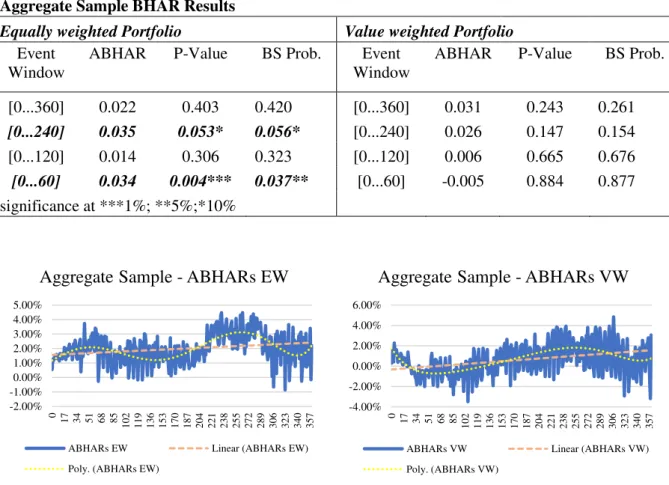
Figures 3 & 4

: Plotted ABHARs for the aggregate sample over the post-event window of 18 months.

For both the equally weighted portfolio and the value weighted portfolio, ABHARs are positive,

and in two cases significantly different from zero. In the equally weighted portfolio results are

significant, at 5% and 10% for the three- and twelve-month post-event windows, respectively.

This implies that, on average, shareholders of acquiring firms in this study experience a 3.5%

statistically significant wealth gain over one year after the announcement. This gain is driven

primarily by significant positive returns for acquirers in emerging countries, as pointed out in

chapter 5.2. An analysis of the results of the value weighted portfolio provides further support

for the previously established interpretation. Although positive and similar to those in the

equally weighted portfolio, no ABHARs in the value weighted portfolio are significant.

Therefore, no value effect is identified in the aggregate sample, which implies that the

significant positive ABHARs in the equally weighted portfolio are driven by long-term returns

-2.00%

-1.00%

0.00%

1.00%

2.00%

3.00%

4.00%

5.00%

0

17

34

51

68

85

102

119

136

153

170

187

204

221

238

255

272

289

306

323

340

357

Aggregate Sample - ABHARs EW

ABHARs EW

Linear (ABHARs EW)

Poly. (ABHARs EW)

-4.00%

-2.00%

0.00%

2.00%

4.00%

6.00%

0

17

34

51

68

85

102

119

136

153

170

187

204

221

238

255

272

289

306

323

340

357

Aggregate Sample - ABHARs VW

ABHARs VW

Linear (ABHARs VW)

Poly. (ABHARs VW)

(27)

27

from acquisitions with smaller deal values. These are the deals announced in emerging

countries.

5.2

Empirical Results of Individual Countries

The next chapter elaborates on the results obtained for event studies implemented separately

for two groups of developed-market acquirers and emerging-market acquirers, as well as

separately for the fourteen countries dealt with in this paper. The presentation follows

alphabetical order, and statistical outputs are grouped by events from developed markets and

emerging markets.

5.2.1 Individual Countries Short-term Event Study

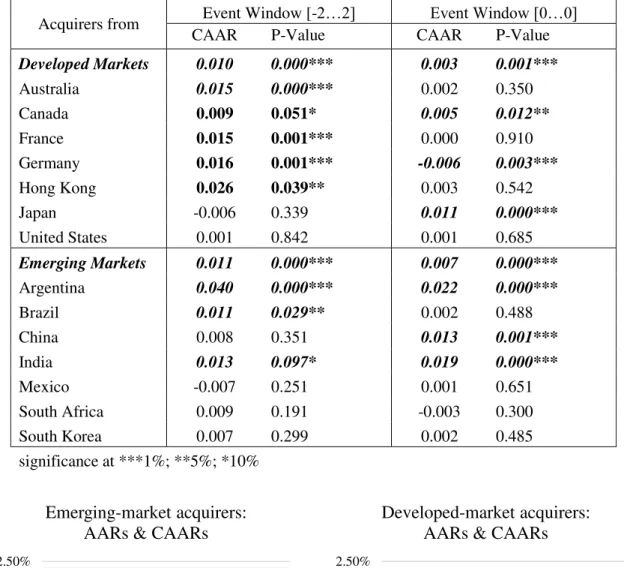
Table 4 illustrates the results obtained for the individual country short-term event study. For the

two subsamples of grouped acquirers from developed markets and emerging markets, this paper

finds proof of significant positive CAARs over a five-day event window and the announcement

date itself. Both developed-market and emerging-market acquirers experience a significant

positive 1% CAAR over a five-day event window. On the announcement day itself,

emerging-market acquirers display a 0.4% higher CAAR than developed-emerging-market acquirers, despite the

fact that both display significant CARs in the short term.

(28)

28

Table 4

: CAAR output short-term event study for individual countries with event windows of five days

and the announcement day itself.

Acquirers from

Event Window [-2…2]

Event Window [0…0]

CAAR

P-Value

CAAR

P-Value

Developed Markets

0.010

0.000***

0.003

0.001***

Australia

0.015

0.000***

0.002

0.350

Canada

0.009

0.051*

0.005

0.012**

France

0.015

0.001***

0.000

0.910

Germany

0.016

0.001***

-0.006

0.003***

Hong Kong

0.026

0.039**

0.003

0.542

Japan

-0.006

0.339

0.011

0.000***

United States

0.001

0.842

0.001

0.685

Emerging Markets

0.011

0.000***

0.007

0.000***

Argentina

0.040

0.000***

0.022

0.000***

Brazil

0.011

0.029**

0.002

0.488

China

0.008

0.351

0.013

0.001***

India

0.013

0.097*

0.019

0.000***

Mexico

-0.007

0.251

0.001

0.651

South Africa

0.009

0.191

-0.003

0.300

South Korea

0.007

0.299

0.002

0.485

significance at ***1%; **5%; *10%

Figures 5&6

: Plotted AARs and CAARs for developed-market acquirers and emerging-market

acquirers

over the main event window of [40…40] with statistically significant CAARs around the event

date for both subsamples.

The previously established hypothesis of no significant abnormal returns for developed-market

acquirers in the short term at the time of an announcement is therefore rejected. Moreover, this

paper finds evidence for the previously established hypothesis relating to acquirer returns from

emerging markets. In particular, significant CAARs are identified for Argentina and India in

-5.00%

-2.50%

0.00%

2.50%

-40-34-28-22-16-10 -4 2 8 14 20 26 32 38

Emerging-market acquirers:

AARs & CAARs

AARs

CAARs

-2.50%

0.00%

2.50%

-40-34-28-22-16-10 -4 2 8 14 20 26 32 38

Developed-market acquirers:

AARs & CAARs

(29)

29

respect of both event windows, and for Brazil and China in respect of one of the two windows.

In Argentina, the significant positive CAARs realised by acquirers can most likely be explained

on the basis of lower regulation and a less efficient security market, as noted by Simoes et al.

(2012). In India it is common practice to retain the acquired entity as a separate subsidiary. Rani

et al. (2013) note that these types of acquisitions result in significant positive abnormal returns

for acquirers, and could therefore also explain the significant positive CAAR on the

announcement date in this study. Furthermore, two factors might explain why Chinese market

acquirers realise a 1.3% gain on the announcement date itself. First, the Chinese market is not

as mature as other developed security markets, such as the US, and seems to be characterised

by irrational trading behavior, as discussed by Chi et al. (2011). In addition, M&As in China

only became frequent in the late 1990s. Therefore, many events in the sample occurred during

the M&A development stage in China.

5.2.2 Individual Countries Long-term Event Study

In addition to a short-term event study, long-term event studies were also conducted on

acquisition announcements from firms listed in the fourteen countries identified previously.

The results are presented in Table 5, and ABHARs are plotted for the groups of

developed-market acquirers and emerging-developed-market acquirers in Figures 7-10. Empirical results for

developed-market acquirers are in line with the established hypothesis H1a. Specifically, there

are no significant abnormal returns for the group of developed-market acquirers with regard to

either the equally weighted portfolio or the value weighted portfolio, over the long-term

post-announcement windows of 12 and 18 months. This suggests strong evidence of efficient

markets in the seven developed countries contained in this study. Although no ABHARS are

statistically significant for the group of developed-market bidders, a general pattern of negative

returns can be observed over the post-announcement period of 18 months. This is well

illustrated in Figures 7 and 8. Acquirers in Australia, in particular, lose a substantial 16% in

(30)

30

both the equally weighted portfolio and value weighted portfolio, which can be explained by

substantial overpayment or incorrect integration. Acquirers in Canada, on the other hand,

experience significant wealth gains of 11% and 13% in the equally weighted and value weighted

portfolios, respectively, over a post-event window of 12 months. In contrast to the wealth loss

experienced by the group of developed-market acquirers, acquirers from emerging countries

display significant positive abnormal returns in the value weighted portfolio over the

post-announcement windows of 12 and 18 months. This implies a value effect in which the

acquisitions with the highest deal values led the respective acquirers to perform considerably

well. The empirical results obtained in this study are therefore in line with the expectations

established in Hypothesis H1b. Moreover, acquirers from Brazil and South Korea experience a

substantial wealth gain over the post-announcement window of 18 months. However, this gain

is only statistically significant at 10%, and not under the bootstrapped version of the

skewness-adjusted t-test.

(31)

31

Table 5

: BHAR output long-term event study for acquirers listed in the fourteen individual countries –

equally weighted and value weighted portfolio

Acquirers from

Event Window [0…360]

Event Window [0…240]

ABHAR P-Value

BS Prob.

ABHAR P-Value

BS Prob.

Equal

ly w

ei

ght

ed

Po

rt

fol

io

Developed Markets

-0.003

0.957

0.9621

0.015

0.484

0.536

Australia

-0.154

0.027**

0.051*

-0.129

0.014**

0.023**

Canada

0.109

0.106

0.254

0.115

0.004***

0.036**

France

-0.011

0.841

0.852

0.016

0.661

0.717

Germany

-0.057

0.213

0.208

-0.017

0.520

0.546

Hong Kong

0.114

0.632

0.701

0.066

0.675

0.670

Japan

-0.009

0.830

0.848

0.008

0.839

0.860

United States

-0.020

0.689

0.703

-0.031

0.448

0.578

V

al

ue we

igh

ted

Po

rt

fo

li

o

Developed Markets

-0.016

0.6833

0.7117

0.004

0.827

0.843

Australia

-0.158

0.024**

0.048**

-0.107

0.037**

0.045**

Canada

0.105

0.120

0.267

0.130

0.001***

0.025**

France

-0.012

0.836

0.847

-0.014

0.696

0.768

Germany

-0.027

0.542

0.541

0.021

0.529

0.605

Hong Kong

-0.044

0.955

0.964

0.109

0.521

0.483

Japan

-0.040

0.388

0.464

-0.024

0.507

0.581

United States

-0.029

0.571

0.590

-0.020

0.624

0.709

Equal

ly w

ei

ght

ed

Po

rt

fol

io

Emerging Markets

0.051

0.229

0.245

0.057

0.051*

0.055*

Argentina

0.123

0.369

0.431

0.150

0.048**

0.323

Brazil

0.145

0.148

0.204

0.133

0.004***

0.007***

China

0.121

0.472

0.534

0.058

0.590

0.676

India

0.062

0.548

0.617

0.050

0.452

0.507

Mexico

0.056

0.622

0.665

0.119

0.235

0.287

South Africa

-0.069

0.504

0.547

-0.063

0.368

0.429

South Korea

0.058

0.533

0.606

0.069

0.313

0.353

V

al

ue we

igh

ted

Po

rt

fo

li

o

Emerging Markets

0.146

0.001*** 0.002***

0.083

0.005***

0.006***

Argentina

-0.276

0.253

0.578

-0.131

0.458

0.781

Brazil

0.210

0.058*

0.118

0.082

0.074*

0.082*

China

0.211

0.321

0.382

0.004

0.937

0.958

India

-0.007

0.975

0.978

0.131

0.070*

0.146

Mexico

-0.052

0.632

0.725

0.000

0.978

0.981

South Africa

0.104

0.329

0.457

0.144

0.095*

0.296

South Korea

0.180

0.078*

0.247

0.108

0.130

0.173

represents significance at ***1%; **5%; *10%

Imagem

Figure 1 illustrates the distribution of deal announcements  over the sample period.  It can be  observed that both deal announcements and deal value declined drastically in 2002 following  the  global  stock  market  downturn,  and  again  after  the  glo
Figure 2: Estimation and event windows for event studies with clear separation between pre- and post- post-event periods
Table 1: Most common methods of estimating the expected return benchmark.
Table 2: CAAR output – short-term event study on aggregate sample  Event
+7

Referências

Documentos relacionados

The company’s rising customer-centric mindset puts an extra emphasis and interest on met- rics, which evaluate the supply chain process from a customer point a view, that

Este estudo tem por objetivo geral: investigar se existe significância estatística de qualidade de vida entre mulheres e homens com anemia falciforme atendidas em unidades de

Ousasse apontar algumas hipóteses para a solução desse problema público a partir do exposto dos autores usados como base para fundamentação teórica, da análise dos dados

Com a grelha de observação pretendemos aferir da utilização dada, pelos formandos, à plataforma de apoio às sessões de formação bem como proceder à

The main objective of the present work is to compare the values of texture and rheological parameters for vegetable gels at different formulation and thermal processing condi-

O Diário de Notícias e o Correio da Manhã publicaram poucas e breves notícias sobre o assunto ao contrário do JN que publicou várias reportagens sobre as rádios no Grande Porto,

The plug-in, called MC-MODS (Merging Conflict and Mutation Operation Detection System), aims to detect behavioral merge conflicts for Java projects.. This is a type of