CIÊNCIAS DA VIDA E DA SAÚDE LIFE AND HEALTH SCIENCES
CIENCIAS DE LA VIDA Y LA SALUD
mill
e
nium
59
Millenium, 2(4), 59 -67.
ELEMENTOS DE ONTOLOGIA IDENTIFICADOS EM DIFERENTES SISTEMAS DE CLASSIFICAÇÃO DE ENFERMAGEM
ONTOLOGY ELEMENTS IDENTIFIED IN DIFFERENT NURSING CLASSIFICATION SYSTEMS
ELEMENTOS DE ONTOLOGÍA IDENTIFICADOS EN DIFERENTES SISTEMAS DE CLASIFICACIÓN DE ENFERMERÍA
Carina Maris Gaspar Carvalho
1Cláudia Regina Biancato
1Deborah Ribeiro Carvalho
1Andreia Malucelli
1Marcia Regina Cubas
1Maria Miriam Lima da Nóbrega
21 Health Technology, Pontifical Catholic University of Paraná, Curitiba, Brazil 2 Federal University of Paraíba, João Pessoa, Brazil.
Carina Maris Gaspar Carvalho - [email protected] | Cláudia Regina Biancato - [email protected] | Deborah Ribeiro Carvalho - [email protected] | Andreia Malucelli – [email protected] | Marcia Regina Cubas – [email protected] | Maria Miriam Lima da Nóbrega - [email protected]
Corresponding Author
Carina Maris Gaspar Carvalho
Health Technology, Pontifical Catholic University of Paraná R. Imac. Conceição, 1155 - Prado Velho, Curitiba - PR, 80215-901, Brasil
RECEIVED: 31th of August, 2017
Carvalho, C. M., Biancato, C. R., Carvalho, D. R., Malucelli, A., Cubas, M. R. & Nóbrega, M. M. (2017). Ontology elements identified in different nursing classification systems. Millenium, 2(4), 59-67.
m
4
60
RESUMO
Introdução: A Classificação Internacional para a Prática de Enfermagem (CIPE®) inclui uma ontologia para representar os seus
termos. No Brasil, a fim de contribuir para o desenvolvimento dessa classificação, foi elaborada uma ontologia, compreendendo a representação de conceitos e termos da Classificação Internacional para as Práticas de Enfermagem em Saúde Coletiva (CIPESC®). A identificação de elementos de ontologia nos sistemas de classificação mencionados ajuda a entender como eles podem ser usados para representar os elementos da prática de enfermagem de forma automatizada.
Objetivos: Identificar elementos de ontologia na CIPE® e CIPESC®.
Métodos: Estudo documental, exploratório e descritivo. A recolha de dados ocorreu pela captura de características estruturais
de diferentes versões da CIPE® e da CIPESC®, incluindo a estrutura de eixos e de hierarquia de termos. A análise dos dados compreendeu a comparação entre os elementos das características capturadas e os elementos de ontologia: conceitos, instâncias, propriedades, relacionamentos, restrições e axiomas.
Resultados: As características estruturais da CIPE® e da CIPESC® são apresentadas. Conceitos, propriedades, relacionamentos,
restrições e axiomas foram identificados em ambas as classificações.
Conclusões: Uma ontologia garante consistência às terminologias de enfermagem, fornecendo evidências para a prática e
contribuindo para a unificação da linguagem em enfermagem. Esta pesquisa facilita o desenvolvimento de ontologias para a prática de enfermagem baseada em terminologias de enfermagem, contribuindo para o desenvolvimento de políticas de saúde pelo uso de ontologias em sistemas de informação.
Palavras-chave: Informática em Enfermagem; Terminologia como Assunto; Representação de Conhecimento
ABSTRACT
Introduction: The International Classification for Nursing Practice (ICNP®) includes an ontology to represent the terms contained
within it. In Brazil, in order to contribute to the development of this classification, an ontology was elaborated, comprising the representation of concepts and terms from the International Classification of Public Health Nursing Practice (Classificação Internacional para as Práticas de Enfermagem em Saúde Coletiva – CIPESC®). The identification of ontology elements in the aforementioned classification systems helps to understand how they might be used to represent the elements of nursing practice in an automated manner.
Objectives: To identify ontology elements in the ICNP® and CIPESC®.
Methods: Documentary, exploratory, and descriptive study. Data collection was based on the capture of structural
characteristics of the various versions of the ICNP® and of the CIPESC®, including axis structure and term hierarchy structure. Data analysis was performed by comparing the elements of the captured characteristics with the following ontology elements: concepts, instances, properties, relationships, constrains and axioms.
Results: The structural characteristics of ICNP® and CIPESC® are presented. Concepts, properties, relationships, constrains, and
axioms were identified in both classifications.
Conclusions: An ontology ensures consistency to nursing terminologies, providing evidence for practice and contributing to the
unification of the nursing language. This research facilitates the development of ontologies for nursing practice based on nursing terminologies, contributing to the development of health policies by using ontologies in information systems.
Keywords: Nursing Informatics; Terminology as Topic; Knowledge Representation
RESUMEN
Introducción: La Clasificación Internacional para la Práctica de Enfermería (CIPE®) incluye una ontología para representar sus
términos. En Brasil, para contribuir al desarrollo de esa clasificación, una ontología fue elaborada, comprendiendo la representación de conceptos y términos de la Clasificación Internacional para las Prácticas de Enfermería en Salud Pública (CIPESC®). La identificación de elementos de ontología en los sistemas de clasificación mencionados ayuda a entender cómo pueden ser usados para representar los elementos de la práctica de enfermería de forma automatizada.
Objetivos: Identificar elementos de ontología en la CIPE® y CIPESC®.
Métodos: Estudio documental, exploratorio y descriptivo. La recolección de datos ocurrió por la captura de características
estructurales de diferentes versiones de CIPE® y de CIPESC®, incluyendo la estructura de ejes y de jerarquía de términos. El análisis de los datos comprendió la comparación entre los elementos de las características capturadas y los elementos de ontología: conceptos, instancias, propiedades, relaciones, restricciones y axiomas.
Resultados: Las características estructurales de CIPE® y CIPESC® se presentan. Conceptos, propiedades, relaciones, restricciones
y axiomas se identificaron en ambas clasificaciones
Conclusións: Una ontología garantiza consistencia a terminologías de enfermería, proporcionando evidencias para la práctica y
contribuyendo a la unificación del lenguaje de enfermería. Esta investigación facilita el desarrollo de ontologías para la práctica de enfermería basada en terminologías de enfermería, contribuyendo al desarrollo de políticas de salud por el uso de ontologías en sistemas de información.
Carvalho, C. M., Biancato, C. R., Carvalho, D. R., Malucelli, A., Cubas, M. R. & Nóbrega, M. M. (2017). Ontology elements identified in different nursing classification systems. Millenium, 2(4), 59-67.
m
4
61
INTRODUCTION
As a reference terminology for nursing practice, the International Classification for Nursing Practice (ICNP®) allows elaboration of nursing diagnoses, outcomes, and interventions through a combination of the terms included in the classification. In order to represent the terms contained within ICNP®, considering the various possibilities of combinations between its terms, the ICNP® has been represented by means of ontology (Conselho Internacional de Enfermeiros, 2016).
Representing knowledge by means of ontology allows for the automation of reasoning (Gruber, 1993). In the case of the ICNP®, the application of this resource will ensure consistency and precision of the concepts included in the terminology (Conselho Internacional de Enfermeiros, 2011).
The International Classification of Public Health Nursing Practice (Classificação Internacional das Práticas de Enfermagem em Saúde Coletiva – CIPESC®) is the Brazilian contribution to the advancement of the ICNP®. The CIPESC® vocabulary inventory was released in 2010, and it seeks to represent the dimensions, diversity, and broadness of nursing practices (Garcia & Nóbrega, 2010).
Aiming at including the Brazilian contribution to the development of the ICNP®, investigators from the Graduate Program in Health Technology of the Pontifical Catholic University of Paraná (Pontifícia Universidade Católica do Paraná – PUCPR) partially elaborated an ontology – the CIPESC® ontology (Silva, Malucelli & Cubas, 2009; Mattei, 2011; Cubas, Brondani & Malucelli, 2013; Bisetto & Cubas, 2015).
Considering the use of ontology in the elaboration of the ICNP® and the proposal to include the Brazilian contribution to it, this article demonstrates the relevance of the identification of ontology elements in the aforementioned classification systems to understand how they might be used to represent the elements of nursing practice in an automated manner.
The development of an ontology by nurses who are specialists in the field of informatics affects the everyday life of nurses in clinical settings since the ontology can ensure consistency of a classification system, and the use of a consistent classification system can provide evidence for nursing practice as well facilitate the unification of the nursing language. The evidence for practice and the unification of the language can be considered the gap that bridge this research with the everyday concerns of nurses, as nurses do not necessarily need to develop classification systems, but they do need to understand how classification systems are developed so that they can use those systems to provide evidence-based care.
As a function of the aforementioned considerations, this study aimed to identify ontology elements in the various versions of the ICNP® and in the CIPESC® vocabulary inventory.
1. THEORETICAL FRAMEWORK
From the development of the International Classification for Nursing Practice (ICNP®) in 1989, the International Council of Nurses (ICN) has elaborated nine ICNP® versions, consistent with the 2-year ICNP® release cycle, which current version is ICNP® 2015 (Conselho Internacional de Enfermeiros, 2016).
The ICNP® allows combination of primitive concepts to form complex concepts (for example the combination of the concepts ‘pain’ and ‘acute’ into the complex concept ‘acute pain’) (Conselho Internacional de Enfermeiros, 2016). As a whole, the rules for the elaboration of nursing diagnoses, outcomes, and interventions using ICNP® meet the recommendations in the International Organization for Standardization (ISO) standard 18104:2014, which seeks to specify the structures for representation of nursing diagnoses and nursing actions in terminological systems (International Organization for Standardization, 2014).
One of the purposes of ISO 18104 is to facilitate the representation of concepts of nursing diagnoses and actions and that of the relationships among concepts in an adequate manner for computer processing (International Organization for Standardization, 2014).
The ontology is at the core of the ICNP®. It provides a formal representation of ‘concepts’ (or ‘classes’) and their interrelationships based on the Classification. The subsequent versions to version 1.0 of the ICNP® (2005) have employed the same technology to arrange their concepts and interrelationships. The releases differ from each other by the addition of new concepts and the removal and replacement of concepts that are no longer required in nursing practice (Hardiker et al., 2011). In Brazil, the CIPESC® has been used in primary health care in order to stimulate the clinical and epidemiological reasoning, which contributes to the analysis of needs relating to health-disease process of the individual, family and social group (Cavalcante et al., 2016).
The CIPESC® ontology comprised the representation of concepts of different versions of the ICNP® and terms included in the CIPESC® vocabulary inventory and in the dissertations developed at PUCPR (Silva, Malucelli & Cubas, 2009; Mattei, 2011; Cubas, Brondani & Malucelli, 2013; Bisetto & Cubas, 2015).
An ontology is a formal (which means machine-processed) specification (Studer, Benjamins & Fensel, 1998) of a given worldview shared by a community (Borst, 1997).
Ontologies comprise the following elements: concepts or classes, which are the categories relevant to the domain of interest (Studer, Benjamins & Fensel, 1998; Grimm, Hitzler & Abecker, 2007); instances, which are particular, concrete, or abstract objects classified based on the concepts of or those belonging to a definite class (Borst, 1997; Grimm, Hitzler & Abecker, 2007);
Carvalho, C. M., Biancato, C. R., Carvalho, D. R., Malucelli, A., Cubas, M. R. & Nóbrega, M. M. (2017). Ontology elements identified in different nursing classification systems. Millenium, 2(4), 59-67.
m
4
62
properties or attributes, which are the characteristics of concepts or values of the class (Studer, Benjamins & Fensel, 1998; Gruber, 1993; Noy & McGuinness, 2001); relationships, which establish connections between concepts or subsumption relationships (Guarino, 1998); constrains, which set limits to the relationships between concepts (Noy & McGuinness, 2001); and axioms, which are defined as assertions that are always true in the domain (Borst, 1997).
In an ontology, a class may be related to other classes through a hierarchy based on the generic relation – a ‘kind of’ hierarchy. For example, in the ICNP®, ‘Analgesic’ is represented as a kind of ‘Drug’. Thus, the ontology allows inference that ‘AdministeringAnalgesic’ would also be a kind of ‘AdminsteringDrug’. Considering that classes may be related to other classes via properties, for ‘AdministeringDrug’, ‘AdministeringAct’ is associated with ‘Drug’ via a property called ‘hasInterventionalTarget’. Therefore, the ICNP® ontology comprises elementary classes, such as ‘Drug’ and ‘AdministeringAct’, which provide the building blocks for composed classes, such as ‘AdministeringDrug’, which is also included in the Classification (Hardiker et al., 2011).
2. METHODS
This manuscript is a documentary, exploratory, and descriptive study.
As this was a documentary study without direct or indirect participation of human beings, approval by a research ethics committee was not required.
2.1 Empirical bases
The empirical bases were: printed ICNP® 1.0; electronic ICNP® 1.1; printed ICNP® 2.0; electronic ICNP® 2.0; electronic ICNP® 2011; ICNP® 2013; ICNP® 2015; and the CIPESC® vocabulary inventory.
The versions of the ICNP® that preceded version 1.0 were not included in this study because they were not elaborated with an ontology.
2.2 Data collection instruments and procedures
Data collection was based on the visual capture of the structural characteristics of the various versions of the ICNP® in chronological order and of the CIPESC® vocabulary inventory, based on the structures that determine the organization of terms within these classification systems, including axis structure and term hierarchy structure.
2.3 Data analysis
Data analysis was performed by comparing the elements of the captured characteristics with the following ontology elements: concepts (or classes), instances, properties, relationships, constrains and axioms.
3. RESULTS
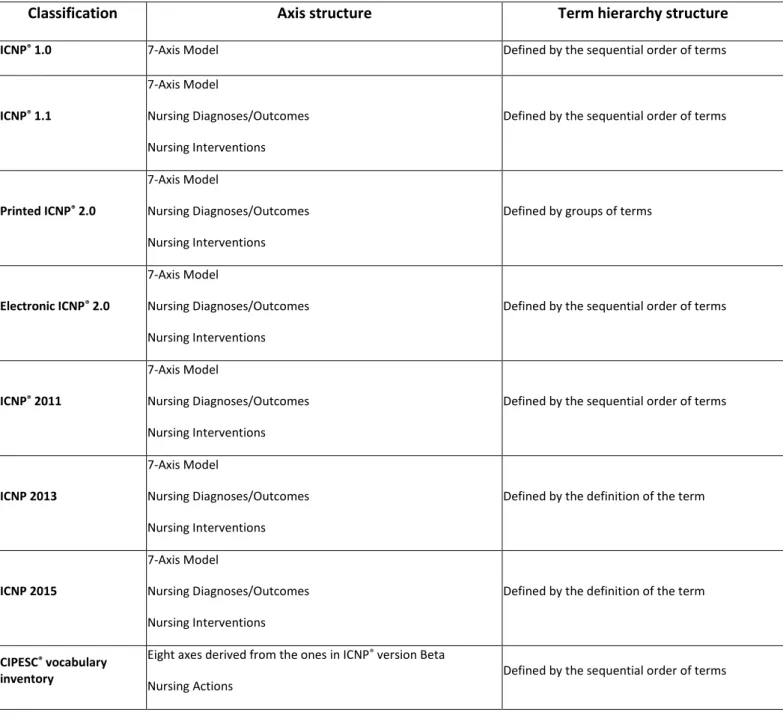
Table 1 depicts the structural characteristics of the various versions of the ICNP® and the CIPESC® vocabulary inventory according to the axes and hierarchies that determine the organization of the terms included within the axes.
The various versions of the ICNP® exhibit a multi-axial structure. In other words, they include multiple axes, which accommodate terms that represent the elements of nursing practice. All the analysed versions follow the 7 -Axis Model introduced in version 1.0, which includes Focus, Judgment, Means, Action, Time, Location, and Client. Starting with version 1.1, lists of assertions of Nursing Diagnoses/Outcomes and Nursing Interventions are included in the structure of the ICNP®.
The structure of the CIPESC® vocabulary inventory comprises eight axes to which terms that represent nursing practice elements are allocated. This structure is similar to that proposed in ICNP® version Beta, which included Nursing Practice Focus, Judgment, Frequency, Duration, Body Site, Topology, Likelihood, and Bearer. In addition to these eight axes, the inventory also includes a list of Nursing Actions, which does not amount to an axis per se.
The various versions of the ICNP® and the CIPESC® vocabulary inventory arrange their terms in hierarchical structures, which are mutually related by means of superclass–subclass relationships. For example, in ICNP®, the term ‘wound’ is a superclass of the term ‘traumatic wound’, while the term ‘traumatic wound’ is a subclass of the t erm ‘wound’.
Carvalho, C. M., Biancato, C. R., Carvalho, D. R., Malucelli, A., Cubas, M. R. & Nóbrega, M. M. (2017). Ontology elements identified in different nursing classification systems. Millenium, 2(4), 59-67.
m
4
63
Table 1 – Structural characteristics of various ICNP® versions and the CIPESC® vocabulary inventory
Classification
Axis structure
Term hierarchy structure
ICNP® 1.0 7-Axis Model Defined by the sequential order of termsICNP® 1.1
7-Axis Model
Nursing Diagnoses/Outcomes Nursing Interventions
Defined by the sequential order of terms
Printed ICNP® 2.0
7-Axis Model
Nursing Diagnoses/Outcomes Nursing Interventions
Defined by groups of terms
Electronic ICNP® 2.0
7-Axis Model
Nursing Diagnoses/Outcomes Nursing Interventions
Defined by the sequential order of terms
ICNP® 2011
7-Axis Model
Nursing Diagnoses/Outcomes Nursing Interventions
Defined by the sequential order of terms
ICNP 2013
7-Axis Model
Nursing Diagnoses/Outcomes Nursing Interventions
Defined by the definition of the term
ICNP 2015
7-Axis Model
Nursing Diagnoses/Outcomes Nursing Interventions
Defined by the definition of the term
CIPESC® vocabulary
inventory
Eight axes derived from the ones in ICNP® version Beta
Nursing Actions
Defined by the sequential order of terms
In versions 1.0, 1.1, 2.0 electronic, and 2011 of the ICNP® and in the CIPESC® vocabulary inventory, the hierarchies are defined by the sequential order of terms, which means that they are arranged in sequences according to their common, shared characteristics. The printed 2.0 version of the ICNP® presents hierarchies defined by groups of terms; that is, the terms are not necessarily arranged in a sequential order. The hierarchy of the 2013 and 2015 versions is defined by the definition of the term, which means that the superclass of the term is found in its definition, since these versions dispose the terms in alphabetic order.
Regardless of the arrangement of the order of the terms, in both the ICNP® and the CIPESC® vocabulary inventory, terms are related to their axes by means of superclass–subclass relationships. For example, the term ‘wound’ is a subclass of the axis Focus, while the axis Focus is the superclass of the term ‘wound’. Moreover, since ‘traumatic wound’ is a subclass of ‘wound’, ‘traumatic wound’ is also a subclass of the axis Focus.
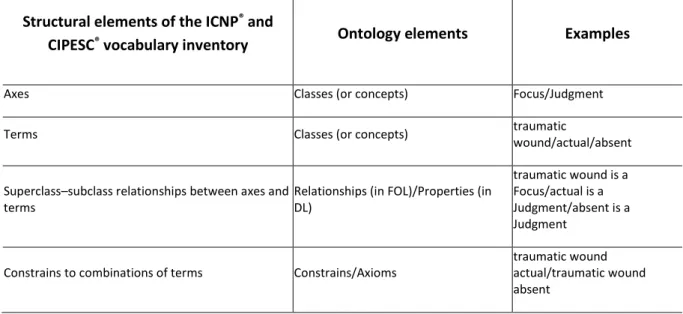
From the structural characteristics of the various ICNP® versions and the CIPESC® vocabulary inventory, the following structural elements were identified: axes, terms, superclass –subclass relationships between axes and terms, and
Carvalho, C. M., Biancato, C. R., Carvalho, D. R., Malucelli, A., Cubas, M. R. & Nóbrega, M. M. (2017). Ontology elements identified in different nursing classification systems. Millenium, 2(4), 59-67.
m
4
64
constrains to combinations of terms. This last element was identified once there are established constrains for the combinations among terms for the construction of nursing diagnoses, interventions, and outcomes.
Based on the structural elements, ontology elements were identified in the ICNP® and the CIPESC® vocabulary inventory (Table 2).
Table 2 – Ontology elements identified based on the structural elements of the ICNP® and the CIPESC® vocabulary inventory
Structural elements of the ICNP
®and
CIPESC
®vocabulary inventory
Ontology elements
Examples
Axes Classes (or concepts) Focus/Judgment Terms Classes (or concepts) traumatic
wound/actual/absent Superclass–subclass relationships between axes and
terms
Relationships (in FOL)/Properties (in DL)
traumatic wound is a Focus/actual is a Judgment/absent is a Judgment
Constrains to combinations of terms Constrains/Axioms
traumatic wound actual/traumatic wound absent
Observation of the ICNP® 7-Axis Model and the eight axes in the CIPESC® vocabulary inventory shows that the axes facilitate the
organization of hierarchical structures for the elaboration of an ontology because they might serve as preset root classes (or concepts).
The relationship between super- and subclasses might be characterised as a subsumption relationship: superclasses contain (subsume) subclasses, while subclasses are contained (subsumed) in the superclasses (Horridge, 2007).
Therefore, from the perspective of ontologies, considering the relationship between an axis and a term in the ICNP® as a
subsumption relationship, one might assert that, for example, the Focus axis contains (subsumes) the concept ‘traumatic wound’; alternatively, the concept ‘traumatic wound’ is contained in (is subsumed by) the Focus axis. Furthermore, once the Judgment axis subsumes the concepts ‘actual’ and ‘absent’, it can be said that the concepts ‘actual’ and ‘absent’ are subsumed by the Judgment axis.
The subsumption relationship also means that being a subclass of ‘A’ implies being ‘A’ (Horridge, 2007). Therefore, it is acceptable to assume that ‘traumatic wound’ is a Focus and that ‘actual’ and ‘absent’ are Judgments.
Observation of the subsumption relationship between ICNP® axes and terms showed that the ontology element ‘relationship’
might be represented by a first-order logic (FOL) binary predicate (Grimm, Hitzler & Abecker, 2007), as shown in the following example: is A (traumatic wound, Focus), which means, ‘traumatic wound is a Focus’. Following the same reasoning, considering that ‘actual’ and ‘absent’ are Judgments, it can be said that ‘actual is a Judgment’ [is A (actual, Judgment)] and ‘absent is a Judgment’ [is A (absent, Judgment)].
The predicate symbol ‘is A’ represents both a relationship between classes (from the perspective of FOL) (Grimm, Hitzler & Abecker, 2007) and a property that relates classes [from the perspective of description logics (DL)] (Baader, Horrocks & Sattler, 2003). Thus, the subsumption relationship between ICNP® axes and terms allows the identification of the ontology elements
‘relationship’ (in FOL) and ‘property’ (in DL).
Considering the establishment of constrains for the combinations among terms for the construction of nursing diagnoses, interventions, and outcomes based on nursing terminologies (International Organization for Standardization, 2014),it was possible to identify the ontology element ‘constrain’. For instance, nursing diagnoses and outcomes must include one term from the Focus axis and one term from the Judgment axis (Conselho Internacional de Enfermeiros, 2016); thus, constrains must necessarily be imposed on the scope of possible relationships among terms to meet those requirements.
The constrains for the relationship among terms for the elaboration of a Nursing Diagnosis (ND) and of a Nursing Outcome (NO) can be expressed as follows:
Carvalho, C. M., Biancato, C. R., Carvalho, D. R., Malucelli, A., Cubas, M. R. & Nóbrega, M. M. (2017). Ontology elements identified in different nursing classification systems. Millenium, 2(4), 59-67.
m
4
65
1. ∀ (ND) ≡ ∃ (Focus(x) ∧ Judgment(y)), which means that ‘for all nursing diagnoses, there exists one Focus and there exists one Judgment’.
2. ∀ (NO) ≡ ∃ (Focus(x) ∧ Judgment(y)), which means that ‘for all nursing outcomes, there exists one Focus and there exists one Judgment’.
Considering ‘x’ and ‘y’ as variables, one value, corresponding to a concept in the Focus axis, ought to be attributed to predicate Focus(x), and another value, corresponding to a concept in the Judgment axis, ought to be attributed to predicate Judgment(y). For example, to compose a nursing diagnosis, the Focus ‘traumatic wound’ must be combined with a term from the Judgment axis, for example, ‘actual’. Thus, the representation to this combination is: (Focus(traumatic wound) ∧ Judgment(actual)), which means that the sentence of the nursing diagnosis is ‘traumatic wound actual’. Following the same reasoning, to compose a nursing outcome to the presented diagnosis, the Focus ‘traumatic wound’ could be combined, for example, with the Judgment ‘absent’. Thus, the sentence of the nursing outcome is ‘traumatic wound absent’, which is represented by: (Focus(traumatic wound) ∧ Judgment(absent)).
The establishment of constrains to the possible relationships among concepts, which comprises rules for the combination of concepts vis-à-vis the elaboration of nursing diagnoses, interventions, and outcomes might also be considered as an ‘axiom’ because this element determines constrains to the relationships among classes (Studer, Benjamins & Fensel, 1998; Grimm, Hitzler & Abecker, 2007) and comprises an assertion of relationships that are always true within the domain (Borst, 1997).
4. DISCUSSION
The versions 1.1, 2.0, 2011, 2013 and 2015 of the ICNP® exhibit two structures of previously related assertions: Nursing Diagnoses/Outcomes and Nursing Interventions. In all the versions, a definition is attributed to each assertion. From an ontology perspective, the descriptions of ICNP® diagnoses, interventions, and outcomes might be represented by concepts (or classes); thus, no rules are needed for the combination of terms. Nevertheless, the relevance of the 7-Axis Model for the elaboration of assertions not included in the ICNP® should be noted.
The format adopted for term presentation in the printed 2.0 version of the ICNP® requires nurses to be previously acquainted with the classification hierarchy. Otherwise, nurses cannot detect any organization in the arrangement of the terms; thus, they do not know how to use the printed version of the ICNP®.
It is noteworthy that, with each release of a new version, the ICNP® presents an increase in the number of complex concepts, whereas the number of primitive concepts is decreasing (Conselho Internacional de Enfermeiros, 2016).
Any formal terminology should include explicit rules for specific formulation of complex concepts from primitive concepts (Conselho Internacional de Enfermeiros, 2016). The representation of the rules to combine ICNP® concepts in an ontology by means of constrains or axioms makes such rules explicit, as can be observed in the following example: ‘for all nursing diagnoses, there exists one Focus and there exists one Judgment’. According to this axiom, every nursing diagnoses must contain one concept from the axis Focus and one concept from the axis Judgment, for example, the nursing diagnosis ‘traumatic wound actual’, in which ‘traumatic wound’ is a Focus and ‘actual’ is a Judgment.
The constrains imposed on the possible relationships and their representation by means of an ontology not only allow for the elaboration of nursing diagnoses, interventions, and outcomes compatible with ICNP® and ISO-18104 requirements but also, by restricting the countless possibilities of combinations among the terms included in the various ICNP® axes, prevent cases of inconsistency and incoherence. Consequently, such constrains might facilitate the development of clinical reasoning among nurses and the unification of the nursing language (Silva, Malucelli & Cubas, 2009).
The use of nursing terminologies contributes to production of knowledge and nursing evidences (Strudwick & Hardiker, 2016). In Brazil, the CIPESC® represents the dimensions, diversity, and breadth of nursing practices in the context of the Unique Health System (Sistema Único de Saúde – SUS) (Garcia & Nóbrega, 2010). In the State of Paraná, Brazil, the CIPESC® is included in an information system to support decision-making within public health policies (Chaves et al., 2011). One of the indicators expected of this system is the incorporation of the elements of nursing practice in the ambulatory information system of SUS (Associação Brasileira de Enfermagem, 2013). However, the ontology of the CIPESC® is not included in that information system.
Therefore, in order to ensure consistency of the concepts within the CIPESC® and, consequently, to provide evidence for nursing practice, it is important to encourage nurses to elaborate the representation of the ontology elements of CIPESC® within information systems which include nursing diagnoses, interventions, and outcomes.
CONCLUSIONS
The identification of ontology elements in the various versions of the ICNP® and the CIPESC® vocabulary inventory contributes to the reflection on how such elements might be used in these classifications to represent the terms of nursing practice as well as the relationships among them.
Carvalho, C. M., Biancato, C. R., Carvalho, D. R., Malucelli, A., Cubas, M. R. & Nóbrega, M. M. (2017). Ontology elements identified in different nursing classification systems. Millenium, 2(4), 59-67.
m
4
66
As a function of the continuous updating of the ICNP® and because of the need to update the CIPESC® vocabulary inventory, the relevance of the use of an ontology for reusing previously modelled knowledge and for explicitly defining the concepts of classifications in an automated manner should be emphasized to avoid inconsistencies, such as redundancies and ambiguities. The use of a consistent classification system can ensure evidence for the nursing practice as well as contribute to the unification of the nursing language. Thus, the development and use of ontology by nurses is an important field to be explored.
This research can be applied to stimulate and facilitate the elaboration and development of ontologies for the nursing practice domain, based on nursing terminologies.
It is important to note that nurses in clinical settings do not necessarily need to develop classification systems, but they do need to understand how classification systems are developed, including the ontology-based ones, so they can use consistent classification systems to provide evidence-based care.
REFERENCES
Associação Brasileira de Enfermagem. (2013). Associação Brasileira de Enfermagem 1926-1976: Documentário. Brasília: ABEn. Baader, F., Horrocks, I., & Sattler, U. (2003). Description logics as ontology languages for the semantic web. Retrieved from:
http://www.cs.man.ac.uk/~horrocks/Publications/download/2003/BaHS03.pdf.
Bisetto, L. H. L., & Cubas, M. R. (2015). Subconjunto terminológico da CIPE® para o cuidado com as pessoas com eventos adversos pós-vacinação. In: M. R. Cubas, & M. M. L. Nóbrega (Orgs), Atenção primária em saúde: Diagnósticos,
resultados e intervenções. Rio de Janeiro: Elsevier.
Borst, W. N. (1997). Construction of engineering ontologies for knowledge sharing and reuse. Enschede: University of Twente. Retrieved from: http://doc.utwente.nl/17864/1/t0000004.pdf.
Cavalcante, M. D. M. A., Larocca, L. M., Chaves, M. M. N., Cubas, M. R., Piosiadlo, L. C. M., & Mazza, V. A. (2016). Nursing terminology as a work process instrument of nurses in collective health. Revista da Escola de Enfermagem da USP,
50(4), 610-616. Retrieved from: http://www.scielo.br/pdf/reeusp/v50n4/pt_0080-6234-reeusp-50-04-0610.pdf.
Chaves, M. M. N., Farias, F. C. S. A., Apostólico, M. R., Cubas, M. R., & Egry, E. Y. (2011). Breastfeeding: Nurses' practice under the perspective of the international classification of collective health nursing practices. Revista da Escola de
Enfermagem da USP, 45(1), 194-200. Retrieved from: http://www.scielo.br/pdf/reeusp/v45n1/en_28.pdf.
Conselho Internacional de Enfermeiros. (2011). Classificação internacional para a prática de enfermagem: CIPE®: Versão 2.0. São Paulo: Algol.
Conselho Internacional de Enfermeiros. (2016). Classificação internacional para a prática de enfermagem: CIPE®: Versão 2015. Porto Alegre: Artmed.
Cubas, M. R., Brondani, A. M., & Malucelli, A. (2013). Nursing diagnoses and outcomes related to the circulatory-system terms (INCP®) represented in an ontology. Revista da Escola de Enfermagem da USP, 47(5), 1068-1075. Retrieved from: http://www.scielo.br/pdf/reeusp/v47n5/0080-6234-reeusp-47-05-1068.pdf.
Garcia, T. R., & Nóbrega, M. M. L. (2010). Inventário vocabular resultante do projeto CIPESC CIE-ABEn. In T. R. Garcia, & E. Y. Egry (Orgs), Integralidade da atenção no SUS e sistematização da assistência de enfermagem. Porto Alegre: Artmed.
Grimm, S., Hitzler, P., & Abecker, A. (2007). Knowledge representation and ontologies: Logic, ontologies and semanticweb
languages. Retrieved from: http://knoesis.wright.edu/pascal/resources/publications/kr-onto-07.pdf.
Gruber, T. R. (1993). A translation approach to portable ontology specifications. Knowledge Acquisition, 5(2), 199-220. Retrieved from: http://www.dbis.informatik.hu-berlin.de/dbisold/lehre/WS0203/SemWeb/lit/KSL-92-17.pdf.
Guarino, N. (1998). Formal ontology and information systems. Proceedings of FOIS’98. Trento: IOS Press. Retrieved from: http://www.loa.istc.cnr.it/Papers/FOIS98.pdf.
Hardiker, N. R., Kim, T. Y., Coenen, A. M., & Jansen, K. R. (2011). A dynamic classification approach for nursing. AMIA Annual
Symposium Proceedings, 2011, 543-548. Retrieved from:
https://www.ncbi.nlm.nih.gov/pmc/articles/PMC3243282/pdf/0543_amia_2011_proc.pdf
Horridge, M. (2007). A practical guide to building OWL ontologies using Protégé 4 and CO-ODE Tools Edition 1.1. The University Of Manchester. Retrieved from:
http://mowl-power.cs.man.ac.uk/protegeowltutorial/resources/ProtegeOWLTutorialP4_v1_3.pdf.
International Organization for Standardization. (2014). ISO 18104 2014: Health informatics: Categorial structures for
representation of nursing diagnoses and nursing actions in terminological systems. Geneva: ISO.
Mattei, F. D. (2011). Elaboration of nursing diagnoses and outcomes related to the pain process through the combination of
Carvalho, C. M., Biancato, C. R., Carvalho, D. R., Malucelli, A., Cubas, M. R. & Nóbrega, M. M. (2017). Ontology elements identified in different nursing classification systems. Millenium, 2(4), 59-67.
m
4
67
Noy, N. F., & McGuinness, D. L. (2001). Ontology development 101: A guide to creating your first ontology. Stanford. Retrieved from: http://www.ksl.stanford.edu/people/dlm/papers/ontology-tutorial-noy-mcguinness.pdf.
Silva, R. R., Malucelli, A., & Cubas, M. R. (2009). Towards ontology CIPESC®. Journal of Health Informatics, 1(1), 22-6. Retrieved from: http://www.jhi-sbis.saude.ws/ojs-jhi/index.php/jhi-sbis/article/viewFile/89/74.
Strudwick, G., & Hardiker, N. R. (2016). Understanding the use of standardized nursing terminology and classification systems in published research: A case study using the international classification for nursing practice®. International Journal of
Medical Informatics, 94, 215–221. Retrieved from:
http://www.sciencedirect.com/science/article/pii/S1386505616301411.
Studer, R., Benjamins, V. R., & Fensel, D. (1998). Knowledge engineering: Principles and methods. Data & Knowledge