Escola das Artes da Universida de Católica Portugues a Mestrado em Gestão de Indústrias Criativas
A process centred perspective of the creative industries: an
analytical model for management
Gestão de Indústrias Criativas 2014
Fernando Afonso Carrapatoso Lima
Professor Orientador: Professora Doutora Ana Lourenço
Acknowledgements
I would like to thank all personnel from UCP that contributed to the success of this work, especially to my dissertation supervisor Ana Lourenço, to whom I would like to express my gratitude for taking this project and for her guidance, efforts and patience that made this research possible.
I would like to thank to my good friends Ana, Rodrigo, Manuel, Mariana, Daniela, Manel, João Pedro, André and António, who spent some time listening to my ideas and worries during this study, and helped me to develop and clarify my research process. I would also like to thank to all my friends of ZigurArtists for being such an inspiration and source of collective creativity, providing me a unique environment for sharing ideas and develop practical knowledge on managing creative industries.
Finally I would like to thank my parents and my sister for always supporting me and encouraging me despite all the adversities. For all the efforts on supporting me, in this work and everyday life, any expression of gratitude will always be short.
Abstract
This dissertation adopts a process-centred perspective of understanding the economic model of the creative industries, so as to explore how can one build an analytical model that can be useful for improving management practices in those industries.
The point of departure to address the research question was to review the debate around the definition of creative industries; then followed a discussion on the development of a framework for the understanding of the creative industries process-centred perspective; finally an assessment of the creative industries’ economic model from the management perspective was done via a value-chain analysis, in order to discuss the implications of the process-centred perspective for management and for public policy design.
The research developed allowed the proposal of an analytical model that revealed the importance of operationalizing the understanding of value-creation through creativity in management practices. It also emphasized the challenge in balancing open-ended processes with the firm’s commercial purposes, by managing intangible aspects of the creative process and the engagement of the creative workers into the creative process.
The analytical model developed may be helpful for managers insofar as it offers a disaggregation of the companies’ activities by focusing on the assessment of how the creative process can recursively occur in the company as a production process. Moreover it may help on the identification of the core-activities and the assessment of the main components of those activities.
The research done intends to contribute to the understanding of how the creative industries work and to the development of good management practices in the sector. Thus, it also suggests that it would be interesting to develop research on a theoretical revision of the components of the creative industries’ economic model and on a proper comparative analysis of the model delivered at an inter-sector, an inter-temporal and at a subsector level. By advancing an analytical model for creative industries that is focused on its usefulness for management, it indicates areas of interest for empirical research.
Index
List of figures ... 1
List of tables ... 2
1. Introduction ... 3
2. Assessing definitions of “creative industries” ... 7
2.1. A review of the concept of ‘creative industry’ ... 7
2.2. The DCMS definition of ‘creative industry’: main aspects and criticisms ... 12
2.2.1. Creativity ... 13
2.2.2. Cultural industries rebranding ... 14
2.2.3. Symbolic meaning ... 15
2.2.4. Knowledge economy, information society and intellectual property ... 16
2.2.5. Production methods and process ... 17
2.2.6. Solving the breadth question ... 18
2.3. A need for a new definition? ... 20
2.3.1. Creative workforce and the creative trident ... 21
2.3.2. “Creative intensity” method ... 21
2.3.3. Creative occupations ... 22
2.3.4. DCMS and the creative-intensity approach ... 23
2.3.5. Social network markets ... 25
2.3.6. Final comments ... 27
2.3.7. Summary ... 29
3. Advancing and discussing an analytical framework of the creative industries’ economic model ... 31
3.1. Origins of the proposed approach ... 31
3.1.1. Main keywords and the IPO model ... 31
3.2. Understanding creativity as the key feature of the creative industries’ economic model ... 36
3.2.1. Exploring the source of creativity ... 36
3.2.2. The process-based view of creativity ... 38
3.3. Creativity Intensive industries: A process-centred perspective ... 40
3.3.1. IPO model of analysing the creativity-intensive industries ... 41
3.4. Summary ... 48
4. Implications of a process-centred perspective of the creative industries ... 50
4.1. Assessing the analytical framework ... 50
4.2.1. Human resource management ... 53
4.2.2. Operations ... 54
4.2.3. Marketing ... 55
4.2.4. Support Activities ... 56
4.2.5. Final comments ... 57
4.3. Implications for definitional issues and public policy ... 58
4.3.1. Process Centred Definition vs. Input-Output Definitions ... 58
4.3.2. All industries are (not) creative ... 59
4.3.3. Cultural vs. Creative ... 60
4.3.4. Classifying, mapping and measuring the creative industries ... 61
5. Conclusions ... 63
List of figures
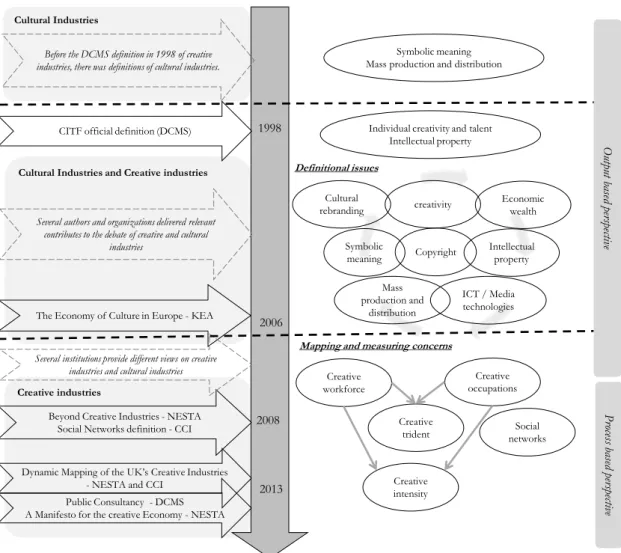
Figure nº 1: Schematic representation of the creative industries’ debate evolution ... 29
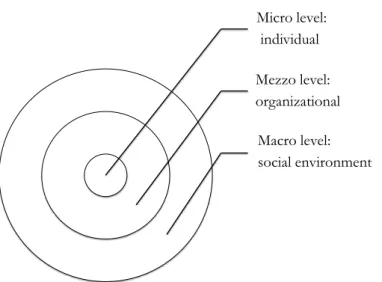
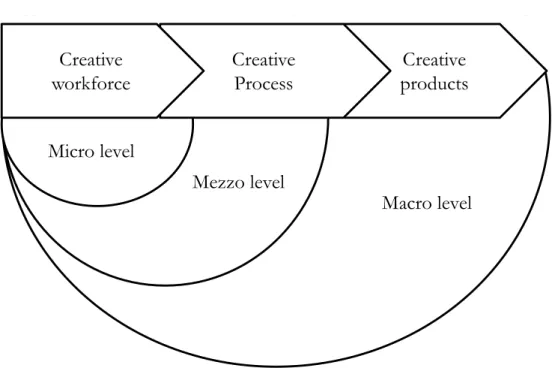
Figure nº 2: Scheme of the creative system’s levels ... 40
Figure nº 3: Creative Industries through the IPO model ... 42
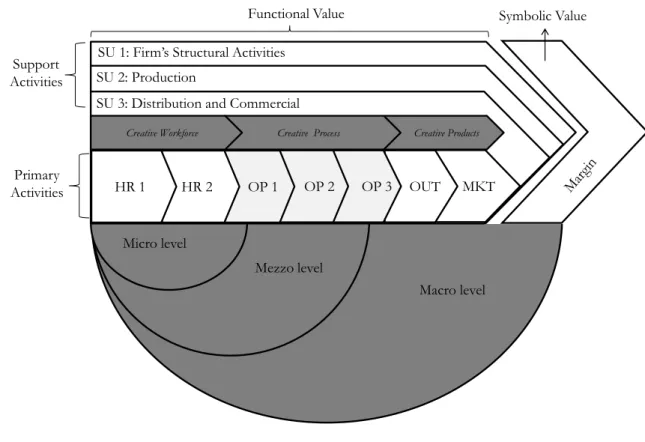
Figure nº 4: The creative industries’ economic model and the creative system ... 42
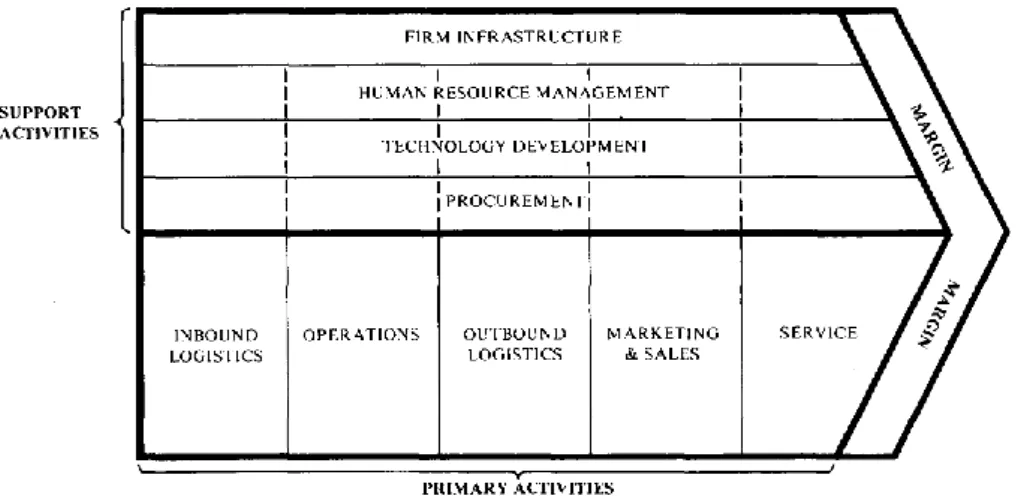
Figure nº 5: Porter’s generic value-chain ... 51
List of tables
Table nº 1: The concepts of ‘creative industries’ and ‘cultural industries’ ... 8
Table nº 2: Classification systems for the creative industries derived from different models ... 19 Table nº 3: Keywords and the IPO model ... 32
1. Introduction
For the last decades the concept of creativity has been increasingly occupying a central role in political, cultural, economics and business debates (Araya & Peters, 2010; Bilton & Leary, 2010; Flew & Cunningham, 2010; KEA European Affairs, 2009; Schiuma, 2011). In the intersection of political and cultural economics, business and creativity is a “range of activities” known as “creative industries”. The official and theoretical definition of the creative industries has been in debate, at least, since 1998, when there was “the decision of the then newly elected British Labour government of Tony Blair to establish a Creative Industries Task Force (CITF), as a central activity of its new Department of Culture, Media and Sport (DCMS)” (Flew & Cunningham, 2010). As a result of this decision, the CITF stated an official definition for this sector that was in the “central plank of the United Kingdom’s ‘post-industrial’ economy” (Flew & Cunningham, 2010) and provided a new political perspective on the cultural sector, by shifting the terminology from cultural to creative industries as a rebranding of the cultural sector, and specifically the cultural industries (Cunningham, 2002; Flew & Cunningham, 2010; Flew, 2012; Garnham, 2005; Hesmondhalgh, 2002; Jeffcutt & Pratt, 2002; O’Connor, 2000, 2007). The ‘Creative Industries Mapping Document’ (DCMS, 1998) was the first attempt to defining, mapping and measuring the creative industries in a public policy context. This pioneer experience of discussing the economic relevance and distinction of the creative industries of the UK’s Government has had an influence in introducing this debate in the political context all over the world. In fact, the DCMS definition of creative industries has been used as reference by several countries and cities, as a tendency for modernization (O’Connor, 2007). The Portuguese case is not an exception: the DCMS definition is referred in such relevant documents such as the Portuguese Government ‘Technological Plan’ (UCPT, 2005), a study for the Ministry of Economy from Augusto Mateus (Mateus, 2010), and the ‘Macroeconomic Study’ from Fundação Serralves (2008), that intended to foster the development of the Creative Industries cluster in the north of the country.
The concept of ‘creative industries’ is historically linked to the concept of ‘cultural industries’, as some authors argument that it is a rebranding of the cultural sector. This terminological clutter provokes that both terms are often referred as synonymous, complementary concepts, or even completely different concepts. Despite the relevance of the debate on ‘cultural industries versus creative industries’, namely regarding issues of terminology and scope, what should be emphasized is how the definition of creative industries established by the DCMS called for a new analytical perspective: the DCMS definition brought a new light into the analysis of a real economic phenomenon – the so called creative industries – that could be analysed apart of the traditional cultural economics (Throsby, 2001) approach: These industries, that are usually assumed as creative industries, don't seem to have any substantial “market failure” issue (O’Connor, 2009), which was considered a central argument of the traditional cultural economics theory on the regulation of cultural markets (Galloway & Dunlop, 2007, p. 26). Towse (2003) also noted that these activities (the creative industries) could not fit into the criteria of ‘cultural industries’, as they do not employ industrial scale productions methods. These industries are economic and market-oriented activities
with business models that incorporate, somehow, creativity at its core. Hence, the ‘creative industries’ definitions could be seen as more than a merely rebranding of the cultural industries.
In the beginning of 2013, NESTA - the National Endowment for Science Technology and the Arts, as innovation hub based in the UK - released a new study on the classification and mapping methodology for the UK’s creative industries called ‘A Dynamic Mapping of the UK’s Creative
Industries’ (Bakhshi, Freeman, et al., 2013). The methodology presented in this document was called
the ‘creativity-intensities’ and had a crucial focus on the role of the creative workers on the creative process. Hence, it points to an understanding of the creative industries based on how creativity happens, and how relevant it is to these business activities. Later that year, the DCMS started a public consultancy to review the classification and mapping of the creative industries based on the ‘creative-intensities’ methodology.
Classical economic theory classifies productive activities as ‘labour-intensive’ or ‘capital-intensive’, according to the intensity in the use of their resources. Considering the existence of an intangible productive factor called 'creativity' as the basis of the concept of creative industry, it might be considered that these activities can be defined as creativity-intensive. Assuming creativity as the primordial resource of the creative industries, a fundamental to the creation of value in this kind of business, it is necessary that organizations have management models that allow them to foster, manage and recursively use creativity in their production process.
The topic of the fostering and management of creativity in organizations in the creative industries has been identified on the research priorities of the sector (Sapsed, Mateos-Garcia, et al., 2008). The idea that the creative industries are business activities based on creativity can help managers to identify the specific features of their production processes and resources, and thus contribute to better management practices of the sector. This triggered my interest on studying how management can understand the specific features of these industries, based on the understanding of the creative process. The central question of this research work was: ‘how can I,
by assuming a process-centred perspective, build an analytical model that can be useful to improve management practices in the creative industries?’ Thus, the present work intents to
be a reflection on how can creative industries be analysed, from the management’s point of view, conducting the research process with the following questions:
How are creative industries defined nowadays and what are the central ideas and building blocks of those definitions?
How does creativity happen within the creative industries?
How can we assume a perspective on the definition of the creative industries that can be useful for management purposes?
What are the key features of the creative industries’ economic model that are relevant for management purposes?
How can management in these industries analyse and act on these features?
My motivation to research this topic came, mostly, from my curiosity to explore how unique are the creative industries, and how do they create value. In my professional experience as a corporate finance consultant I’ve been working with several industries, and I have realized that the
most important element to consider when analysing a business, and valuating it, is to understand where the value creation resides, and what are the resources needed. In the analysis of creative businesses I have felt a lack of understanding of how creativity is incorporated in the business model, and what are the resources in need. Thus, I recognized that, even for management, it would be useful to understand the specificities of creative industries and the use of creativity on a business model. In addition, I was highly impressed by the book ‘Group Genius’ (Sawyer, 2007), and the Business Harvard Review article ‘How Pixar fosters collective creativity’ (Catmull, 2008), which are studies that highlighted the challenges faced by managers in these industries to continuously deal with the specificities of creativity, in order to use and promote it in their business activity.
For the development of this dissertation I developed the method based on a literature review. Hart (1998) states that the main purpose of a research work, such as a dissertation, is to contribute to our ‘understanding of the world’ through the dissemination of knowledge, thus the literature review is pointed as crucial to the success of a research work as it connects the topic of research with extant knowledge. In the context of a research work for a master’s postgraduate dissertation the literature review is mostly seen as a ‘work of synthesis’ of the findings and knowledge available through prior research on a subject (Knopf, 2006). Knopf (2006) also states that the literature review can be “an end in and of itself”. Thus, I assumed the investigation process, through the literature review, not only as a learning activity, but also as a development and revealing process of new hypotheses of investigation. In order to develop the basis of my argument - that it is possible to understand a creative industries’ perspective that is useful for management - I intended to provide answers to the research questions pointed above, unfolding the argument in an iterative way, within an hermeneutic approach for the analysis and interpretation of the selected literature on the definitions of creative industries, the issue of, creativity in an organizational context; and creativity management.
During the research process I realized that there are different definitions of creative industries, and that the way in which these industries are conceived has implications in the way in which they are analysed and managed. Thus, I felt the need to review the definitions of creative industries so as to provide a basis for their analysis and management. This is the focus of the next chapter.
Then, in the third chapter I will explore the origins of the concept of creative industries, and explore the main building blocks of the several definitions reviewed. The fourth chapter explores the most recent trends on the definition and classification of the creative industries. My overall intention is to provide a clear view on the debate about a process centred perspective of the creative industries that I assume useful for management purposes.
In the fifth chapter I develop an analytical model for the creative industries that is based on the process perspective. I assume creativity as a central concept of this analysis and I focus on the understanding of the creative process as the production process of the creative industries. For this analysis I assume an input-process-output model for the assessment of the key features of the creative process.
In the last chapter before concluding I analyse what are the implications for management of assuming a process-based economic model. I present a value-chain analysis of creative industries so as to understand how relevant are some activities for the creative process, and what the challenges of managing them in this context are.
I conclude with the possible contributions that the work done may have for management, and also with the main limitations found during the research process. A few suggestions for further research are also pointed out.
2.
Assessing definitions of “creative industries”
2.1. A review of the concept of ‘creative industry’
The UK’s government, via the DCMS study ‘Creative Industries Mapping Document’ (DCMS, 1998), presented the first official definition of creative industries. The document set a list of 13 sub-sectors that constitute the creative sector, and stated a that creative industries were “those activities that have their origin in individual creativity, skill and talent and which have potential for wealth and job creation through the general exploitation of intellectual property”. This definition was in the “central plank of the United Kingdom’s ‘post-industrial’ economy” (Flew & Cunningham, 2010) and allegedly it attempted to represent a new political perspective on the cultural sector (O’Connor, 2007).
However, this interest in ‘creative industries’ was not new. In 1995, while exploring the concept of a “creative city” and the idea of how creativity would “provide the basis for urban economic revival” of British cities, Landry and Bianchini clearly stated the theoretical basis and contextualization of the creative industries: “Whereas the dominant industries of the nineteenth and twentieth centuries depended on materials and industry, science and technology, the industries of the twenty first century will depend increasingly on the generation of knowledge through creativity and innovation matched with rigorous systems of control” (Landry & Bianchini, 1995). This statement relates a new economic and industrial landscape to the emergence of a “post-industrial economy”, where the “driving force in capitalist development was no longer physical capital, but human capital in the form of scientific knowledge”(Garnham, 2005, p. 21). This put forth the idea of “generation of knowledge through creativity and innovation” as the defining DNA of the 21st century industries. The relation between the knowledge economy and the creative
industries has been widely discussed within the review of the definition of the creative sector (Araya & Peters, 2010; Galloway & Dunlop, 2006, 2007; Roodhouse, 2006; Work Foundation, 2007). There is a view on the sector that claims that creative industries are best defined as based on the so-called ‘knowledge economy’ (Howkins, 2001), where creativity is essential to the knowledge economy as “both currency and language” (Bilton & Leary, 2010). So, even without naming it and before any official definition, Landry and Bianchini were, somehow, defining the basis of the creative industries’ theoretical concept.
Since the first official definition of the DCMS in 1998, the debate on the definition of the creative industries has involved some interesting criticisms, developments and alternative views on the models to define and measure the creative industries. But it has also revealed that there is still a need to understand what makes an industry ‘creative’. This debate delivered different perspectives on several characteristics of the activities considered as creative industries, and it might offer different perspectives on how creativity is incorporated into the creative industries.
In order to understand the main aspects of this debate I did a literature review on the definition of ‘creative industries’. This review led me to select a set of documents that I used as a compilation of main definitions and critiques. The review of definitions took as starting point a selection of articles and reports on the topics of “definition of creative industries”. The selected
works were: “A Critique of Definitions of the Cultural and Creative Industries in Public Policy” (Galloway & Dunlop, 2007); “From cultural to creative industries” (Garnham, 2005); “From Cultural to Creative Industries: Theory, Industry, and Policy Implications” (Cunningham, 2002); “Origins of Creative Industries Policy” (Flew, 2012); “Creative Industries after the First Decade of Debate” (Flew & Cunningham, 2010); “The cultural and creative industries: a review of the literature A report for Creative Partnerships” (O’Connor, 2007); “Creative Industries: a new direction?” (O’Connor, 2009); “The Creative Industries: Definitions, Quantification and Practice” (Roodhouse, 2006). These documents contain interpretations of the official creative industries definition or proposed alternative definitions. Most of these documents are official reports for political purposes and well-referenced academic papers about the debate of the concepts of ‘creative industries’ and ‘cultural industries’. Table n.1 summarizes the list of main official and proposed definitions and the theoretical models for the concepts of ‘creative industries’ and ‘cultural industries’ collected from that review. Although it is my view that ‘cultural industries’ and ‘creative industries’ are two different concepts, with divergent characteristics, I decided to include the concept of ‘cultural industries’ in the review, because both concepts are often used as synonymous. Later on I will present my argument about these two concepts.
The analysis of the main characteristics of the definitions reviewed and presented in chronological order on table nº 1 departs from the DCMS definition, since I assume that the DCMS definition intended to circumscribe an economic reality that – with the exception of Garnham (1987) – hadn’t been defined till then as an integrated economic sector. With this assumption, of using the DCMS as a starting point, my intention was to exclude previous and extended considerations of the ‘cultural industries’ definitions that are more related to the debate on the cultural relevance of dissemination of art than to discussion of defining an economic sector based on how the DCMS analysed and defined.
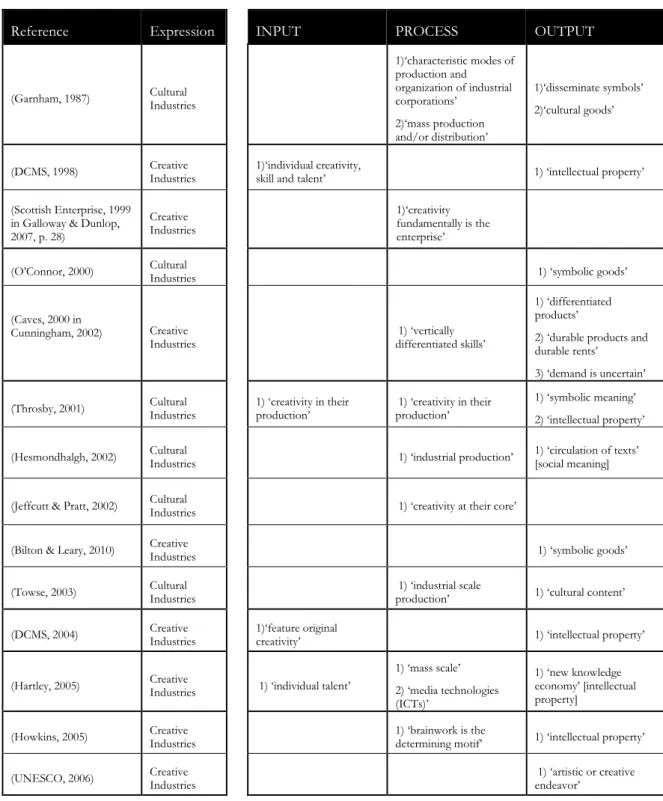
Table nº 1: The concepts of ‘creative industries’ and ‘cultural industries’
Reference Expression Definition
(Garnham, 1987) Cultural Industries
“‘Cultural Industries’ refers to those institutions (...) which employ the characteristic modes of production and organization of industrial corporations to produce and disseminate symbols in the form of cultural
goods and services generally, although not exclusively, as commodities (…).
In all these cultural processes, we characteristically find at some point the use of capital-intensive, technological means of mass production and/or distribution, highly developed divisions of labour and hierarchical modes of managerial organization. ”
(DCMS, 1998) Creative Industries
[creative industries are] “those activities that have their origin in individual
creativity, skill and talent and which have potential for wealth and Job creation through the general exploitation of intellectual property”
(Scottish Enterprise, 1999 in Galloway & Dunlop, 2007, p. 28) Creative
(O’Connor, 2000) Cultural Industries
“those activities which deal primarily in symbolic goods – goods whose primary economic value is derived from their cultural value … This definition, then, includes what have been called the ‘classical’ cultural industries – broadcast media, film, publishing, recorded music, design, architecture, new media – and the ‘traditional arts‘ – visual art, crafts, theatre, music theatre, concerts and performance, literature, museums and galleries – all those activities that have been eligible for public funding as ‘art’” (Caves, 2000 in Cunningham, 2002) (Caves, 2000) Creative Industries
[creative industries are characterized by the properties:] “Nobody knows/demand is uncertain
Art for arts sake/Creative workers care about their product Motley crew/some products require diverse skills
Infinite variety/differentiated products A list/B list/vertically differentiated skills Time flies/time is of the essence
Ars longa/durable products and durable rents”1
(Throsby, 2001) Cultural Industries
[Cultural industries combine three characteristics.] They are:
- that the activities concerned involve some form of creativity in their
production;
- that they are concerned with the generation and communication of
symbolic meaning, and
- that their output embodies, at least potentially, some form of intellectual
property.”
(Hesmondhalgh,
2002) Cultural Industries
“the core cultural industries deal with the industrial production and
circulation of texts [the production of social meaning] and are centrally
reliant on the work of symbol creators”
(Jeffcutt & Pratt,
2002) Cultural Industries
“The cultural industries span a diverse range of activities (arts, genres, crafts, specialisms, and domains of endeavor) all of which have creativity at their
core (…). This produces a terrain with a very mixed economy of forms –
from micro-businesses, through micro-enterprises to trans-national organizations – encompassing the range from sole artists to global media corporations”.
(Bilton & Leary,
2010) Creative Industries
“‘Creative industries’ produce ‘symbolic goods’ (ideas, experiences, images) where value is primarily dependent upon the play of symbolic
meanings. Their value is dependent upon the end user (viewer, audience,
reader, consumer) decoding and finding value within these meanings; the value of “symbolic goods” is therefore dependent on the user’s perceptions as much as on the creation of original content, and that value may or may not translate into a financial return.”
1 Richard Caves presented a range of criteria for properties that characterized the creative industries in his book
“Creative Industries: Contracts between Art and Commerce”. The definition presented was summarized by Cunningham in the article “From Cultural to Creative Industries: Theory, Industry, and Policy Implications”
(Towse, 2003) Cultural Industries
[cultural industries as those that] “mass-produce goods and services with sufficient artistic content to be considered creatively and culturally
significant. The essential features are industrial-scale production
combined with cultural content”
(DCMS, 2004) Creative Industries
“A broad definition of the Creative Industries is those goods and services in the creative sector:
Advertising, architecture, art and antiques, crafts, design, designer fashion, film and video, interactive leisure software, television and radio, performing arts, music and software and computer services which feature original
creativity and generate intellectual property with a potential for wealth
and job creation.”
(Hartley, 2005) Creative Industries
“The idea of the creative industries seeks to describe the conceptual and practical convergence of the creative arts (individual talent) with Cultural Industries (mass scale), in the context of new media technologies (ICTs) within a new knowledge economy, for the use of newly interactive citizen-consumers”.
(Howkins, 2005) Creative Industries
“In my view it is best to restrict the term ‘creative industry’ to an industry where brain work is preponderant and where the outcome is intellectual
property. This definition does not pretend to include all industries where
creativity takes place. Creativity can take place anywhere. But it does include industries where brainwork is the determining motif. It seems more reasonable than including, say, copyright but not patents; or advertising but not marketing.”
(UNESCO, 2006)2
Creative Industries
“The term ‘creative industries’ encompasses a broader range of activities which include the cultural industries plus all cultural or artistic production, whether live or produced as an individual unit. The creative industries are those in which the product or service contains a substantial element of
artistic or creative endeavor and include activities such as architecture and
advertising.”
(UNESCO, 2006) Cultural Industries
“The term cultural industries refers to industries which combine the
creation, production and commercialization of creative contents
which are intangible and cultural in nature. The contents are typically protected by copyright and they can take the form of a good or a service. Cultural industries generally include printing, publishing and multimedia, audiovisual, phonographic and cinematographic productions as well as crafts and design.”
(NESTA, 2006) Creative Industries
“At a general level, the ‘creative industries’ is the collective term for those
businesses in the economy which focus on creating and exploiting symbolic cultural products (such as the arts, films and interactive games),
or on providing business-to-business symbolic or information services in areas such as architecture, advertising and marketing and design, as well as web, multimedia and software development.”
2 According to O’Connor (2007) this definition is based on Throsby (2001) concentric model. The model is also
described in KEA’s report “The Economy of Culture in Europe” (2006) and in the report “Staying ahead the economic performance
of the UK's creative industries” from Work Foundation (2007) where it’s also presented a visual model for the creative
(KEA European Affairs, 2006) (Work Foundation, 2007) Cultural Industries
[Those with the following characteristics]:
“- Industrial activities aimed at massive reproduction. - Outputs are based on copyright.”3
(KEA European Affairs, 2006) (Work Foundation, 2007)4 Creative Industries
[Those with the following characteristics]:
“- Activities are not necessarily industrial, and may be prototypes. - Although outputs are based on copyright, they may include other
intellectual property inputs (trademark for instance).
- The use of creativity (creative skills and creative people originating in the arts field and in the field of cultural industries) is essential to the performances of these non-cultural sectors.”5
(UNCTAD, 2008) Creative Industries
“«Creative industries» can be defined as the cycles of creation, production
and distribution of goods and services that use creativity and intellectual capital as primary inputs. They comprise a set of knowledge-based
activities that produce tangible goods and intangible intellectual or artistic services with creative content, economic value and market objectives.” (Potts,
Cunningham, et al., 2008)
Creative
Industries “The set of agents in a market characterized by adoption of novel ideas within social networks for production and consumption.”
(Bakhshi, Freeman, et al., 2013)
Creative Industries
[The creative industries] “are defined in summary by:
1. A common type of input or resource (the creative workforce).
2. Common features of the output (emphasis on content, product
differentiation, shorter, often smaller, production runs, preponderance of
cultural or culture-related outputs, sale to discretionary markets, exploitation of both traditional IP and first-mover advantage).
3. Common processes of production (pre-market selection,
uncertainty-management contracts, just-in-time short-run production methods,
‘open innovation’ with an emphasis on collaborative contracts, geographical clustering at the micro level, and so on).”
(Bakhshi, Hargreaves, et al., 2013)
Creative
Industries “those sectors which specialise in the use of creative talent for commercial purposes.”
The table above was arranged in a chronological disposition in order to better understand and identify the traces of evolution on the definitions of creative industries. The chronological setting seems to indicate an evolution on the concept of creative industries, aimed at better defining each characteristic presented in the original DCMS definition. In each approach to the definition it is possible to identify a focus on the preferential definitional element of the creative industries:
3 Work Foundation (2007) stated as main characteristics for cultural industries: “Activities involve mass reproduction
of expressive outputs. Outputs are based on copyright”
4 As it happens in UNESCO (2006) this definition is also based on Throsby (2001) concentric model and it is described
similarly in KEA’s report “The Economy of Culture in Europe” (2006) and in the report “Staying ahead the economic performance
of the UK's creative industries” from Work Foundation (2007).
for instance Howkins (2001, 2005) focuses on the intellectual property; Hartley (2005) on the production methods; and O’Connor (2000) on the symbolic meaning. Despite of departing from the DCMS (1998) definition, I decided to include the definition made by Garnham (1987) because it was my interpretation that the definition stated could capture some of the main characteristics of the creative industries.
By analysing the constitutive elements of each definition, which are highlighted in bold in the table above, I identified the following main aspects involved in the definition of the creative industries: the use of creativity, and how it is understood; the relationship between creative and cultural industries, or how far can it be understood as the same reality or not; the symbolic value of the output, and the generation of symbols; the economic wealth generation through Intellectual Property Rights (IPR); and the production methods with the use of specific technology.
The next sections will analyse the main arguments of the debate about what makes an industry creative. First, while assuming the DCMS definition as the pillar of subsequent ones, I will explore its main criticisms and supportive arguments. Then the most recent advances on the renewed classifying methods of the creative industries made by DCMS will be discussed, as well as some alternative attempts to redefine the sector.
2.2. The DCMS definition of ‘creative industry’: main aspects and criticisms
The concept of creative industries has gained a global relevance since the DMCS definition in 1998 was out into public domain. Since then the debate on the DCMS definition has provided interesting contributions that may unveil the main common characteristics of the definitions (Flew & Cunningham, 2010). In this section I will describe the origins of the DCMS definition and review the main elements of the definitions of creative industries previously referred to, so as to clarify which are the central characteristics of the concept of the creative industries.
After the New Labour was elected in the UK in 1997, the new DCMS established the Creative Industries Task Force (CITF) in order to reformulate the policy discourse approach to the cultural sector, and specifically to those activities in the cultural sector that have evident contribution to wealth creation and economic performance. These activities were put in the centre of the UK’s post-industrial economy, and the approach assumed went beyond the traditional discourses of subsidized arts (Flew & Cunningham, 2010). In the Creative Industries Mapping Document (DCMS, 1998) the creative industries were defined as follows:
“those activities that have their origin in individual creativity, skill and talent and which have potential for wealth and Job creation through the general exploitation of intellectual property”
Additionally, the document set a list of 13 sub-sectors that constituted the creative sector, thus establishing the starting point for mapping and measuring the creative economy (Higgs & Cunningham, 2008). This list included: (i) Advertising, (ii) Architecture, (iii) Art & Antiques Market, (iv) Crafts, (v) Design, (vi) Designer Fashion, (vii) Film & Video, (viii) Interactive Leisure Software, (ix) Music, (x) Performing Arts, (xi) Publishing, (xii) Software & Computer Services and (xiii) Television & Radio. As such, and for the purpose of mapping and measuring the economic
relevance of these activities, the sector was defined in terms of the characteristics of its outputs. It was the first time that the term “creative industries” was used in a political context, and with an intended economic relevance.
Nevertheless most European governments and the US have revealed some resisting in simply adopt the definitions and classification provided by the British government, with the allegation that the DCMS formulation in other countries would imply comparative weakness in terms of cultural policies (Flew & Cunningham, 2010), the DCMS definitions is commonly referred in political context as the basis of the assessment of the creative sector. In fact, the “Creative Industries Mapping Document itself became a lead export, as governments and cities in Europe (…), in Latin America and particularly in the Far East saw a new idea for the dynamic association of culture, economics and a new wave of modernisation”(O’Connor, 2007, p. 41). In sum, the UK’s Creative Industries definition and mapping strategy became a reference for policy discourse all over the world.
Having the creative industries officially described as those based on ‘individual creativity’ with economic potential, in an official definition of the sector, provoked a significant debate around the concept and scope of the creative industries. First, because it revealed itself as insufficient to clarify the distinctiveness and importance of the creative industries and second, because it represented a significant shift for the UK’s cultural policy – from subsided arts to a post-industrial economic context – and stimulated the questioning of the economic relevance of the so-called ‘cultural industries’. In any case, what one may elicit from table nº1 above is that there are a few elements that seem to be pervasive across different definitions of cultural or creative industries: creativity, as well as a kind of a ‘rebranding’ of cultural industries along the time frame; the relevance of the knowledge economy, the information society and of intellectual property rights; symbolic meaning; and methods and processes that are characteristic of the sector under analysis.
2.2.1. Creativity
For the last years creativity has become a very popular and fashionable term in public policy and business contemporary discourses (Bilton & Leary, 2010; Jeffcutt & Pratt, 2002). Hence, this incorporation of the concept – which is per se difficult to define - in such wide range of discourses led the term creativity to some kind of ‘meaning void’, incapable to be useful as a defining concept. As it has expressively been stated: “The term creativity has become so all-embracing as to lose any clearly defined meaning and value” (Bilton & Leary, 2010, p. 49). In the debate on defining the creative industries many kinds of creativity have been referred, such as artistic, scientific, economic, cultural and technological (KEA European Affairs, 2006, 2009; UNCTAD, 2008). So, actually, as Bilton and Leary (2010) stated: “every industry would surely lay claim to some measure of individual creativity, skill and talent”. This brings forth the ‘everything is creative’ argument, which represents a problem for public policy, as it highlights the difficulty of delimitating the scope of the definition for more effective policy intervention and development (Flew, 2012; Galloway & Dunlop, 2007).
Hence, one of the main problems of the DCMS definition of the ‘creative industries’ is that the defining concept ‘creativity’ is a poorly defined concept and DCMS never made it clear what
the word ‘creativity’ means (Bakhshi, Freeman, et al., 2013). It has been assumed in several studies (KEA European Affairs, 2006, 2009; UNESCO, 2005, 2013) that the term ‘creativity’, in the context of the ‘creative industries’, is referring to ‘cultural creativity’, as a specific type of creativity, that produces artistic and cultural outputs. This idea of ‘cultural creativity’ as a defining concept of the creative industries is, in my opinion, on the centre of the “terminological clutter” (Galloway & Dunlop, 2007) between ‘creative industries’ and ‘cultural industries’, because it suggests that the purpose of creativity is to produce relevant outcomes only for cultural wealth and does not relate the potential of the outcomes of creativity in terms of economic wealth.
2.2.2. Cultural industries rebranding
The term “cultural industries”, coined by Adorno and Horkheimer6, has been used to refer
to a range of activities that, according to Hesmondhalgh “deal with the industrial production and circulation of texts”, which the author defines as “the production of social meaning” (2002, p. 16). It seems that the author used the term “cultural industries” to define the same reality of “creative industries” using the terms as synonyms.
In fact, many authors argue that the DCMS conception of ‘creative industries’ and of ‘creative sector’ might be considered as a merely re-branding, for policy discourse, of the cultural sector and the “cultural industries” (Flew & Cunningham, 2010; Flew, 2002, 2012; Garnham, 2005; Jeffcutt & Pratt, 2002; O’Connor, 2007, 2009; Pratt, 2005). The shift of the terminology is often seen, in historical context, as a policy positioning of the creative industries as contributors “to wealth creation and economic performance”, and “way beyond the traditional discourses of subsidized arts” (Flew & Cunningham, 2010, p. 113). As O’Connor (2007) noted, in his review of the ‘creative industries’ literature, this re-branding has permitted to uncouple the creative industries from the cultural and artistic sector that claimed to be not about economics at all, but still maintaining some of the benefits of cultural policies; by focusing these activities in the exploitation of the IPR they become, in the policy discourse, part of the ‘new economy’ that is driven by digital technologies and the ‘knowledge economy’ suiting with the economic policy agenda of the UK’s New Labour.
Nevertheless, this shift in terminology was not a well-accepted idea. Roodhouse (2006) argues that “there is a conceptual confusion, at sector and sub sectorial level” that came from a “contorted and tortuous” definitional historical discourse of arts, culture and creative industries, mainly in the UK’s cultural policy. For Garnham, - perceived by Flew and Cunningham as “one of the more trenchant critics in creative industries theory and policy discourse” (Flew & Cunningham, 2010, p. 116) – it “serves a specific rhetorical purpose within policy discourse” and “disguises the very real contradictions and empirical weaknesses of the theoretical analysis it mobilises” (Garnham, 2005). Although the recognized importance and effects on levering the cultural sector and the reformulated approach of the public policy discourse on culture, arts and creativity, it has
6 According to Hesmondhalgh (2002) the first use of the term can be found in the chapter “The Culture Industry:
been argued, by some authors (Flew & Cunningham, 2010; Garnham, 2005; Hesmondhalgh & Pratt, 2005; O’Connor, 2007), that shifting the term “cultural” into “creative” introduced more problems on what Andy Pratt (2005) called the “breadth question”: the clarification of the specificity and distinctiveness of the creative industries that can differentiate them from other sectors. Hence, these criticisms also led to discussions on what activities should be or not included. While Graham (2005) criticized the inclusion of software and computer gaming as it inflates the creative sector size, Hesmondhalgh (2002) questioned the exclusion of sectors with cultural relevance such as heritage, tourism, entertainment and sports.
In terms of definitional issues, this so called re-branding of the cultural sector is seen more as an “extension of the cultural industries definition to incorporate the copyright industries” (Potts, Cunningham, et al., 2008, p. 1) than as a conception of an autonomous economic reality. In fact, on of the main criticisms made to the DCMS definition of the creative industries is that it reveals a lack of clarity as to the “specificity” and “distinctiveness” of these activities (O’Connor, 2007, p. 44). Pratt (2005) claimed that the defining term “creative” is not specific enough to distinguish the creative industries from the scientific activities. But it also claimed that this definition ignores the distinctive aspect of the production of symbolic texts due to the lack of cultural dimension on the definition of creative industries (Hesmondhalgh & Pratt, 2005; O’Connor, 2007).
2.2.3. Symbolic meaning
Bilton and Leary (2010, p. 50) criticized the DCMS definition because, as they stated, it “does not really explain what is distinctive about the ‘creative’ industries”. As they argued, every industry can claim to be creative, and have potential for IPR exploitation. They also criticized the subsectors list, proposed on the Mapping Document, as it fails to define “clear boundaries or distinctive characteristics” of the creative industries. For the authors, the creative industries “produce ‘symbolic goods’ (ideas, experiences, images) where value is primarily dependent upon the play of symbolic meanings.” This idea of the ‘symbolic meaning’ as one of the distinctive characteristics of the output of the creative industries, and its non inclusion on the official definition, has been pointed out as one of the main failures of the DCMS’s definition of creative industries (Galloway & Dunlop, 2006), and it has been referred as a defining concept in many alternative definitions of cultural and creative industries as it can be observed in table nº1, where the definitions of O’Connor (2000) and Bilton & Leary (2010) clearly state that these industries produce symbolic goods. Some authors and institutions also refer to the importance of the “content” (or “creative content”) of goods and services (Bakhshi, Freeman, et al., 2013; Towse, 2003; UNCTAD, 2008; UNESCO, 2006) that might be as well interpreted as “symbolic meaning”. For the current analysis it is assumed that these definitions (‘content’ and ‘symbolic meaning’) are referring to the same concept. In his book Economics and Culture, Throsby (2001) deconstructed the terms of cultural industries and proposed a way to define what makes them “cultural”. In this study he stated that those activities “are concerned with the generation and communication of symbolic meaning” (Throsby, 2001, p. 4). For Throsby and others (such as O’Connor (2000) and Hesmondhalgh (2002)), the “generation, or communication of symbolic meaning is the defining concept of culture
and economic value of good is derived from, or reflects, their cultural value”(Galloway & Dunlop, 2007, p. 4).
Bilton and Leary have a complementary idea of the ‘symbolic meaning’, introducing the concept of ‘use value’ arguing that “the value of ‘symbolic goods’ is therefore dependent on the user’s perceptions as much as on the creation of original content, and that value may or may not translate into a financial return” (Bilton & Leary, 2010, p. 50).
However, as Bilton and Leary also admitted, the concept of ‘symbolic goods’ may not be sufficient for defining the uniqueness of the creative industries, since “‘manufacturers’ are able to focus their core business on symbolic production through branding and advertising. As Hesmondhalgh and Pratt (2005) also noted, symbolic meaning has also been used as an argument to point out that it is useless to talk about cultural industries “by arguing that all industries are cultural industries, because all industries are involved in the production of goods and services which become part of the web of meanings and symbols we know as culture”.
2.2.4. Knowledge economy, information society and intellectual property
The DCMS’s definition considered “intellectual property” as the defining characteristic of the output – the products of the creative industries must have an intangible value that makes the product unique, and that allows the people who produce them to exercise both economic and moral rights over these products (Galloway & Dunlop, 2006). The “intellectual property” on the creative industries’ output has been one of the most debated characteristic of the definition of the creative and cultural industries (Galloway & Dunlop, 2006). Towse, for example, argues that copyright is the “basis for defining the cultural industries” and “viewed as the organising principle for the creative industries” (Towse, 2003). The use of this criterion as the defining one of the creative industries by the DCMS could be understood as a way to capture the economic value of the creative goods.
The main criticism about the use of the ‘intellectual property principle’ to define the output of the creative industries is that intellectual property comes from “many types of creative activity, including science, engineering and academia” and by defining the industry in this way one fails to identify “the distinctive aspects of the cultural sector” (Galloway & Dunlop, 2006). Howkins presented a more inclusive concept for creative industries and “creative economy” by assuming the definition of creative industry as corresponding to “an industry where brain work is preponderant and where the outcome is intellectual property”, but since “creativity can take place anywhere” it should only “include industries where brain work is the determining motif” (2001). This definition assumes the creative industries as part of the knowledge economy. Despite the disclaimer on “everything is creative” – as creativity was not a completely inclusive definition for the creative industries – Howkins’ definition would suite the policy agenda as a supportive link between cultural (and art) policy with the economic policy agenda in a “new economy driven by digital technologies and closely related to the information and knowledge economy” (O’Connor, 2007), and thus, justifying the enforce of policy regulation on intellectual property rights (IPR).
Garnham (2005) criticized the “knowledge economy” and “information society” approach of the creative industries definition. He considered that the shift [from cultural to creative industries] was opportunistic, suggesting that the approach of bringing the arguments and assumptions of knowledge economy and information society was an attempt to introduce (or reinforce) the profitability of cultural goods by exploitation of the IPR (Cunningham, 2002; Flew & Cunningham, 2010; Garnham, 2005; O’Connor, 2007). He claimed that this shift did not come out of the blue, but “it was motivated by a historically specific political context” that intended to shift tensions across the cultural field – “whether the arts should be associated to the economic discourses focused on wealth creation” (Flew, 2012, p. 17) –, and represented a contemporary neo-liberalism policy program for culture and arts (Flew & Cunningham, 2010; Flew, 2012; Hesmondhalgh & Pratt, 2005; O’Connor, 2012). In short, he argued that it stated a change on how the public funds are justified not in “terms of art policy, but in terms of information society policy” so the “pay-off is not widened access or higher quality within the United Kingdom, but jobs and export earnings in a competitive global economy” (Garnham, 2005, p. 28).
2.2.5. Production methods and process
Production methods are crucial for an understanding of the ‘cultural industries’. Hesmondhalgh (2002) characterized those industries as a combination of symbolic meaning and industrial production – or mass-scale production – and these concepts of ‘industrial production’ and ‘mass-scale production’ have been present in many definitions of the ‘cultural industries’ in table 1 (Garnham, 1987; Hartley, 2005; Hesmondhalgh, 2002; KEA European Affairs, 2006; Towse, 2003; Work Foundation, 2007). Garnham (1987) referred that cultural industries were those institutions that employ characteristically organizational and production methods of traditional industry to produce or disseminate cultural goods, for that he employs the expression “capital-intensive” as characteristic of industrial methods. A similar expression has been used by Cunningham (2002, 2005) to classify the creative industries, but where ‘capital’ is replaced by ‘creativity’. He referred to the ‘creative enterprises’ as becoming more relevant in the new economy and as being specialized in creative inputs that are increasingly more important for the services sector. As he stated: “in the same way that enterprises in general have had to become information intensive, so they are becoming more ‘creativity intensive’” (Cunningham, 2002).
In the DCMS definition there was no reference to specific production methods or mass-scale production, although the idea of the potential for wealth creation through exploitation of the intellectual property could recall to the mass-scale production methods, since the IPR could be seen as the form of protection when ‘symbolic good’ is disseminated in mass-scale. Although, if we consider the argument that the implicit policy agenda of UK’s government intended to link the ‘creative industries’ to the ‘new media technologies’ and the ‘information economy’ (O’Connor, 2007) it is understandable that the use of the Information and Communication Technologies (ICT) in the production and dissemination within these industries may be seen as a specific characteristic of the Creative Industries. The new media technologies and the knowledge economy are pointed
by Hartley (2005) in his characterization and definition of creative industries, as the context where and how they operate.
The report Dynamic Mapping of the UK’s Creative Industries (Bakhshi, Freeman, et al., 2013) elicited several critiques to the DCMS definition, and suggested several clues for an alternative official definition. As the document refers “the creative industries” may be thought of as an industry, in the normal economic sense of the word, which has a characteristic input, a characteristic output and a characteristic process of production”, so it is expected that these activities share “common processes of production” (Bakhshi, Freeman, et al., 2013, p. 23). The report also calls attention to the importance of the combination of ICT and content activities for the creative industries, although they are not seen in the context specific production methods of the creative industries.
2.2.6. Solving the breadth question
Many authors, as described above, criticized the DCMS definition on what Pratt (2005) described as the ‘breadth question’. “The DCMS definition was seen by critics as being simultaneously too broad and too narrow” (Flew, 2012) because, despite the fact that the DCMS document pointed out specific activities as subsectors of the ‘creative industries’, the terms used and the ‘terminological clutter’ with the idea of ‘cultural industries’ provoked several doubts about the criteria of inclusion and/or exclusion of some activities.
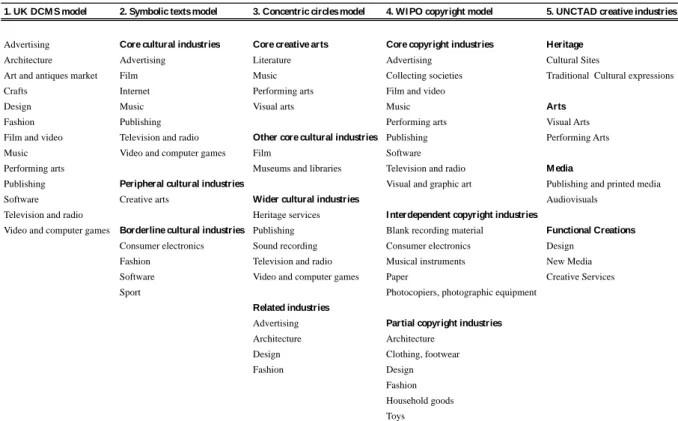
In the years following the DCMS definition, one finds relevant contributions on clarifying the distinctions of the concepts of cultural industries, creative industries, copyright industries, and on answering the “breadth question” by defining inclusive and exclusive criteria of the activities to be considered. Contributions such as the “concentric model” of the cultural and creative activities based on the work of Throsby (2001) and later adopted by KEA (2006) and Work Foundation (2007), or the “symbolic-texts model”, as referred in the UNCTAD report (2008), typically by defining the cultural industries through the ‘symbolic meaning’ of the outputs (Hesmondhalgh, 2002), have provided some proposals regarding relevant inclusive and exclusive criteria for the cultural and creative industries. UNESCO (2006) attempted to distinguish the definitions of creative industries and cultural industries by providing some principles (as “mass production” and the “core” creativity) to clarify the two concepts. Additionally, there has been a proposed model for the classification of the creative industries from WIPO, which is called the ‘WIPO copyright model’. This model was based on the idea that the creative industries are better defined as those that create economic wealth through the exploitation of intellectual property rights (IPR). Later, in order to bring some consensus on what activities global policy makers should consider as creative industries for a more efficient public policy, UNCTAD’s document Creative Economy Report (2008) presented a definition of the creative industries based on the concept of ‘cycles of creation’, bringing together contributions of the DCMS model, the symbolic -texts model, the concentric circles model, and the WIPO copyright model, so as to present a more inclusive classification for the creative industries constituted by nine subgroups of activities with similar characteristics, comprised in four main groups: heritage, arts, media and functional creation.
Table nº 2: Classification systems for the creative industries derived from different models7
Table nº 2, above, is a synthetized representation of the classification systems referred in the previous paragraph. Notwithstanding the relevance of this definitional debate, “the impact of this continuous boundary redefinition through national government machinery and by political parties for the arts, creativity and culture works against cohesion, interaction and connectivity” on the creative sector (Roodhouse, 2006). Despite all criticism, the DCMS definition still is the reference definition, and the debate around its problems brought to light the most relevant contributions and attempts of creating a unifying concept and clarifying definitions for creativity-based commercial activities with potential generation and exploitation of intellectual property. The criticisms on the DCMS definition exposed the lack of an explicit method to apply the DCMS classification system, as it revealed a problem of inconsistency: “although it does reflect an underlying economic reality, it does not fully capture that reality”(Bakhshi, Freeman, et al., 2013, p. 6). Despite the attempts made, the ‘breadth question’ remains unsolved, and my argument here is that there is a lack of a theoretical solid definition based on what the ‘creative industries’ really do, what is it that they are for, and what makes the ‘creative industries’ uniquely creative.
This led me to question whether the DCMS definition can be improved in order to overcome the inconsistency problems, or whether there is a need for a different and new definition. In the next section I will present and assess the most recent and relevant contributions regarding the
7 Source: Creative Economy Report 2008 (UNCTAD, 2008, p. 13): ‘Classification systems for the creative industries derived 1. UK DCM S model 2. Symbolic texts model 3. Concentric circles model 4. WI PO copyright model 5. UNCTAD creative industries
Advertising Core cultural industries Core creative arts Core copyright industries Heritage
Architecture Advertising Literature Advertising Cultural Sites
Art and antiques market Film Music Collecting societies Traditional Cultural expressions
Crafts Internet Performing arts Film and video
Design Music Visual arts Music Arts
Fashion Publishing Performing arts Visual Arts
Film and video Television and radio Other core cultural industries Publishing Performing Arts Music Video and computer games Film Software
Performing arts Museums and libraries Television and radio M edia
Publishing Peripheral cultural industries Visual and graphic art Publishing and printed media
Software Creative arts Wider cultural industries Audiovisuals
Television and radio Heritage services I nterdependent copyright industries
Video and computer games Borderline cultural industries Publishing Blank recording material Functional Creations Consumer electronics Sound recording Consumer electronics Design
Fashion Television and radio Musical instruments New Media Software Video and computer games Paper Creative Services
Sport Photocopiers, photographic equipment
Related industries
Advertising Partial copyright industries Architecture Architecture
Design Clothing, footwear
Fashion Design
Fashion Household goods Toys
Source: Creative Economy Report 2008 (UNCTAD, 2008, p13): 'Classification systems for the creative industries derived from different models' (adapted) Table 2. Classification systems for the creative industries derived from different models
review of the DCMS definition, and I will add some of the most recent proposals for a new definition of the creative industries that came from the need to improve the classification of the sector, in order to better capture its value and relevance.
2.3. A need for a new definition?
Since the first attempt of measuring the creative sector by the DCMS in 1998, the problems of the definition have revealed limitations that may have an impact the on sectorial and cross-economy comparisons. Higgs and Cunningham (2008) pointed the key limitations for mapping and classifying the creative industries under the DCMS template on the industry activity-based segment definition, the inconsistences in measure, frequency and time periods on the data source and classifications and the highly aggregated source data. In order to solve some of the cross-temporal comparisons problems the DCMS commenced to release reports, since 2002, in time series for each segment, using the same metrics and the same source. Despite of the DCMS (2004) effort made in the DCMS Evidence Toolkit (DET) to increase the consistency in metrics by detailing the industry activities on the industry value-chain for each segment, and introducing the occupation codes (SOC) on the metrics, it still reveals comparability limitations, as pointed by Higgs and Cunningham (2008), such as the activity-based segment definition, and the data source in terms of the lack of reliably on the occupation statistics and the use of them, with the industry codes (SIC), to capture the creative sector value. While the debate of the definition of creative industries proceeded in a text discussion, as it was reviewed in the last section, the mapping and measuring methodologies revealed practical problems and suffered several changes in order to better capture the reality of creative industries in terms of value and economic relevance. In this section I will review some of the most relevant changes and how they brought to the fore a need for a new definition.
In April 2013, the DCMS started a public consultation with the main purpose of updating the DCMS Creative Industries classification (DCMS, 2013a). Although it has been clarified that the scope of what was considered as a creative industry would not be altered8, the review put forth
some ideas that are, in some way, definitional issues of what can be considered as a creative industry. Hence, it should be at least admitted that a review of the classifying methodology could redefine the scope of the creative industries.
In the centre of this consultation is the idea of ‘creative intensity’, which is assumed as “the proportion of people doing creative jobs within each industry”, and it is the main classifying concept of an industry as a creative industry. In the basis of the DCMS’s consultation proposal (2013a) it is possible to find the previous attempts of changing the methodologies of measuring the creative industries and the creative economy. This debate on the measurement frameworks and quantitative technics has been going on since the first mapping document of DCMS in 1998 (Higgs,
8 A clarification note in the consultation states that: “The consultation is not intended to pass judgment on which
Cunningham, et al., 2008, p. 16). One of most relevant contributions to the DCMS new proposal (DCMS, 2013a, p. 5) is the document ‘A Dynamic Mapping of the UK’s Creative Industries’ (Bakhshi, Freeman, et al., 2013) produced by NESTA and ‘ARC Centre of Excellence for Creative Industries and Innovation’ (CCI).
The researchers from NESTA, in the UK, and CCI, in Australia, have been delivering innovative approaches in treating the definitional issues of the creative industries and disseminating relevant concepts for mapping/classifying, measuring and understanding the creative industries, such as the relevant concepts for new definitional proposals: ‘creative trident’, ‘creative workforce’, ‘creative intensity’, ‘creative occupation’ and ‘social network markets’.
2.3.1. Creative workforce and the creative trident
In 2008, NESTA’s report “Beyond the Creative Industries” highlighted a methodology developed by CCI in Australia in 2005 – a refreshed and improved approach for mapping the Creative Economy in the UK that the authors called the ‘Creative Trident’ methodology. This methodology intends to be a tool to measure the creative economy based on the idea that creative activity may be defined as three situations of employment: “Workers within a creative profession within a Creative sector – the specialist mode; Workers in a non-creative profession within a creative sector – support mode; workers in a creative occupation outside the creative industries – embedded mode” (Higgs, Cunningham, et al., 2008, p. 27). This methodology was an attempt to create a more dynamic method for the creative economy than that proposed by the DCMS (DCMS, 2004); in fact, this report points out some of the limitations on the DCMS approach, such as the fact that the DCMS mapping approach held a static view on creative industries, which was considered out-dated given the technological progress and changes in market and industry boundaries. Using the ‘employment modes’ as the referential on this mapping technic, the ‘creative trident’ concept reveals a new perspective of looking at the creative sector based on the so-called ‘creative workforce’ which is defined as: “the group of people employed in the Creative Trident (i.e. in specialist, support and embedded modes) across all selected creative occupations and creative industries” (Higgs, Cunningham, et al., 2008, p. 20).
By taking the same question that lead to the concept of the ‘creative trident’ – “how many creative people work inside the creative industries?” – as it is emphasized by Freeman (2013), – the researchers involved came out with the calculation of the proportion of creative workers working within the creative industries, and in such way they came out with the concept of ‘creative intensity’.
2.3.2. “Creative intensity” method
The methodology of ‘creative intensity’ was first introduced by Freeman in a report of the Greater London Authority (GLA) on London’s Creative Sector (Freeman, 2004). This report focused on a measure for the relevance of creative workers in the industry, by measuring the proportion of creative workforce within an industry. Freeman (2004) obtained results that revealed – as it was later stated - that the ‘creative intensity’ was “systematically higher in the creative industries than elsewhere” (Bakhshi, Freeman, et al., 2013, p. 9). But it was only in January 2013