CERN-PH-EP/2013-037 2015/01/16
CMS-TOP-12-020
Measurement of the W boson helicity in events with a
single reconstructed top quark in pp collisions at
√
s
=
8 TeV
The CMS Collaboration
∗Abstract
A measurement of the W boson helicity is presented, where the W boson originates from the decay of a top quark produced in pp collisions. The event selection, op-timized for reconstructing a single top quark in the final state, requires exactly one isolated lepton (muon or electron) and exactly two jets, one of which is likely to originate from the hadronization of a bottom quark. The analysis is performed us-ing data recorded at a center-of-mass energy of 8 TeV with the CMS detector at the CERN LHC in 2012. The data sample corresponds to an integrated luminosity of 19.7 fb−1. The measured helicity fractions are FL = 0.298±0.028 (stat)±0.032 (syst),
F0 = 0.720±0.039 (stat)±0.037 (syst), and FR = −0.018±0.019 (stat)±0.011 (syst).
These results are used to set limits on the real part of the tWb anomalous couplings, gLand gR.
Published in the Journal of High Energy Physics as doi:10.1007/JHEP01(2015)053.
c
2015 CERN for the benefit of the CMS Collaboration. CC-BY-3.0 license ∗See Appendix A for the list of collaboration members
1
Introduction
The top quark, discovered in 1995 [1, 2], is the heaviest particle in the standard model (SM) of particle physics. At the CERN LHC [3], top quarks are produced in pairs through the strong interaction and individually through electroweak processes including the tWb vertex. The production of single top quarks has been observed both at the Tevatron [4, 5] and at the LHC [6, 7]. The t-channel process is the dominant electroweak single top quark production mechanism at the LHC. The other two processes, W-associated (tW) and s-channel, amount to≈20% of the cross section [8].
Because of its high mass, the top quark decays before hadronization and its spin information is accessible through its decay products. The top quark decays almost exclusively into a W boson and a b quark, and thus provides an effective testing ground for studying the tWb vertex in a search for new interactions.
The polarization of the W bosons from top quark decays is sensitive to non-SM tWb cou-plings [9]. The W boson can be produced with left-handed, longitudinal, or right-handed helicity; the relation Γ(t → Wb) =ΓL+Γ0+ΓR holds for the corresponding partial widths of the top quark decay. Hence, the W boson helicity fractions defined as Fi = Γi/Γ, where
i = L, 0, or R, fulfill the condition of∑ Fi = 1. The SM predictions for the W boson helicity
fractions at next-to-next-to-leading-order (NNLO) in the strong coupling constant, including the finite b quark mass and electroweak effects, are FL = 0.311±0.005, F0 = 0.687±0.005,
and FR = 0.0017±0.0001 [10] for a bottom quark mass mb = 4.8 GeV and a top quark mass
mt = 172.8±1.3 GeV. The current experimental results for the W boson helicity fractions [11–
14], all extracted using tt events, are in good agreement with the SM predictions.
We present for the first time a measurement of the W boson helicity fractions using events with the t-channel single top quark topology, with a precision comparable to that of tt events [11– 14]. The single top quark topology here refers to a final state of exactly one lepton (` =e or µ) and exactly two jets, one of which is associated to a b quark. While the event selection requires a single top quark to be reconstructed in the final state, a significant contribution is expected from tt events with one top quark decaying leptonically. The tt events carry the same physics information on the tWb vertex in the top quark decay as single top quark events. The selected tt event sample in this analysis do not overlap with the one obtained from the standard CMS tt event selection. Inclusion of tt events in the signal sample provides a larger event sample and results in smaller uncertainties in the measurement.
The helicity angle θ`∗is defined as the angle between the W boson momentum in the top quark rest frame and the momentum of the down-type decay fermion in the rest frame of the W boson. The probability distribution function of cos θ∗` contains contributions from all W boson helicity fractions, ρ(cos θ∗`) ≡ 1 Γ dΓ d cos θ`∗ = 3 8(1−cos θ ∗ `)2FL+ 3 4sin 2 θ∗` F0+ 3 8(1+cos θ ∗ `)2FR, (1)
which can be extracted from a fit of this distribution to the data. In this analysis, we use the measured W boson helicity fractions to set exclusion limits on the tWb anomalous couplings given by the following effective Lagrangian [9]
Lanom. tWb = − g √ 2bγ µ(V LPL+VRPR)tW−µ− g √ 2b iσµνq ν mW (gLPL+gRPR)tW−µ+h.c., (2)
where q is the difference of the top and bottom quark 4-momenta. The operators PL and PR
2 4 Event selection and topology reconstruction
vector (VL, VR) and tensor (gL, gR) couplings are real, assuming CP conservation. Within the
SM, VL ≡Vtb≈1 and all other couplings vanish at tree level, while they are non-zero at higher
orders.
2
CMS detector
The central feature of the CMS apparatus is a superconducting solenoid of 6 m internal diam-eter, providing a magnetic field of 3.8 T. Within the superconducting solenoid volume are a silicon pixel and strip tracker, a lead tungstate crystal electromagnetic calorimeter (ECAL), and a brass/scintillator hadron calorimeter (HCAL). Muons are measured in gas-ionization detec-tors embedded in the steel flux-return yoke outside the solenoid. Extensive forward calorime-try complements the coverage provided by the barrel and endcap detectors.
Muons measured in the pseudorapidity range |η| < 2.4 of the muon system are matched to
tracks measured in the silicon tracker. This results in transverse momentum resolution for muons with 20< pT <100 GeV of 1.3–2.0% in the barrel and better than 6% in the endcaps [15].
The calorimetry systems, ECAL and HCAL, with|η| < 3.0 coverage are used to identify and
measure the energy of different particles including electrons and hadrons. The HCAL coverage is further extended by the forward calorimeter, 3.0< |η| <5.0.
Electrons in the energy range of the presented measurement have an energy resolution of
<5% [16]. The HCAL, when combined with the ECAL, measures jets with a resolution∆E/E≈
100%/pE[GeV] ⊕5% [16]. The CMS detector is nearly hermetic, which permits good mea-surements of the energy imbalance in the plane transverse to the beam line. A more detailed description of the CMS detector, together with a definition of the coordinate system used and the relevant kinematic variables, can be found in [17].
3
Data and simulated samples
This analysis is performed using the data from the LHC proton-proton collisions at 8 TeV center-of-mass energy. The data sample, corresponding to an integrated luminosity of 19.7 fb−1 for both muon and electron triggers, was collected with the CMS detector in 2012.
Single top quark events produced via t-channel, s-channel, and W-associated processes are generated usingPOWHEG 1.0 [18–22] with mt =172.5 GeV interfaced withPYTHIA 6.4 [23] for
parton showering. Other samples including tt (mt = 172.5 GeV), single vector bosons
asso-ciated with jets (W/Z+jets), and dibosons (WW, WZ, ZZ) are generated by the MADGRAPH
5.148 [24] event generator interfaced withPYTHIA 6.4. The QCD multijet events are generated
usingPYTHIA 6.4. The full CMS detector simulation based on GEANT4 [25] is implemented for all Monte Carlo (MC) generated event samples.
4
Event selection and topology reconstruction
The final state of interest for this analysis contains a high-pT muon or electron from the decay
of the W boson coming from a top quark decay. In addition, a b quark jet from the top quark decay, together with a light-flavored jet present in the t-channel single top quark production, define the selected event signature. The b quark from the gluon splitting with a softer pT and
a broader η spectrum is not considered in the selection. The event selection for this analysis follows closely that of the CMS single top quark cross section measurements [26].
Events are filtered using a high-level trigger (HLT) requirement based on the presence of an isolated muon (electron) with pT > 24(27)GeV. The online muon candidate is required to
be within |η| < 2.1. For offline selection, events must contain at least one primary vertex,
considered as the vertex of the hard interaction. At least four tracks must be associated to the selected primary vertex. The longitudinal and radial distances of the vertex from the center of the detector must be smaller than 24 cm and 2 cm, respectively. For events with more than one selected primary vertex, the one with the largestΣp2T of the associated tracks is chosen for the analysis. Events with high level of noise in the HCAL barrel or endcaps are rejected [27]. Extra selection criteria are applied to leptons and jets reconstructed using the CMS particle flow algorithm [28, 29]. For events containing a muon, the selection requires exactly one iso-lated muon originating from the selected primary vertex with|η| < 2.1 and pT >26 GeV. The
isolation variable Irelis calculated by summing the transverse energy deposited by other
parti-cles in a cone of size∆R =√(∆η)2+ (∆φ)2 = 0.4 around the muon, divided by the muon p T.
This quantity is required to be less than 0.12 [26]. For events containing an electron, we look for exactly one isolated electron with pT >30 GeV and|η| <2.5. The electron is selected if the
isolation variable, defined similarly to that of muons but with a cone size of 0.3, is less than 0.1. Events with additional leptons, passing less restrictive kinematic and qualification criteria, are rejected. Details on the prompt muon and electron isolation and identification, as well as the criteria to veto additional muons and electrons, can be found in [26]. The final event yields for simulated events are corrected for efficiency differences between data and simulation in the HLT and lepton selection [26].
Jets are reconstructed by clustering the charged and neutral particles using an anti-kT
algo-rithm [30] with a distance parameter of 0.5. The reconstructed jet energy is corrected for effects from the detector response as a function of the jet pTand η. Furthermore, contamination from
additional interactions (pileup), underlying events, and electronic noise are subtracted [31]. To achieve a better agreement between data and simulation, an extra η-dependent smearing is performed on the jet energy of the simulated events [31]. Events are required to have exactly two jets with|η| <4.7 and pT > 40 GeV, where both jets must be separated from the selected
lepton (∆R>0.3).
The neutrino in the decay of the W boson (W → `ν) escapes detection, introducing an
imbal-ance in the event transverse momentum. The missing transverse energy, E/ , is defined as theT
modulus of6~pT, which is the negative vector pT sum of all reconstructed particles. The jet
en-ergy calibration therefore introduces corrections to the E/ measurement. Events are accepted ifT
they have a significant transverse mass for the W boson candidate, mW
T >50 GeV, where mWT is
calculated from E/ and lepton pT T as [26]
mWT =
q
(p`
T+E/T)2− (p`x+p/x)2− (p`y+p/y)2. (3)
Finally, it is required that exactly one of the selected jets is identified as likely originating from the hadronization of a b quark. The b-jet identification (b tagging) algorithm uses the three-dimensional impact parameter of the third-highest-momentum track in the jet. The chosen working point gives a misidentification rate of∼0.3% for jets from the hadronization of light quarks (u, d, s) or gluons and an efficiency of 46% for b jets [32]. The observed differences between simulated and measured b tagging efficiencies for genuine and misidentified b jets are corrected for by scaling the simulated events according to pT-dependent correction factors [32].
To reduce the contribution of jets coming from pileup, the non-b-tagged jet in the event is required to pass the requirement that the root-mean-square of the∆R between the momenta of the jet constituents and the jet axis is less than 0.025. The simulated events include pileup
4 5 Backgrounds
interactions with the multiplicity matching that observed in data. 4.1 Reconstruction of the top quark
As indicated in the introduction, cos θ`∗ is computed in the top quark rest frame. Therefore, the top quark 4-momentum, which is the vector sum of the 4-momenta of its decay products, needs to be known. In our selection, the decay products are a b jet, a charged lepton and a neutrino, whose transverse momentum can be inferred from E/ . The longitudinal momentumT
of the neutrino, pz,ν, is determined from other kinematic constraints such as the W boson mass,
mW =80.4 GeV [33].
Given E/T =
√
p/2x+p/2yand energy-momentum conservation at the W`νvertex, we obtain
pz,ν= Λpz,` p2T,` ± 1 p2T,` q Λ2p2 z,`−p2T,`(E`2E/T2−Λ2), (4) where Λ= m 2 W 2 + ~pT,`· 6~pT. (5) A negative discriminant in Eq. (4) leads to complex solutions for pz,ν. Events with such
solu-tions are found not to carry significant information on the W boson helicity and are discarded. Otherwise, the solution with the smallest absolute value is chosen [4, 5].
The sample composition after the full event selection and top quark reconstruction is summa-rized in Table 1; the total event yields for data and simulation are in good agreement within statistical uncertainties for both muon and electron decay channels. The top quark reconstruc-tion efficiency is about 76% in t-channel single top quark events.
About 70% of the selected tt events belong to the lepton+jets final state at generator level. The reconstructed top quark is matched to the generated one in about 55% of cases in these events. The reconstruction efficiency is slightly lower than that of the single top quark signal due to possible b jet mis-assignments. The tt events with the µ(e)+τ decay mode, where the τ-lepton decays hadronically, contribute about 16% of the selected events. The remaining 14% is mainly attributed to the dileptonic final states with muons and electrons, where one of the leptons has failed the veto criteria. The tt events in the current sample are rejected by the standard lepton+jets tt selection because of the required number of jets and the b-jet multiplicity.
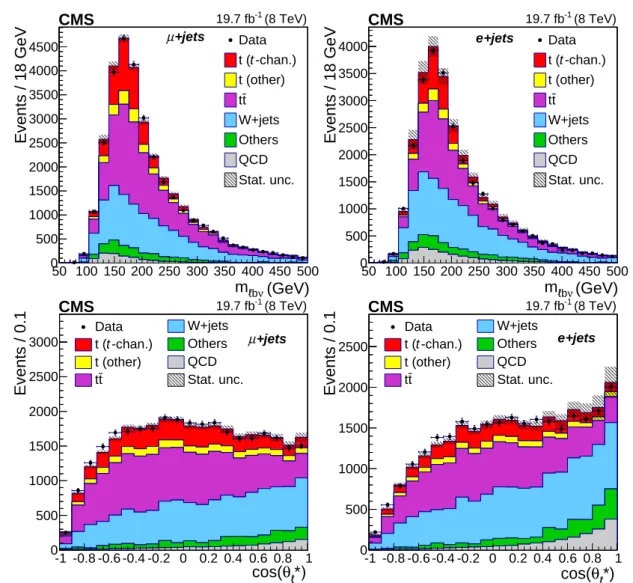
Figure 1 (top) illustrates the reconstructed top quark mass, m`bν, in data and simulation. The
detector effects, together with the uncertainties in pz,νsolutions, result in the broadness of the
distribution as well as the change in the mean mass value. The distribution of reconstructed cos θ∗` in data is compared with simulation in Fig. 1 (bottom). The difference between the muon and electron decay channels is due to different lepton pT requirements and the different
con-tributions of the QCD multijet background. Lower cos θ`∗ values are removed with a harder requirement on the lepton pT. These distributions are used as input to the likelihood fit method
to measure the W boson helicity fractions.
5
Backgrounds
Figure 1 and Table 1 indicate that the production of the W boson in association with jets (W+jets) is the dominant background with a different shape in cos θ`∗ than for the signal. We determine the normalization of the W+jets event sample together with the W boson helicity fractions in the fit in order to reduce the related systematic uncertainties. The shape for the W+jets background is taken from simulation.
Table 1: Event yields for data and simulation after the full event selection. Events with complex pz,νsolutions are discarded. This rejects 40% of the single top quark events and about 50% of
events from the other processes. The expected number of simulated events is normalized to the integrated luminosity of 19.7 fb−1 . Corrections from different sources [26] are considered in simulation yields. The uncertainties are statistical only.
Process Muon channel Electron channel Single top quark (t) 4459±28 3031±21 Single top quark (tW) 1504±35 1059±27 Single top quark (s) 265±2 182±1
tt 12017±42 8705±34 W+jets 10170±110 10800±110 Z/γ∗+jets 1451±34 1702±41 Dibosons 361±11 377±12 QCD 994±10 1698±23 Total expected 31209±130 27550±130 Data 31219 27607
The shape and the normalization of the QCD multijet background are obtained from an inde-pendent measurement [26]. The shape is obtained from a QCD-enriched event sample, con-structed by applying to data the selection mentioned in Section 4, but with the lepton isolation requirement reversed, i.e. Irel>0.12 and Irel>0.1 for the muon and electron, respectively. The
normalization is extracted from a fit to the mWT distribution in the signal region. The normaliza-tions for other backgrounds, namely Z+jets and dibosons, are taken from the single top quark cross section measurement [26] where their shapes are derived from simulation.
6
The fit method
The cos θ`∗distribution from a MC-reweighted simulation is fitted to the observed distribution to extract the W boson helicity fractions. The left-handed and longitudinal polarizations are treated as free parameters in the fit, while the right-handed polarization is obtained from the constraint of∑ Fi =1. The top quark MC events are simulated using SM parameters, hereafter
referred to as~FSM, and are reweighted according to,
w(cos θ`∗, gen;~F) = ρ(cos θ ∗ `, gen|~F)
ρ(cos θ`∗, gen|~FSM)
, (6)
with ~F being an arbitrary choice for the W boson helicity fractions, to be determined in the fit. The~FSM values are approximated within POWHEG as FL = 0.30, F0 = 0.70 and FR = 0.
A transfer matrix,R(cos θ`∗, gen, cos θ`∗, rec), relates the generator-level variable, cos θ∗`, gen, to that observed in the detector, cos θ`∗, rec. The probability density of a final state cos θ∗`, rec, for a given
~F, can be expressed, as
ρ(cos θ∗`, rec|~F)∝
∑
gen
w(cos θ∗`, gen;~F)ρ(cos θ`∗, gen|~FSM) R(cos θ`∗, gen, cos θ`∗, rec). (7)
We define a Poisson likelihood function,
L(~F) =
∏
i∈bins
(λMC;i ~F)ndatai
ndatai ! ×e
6 6 The fit method mℓbν (GeV) 50 100 150 200 250 300 350 400 450 500 Events / 18 GeV 0 500 1000 1500 2000 2500 3000 3500 4000 4500 Data -chan.) t t ( t (other) t t W+jets Others QCD Stat. unc. CMS 19.7 fb-1 (8 TeV) jets + µ mℓbν (GeV) 50 100 150 200 250 300 350 400 450 500 Events / 18 GeV 0 500 1000 1500 2000 2500 3000 3500 4000 Data -chan.) t t ( t (other) t t W+jets Others QCD Stat. unc. CMS 19.7 fb-1 (8 TeV) jets + e cos(θℓ*) -1 -0.8 -0.6 -0.4 -0.2 0 0.2 0.4 0.6 0.8 1 Events / 0.1 0 500 1000 1500 2000 2500 3000 Data -chan.) t t ( t (other) t t W+jets Others QCD Stat. unc. CMS 19.7 fb-1 (8 TeV) jets + µ cos(θℓ*) -1 -0.8 -0.6 -0.4 -0.2 0 0.2 0.4 0.6 0.8 1 Events / 0.1 0 500 1000 1500 2000 2500 Data -chan.) t t ( t (other) t t W+jets Others QCD Stat. unc. CMS 19.7 fb-1 (8 TeV) jets + e
Figure 1: The reconstructed top quark mass (upper left, upper right) and the reconstructed cos θ∗` distributions (lower left, lower right) for data and simulation in the muon (left) and the electron (right) decay channels. The normalization for simulated samples are corrected accord-ing to the saccord-ingle top quark cross section measurement in which the shape for QCD multijet events is obtained from data [26].
in which i runs over the bins of the measured cos θ`∗, recdistribution. For each bin, ndata i is the
number of selected data events and λMC;i ~F is the expected number of simulated events. The latter is a combination of the signal events reweighted according to a set of~F components and backgrounds,
λMC;i ~F=λbkg-otheri +βW jets×λW jetsi + f×λsignal;
~
F
i , (9)
where the parameter f accounts for the normalization of the signal and is fixed to 1. This means that the single top quark and tt normalizations are those measured in [26]. The W+jets content after the full event selection is not well known and therefore its normalization, βW jets, is left as
a free parameter in the fit, which also absorbs the overall detector inefficiency. The shape of the W+jets distribution, λW jets, is obtained from simulation. The yields for other backgrounds,
λbkg-otheri , are fixed to those measured in [26].
The signal sample includes the leptonic decay of t-channel, s-channel, and tW single top quark production, as well as tt events in semileptonic and dileptonic final states. Although the
kine-matical variables of final-state particles of the two top quarks in tt events are not strongly cor-related at generator level, because of the relatively hard selection requirements, some corre-lation is introduced between the reconstructed top quark variables and those from the non-reconstructed tWb vertex. To avoid any bias from these correlations, the non-non-reconstructed tWb vertex in tt events is also reweighted in the fit.
The~F components, as well as βW jets, are treated as free parameters in the likelihood fit, Eq. (8).
Considering the constraint of∑ Fi = 1, the likelihood is a 3-parameter function. The negative
log-likelihood function is minimized usingMINUIT[34].
7
Systematic uncertainties
The following sources of systematic uncertainties are investigated for both muon and electron decay channels of the W boson. The fit procedure is repeated varying the different systematic sources and for each case the shift in the mean value compared to the nominal result is taken as the systematic uncertainty. Where needed, limitations in the size of the systematic event sam-ples are taken into account. A covariance matrix is constructed for the systematic uncertainties in the fit parameters, FL and F0, to account for the related correlations. Such correlations affect
the systematic uncertainty in FR.
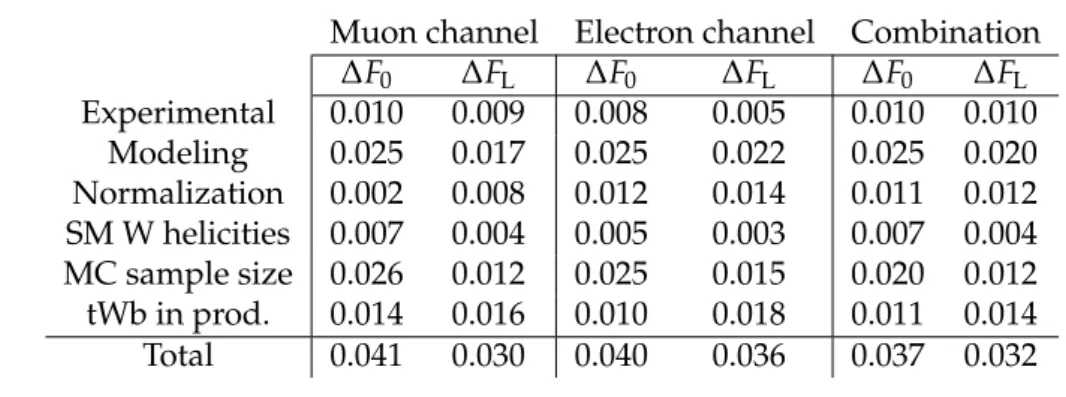
The total systematic uncertainties in FL and F0 are extracted from the diagonal components of
the covariance matrix. Table 2 summarizes the systematic uncertainties in the fit parameters. 7.1 Experimental uncertainties
Jet energy scale: uncertainties in the jet energy scale are calculated and propagated to E/T
through simultaneous variation of all reconstructed jet 4-momenta in simulated events. The variations are made according to the η- and pT-dependent uncertainties in the jet energy scale [31].
Jet energy resolution: the simulated jet energy resolution is smeared to better match that ob-served in data. The smearing correction is varied within its uncertainty [31].
Unclustered E/ : an additional uncertainty arises from the effect of the unclustered calorimetricT
energy on E/ . This energy is computed by taking the vector difference betweenT 6~pTand the
neg-ative vector sum of all leptons and jets momenta before applying the jet corrections described in Section 4. The components of the resulting momenta are varied by±10% and thereby change the vector sum of leptons and jets 4-momenta to obtain the new value for E/ .T
Pileup: the uncertainty in the level of pileup is estimated by varying total inelastic pp cross section [35] by±5%.
Lepton trigger and reconstruction: the data-to-simulation correction factors for the single-lepton trigger and single-lepton selection efficiency are estimated using a “tag-and-probe” method [36] in Drell–Yan (Z/γ∗ → ll) data and MC samples [26]. Uncertainties are assigned to the correc-tion factors in order to cover possible differences between the single top quark enriched and Drell–Yan data samples. The uncertainties also cover the pileup dependence of the scale fac-tors.
b tagging and misidentification corrections: the b tagging and misidentification efficiencies are estimated from control samples in data [32]. Scale factors are applied to the simulated events to reproduce efficiencies in data and the corresponding uncertainties are propagated as systematic uncertainties.
Uncertainty in the integrated luminosity: the normalization of the expected signal and back-ground is varied by 2.6% to account for the uncertainty in the luminosity measurement [37].
8 7 Systematic uncertainties
7.2 Modeling uncertainties
Single top quark production modeling:to account for the effects due to production modeling, results are compared with those from an alternative generator (COMPHEP [38, 39]).
Scale: the renormalization and factorization scales (µR and µF) of the hard scattering in the
event are varied up and down by a factor of two from their nominal values, µ2R = µ2F = Q2, to
account for the scale uncertainties in the simulated single top quark and tt event samples.
Top quark mass: the single top quark and tt samples are simulated with mt = 178.5 GeV and
166.5 GeV to evaluate the uncertainty due to the top quark mass variations. The LHC-Tevatron combination of the top quark mass uncertainty is 0.7 GeV [40]. The systematic uncertainty due to mtis therefore obtained by interpolating the estimated uncertainty to mt=172.5±0.7 GeV.
Parton distribution function: the uncertainty due to the choice of the parton distribution functions (PDF) is estimated by reweighting the simulated events with uncertainties in PDF parameters, where each parameter corresponds to one of the PDF eigenvectors described by CT10 [41]. The uncertainties in PDF parameters are evaluated using the LHAPDF [42] pack-age. The analysis is redone for each set of the reweighted event samples and the results are compared with those of the nominal analysis.
Shape uncertainty inW+jets control sample: the uncertainty arising from the heavy-flavor content of the simulated W+jets event sample is taken into account by varying up and down the W+b and W+q contributions by a factor of two. The W boson helicity fractions are estimated using the altered W+jets template.
7.3 Normalization uncertainties
Normalization oftt: the tt cross section, σtt=245.8±10 pb [43], is varied within its theoretical uncertainty, which is in agreement with the results of a method based on control samples in data used to estimate the tt normalization in single top quark analyses [26].
Single top quark normalization:the single top quark production rates in t and tW channels [8] are varied within their theoretical uncertainties.
QCD multijet: a 50% (100%) uncertainty for the muon (electron) decay channel is assumed for the normalization of QCD multijet events, covering also the cos θ∗` shape dependence on the lepton isolation requirement. The mWT shape, used for the QCD background estimation, is found to be more stable in the muon decay channel.
Electroweak backgrounds: the normalization of Z+jets and diboson processes are taken from the measurement in [26], where an uncertainty of about 17% is estimated in the measured values.
7.4 Method-specific uncertainties
SMW helicities in the weight function: the tt events are generated with MADGRAPH, where the SM predictions for W helicities differ by about 0.01 from those predicted byPOWHEG. Given the considerable tt contribution, the effect of applying the same weight function (Eq. (6)) to all top quark processes is estimated by changing the SM helicity fractions in the weight function to the MADGRAPHpredictions for the tt component. The shift in the final results is considered as a systematic uncertainty.
Fixing the signal normalization in the fit, f = 1: the effect of fixing the signal normaliza-tion in the fit for the W boson helicity measurement (Secnormaliza-tion 6) is estimated by performing pseudo-experiments, where the normalization of the top quark processes is varied by 10% in pseudo-data and fixed in the fit. The observed effect is negligible, and is not included in the uncertainties.
is estimated using pseudo-experiments. The number of simulated events in each bin are var-ied according to a Gaussian with the mean and width set equal to the bin posterior and its uncertainty. The width of a Gaussian fit to the W boson helicity fractions obtained from the pseudo-experiments is taken for this systematic uncertainty.
The tWb vertex in single top quark production: the anomalous couplings in the tWb pro-duction vertex are not considered in the analysis, but their effects on the W boson helicity measurements are estimated with a set of pseudo-experiments. Pseudo-data are randomly produced from the simulated event samples with gL, VR and VL anomalous couplings
imple-mented in both production and decay [38, 39]. The values of the real anomalous couplings are varied within the range obtained from [44]. The bias, estimated by fitting the pseudo-data with anomalous couplings to the SM simulation, is included in the systematic uncertainties.
Table 2: Summary of the systematic uncertainties.
Muon channel Electron channel Combination ∆F0 ∆FL ∆F0 ∆FL ∆F0 ∆FL Experimental 0.010 0.009 0.008 0.005 0.010 0.010 Modeling 0.025 0.017 0.025 0.022 0.025 0.020 Normalization 0.002 0.008 0.012 0.014 0.011 0.012 SM W helicities 0.007 0.004 0.005 0.003 0.007 0.004 MC sample size 0.026 0.012 0.025 0.015 0.020 0.012 tWb in prod. 0.014 0.016 0.010 0.018 0.011 0.014 Total 0.041 0.030 0.040 0.036 0.037 0.032
8
Results
The analysis yields the following results for W boson helicity fractions in the muon decay chan-nel,
FL =0.316±0.033 (stat)±0.030 (syst),
F0=0.715±0.045 (stat)±0.041 (syst),
FR= −0.031±0.022 (stat)±0.022 (syst),
and the electron decay channel,
FL =0.272±0.057 (stat)±0.036 (syst),
F0=0.753±0.087 (stat)±0.040 (syst),
FR= −0.025±0.042 (stat)±0.025 (syst).
The smaller statistical uncertainty in the muon decay channel is the result of more events and a relatively better correspondence between the generated and reconstructed cos θ`∗. The right-handed helicity fraction in both channels is obtained using the ∑ Fi = 1 condition. The
sta-tistical correlation between FL and F0, about −0.90 in both channels, is taken into account in
calculating the statistical uncertainties in FR. The results from the two channels are compatible,
within the uncertainties, with each other as well as with the SM predictions.
We combine the measurements from both channels by constructing a combined likelihood from the two likelihood functions,
Lcomb.(FL, F0, βµW jet, βeW jet) ≡ Lµ(FL, F0, β µ
10 8 Results
where the two terms on right-hand side have the W boson helicity fractions in common as free parameters. The contribution of the W+jets background in each decay channel, βµW jet(e), is also determined by the fit. The combined likelihood is used to extract the W boson polariza-tions and the systematic uncertainties in Table 2. All theoretical and experimental uncertainties are considered fully correlated between the two channels, except for the lepton trigger and reconstruction efficiencies and for the limited size of simulated signal event samples. The com-bination of the two measurements leads to
FL =0.298±0.028 (stat)±0.032 (syst),
F0=0.720±0.039 (stat)±0.037 (syst),
FR= −0.018±0.019 (stat)±0.011 (syst),
with a total correlation of −0.80 between FL and F0. The behavior of the combined FR value
being outside the interval of the FRin the muon and electron channels is a consequence of the
∑ Fi =1 constraint together with the different contributions of the two channels in the
combi-nation. The smaller statistical uncertainty in FRis because of the negative(FL, F0)correlation.
Moreover, correlations between the systematic uncertainties in the two channels, which are taken into account by construction in the combined fit, lead to smaller systematic uncertainty in the combined FR.
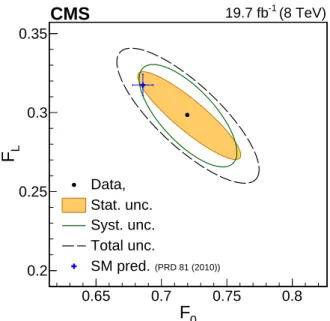
Figure 2 illustrates the combined measured left-handed and longitudinal W boson helicity frac-tions with their uncertainties, compared to the SM expectation in the (FL; F0) plane. The
right-handed polarization, FR, is compared with the SM prediction and previous results in Fig. 3.
0 F 0.65 0.7 0.75 0.8 L F 0.2 0.25 0.3 0.35 Data, Stat. unc. Syst. unc. Total unc. SM pred. CMS 19.7 fb-1 (8 TeV) (PRD 81 (2010))
Figure 2: Combined results from the muon+jets and electron+jets events for the left-handed and longitudinal W boson helicity fractions, shown as 68% contours for statistical, systematic, and total uncertainties, compared with the SM predictions [10].
The combined W helicities, which are consistent with the SM expectations, are used as input to the TOPFIT [9, 45] program to exclude the tensor terms of the tWb anomalous couplings,
gL and gR, while assuming VL = 1 and VR = 0. The best fit values for gL and gR couplings
are −0.017 and −0.008, respectively. Figure 4 shows the exclusion limits with 68% and 95% confidence levels (CL).
R
F
-0.2 -0.1 0 0.1 0.2 -0.2 0 0.2 0.4 0.6 0.8 1 1.2 1.4 SM pred. Stat. unc. Syst. unc. Total unc. CMS (JHEP 10 (2013)) ATLAS (JHEP 06 (2012)) CDF (PRD 87 (2013)) D0 (PRD 83 (2011)) Combination +jets µ e+jetsCMS
19.7 fb-1 (8 TeV) (PRD 81 (2010))Figure 3: The right-handed helicity fraction of the W boson from the top quark decay. The results from this analysis (top three entries) are compared with the SM prediction [10] and with the previous measurements [11–14], which are based on tt events.
)
LRe(g
-0.4 -0.2 0 0.2 0.4)
RRe(g
-0.5 0 0.5 1 @ 68% CL @ 95% CL Best fit SM pred.CMS
19.7 fb-1 (8 TeV)Figure 4: Exclusion limits on the real part of gL and gR anomalous couplings, with VL = 1
and VR = 0, using the combined W boson helicity measurement in the single top quark event
topology. Dashed blue lines show gL =0 and gR=0 as predicted by the SM at tree level.
9
Summary
The W boson helicity fractions are measured in the single top quark event topology, where the W boson from the top quark decays into a charged lepton (muon or electron) and a neutrino. The selected data complement the data from the standard CMS tt event selection and have
12 References
different systematic uncertainties. The results from the analysis of 19.7 fb−1 of pp collision data at√s = 8 TeV are in agreement, within their uncertainties, with the standard model NNLO predictions [10]. The measurements have similar precision to those based on tt events. The combined results are used to set exclusion limits on the tWb anomalous couplings.
Acknowledgments
We congratulate our colleagues in the CERN accelerator departments for the excellent perfor-mance of the LHC and thank the technical and administrative staffs at CERN and at other CMS institutes for their contributions to the success of the CMS effort. In addition, we gratefully acknowledge the computing centres and personnel of the Worldwide LHC Computing Grid for delivering so effectively the computing infrastructure essential to our analyses. Finally, we acknowledge the enduring support for the construction and operation of the LHC and the CMS detector provided by the following funding agencies: BMWFW and FWF (Austria); FNRS and FWO (Belgium); CNPq, CAPES, FAPERJ, and FAPESP (Brazil); MES (Bulgaria); CERN; CAS, MoST, and NSFC (China); COLCIENCIAS (Colombia); MSES and CSF (Croatia); RPF (Cyprus); MoER, ERC IUT and ERDF (Estonia); Academy of Finland, MEC, and HIP (Finland); CEA and CNRS/IN2P3 (France); BMBF, DFG, and HGF (Germany); GSRT (Greece); OTKA and NIH (Hungary); DAE and DST (India); IPM (Iran); SFI (Ireland); INFN (Italy); NRF and WCU (Re-public of Korea); LAS (Lithuania); MOE and UM (Malaysia); CINVESTAV, CONACYT, SEP, and UASLP-FAI (Mexico); MBIE (New Zealand); PAEC (Pakistan); MSHE and NSC (Poland); FCT (Portugal); JINR (Dubna); MON, RosAtom, RAS and RFBR (Russia); MESTD (Serbia); SEIDI and CPAN (Spain); Swiss Funding Agencies (Switzerland); MST (Taipei); ThEPCenter, IPST, STAR and NSTDA (Thailand); TUBITAK and TAEK (Turkey); NASU and SFFR (Ukraine); STFC (United Kingdom); DOE and NSF (USA).
Individuals have received support from the Marie-Curie programme and the European Re-search Council and EPLANET (European Union); the Leventis Foundation; the A. P. Sloan Foundation; the Alexander von Humboldt Foundation; the Belgian Federal Science Policy Of-fice; the Fonds pour la Formation `a la Recherche dans l’Industrie et dans l’Agriculture (FRIA-Belgium); the Agentschap voor Innovatie door Wetenschap en Technologie (IWT-(FRIA-Belgium); the Ministry of Education, Youth and Sports (MEYS) of the Czech Republic; the Council of Sci-ence and Industrial Research, India; the HOMING PLUS programme of Foundation for Polish Science, cofinanced from European Union, Regional Development Fund; the Compagnia di San Paolo (Torino); the Consorzio per la Fisica (Trieste); MIUR project 20108T4XTM (Italy); the Thalis and Aristeia programmes cofinanced by EU-ESF and the Greek NSRF; and the National Priorities Research Program by Qatar National Research Fund.
References
[1] CDF Collaboration, “Observation of Top Quark Production in ¯pp Collisions with the Collider Detector at Fermilab”, Phys. Rev. Lett. 74 (1995) 2626,
doi:10.1103/PhysRevLett.74.2626, arXiv:hep-ex/9503002.
[2] D0 Collaboration, “Observation of the Top Quark”, Phys. Rev. Lett. 74 (1995) 2632, doi:10.1103/PhysRevLett.74.2632, arXiv:hep-ex/9503003.
[3] L. Evans and P. Bryant, “LHC Machine”, JINST 3 (2008) S08001, doi:10.1088/1748-0221/3/08/S08001.
[4] CDF Collaboration, “First Observation of Electroweak Single Top Quark Production”, Phys. Rev. Lett. 103 (2009) 092002, doi:10.1103/PhysRevLett.103.092002, arXiv:0903.0885.
[5] D0 Collaboration, “Observation of Single Top-Quark Production”, Phys. Rev. Lett. 103 (2009) 092001, doi:10.1103/PhysRevLett.103.092001, arXiv:0903.0850. [6] CMS Collaboration, “Observation of the Associated Production of a Single Top Quark
and a W Boson in pp Collisions at√s =8 TeV”, Phys. Rev. Lett. 112 (2014) 231802, doi:10.1103/PhysRevLett.112.231802, arXiv:1401.2942.
[7] ATLAS Collaboration, “Measurement of the t-channel single top-quark production cross section in pp collisions at√s=7 TeV with the ATLAS detector”, Phys. Lett. B 717 (2012) 330, doi:10.1016/j.physletb.2012.09.031, arXiv:1205.3130.
[8] N. Kidonakis, “Differential and total cross sections for top pair and single top production”, (2012). arXiv:1205.3453.
[9] J. A. Aguilar-Saavedra et al., “Probing anomalous Wtb couplings in top pair decays”, Eur. Phys. J. C 50 (2007) 519, doi:10.1140/epjc/s10052-007-0289-4,
arXiv:hep-ph/0605190.
[10] A. Czarnecki, J. G. Korner, and J. H. Piclum, “Helicity fractions of W bosons from top quark decays at NNLO in QCD”, Phys. Rev. D 81 (2010) 111503,
doi:10.1103/PhysRevD.81.111503, arXiv:1005.2625.
[11] D0 Collaboration, “Measurement of the W boson helicity in top quark decays using 5.4 fb−1of p ¯p collision data”, Phys. Rev. D 83 (2011) 032009,
doi:10.1103/PhysRevD.83.032009, arXiv:1011.6549.
[12] CDF Collaboration, “Measurement of W-boson polarization in top-quark decay using the full CDF Run II data set”, Phys. Rev. D 87 (2013) 031104,
doi:10.1103/PhysRevD.87.031104, arXiv:1211.4523.
[13] ATLAS Collaboration, “Measurement of the W boson polarization in top quark decays with the ATLAS detector”, JHEP 06 (2012) 088, doi:10.1007/JHEP06(2012)088, arXiv:1205.2484.
[14] CMS Collaboration, “Measurement of the W-boson helicity in top-quark decays from tt production in lepton+jets events in pp collisions at√s=7 TeV”, JHEP 10 (2013) 167, doi:10.1007/JHEP10(2013)167, arXiv:1308.3879.
[15] CMS Collaboration, “Performance of CMS muon reconstruction in pp collision events at√ s =7 TeV”, JINST 7 (2012) P10002, doi:10.1088/1748-0221/7/10/P10002, arXiv:1206.4071.
[16] CMS Collaboration, “Energy calibration and resolution of the CMS electromagnetic calorimeter in pp collisions at√s=7 TeV”, JINST 8 (2013) P09009,
doi:10.1088/1748-0221/8/09/P09009.
[17] CMS Collaboration, “The CMS experiment at the CERN LHC”, JINST 3 (2008) S08004, doi:10.1088/1748-0221/3/08/S08004.
14 References
[18] P. Nason, “A New method for combining NLO QCD with shower Monte Carlo algorithms”, JHEP 11 (2004) 040, doi:10.1088/1126-6708/2004/11/040, arXiv:hep-ph/0409146.
[19] S. Alioli, P. Nason, C. Oleari, and E. Re, “NLO single-top production matched with shower in POWHEG: s- and t-channel contributions”, JHEP 09 (2009) 111,
doi:10.1088/1126-6708/2009/09/111, arXiv:0907.4076. [Erratum: doi:10.1007/JHEP02(2010)011].
[20] S. Alioli, P. Nason, C. Oleari, and E. Re, “A general framework for implementing NLO calculations in shower Monte Carlo programs: the POWHEG BOX”, JHEP 06 (2010) 043, doi:10.1007/JHEP06(2010)043, arXiv:1002.2581.
[21] E. Re, “Single-top Wt-channel production matched with parton showers using the POWHEG method”, Eur. Phys. J. C 71 (2011) 1547,
doi:10.1140/epjc/s10052-011-1547-z, arXiv:1009.2450.
[22] S. Frixione, P. Nason, and C. Oleari, “Matching NLO QCD computations with Parton Shower simulations: the POWHEG method”, JHEP 11 (2007) 070,
doi:10.1088/1126-6708/2007/11/070, arXiv:0709.2092.
[23] T. Sj ¨ostrand, S. Mrenna, and P. Z. Skands, “PYTHIA 6.4 physics and manual”, JHEP 05 (2006) 026, doi:10.1088/1126-6708/2006/05/026, arXiv:hep-ph/0603175. [24] J. Alwall et al., “MadGraph 5: going beyond”, JHEP 06 (2011) 128,
doi:10.1007/JHEP06(2011)128, arXiv:1106.0522.
[25] GEANT4 Collaboration, “Geant4—a simulation toolkit”, Nucl. Instrum. Meth. A 506 (2003) 250, doi:10.1016/S0168-9002(03)01368-8.
[26] CMS Collaboration, “Measurement of the t-channel single-top-quark production cross section and of the|Vtb|CKM matrix element in pp collisions at√s=8 TeV”, JHEP 06 (2014) 090, doi:10.1007/JHEP06(2014)090.
[27] CMS Collaboration, “HCAL performance from first collisions data”, CMS Detector Performance Summary CMS-DP-2010-025, 2010.
[28] CMS Collaboration, “Particle–Flow Event Reconstruction in CMS and Performance for Jets, Taus, and EmissT ”, CMS Physics Analysis Summary CMS-PAS-PFT-09-001, 2009. [29] CMS Collaboration, “Commissioning of the Particle-Flow Reconstruction in
Minimum-Bias and Jet Events from pp Collisions at 7 TeV”, CMS Physics Analysis Summary CMS-PAS-PFT-10-002, 2010.
[30] M. Cacciari, G. P. Salam, and G. Soyez, “The anti-ktjet clustering algorithm”, JHEP 04
(2008) 063, doi:10.1088/1126-6708/2008/04/063, arXiv:0802.1189.
[31] CMS Collaboration, “Determination of jet energy calibration and transverse momentum resolution in CMS”, JINST 6 (2011) P11002,
doi:10.1088/1748-0221/6/11/P11002.
[32] CMS Collaboration, “Identification of b-quark jets with the CMS experiment”, JINST 8 (2013) P04013, doi:10.1088/1748-0221/8/04/P04013.
[33] Particle Data Group, J. Beringer et al., “Review of Particle Physics”, Phys. Rev. D 86 (2012) 010001, doi:10.1103/PhysRevD.86.010001.
[34] F. James and M. Roos, “Minuit: a system for function minimization and analysis of the parameter errors and correlations”, Comput. Phys. Commun. 10 (1975) 343,
doi:10.1016/0010-4655(75)90039-9.
[35] CMS Collaboration, “Measurement of the inelastic proton-proton cross section at√ s =7 TeV”, Phys. Lett. B 722 (2013) 5, doi:10.1016/j.physletb.2013.03.024. [36] CMS Collaboration, “Measurements of inclusive W and Z cross sections in pp collisions
at√s = 7 TeV”, JHEP 01 (2010) 080, doi:10.1007/JHEP01(2011)080.
[37] CMS Collaboration, “CMS Luminosity Based on Pixel Cluster Counting - Summer 2013 Update”, CMS Physics Analysis Summary CMS-PAS-LUM-13-001, 2013.
[38] E. E. Boos et al., “Method for simulating electroweak top-quark production events in the NLO approximation: SingleTop event generator”, Phys. Atom. Nucl. 69 (2006) 1317, doi:10.1134/S1063778806080084.
[39] CompHEP Collaboration, “CompHEP 4.4: Automatic computations from Lagrangians to events”, Nucl. Instrum. Meth. A 534 (2004) 250, doi:10.1016/j.nima.2004.07.096, arXiv:hep-ph/0403113.
[40] ATLAS, CDF, CMS, and D0 Collaborations, “First combination of Tevatron and LHC measurements of the top quark mass”, (2014). arXiv:1403.4427.
[41] H.-L. Lai et al., “New parton distributions for collider physics”, Phys. Rev. D 82 (2010) 074024, doi:10.1103/PhysRevD.82.074024, arXiv:1007.2241.
[42] M. R. Whalley, D. Bourilkov, and R. C. Group, “The Les Houches accord PDFs (LHAPDF) and LHAGLUE”, (2005). arXiv:hep-ph/0508110.
[43] M. Czakon, P. Fiedler, and A. Mitov, “Total Top-Quark Pair-Production Cross Section at Hadron Colliders ThroughO(α4S)”, Phys. Rev. Lett. 110 (2013) 252004,
doi:10.1103/PhysRevLett.110.252004, arXiv:1303.6254.
[44] D0 Collaboration, “Combination of searches for anomalous top quark couplings with 5.4 fb−1of p ¯p collisions”, Phys. Lett. B 713 (2012) 165,
doi:10.1016/j.physletb.2012.05.048, arXiv:1204.2332.
[45] J. A. Aguilar-Saavedra and J. Bernab´eu, “W polarisation beyond helicity fractions in top quark decays”, Nucl. Phys. B 840 (2010) 349,
A
The CMS Collaboration
Yerevan Physics Institute, Yerevan, Armenia
V. Khachatryan, A.M. Sirunyan, A. Tumasyan
Institut f ¨ur Hochenergiephysik der OeAW, Wien, Austria
W. Adam, T. Bergauer, M. Dragicevic, J. Er ¨o, M. Friedl, R. Fr ¨uhwirth1, V.M. Ghete, C. Hartl, N. H ¨ormann, J. Hrubec, M. Jeitler1, W. Kiesenhofer, V. Kn ¨unz, M. Krammer1, I. Kr¨atschmer, D. Liko, I. Mikulec, D. Rabady2, B. Rahbaran, H. Rohringer, R. Sch ¨ofbeck, J. Strauss,
W. Treberer-Treberspurg, W. Waltenberger, C.-E. Wulz1
National Centre for Particle and High Energy Physics, Minsk, Belarus
V. Mossolov, N. Shumeiko, J. Suarez Gonzalez
Universiteit Antwerpen, Antwerpen, Belgium
S. Alderweireldt, M. Bansal, S. Bansal, T. Cornelis, E.A. De Wolf, X. Janssen, A. Knutsson, J. Lauwers, S. Luyckx, S. Ochesanu, R. Rougny, M. Van De Klundert, H. Van Haevermaet, P. Van Mechelen, N. Van Remortel, A. Van Spilbeeck
Vrije Universiteit Brussel, Brussel, Belgium
F. Blekman, S. Blyweert, J. D’Hondt, N. Daci, N. Heracleous, J. Keaveney, S. Lowette, M. Maes, A. Olbrechts, Q. Python, D. Strom, S. Tavernier, W. Van Doninck, P. Van Mulders, G.P. Van Onsem, I. Villella
Universit´e Libre de Bruxelles, Bruxelles, Belgium
C. Caillol, B. Clerbaux, G. De Lentdecker, D. Dobur, L. Favart, A.P.R. Gay, A. Grebenyuk, A. L´eonard, A. Mohammadi, L. Perni`e2, T. Reis, T. Seva, L. Thomas, C. Vander Velde, P. Vanlaer, J. Wang, F. Zenoni
Ghent University, Ghent, Belgium
V. Adler, K. Beernaert, L. Benucci, A. Cimmino, S. Costantini, S. Crucy, S. Dildick, A. Fagot, G. Garcia, J. Mccartin, A.A. Ocampo Rios, D. Ryckbosch, S. Salva Diblen, M. Sigamani, N. Strobbe, F. Thyssen, M. Tytgat, E. Yazgan, N. Zaganidis
Universit´e Catholique de Louvain, Louvain-la-Neuve, Belgium
S. Basegmez, C. Beluffi3, G. Bruno, R. Castello, A. Caudron, L. Ceard, G.G. Da Silveira, C. Delaere, T. du Pree, D. Favart, L. Forthomme, A. Giammanco4, J. Hollar, A. Jafari, P. Jez, M. Komm, V. Lemaitre, C. Nuttens, D. Pagano, L. Perrini, A. Pin, K. Piotrzkowski, A. Popov5, L. Quertenmont, M. Selvaggi, M. Vidal Marono, J.M. Vizan Garcia
Universit´e de Mons, Mons, Belgium
N. Beliy, T. Caebergs, E. Daubie, G.H. Hammad
Centro Brasileiro de Pesquisas Fisicas, Rio de Janeiro, Brazil
W.L. Ald´a J ´unior, G.A. Alves, L. Brito, M. Correa Martins Junior, T. Dos Reis Martins, C. Mora Herrera, M.E. Pol
Universidade do Estado do Rio de Janeiro, Rio de Janeiro, Brazil
W. Carvalho, J. Chinellato6, A. Cust ´odio, E.M. Da Costa, D. De Jesus Damiao, C. De Oliveira Martins, S. Fonseca De Souza, H. Malbouisson, D. Matos Figueiredo, L. Mundim, H. Nogima, W.L. Prado Da Silva, J. Santaolalla, A. Santoro, A. Sznajder, E.J. Tonelli Manganote6, A. Vilela Pereira
18 A The CMS Collaboration
Universidade Estadual Paulistaa, Universidade Federal do ABCb, S˜ao Paulo, Brazil
C.A. Bernardesb, S. Dograa, T.R. Fernandez Perez Tomeia, E.M. Gregoresb, P.G. Mercadanteb, S.F. Novaesa, Sandra S. Padulaa
Institute for Nuclear Research and Nuclear Energy, Sofia, Bulgaria
A. Aleksandrov, V. Genchev2, P. Iaydjiev, A. Marinov, S. Piperov, M. Rodozov, G. Sultanov, M. Vutova
University of Sofia, Sofia, Bulgaria
A. Dimitrov, I. Glushkov, R. Hadjiiska, L. Litov, B. Pavlov, P. Petkov
Institute of High Energy Physics, Beijing, China
J.G. Bian, G.M. Chen, H.S. Chen, M. Chen, T. Cheng, R. Du, C.H. Jiang, R. Plestina7, F. Romeo, J. Tao, Z. Wang
State Key Laboratory of Nuclear Physics and Technology, Peking University, Beijing, China
C. Asawatangtrakuldee, Y. Ban, Q. Li, S. Liu, Y. Mao, S.J. Qian, D. Wang, W. Zou
Universidad de Los Andes, Bogota, Colombia
C. Avila, A. Cabrera, L.F. Chaparro Sierra, C. Florez, J.P. Gomez, B. Gomez Moreno, J.C. Sanabria
University of Split, Faculty of Electrical Engineering, Mechanical Engineering and Naval Architecture, Split, Croatia
N. Godinovic, D. Lelas, D. Polic, I. Puljak
University of Split, Faculty of Science, Split, Croatia
Z. Antunovic, M. Kovac
Institute Rudjer Boskovic, Zagreb, Croatia
V. Brigljevic, K. Kadija, J. Luetic, D. Mekterovic, L. Sudic
University of Cyprus, Nicosia, Cyprus
A. Attikis, G. Mavromanolakis, J. Mousa, C. Nicolaou, F. Ptochos, P.A. Razis
Charles University, Prague, Czech Republic
M. Bodlak, M. Finger, M. Finger Jr.8
Academy of Scientific Research and Technology of the Arab Republic of Egypt, Egyptian Network of High Energy Physics, Cairo, Egypt
Y. Assran9, A. Ellithi Kamel10, M.A. Mahmoud11, A. Radi12,13
National Institute of Chemical Physics and Biophysics, Tallinn, Estonia
M. Kadastik, M. Murumaa, M. Raidal, A. Tiko
Department of Physics, University of Helsinki, Helsinki, Finland
P. Eerola, G. Fedi, M. Voutilainen
Helsinki Institute of Physics, Helsinki, Finland
J. H¨ark ¨onen, V. Karim¨aki, R. Kinnunen, M.J. Kortelainen, T. Lamp´en, K. Lassila-Perini, S. Lehti, T. Lind´en, P. Luukka, T. M¨aenp¨a¨a, T. Peltola, E. Tuominen, J. Tuominiemi, E. Tuovinen, L. Wendland
Lappeenranta University of Technology, Lappeenranta, Finland
DSM/IRFU, CEA/Saclay, Gif-sur-Yvette, France
M. Besancon, F. Couderc, M. Dejardin, D. Denegri, B. Fabbro, J.L. Faure, C. Favaro, F. Ferri, S. Ganjour, A. Givernaud, P. Gras, G. Hamel de Monchenault, P. Jarry, E. Locci, J. Malcles, J. Rander, A. Rosowsky, M. Titov
Laboratoire Leprince-Ringuet, Ecole Polytechnique, IN2P3-CNRS, Palaiseau, France
S. Baffioni, F. Beaudette, P. Busson, C. Charlot, T. Dahms, M. Dalchenko, L. Dobrzynski, N. Filipovic, A. Florent, R. Granier de Cassagnac, L. Mastrolorenzo, P. Min´e, C. Mironov, I.N. Naranjo, M. Nguyen, C. Ochando, P. Paganini, S. Regnard, R. Salerno, J.B. Sauvan, Y. Sirois, C. Veelken, Y. Yilmaz, A. Zabi
Institut Pluridisciplinaire Hubert Curien, Universit´e de Strasbourg, Universit´e de Haute Alsace Mulhouse, CNRS/IN2P3, Strasbourg, France
J.-L. Agram14, J. Andrea, A. Aubin, D. Bloch, J.-M. Brom, E.C. Chabert, C. Collard, E. Conte14, J.-C. Fontaine14, D. Gel´e, U. Goerlach, C. Goetzmann, A.-C. Le Bihan, P. Van Hove
Centre de Calcul de l’Institut National de Physique Nucleaire et de Physique des Particules, CNRS/IN2P3, Villeurbanne, France
S. Gadrat
Universit´e de Lyon, Universit´e Claude Bernard Lyon 1, CNRS-IN2P3, Institut de Physique Nucl´eaire de Lyon, Villeurbanne, France
S. Beauceron, N. Beaupere, G. Boudoul2, E. Bouvier, S. Brochet, C.A. Carrillo Montoya, J. Chasserat, R. Chierici, D. Contardo2, P. Depasse, H. El Mamouni, J. Fan, J. Fay, S. Gascon, M. Gouzevitch, B. Ille, T. Kurca, M. Lethuillier, L. Mirabito, S. Perries, J.D. Ruiz Alvarez, D. Sabes, L. Sgandurra, V. Sordini, M. Vander Donckt, P. Verdier, S. Viret, H. Xiao
Institute of High Energy Physics and Informatization, Tbilisi State University, Tbilisi, Georgia
Z. Tsamalaidze8
RWTH Aachen University, I. Physikalisches Institut, Aachen, Germany
C. Autermann, S. Beranek, M. Bontenackels, M. Edelhoff, L. Feld, A. Heister, O. Hindrichs, K. Klein, A. Ostapchuk, F. Raupach, J. Sammet, S. Schael, H. Weber, B. Wittmer, V. Zhukov5
RWTH Aachen University, III. Physikalisches Institut A, Aachen, Germany
M. Ata, M. Brodski, E. Dietz-Laursonn, D. Duchardt, M. Erdmann, R. Fischer, A. G ¨uth, T. Hebbeker, C. Heidemann, K. Hoepfner, D. Klingebiel, S. Knutzen, P. Kreuzer, M. Merschmeyer, A. Meyer, P. Millet, M. Olschewski, K. Padeken, P. Papacz, H. Reithler, S.A. Schmitz, L. Sonnenschein, D. Teyssier, S. Th ¨uer, M. Weber
RWTH Aachen University, III. Physikalisches Institut B, Aachen, Germany
V. Cherepanov, Y. Erdogan, G. Fl ¨ugge, H. Geenen, M. Geisler, W. Haj Ahmad, F. Hoehle, B. Kargoll, T. Kress, Y. Kuessel, A. K ¨unsken, J. Lingemann2, A. Nowack, I.M. Nugent, L. Perchalla, O. Pooth, A. Stahl
Deutsches Elektronen-Synchrotron, Hamburg, Germany
I. Asin, N. Bartosik, J. Behr, W. Behrenhoff, U. Behrens, A.J. Bell, M. Bergholz15, A. Bethani, K. Borras, A. Burgmeier, A. Cakir, L. Calligaris, A. Campbell, S. Choudhury, F. Costanza, C. Diez Pardos, G. Dolinska, S. Dooling, T. Dorland, G. Eckerlin, D. Eckstein, T. Eichhorn, G. Flucke, J. Garay Garcia, A. Geiser, P. Gunnellini, J. Hauk, M. Hempel15, D. Horton, H. Jung,
A. Kalogeropoulos, M. Kasemann, P. Katsas, J. Kieseler, C. Kleinwort, I. Korol, D. Kr ¨ucker, W. Lange, J. Leonard, K. Lipka, A. Lobanov, W. Lohmann15, B. Lutz, R. Mankel, I. Marfin15, I.-A. Melzer-Pellmann, A.B. Meyer, G. Mittag, J. Mnich, A. Mussgiller, S. Naumann-Emme,
20 A The CMS Collaboration
A. Nayak, O. Novgorodova, E. Ntomari, H. Perrey, D. Pitzl, R. Placakyte, A. Raspereza, P.M. Ribeiro Cipriano, B. Roland, E. Ron, M. ¨O. Sahin, J. Salfeld-Nebgen, P. Saxena, R. Schmidt15, T. Schoerner-Sadenius, M. Schr ¨oder, C. Seitz, S. Spannagel, A.D.R. Vargas Trevino, R. Walsh, C. Wissing
University of Hamburg, Hamburg, Germany
M. Aldaya Martin, V. Blobel, M. Centis Vignali, A.R. Draeger, J. Erfle, E. Garutti, K. Goebel, M. G ¨orner, J. Haller, M. Hoffmann, R.S. H ¨oing, A. Junkes, H. Kirschenmann, R. Klanner, R. Kogler, J. Lange, T. Lapsien, T. Lenz, I. Marchesini, J. Ott, T. Peiffer, A. Perieanu, N. Pietsch, J. Poehlsen, T. Poehlsen, D. Rathjens, C. Sander, H. Schettler, P. Schleper, E. Schlieckau, A. Schmidt, M. Seidel, V. Sola, H. Stadie, G. Steinbr ¨uck, D. Troendle, E. Usai, L. Vanelderen, A. Vanhoefer
Institut f ¨ur Experimentelle Kernphysik, Karlsruhe, Germany
C. Barth, C. Baus, J. Berger, C. B ¨oser, E. Butz, T. Chwalek, W. De Boer, A. Descroix, A. Dierlamm, M. Feindt, F. Frensch, M. Giffels, A. Gilbert, F. Hartmann2, T. Hauth2, U. Husemann, I. Katkov5, A. Kornmayer2, E. Kuznetsova, P. Lobelle Pardo, M.U. Mozer, T. M ¨uller, Th. M ¨uller, A. N ¨urnberg, G. Quast, K. Rabbertz, S. R ¨ocker, H.J. Simonis, F.M. Stober, R. Ulrich, J. Wagner-Kuhr, S. Wayand, T. Weiler, R. Wolf
Institute of Nuclear and Particle Physics (INPP), NCSR Demokritos, Aghia Paraskevi, Greece
G. Anagnostou, G. Daskalakis, T. Geralis, V.A. Giakoumopoulou, A. Kyriakis, D. Loukas, A. Markou, C. Markou, A. Psallidas, I. Topsis-Giotis
University of Athens, Athens, Greece
A. Agapitos, S. Kesisoglou, A. Panagiotou, N. Saoulidou, E. Stiliaris
University of Io´annina, Io´annina, Greece
X. Aslanoglou, I. Evangelou, G. Flouris, C. Foudas, P. Kokkas, N. Manthos, I. Papadopoulos, E. Paradas, J. Strologas
Wigner Research Centre for Physics, Budapest, Hungary
G. Bencze, C. Hajdu, P. Hidas, D. Horvath16, F. Sikler, V. Veszpremi, G. Vesztergombi17, A.J. Zsigmond
Institute of Nuclear Research ATOMKI, Debrecen, Hungary
N. Beni, S. Czellar, J. Karancsi18, J. Molnar, J. Palinkas, Z. Szillasi
University of Debrecen, Debrecen, Hungary
A. Makovec, P. Raics, Z.L. Trocsanyi, B. Ujvari
National Institute of Science Education and Research, Bhubaneswar, India
S.K. Swain
Panjab University, Chandigarh, India
S.B. Beri, V. Bhatnagar, R. Gupta, U.Bhawandeep, A.K. Kalsi, M. Kaur, R. Kumar, M. Mittal, N. Nishu, J.B. Singh
University of Delhi, Delhi, India
Ashok Kumar, Arun Kumar, S. Ahuja, A. Bhardwaj, B.C. Choudhary, A. Kumar, S. Malhotra, M. Naimuddin, K. Ranjan, V. Sharma
Saha Institute of Nuclear Physics, Kolkata, India
S. Banerjee, S. Bhattacharya, K. Chatterjee, S. Dutta, B. Gomber, Sa. Jain, Sh. Jain, R. Khurana, A. Modak, S. Mukherjee, D. Roy, S. Sarkar, M. Sharan
Bhabha Atomic Research Centre, Mumbai, India
A. Abdulsalam, D. Dutta, S. Kailas, V. Kumar, A.K. Mohanty2, L.M. Pant, P. Shukla, A. Topkar
Tata Institute of Fundamental Research, Mumbai, India
T. Aziz, S. Banerjee, S. Bhowmik19, R.M. Chatterjee, R.K. Dewanjee, S. Dugad, S. Ganguly, S. Ghosh, M. Guchait, A. Gurtu20, G. Kole, S. Kumar, M. Maity19, G. Majumder, K. Mazumdar, G.B. Mohanty, B. Parida, K. Sudhakar, N. Wickramage21
Institute for Research in Fundamental Sciences (IPM), Tehran, Iran
H. Bakhshiansohi, H. Behnamian, S.M. Etesami22, A. Fahim23, R. Goldouzian, M. Khakzad, M. Mohammadi Najafabadi, M. Naseri, S. Paktinat Mehdiabadi, F. Rezaei Hosseinabadi, B. Safarzadeh24, M. Zeinali
University College Dublin, Dublin, Ireland
M. Felcini, M. Grunewald
INFN Sezione di Baria, Universit`a di Barib, Politecnico di Baric, Bari, Italy
M. Abbresciaa,b, C. Calabriaa,b, S.S. Chhibraa,b, A. Colaleoa, D. Creanzaa,c, N. De Filippisa,c, M. De Palmaa,b, L. Fiorea, G. Iasellia,c, G. Maggia,c, M. Maggia, S. Mya,c, S. Nuzzoa,b, A. Pompilia,b, G. Pugliesea,c, R. Radognaa,b,2, G. Selvaggia,b, A. Sharma, L. Silvestrisa,2, R. Vendittia,b
INFN Sezione di Bolognaa, Universit`a di Bolognab, Bologna, Italy
G. Abbiendia, A.C. Benvenutia, D. Bonacorsia,b, S. Braibant-Giacomellia,b, L. Brigliadoria,b, R. Campaninia,b, P. Capiluppia,b, A. Castroa,b, F.R. Cavalloa, G. Codispotia,b, M. Cuffiania,b, G.M. Dallavallea, F. Fabbria, A. Fanfania,b, D. Fasanellaa,b, P. Giacomellia, C. Grandia, L. Guiduccia,b, S. Marcellinia, G. Masettia, A. Montanaria, F.L. Navarriaa,b, A. Perrottaa, F. Primaveraa,b, A.M. Rossia,b, T. Rovellia,b, G.P. Sirolia,b, N. Tosia,b, R. Travaglinia,b
INFN Sezione di Cataniaa, Universit`a di Cataniab, CSFNSMc, Catania, Italy
S. Albergoa,b, G. Cappelloa, M. Chiorbolia,b, S. Costaa,b, F. Giordanoa,2, R. Potenzaa,b,
A. Tricomia,b, C. Tuvea,b
INFN Sezione di Firenzea, Universit`a di Firenzeb, Firenze, Italy
G. Barbaglia, V. Ciullia,b, C. Civininia, R. D’Alessandroa,b, E. Focardia,b, E. Galloa, S. Gonzia,b, V. Goria,b,2, P. Lenzia,b, M. Meschinia, S. Paolettia, G. Sguazzonia, A. Tropianoa,b
INFN Laboratori Nazionali di Frascati, Frascati, Italy
L. Benussi, S. Bianco, F. Fabbri, D. Piccolo
INFN Sezione di Genovaa, Universit`a di Genovab, Genova, Italy
R. Ferrettia,b, F. Ferroa, M. Lo Veterea,b, E. Robuttia, S. Tosia,b
INFN Sezione di Milano-Bicoccaa, Universit`a di Milano-Bicoccab, Milano, Italy
M.E. Dinardoa,b, S. Fiorendia,b, S. Gennaia,2, R. Gerosaa,b,2, A. Ghezzia,b, P. Govonia,b, M.T. Lucchinia,b,2, S. Malvezzia, R.A. Manzonia,b, A. Martellia,b, B. Marzocchia,b,2, D. Menascea,
L. Moronia, M. Paganonia,b, D. Pedrinia, S. Ragazzia,b, N. Redaellia, T. Tabarelli de Fatisa,b
22 A The CMS Collaboration
Basilicata (Potenza)c, Universit`a G. Marconi (Roma)d, Napoli, Italy
S. Buontempoa, N. Cavalloa,c, S. Di Guidaa,d,2, F. Fabozzia,c, A.O.M. Iorioa,b, L. Listaa, S. Meolaa,d,2, M. Merolaa, P. Paoluccia,2
INFN Sezione di Padovaa, Universit`a di Padovab, Universit`a di Trento (Trento)c, Padova, Italy
P. Azzia, N. Bacchettaa, M. Biasottoa,25, D. Biselloa,b, R. Carlina,b, P. Checchiaa, M. Dall’Ossoa,b, T. Dorigoa, U. Dossellia, M. Galantia,b, F. Gasparinia,b, U. Gasparinia,b, P. Giubilatoa,b, A. Gozzelinoa, K. Kanishcheva,c, S. Lacapraraa, M. Margonia,b, A.T. Meneguzzoa,b, J. Pazzinia,b, N. Pozzobona,b, P. Ronchesea,b, F. Simonettoa,b, E. Torassaa, M. Tosia,b, P. Zottoa,b, A. Zucchettaa,b, G. Zumerlea,b
INFN Sezione di Paviaa, Universit`a di Paviab, Pavia, Italy
M. Gabusia,b, S.P. Rattia,b, V. Rea, C. Riccardia,b, P. Salvinia, P. Vituloa,b
INFN Sezione di Perugiaa, Universit`a di Perugiab, Perugia, Italy
M. Biasinia,b, G.M. Bileia, D. Ciangottinia,b,2, L. Fan `oa,b, P. Laricciaa,b, G. Mantovania,b, M. Menichellia, A. Sahaa, A. Santocchiaa,b, A. Spieziaa,b,2
INFN Sezione di Pisaa, Universit`a di Pisab, Scuola Normale Superiore di Pisac, Pisa, Italy
K. Androsova,26, P. Azzurria, G. Bagliesia, J. Bernardinia, T. Boccalia, G. Broccoloa,c, R. Castaldia, M.A. Cioccia,26, R. Dell’Orsoa, S. Donatoa,c,2, F. Fioria,c, L. Fo`aa,c, A. Giassia, M.T. Grippoa,26, F. Ligabuea,c, T. Lomtadzea, L. Martinia,b, A. Messineoa,b, C.S. Moona,27, F. Pallaa,2, A. Rizzia,b, A. Savoy-Navarroa,28, A.T. Serbana, P. Spagnoloa, P. Squillaciotia,26, R. Tenchinia, G. Tonellia,b, A. Venturia, P.G. Verdinia, C. Vernieria,c,2
INFN Sezione di Romaa, Universit`a di Romab, Roma, Italy
L. Baronea,b, F. Cavallaria, G. D’imperioa,b, D. Del Rea,b, M. Diemoza, C. Jordaa, E. Longoa,b,
F. Margarolia,b, P. Meridiania, F. Michelia,b,2, S. Nourbakhsha,b, G. Organtinia,b, R. Paramattia, S. Rahatloua,b, C. Rovellia, F. Santanastasioa,b, L. Soffia,b,2, P. Traczyka,b,2
INFN Sezione di Torino a, Universit`a di Torino b, Universit`a del Piemonte Orientale (No-vara)c, Torino, Italy
N. Amapanea,b, R. Arcidiaconoa,c, S. Argiroa,b, M. Arneodoa,c, R. Bellana,b, C. Biinoa, N. Cartigliaa, S. Casassoa,b,2, M. Costaa,b, A. Deganoa,b, N. Demariaa, L. Fincoa,b,2, C. Mariottia,
S. Masellia, E. Migliorea,b, V. Monacoa,b, M. Musicha, M.M. Obertinoa,c,2, G. Ortonaa,b, L. Pachera,b, N. Pastronea, M. Pelliccionia, G.L. Pinna Angionia,b, A. Potenzaa,b, A. Romeroa,b, M. Ruspaa,c, R. Sacchia,b, A. Solanoa,b, A. Staianoa, U. Tamponia
INFN Sezione di Triestea, Universit`a di Triesteb, Trieste, Italy
S. Belfortea, V. Candelisea,b,2, M. Casarsaa, F. Cossuttia, G. Della Riccaa,b, B. Gobboa, C. La Licataa,b, M. Maronea,b, A. Schizzia,b, T. Umera,b, A. Zanettia
Kangwon National University, Chunchon, Korea
S. Chang, A. Kropivnitskaya, S.K. Nam
Kyungpook National University, Daegu, Korea
D.H. Kim, G.N. Kim, M.S. Kim, D.J. Kong, S. Lee, Y.D. Oh, H. Park, A. Sakharov, D.C. Son
Chonbuk National University, Jeonju, Korea
T.J. Kim
Chonnam National University, Institute for Universe and Elementary Particles, Kwangju, Korea
Korea University, Seoul, Korea
S. Choi, D. Gyun, B. Hong, M. Jo, H. Kim, Y. Kim, B. Lee, K.S. Lee, S.K. Park, Y. Roh
University of Seoul, Seoul, Korea
M. Choi, J.H. Kim, I.C. Park, G. Ryu, M.S. Ryu
Sungkyunkwan University, Suwon, Korea
Y. Choi, Y.K. Choi, J. Goh, D. Kim, E. Kwon, J. Lee, H. Seo, I. Yu
Vilnius University, Vilnius, Lithuania
A. Juodagalvis
National Centre for Particle Physics, Universiti Malaya, Kuala Lumpur, Malaysia
J.R. Komaragiri, M.A.B. Md Ali
Centro de Investigacion y de Estudios Avanzados del IPN, Mexico City, Mexico
E. Casimiro Linares, H. Castilla-Valdez, E. De La Cruz-Burelo, I. Heredia-de La Cruz29, A. Hernandez-Almada, R. Lopez-Fernandez, A. Sanchez-Hernandez
Universidad Iberoamericana, Mexico City, Mexico
S. Carrillo Moreno, F. Vazquez Valencia
Benemerita Universidad Autonoma de Puebla, Puebla, Mexico
I. Pedraza, H.A. Salazar Ibarguen
Universidad Aut ´onoma de San Luis Potos´ı, San Luis Potos´ı, Mexico
A. Morelos Pineda
University of Auckland, Auckland, New Zealand
D. Krofcheck
University of Canterbury, Christchurch, New Zealand
P.H. Butler, S. Reucroft
National Centre for Physics, Quaid-I-Azam University, Islamabad, Pakistan
A. Ahmad, M. Ahmad, Q. Hassan, H.R. Hoorani, W.A. Khan, T. Khurshid, M. Shoaib
National Centre for Nuclear Research, Swierk, Poland
H. Bialkowska, M. Bluj, B. Boimska, T. Frueboes, M. G ´orski, M. Kazana, K. Nawrocki, K. Romanowska-Rybinska, M. Szleper, P. Zalewski
Institute of Experimental Physics, Faculty of Physics, University of Warsaw, Warsaw, Poland
G. Brona, K. Bunkowski, M. Cwiok, W. Dominik, K. Doroba, A. Kalinowski, M. Konecki, J. Krolikowski, M. Misiura, M. Olszewski, W. Wolszczak
Laborat ´orio de Instrumenta¸c˜ao e F´ısica Experimental de Part´ıculas, Lisboa, Portugal
P. Bargassa, C. Beir˜ao Da Cruz E Silva, P. Faccioli, P.G. Ferreira Parracho, M. Gallinaro, L. Lloret Iglesias, F. Nguyen, J. Rodrigues Antunes, J. Seixas, J. Varela, P. Vischia
Joint Institute for Nuclear Research, Dubna, Russia
S. Afanasiev, P. Bunin, M. Gavrilenko, I. Golutvin, I. Gorbunov, A. Kamenev, V. Karjavin, V. Konoplyanikov, A. Lanev, A. Malakhov, V. Matveev30, P. Moisenz, V. Palichik, V. Perelygin, S. Shmatov, N. Skatchkov, V. Smirnov, A. Zarubin
Petersburg Nuclear Physics Institute, Gatchina (St. Petersburg), Russia
V. Golovtsov, Y. Ivanov, V. Kim31, P. Levchenko, V. Murzin, V. Oreshkin, I. Smirnov, V. Sulimov,
24 A The CMS Collaboration
Institute for Nuclear Research, Moscow, Russia
Yu. Andreev, A. Dermenev, S. Gninenko, N. Golubev, M. Kirsanov, N. Krasnikov, A. Pashenkov, D. Tlisov, A. Toropin
Institute for Theoretical and Experimental Physics, Moscow, Russia
V. Epshteyn, V. Gavrilov, N. Lychkovskaya, V. Popov, I. Pozdnyakov, G. Safronov, S. Semenov, A. Spiridonov, V. Stolin, E. Vlasov, A. Zhokin
P.N. Lebedev Physical Institute, Moscow, Russia
V. Andreev, M. Azarkin, I. Dremin, M. Kirakosyan, A. Leonidov, G. Mesyats, S.V. Rusakov, A. Vinogradov
Skobeltsyn Institute of Nuclear Physics, Lomonosov Moscow State University, Moscow, Russia
A. Belyaev, E. Boos, V. Bunichev, M. Dubinin32, L. Dudko, A. Gribushin, V. Klyukhin, O. Kodolova, I. Lokhtin, S. Obraztsov, M. Perfilov, S. Petrushanko, V. Savrin
State Research Center of Russian Federation, Institute for High Energy Physics, Protvino, Russia
I. Azhgirey, I. Bayshev, S. Bitioukov, V. Kachanov, A. Kalinin, D. Konstantinov, V. Krychkine, V. Petrov, R. Ryutin, A. Sobol, L. Tourtchanovitch, S. Troshin, N. Tyurin, A. Uzunian, A. Volkov
University of Belgrade, Faculty of Physics and Vinca Institute of Nuclear Sciences, Belgrade, Serbia
P. Adzic33, M. Ekmedzic, J. Milosevic, V. Rekovic
Centro de Investigaciones Energ´eticas Medioambientales y Tecnol ´ogicas (CIEMAT), Madrid, Spain
J. Alcaraz Maestre, C. Battilana, E. Calvo, M. Cerrada, M. Chamizo Llatas, N. Colino, B. De La Cruz, A. Delgado Peris, D. Dom´ınguez V´azquez, A. Escalante Del Valle, C. Fernandez Bedoya, J.P. Fern´andez Ramos, J. Flix, M.C. Fouz, P. Garcia-Abia, O. Gonzalez Lopez, S. Goy Lopez, J.M. Hernandez, M.I. Josa, E. Navarro De Martino, A. P´erez-Calero Yzquierdo, J. Puerta Pelayo, A. Quintario Olmeda, I. Redondo, L. Romero, M.S. Soares
Universidad Aut ´onoma de Madrid, Madrid, Spain
C. Albajar, J.F. de Troc ´oniz, M. Missiroli, D. Moran
Universidad de Oviedo, Oviedo, Spain
H. Brun, J. Cuevas, J. Fernandez Menendez, S. Folgueras, I. Gonzalez Caballero
Instituto de F´ısica de Cantabria (IFCA), CSIC-Universidad de Cantabria, Santander, Spain
J.A. Brochero Cifuentes, I.J. Cabrillo, A. Calderon, J. Duarte Campderros, M. Fernandez, G. Gomez, A. Graziano, A. Lopez Virto, J. Marco, R. Marco, C. Martinez Rivero, F. Matorras, F.J. Munoz Sanchez, J. Piedra Gomez, T. Rodrigo, A.Y. Rodr´ıguez-Marrero, A. Ruiz-Jimeno, L. Scodellaro, I. Vila, R. Vilar Cortabitarte
CERN, European Organization for Nuclear Research, Geneva, Switzerland
D. Abbaneo, E. Auffray, G. Auzinger, M. Bachtis, P. Baillon, A.H. Ball, D. Barney, A. Benaglia, J. Bendavid, L. Benhabib, J.F. Benitez, C. Bernet7, P. Bloch, A. Bocci, A. Bonato, O. Bondu, C. Botta, H. Breuker, T. Camporesi, G. Cerminara, S. Colafranceschi34, M. D’Alfonso,
D. d’Enterria, A. Dabrowski, A. David, F. De Guio, A. De Roeck, S. De Visscher, E. Di Marco, M. Dobson, M. Dordevic, N. Dupont-Sagorin, A. Elliott-Peisert, J. Eugster, G. Franzoni, W. Funk, D. Gigi, K. Gill, D. Giordano, M. Girone, F. Glege, R. Guida, S. Gundacker, M. Guthoff, J. Hammer, M. Hansen, P. Harris, J. Hegeman, V. Innocente, P. Janot, K. Kousouris, K. Krajczar,