“Design elements that Influence the
Participation of Solvers in Innovation
Contests”
Daniel Gadit Mendes
152115242
Dissertation written under the supervision of Cláudia Costa
Dissertation submitted in partial fulfilment of requirements for the MSc
in Business, at the Universidade Católica Portuguesa, 05\01\2018.
Abstract 2
ABSTRACT
Title: “Design elements that Influence the Participation of Solvers in Innovation Contests”
Author: Daniel Gadit Mendes
This study analyzes all of the innovation contests, also known as crowdsourcing contests, posted on the Inocrowd platform. Inocrowd is an open innovation intermediary firm, based in Portugal, that hosts crowdsourcing contests for firms, called “seekers” looking to solve innovation challenges. The main aim of this study is to examine to what extent some design elements of crowdsourcing contests can influence the participation of “solvers” in these contests. The design elements considered in this study are the monetary award amount, the project type, the platform maturity and the anonymity of “seeker” firms. We then created a mathematical model that can be used to predict the participation of “solvers” in crowdsourcing contests, based on the design elements examined. This paper contributes to the growing research field of open innovation, particularly crowdsourcing contests hosted by intermediary firms, and will provide managers with a framework for designing innovation contests with more participation.
Keywords: Open innovation, Intermediaries, Crowdsourcing, Design elements
Abstract 3
RESUMO
Título: “Elementos de Design que influenciam a participação de solvers em concursos de
inovação”
Autor: Daniel Gadit Mendes
Este estudo tem como objetivo analisar todos os concursos de inovação, ou concursos de
crowdsourcing, colocados na plataforma Inocrowd. A Inocrowd e um intermediário de
inovação aberta, sediada em Portugal, que coloca concursos de crowdsourcing para empresas, conhecidas como ”seekers”, que procuram resolver desafios de inovação. O objetivo primário deste estudo é examinar até que ponto alguns elementos de design destes concursos de inovação influenciam a participação de investigadores, de nome “solvers”, nestes concursos. Os elementos de design considerados nesta investigação são a valor do prémio monetário, o tipo de projeto, a maturidade da plataforma e o anonimato dos “seekers”. Um modelo matemático foi desenvolvido no âmbito de prever a participação dos “solvers” nos concursos de crowdsourcing colocados na plataforma Inocrowd, baseado nos elementos de design examinados. Este estudo contribui para área de pesquisa crescente que e a Inovação aberta, particularmente na área dos concursos de crowdsourcing colocados por intermediários de inovação, tendo como objetivo fornecer aos gestores uma estrutura para criar concursos de inovação com mais participação.
Aknowledgements 4
Acknowledgements
I would like to thank my supervisor for all of the patience, understanding and help that she has provided me with throughout the whole process. I would like to thank my family and friends for supporting me and proof reading the project. Special thanks for my girlfriend who supported during the whole process. Finally, I would like to thank Inocrowd’s CEO for letting me access all of the data from the platform and for letting me focus on this project while I was working there.
Contents 5
Contents
ABSTRACT --- 2 RESUMO --- 3 ACKNOWLEDGEMENTS --- 4 CONTENTS --- 5 1. INTRODUCTION --- 7 2. LITERATURE REVIEW --- 12 2.1 Open innovation --- 12 2.2. Innovation Intermediaries --- 13 2.3. Crowdsourcing --- 142.3.1 Types of crowdsourcing contests --- 15
2.3.2 The Number of Participants in Crowdsourcing Contests --- 16
2.3.3 Monetary award --- 17 2.3.4 Project type --- 18 2.3.5 Marketplace Maturity --- 20 2.3.6 Anonymity --- 20 3. METHOD --- 22 3.1 Data --- 22 3.2 Sample Procedure --- 22 3.3 Variables --- 22
3.3.1 Performance of crowdsourcing contests --- 23
3.3.2 Participation in Crowdsourcing contests --- 23
3.3.3 Monetary award --- 23
3.3.4 Project type --- 24
3.3.5 Platform maturity --- 25
3.3.6 Anonymity --- 25
3.4. Model description --- Erro! Marcador não definido.
4.RESULTS --- ERRO! MARCADOR NÃO DEFINIDO.
Contents 6
4.2 Regression results --- Erro! Marcador não definido.
4.3 Discussion--- 30
4.4 conclusion--- 32
5. LIMITATIONS AND FUTURE RESEARCH --- 35
Introduction 7
1. Introduction
Companies are looking for fresh innovation strategies aiming to shorten innovation cycles, to reduce escalating costs of industrial R&D, to cope with globalization of research technologies, and the lack of natural resources (Enkel and Gassmann, 2004). In 2003, Chesbrough described a paradigm shift in innovation models, from a closed to an open model. The open model suggests that when companies want to improve and update their technology, they should take advantage of external as well as internal ideas, and use internal and external paths to market (Chesbrough, 2005). Open innovation views research and development as an open system, hence valuable ideas that come from inside or outside the company can and should be taken to market internally or externally, with the main goal of capturing the value from any idea (Chesbrough, 2005).
The concept of Open innovation was first used in 2003, when Chesbrough introduced the term defining it as “the use of purposive inflows and outflows of knowledge to accelerate internal
innovation, and expand the markets for external use of innovation, respectively” (Chesbrough,
2005). Chesbrough created this definition by grouping different concepts, that had been in use previously, related to the sharing of information between organizations and the acquisition of external information, such as, absorptive capacity (Zahra, 2001), complementary assets (Teece, 1986), the exploration and exploitation argument (March 1991) and user integration (Henkel and Von Hippel, 2005) and others.
In 2004, Enkel and Gassmann identified three core processes that differentiate open innovation from previous models: (1) The outside-in process, which companies use to enrich their own knowledge base through the integration of suppliers, customers, and external knowledge sourcing thus increasing a company’s innovativeness. For example, IBM’s solution lab in Rüschlikon, integrates external knowledge in research projects and finds partners for joint ventures. Access to this external knowledge is one of the main assets of the solution lab and provides it with a high status within IBM’s research (Gassmann and Enkel, 2004). (2) The inside-out process: This process deals with external exploitation of ideas in different markets, selling IP and multiplying technology by channeling ideas to the external environment. Big Pharmaceutical companies often engage in this type of open innovation, for example, often, drugs were developed to treat specific conditions but became known by being used to treat different health issues, such as Viagra, which was originally used to control blood pressure, but enjoyed great success as a sexual aid (Enkel and Gassmann, 2004). (3) The coupled process links outside-in and inside-out processes by working in alliances with
Introduction 8 complementary companies. The European space agency provides a good example of the coupled process of open innovation, because it is forced to jointly develop satellites with various European partners (Enkel and Gassmann, 2004).
The outside-in process allows companies to acquire knowledge from external sources, such as universities, suppliers, customers and others, which can then be integrated in the company (Mention, 2011). Companies usually have two motivations when looking for outside innovations, to access innovations, that are not owned by the firm, and to improve efficiency through economies of scale (West and Bogers, 2014). Evidence shows that firms engage more in the outside-in process than in the inside-out process (Chesbrough and Crowther, 2006). Hence, the outside-in process is an important vehicle for companies to increase their innovativeness (Laursen and Salter, 2006).
Furthermore, when companies look outside for technologies, they reduce financial risk by investing in technology that has been used in other applications (Chesbrough and Crowther ,2006). A good example of the importance of leveraging external sources of knowledge, can be found at SAP or Microsoft who have opened decentralized research laboratories, in places such as universities, in order to increase their absorptive capacity of “inbound” innovation (Gassmann, Enkel and Chesbrough, 2010). It is important to note, however, that the open innovation phenomenon is not limited to large high-tech industries, it has spread to other industries such as machinery and, fast moving consumer goods and much more (Gassmann, Enkel and Chesbrough, 2010). Chesbrough and Crowther’s study of 12 companies across different industries showed that all 12 companies engaged in some open innovation practices (Chesbrough and Crowther, 2006).
Dahlander and Gann, divided inbound innovation into pecuniary activities (acquiring) and non-pecuniary activities (sourcing) and found that some companies spend too much time searching for external innovations when sourcing for external innovations (Dahlander and Gann, 2010), hence having a good partner would allow companies to reduce time spent on the activities mentioned above. They also showed that, when acquiring external knowledge, the effectiveness of openness depends of the quality of the resources of the partnering organization (Dahlander and Gann, 2010), hence it is important for the seeker firms to find the best partnering organization. Fortunately, there are now intermediary firms that assist firms in the information scanning and gathering functions and the communication function (Howells, 2006). These intermediaries allow companies to engage in inbound innovation without having to worry too much about scanning and gathering of relevant information. There is also the issue
Introduction 9 of the “Innovation Gap”, the separation of the research and the business communities (Dazniel, 2010), as a consequence of the differences of measures and performance goals of these two separate communities (Partha and David, 1994). It has been showed that innovation intermediaries are the only firms that operate in the “Innovation Gap” purposefully, and are able to enhance the capacities of different innovation systems by intermediating between the business and research communities (Dazniel, 2010). An Innovation intermediary is “An
organization or body that acts as an agent or broker in any aspect of the innovation process between two or more parties.” (Howells, 2006). Moreover, these open innovation
intermediaries, have begun to find specific technological solutions, through the use of external parties, known as “solvers”, to answer to specific technological challenges of various firms, called “seekers”.
Past studies have also identified several types of innovation intermediaries, differentiated by their activities :(1) interorganizational networking activities; (2) technology development and related activities, (3) and other activities (Dazniel, 2010). The focus of this study is in the first category, interorganizational networking activities, where intermediaries work to create interorganizational networks where knowledge and resources are traded openly between the members of the network. NineSigma (2000) and Innocentive (2001) are two examples of internet based platforms that focus on transferring knowledge (Chesbrough, 2006) and have created a new industry by dramatically changing the innovation spectrum (Hossain, 2012). These platforms have become increasingly important to companies because they (1) facilitate technology communication internally and externally, (2) connect innovation providers to innovation seekers, (3) help companies screen external markets and understand the technology market better, (4) make searching tasks easier for companies, (5) reduce search costs for the companies (Hossain, 2012). The type of intermediaries considered in this study use crowdsourcing contests, also known as open innovation contests, to come up with innovative solutions for a “seeker’s” technological challenges.
A crowdsourcing contest, or open innovation contest (Terwiesch and Xu, 2008), can be defined as a “problem solving process by disclosing the details of the problem at hand and inviting the
participation of anyone who deems himself qualified to solve the problem” (Jeppesen and
Lakhani, 2008). Previous studies on open innovation contests have primarily focused on incentives to participate, award size and structure, the optimal size of the solver pool, entry criteria, tournament design and how these factors affect the effectiveness of innovation contests (Che and Gale, 2003).
Introduction 10 The optimum number of solvers for a seeker firm, in a crowdsourcing contest, has been investigated before, and in 1999, Mcafee and Fullerton showed that, for seekers, the ideal solution space is to have 2 solvers working in the contest. Having to many solvers working on a problem leads to a lower equilibrium effort for each solver, which is not desirable for seeker firms (Terwiesch and Xu, 2008), this is known as the “competition effect”. However, seeker firms benefit from a larger solver population because that leads to a more diverse set of solutions submitted (Terwiesch and Xu, 2008), this is called the “parallel path effect”. Hence, according to the “parallel path effect”, it is preferable for innovation platforms to maximize participation because it increases the quality of the best solution and benefits innovation by broadening the search for solutions (Boudreau, Lacetera, and Lakhani, 2008; Terwiesch and Xu, 2008; Lakhani et al., 2007).Interestingly, Boudreau, Lacetera and Lakhani (2008) showed that the two effects coexist, but at different levels. However, in this study we consider that for a start-up intermediary firm that hosts crowdsourcing contests in Portugal, the “parallel path effect” is more relevant since both the intermediary and the seeker firm are mostly concerned with the quality of the best solution. Hence, we will investigate how design elements mentioned below influence participation in crowdsourcing contests, hosted by a crowdsourcing intermediary in Portugal, and we will develop a model that shows how each design element affects participation in crowdsourcing contests.
The effects of the monetary award on the participation of solvers show that the higher the reward, the higher the participation of solvers (Di Palantino and Vojnovic, 2009 ; Zheng, Li, and Hou, 2011; Yang et al., 2009) and the better the quality of solutions submitted (Archak and Sundararajan, 2009). Secondly, the effects of Platform Maturity (Walter and Back, 2011) on the participation of solvers in crowdsourcing contests will be analyzed Platform maturity, is the overall age of the marketplace, and past investigations have showed the existence of positive network effects in open innovation platforms, which means that over time there is a growing population of solvers registered in the platform which means that the innovation contests will benefit from more participation (Snir and Hitt, 2003; Yang et al, 2009; Walter and Back, 2011). Thirdly, the platform maturity was investigated. The platform maturity is the overall age of the platform and past investigation show that increases platform maturity leads to heightened levels of participation (Yang et al., 2009). Terwiesch and Xu (2008) looked at types of contests, showing that different types could be defined according to the technical and market uncertainty: ideation, trial and error, and expertise based projects. Past studies show that different project types are influenced by certain design elements of the contest (Boudreau, Lacetera, and Lakhani, 2008), and that ideation projects capture the highest number of solvers
Introduction 11 of the three types (Yang et al., 2009; Terwiesch and Xu, 2008). The last design element considered is the anonymity of the seekers. To our knowledge this variable has never been investigated before. Past literature focuses on the reputation of seeker firms and states that solvers are more likely to register for challenges of seekers with strong brand strength (Walter and Back, 2011). Walter and Back (2010) showed similar results in a qualitative study of four crowdsourcing case studies. Understanding the effects of seeker anonymity on the participation of solvers would help companies to decide whether or not they should remain anonymous when broadcasting their innovation challenges, through the use of crowdsourcing contests hosted by intermediary firms.
In summary, past investigations have showed that participation of solvers in crowdsourcing contests is influenced by award amount, project time cost, description length, contest duration, project type and marketplace maturity (Yang, Chen, and Pavlou, 2009). This study investigates some easily adjustable design elements of crowdsourcing contests, hosted by intermediary firms, namely the monetary award, the problem description length, project type, platform maturity, and the anonymity of the seeker firm. This study allowed us to develop a model that accurately explains the participation of solvers in crowdsourcing contests.
This work analyzes the Inocrowd Platform. InoCrowd is a Portuguese crowdsourcing intermediary firm, that hosts “open call” innovation contests. Portugal is a very interesting case, since it is a small country recovering from a recession mainly by investing in technology, hence this type of business should experience exponential growth. Identifying design elements that directly influence participation of solvers, would be extremely valuable for crowdsourcing intermediaries and for “seeker firms, because these findings could be used to design more effective crowdsourcing contests.
Litterature Review 12
2. Literature Review
2.1 Open InnovationCurrently Open innovation research is an important and diverse topic. Since its first definition in 2003 by Chesbrough, it experienced exponential growth in practice and in research. Individual companies have proclaimed their success with their versions of open innovation, such as Procter and Gamble’s Connect and Develop program (Huston and Sakkab, 2006) Traditionally, Innovation was confined to R&D labs and was very firm specific, hence large scale dedicated R&D functions, in many industries, provided entry barriers to competitors through economies of scale (Teece, 1986). These benefits of scale lead to a vertically integrated model of innovation where large enterprises internalized their firm specific R&D activities and commercialized them through internal development, manufacturing and distribution processes (Chesbrough, 2003). This is known as the “closed” model of innovation.
This model of “closed” innovation lead to many innovations in the past, however it also shed some light to some issues associated with it, such as the Not Invented Here Syndrome (Katz and Allen, 1985), and the Spillover effect, where basic research generates a lot of spillovers from which, firms, who had funded the research, had limited ability to capture value from (Nelson, 1959). Finally, in 1996 Rosenbloom and Spencer were already showing that this model of innovation was “at the end of an era” (Rosenbloom and Spencer, 1996).
The open model allowed for new opportunities not possible in the “closed” innovation model. Firstly, the importance given to external knowledge in the “closed” innovation model is very limited, however by opening up the innovation process, equal weight is given to external knowledge, in comparison to internal knowledge, this reflects the fact that not all good ideas come from inside the firm (Chesbrough, 2003). Secondly, the purposive outbound flow of knowledge and technology are not addressed in a “closed” innovation model, whereas in an open model outward flow of technology allows firms to let technologies, that would otherwise not be used by the firm (spillovers), seek an external path to the market, and hence the firm is able to capture some value out of these technologies (Chesbrough, 2003).
Thirdly, the massive knowledge landscape is almost never used in a “closed” model of innovation, even though companies should always be open to outside innovation (Rigby and Zook, 2002), because it allows them to reduce risk by investing in technology that has been tested and used in other applications (Chesbrough and Crowther, 2006). The open innovation model, states that useful knowledge is widely distributed and of general high quality which can and should be used by firms in their innovation quest (Chesbrough, 2003). Thus, companies
Litterature Review 13 must use external ideas as well as internal ideas, to advance their technology (Chesbrough, 2003). Open innovation, uses processes to combine both sources of ideas into building their own architectures and systems. The requirements for these architectures and systems are determined by business models, which allow the two sources of ideas to create value (Chesbrough, 2006). Enkel and Gassmann identified three core processes of innovation “(1) The outside-in process: which enriches a company’s own knowledge base through the integration of suppliers, customers, and external knowledge. (2) The inside-out process: The external exploitation of ideas in different markets, selling IP and multiplying technology by channeling ideas to the external environment. (3) The coupled process: Linking outside-in and inside-out by working in alliances with complementary companies during which give and take are crucial for success.” (Enkel and Gassmann, 2004). These processes show why it is important to have a full understanding of how and where open innovation can add value in knowledge intensive-processes (Enkel, Gassmann and Chesbrough, 2009). The “outside-in” or “inbound” process of open innovation is the one that has been most researched, in terms of profiting from outside innovations (West and Bogers, 2013). In fact, the “outside-in” process has even, been shown empirically to increase company's innovativeness (Laursen and Salter,2006; Piller and Walcher, 2006). Accordingly, this process, allows companies to acquire knowledge from external sources, such as universities, suppliers, competitors, and customers, which can then be integrated into the company itself (Mention, 2011). Although these are the knowledge sources that companies use the most, Enkel and Gassmann (2008) showed that a very large number of other sources are used by companies, such as customers, and non-competitors (Enkel and Gassmann, 2008).
Due to the outside-in process, there is now, more awareness of the importance innovation networks, and of the role of innovation intermediaries, such as Inocrowd or Innocentive, that help companies increase their innovativeness, by connecting innovation seekers with innovation providers, by screening external markets and understanding the technology market better, and to reduce search costs for the companies (Hossain, 2012).
2.2 Innovation Intermediaries
Innovation intermediaries have become increasingly important for companies because, they connect innovation seekers to innovation providers, they help companies screen external markets and they make searching tasks cheaper and easier for companies (Hossain, 2012). Intermediary activities have recently been grouped into three categories interorganizational
Litterature Review 14 networking activities; technology development and related activities, and other activities (Dazniel, 2010). The first category consists of supporting inward flows of knowledge from various sources (Dazniel, 2010), by providing functions of information scanning and processing (Howells, 2006). These intermediaries also support outward flows of knowledge from the firm to a range of different recipients. Technology development and related activities entails large multidisciplinary research institutes that specialize in testing and validating new technologies (Howells, 2006), finding alternative uses for technologies and intellectual property management associated with the use of new technologies created by public sector researchers (Dazniel, 2010). Other activities undertaken by intermediaries are usually activities that complement their networking and technology development activities, such as providing physical space or training sessions (Dazniel, 2010).
Innovation intermediaries, have been known in the innovation management literature by different names, such as intermediary firms (Stankiewicz, 1995), Intermediaries (Shohert and Prevezer 1996), knowledge brokers (Hargadon and Sutton, 1997) or boundary organizations (Cash, 2001). This could be due to the lack of cross referencing of studies on this subject, or due to fact that these organizations can engage in all sorts of activities (Howells, 2006). Howells in 2006 is the first to define the concept of innovation intermediaries. However, the definition provided is only applicable if we consider intermediaries as organizations, and not intermediation as a function (Howells, 2006). If we were to consider intermediation as a function, we would not be able to come up with a working definition, because most firms already engage in at least some intermediation functions on their own, such as technology development (Dazniel, 2010). NineSigma (2000) and Innocentive (2001) are two examples of internet based intermediaries that focus on transferring knowledge (Chesbrough, 2006). These platforms use the crowdsourcing method, and have changed the innovation spectrum dramatically, and created a new industry (Hossain, 2012). These specialized intermediaries, apply the crowdsourcing method as a service for other organizations, to bridge the gap between solution seeking companies and external solvers (Lutgens, Pollok, Anton and Piller, 2014). The intermediaries achieve this by broadcasting the firm’s technological challenges to a large network of expert solvers that will attempt to solve the challenge (Inocrowd, 2011).
2.3. Crowdsourcing
The term Crowdsourcing was first defined by Jeff Howe in 2008 as “the act of taking a task traditionally performed by a designated agent (such as an employee or a contractor) and
Litterature Review 15 outsourcing it, by making an open call to an undefined but large group of people.” (Howe, 2008). Even though it was only defined in 2008, because the rise of the internet allowed it to spread rapidly in recent years (Afuah and Tucci, 2012), crowdsourcing has been a very useful tool for managers for a long time now. One of the first ever recorded acts of outsourcing a task to the public in the form of an open call, was done in 1714 when the British navy offered a cash prize to whoever could find an elegant way of finding ships at sea, and called it the Longitude Prize (Afuah and Tucci, 2012).
It is important to note, that Crowdsourcing has a strong focus on increasing R&D quality and reducing R&D costs (Leimeister et al., 2009), and it can be extremely effective at finding superior external knowledge (Brabham, 2008). Jeppesen and Lakhani showed that solvers from fields that are further away from the field of the problem broadcasted, are more likely to solve the problem (Jeppesen and Lakhani, 2009).
The motivation of users to participate has been investigated thoroughly. After analyzing the habits of users on Istockphoto, Brabham concluded that the desire to develop individual skills, make money, and to have fun were the strongest motivators for participation (Brabham, 2010). Moreover, Leimeister et al. (2009) showed that users benefit from a mix of intrinsic as well as extrinsic motivation to participate, and that the right incentives can be used to activate participation intention. Similarly, Zheng, Li and Hou (2011) showed that a balanced view of extrinsic and intrinsic motivation is necessary, in order to encourage participation in crowdsourcing. Finally, research has consistently shown that Crowdsourcing is a more cost effective way of procuring innovation, than the traditional method (Leimeister et al., 2009; Afuah and Tucci, 2012). Schenk and Guittard, discussed the benefits of crowdsourcing showing that crowdsourcing initiatives are relatively low-cost, and can be used to reduce the risk undertaken by seeker firms (Schenk and Guittard, 2009).
2.3.1. Types of crowdsourcing contests
Crowdsourcing can take three forms: “open call”, “selective open call”, and “open search” (Piller and West, 2014). An “open call”, “broadcast search” (Jeppesen and Lakhani, 2009), or “innovation contest” (Terwiesch and Xu, 2008) is when a firm, facing an innovation problem, posts this problem to a large population of independent agents, and pays a cash prize to whoever comes up with the best solution (Piller and West, 2014). The main premise of this type of crowdsourcing is the fact that participation is dynamic and open to everyone who deems himself capable of solving a given problem (Yang et al., 2009; Afuah and Tucci, 2012; Howe,
Litterature Review 16 2006). Whereas, open call contests call upon as much people as possible, for the other two types of crowdsourcing, participation is restricted. For “selective open call” crowdsourcing, firms identify key attributes that they believe solvers must have, such as the right expertise or background, and invite only the people who match these attributes to work on the project (Piller and West, 2014). Finally, “open search” crowdsourcing is mostly associated with lead user theory, developed by Von Hippel in 1989. In this case, firms engage in their own search efforts to identify suitable partners, and then invite them to join the co-creation activity (Piller and West, 2014).
This study will focus exclusively on “open call” crowdsourcing, more specifically in how some design elements of innovation contests (Terwiesch and Xu, 2008), broadcasted by intermediaries, can be used to increase participation of solvers. Our analysis is limited to these challenges because they are the closest to the original definition of crowdsourcing by Howe (2006) (Piller and West, 2014), and because the Inocrowd platform has only hosted these types of challenges.
2.3.2 Participation of Solvers in Crowdsourcing Contests
In spite wide discussion two opposing effects were found, when investigating the effects of adding participants to innovation contests. The first is the “competition effect”, which states that adding more competitors to an innovation problem will cause underinvestment in effort by individual solvers (Taylor, 1995). Accordingly, limiting the number of participants is beneficial because investments are sunk (Che and Gale, 2003). To reduce this effect Fullerton and Mcafee state that the optimum number of solvers for innovation contests is just two (Fullerton and Mcafee, 1999). However, Terwiesch and Xu argue that having more participants working on an innovation contest could be preferable because the seeker would benefit from a more diverse set of solutions (Terwiesch and Xu, 2008). This leads to the second effect, the “parallel path effect”, which states that the quality of the best solution submitted increases along with the number of competitors (Boudreau, Lacetera and Lakhani, 2009; Nelson,1961). Consequently, increasing the number of participants in a crowdsourcing contest leads to increased breadth and diversity of solutions (Terwiesh and Xu, 2008; Lakhani et al., 2007). More recently, Boudreau Lacetera and Lakhani, showed that the two effects in fact coexist and that the average quality of solutions decreases when the number of competitors increases, while the best “individual score” or maximum performance increases along with the number of competitors (Boudreau, Lacetera and Lakhani, 2009). It is important to note that in the crowdsourcing contests considered in this study, only the best solution gets paid the cash prize and hence it is
Litterature Review 17 preferable, for the seeker firms and for the intermediaries, to improve the maximum solution, by increasing the number of competitors (Terwiesch and Xu, 2008). Terwiesch and Xu argue that since the seeker is concerned with the quality of the best solution submitted, it is preferable for the seeker to have 100 bad solutions and 1 great one, then 101 average solutions (Terwiesh and Xu, 2008).
Consequently, the rest of the paper considers the fact that the underinvestment of individual effort exerted by each solver, caused by increasing the number of participants in a crowdsourcing contest (competition effect), can be outweighed by the “parallel path effect” (Terwiesh and Xu, 2008). Hence, we consider that it is preferable for seeker firms and for intermediaries to maximize participation in crowdsourcing contests because it improves their overall effectiveness, by increasing the quality of the best solution and the diversity of solutions submitted (Terwiesh and Xu, 2008).
2.3.3 Monetary Award
This design element of innovation contests is the most researched, and research as focused mainly on the structure (Cason et al., 2010) and amount of the awards (Snir and Hitt, 2013; Yang et al. 2009; Dipalantino and Vojnovic, 2009; Shao et al., 2011). There are three types of award structure: “winner takes all”, “multiple” or “proportional” awards. Cason et al. (2010) showed that multiple prizes enhance participation. However, the intermediaries considered in this study only engage in “winner takes all” type of tournaments, hence the other two types will be overlooked for the rest of this paper. One of the most researched topics on crowdsourcing is the motivation of users (solvers). Past literature has showed that the most efficient solvers are the ones that benefit from a mix of intrinsic motivation and extrinsic motivation (Brabam, 2010; Frey, Luthje and Haag, 2011; Leimester et al., 2009; Zheng, Li and Hou, 2011). Intrinsic motivation of solvers can be explained as the enjoyment or personal fulfillment that solvers feel while developing a solution (Frey, Luthje and Haag, 2011; Leimester et al., 2009). Extrinsic motivation can be explained as the need to get an external reward for the job performed (Leimester et al., 2009). Leimester and coleagues (2009), showed that there are different motives that have to fostered through incentives in order to activate participation in crowdsourcing contests. Specifically, the authors highlighted 4 motives, two extrinsic and two intrinsic. Learning, and self-marketing are the intrinsic motives. Learning relates to the access of knowledge of peers, mentors and experts, while self-marketing relates to the profiling options of the solvers. The extrinsic motives are social motives (appreciation
Litterature Review 18 of organizer and peers) and direct compensation, which is the prize paid out to the winning solution. Accordingly, we can increase participation by increasing the direct compensation of solvers (Leimester et al., 2009). A vast number of studies support the previous statement since most research has showed that the higher the cash prize the higher the participation (Snir and Hitt, 2013; Yang et al., 2009; Dipalantino and Vojnovic, 2009; Shao et al., 2011), and the better the maximum performance (Archak,2010; Boudreau et al., 2009; Walter & Back, 2011). When analyzing the strategic behavior of users of Taskcn, Yang et al. showed that users counterproductively choose tasks with higher expected rewards (Yang et al., 2009). Hence our first hypothesis is:
H1: The greater the monetary awards the higher the participation in crowdsourcing contests.
2.3.4 Project Type
From reviewing the literature on innovation contests, it quickly becomes apparent that there are three types of innovation contests: “Ideation”; “Expertise based” and “Trial and error” determined by their technical and market uncertainty (Terwiesch and Xu, 2008). Market uncertainty describes how well contest goals and expectations are defined, and allow solvers to anticipate whether the seeker will like his/her solution. And technical uncertainty, is whether the solution landscape is well defined, and allows the solvers to anticipate if the solution is feasible, before experimenting it (Terwiesch and Xu, 2008).
Litterature Review 19
From figure one, it is quite clear that Ideation problems have low technical uncertainty and high market uncertainty, because these usually are innovation problems with no clear specifications (Terwiesch and Xu, 2008), and are known as Ideastorming challenges in the Inocrowd platform. Expertise based problems are low on both technical as well as market uncertainty, these are usually engineering tasks. These projects are known in the Inocrowd platform as Practical challenges.
Finally, “Trial and error” problems, are high on technical uncertainty but low on market uncertainty, because they usually require solutions to research problems with well-defined goals but with a very rugged solution landscape (Terwiesch and Xu, 2008). These projects are called theoretical challenges by the Inocrowd platform.
Previous investigations on project type have showed that ideation and trial-and-error projects are able to create higher profits for seekers if they have performance contingent awards, and that expertise and ideation problems are more suitable for an intermediary administered innovation contest than are trial-and-error projects (Terwiesch and Xu, 2008).
Furthermore, studies into how project type affects participation have showed that, ideation projects are the ones with highest amounts of participation, because these projects have the most potential solvers, because they tend to have low technical uncertainty (Yang et al., 2009). Hence, our second Hypothesis states that the project type is an important predictor of the number of registered solvers in the contest thus:
Litterature Review 20
H2: Ideation projects have more participation on average than do expertise and trial-and- error projects.
2.3.5 Platform Maturity
Platform maturity or Marketplace maturity can be defined as the overall age of a specific marketplace (Snir and Hitt, 2003), and it reflects changes in the market structure over time such as network effects and growth of the solver population (Snir and Hitt, 2003). Walter and Back (2011) showed in their study of the Atizo platform that platform maturity will positively influence the outcome of idea contests due to solver population growth and due to the existence of positive network effects (Walter and Back, 2011). Network effects are, simply defined, an intrinsic benefit that the solvers enjoy when they align their behavior with the behavior of others (Chen, Li and Zhang, 2016). Finally, Chen, Li and Zhang showed that when seekers design extrinsic reward mechanisms while considering network effects, they are able to attract more participants with higher contributed efforts (Chen, Li and Zhang, 2016). Hence, we postulate:
H3: Higher platform maturity leads to higher amounts of participation in crowdsourcing contests.
2.3.6 Anonymity
Some companies prefer to remain anonymous when they post their innovation challenges online. The awareness of the company seeking to innovate has never been investigated before, however the influence of brand strength has, and research shows that the brand strength has a positive effect on participation (Walter and Back, 2011). But we can also analyze this issue from a motivational perspective. Leimester et al. derived a set of motives that have to be fostered in order to activate participation intention in solvers (Leimester et al., 2009). We believe that by remaining anonymous, the seeker firm is purposefully reducing the effects of the intrinsic motives (Learning and Self-marketing), because the solver will not be as interested in learning from a company that is unknown to the solver. And, by remaining anonymous the seeker is removing the self-marketing dimension as well, because some solvers use crowdsourcing as a channel for self-advertisement in order to seek new job opportunities (Leimester et al., 2009). Furthermore Zheng, li and Hou (2011) showed that participation intention depends of a mix of intrinsic and extrinsic motivation, and they showed that the
Litterature Review 21 extrinsic motivation dimension includes the will to gain money and recognition (Zheng, Li and Hou, 2011), hence by remaining anonymous these seekers are intentionally removing the recognition and the self-marketing dimensions and will consequently reduce participation. Hence, we hypothesize that:
H4a: Challenges in which the seeker firm remains anonymous will have lower levels of participation, than challenges where the seeker firm is known.
We also argue that the anonymity of seeker firms differently influences the participation of different project types. This is due to the natural difference between project types. Practical challenges have a rugged solution landscape as well as low market ambiguity, and Theoretical challenges have high technical and low market uncertainty (Terwiesh and Xu, 2008). We argue that by not disclosing their names, seeker firms are increasing the market uncertainty of these project types, this means that solvers will not be able to anticipate as well whether the seeker firms will like their solutions, and hence will be less likely to participate. This is especially important for Practical challenges which have low market and technical uncertainty. By purposefully remaining anonymous seeker firms are going to increase the technical and market uncertainty of these challenges, because solvers will have access to less information about the company, and hence will not be able to know if the seeker firm likes their ideas or if these can be implemented easily. We shall not consider Ideastorming challenges in this part of the study because the Inocrowd platform has never hosted one of these challenges where the seeker firm remained anonymous.
Research Methodology 22
3. Method
3.1 DataWe examined all of the challenges posted on the Inocrowd platform in order to determine which design elements can be used to influence participation in these contests.
Inocrowd.com is the only Portuguese intermediary firm, which started in 2012, that specializes in hosting crowdsourcing contests for any company facing an innovation challenge, these companies are called “seeker” firms. Essentially, Inocrowd focuses on finding seeker firms, and broadcasting their innovation challenges, in the form of
crowdsourcing contests, to a large network of researchers, called “solvers”, who will attempt to submit an innovative solution before the end of the deadline, given by the seeker firms. Once the deadline is reached all of the submitted proposals will be evaluated by the seeker firm, who will have to pick the most suitable solution and attempt to implement it.
Inocrowd uses an “open call” approach to crowdsourcing, hence anyone can sign up and submit solutions to the challenges posted, before the deadline. It is important to note that the contests posted on the Inocrowd platform are on a “winner takes all” basis, which means that only the best solution will be awarded with the cash prize offered by the seeker firm. In essence, Inocrowd tries to bridge the innovation gap between the business and research communities. Some of the most prominent success cases are the Bosh, EDP and General Motors challenges that were all solved successfully.
3.2 Sample Procedure
In order to create the data set, we manually collected all of the information available about every innovation challenge posted on the platform since the day it posted the first crowdsourcing contest in 29 of June of 2011 until the present day. We ended up with a dataset composed of 41 challenges. Each challenge has its own number of solutions submitted, number of registered solvers, contest duration, description length, Monetary award amount, project type, and brand of seeker firm, and all of this information was collected and put together in a database.
3.3 Variables
The analysis performed in this study uses variables that have been used in similar studies performed in the past (Archak, 2010; Boudreau et al., 2011, 2008; Shao et al., 2012; Snir &
Research Methodology 23 Hitt, 2003; Yang et al., 2009). We analyzed performance as the number of solutions submitted, participation was measured in terms of number of registered solvers (NRS), and some design elements also known as contest characteristics namely, project type (Terwiesh and Xu, 2008), monetary award amount (Yang et al., 2009), anonymity of seeker firm, and platform maturity (Yang et al., 2009).
3.3.1 Performance of crowdsourcing contests
In order to determine the effects of adding more competitors to a crowdsourcing contest hosted by an intermediary start-up firm, we will use the number of solutions
submitted as the only performance measurement tool. This only reflects the quantity of solutions submitted and not the quality. The reason this study overlooks quality of solutions is because we did not have access to the final solutions because they are often confidential to the seeker firms. Hence, we cannot make any considerations about whether the “parallel path effect” has a stronger influence than the “competition effect” on the participation and the outcome of crowdsourcing contests hosted by intermediary start-up companies. Our sample of 43 innovation challenges has a 4.1 average of solutions submitted ranging from a minimum of 0 to a maximum of 19.
3.3.2 Participation in Crowdsourcing contests
To measure participation this study uses the number of registered solvers (NRS) in each innovation challenge posted by the Inocrowd Platform. The crowdsourcing contests hosted by this platform have an “open call” approach, which means that anyone can register as a solver for any innovation challenge that is underway, at any time. Hence, participation can be measured as the number of solvers that registered to the challenge and attempted to solve the problem before the deadline. Th sample contains 41 innovation contests posted by the Inocrowd platform. Number of registered solvers in this sample averages 14 solvers per challenge and ranges between 1 and 53 solvers.
3.3.3 Monetary award
In this study, we consider Monetary award (MA) as a predictor of participation, because solvers are very extrinsically motivated (Brabam, 2010; Terwiesh and Xu, 2008). The contests considered in this study are on a “winner takes all” basis, which means that only the best solution is awarded with the cash prize at the end of the challenge. Prizes range from 0 to
Research Methodology 24 50.000 €. In order to simplify the analysis, we created three categories of challenges based on their MA. Free challenges, where there is no cash prize, and there are 9 of these challenges in the sample. Low paying challenges are the ones that pay between 0 and 5000 €, and Inocrowd has hosted 24 of these challenges. Finally, high paying challenges are all of the challenges that pay more than 5000€ as the cash prize to the winning solver, the sample contains 10 of these challenges. It is important to note that the variable is measured in euros. The table below shows the challenges that have been posted on the Inocrowd platform and the average participation associated with each monetary award.
Monetary awards N AVG NRS
Free challenges 9 4.33 Low paying 24 18.42 High paying 10 19.00 Total 43 15.60 Table 1 3.3.4 Project type
It was mentioned earlier that there are three types of crowdsourcing contests: Ideation, trial and error and expertise projects and their definitions were given above. It is important to have a distinction between them because some design elements influence these projects differently, depending on their type. The Inocrowd platform considers these project types, but has different names for them: ideation projects are known as “Ideastorming” contests and the platform has posted 5 of these challenges with an average NRS of around 32 registered solvers. Expertise based projects are called, on the Inocrowd platform, theoretical challenges and the platform has posted 14 of these challenges. Trial and error projects are known by Inocrowd as Practical challenges and the platform has solved 24 of these challenges since the day it started its operation. Table 2 shows the different project types hosted by the Inocrowd platform and shows their respective number of registered solvers.
Research Methodology 25
Project type N AVG NRS
Practical challenges 24 13.21 Theoretical challenges 14 12.36 IdeaStorming 5 36.20 Total 43 15.60 Table 2 3.3.5 Platform maturity
This variable measures the total amount of months that the platform has been open. We measured this variable by simply subtracting the crowdsourcing contest start date by the date when the platform was first opened the 29-06-2011.
3.3.6 Anonymity
The final variable to be considered in our study is whether the seeker firm remains
anonymous when broadcasting their innovation challenges through the Inocrowd platform. In order to measure it we created a dichotomous variable where seeker firms can either reveal their identity or not. The Inocrowd platform has posted 11 challenges anonymously and 30 challenges were posted without the seeker firms hiding their identity. The table below shows all of the challenges posted on the Inocrowd platform anonymously and non-anonymously
Anonymity N Avg NRS
Yes 11 10.18
No 30 16.53
Total 41 14.83
Results and Discussion 26
4. Results
4.1 ANOVA results
In the first part of the analysis we ran 4 ANOVAS in order to compare the average participation of the challenges with, firstly the different amounts of monetary awards and found that there is a statistically significant difference between groups(F(2,42)=4.088, p=.024). Secondly, we
looked at the average participation that each project type had and compared them with each other, and we also found a statistically significant difference of the NRS between project types
(F(2,42)=7.854, p=.001). Thirdly, we compared the average participation of challenges that were
posted anonymously versus that were posted non-anonymously, but the relationship was not statistically significant (F(2,42)=2.200; p=.146). Fourthly, we compared the mean participation
of different project types, when they were posted anonymously or non-anonymously and compared them with each other, and we found that there is a statistically significant difference between groups (F(2,42)=6.152; p=.001).
Monetary award
project type Anony mity Projtype*Anonymity Practic al challe nge Theorect ical challeng e Ideastor ming free challen ges low pa y hi gh pa y practi cal ch Th eo ch al. Ideastor ming
Yes No Yes No Yes No Yes No
N 9 24 10 24 14 5 11 32 9 15 2 12 n\a 5 Avg NRS 4.33 18. 42 19 13.21 12. 36 36.2 10.1 8 17.4 7 6.89 17 25 10.25 n\a 36 Mai n effe cts 4.088 * 7.854** 2.2 5.957* Table 4 *p<.05 **p<.001
In this section we will describe the results that were obtained by running 4 ANOVAS in order to understand the effects of certain design elements of crowdsourcing contests on the participation of solvers in these contests.
Results and Discussion 27 In order to test H1, where we state that increasing the monetary award of crowdsourcing contests increases the participation of solvers in these contests, we ran a one-way ANOVA between the monetary award and the NRS. This allowed us to identify the average number of registered solvers, NRS, associated with crowdsourcing contests that have different monetary awards. We found that there is a statistically significant difference between groups (NRSfree=
4,33, NRSawardlow= 18.42; NRSawardhigh = 19, p< .05; F(2,42)=4.088, p=.024). A Tuckey post hoc test
showed that the average participation of solvers in crowdsourcing contests (NRS) of free challenges, is statistically and significantly lower than the NRS of low paying challenges
(NRSawardlow= 18.42; p=.026) and high paying challenges (NRSawardhigh = 19; p=.054). However,
there was no significant difference between the NRS of high paying and low paying challenges (p=.993).
In order to test H2, where we state that Ideastorming challenges have more participation, we ran a second ANOVA which shows the average NRS that is associated with different project types (NRSpractical= 13.21, NRStheoretical= 12.36; NRSideastorming = 36.2, p< .001). The test showed
that there was a statistically significant difference between groups (F(2,42)=7.854, p=.001). A
Tuckey post-hoc test showed that the average NRS of Ideastorming challenges is statistically and significantly higher than the NRS of Practical challenges (NRSpractical= 13.21; p= .001), and
of Theoretical challenges (NRStheoretical= 12.36; p=.002). However, there was no significant
difference between the NRS of Practical and Theoretical challenges (p=.977).
To test H4a, where we state that challenges where the seeker firm remains anonymous have less participation, we run an analysis of variance between NRS and the anonymity of seeker firms. The results show the different levels of participation of solvers in challenges where the seeker remains anonymous. Challenges in which seeker firms do not remain anonymous have and average participation of NRSanon= 17.42 registered solvers, whereas challenges in which
the company chooses to remain anonymous only have NRSnon-anon=10. 12 registered solvers on
average. However, these results show that there isn’t a statistically significant difference in the participation of anonymous and non-anonymous challenges (F(1,41)=2.200, p=.146).
The final ANOVA consisted of testing the interaction effect of anonymity and project type on the participation of solvers, in order to determine whether anonymity of seekers firms influences different project types in the same way. The results showed that there was a statistically significant interaction between the effects of anonymity and project type on the NRS (F(2,38)=5.957, p=0.019). We then analyzed the simple main effects which showed that
there is a statistically significant difference between practical challenges posted anonymously and non-anonymously (F(1,22)=4.975;p=.036). However, when we analyzed the simple main
Results and Discussion 28 effects of Theoretical challenges, we found that there wasn’t a statistically significant difference between Theoretical challenges posted anonymously and non-anonymously
F(1,12)=2.766, p=.122).
4.2 Regression results
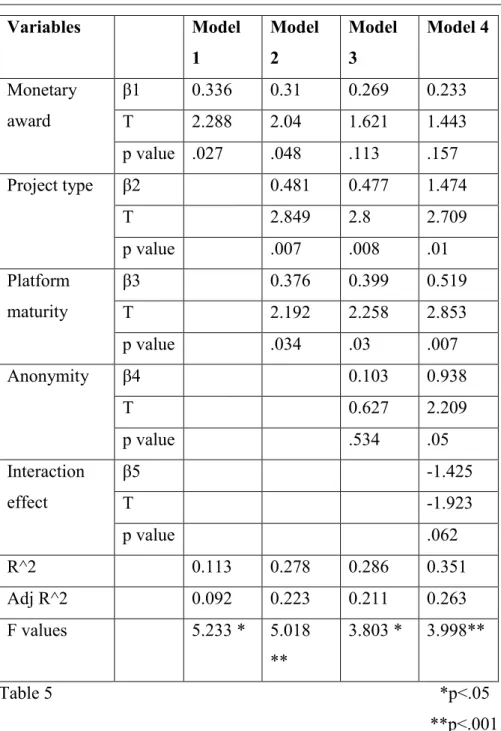
We also ran a hierarchical multiple regression, in order to create a model that accurately predicts the participation levels of crowdsourcing contests. This added analysis will allow us to learn more about the relationship between certain design elements and the NRS. In the first step we predicted NRS from the monetary award. In the second step we added the project type and the platform maturity. The third step predicts NRS from the monetary award, project type, platform maturity and the anonymity of seeker firms. In the fourth step, we predicted NRS using the monetary award, the platform maturity and the interaction effect between the project type and the anonymity of seeker firms.
Model 1: NRS=α+β1M
Model 2: NRS=α+β1MA+ β2ProjTyp+ β3PlatformMaturity
Model 3: NRS=α+β1MA+ β2ProjTyp+ β3PlatformMaturity+ β4Anon
Results and Discussion 29
Table 5 *p<.05 **p<.001
The following section describes the results obtained from the multiple regressions. The regressions were run in order to identify the effects that each design element has on the participation of crowdsourcing contests hosted by intermediary start-up companies.
The monetary award explains 9% of the variability in the NRS (adjusted R^2=.092). The model is appropriate to explain NRS (F(1, 41) =5.233, β = .336, t(42) = 2.288, p =.027).
In the second step of the model we added 2 more predictor variables, the project type, and the Platform maturity. This model now explains 22% of the variability in the NRS (adjusted R^2= .223). The addition of the new predictors in this step significantly explains the incremental variance of NRS (ΔR^2=.165 p<.05). The results also show that we can significantly predict
Variables Model 1 Model 2 Model 3 Model 4 Monetary award β1 0.336 0.31 0.269 0.233 T 2.288 2.04 1.621 1.443 p value .027 .048 .113 .157 Project type β2 0.481 0.477 1.474 T 2.849 2.8 2.709 p value .007 .008 .01 Platform maturity β3 0.376 0.399 0.519 T 2.192 2.258 2.853 p value .034 .03 .007 Anonymity β4 0.103 0.938 T 0.627 2.209 p value .534 .05 Interaction effect β5 -1.425 T -1.923 p value .062 R^2 0.113 0.278 0.286 0.351 Adj R^2 0.092 0.223 0.211 0.263 F values 5.233 * 5.018 ** 3.803 * 3.998**
Results and Discussion 30 NRS from the three predictors F(3,42)=5.018, p=.005). The monetary award (β1 = .310, t(42)
=2.040 , p=.048 ), the Project type ( β2 = .481, t(42) =2.849 , p=.007 ) and the platform maturity
(β3 = .376, t(42) =2.192 , p=.034) have a positive and significant relationships with the NRS
of a crowdsourcing contest.
In the third step of the model we added a fourth predictor variable, the Anonymity of seeker firms. This model explains 21% of the variability in the NRS (adjR^2=.211). The addition of the fourth predictor does not significantly explain the incremental variance of NRS (ΔR^2=.007, p>.05). The results also show that we can predict NRS from these four predictors significantly (F(4,38)=3.803, p=.011). The monetary award (β1 = .269, t(42) =1.621 , p=.113)
and the Anonymity of seeker firms (β4 = .103, t(42) =0.627 , p=.534) have a positive but
non-significant effect on NRS. The Project type (β2 = .477, t(42) =2.800 , p=.008) and the platform
maturity( β3 = .399, t(42) =2.258 , p=.030 ) have positive and significant effects on the
Participation of a crowdsourcing contest.
The fourth and final step consisted in adding the interaction effect of the anonymity with the project type. This model explains 26% of the variability of in NRS(adjR^2=.263). The results show that we can predict significantly the NRS from these predictors (F(5,37)=3.998, p=.005).
The monetary award (β1 = .233, t(42) =.1.628 , p >.05) has a positive but not significant
relationship with the NRS. The project type (β2 = .1.474, t(42) =2.709 , p=.010), the anonymity
of seeker firms (β4 = .938, t(42) =2.029 , p=.050) and the platform maturity (β3 = 0.519, t(42)
=2.853 , p =.007) have positive and significant effects on the NRS. The interaction effect between the Anonymity and the project type (β5 = -1.425, t(42) = -1.923 , p =.062) has a
negative and partial significant effect on the NRS (p-value =.062).
These results show that it is possible to predict the participation of crowdsourcing contests using the design elements mentioned above, which means that they could be adjusted to increase the participation in a given crowdsourcing contest.
4.3 Discussion
The results obtained in the two-previous sections will now be described and interpreted in terms of their academic and managerial implications and relevance towards our Hypothesis. In the first ANOVA we compared the average number of registered solvers between free, low pay and high pay challenges posted on the InoCrowd platform. We found that there is a significant difference between free challenges and the other two. However, a post hoc test revealed that there is no significant difference in the participation of high pay and low pay
Results and Discussion 31 challenges, this leads us to reject H1, where we stated that increasing the monetary awards of innovation challenges posted on the Inocrowd platform would increase participation in these challenges. This could be due to the effect documented by Yang and colleagues (2009) who stated that challenges with higher cash prizes are associated with higher complexity of the problem (Yang et al, 2008), and increased complexity leads to less participation due to an increase of the time cost of the challenge (Yang et al ,2009).
Our results confirm Terwiesh and Xu’s model. Ideastorming challenges have more registered solvers on average than the other two project types. This can be explained by Terwiesh and Xu’s model of innovation contests. The authors model a solver’s performance as a function of the solver’s expertise, which reflects the solvers past experience, of the improvement effort of each solver, which shows activities such as running a thorough literature review or patent search, and of the stochastic nature of problem solving in innovation, captured by noise variables. Since Ideastorming challenges are non-detailed challenges where seekers are simply looking for new ideas, there is little need for solvers to have a lot of expertise or improvement efforts which increases the number of potential solvers that will be able to understand the problem requirements and register for the challenge. Consequently, H2 is accepted.
The analysis of variance between anonymity and the NRS did not yield any statistically significant results; hence we reject Hypothesis 4a, where we hypothesized that challenges posted anonymously would have less participation than challenges posted non-anonymously. Finally, we wanted to understand whether the anonymity of seeker firms had the same effect on different project types. We found that there was a statistically significant difference between groups (F(2,38)=5.957, p=0.019). We also found that there is a statistically significant difference
in participation between Practical challenges posted anonymously and practical challenges posted non-anonimously. Essentially, seeker firms that post Practical challenges anonymously on the InoCrowd Platform will have an average participation of NRSPract-anon=6.89 registered
solvers, whereas if they choose to not remain anonymous they will benefit from an increased amount of participation (NRSPract-nonanon= 17). Furthermore, Theoretical challenges have higher
amounts of participation when posted anonymously (NRStheore-anon=25) than when the seeker
firm is known (NRStheore-nonanon=10,25), however this result is not statistically significant.
Nonetheless, this confirms our Hypotheses 4b, where we state that anonymity of seeker firms does not influence the participation of different project types in the same way.
The second part of our analysis consisted in running a sequential multiple regression in order to create a model that allows seeker firms and intermediaries to predict the participation in
Results and Discussion 32 innovation challenges. The model created predicts the NRS of crowdsourcing contests as a function of the Monetary award, the platform maturity, the project type, the anonymity of seeker firms and the interaction effect between project type and anonymity of seeker firms. The final model showed that we can predict significantly the NRS from these predictors
(F(5,37)=3.998, p=.005), and explains 26% of the variability in the NRS(adjR^2=.263). This also
confirms the third hypotheses, where we stated that increased platform maturity leads to higher levels of participation in crowdsourcing contests, because the platform maturity (β = 0.519, t(42) =2.853 , p =.007) has positive and significant effect on the NRS, which consistent with the presence of positive network effects (Snir and Hitt, 2003 ; Walter and Back, 2011).
Now that we know the effect that each design element has on the participation of solvers in crowdsourcing contests hosted by intermediary firms, we can deduce some managerial implications regarding these design elements. It is important to note that this analysis was run in order to make these contests more effective. Firstly, we found that crowdsourcing challenges with a cash prize are able to capture more solvers than challenges with no cash prizes. We also found that there is no significant increase in the participation of solvers when we increase the amount of cash paid out to the winning solver. Hence, the crowdsourcing contests posted on the Inocrowd platform must always have some sort of cash prize, even a small one may have large implications on the participation of solvers in these contests. Secondly, we found that Ideastorming challenges have the most participation when compared to other project types, due to their nature. We also found that participation in crowdsourcing contests increases with the platform maturity. This means that along time, the participation of solvers in crowdsourcing contests will increase due to positive network effects. Finally, we found that it is very important for the seeker firms to know exactly what Project type their innovation contest belongs. This is because it will allow the seeker firm to better decide on whether to remain anonymous or not. Basically, for theoretical challenges it is preferable for seeker firms to remain anonymous whereas for practical challenges it is preferable for seekers to not remain anonymous, because this will allow these challenges have more participants.
4.4 Conclusion
This study analyzed all of the innovation contests posted on the Inocrowd platform in order to determine the effects of design elements on the participation of solvers in these contests. This analysis will allow innovation intermediaries and “seeker” firms to design innovation contests that will have higher amounts of registered solvers (participation), and consequently will
Results and Discussion 33 benefit from more high-quality solutions. We postulated that increased monetary awards lead to higher participation, in accordance with past investigations of this topic (Snir and Hitt, 2013; Yang et al., 2009; Dipalantino and Vojnovic, 2009; Shao et al., 2011)). We found that challenges with no Monetary awards have on average less participation than challenges that offer a cash prize to the winning solver. However, we did not find a significant difference between challenges that have a low cash prizes and challenges that have a high cash prizes, which means that simply increasing the monetary award of an innovation challenge will not result in higher participation, contrary to what had been showed in past investigations. For managers of intermediary platforms this result means that posting challenges with very high monetary awards does not necessarily mean that the contest will have high amounts of participation. Consequently, innovation intermediaries should be wary of what challenges they post.
We then tested the effect that the project type has on participation of innovation contests, and we hypothesized that Ideastorming challenges have the highest participation of the three project types, this effect had been showed before by Terwiesh and Xu (2008) and it was confirmed by our results. This means that in the future, Intermediary firms should focus more on posting Ideastorming challenges because these challenges benefit from more participation, and hence are more effective.
Furthermore, we tested the effect of platform maturity on the participation of solvers in innovation challenges in order to prove the existence of positive network effects and growing population of solvers (Walter and Back, 2011), and we found that indeed, higher platform maturity is associated with more participation in innovation contests. This means that over time the Intermediary will benefit from more participation, thus challenges that are very complex in nature and that are not expected to have a lot of participation could be postponed to a later date, and benefit from higher NRS.
Finally, we wanted to identify the effect of anonymity of seeker firms on the participation of crowdsourcing contests. We found that there was no significant difference in the participation of challenges posted anonymously or non-anonymously. Nonetheless, we tested the effect of the anonymity across different project types, and we concluded that Practical challenges have more participation when posted non-anonymously, whereas Theoretical Challenges benefit from the opposite effect. For the innovation intermediary this means that when a seeker firm wants to post a practical challenge, the manager of the Intermediary should post the challenge non-anonymously. Whereas if the seeker wanted to post a Theoretical challenge we would advice the intermediary to do the opposite.
Results and Discussion 34 In summary, this paper provides us with a framework that can be used to increase the participation of crowdsourcing contests by slightly adjusting some design elements of these challenges. Managers of intermediary firms hosting innovation contests can now make estimations on the participation of innovation challenges based on their design elements, and can now advice seeker firms on what cash prize should be awarded, the types of challenges that should be posted, when they should be posted and whether they should post them anonymously or non-anonymously.