marine drugs
ISSN 1660-3397www.mdpi.com/journal/marinedrugs Review
Marine Polysaccharides from Algae with Potential
Biomedical Applications
Maria Filomena de Jesus Raposo, Alcina Maria Bernardo de Morais and Rui Manuel Santos Costa de Morais *
CBQF—Centro de Biotecnologia e Química Fina, Laboratório Associado, Escola Superior de Biotecnologia, Universidade Católica Portuguesa/Porto, Rua Arquiteto Lobão Vital, Apartado 2511, 4202-401 Porto, Portugal;
E-Mails: [email protected] (M.F.J.R.); [email protected] (A.M.B.M.)
* Author to whom correspondence should be addressed; E-Mail: [email protected];
Tel.: +351-22-5580050; Fax: +351-22-5090351. Academic Editor: Paola Laurienzo
Received: 10 March 2015 / Accepted: 4 May 2015 / Published: 15 May 2015
Abstract: There is a current tendency towards bioactive natural products with applications
in various industries, such as pharmaceutical, biomedical, cosmetics and food. This has put some emphasis in research on marine organisms, including macroalgae and microalgae, among others. Polysaccharides with marine origin constitute one type of these biochemical compounds that have already proved to have several important properties, such as anticoagulant and/or antithrombotic, immunomodulatory ability, antitumor and cancer preventive, antilipidaemic and hypoglycaemic, antibiotics and anti-inflammatory and antioxidant, making them promising bioactive products and biomaterials with a wide range of applications. Their properties are mainly due to their structure and physicochemical characteristics, which depend on the organism they are produced by. In the biomedical field, the polysaccharides from algae can be used in controlled drug delivery, wound management, and regenerative medicine. This review will focus on the biomedical applications of marine polysaccharides from algae.
Keywords: polysaccharides; algae; bioactive; biomedical; pharmaceuticals; therapeutics;
1. Introduction
Contemporary tendency for natural products to be applied in medicine and to promote health has put some emphasis in research on marine organisms, including macro- and microalgae, and cyanobacteria. Extensive literature on the health benefits and uses as food or as drug carriers of brown, red and green seaweeds, and the polysaccharides (PS) they produce, was published in the last decade [1–8]. However, comparatively, there are only a handful of research papers on microalgae [9–14], despite the richness of their composition and the ability to make them grow.
Polysaccharides already proved to have several important properties [3,8,12,15–22]. However, the attempts to establish a relationship between the structures of the PS and their bioactivities/actions have been a challenge due to the complexity of this type of polymers. In fact, aside from the homogalactan from Gyrodinium impudicum (a dinoflagellate) [23], the β-glucan from Chlorella vulgaris (a green microalga) [24] and the PS from a few species of seaweeds (Tables 1–3), most of these carbohydrates are highly branched heteropolymers with different substituents in the various carbons of their backbone and side-sugar components. Additionally, the monosaccharide composition and distribution within the molecule, and the glycosidic bonds between monosaccharides can be very heterogeneous, which is a real impairment for the study of their structures. Moreover, this heterogeneity also depends on the species, between strains of the same species, and on the time and place of harvest.
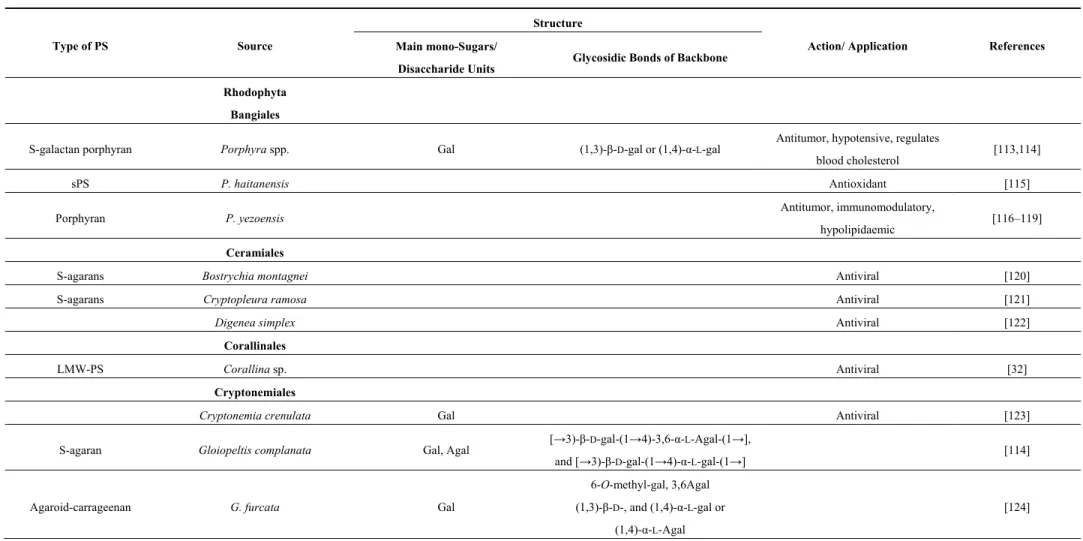
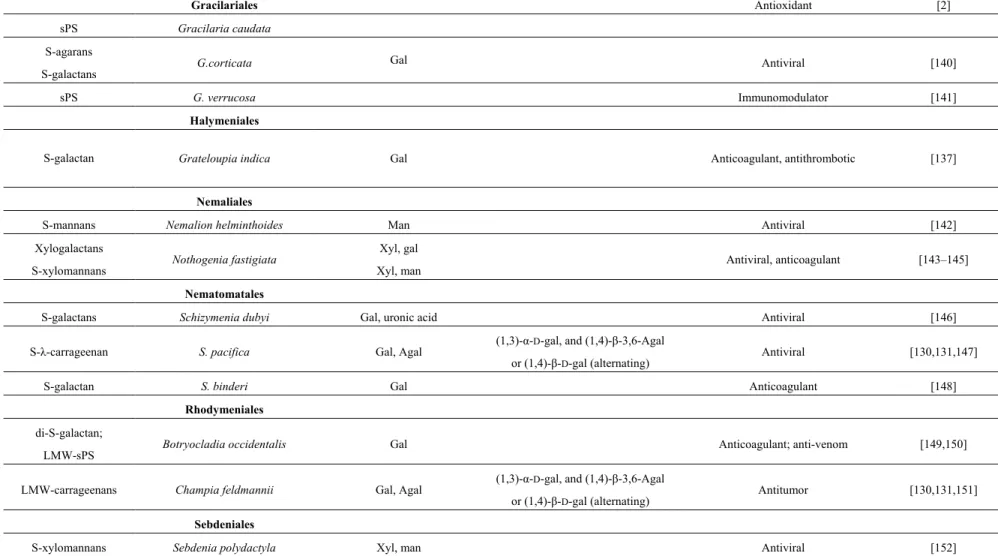
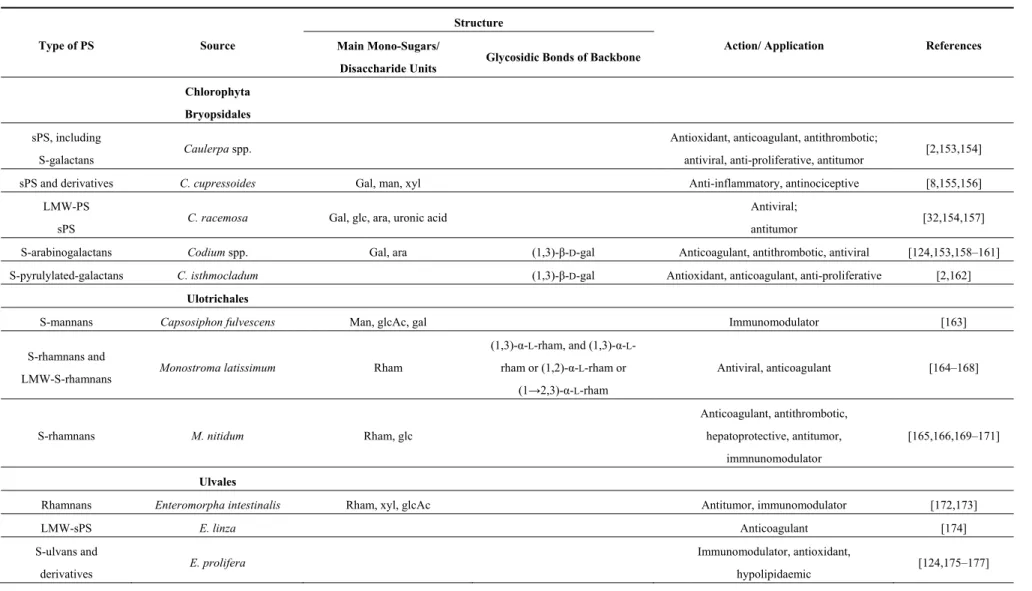
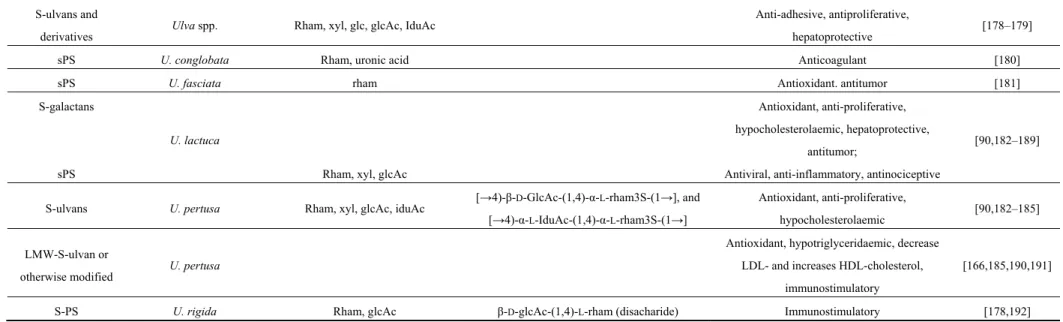
The PS produced by algae are presented in Tables 1–3, according to the group of macroalga, Phaeophytes, Rhodophytes, Chlorophytes, and in Table 4, which is relative to microalgae. Nevertheless, there are always some similarities between the PS from each group of seaweeds: often, fucoidans are extracted from brown algal species (Table 1), agaroids and carrageenans come from red macroalgae (Table 2), and ulvans are obtained from green seaweeds (Table 3). Regarding microalgae (Table 4), and as far as we know, there are not common names for their PS, to the exception of spirulan from Arthrospira platensis. There are species that, besides producing large amounts of these useful polymers, they secrete them out into the culture medium and these polymers are easily extracted [14].
Table 1. Marine species of brown macroalgae (PHAEOPHYTES) producing polysaccharides (PS): some structural features and applications. Type of PS Source Structure Action/Application References Main Mono-Sugars/ Disaccharide Units Glycosidic Bonds of Backbone Chromophyta Dictyotales Heterofucans S-fucans Canistrocarpus cervicornis
a.k.a. Dictyota cervicornis Fuc Anticoagulant, antioxidant; anti-proliferative [2,25] S-galactofucans D. menstrualis Gal, fuc, xyl, glcAc Peripheral anti-nociceptive, anti-inflammatory,
antioxidant; anticoagulant, anti-proliferative [1,2,26]
D. mertensis antioxidant; anticoagulant, anti-proliferative [2]
Heterofucans Dictyopteris delicatula Fuc Anticoagulant, antioxidant, antitumor, anti-proliferative [2,27]
D. polypodioides Fuc Antitumor [28]
S-galactofucans Lobophora variegata Gal, fuc Antioxidant, anticoagulant, anti-inflammatory [29,30]
Heterofucans Padina gymnospora GlcAc, fuc, (1,3)- and (1,4)-β-D-glcAc Antioxidant, anticoagulant, anti-thrombotic, antiviral [2,31,32] S-fucan P. tetrastromatica Fuc, gal, xyl, glcAc (1,2)- and (1,3)-α-fuc [33]
S-galactofucans; sPS; S-fucans
Spatoglossum schröederi
Gal, fuc, xyl;
Fuc
(1,4)- and (1,3)-α-fuc
Anti-thrombotic; Peripheral anti-nociceptive; Anti-proliferative, anti-adhesive, antioxidant
[2,34–38]
Ectocarpales
S-galactofucans Adenocystis utricularis Gal, fuc, rham, uronic acid (1,3)-α-fuc Antiviral [39]
S-fucans Cladosiphon okamuranus
a.k.a. Okinawa mozuku Fuc, glc, glcAc (1,3)-α-L-fuc
Anti-proliferative, antiviral, anti-inflammatory, antiadhesive, antitumor, immunomodulator; angiogenic, gastroprotective,
cardioprotective, restenosis preventive
[15,22,40–47]
S-fucoidan C. novae-caledoniae Fuc Antitumor [48]
Fucans Leathesia difformis Fuc Antiviral [49]
Table 1. Cont. Fucales S-fucans; LMW-sPS; S-Laminaran; or otherwise modified
Ascophyllum nodosum Fuc, xyl, gal, glcAc;
Glc
(1,3)- and (1,4)-α-L-fuc (alternating); (1,3)- and (1,6)-β-glc
Immunomodulatory, anti-inflammatory, anticoagulant, anti-thrombotic, anti-metastatic, antitumor, antiadhesive, restenosis preventive;
Anti-thrombotic, anticoagulant, angiogenic
Antitumor, anticoagulant; serum hypocholesterolaemic, hypotensive, antibacterial, immunomodulator
[15,20,51–61]
S-fucans Fucus spp.
F. vesiculosus Fuc, xyl, gal, glcAc
(1,3)- and (1,4)-α-L-fuc (alternating)
Immunostimulant, antiviral, antitumor, antiproliferative, antiadhesive, anticoagulant, antioxidant, anti-metastatic, anti-inflammatory;
anti-angiogenic, antithrombotic (except F. vesiculosus)
[2,15,62–70]
Laminaran; S-laminaran or otherwise modified
Fucus sp. Glc (1,3)- and (1,6)-β-glc
Antitumor, decreases liver triglyceride,
cholesterol and phospholipid levels; serum hypocholesterolaemic, hypotensive, antibacterial, immunomodulator
anticoagulant
[56,59,61]
S-fucans Hizikia fusiforme
a.k.a. Sargassum fusiforme Fuc, gal, man, glcAc
(1,2)-α-D-man alternating with (1,4)-β-D-glcAc; some (1,4)-β-D-gal
Anticoagulant, anti-thrombotic [71,72]
Fucans Pelvetia fastigiata Fuc Antiviral [73]
LMW-S-fucans P. canaliculata Fuc Antiviral [74]
S-fucans Sargassum spp. Fuc, gal, xyl, uronic
acid Prevent hyperlipidaemia, normalize dislipidaemia [75–77] S-galactofucans Sargassum sp. Gal, fuc, rham,
glcAc
(1,6)-β-D-gal
and/or (1,2)-β-D-man Antitumor [28,62,78–80] S-heterofucans S.filipendula Fuc Antioxidant, anti-proliferative [2,81]
S-fucoidan S. henslowianum Fuc Anti-proliferative, antitumor [75] S-fucoidan S. horneri Fuc (1,3)-α-L-fuc,
(1,3)- and (1,4)-α-L-fuc Antitumor, antiviral [62,80]
LMW-fucoidan S. patens Fuc Antiviral [32]
sPS Turbinaria conoides Antioxidant [82]
Table 1. Cont.
Laminariales
S-galactofucan Costaria costata Gal, fuc Antitumor [16] S-fucans Ecklonia cava
E. kurome
Fuc, rham, gal,
glcAc (1,3)- or (1,6)-, and (1,4)-α-L-fuc
Anti-proliferative, antitumor, anticoagulant,
antioxidant, antithrombotic, anti-inflammatory [16,83–88] Fucoidans;
laminarans Eisenia bicyclis
Fuc;
Glc (1,3)- and (1,6)-β-D-glc
Anti-proliferative, antitumor, anticoagulant;
Antitumor [83,89–91] Laminaran;
S-laminaran or otherwise modified
Laminaria sp (or Saccharina) Glc (1,3)- and (1,6)-β-glc
Antitumor, anticoagulant, decreases liver triglyceride, cholesterol and phospholipid levels; serum hypocholesterolaemic, hypotensive,
antibacterial, immunomodulator
[56,59,61]
S-fucoidans Laminaria spp. Fuc, xyl, man, glcAc (1,3)-α-L-fuc Antioxidant, anticoagulant, antithrombotic, anti-adhesive,
anti-proliferative, anti-inflammatory, anti-angiogenic, anti-metastatic [15,52,83,92–96]
S-galactofucan L. japonica
a.k.a. Saccharina japonica Gal, fuc
(1,3)- and (1,4)-α-L-fuc (alternating)
Anti-lipidaemic, increases HDL, antiviral, antitumor, immunomodulator, antioxidant
neuroprotective
[3,15,97–102]
Fucoidans Lessonia vadosa Fuc Anticoagulant [103]
S-fucoidan Saccharina cichorioides
a.k.a. Laminaria cichorioides Fuc Antitumor, anticoagulant, anti-thrombotic [104,105] S-galactofucans
fucoidan Undaria pinnatifida
Gal, fuc, xyl, uronic acid
(1,3)- and (1,4)-α-L-fuc (alternating)
Antiviral, anticoagulant, antitumor, anti-proliferative, immunomodulatory, anti-inflammatory
induced osteoblastic differentiation
[3,52,69, 106–111] LMW-S-fucans Anticoagulant [112] Laminaran; S-laminaran or otherwise modified
Glc Anticoagulant, antitumor; serum hypocholesterolaemic, hypotensive,
Table 2. Marine species of red macroalgae (RHODOPHYTES) producing PS: some structural features and applications.
Type of PS Source
Structure
Action/ Application References Main mono-Sugars/
Disaccharide Units Glycosidic Bonds of Backbone Rhodophyta
Bangiales
S-galactan porphyran Porphyra spp. Gal (1,3)-β-D-gal or (1,4)-α-L-gal Antitumor, hypotensive, regulates
blood cholesterol [113,114]
sPS P. haitanensis Antioxidant [115]
Porphyran P. yezoensis Antitumor, immunomodulatory,
hypolipidaemic [116–119]
Ceramiales
S-agarans Bostrychia montagnei Antiviral [120]
S-agarans Cryptopleura ramosa Antiviral [121]
Digenea simplex Antiviral [122]
Corallinales
LMW-PS Corallina sp. Antiviral [32]
Cryptonemiales
Cryptonemia crenulata Gal Antiviral [123]
S-agaran Gloiopeltis complanata Gal, Agal [→3)-β-D-gal-(1→4)-3,6-α-L-Agal-(1→],
and [→3)-β-D-gal-(1→4)-α-L-gal-(1→] [114]
Agaroid-carrageenan G. furcata Gal
6-O-methyl-gal, 3,6Agal (1,3)-β-D-, and (1,4)-α-L-gal or
(1,4)-α-L-Agal
Table 2. Cont.
Gelidiales
di-S-galactan Gelidium crinale Gal Anticoagulant [125] S-agarans and hybrid
DL-galactans Pterocladia capillacea Gal Antiviral [126]
Gigartinales
S-agarans
S-galactans Aghardiella tenera Gal Antiviral [127,128] S-λ-carrageenan Chondrus crispus Gal, Agal (1,3)-α-D-gal, and (1,4)-β-3,6-Agal
or (1,4)-β-D-gal (alternating) Antiviral, anticoagulant, antithrombotic [1,5,129–131]
LMW-sPS C. ocellatus Antitumor [132]
S-galactans Euchema cottonii Gal Antioxidant [2]
S-κ-carrageenan E. spinosa Gal, Agal (1,3)-α-D-gal, and (1,4)-β-3,6-Agal
or (1,4)-β-D-gal (alternating) Anticoagulant, anti-thrombotic [5,130,131]
LMW-sPS Furcellaria lumbricalis Immunostimulant [133] S-galactans Gigartina acicularis Gal Antioxidant [2] S-carrageenans G. skottsbergii Gal, Agal (1,3)-α-D-gal, and (1,4)-β-3,6-Agal
or (1,4)-β-D-gal (alternating) Antiviral, anticoagulant [130,131,134,135]
Hybrid DL-galactans Gymnogongrus torulosus Gal Antiviral [136]
LMW-PS Hypnea charoides Antiviral [32]
LMW-S-carrageenans Kappaphycus striatus Gal, Agal (1,3)-α-D-gal, and (1,4)-β-3,6-Agal
or (1,4)-β-D-gal (alternating) Antitumor, immunomodulator [1,131] S-λ-carrageenan Phyllophora brodiei Gal, Agal (1,3)-α-D-gal, and (1,4)-β-3,6-Agal
or (1,4)-β-D-gal (alternating) Anticoagulant, antithrombotic [130,131,137]
LMW-sPS Soliera chordalis Immunostimulant [138]
S-carrageenans Stenogramme interrupta Gal, Agal (1,3)-α-D-gal, and (1,4)-β-3,6-Agal
Table 2. Cont. Gracilariales Antioxidant [2] sPS Gracilaria caudata S-agarans S-galactans G.corticata Gal Antiviral [140] sPS G. verrucosa Immunomodulator [141] Halymeniales
S-galactan Grateloupia indica Gal Anticoagulant, antithrombotic [137]
Nemaliales
S-mannans Nemalion helminthoides Man Antiviral [142] Xylogalactans
S-xylomannans Nothogenia fastigiata
Xyl, gal
Xyl, man Antiviral, anticoagulant [143–145]
Nematomatales
S-galactans Schizymenia dubyi Gal, uronic acid Antiviral [146] S-λ-carrageenan S. pacifica Gal, Agal (1,3)-α-D-gal, and (1,4)-β-3,6-Agal
or (1,4)-β-D-gal (alternating) Antiviral [130,131,147]
S-galactan S. binderi Gal Anticoagulant [148]
Rhodymeniales
di-S-galactan;
LMW-sPS Botryocladia occidentalis Gal Anticoagulant; anti-venom [149,150] LMW-carrageenans Champia feldmannii Gal, Agal (1,3)-α-D-gal, and (1,4)-β-3,6-Agal
or (1,4)-β-D-gal (alternating) Antitumor [130,131,151]
Sebdeniales
Table 3. Marine species of green macroalgae (CHLOROPHYTES) producing PS: some structural features and applications.
Type of PS Source
Structure
Action/ Application References
Main Mono-Sugars/
Disaccharide Units Glycosidic Bonds of Backbone Chlorophyta
Bryopsidales
sPS, including
S-galactans Caulerpa spp.
Antioxidant, anticoagulant, antithrombotic;
antiviral, anti-proliferative, antitumor [2,153,154] sPS and derivatives C. cupressoides Gal, man, xyl Anti-inflammatory, antinociceptive [8,155,156]
LMW-PS
sPS C. racemosa Gal, glc, ara, uronic acid
Antiviral;
antitumor [32,154,157] S-arabinogalactans Codium spp. Gal, ara (1,3)-β-D-gal Anticoagulant, antithrombotic, antiviral [124,153,158–161] S-pyrulylated-galactans C. isthmocladum (1,3)-β-D-gal Antioxidant, anticoagulant, anti-proliferative [2,162]
Ulotrichales
S-mannans Capsosiphon fulvescens Man, glcAc, gal Immunomodulator [163] S-rhamnans and
LMW-S-rhamnans Monostroma latissimum Rham
(1,3)-α-L-rham, and (1,3)-α-L -rham or (1,2)-α-L-rham or
(1→2,3)-α-L-rham
Antiviral, anticoagulant [164–168]
S-rhamnans M. nitidum Rham, glc
Anticoagulant, antithrombotic, hepatoprotective, antitumor,
immnunomodulator
[165,166,169–171]
Ulvales
Rhamnans Enteromorpha intestinalis Rham, xyl, glcAc Antitumor, immunomodulator [172,173]
LMW-sPS E. linza Anticoagulant [174]
S-ulvans and
derivatives E. prolifera
Immunomodulator, antioxidant,
Table 3. Cont.
S-ulvans and
derivatives Ulva spp. Rham, xyl, glc, glcAc, IduAc
Anti-adhesive, antiproliferative,
hepatoprotective [178–179]
sPS U. conglobata Rham, uronic acid Anticoagulant [180]
sPS U. fasciata rham Antioxidant. antitumor [181]
S-galactans
sPS
U. lactuca
Rham, xyl, glcAc
Antioxidant, anti-proliferative, hypocholesterolaemic, hepatoprotective,
antitumor;
Antiviral, anti-inflammatory, antinociceptive
[90,182–189]
S-ulvans U. pertusa Rham, xyl, glcAc, iduAc [→4)-β-D-GlcAc-(1,4)-α-L-rham3S-(1→], and [→4)-α-L-IduAc-(1,4)-α-L-rham3S-(1→]
Antioxidant, anti-proliferative,
hypocholesterolaemic [90,182–185] LMW-S-ulvan or
otherwise modified U. pertusa
Antioxidant, hypotriglyceridaemic, decrease LDL- and increases HDL-cholesterol,
immunostimulatory
[166,185,190,191]
S-PS U. rigida Rham, glcAc β-D-glcAc-(1,4)-L-rham (disacharide) Immunostimulatory [178,192]
Table 4. Marine species of microalgae/blue-green algae producing PS; main neutral sugars.
Type of PS Source Main Neutral Sugars Action/Application References
MICROALGAE Diatoms
sPS Cylindrotheca closterium xyl, glc, man, rham [193,194]
sPS Navicula salinarum glc, xyl, gal, man [193] s-EPS Phaeodactylum tricornutum glc, man, xyl, rham Anti-adhesive [195–197]
EPS Haslea ostrearia [198]
EPS Nitzschia closterium [199]
EPS Skeletonema costatum
EPS Chaetoceros spp. rham, fuc, gal, man [200]
EPS Amphora sp. [201]
Chlorophytes
sPS Chlorella stigmatophora glc, xyl, fuc, Anti-inflammatory, immunomodulator [195]
sPS C. autotrophica [202]
PS
β-(1,3)-glucan
C. vulgaris
rham, gal, arab, 2-O-methyl-rham
glc Antitumor, infection preventive agent
[24,203,204]
EPS Dunaliella salina gal, glc, xyl, fru [205]
EPS Ankistrodesmus angustus [201]
EPS Botryococcus braunii gal, fuc, glc, rham [206,207]
Prasinophyte
sPS Tetraselmis sp. Anti-adhesive [202]
Prymnesiophyte/haptophyte
Table 4. Cont.
Rhodophytes
sPS Porphyridium sp. xyl, gal, glc
Anti-inflammatory, immunomodulator, prevention of tumour cell growth, anti-adhesive,
antiviral, biolubricant
[208–213]
sPS P. cruentum xyl, gal, glc, glcAc,
3-O-methyl-xyl
Antioxidant and free radical scavenging, immunomodulator, antiviral, antibacterial,
antilipidaemic, antiglycaemic [214–222] sPS P. purpureum antiviral [223] sPS Rhodella reticulata xyl, rham, 3-O-methyl-rham, 4-O-methyl-gal
Antiviral, antilipidaemic, antiglycaemic,
prevention of tumour cell growth [208,213,219],
R. maculata xyl, gal, glc,
3-O-methyl-xyl [224,225]
Dinoflagellates
sPS Cochlodinium polykrikoides man, gal, glc Antiviral [226]
sPS Gyrodinium impudicum gal
Antiviral, anti-inflammatory, immunomodulator, anti-proliferative, prevention
of tumour cell growth
[23,227–229]
CYANOBACTERIA
EPS Aphanothece halophytica glc, fuc, man, arab, glcAc [230] EPS
s-Spirulan
Arthrospira platensis
gal, xyl, glc, fru
rham, fuc, glc, 3-O-methyl-rham
Antiviral, antibacterial, prevention of tumour cell growth
Anti-proliferative, anti-adhesive, anti-metastatic
[19,223,231–235]
sPS Anabaena, Gloethece, Nostoc Aphanocapsa,
Both micro- and macroalgae are excellent sources of PS, most of them being sulphated (sPS). They are associated with several biological activities and potential health benefits, making them interesting compounds for the application in pharmaceuticals, therapeutics, and regenerative medicine. Some of the beneficial bioactivities demonstrated by the crude PS and their derivatives, either in vitro or in vivo, upon various kinds of cell-lines and animal models, include anticoagulant and/or antithrombotic properties, immunomodulatory ability, antitumor and cancer preventive activity (as anti-proliferative agents, tumour suppressors or natural cell-killers). They are also good antidislipidaemic and hypoglycaemic agents, and can be powerful antioxidants, antibiotics and anti-inflammatory. For example, the sPS from Enteromorpha and Porphyridium have demonstrated strong antitumor and immunomodulating properties [173,211]; those from Caulerpa cupressoides and Dyctiota menstrualis are good antinociceptive agents [1,155], and the sPS from Cladosiphon okaramanus showed angiogenic, gastro- and cardioprotective bioactivities [15,46,47]
2. Some Structural Characteristics of Polysaccharides Produced by Marine Algae
The chemical structure of PS produced by macro- and microalgae may significantly determine their properties, namely physico-chemical and biochemical, and reflect their physical behavior and biological activities, as will be discussed further on in this review.
2.1. Macroalgae
Seaweeds (or marine macroalgae), whose PS have been studied more often, belong to the groups Chlorophyta (green seaweeds), Phaeophyceae (brown algae, Chromophyta) and Rhodophyta (red macroalgae).
Brown seaweeds usually contain fucoidans; the oligosaccharides obtained from the hydrolysis of fucoidans may often contain gal, glc, uronic acids, and/or other monosaccharides (Table 1), linked together and to the main chain by different types of glycosidic bonds. This is the case, for example, for the laminaran from E. bicyclis (Laminarales), or the galactofucan from Sargassum sp. (Fucales), and the fucan from P. tetrastromatica (Dictyotales) (Table 1). However, the structure complexity of these fucoidans makes difficult to establish a relationship between the PS-chains/composition and their biological actions, and/or some kind of protocols to design universal pharmaceuticals or other drug-like substances to prevent and/or cure specific diseases. This issue will be discussed later in this review.
The monosaccharide composition, the linkage types, the overall structure of fucoidans, and some of their di- and oligosaccharides were well explored by Ale et al. [75], Fedorov et al. [3] and Li et al. [103]. For example, Ale’s group [75] showed the difference between sPS from three species of Fucus by focusing on the various substituents at C-2 and C-4 carbons, despite the similarities of their backbones; they also highlighted the possible structures of fucoidans from two species of Sargassum, already suggested by Duarte et al. [78] and Li et al. [71]. Cumashi and coworkers suggested some structures for the backbone chain of several seaweeds [15]. Among them are the schemes for the components of the main chain showing either the (1,3)-, and (1,3)- and (1,4)-linked fuc residues or some di- and trisaccharide repeating units for A. nodosum, C. okamuranus, L. saccharina (a.k.a. Saccharina latissima), and some species of Fucus. On the other hand, Fedorov et al. [3] focused on the structures
and bioactivities of different sPS, such as fucoidans (e.g., galactofucan from Laminaria (a.k.a. Saccharina japonica), and laminarans (e.g., the one from E. bicyclis) (Table 1).
Red macroalgae contain large amounts of sPS (Table 2), mostly galactans (agaroids and/or carrageenans), with alternating repeating units of 1,3-α-gal and 1,4-β-D-gal [236], and/or 3,6-anhydrogal (3,6-Agal) [237]. Substituents can be other monosaccharides (man, xyl), sulphate, methoxy and/or pyruvate groups, the pattern of sulphation dividing carrageenans into different families, for example, in C-4 for κ-carrageenan, and in C-2 for λ-carrageenan. In addition, the rotation of gal in 1,3-linked residues divides agaroids (L-isomer) from carrageenans (D-isomer) [18]. Apart from agarans [18], found in species of Porphyra, Polysiphonia, Acanthophora, Goiopeltis, Bostrychia or Cryptopleura (Table 2), red seaweeds are also good sources of κ-carrageenan (E. spinosa, K. alvarezii), λ-carrageenan (Chondrus sp, G. skottsbergii and Phillophora) (Table 2) [238], ι-carrageenan (E. spinosa) [239], and other heterogalactans with man and/or xyl bulding up their backbones. Among these, we may find xylogalactans in N. fastigiata [143], xylomannans in S. polydactyla [152] (Table 2).
Regarding green macroalgae, the information on their structures and applications is scarce. Nevertheless, Wangs’s group [8] has made an excellent overview on those properties for the sPS from several genera of “macro-chlorophytes”. These sPS are very diverse and complex, with various types of glycosidic bonds between monomers, and include galactans (Caulerpa spp.), rhamnans (C. fulvescens and Enteromorpha), arabino- and pyruvylated galactans (Codium spp.), and the most known ulvans from Ulva spp and E. prolifera (Table 3). Wang and coworkers [8] also included some repeating aldobiuronic di-units for the backbone of ulvans, containing IduAc or glcAc (U. armoricana and U. rigida, respectively), disaccharides (S-)xyl-S-rham, and a trisaccharide unit composed by 1,4-linked
glcAc, glcAc, and S-rham. The backbone of rhamnans seems to be somewhat simpler (Table 3), but
other types of glycosidic bonds can also appear. For example, four repeating disaccharide units were indicated for the homopolymer of M. latissimum [240] (Table 3). Species from Codium are very interesting: their sPS may include different percentages of arabinose (ara) and gal, giving place to arabinans (C. adhaerens; [153]), galactans (C. yezoense) [241], arabinogalactans [8]. Pyruvylated galactans were also identified in C. yezoense [241], C. isthmocladium [2] and C. fragile [242]. Some other species of Codium present other PS-types such as (1,4)-β-D mannans in C. vermilara [158], or the rare (1,3)-β-D mannans in C. fragile [243], with various sulphation patterns. C. fulvescens contains “vary branched” S-mannan as well [163].
2.2. Microalgae and Cyanobacteria
The characteristics of the various PS produced by microalgae, including their composition and structure, were recently discussed [14]. Some particular aspects about these polymers came to light. For example, it seems that concerning microalgae only G. impudicum and C. vulgaris contain homo-PS of galactose (gal) [23] and glucose (glc) [24], respectively, while the PS from the other species are heteropolymers of gal, xylose (xyl) and glc in different proportions. Rhamnose (rham), fuc and fructose can also appear, and some of the microalgal PS present uronic acids as well (Table 4). The glycosidic bonds are described for only a few PS, such as the one from Aphanothece halophytica, whose monosaccharides are mainly 1,3-linked, but linkages of type 1 also appear for glc and glcAc [230], which suggests that these two last molecules are terminal, and some multiple bonds, such as 1,2,4-linked
and 1,3,6-linked mannose (man) residues [230], are present as well, suggesting some branches coming out from the backbone of the PS. Further, there are some special features of microalgal PS, as it is the case of acofriose 3-O-methyl-rham in the polymers of Chlorella [203], Botryococcus braunii and calcium-spirulan (CaSp) of Arthrospira platensis [244]. In Porphyridium cruentum, an aldobiuronic acid [3-O-(α-D-glucopyranosyluronic acid)-L-galactopyranose), or glcAc-gal disaccharide], and two hetero-oligosaccharides were also identified [245], and so did two other aldobiuronic acids [246], which were also found in other species of Porphyridium and Rhodella [247]. Furthermore, other repeating disaccharide-units [233,234], and some oligosaccharides were also highlighted [233]. In addition, Ford and Percival [196,197] found that the structure of the sPS from Phaeodactylum tricornutum was a ramified sulphated glucoronomannan, with a backbone composed by β-(1,3)-linked
man; a triuronic acid, an aldobiuronic acid and a glucan made of β-(1,3)-linked glc were also
identified as being constituents of the side chains of that polymer.
Figure 1 illustrates the structures of some PS from macro- and microalgae.
(A)
(B)
Figure 1. Cont.
(C)
(D)
(E)
(F)
(G)
(H)
Figure 1. Examples of structures of PS from macro- and microalgae. (A) Repeating units
suggested for the structure of alginates [3]; (B) Repeating units of some carrageenans [3]; (C) Fucoidan backbone of A. nodosum and three species of Fucus, showing the different distribution pattern of sulphate [75]; (D) Repeating units, sulphation pattern and gycosidic bounds of the backbone structures of PS of three different brown seaweeds [75]; (E) Alternative positions and combinations for the repeating units of ulvans. A3s and B3s are aldobiouronic repeating di-units suggested for U. rigida and U. armoricana. U3s and U2s,3s are, respectively, a xyl-(S-rham) and a (S-xyl)-(S-rham) disaccharides [8]; (F) Galactans of Codium spp. (a) linear (1,3)-β-D-galactan, (b) and (c) pyruvylated branched sulphated galactans [8]; (G) A rare mannan of the PS from C. fragile, with (1,3)-β-man residues and branches at C-2 [8]. Tabarsa et al. [243] referred that either branches or sulphates may be bound at the C-2 and/or C-4 positions along the PS backbone); (H) Models 1 or 2 for the possible acidic repeating unit in polysaccharide II, from Porphyridium sp. R = H, SO2O, terminal gal or terminal xyl, m = 2 or 3 [14].
3. Potential Medical/Biomedical Applications of Polysaccharides from Marine Algae. Relation with Some Chemical Features of Their Structures
The PS are complex and heterogeneous macromolecules, coming from different genera belonging to the larger groups of algae, and species and strains of the same genus. Often, difficulties are found in identifying their chemical structure and therefore, their biological activities not being thoroughly understood. Few researchers have focused on such a challenging task as the exploitation of possible relation chemical structure–activity of PS. One approach to look for structure–biological activity relationships has been to make inferences based on information obtained from studies of invertebrate sulphated polysaccharides that have a regular structure and, thus, could be more easily studied [18].
The types of glycosidic linkages and the contents and positions of the sulphate groups may be significantly different in the various sPS, depending on species, region of the thallus, growing conditions, extraction procedures, and analytical methods [2,186]. The biological and pharmacological activities of sPS normally result from a complex interaction of several structural features, including the sulphation level, distribution of sulphate groups along the polysaccharide backbone, molecular weight, sugar residue composition, and stereochemistry [248,249]. For instance, the general structural features of fucans that are important in their anticoagulation activity include the sugar composition, molecular weight, sulphation level and the position of sulphate groups on the sugar backbone [84,86,250,251]. Also, it has been observed that the antiviral activity of sPS increases with the molecular weight [252]. Galactans, fucans and galactofucans are representative polysaccharides from brown and red seaweeds that differ in structure, sulphation level and molecular weight, and yet all were shown to inhibit HSV-1 and HSV-2 infection [253]. Recently, by using NMR, it was found that branched fucoidan oligosaccharides might present higher imuno-inflammatory activity than linear structures, because they were better at inhibiting the complement system [254]. Usov [236] compared two sulphated galactans from Botryocladia occidentalis and Gelidium crinale. He concluded that the interaction of the sPS with different compounds participating in the coagulation process depends on the differences in the structural features; unfortunately, data on the configuration of galactose in the galactan from G. crinale are not sufficient to fully understand the relationship.
3.1. Antiviral, Antibacterial and Antifungal Activities
An overview on the antiviral activity against several kinds of virus and retrovirus, enveloped or naked was well documented by Carlucci et al. [255] and Wijesekara et al. [21]. These reviews focused on the HIV type 1 and type 2, the human papilloma virus (HPV), the encephalo-myocarditis virus, the hepatitis virus type A and type B and the dengue and yellow fever virus. The inhibition of infection by most of these viruses was explained by the action of sPS, which might block the attachment of virions to the host cell surfaces [140,256]. Another way of exerting their activity is by inhibiting the replication of the enveloped virus, such as the HIV, the human cytomegalovirus (HCMV) and the respiratory syncytial virus (RSV) [18,147,153], either by inhibiting the virus adsorption or the entry into the host cells. Some of the sPS are effective only if applied simultaneously with the virus or immediately after infection [18]. Another mechanism of action of fucoidans and other sPS is through the inhibition of the syncytium formation induced by viruses [21,257].
Some S-xylomannans were reported to present antiviral sulphate-dependent activity, as it was the case of PS from S. polydactyla and S. latifolium, which inhibited the multiplication of HSV-1 in Vero-cells [152,258]. In addition, the molecular weight (MW) seems to play an important role in the antiviral properties of the sPS, the effect increasing with the MW [18]. However, other structural features can be co-responsible for the reinforcement of the antiviral effectiveness, like sulphation patterns, composition and distribution of sugar residues along the backbone, and the complexity of the polymers [18,152,248,253]. Further, the fucoidans from L. japonica already proved their effectiveness in fighting both RNA and DNA viruses [103], such as poliovirus III, adenovirus III, ECHO6 virus, coxsackie B3 and A16 viruses. Moreover, these sPS can protect host cells by inhibiting the cytopathic activity of those viruses [99].
In addition to their virucidal activity against HIV and other viruses associated to sexually transmitted diseases (STD) [5], including HPV, some carrageenans might find application as vaginal lubricant gels and coatings of condoms, with microbicidal activity, for they do not present any significant anticoagulant properties or cytotoxicity [259,260]. Furthermore, some fucoidans, apart from inhibiting attachment of virus particles to host cells, were able to inhibit the attachment of human spermatozoids to the zona pellucida of oocytes [261]; this property could be used for the development of a contraceptive gel with microbicidal characteristics [20].
The polysaccharides produced by some marine microalgae, and which may be released into the culture medium, showed antiviral activity against different kinds of viruses, such as the HIV-1, HSV-1 and HSV-2, VACV and Flu-A (Table 4), as described by Raposo et al. [14]. Sulphated PS, in particular, proved to increase the antiviral capacity [231]. In fact, the antiviral activity of the PS may depend on the culture medium, algal strain and cell line used for testing, but also on the methodology, and the degree of sulphation, as is the case of EPS from P. cruentum [216,262]. Despite the slight toxicity that some PS may present, they could be safely applied in in vivo experiments, decreasing the replication of the virus VACV, for instance [223].
The mechanisms involved in the antiviral activity of sPS may be understood analyzing what happens when cells are infected by a virus. Just before infection, viruses have to interact with some glycosaminoglycan receptors (GAG), such as heparin sulphate (HS) [263]. The GAG to which a protein can be covalently bound are part of the target cell surface and can also be found in the intracellular matrix of various connective and muscle tissues. SPS may impair the attachment of the virus particles by competing for those GAG-receptors, as they are chemically similar to HS [130,255], most of them having a covalently linked core protein [264,265]. Besides, as it happens with GAG,
sPS are negatively charged and highly sulphated polymers [40,255,266], whose monosaccharide
distribution pattern might influence the specificity of the bound protein, determining several biological functions [263]. For viruses to attach to the host cell surface, the linkage between the basic groups of the glycoproteins of the virus and the anionic components of the PS (sulphate, for example) at the cell surface must be established [248]. In fact, whichever the algal PS is, either from seaweeds or microalgae, by mimicking these GAG, they may induce the formation of a virus-algal PS complex, thus, impairing the cell infection by blocking the interaction virus-host cell receptor. Hidari and coworkers [40], for instance, showed that dengue virus (DENV) establishes an exclusive complex with fucoidan, and viral infection is, therefore, inhibited. They suggested that arginine-323 had a high influence on the interaction between the DENV-2 virus and the fucoidan, in an in vitro experiment with BHK-21 cells. These researchers also found that glucuronic acid seems to be crucial since no antiviral activity was observed when this compound was reduced to glucose.
Sulphated polysaccharides from seaweeds, such as alginates, fucoidans and laminaran appear to have antibacterial activity against E. coli and species from Staphylococcus. A fucoidan from L. japonica and sodium alginate were found to inhibit E. coli [267], for example, by adhering to bacteria and killing those microorganisms [5], thus showing bactericidal properties. This type of PS is also a good antibacterial agent against Helicobacter pylori, eradicating their colonies, restoring the stomach mucosa, in clinical trial studies, and regenerating biocenosis in the intestines [268]. Laminaran from Fucus, Laminaria, A. nodosum and U. pinnatifida demonstrated to have an effect on pathogenic bacteria [56] as well, with the advantage of being unable to promote blood coagulation [269]. An S-galactan from
Chaetomorpha aerea inhibited the growth of Staphylococcus aureus (50 mg/mL of extract) but not that of Salmonella enteritidis [270]. In contrast, the carrageenans from some seaweeds [271] and the sulphated exopolysaccharide (sEPS) from the red microalga Porphyridium cruentum, despite the higher concentration used [216], showed a significant inhibitory activity against S. enteritidis. In fact, some PS from microalgae, such as A. platensis (Table 4), may present antibacterial properties against some specific bacteria, the activity depending on the solvent used to extract the polymer, as referred to by Raposo et al. [14].
By stimulating the production and/or expression of ILs, dectin-1 and toll-like receptors-2 on macrophages and dendritic cells, respectively, (1,3)-β-glucans from, e.g., C. vulgaris, and laminarans, also induced antifungal and antibacterial responses in rats [272], and some resistance to mammal organisms towards infections by E. coli [273]. Therefore, these types of PS promise to be good antimicrobial agents.
3.2. Anti-Inflammatory and Immunomodulatory Activities
Polysaccharides from macro- and microalgae have long demonstrated to have biological and pharmaceutical properties, such as anti-inflammatory and immunomodulation (Tables 1–4) [14]. Neverthless, the anti-inflammatory properties may be shown in several ways, depending on the PS, its source and type/site of inflammation. There is growing evidence that sPS are able to interefere with the migration of leukocytes to the sites of inflammation. For example, the heterofucan from D. menstrualis decreases inflammation by directly binding to the cell surface of leukocytes, especially polymorphonuclear cells (PMNs). It completely inhibits the migration of the leukocytes into the peritoneal cavity of mice where the injured tissue was after being submitted to simulated pain and inflammation, without the production of pro-inflammatory cytokines [1]. Sometimes, the recruitment of these PMNs shows to be dependent on P- and/or L-selectins, as it was demonstrated for fucoidans of some brown seaweeds [15,112].
Some other studies refer the association of the anti-inflammatory activity with the immunomodulatory ability. This seems to be the case in the work by Kang et al. [88], who simulated an inflammation process in RAW 264.7 cells (peritoneal macrophage primary cells) induced by lipopolysaccharides (LPS). They found that the fucoidan from E. cava inhibited, in a dose-dependent manner, the enzyme
nitric oxide synthase induced by LPS (iNOS) and the gene expression for the enzyme
cyclooxygenase-2 (COX-2) and, as a consequence, the production of nitric oxide (NO) and prostaglandin E2 (PGL2). Li et al. [274] confirmed the anti-inflammation mechanism in vivo via the immunomodulatory system in vivo, since the fucoidan from L. japonica reduced the inflammation of rats’ myocardium damaged cells, by inactivating the cytokines HMG B1 and NF-κB, two groups of proteins secreted by the immune cells during inflammatory diseases. These protective and regenerative effects of fucoidans (from A. nodosum), via the immunomodulatory system, were also verified in the destruction/proteolysis of connective tissue by Senni et al. [275]. These researchers referred to the fact that severe inflammation and the subsequent excessive release of cytokines and matrix proteinases could result in rheumatoid arthritis or chronic wounds and leg ulcers, which could be treated with fucoidans [275].
In addition to the polysaccharide from Ulva rigida, a green seaweed [192], the sPS p-KG03 from the marine dinoflagellate G. impudicum, also activates the production of nitric oxide and immunostimulates the production of cytokines in macrophages [227].
The enhancement of the immunomodulatory system by some sPS from marine algae is also a way for sPS to suppress tumour cell’s growth and their proliferation, and to be natural neoplastic-cell killers (apoptotic effect).
Studies with arabinogalactan and other fucoidans revealed them to be immunostimulators by activating macrophages and lymphocytes, which suggests their effectiveness in the immuno-prevention of cancer [22,276]. The PS from U. pinnatifida was also suggested to treat/relieve the symptoms of pulmonary allergic inflammation as it supresses the activity of Th2 immune responses [111]. On the other hand, fucoidan activated macrophages and splenocytes to produce cytokines and chemokines [277].
Polysaccharides from marine microalgae, such as Porphyridium, Phaeodactylum, and C. stigmatophora (Table 4), showed pharmacological properties, such as anti-inflammatory activity and as immunomodulatory agents, as reported by Raposo et al. [14]. Some of these sPS, for example, the ones from C. stigmatophora and P. tricornutum (Table 4), have revealed anti-inflammatory efficacy in vivo and in vitro [195]. The mechanisms underlying the anti-inflammatory and immunomodulatory activities may be unsderstood by making some considerations at the molecular level. On one side, the protein moiety that is covalently bound to most PS seems to play a critical role in the activation of NF-κB and MAPK pathways involved in the macrophage stimulation [265,278]. This was evidenced in an in vitro experiment performed by Tabarsa and colleagues [265]. They showed that the PS from C. fragile was not able to stimulate RAW264.7 cells to produce NO and the protein alone was also unable to induce NO release, but the complex sPS-protein did inhibit the inflammatory process. On the other side, several other researchers found that proteins were not essential or responsible for the immunostimulatory responses of the cells [192,279]. In addition, Tabarsa and coworkers [265] demonstrated that the sulphate content and the MW were not crucial for the stimulation of murine macrophage cells. In fact, both desulphated and LMW-PS derivatives of C. fragile produced immunomodulatory responses similar to the ones of the original PS. In contrast, the sPS from U. rigida induced a strong sulphate-dependent release of NO [192], thus, the sulphate content showing to be essential for the stimulation of macrophages. These researchers mentioned the possibility of the sulphate interfering in the interaction PS-cell surface receptors.
The interaction of algal sPS with the complement system suggests that they might influence the innate immunity to reduce the pro-inflammatory state [254]. In addition, algal polysaccharides have been shown to regulate the innate immune response directly by binding to pattern recognition receptors (PRRs) [280]. For example, λ-carrageenan stimulated mouse T cell cultures in a toll-like receptor-4 (TLR4) [281].
Different effects were observed in other types of sPS: Zhou et al. [282] proved that carrageenans from Chondrus with lower molecular weights better stimulated the immune system. The same trend was verified for the sEPS from the red microalga Porphyridium [221], a 6.53 kDa LMW-fragment at 100 µg/mL presenting the strongest immunostimulating activity.
It is worth remarking that carrageenans from red seaweeds are recognized for triggering potent inflammatory and carcinogenic effects either in rats and mice cells [130]. However, while some carrageenans stimulate the activity of macrophages, others inhibit macrophage activities [21].
Although PS from various macro- and microalgae do not show anticoagulant and/or antithrombotic activities, attention should be paid to the anticoagulant properties of some PS, since their use could cause severe bleeding complications. This issue will be discussed further on in this review.
3.3. Anti-Proliferative, Tumour Suppressor, Apoptotic and Cytotoxicity Activities
Because of the growing number of individuals suffering from different types of cancer and the secondary effects of synthetic chemicals and other types of treatment used against tumour damages, research was driven towards demand for natural therapeutics with bioactive compounds. In this context, sPS from both macro- and microalgae already proved to have antitumor biological activities.
An S-fucoidan from C. okamuranus exhibited anti-proliferative activity in U937 cells (myeloid cancer cell-line) by inducing cell apoptosis following a pathway dependent of Caspases-3 and -7 [43]. In another study, conducted by Heneji’s group [283], a similar fucoidan induced apoptosis in two different leukaemia cell lines. These results indicate that fucoidans might be good candidates for alternative therapeutics in treating adult T-cell leukaemia [22]. S-fucoidans from E. cava also seem to be promising to treat other types of human leukaemia (monocyte- and promyelocytic-origin) cell-lines [284]. There was some evidence that the fucoidan from L. guryanovae inactivated the epidermal growth factor (tyrosine kinase) receptor (EGFR), which is greatly involved in cell transformation, differentiation and proliferation [285,286]. Therefore, this kind of sPS could be used as antitumor and anti-metastatic therapeutical/preventing agent, which might act either on tumour cells or by stimulating the immune response [287].
Further, the sPS from E. bicyclis and several other seaweeds (Tables 1–3) have demonstrated their potent bioactivity against different kinds of tumours, including lung and skin, both in vitro and in vivo [62,83,288,289] causing apoptosis in various tumour cell-lines [62,290–292]. The mechanisms involved in this antitumor activity might be associated again with the production of pro-inflammatory interleukins IL-2 and IL-12 and cytokine interferon-gamma (INF-γ) by the immune-stimulated macrophages, together with the increase of the activity of the natural killer cells (NK cells) and the induction of apoptosis [62,293]. NK cells can also upregulate the secretion of IFN-γ, which can activate either the T-cells for the production of IL-2 or the macrophages, which, after being activated, keep on producing IL-12 and activating NK cells [293,294]. The enhancement of the cytotoxicity of these NK cells (lymphocytes and macrophages) can be stimulated by other sPS such as fucoidans and carrageenans from other seaweeds [276,282]. Polysaccharides can also activate some signalling receptors in the membranes of macrophages, such as Toll-like receptor-4 (TLR-4), cluster of differentiation 14 (CD14), competent receptor-3 (CR-3) and scavenging receptor (SR) [295]; these are also activated by other intracellular pathways, involving several other protein-kinases, that enhance the production of NO, which, in turn, plays an important role in causing tumour apoptosis [295]. These immunomodulation properties of S-fucoidans could be used for the protection of the damaged gastric mucosa as it was already demonstrated by using rat-models [296]. More information on the pathways and mechanisms responsible for the immune-inflammatory activities, including the involvement of the complementary system, may be found in Jiao and colleagues’ work [18].
The anti-adhesive properties of some sPS, especially fucoidans might also explain their anti-metastatic activity (Tables 1–3), both in vitro and in vivo, in various animal-models [15,297], as they can inhibit
the adhesion of tumour cells to platelets, thus decreasing the possibilities of proliferation of neoplastic cells. The mechanisms by which fucoidans and other sPS exert their anti-adhesive ability were well documented by Li’s group [103]. Some researchers also highlighted the mitogenic properties and the cytotoxicity and tumoricidal activity of some arabinogalactans and fucoidans as well [42,276], either in different cell-lines or various animal-models.
The anti-adhesive properties of algal sPS may also be relevant as these polymers can block the adhesion of tumour cells to the basal membrane, thus demonstrating to impair implantation of tumour cells and metastatic activity by binding to the extracellular matrix [37]. For example, the sPS from Cladosiphon was shown to prevent gastric cancer in vivo, since it inhibited the adhesion of H. pylori to the stomach mucosa (mucin) of gerbils [45]. Metastasis appearance could also be reduced in vivo by S-laminaran, a 1,3:1,6-β-D-glucan, because this compound inhibited the activity of heparanase, an endo-β-D-glucuronidase involved in the degradation of the main PS component in the basal membrane and the extracellular matrix. The expression of this enzyme is known to be associated with tumour metastasis [59].
These antitumor properties may also be found in some PS from microalgae, such as A. platensis, which are inhibitors of cell proliferation [234]. Other sPS, such as sPS p-KG03 from G. impudicum, have also anti-proliferative activity in cancer cell lines (in vitro) and inhibitory activity against tumour growth (in vivo) [227,228,298]. Other PS from microalgae, such as C. vulgaris (Table 4), and sPS or LMW-derivatives of sPS from P. cruentum (Table 4), for example, are described as having similar properties in the review performed by Raposo et al. [14].
In some research work, the immunomodulatory activity was associated to the ability of inhibiting carcinogenesis. For example, Jiao’s group [172] found that a sulphated rhamnan and some derivatives from the green seaweed E. intestinalis suppressed tumour cell growth in vivo (mice), but they did not show any toxicity against tumour cells in vitro. The oral administration of the sPS to mice enhanced the spleen and thymus indexes, and also induced the production of TNF-α and NO in macrophages, increased lymphocyte proliferation, and enhanced TNF-α release into serum.
The degree of sulphation may play some role in the carcinogenesis process, although the action of the sPS may also depend on the type of tumour. In fact, an oversulphated PS demonstrated the capacity of inhibiting the growth of L-1210 leukaemia tumour in mice, but, on the other hand, it was unable to inhibit the growth of Sarcoma-180 tumour in mice [83]. In addition to the sulphation level, MW may also influence the anticancer activity. For instance, LMW-PS derivatives showed to enhance antitumor activity [91,299]. However, the increment in the anticancer activity greatly depends on the conditions of the PS depolymerisation [299]. Kaeffer et al. [186] suggested that the in vitro antitumor activity of LMW-PS, sulphated or not, against cancerous colonic epithelial cells (Caco cells) might be associated with the inhibition of tumour cells proliferation and/or differentiation.
3.4. Anticoagulant and Antithrombotic Activities
There are several studies on the anticoagulant properties of PS isolated from seaweeds, presented in a recent review [14] by different groups of researchers: Wang et al. [8], Costa and colleagues [2], Cumashi et al. [15], Athukorala et al. [300] and Wijesekara and coworkers [21].
The main sources of the sPS from green seaweeds with anticoagulant properties are Codium and Monostroma [167,301]. Some of the PS, such as S-rhamnans, showed their action by extending the clotting time via the intrinsic and extrinsic pathways [167]. In fact, Codium spp present strong anticoagulant effects [159,160], but other species from Division/Phyllum Chlorophyta also contain
sPS (native, low-molecular or otherwise modified) with anticoagulant properties (Table 3). The
mechanism of action of the referred PS is mostly attributed to either a direct inhibition of thrombin or by enhancing the power of antithrombin III [302,303].
Some other PS from green seaweeds also showed potent anticoagulant properties but their mechanisms of action are associated not only to a direct increase in the clotting time (APTT assays) by inhibiting the contact activation pathway (intrinsic pathway), but also by inhibiting the heparin cofactor II-mediated action of thrombin [180,304] thus showing a potent antithrombotic bioactivity.
In addition to their anticoagulant properties demonstrated in vitro by APTT and TT tests, several
sPS from algae of different groups (Tables 1–3) present antithrombotic qualities in vivo [305,306] by
increasing the time of clot formation. In fact, Wang and colleagues [8] published an exhaustive work on this issue by including a summary table with 24 references about both the anticoagulant, and anti- and prothrombotic activities of several sPS from various green seaweeds. In two other studies, Wijesekara et al. [21] and Costa and coworkers [2] also included the sPS from brown and red macroalgae that present effects on the blood clotting time. Wijesekara and colleagues [21] referred to the fact that there are few reports on the interference of PS from algae on the PT (prothrombin) pathway, meaning that most of the marine sPS may not affect the extrinsic pathway of coagulation [21]. As a matter of fact, Costa et al. [2] did not detect any inhibition in the extrinsic coagulation pathway (PT test), for the concentrations used; only C. cupressoides increased the clotting time. In addition, they found no anticoagulant properties (APTT and PT assays) in the sPS from a brown seaweed (S. filipendula) and a red macroalga (G. caudate). Further, in our laboratory we found no anticoagulant properties in the sEPS from different strains of the red microalga P. cruentum, despite the high content in sulphate and molecular weight. As Costa et al. [2] observed, this could be due to the absence of sulphate groups in the monosaccharides at the non-reducing ends of the branches, which impaired the interaction between target proteases and coagulation factors. Nishino et al. [84] and Dobashi et al. [72] defended that there might be no effect above an upper limit for the content in sulphate, since the difference in the anticoagulant and antithrombotic activities decreased with the increase of the sulphate content.
It seems that some of the chemical and structural features of the sPS may have some influence on their anticoagulant and/or antithrombotic activities. The degree and distribution pattern of sulphate, the nature and distribution of monosaccharides and their glycosidic bonds, and also the molecular weight showed to play some role on the coagulation and platelet aggregation processes induced by S-galactans and S-fucoidans [2,307,308]. In fact, at least for some fucoidans, the anticoagulant properties are related to the content in C-2 and C-2,3 (di)sulphate, this last feature being usually common in these
PS [52,53,105]. Several other studies documented the anticoagulant activity and inhibition of platelet
aggregation [22,103,130], supplying more information on the mechanisms of different sPS for these biological activities. Higher MW-PS usually present stronger anticoagulant activity [309] and if a
PS has a more linear backbone, a longer polymer is required to accomplish the same anticoagulant
presented strong anticoagulant activities [168]. Nishino and colleagues also observed that high molecular weight fucans (e.g., 27 and 58 kDa) showed greater anticoagulant activity than the ones with lower molecular weight (~10 kDa) [85]. They found that a higher content of fucose and sulphate groups coincided with higher anticoagulant activities of sulphated polysaccharide fractions from E. kurome [84]. However, despite its high sulphation level, the galactofucan from U. pinnatifida lacks significant anticoagulation activity [38]. Moreover, an S-galactofucan from the brown seaweed S. schröederi did not present any anticoagulant properties in vitro, but demonstrated a strong antithrombotic activity when administered to an animal-model during an experimental induced venous thrombosis, this effect disappearing with the desulphation of the polymer [38].
As for other PS, the anticoagulant properties of the PS from marine microalgae may not only depend on the percentage of sulphate residues, but rather on the distribution/position of sulphate groups and, probably, on the configuration of the polymer chains [14]. Spirulan from A. platensis (Table 4) is one of the PS from marine microalgae that strongly interferes with the blood coagulation-fibrinolytic system and exhibits antithrombogenic properties [159,310], therefore, promising to be an anti-thrombotic agent in clots’ breakdown, although care should be taken regarding hemorrhagic strokes [14].
It seems that the anticoagulant mechanisms of action of PS may be attributed to: (i) the inhibition of thrombin directly or via antithrombin III (AT-III) [66,302,303,311,312]; (ii) the increment in the activity of thrombin inhibitors, such as AT-III and/or heparin cofactor II (HC-II) [130,304,313], in both the intrinsic (contact activation or normal, measured by APPT test) and extrinsic (Tissue factor, TF, measured by PT test) pathways [314], the activation of HC-II seeming to be sulphate-dependent [315].
One explanation for the sPS to act directly on thrombin may be associated with the ability of those polymers to bind to thrombin, thus, hindering its catalytic activity [15,316]. In addition, some sPS may also inhibit thrombin from linking to their receptors in human platelets (protease activated receptor-1 and GP-1b) [317]. However, a high content of glucuronic acid might render a sPS unable to interfere in the coagulation process [15].
3.5. Antilipidaemic (Hypocholesterolaemic and Hypotriglyreridaemic), Hypoglycaemic and Hypotensive Activities
Sulphated PS from seaweeds are potent inhibitors of human pancreatic cholesterol esterase, an enzyme that promotes its absorption at the intestinal level; this inhibitory effect is enhanced by higher molecular weights and degree of sulphation [6].
An S-ulvan from U. pertusa in an in vivo study using mice-models regulated the ratio HDL/ LDL-cholesterol and reduced the levels of triglycerides (TG) in serum [185]. However, in another experiment with rats and mice, using native ulvans from the same species, the animals experienced a hypocholesterolaemic effect but no reduction in the TG profile [318]. An opposite reaction was observed when the PS was acetylated and oversulphated, as TG levels were normalized. It seems that the ability to sequester bile extracts may be involved [185]. The contents in sulphate and acetylate groups play important roles during the dislipidaemia process [191,319]. Ulvans from Ulva spp also showed antiperoxidative properties, preventing liver tissues from hyperlipidaemia, including that induced by toxic chemicals and protecting the injured tissue from the oxidative stress [189], and improving antioxidant performance of the animal models. In fact, these sPS regulated superoxide
dismutase (SOD) and catalase, increased vitamins E and C, and reduced-glutathione, and had some role in reducing the levels of aspartate and alanine transaminases in the rats’ liver [179,185]. Further, the sPS from M. nitidum also demonstrated hepatoprotective activity by increasing the expression of liver detoxifying enzymes, and, therefore, showed to be good agents for chemoprevention medicine [171]. The activity of these PS may be related to their uronic acid and sulphate content, which are able to sequester and bind to bile acids [320], reducing their levels. Other sPS from green seaweeds also revealed hypolipidaemic properties, such as that from E. prolifera. This PS regulated the lipidic profile both in plasma and liver, increasing HDL-cholesterol, in rats [177]. Fucoidans from L. japonica, the native or LMW-derivate, have hypolipidaemic effects, decreasing total and LDL-cholesterol in the serum and TG in rats [321], and they prevented hypercholesterolaemia in mice [322]. Another mechanism to reduce blood cholesterol in humans by sPS is associated to their high capacity to inhibit pancreatic cholesterol esterase, which is responsible for the absorption of cholesterol and fatty acids at the intestine [6]. It seems that the presence of sulphate at the C-3 position of the sugar residues greatly enhances that inhibition [6]. Porphyran from P. yezoensis has anti-hyperlipidaemic properties [119,323] by reducing the release of apolipoprotein-B100 (apoB100) and decreasing the synthesis of lipids in human liver cultured cells [324]. By reducing the secretion of apoB100, porphyran has the potential to be used as a therapeutic agent to treat CVD. In addition, some types of carrageenans have already proved to decrease blood cholesterol in humans [325] and in rats fed on a diet enriched with a mixture of κ/λ-carrageenans from G. radula [326].
Most of the PS from marine microalgae are naturally highly sulphated, with high molecular weights, making them not-easily absorbable and thus enabling them to be used as anticholesterolaemic agents. Few studies were carried out in this area, namely focusing on Porphyridium, P. cruentum, R. reticulata (Table 4) [327–330], but these suggest a strong potential of sulphated polysaccharides from unicellular algae to be used as hypolipidaemic and hypoglycaemic agents, and as promising agents for reducing coronary heart disease, due to their hypocholesterolaemic effects [14].
As far as we know, scarce research was performed on the mechanisms underlying the antihyperlipidaemic activity. However, the sequestration and disruption of the enterophatic circulation of the bile acids may be involved [185,331,332]. For example, ulvans and their LMW-derivatives, and also the sEPS from Porphyridium showed to increase the excretion of bile [185,333]. Another explanation for the antihyperlipidaemic activity of sPS may be associated to the fact that they can effectively increase the anionic charges on the cell surface, which improve the removal of cholesterol excess from the blood, thus, resulting in a decrease of serum cholesterol [103]. In addition, most PS have ion exchange capacity, such as those from Porphyridium and Rhodella [334], and they can function as dietary fibres. This could also explain the ability to lower down cholesterol [335]. PS may act as dietary fibres, immunostimulating the goblet cells in the intestine to increase the release and effects of mucin [336]. Moreover, the administration of PS may increase the viscosity of the intestinal contents, interfering with the formation of micelles and nutrient absorption, thus, lowering lipid absorption, and reducing gastrointestinal transit time (GTT) [333,337].
Other PS have the ability to inhibit the enzyme α-glucosidase, thus improving the postprandial hyperglycaemia [338], and another can also reduce the blood pressure by inhibiting the release of plasma angiotensin II [339].
3.6. Antiaging (Antioxidant) Activity
The main mechanism by which sPS from green seaweeds exert their primary antioxidant action is by scavenging free-radicals (superoxide, hydroxyl, 1,1-diphenyl-2-picrylhydrazyl (DPPH)-radicals) or by inhibiting their appearance [8]. They also demonstrated to have total antioxidant capacity, and a strong ability as reducing agents and as ferrous chelators [8]. However, some other sPS, such as S-heterogalactan (C. cupressoides) do not show a good scavenging power, but they are rather powerful against reactive oxygen species (ROS) [340]. It is interesting to note that fucoidans from brown seaweeds seem to exert a reducing power bigger than the sPS from other groups [2]; the PS from S. filipendula has an effect even stronger than vitamin C. Moreover, the fucoidan from L. japonica has a great potential to be used in medicine in order to prevent free-radical-mediated diseases, as it successfully prevented peroxidation of lipids in plasma, liver and spleen in vivo (mice), despite showing no effects in vitro [100]. The sPS from another species of Sargassum (S. fulvellum) has shown a NO scavenging activity higher than some commercial antioxidants [341]. In addition, the sPS from the red macroalga P. haitanensis demonstrated to decrease antioxidant damages in aging mice [115].
It seems that LMW-sPS may present higher antioxidant activity than the native polymers, as it was verified with the PS from U. pertusa and E. prolifera [166,342]. It is probably related with the ability of PS to be incorporated in the cells and to donate protons [21].
As noted by Raposo et al. [14], sulphated PS produced and secreted out by marine microalgae have shown the capacity to prevent the accumulation and the activity of free radicals and reactive chemical species. Therefore, sPS might act as protecting systems against these oxidative and radical stress agents. The sPS from Porphyridium and Rhodella reticulata (Table 4) exhibited antioxidant activity [343,344], although some research revealed no scavenging activity and no ability to inhibit the oxidative damage in cells and tissues for the crude sPS with high molecular weight from Porphyridium cruentum, while the EPS-derived products after microwave treatment showed antioxidant activity [220]. In all cases, the antioxidant activity was dose-dependent. Methanolic extracts of EPS from A. platensis also exhibit a very high antioxidant capacity [235].
Due to their strong antioxidant properties, most of the sPS from marine macro- and microalgae are promising since they may protect human health from injuries induced by ROS, which can result in cancer, diabetes, some inflammatory and neurodegenerative diseases, and some other aging-related disorders, such as Alzheimer and CVD.
The influence of sulphate content on the antioxidant activity depends rather on the origin of the PS. For example, the PS from U. fasciata and other macro- and microalgae with lower sulphate content demonstrated a strong antioxidative power [165,181,220,343], while the antioxidant activity observed in PS from E. linza and other seaweeds showed to be sulphate-dependent [174,345]. Furthermore, high sulphated PS was shown to have an enhanced scavenging power [97,182], this property being also dependent on the sulphate distribution pattern [2]. It seems, in addition, that the protein moiety of PS may play some role on the antioxidative power. For example, Tannin-Spitz et al. [343] reported a stronger antioxidant activity for the crude PS of Porphyridium than for the denatured PS.
Zhao et al. [346] found that the antioxidant activity of sPS was apparently related, not only to molecular weight and sulphated ester content, but also to glucuronic acid and fructose content. This