International Journal of Marketing, Communication and New Media. ISSN: 2182-9306. Vol 5 Nº 8, January/June 2017
52
Research Paper Analysis of Trust in B2B Relationships: The case of automatic storage and retrieval systems. Análise da Confiança no Sucesso das Relações B2B: O caso dos sistemas de armazenamento automático.
Vítor Alves * Pedro Campos ** Maria Felício ***
ABSTRACT
This paper emphasizes the role that trust plays in the success of B2B relationships providing a model and contributing to better understand the relationship between buyers and suppliers in the sector of automatic storage and retrieval systems. Relationships between a large global manufacturer and supplier of storage and retrieval systems and their major Portuguese references are studied. A questionnaire has been applied and the opinion of administrators/buyers of such systems, directors and logistics managers and finally supervisors and managers of the logistics or production system were collected in order to obtain the necessary information to assess whether trust contributes to the success of B2B relationships. The results introduced new determinant factors for success in B2B relationships and gave rise to a new model that resulted from the exploratory factor analysis. The authors conclude that trust is associated with confidentiality, as well as with the assistance provided by the supplier which is highly valued in a B2B relationship and contributes to improving the relationship between buyers and suppliers. Little research has been done in the area of B2B relationships, in what concerns to the specific role that trust plays in the success of B2B relationships in the sector of automated storage and retrieval systems. Due to the specificity of the business area where the turnover is very high, trust plays a crucial role in B2B relationships. This paper emphasizes the role that trust plays in these types of relationships, by providing a model and contributing to improve the relationship between buyers and suppliers.
Keywords ASRS, WMS, B2B, Trust, Success of B2B Relationship.
* Faculty of Economics, University of Porto, Portugal. E-Mail: [email protected]
** LIAAD-INESC TEC and Faculty of Economics, University of Porto, Portugal. E-Mail: [email protected]
*** Higher School of Technology and Management, University of Aveiro, Portugal. E-Mail: [email protected]
International Journal of Marketing, Communication and New Media. ISSN: 2182-9306. Vol 5 Nº 8, January/June 2017
53
RESUMO
Este artigo enfatiza o papel que a confiança desempenha no sucesso das relações B2B proporcionando um modelo e contribuindo para compreender melhor a relação entre fornecedores e clientes no setor de sistemas de armazenamento automático. As relações entre um grande fabricante e fornecedor de sistemas de armazenamento automático e as suas principais referências Portuguesas são estudadas. Foi feito um questionário e foram recolhidas as opiniões dos administradores/compradores deste tipo de sistemas, dos diretores e responsáveis logísticos e finalmente dos supervisores e gestores do sistema logístico ou de produção, com a finalidade de obter as informações necessárias para avaliar se a confiança contribui para o sucesso das relações B2B. Os resultados introduziram novos fatores determinantes para o sucesso nos relacionamentos B2B e deram origem a um novo modelo resultante da análise fatorial exploratória. Os autores concluem que a confiança associada ao sigilo, bem como a ajuda prestada pelo fornecedor, são muito valorizados numa relação B2B, sendo que contribuem para melhorar a relação entre fornecedores e clientes. Pouca pesquisa foi feita na área dos relacionamentos B2B, no que diz respeito ao papel específico que a confiança desempenha no sucesso das relações B2B no setor dos sistemas de armazenamento automático. Dada a especificidade da área de negócio, onde o volume de negócio é muito elevado, a confiança tem um papel crucial no sucesso das relações B2B. Deste modo, este artigo enfatiza o papel que a confiança desempenha neste tipo de relacionamentos, fornecendo um modelo e contribuindo para melhorar a relação entre fornecedores e clientes.
Palavras-chave ASRS, WMS, B2B, Confiança, Sucesso da Relação B2B.
Received on: 2017.01.07 Approved on: 2017.05.05
Evaluated by a double blind review system
1. INTRODUCTION
The current socio-economic situation and the constant challenge that companies face to maintain or increase their market share and profitability, make administrators look for mechanisms to maintain and even improve the efficiency of their businesses. According to Heragu et al. (2008), most companies look for shorter response and production times, as well as to a greater variety of products, in such way that its warehouses are increasingly using automation technologies to control costs, increase capacity and improve service. In this sense, many companies look for automatic storage systems (ASRS) and warehouse management systems (WMS). An automatic storage system (ASRS) can be defined as a storage system for loads that uses machines circulating on one or more rails in fixed paths through metallic racks. Usually associated with these
International Journal of Marketing, Communication and New Media. ISSN: 2182-9306. Vol 5 Nº 8, January/June 2017
54
machines are for example, conveyors that conduct loads to the inputs and outputs of the system (Heragu et al., 2008). This system can be managed by the warehouse management system (WMS).
The ASRS systems can be found in a wide range of industries such as food, beverage, paper, chemical, parts and components, pharmaceutical, automotive as well as third party logistic operators, retailers, banking, military and airports. The same can store and in case of a simultaneous existence of the WMS system, it may also automatically manage any type of cargo, such as containers, paper reels, pallets or boxes of various sizes and weights. Such systems are not intended to replace people or workers, but rather equip companies with means to monitor stock levels, improve and enhance the packaging of goods, increase the speed of response to requests or orders, improve the efficiency of logistics and increase safety in the working areas. Companies being equipped with such systems can allocate their workers to other relevant functions. Companies that use the manual type of solutions for packaging of goods typically require motorized vehicles, such as forklifts for handling and packaging of loads. A large number of such vehicles exponentially increases the probability of accidents, since they normally operate in working areas.
The implementation of automatic storage and retrieval systems (ASRS) and warehouse management systems (WMS) imply the existence of a B2B relationship between the supplier of such systems and the end customer. Taking into account the above, it was defined as main purpose to analyse trust in the success of B2B relationships, in markets related to automatic storage systems (ASRS) and warehouse management systems (WMS).
In this paper, we analyse the role that trust plays in the success of B2B relationships, by providing a model that contributes to better understand the relationship between buyers and suppliers in the sector of automatic storage and retrieval systems. A quantitative approach was followed, a questionnaire was created and data was collected from a panel of firms. Then, several different statistical techniques were applied. The results introduced new determinant factors for success in B2B relationships and gave rise to a new model that resulted from the exploratory factor analysis. The authors conclude that trust is associated with confidentiality, as well as with the assistance provided by the supplier which is highly valued in a B2B relationship and contributes to improving the relationship between buyers and suppliers.
International Journal of Marketing, Communication and New Media. ISSN: 2182-9306. Vol 5 Nº 8, January/June 2017
55
Few research has been conducted in the area of B2B relationships, in what concerns to the role that trust plays in the success of the automated storage and retrieval systems sector.
2. THEORETICAL FRAMEWORK 2.1. ASRS
In the conceptualization phase of an automatic storage and retrieval system (ASRS) are defined the main settings, such as the rack, the number of handling mechanisms, the location of input and output points (Heragu et al, 2008). Receiving, shipping, storing, picking, among others, are warehouse operations in which optimisation is highly complex (Alonso-Ayuso et al, 2013). A good conceptualization will allow the system to be flexible enough to adapt to future changes. Taking this into consideration, we explain the primary mechanism for the loads transportation in ASRS, which is the stacker crane that operates within the aisles of a rack. The stacker cranes can be single mast, double mast, with aisle changing or with transfer bridge. Applied to light loads are designated as miniloads, and when inverted are called transfer bridge cars. These devices can move both horizontally and vertically since they have independent motors, and can make storage and remove loads on both sides of the aisle (Heragu et al, 2008). The load transfer is made through telescopic forks, satellites or box extractors. Often associated with the rack and the stacker crane is a conveyor system, leading the loads to the inputs of the aisle, where the stacker crane can pick up the load and then store it. The inverse circuit is composed by a conveyor system. After the stacker crane removes a load from the rack and puts it into an output conveyor, the conveyor system conducts the load to the system output. An ASRS is adaptable to the type of load being transported, container type, size, weight and special environments such as cold storage. An article dedicated to the automatic storage and retrieval systems in IMPO (2009), presents a case of a system installed for over ten years and which never had a day of failure. According Heragu et al. (2008), IMPO (2009), Ghomri and Sari (2015) and Nissanka et al. (2016), the main advantages of an ASRS are minimizing labour costs, reducing logistics costs, increased customer satisfaction, improvement of operational efficiency and safety, accuracy and optimizing the material flow, unlike the conventional methods.
International Journal of Marketing, Communication and New Media. ISSN: 2182-9306. Vol 5 Nº 8, January/June 2017
56
2.2. WMS
According to IMPO (2009), in addition to the automatic storage and retrieval system there is a warehouse management system (WMS). The WMS is a system that allows you to manage much more efficiently and quickly the delivery of products, control all the daily movements of pallets and make an instant update of the inventory and product flow by generating a set of reports. This system greatly increases the transparency of the inventory, allows a considerable reduction in picking errors and facilitates the storage and handling operations through defined parameters (Novaes et al, 2016). According to Compiere (2009), these benefits help increase operational visibility of the automated warehouse, maximize the productivity of labour resources, reduce operating costs and the need for return handling and consequently increase customer satisfaction. For IMPO (2009), the information collected by the WMS at the input point of an automatic storage system is about: the stock keeping unit (SKU) of the pallet, height, weight, description, special storage conditions and the expiration date. This information can easily be changed, deleted, or added by an operator. The WMS has a friendly interface, easy to read and easy and quick to learn by their operators. After having defined the ASRS and the WMS, it is necessary to understand the B2B relationship in which they are traded between supplier and end customer. Therefore, we will move up to the topic of B2B relationships.
2.3. B2B
When addressing the theme of B2B relationships in industrial market, Woodside (1996) reported that the introduction of superior technologies with success (having as comparison technologies already installed with lower performance) often does not result in commercial success, since there is no guarantee of acceptance of innovation and of replacement of a currently used (lower performance technology) by the industrial customer (Gatignon and Robertson, 1989; Ram, 1987; Sheth, 1981 cfr Woodside, 1996). Another dilemma that industrial companies deal today is the dilemma of innovation (Christensen, 1997) in which leading companies put too much emphasis on the satisfaction of current customers by investing in new technologies that meet their needs. What actually happens is that these technological innovations are initially rejected by their current customers. This rejection can lead to the decline of the leading companies
International Journal of Marketing, Communication and New Media. ISSN: 2182-9306. Vol 5 Nº 8, January/June 2017
57
in technological innovation with a strong customer focus, since they waste opportunities to enter new markets and acquire new customers, this way opening the door to competitors. Another important data in B2B relationships is the need for suppliers to realize how they can provide added value to its customers, in addition to merely restricting themselves to the sale of their products (Eggert and Ulaga, 2006). Not only past experiences, present perceptions and future expectations influence the interaction between companies (Biggemann, 2012), but also the assessments that one side makes to the acts of another also contributes substantially (Examples of actions are: a request for quotation; a commercial proposal; delivery of the goods; sending or paying an invoice; the acceptance or rejection of a proposal, etc).
The characteristics of the industrial market were summarized by Mudambi (2002) and include: emphasis on the tangible product and increased services in the purchase decision; customized services and products; personal relationship between the buyer and the seller; highly complex products, sophisticated buyers and trust in personal selling. According to this author trust is an essential element in a B2B relationship, so it will be analysed below.
2.4. Trust
Trust can be defined, according to Mayer et al. (1995) as the "willingness of a party to be vulnerable to the actions of another party based on the expectation that the other will perform a particular action important to the trustor, irrespective of the ability to monitor that other party”. The Foster and Cadogan (2000) results, highlight the importance of a strong customer-seller relationship for the development of the customer’s evaluation by the supplier. Crotts and Turner (1999) consider "trust as an essential part of the buyer-supplier relationships". The Akrout et al. (2016) research demonstrated that a sentiment of security-based trust affects investment in business relationships. For Alves et al. (2012) trust is the basis of B2B relationships, and the selection of the supplier depends, not only on their reputation and on the costs involved, but also on its trustworthiness. According Woodside (2010), trust is a highly desired feature in B2B relationships. Since trust is difficult to be observed and conceptualized, observation is made indirectly. In a study of buyer-seller relationships Selnes and Gonhaug (2000) inferred that a low reliability in the supplier created a negative affect, while a high supplier reliability created a positive affect. Supplier reliability demonstrated a strong positive effect on
International Journal of Marketing, Communication and New Media. ISSN: 2182-9306. Vol 5 Nº 8, January/June 2017
58
customer satisfaction. However, supplier benevolence does not seem to have any direct effect on customer satisfaction. They have also deducted another dimension of trust, in this case reliability, defined as the supplier's capability to meet its promises. For this study, are particularly relevant the conclusions of Walter et al. (2003) who conceptualized trust in three essential components, summarizing the conceptual approaches of other authors:
(1) benevolence, the belief that the business partner will be well intentioned in his actions;
(2) honesty, the belief that the business partner is credible;
(3) competence, the belief that the business partner has the expertise to act for the benefit of the relationship.
2.4.1 Benevolence
To Selnes and Gonhaug (2000), the supplier benevolence is the perceived willingness of the same to behave in a way that benefits the interests of both parties and to make an extra effort when unexpected problems arise. Companies look to build relationships with a few suppliers that are reliable and not the opposite, since maintaining relations with many suppliers is difficult to manage (Woodside, 2010). A supplier is distinguished from competitors when acting correctly and taking into account customer's interests, rather than behaving opportunistically. It is also important to make clear to the customer that sometimes they may not fully enjoy the work that is being made by the supplier, but that the supplier is doing the best they can under the circumstances. Benevolence according to Anderson and Narus (1990) (cfr Pavlou, 2002), “refers to the expectation that a party will act fairly and will not take unfair advantage of the trustor even given the chance”. According to Mayer et al. (1995), benevolence is defined by the extent by which the trusted believes it is able to do good to those who trust him, apart from a self-centred profit purpose. In a study about the determinant factors for an entrepreneurial business relationship success Rahatullah and Raeside (2015) inferred that benevolence relationships act to increase trust.
2.4.2 Honesty
With regard to honesty, Geyskens et al. (1998) defines it as the belief that the other party will be credible. Honesty can be expressed in various ways, such as having the
International Journal of Marketing, Communication and New Media. ISSN: 2182-9306. Vol 5 Nº 8, January/June 2017
59
right attitude, or through a clear and direct communication when addressing complex problems (Woodside, 2010). Either suppliers or customers look for both parties to be equally honest, and honesty is seen by both as fundamental to maintain relationships at high levels of quality and to achieve customer satisfaction.
2.4.3 Competence
Another also important concept in B2B relationships is competence. Selnes and Gonhaug (2000) state that there is competence when one party believes that the other party has the expertise required to perform the task. According Woodside (2010), competence is the capability developed by the supplier to demonstrate to the customer that he is able to comply with what has been contracted. Competence is also demonstrated by meeting the deadline of delivery or solving a problem within the proposed time frame. The term competence is used by some, according to Ritter and Gemunden (2003) “to describe resources and preconditions, i.e., qualifications, skills or knowledge, necessary to perform certain tasks”. According to Perry et al. (2002), “competence refers to skills and abilities”. In a research on the characteristics that form the basis of trust in partners, in the context of relationship B2B, Laeequddin and Sardana (2010) suggested that benevolence, honesty, etc., are useful in order to help partners to evaluate the other partner as trustworthy. Following the previously mentioned studies, trust was inferred and its three-dimensionality as constructs able to influence the success of B2B relationship. Therefore it will be addressed below the success of B2B relationships.
2.5. Success of B2B relationship
In the study by Cullen and Taylor (2009) five potential critical success factors were identified to influence the successful use of e-commerce, and trust was one of them. According to Ganesan (1994), trust is a necessary factor for the development of successful relationships, and according to Srinivasan (2004) (cfr Gil-Saura, et al., 2009) trust contributes to success in e-business relationships. Also a study of Chong (2011) which focused on various organizations and business sectors, about the critical success factors in the B2B small and medium-sized companies, identified trust as being a crucial factor for success in B2B e-commerce. According to Walter et al. (2001), different functions of value that can be used in a partnership between a supplier and a
International Journal of Marketing, Communication and New Media. ISSN: 2182-9306. Vol 5 Nº 8, January/June 2017
60
buyer, therefore it is very important for the buyer to understand the functions of its relations with suppliers in order to use them to create value. The success of the relation can be determined by results of various functions of value. Only with an optimized use of various value functions, the buyer creates a highly successful relationship. The success relation is measured by two components: direct and indirect value functions. The direct value functions characterize the monetary results in cost reductions; the indirect value functions summarize the non-monetary benefits. Baker et al. (1999) also states that the quality of a relationship is formed of trust, commitment, cooperative norms and satisfaction. The Gil-Saura et al. (2009) research assumes that the cognitive perceptions of value interact with feelings of satisfaction, trust and commitment, which ultimately lead to behavioural intentions to maintain and intensify the purchase relationship, that is of an increase in purchase intention. According to the authors in order to evaluate the success of B2B relationships, it is also relevant the study of satisfaction and purchase intention.
2.6. Satisfaction
Customer satisfaction according to Oliver (1997) (cfr Gungor, 2007) is "one of the most popular phrases in business, the word satisfaction derive from the Latin satis (enough) and facere (to do or make)." In a study by Homburg et al. (2014), only in long-term buyer–seller relationships, customers have already formed a customer satisfaction opinion. The results of Crosby et al. (1990) suggest that future sales opportunities depend mainly on trust and satisfaction. The results of several authors (Ennew and Binks, 1999; Eriksson and Vaghult, 2000) support that satisfaction has an important influence on customer retention and is connected to the fact that a customer may buy more. According to Mihelis et al. (2001), customer satisfaction is a dynamic parameter of the business organization and is affected by changes in customer preferences and expectations, and some of the dimensions of satisfaction may become critical in the near future if customers give more importance to them. According to recent research (Sharma, 2006) key accounts1 have become an important part of most industrial companies, in which the satisfaction and social/personal bonds increase the company’s success. To Ganesan (1994) and Anderson and Narus (1984) satisfaction while construct can be defined as "a positive affective state resulting from the appraisal of all aspects of a firm’s working relationship with another firm". Satisfaction is recognized as
International Journal of Marketing, Communication and New Media. ISSN: 2182-9306. Vol 5 Nº 8, January/June 2017
61
a key condition for building relationships and a condition for future investments by the customer with a particular supplier (Geyskens et al., 1999). As trust consequences, Geyskens et al. (1998) found satisfaction and long-term orientation. According to Fleming et al. (2016), satisfaction is vital to the establishment of close business relationships. Similarly, Eggert and Ulaga (2006) inferred that only if the purchase relationship is characterized by trust, there will be satisfaction with the supplier. Once characterized satisfaction, the last associated concept will be addressed, the purchase intention.
1 key accounts - Anglo-Saxon term used to designate key accounts. For example, a
supplier can keep key accounts for the most important industrial companies with which they do business with.
2.7. Purchase intention
Customer satisfaction is widely accepted among researchers as a strong indicator of the behavioural purchase intention variable (Eggert and Ulaga, 2006). In the study by Zhang et al. (2014), purchase behaviors are consistent with high relational trust.
The Keh and Xie study (2009) proposes a model where trust, customer identification and customer commitment are the main factors involved in the business reputation and customer purchase intention and willingness to pay a premium price. According to Rauyruen et al. (2009), purchase intentions are a major driver of customer readiness to pay a premium price in the B2B context. Since the characterization of the concepts has been completed, in the next chapter the objectives and methodology of this study will be presented.
3. METHODOLOGY 3.1. Conceptual model A
Based on the literature review, the conceptual model A emerged in this study and is presented in Figure 1:
International Journal of Marketing, Communication and New Media. ISSN: 2182-9306. Vol 5 Nº 8, January/June 2017 62 Benevolence Honesty Competence Trust Satisfaction Success of B2b relationship Purchase intention
Figure 1. Conceptual model A
3.2. Concepts operationalization
The variables mentioned in the conceptual model were put in practice by a set of items to which respectively corresponds a question. The sample of this study follows the dimensions recommended by the literature using the non-comparative Likert scale, in which the respondent indicated his degree of agreement or disagreement with the attribute. The categories were ranked from 1 to 5, in this case a balanced scale with a neutral point, resulting from the odd number of categories used. According to the work of Gorgievski et al. (2011), which used a six-point scale to measure the criteria of business success, the items were adapted to the business context of B2B relationship and made it possible to define the construct benevolence. Honesty on the other hand was measured having into consideration the works of Tuten and Urban (2001) who created an expanded model of B2B partnership formation and success. In addition, competence was evaluated taking into account the work of Kumar et al. (1992) that assessed the reseller performance from the supplier perspective and the items were adapted to the context of the provider of the implemented solution. Trust was measured following the proposal by Eggert and Ulaga (2006) who used a seven-point scale to measure the relationship value and relationship quality; Moreover, Walter et al. (2003) used a seven point scale for measuring the functions of the industrial supplier relationships and their impact on relationship quality, while Keh and Xie (2009), used a seven-point scale to measure the corporate reputation and customer behavioural intentions: the roles of trust, identification and commitment; Also, Morgan and Hunt (1994) made refence to a seven-point scale to measure the relationship marketing theory of trust-commitment; and Gil-Saura et al. (2009) used a five-point scale to measure the
International Journal of Marketing, Communication and New Media. ISSN: 2182-9306. Vol 5 Nº 8, January/June 2017
63
value of B2B relationships. Satisfaction was evaluated taking into account the work of Eggert and Ulaga (2006) who used a seven-point scale to measure relationship value and relationship quality; Walter et al. (2003) used a seven point scale for measuring the functions of industrial supplier relationships and their impact on relationship quality; and Gil-Saura et al. (2009) used a five-point scale to measure the value of B2B relationships. Purchase intention was measured taking into account the work of Keh and Xie (2009), where these used a seven-point scale to measure corporate reputation and customer behavioural intentions: the roles of trust, identification and commitment. Finally, the success of the B2B relationship was evaluated by following the work of Walter, A. (1999), who used a five or seven-point scale to measure relationship promoters: driving forces for successful customer relationships; and Walter, A., et al. (2001) who used a seven-point scale to measure value creation in buyer-seller relationships. A more systematic view of the questionnaire is available in Appendix 1.
3.3. Sample selection
In this case study the premise was to select employees in different positions, but with some level of technical knowledge about the automatic storage and retrieval systems, divided into three groups. These three groups are: top management, including administrators / buyers of such systems; intermediate employees, in this case, directors and logistics managers; and supervisors and managers of the logistics or production system. In order to limit the influence of multiculturalism they were only inquired Portuguese companies, since the notion of values is different between different cultures. The sampling technique used is non-probabilistic, by convenience and intentional.
3.4. Data Collection
The approach method chosen for data collection was the email. It contained the request to participate in the investigation, explaining that it would be necessary to answer the questions of an online questionnaire, available on this same email through a Google Docs link. An initial pre-test was held and the questionnaire was sent to 6 people before its final distribution. The author of this work was not identified as an employee of the company EFACEC Handling Solutions, SA (a large global manufacturer and supplier of storage and retrieval systems) in order to prevent biased answers in the questionnaire. The final data collection was conducted between the months of June and July 2015. The
International Journal of Marketing, Communication and New Media. ISSN: 2182-9306. Vol 5 Nº 8, January/June 2017
64
final questionnaire consisting of 41 questions was sent to 43 companies. This number represents the total universe of companies that are our references and that have these type of systems installed in Portugal. During this period, it was possible to obtain a total of 48 questionnaires, and none was eliminated by having incomplete responses. Despite the difficulties encountered about 37.2% responses were obtained, from the initially equated 129 respondents (3 individuals per each of the 43companies).
4. RESULTS
In what concerns to the results analysis it was first made a characterization of the socio-economic and demographic profile of the sample, as described below.
4.1. Characterization of demographic and socio-economic profile of the sample
All these analyses were performed using SPSS version 21 for Windows (Maroco, 2014). This study had the contribution of a sample of 48 individuals. These were aged between 28 and 79 years, with a high range of ages where the average stands at 45.02 years. With regard to the gender of respondents it was found that the majority were male, 89.6% and 10.4% female. Concerning to the level of education, the qualifications with greater representation in the sample are graduates (56.3%), followed by master's degree (22.9%), high school (18.8%), and finally the 9th grade for only 2.1% of respondents. It can also be observed that most respondents have higher education (79.2%). There is great diversity in terms of the working area among the respondents. The working areas with greater representation in the sample are the logistics with 33.3% of respondents, followed by production with 16.7%, information technology with 14.6%, others with 12.5% and management with 10.4%. Regarding the number of workers in each company there is also a high multiplicity ranging from a minimum of 7 to a maximum of 15000 workers.
Finally, with regard to the type(s) of system(s) that is/(are) installed in the company of respondents, there is a marked prevalence of the first hypothesis automatic storage and retrieval system (ASRS) with warehouse management system (WMS) in 79.2% of respondents. The other two choices add up the remaining 20.8%, equally divided with 10.4% for each of the hypotheses - automatic storage and retrieval system (ASRS) without warehouse management system (WMS) and warehouse management system (WMS) without automatic storage and retrieval system (ASRS) respectively.
International Journal of Marketing, Communication and New Media. ISSN: 2182-9306. Vol 5 Nº 8, January/June 2017
65
4.2. Reliability of the scales
In order to check the internal consistency of the questionnaire, the Cronbach alphas for each of the scales were analysed. After analysing the reliability of the scales, the conceptual model was modified:
Benevolence Competence Trust Satisfaction Success of B2B relationship Purchase intention
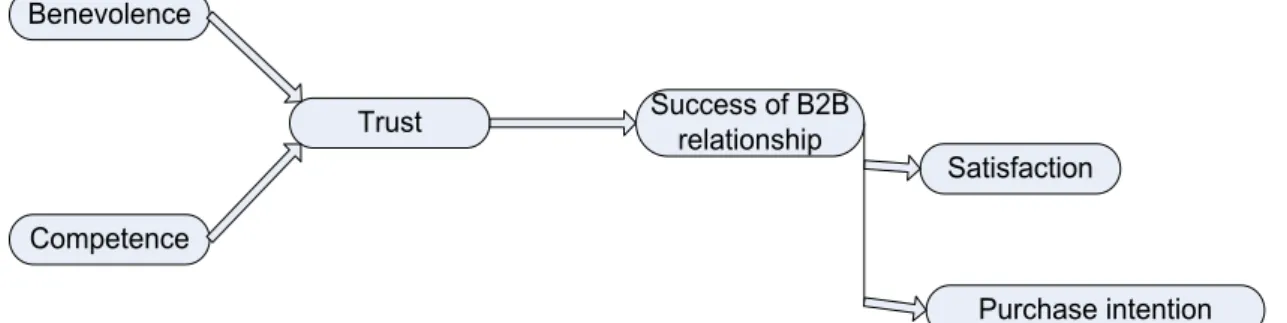
Figure 2. Conceptual model B
After verifying the values of Cronbach's alpha if any of the items were deleted, it was found that it is not possible to improve the consistency of the scale honesty. Therefore, it was decided to eliminate the variable honesty and its three items in later studies. Given the specific sample of this questionnaire, it was not possible to make this reliability analysis in the pre-test phase, it only could be made after the final questionnaire.
4.3. Exploratory factor analysis
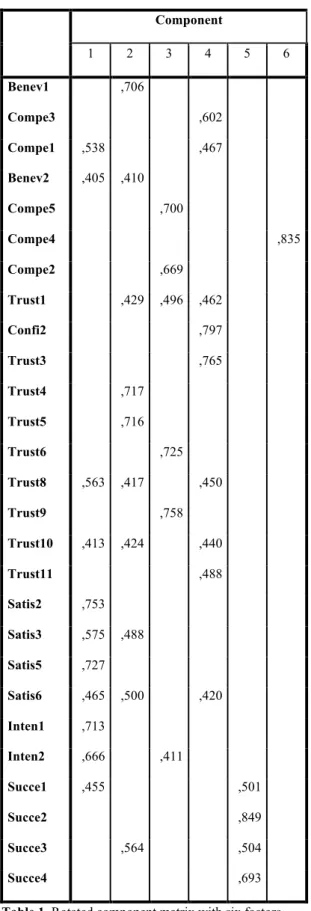
In addition to analyzing the consistency of scales, it was also made an exploratory factor analysis to reduce the number of variables involved in the analysis, by making a correlation between the various items. See Appendix 1 for items designation. To check the factor weights of each of the items of the conceptual model B after rotation of the factors of each of the items, was made the rotated component matrix:
International Journal of Marketing, Communication and New Media. ISSN: 2182-9306. Vol 5 Nº 8, January/June 2017 66 Component 1 2 3 4 5 6 Benev1 ,706 Compe3 ,602 Compe1 ,538 ,467 Benev2 ,405 ,410 Compe5 ,700 Compe4 ,835 Compe2 ,669 Trust1 ,429 ,496 ,462 Confi2 ,797 Trust3 ,765 Trust4 ,717 Trust5 ,716 Trust6 ,725 Trust8 ,563 ,417 ,450 Trust9 ,758 Trust10 ,413 ,424 ,440 Trust11 ,488 Satis2 ,753 Satis3 ,575 ,488 Satis5 ,727 Satis6 ,465 ,500 ,420 Inten1 ,713 Inten2 ,666 ,411 Succe1 ,455 ,501 Succe2 ,849 Succe3 ,564 ,504 Succe4 ,693
Table 1. Rotated component matrix with six factors
Extraction Method: Principal Component Analysis. Rotation Method: Varimax with Kaiser Normalization. a. Rotation converged in 16 iterations.
International Journal of Marketing, Communication and New Media. ISSN: 2182-9306. Vol 5 Nº 8, January/June 2017
67
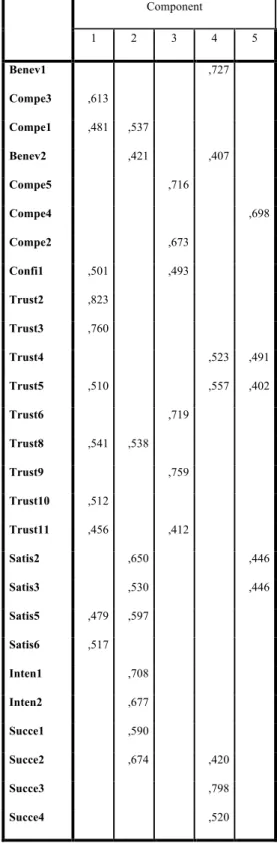
explained the variable success of the relationship B2B and that the factor 6 explained the variable competence. It was not directly observed that other factors explained one variable. Having made the rotation of factors and due to the fact that each factor had not allowed to fully explain each of the variables of the conceptual model B, we tried to reduce the number of factors to five. Again after the rotation of the factors of each of the items, was found that the five factors obtained did not explain only one variable. Finally, to confirm the relationship between the items and the variables, a new approach was used by structural equations analysis.
Through the confirmatory factor analysis, we aimed to confirm the existence of an exploratory model that previously identified the conceptual model B. The estimation of the model parameters and the evaluation of its degree of adjustment to the matrix were performed with the AMOS Graphics (Maroco, 2010), using the estimation method of maximum likelihood, but it was not possible to validate the model of exploratory factor analysis due to non-admissibility of the same. The reasons for this are the requirement of "large" sample sizes, which according to Maroco (2010) implies samples N> 200-400; another requirement is that at least 15 subjects by variable and 5 subjects per parameter need to be estimated.
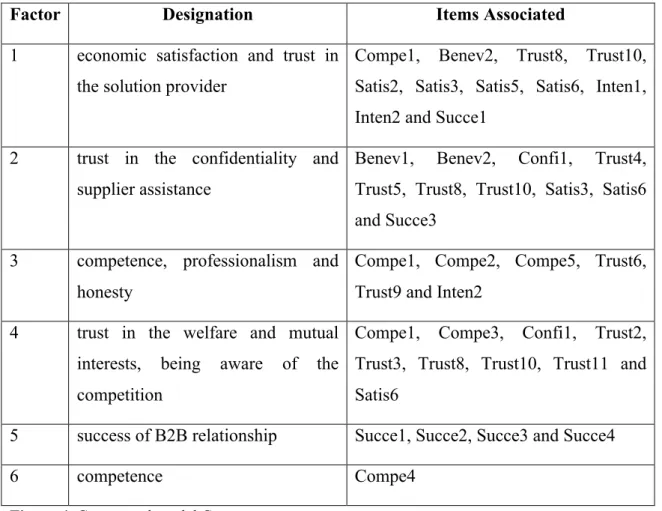
Therefore, the variables were renamed and the conceptual model was redefined into conceptual model C: Factor1 Factor2 Factor5 Factor3 Factor6 Factor4
Figure 3. Conceptual model C
International Journal of Marketing, Communication and New Media. ISSN: 2182-9306. Vol 5 Nº 8, January/June 2017
68
Factor Designation Items Associated
1 economic satisfaction and trust in
the solution provider
Compe1, Benev2, Trust8, Trust10, Satis2, Satis3, Satis5, Satis6, Inten1, Inten2 and Succe1
2 trust in the confidentiality and
supplier assistance
Benev1, Benev2, Confi1, Trust4, Trust5, Trust8, Trust10, Satis3, Satis6 and Succe3
3 competence, professionalism and
honesty
Compe1, Compe2, Compe5, Trust6, Trust9 and Inten2
4 trust in the welfare and mutual
interests, being aware of the competition
Compe1, Compe3, Confi1, Trust2, Trust3, Trust8, Trust10, Trust11 and Satis6
5 success of B2B relationship Succe1, Succe2, Succe3 and Succe4
6 competence Compe4
Figure 4. Conceptual model C
Again we proceeded to the construction of the confirmatory factor analysis model according to the conceptual model C, without repeated items in the various factors in order to avoid collinearity problems between variables. As before, the failure to identify the structural equation model was due to the failure of one of the requirements, which are the requirement of "large" size samples, according to Maroco (2010), and therefore it was not possible to validate model C.
4.4. Linear regression
A linear regression model was sought to be able to infer about the relationship between the new factors and the success of the B2B relationship. Four different approaches were admitted to form all items of the factors 1, 2, 3, 4, 5 and 6: the first approach considers the sum of all items of each variable of the conceptual model B; the second approach considers the average of all items in each variable of the conceptual model B; the third approach consists on the sum of all items of each variable of the conceptual model C and finally, the fourth approach analyses the average of all the items in each variable of
International Journal of Marketing, Communication and New Media. ISSN: 2182-9306. Vol 5 Nº 8, January/June 2017
69
the conceptual model C.
Variable Sum of all items of each variable of the conceptual model B
Variable Average of all items in each variable of the conceptual model B B Std. Error β B Std. Error β Benevolenc e ,809 ,407 ,345 Benevolenc e ,405 ,203 ,345 Competenc e -,010 ,198 -,008 Competenc e -,012 ,248 -,008 Trust ,084 ,131 ,154 Trust ,209 ,327 ,154 Satisfaction ,189 ,232 ,169 Satisfaction ,189 ,232 ,169 Purchase intention ,187 ,278 ,100 Purchase intention ,093 ,139 ,100 R ,662a R ,662a R Square ,439 R Square ,439 Adjusted R Square ,372 Adjusted R Square ,372 Std. Error of the Estimate 2,3403 0 Std. Error of the Estimate ,5850 8 Durbin-Watson 1,895 Durbin-Watson 1,895 F 6,565* * F 6,565 ** Table 2. Summary of the first and second approaches
**P_value<0,001
International Journal of Marketing, Communication and New Media. ISSN: 2182-9306. Vol 5 Nº 8, January/June 2017
70
Variable Sum of all items of each variable of the conceptual model C
Variable Average of all items in each variable of the conceptual model C B Std. Error β B Std. Error β Factor1 ,147 ,122 ,320 Factor1 ,404 ,335 ,320 Factor2 ,328 ,142 ,619* Factor2 ,820 ,354 ,619* Factor3 -,062 ,170 -,073 Factor3 -,093 ,254 -,073 Factor4 -,097 ,150 -,167 Factor4 -,218 ,337 -,167 Factor6 -,091 ,425 -,025 Factor6 -,023 ,106 -,025 R ,702a R ,702a R Square ,493 R Square ,493 Adjusted R Square ,433 Adjusted R Square ,433 Std. Error of the Estimate 2,2231 1 Std. Error of the Estimate ,5557 8 Durbin-Watson 1,860 Durbin-Watson 1,860 F 8,184* * F 8,184 ** Table 3. Summary of the third and forth approaches
*P_value<0,05 **P_value<0,001
Subsequently, an automatic linear regression was made with the objective of optimizing the linear regression model for predictive purposes:
International Journal of Marketing, Communication and New Media. ISSN: 2182-9306. Vol 5 Nº 8, January/June 2017
71
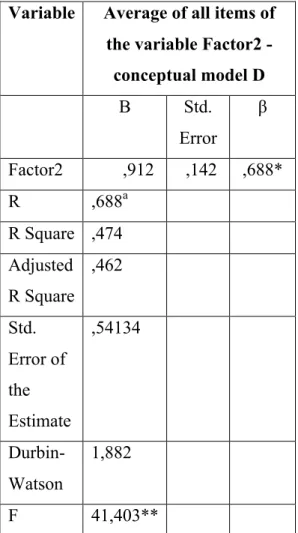
Variable Average of all items of the variable Factor2 - conceptual model D B Std. Error β Factor2 ,912 ,142 ,688* R ,688a R Square ,474 Adjusted R Square ,462 Std. Error of the Estimate ,54134 Durbin-Watson 1,882 F 41,403**
Table 4. Summary of the conceptual model D
*P_value<0,05 **P_value<0,001
An improved fit of the model after the automatic linear regression was evidenced, as 46.2% of the Y (success of B2B relationship) variability was explained by the independent variable “trust in confidentiality and supplier assistance”. Thus, the conceptual model has been reset to the following conceptual model D:
Factor2 Factor5
Figure 5. Conceptual model D
This model is highly significant, it has a p value <0.05 and explains a considerable proportion of the variability of the "success of B2B relationship" (Adjusted R Square =
International Journal of Marketing, Communication and New Media. ISSN: 2182-9306. Vol 5 Nº 8, January/June 2017
72
0.462). In summary, this was the model that was used to measure the success of B2B relationships.
5. CONCLUSION
5.1. Conclusions and research contributions
The main goal of this research was to analyse trust and verify if it contributes to the success of B2B relationships. This research intended to study the variables suggested by the literature in order to verify if they influenced the success of B2B relationships. Along the study several models were used to measure the success of B2B relationships. First it was performed an exploratory factor analysis to reduce the number of variables involved in the analysis. Then, and in order to confirm the relationship between the items and the variables, we tried a new approach by structural equations analysis, but it did not allow to validate the models assumed. Finally, we tried a linear regression model that could be able to infer about the relationship between the new factors found and the success of B2B relationship. From several models used, the one which achieved better results was used in this study to measure the success of B2B relationships. The variable that emerged more significantly and was able to explain and measure a considerable proportion of the variability of the "success of B2B relationship" was "trust in the confidentiality and supplier assistance". Trust associated with secrecy, as well as the assistance provided by the supplier are highly valued in a B2B relationship, and contribute to improve the relationship between suppliers and customers. Another important contribution of this study is the fact that the investigation was aimed to three distinct groups of respondents. This assumed premise had its advantages and disadvantages. The advantage that can be inferred is that the analysis of trust in the success of B2B relationships can be more assertive or more real, than if it was made exclusively to top management. The top managers may not have an exact notion that allows them to analyse trust in the success of B2B relationships, as they may not have had any interaction with the solution provider at the different stages of installation of the systems implemented in the company. Moreover, the disadvantage of the analysis of trust in the success of B2B relationships being made to intermediate and operating staff is that they may not have a global vision of the reality. For example, a logistic or production system manager may not be aware of the effectiveness of the company's sales. In this case, sales managers would be the right individuals to answer questions
International Journal of Marketing, Communication and New Media. ISSN: 2182-9306. Vol 5 Nº 8, January/June 2017
73
about the volume of the company's sales. With regard to the research in a non explored area as is the automatic storage systems, the analysis of trust in the success of the B2B relationship, allowed taking important conclusions, despite the limited size sample of companies that benefit from the attributes of this type of systems at national level. The majority of respondents believe that the company benefited a lot with regard to the effectiveness of sales, due to the relationship with the supplier of the implemented solution. Another important result is that most respondents have the opinion that the company benefited greatly with regard to innovation, taking into consideration the relationship with the supplier of the implemented solution. In sum, it is expected that this study can raise awareness to the administrators / buyers of such systems to the advantages of the same.
5.2. Study limitations and suggestions for future research
Given the specificity and the profile of the respondents, divided into three groups (top management, managers/buyers of such systems; middle level management, directors and logistics managers; first level management, supervisors and managers of the logistics or production system) with knowledge of the automatic storage and retrieval system and the inquired population, national customers of EFACEC Handling Solutions, SA, it was not possible no obtain a statistically high sample size, since it represented an extremely limiting factor in the number of replies (48 questionnaires).
Another limitation was the difficulty in data collection, since many of the companies contacted refused to provide the responders direct email. Therefore, the collaboration request had to be sent to the main company email, requesting that the same should be forwarded to the respective responders. This led to a situation that it wasn’t possible to directly control the sending of the questionnaires, and therefore not possible to confirm the replies. Another of the particularities was the timeline for collecting the data for this study (period from June 25 to July 10) in which some of the inquiries were on vacation. In addition, there was a case of a company that refused to answer the questionnaire and the fact that some of the companies contacted informed that only the administrator/buyer of such systems would reply to the questionnaire.
The low reply rate is a limitation to be considered in generalizing the results. It would be interesting to widen the focus of the research to customers of other international companies. This alternative could enrich the information at various levels, specifically
International Journal of Marketing, Communication and New Media. ISSN: 2182-9306. Vol 5 Nº 8, January/June 2017
74
the size of the sample since it was one of the main limitations of this study. On the other hand, this solution could possibly misinterpret the results of this study, due to differences in valuation between different cultures. The concern over the lack of multiculturalism and its possible influence on the study was the main reason why respondents from other international companies were not inquiry.
We recall the fact that we began by a conceptual model with seven variables that after put into practice, resulted in a conceptual model with two variables. The “trust in confidentiality and supplier assistance” was the variable that explained a considerable proportion of the variability of the “success of B2B relationship”. Although this can be seen as a limiting factor, we believe that in it also relies the strength of the model that can be improved in future research.
REFERENCES
Akrout, H., Diallo, M. F., Akrout, W. & Chandon, J. L. (2016), "Affective trust in buyer-seller relationships: a two-dimensional scale", Journal of Business & Industrial Marketing, Vol: 31, Nº 2, pp. 260-273.
Alonso-Ayuso, A., Tirado, G. & Udias, A. (2013), "On a selection and scheduling problem in automatic storage and retrieval warehouses", International Journal of Production Research, Vol: 51, Nº 17, pp. 5337-5353.
Anderson, J. C. & J. A. Narus (1984), "A Model of the Distributors Perspective of Distributor-Manufacturer Working Relationships", Journal of Marketing, Vol. 48, Nº 4, pp. 62-74.
Andrew Hill, M. M. H. (2008), Investigação por questionário 2ª edição, Edições sílabo. Alves, P., Campos, P. & Oliveira, E. (2012), “Determinants of the trustworthiness of a supplier in a B2B relationship for Modeling Suppliers in a Virtual Enterprises’ Platform, in Collaborative Networks in the Internet of Services”, IFIP Advances in Information and Communication Technology, Vol. 380, pp. 675-686.
Baker, Thomas L., Simpson, Penny M. & Siguaw, Judy A. (1999), "The impact of suppliers' perceptions of reseller market orientation on key relationship constructs", Journal of the Academy of Marketing Science, Vol. 27, Nº1, pp. 50-57.
Biggemann, S. (2012), "The essential role of information sharing in relationship development", Journal of Business & Industrial Marketing, Vol. 27, Nº 7, pp. 521-526. Chong, W. K. (2011), "Development of a business-to-business critical success factors (B2B CSFs) framework for Chinese SMEs", Marketing Intelligence & Planning, Vol. 29,
International Journal of Marketing, Communication and New Media. ISSN: 2182-9306. Vol 5 Nº 8, January/June 2017
75
Nº 5, pp. 517 - 533.
Christensen, C. (1997), "The innovator's dilemma: When new technologies cause great firms to fail", Research-Technology Management, Vol. 40, Nº 4, pp. 59-59.
Compiere (2009), "IT Solutions", Industry Week/IW, Vol. 258, Nº 5, pp. 54-54.
Crosby, L. A., Evans, K. R. & Cowles, D. L. (1990), “Relationship quality in services selling: An interpersonal perspective”, Journal of Marketing, Vol. 54, pp. 68–81.
Cullen, A. J. & M. Taylor (2009), "Critical success factors for B2B e-commerce use within the UK NHS pharmaceutical supply chain", International Journal of Operations & Production Management, Vol. 29, Nº 11-12, pp. 1156-1185.
Dwyer, F. R., Schurr, P. H. & Oh, S. (1987), "Developing buyer-seller relationships", Journal of Marketing, Vol. 51, Nº 2, pp. 11-27.
Eggert, A. & Ulaga, W. (2006), "Relationship value and relationship quality: Broadening the nomological network of business to business relationships", European Journal of Marketing, Vol. 40, Nº3/4, pp. 311-327.
Ennew, C. T. & Binks, M. R. (1999), "Impact of Participative Service Relationships on Quality, Satisfaction and Retention: An Exploratory Study", Journal of Business Research, Vol. 46, Nº 2, pp. 121-132.
Eriksson, K. & Vaghult, A. L. (2000), "Customer Retention, Purchasing Behavior and Relationship Substance in Professional Services", Industrial Marketing Management, Vol. 29, Nº 4, pp. 363-372.
Fleming, D., Lynch, P. & Kelliher, F. (2016), "The process of evaluating business to business relationships facing dissolution: An SME owner manager perspective", Industrial Marketing Management, Vol.58, pp. 83-93.
Foster, B. & Cadogan, J. (2000), "Relationship selling and customer loyalty: an empirical investigation", Marketing Intelligence & Planning, Vol. 18, Nº 4, pp. 185-199.
Fullerton, G. (2003), "When Does Commitment Lead to Loyalty?", Journal of Service Research, Vol. 5, Nº 4, pp. 333-344.
Garbarino, E. & Johnson, M. S. (1999), "The different roles of satisfaction, trust, and commitment in customer relationships", Journal of Marketing, Vol. 63, Nº 2, pp: 70-87. Ganesan, S. (1994), "Determinants of Long-Term Orientation in Buyer-Seller Relationships", Journal of Marketing, Vol. 58, Nº 2, pp. 1-19.
Gatignon, H. & Robertson, T.S. (1989), “Technology diffusion: an empirical test of competitive effects”, Journal of Marketing, Vol. 53, pp. 35-49.
Geyskens, I., Steenkamp, J. B. E. M., Scheer, L. K. & Kumar, N. (1996). "The effects of trust and interdependence on relationship commitment: a trans-Atlantic study", International Journal of Research in Marketing, Vol. 13, pp. 303–317.
International Journal of Marketing, Communication and New Media. ISSN: 2182-9306. Vol 5 Nº 8, January/June 2017
76
Geyskens, I., Steenkamp, J. B. E. M. & Kumar, N. (1998), “Generalizations about trust in marketing channel relationships using meta-analysis”, International Journal of Research in Marketing, Vol. 15, pp. 223-248.
Geyskens, I., Steenkamp, J. B. E. M. & Kumar, N. (1999), "A meta-analysis of satisfaction in marketing channel relationships", Journal of Marketing Research, Vol. 36, Nº 2, pp. 223-238.
Ghiglione, R. & Matalon, B. (2005), O Inquérito - Teoria e prática 4ª edição, Celta Editora. Ghomri, L. and Sari, Z. (2015), "Mathematical modeling of retrieval travel time for flow-rack automated storage and retrieval systems", Ifac Papersonline, Vol. 48, Nº 3, pp. 1906-1911.
Gilliland, D. I. & Bello, D. C. (2002), "Two sides to attitudinal commitment: The effect of calculative and loyalty commitment on enforcement mechanisms in distribution channels", Journal of the Academy of Marketing Science, Vol. 30, Nº 1, pp. 24-43.
Gil-Saura, I., Frasquet-Deltoro, M. & Cervera-Taulet, A. (2009), "The value of B2B relationships", Industrial Management & Data Systems, Vol. 109, Nº 5-6, pp. 593-609. Gorgievski, M. J., Ascalon, M. E. & Stephan, U. (2011), "Small Business Owners' Success Criteria, a Values Approach to Personal Differences", Journal of Small Business Management, Vol. 49, Nº 2, pp. 207-232.
Gungor, H. S. (2007), “Observing and Registering Emotional Satisfaction of Customer Contacts: For Customer Satisfaction & Loyalty”. [Amsterdam], Amsterdam Univ. Press. Heragu, S. S., Cai, X., Krishnamurthy, A. & Malmborg, C. J. (2008), "Striving for Warehouse Excellence", Industrial Engineer, Vol. 40, Nº 12, pp. 43-47.
Homburg, C., Allmann, J. & Klarmann, M. (2014), "Internal and external price search in industrial buying: The moderating role of customer satisfaction", Journal of Business Research, Vol. 67, Nº8, pp.1581-1588.
IMPO (2009), "AS/RS Provides Decade Of Uptime", Industrial Maintenance & Plant Operation, Vol. 70, Nº 7, pp. 14-14.
Keh, H. T. & Xie, Y. (2009), "Corporate reputation and customer behavioral intentions: The roles of trust, identification and commitment", Industrial Marketing Management, Vol. 38, Nº7, pp. 732-742.
Kumar, N., Stern, L. W. & Achrol, R. S. (1992), "Assessing Reseller Performance from the Perspective of the Supplier", Journal of Marketing Research, Vol. 29, Nº 2, pp. 238-253. Laeequddin, M. & Sardana, G. D. (2010), "What breaks trust in customer supplier relationship?", Management Decision, Vol. 48, Nº 3, pp. 353-365.
Malhotra, N. K. (2007), Marketing Research: an applied orientation: 5th Edition, Pearson Education.
International Journal of Marketing, Communication and New Media. ISSN: 2182-9306. Vol 5 Nº 8, January/June 2017
77
Marôco, J. (2010), Análise de Equações Estruturais - Fundamentos teóricos, software & aplicações, ReportNumber.
Marôco, J. (2014), Análise Estatística com o SPSS Statistics (6ª Edição), ReportNumber. Mayer, R. C., Davis, J. H. and Schoorman, F. D. (1995), “An Integrative Model of Organizational Trust”, The Academy of Management Review, Vol. 20, Nº 3, pp. 709-734. Mihelis, G., Grigoroudis, E., Siskos, Y., Politis, Y. & Malandrakis, Y. (2001), "Customer satisfaction measurement in the private bank sector", European Journal of Operational Research, Vol. 130, Nº 2, pp. 347-360.
Morgan, R. M. & Hunt, S. D. (1994), "The Commitment-Trust Theory of Relationship Marketing", Journal of Marketing, Vol. 58, Nº 3, pp. 20-38.
Mudambi, S. (2002), "Branding importance in business-to-business markets - Three buyer clusters", Industrial Marketing Management, Vol. 31, Nº 6, pp. 525-533.
Nissanka, S. A., Senevirathna, M. A. J. R. & Dharmawardana, M. (2016), "IoT based Automatic Storing and Retrieval System", Proceedings of the 2016 Manufacturing & Industrial Engineering Symposium (Mies): Innovative Applications for Industry, pp. 120-124.
Novaes, D. R., Souza, D. C., Filial, M. A. D., Giordano, C. V. & Goncalves, L. C. (2016), "Implementation of Warehouse Management System Technology in a Logistics Operator (3pl)", Revista Eniac Pesquisa, Vol. 5, Nº 2, pp. 223-239.
Pavlou, P. A. (2002), "Institution-based trust in interorganizational exchange relationships: the role of online B2B marketplaces on trust formation", Journal of Strategic Information Systems, Vol. 11, Nº3-4, pp. 215-243.
Perry, C., Cavaye, A. & Coote, L. (2002), "Technical and social bonds within business-to-business relationships", Journal of Business & Industrial Marketing, Vol. 17, Nº 1, pp. 75-88.
Rahatullah, M. & Raeside, R. (2015), "Determinants of Entrepreneurial Business Relationship Success", International Journal of Business & Society, Vol. 16, Nº 1, pp. 1-18. Ram, S. (1987), “A model of innovation resistance”, in Wallendorf, M. and Anderson, P. (Eds), Advances in Consumer Research, Vol. 14, Association for Consumer Research, Provo, UT.
Rauyruen, P., Miller, K. E. & Groth, M. (2009), "B2B services: linking service loyalty and brand equity", Journal of Services Marketing, Vol. 23, Nº 2-3, pp. 175-185.
Ritter, T. & Gemunden, H. G. (2003), "Network competence: Its impact on innovation success and its antecedents", Journal of Business Research, Vol. 56, Nº 9, pp. 745-755. Selnes, F. & Gonhaug, K. (2000), "Effects of supplier reliability and benevolence in business marketing", Journal of Business Research, Vol. 49, Nº 3, pp. 259-271.
International Journal of Marketing, Communication and New Media. ISSN: 2182-9306. Vol 5 Nº 8, January/June 2017
78
Sharma, A. (2006), "Success factors in key accounts", Journal of Business & Industrial Marketing, Vol. 21, Nº 3, pp. 141-150.
Sheth, J. N. (1981), “Psychology of innovation resistence: the less developed concept (LDC) in diffusion research”, in Sheth, J.N. (Ed.), Research in Marketing, JAI Press, Greenwich, CT, pp. 273-82.
Srinivasan, S. (2004), "Role of trust in e-business success", Information Management & Computer Security, Vol. 12, Nº 1, pp. 66-72.
Turner, J. C. C. G. B. (1999), "Determinants of intra-firm trust in buyer-seller relationships in the international travel trade", International Journal of Contemporary Hospitality Management, Vol. 11, Nº 2/3, pp. 116-123.
Tuten, T. L. & Urban, D. J. (2001), "An expanded model of business-to-business partnership formation and success", Industrial Marketing Management, Vol. 30, Nº 2, pp. 149-164.
Walter, A. (1999), "Relationship promoters - Driving forces for successful customer relationships", Industrial Marketing Management, Vol. 28, Nº 5, pp. 537-551.
Walter, A., Ritter, T. & Gemunden, H. G. (2001), "Value Creation in Buyer–Seller Relationships", Industrial Marketing Management, Vol. 30, Nº 4, pp. 365-377.
Walter, A., Muller, T. A., Helfert, G. and Ritter, T. (2003), "Functions of industrial supplier relationships and their impact on relationship quality", Industrial Marketing Management, Vol. 32, Nº 2, pp. 159-169.
Wetzels, M., Ruyter, K. & Birgelen, M. (1998), "Marketing service relationships: the role of commitment", Journal of Business & Industrial Marketing, Vol. 13, Nº 4/5, pp. 406–423. Woodside, A. G. (2010), "Organizational Culture, Business-to-business Relationships, and Interfirm Networks”, Bingley, Emerald.
Yin, R. K. (2009), Case study research: design and methods 4th Edition, SAGE Inc.
Zhang, J. Z., Netzer, O. and Ansari, A. (2014), "Dynamic Targeted Pricing in B2B Relationships", Marketing Science, Vol. 33, Nº 3, pp. 317-337.
International Journal of Marketing, Communication and New Media. ISSN: 2182-9306. Vol 5 Nº 8, January/June 2017
79
APPENDIX 1 Questionnaire
Question Source Item
shortname
7. The supplier of the implemented solution has always tried to help us.
Gorgievski et al. (2011)
Benev1
8. The supplier of the implemented solution and its employees have an extensive knowledge of competitors’ products and services.
Kumar et al. (1992)
Compe3
9. A partnership will be successful if both parties are honest about their goals.
Tuten and Urban (2001)
Hones1
10. The willingness to do good was a key factor in the relationship with the supplier of the implemented solution.
Gorgievski et al. (2011)
Benev3
11. The supplier of the implemented solution has the needed business skills to have a successful business.
Kumar et al. (1992)
Compe1
12. Both parties were honest about their goals and promises made, so that the partnership was successful.
Tuten and Urban (2001)
Hones2
13. The supplier of the implemented solution was genuinely worried with our business.
Gorgievski et al. (2011)
Benev2
14. The technical expertise was a key factor in the relationship with the supplier of the implemented solution.
Kumar et al. (1992)
Compe5
15. The supplier of the implemented solution has invested time and money to educate and train their employees to be more competent in selling their products and services.
Kumar et al. (1992)
International Journal of Marketing, Communication and New Media. ISSN: 2182-9306. Vol 5 Nº 8, January/June 2017
80
16. Honesty was a key factor in the relationship with the supplier of the implemented solution.
Tuten and Urban (2001)
Hones3
17. The supplier of the implemented solution demonstrates a high knowledge of the characteristics and attributes of their products and services.
Kumar et al. (1992)
Compe2
18. The supplier of the implemented solution keeps the promises he makes with our company.
Eggert and Ulaga (2006)
Trust1
19. The supplier of the implemented solution takes into consideration our well-being and their own well-being when making important decisions.
Eggert and Ulaga (2006)
Trust2
20. Our company trusts that the solution supplier keeps our best interests in mind.
Eggert and Ulaga (2006)
Trust3
21. We can rely on the solution supplier to confidentially handle critical information about our company.
Walter et al. (2003)
Trust4
22. When we have an important requirement, we can rely on the support of the implemented solution supplier.
Walter et al. (2003)
Trust5
23. We are convinced that the implemented solution supplier performed their tasks professionally.
Walter et al. (2003)
Trust6
24. The supplier of the implemented solution is not always honest to us.
Walter et al. (2003)
Trust7
25. My company feels that in general the implemented solution supplier is of the highest integrity.
Keh and Xie (2009)
Trust8
26. The supplier of the implemented solution honestly informs us of any problem that may affect us.
Gil-Saura et al. (2009)
Trust9
27. The supplier of the implemented solution is an expert in the products it sells.
Gil-Saura et al. (2009)
Trust10
28. Trust was a key factor in the relationship with the supplier of the implemented solution.
Keh and Xie (2009)
Trust11
29. Our company regrets the decision to have done business with the supplier of the implemented solution.
Eggert and Ulaga (2006)
International Journal of Marketing, Communication and New Media. ISSN: 2182-9306. Vol 5 Nº 8, January/June 2017
81
30. Our company is very satisfied with what the supplier of the implemented solution does for us.
Eggert and Ulaga (2006)
Satis2
31. If we had to do it all again, our company would choose again the supplier of the implemented solution.
Eggert and Ulaga (2006)
Satis3
32. Our company is not completely satisfied with the performance of the supplier of the implemented solution.
Eggert and Ulaga (2006)
Satis4
33. With reference to our expectations, we are very satisfied with the supplier of the implemented solution.
Walter et al. (2003)
Satis5
34. Overall we are satisfied with the relationship with the supplier of the implemented solution.
Gil-Saura et al. (2009)
Satis6
35. In the future my company will buy most of the main products/services of the solution supplier.
Keh and Xie (2009)
Inten1
36. My company will consider the supplier of the implemented solution as first choice to buy products/services.
Keh and Xie (2009)
Inten2
37. My company will do more business with the supplier of the implemented solution in the coming years.
Keh and Xie (2009)
Inten3
38. Considering all the costs and returns associated with this relationship, how would you rate your profitability?
Walter et al. (2001)
Succe1
Please rate the benefit that your company gained through the relationship with the supplier of the implemented solution:
39. Sales effectiveness (e.g., sales volume). Walter (1999) Succe2 40. Innovation (e.g., adoption of new technologies). Walter (1999) Succe3 41. Market access effectiveness (e.g., contacts with new
customers).
International Journal of Marketing, Communication and New Media. ISSN: 2182-9306. Vol 5 Nº 8, January/June 2017
82
APPENDIX 2
Rotated Component Matrixa
Component 1 2 3 4 5 Benev1 ,727 Compe3 ,613 Compe1 ,481 ,537 Benev2 ,421 ,407 Compe5 ,716 Compe4 ,698 Compe2 ,673 Confi1 ,501 ,493 Trust2 ,823 Trust3 ,760 Trust4 ,523 ,491 Trust5 ,510 ,557 ,402 Trust6 ,719 Trust8 ,541 ,538 Trust9 ,759 Trust10 ,512 Trust11 ,456 ,412 Satis2 ,650 ,446 Satis3 ,530 ,446 Satis5 ,479 ,597 Satis6 ,517 Inten1 ,708 Inten2 ,677 Succe1 ,590 Succe2 ,674 ,420 Succe3 ,798 Succe4 ,520
Table 5. Rotated component matrix with five factors.
Extraction Method: Principal Component Analysis. Rotation Method: Varimax with Kaiser Normalization. a. Rotation converged in 10 iterations.
International Journal of Marketing, Communication and New Media. ISSN: 2182-9306. Vol 5 Nº 8, January/June 2017
83
How to cite this article:
Alves, V., Campos, P. & Felício, M. (2017). Analysis of Trust in B2B Relationships: The case of automatic storage and retrieval systems. International Journal of Marketing,
Communication and New Media. 8 (5), 52-83. Available at