WORKING PAPER SERIES
Universidade dos Açores Universidade da Madeira
CEEAplA WP No. 02/2016
A multivariate logit for propensity to choose
package tour over independent travel
Christer Thrane Antonio Menezes Ainura Uzagalieva July 2016
A multivariate logit for propensity to choose package
tour over independent travel
Christer Thrane
Lillehammer University College
António Menezes
University of the Azores (FEG and CEEAplA)
Ainura Uzagalieva
CASE - Center for Social and Economic Research
Working Paper n.º 02/2016
julho de 2016
CEEAplA Working Paper n.º 02/2016 julho de 2016
RESUMO/ABSTRACT
A multivariate logit for propensity to choose package tour over independent travel
The antecedents of choosing package tours as opposed to independent travel have received surprisingly little attention in empirical tourism research. This paper therefore examines how a number of independent variables by means of logistic regression analysis explain the propensity for package tours to be chosen over independent travel. The empirical context is the inbound tourism market to the Azores, and the data refer to two visitor surveys conducted in 2007. There are two main findings. (1) Socio-demographic variables explain very little of the propensity to engage in package tourism. (2) Country-of-residence and certain trip-related variables, by contrast, are important predictors of this propensity. Implications for policy and future research are finally discussed.
Key words: package tour; independent travel; statistical modeling; logit; market
segmentation; policy
Christer Thrane
Lillehammer University College The Department of Social Science PO Box 952, N-2604
Lillehammer, Norway António Menezes
Universidade dos Açores
Faculdade de Economia, Gestão e Direito Rua da Mãe de Deus, 58
9501-801 Ponta Delgada Ainura Uzagalieva
CASE - Center for Social and Economic Research Jana Pawla II 61/212, 01-031
A multivariate logit for propensity to choose
package tour over independent travel*
Christer Thranea, Antonio Menezesb and Ainura Uzagalievac
Abstract:
The antecedents of choosing package tours as opposed to independent travel have received surprisingly little attention in empirical tourism research. This paper therefore examines how a number of independent variables by means of logistic regression analysis explain the propensity for package tours to be chosen over independent travel. The empirical context is the inbound tourism market to the Azores, and the data refer to two visitor surveys conducted in 2007. There are two main findings. (1) Socio-demographic variables explain very little of the propensity to engage in package tourism. (2) Country-of-residence and certain trip-related variables, by contrast, are important predictors of this propensity. Implications for policy and future research are finally discussed.
Key words: package tour; independent travel; statistical modeling; logit; market segmentation; policy
a The Department of Social Science at Lillehammer University College, Norway. Address: The Department of Social Science at Lillehammer University College, Lillehammer University College, PO Box 952, N-2604, Lillehammer, Norway; e-mail: [email protected].
b Centre of Applied Economics Studies of the Atlantic at the Department of Economics and Management, the University of the Azores, Portugal. Address: Centre of Applied Economics Studies of the Atlantic at the Department
of Economics and Management, the University of the Azores, Rua da Mãe de Deus, 9501-801, Ponta Delgada, S.
Miguel Azores, Portugal; e-mail: [email protected]
c Centre of Applied Economics Studies of the Atlantic at the Department of Economics and Management, the University of the Azores, Portugal. Address: Centre of Applied Economics Studies of the Atlantic at the Department
of Economics and Management, the University of the Azores, Rua da Mãe de Deus, 9501-801, Ponta Delgada, S.
Miguel Azores, Portugal; e-mail: [email protected].
*) We thank Carlos Santos and Carla Pacheco from the agency “Observatório do Turismo dos Açores” (http://www.observatorioturismoacores.com) for providing the survey data on tourists visited the Azores. All usual disclaimers apply. The opinion of the authors does not necessarily express the view of the Institutions with which they are affiliated.
1. Introduction
Despite its pivotal role in the emergence of international tourism as a phenomenon in the twentieth century, the package tour has received little attention from scholars (Thrane, 2005; Quiroga, 1990). To say that it has been neglected might seem to push it, but if we as a thought experiment for a moment consider all the papers appearing in tourism journals from the 1970s and onwards, the 20 or so papers about dealing primarily
and empirically with package tours appear rather minuscule. However, matters do not
become much better with the package tour’s supposed flip side – independent travel or individual tourism. That is, the first comprehensive scholarly treatment of independent travel appeared as late as ten years ago (Hyde & Lawson, 2003). In other words, more empirical research is called for on both of these types of tourism.
In this study, package tours and independent travel – arguably two “extreme” types of tourism – are contrasted. Although this has been done before in the tourism literature (see section 2), much remains to be examined, explained and understood when it comes to the antecedents of choosing between package tours or independent travel. The purpose of this study, therefore, is to examine how certain independent variables explain the propensity to choose package tourism over independent travel. Another point in this respect is that most of the extant research on this topic is rather dated. The empirical analyses in the paper are based on two visitor surveys carried out among tourists to the Azores. The next section presents the study’s theoretical background, prior research and purpose of study, whereas section 3 paints a broad picture of the tourism in the Azores. Section 4 describes the data and the statistical analyses, while section 5 presents the
results. Section 6 finally concludes and offers some implications for tourism management and policy as well as for future research.
2. Dichotomies and choices in tourism – prior research, theoretical background and purpose of study
The tourism literature is abundant in terms of the coverage of the motivational aspect behind the (often binary) choices people make when they are about to set off on their vacations or holiday trips. Hyde and Lawson (2003, p. 14-15) reviewed much of this research which, save for a few exceptions, mostly tend to lack a sound empirical footing. Examples of such choices include “sunlust” versus “wanderlust” (Gray, 1970), “psychocentric” tourists versus “allocentric” ones (Plog, 1973), “old” versus “new” tourists (Poon, 1993) and slightly more complex typologies, such as Cohen’s four distinct tourist roles (Cohen, 1972). As such, the choice between package and independent travelling falls into a familiar line of important choices covered in the tourism literature.1
Sheldon and Mak’s (1987) study examining US travelers to Hawaii could perhaps be labeled as the first rigorous micro-econometric treatment on the subject in question.2 Among the socio-demographic differences in package tour preference (41% of the total sample preferred this travel mode), they found by means of logistic regression analysis that older persons tended to prefer package tours over independent travel. They also noted that package travelers more often were “not rich.” For Australian outbound travelers (with a 49% package tour propensity in the total sample), Hsieh et al. (1993) did a similar analysis with a larger set of independent variables. Again older people turned out to be more typical package tourists, compared to younger ones. Yet only four of their fourteen independent variables reached statistical significance at conventional levels. In both
Sheldon and Mak’s (1987) and Hsieh et al.’s (1993) study the effects of gender were insignificant. Hsieh et al. (1994) conducted a more simplistic study – in terms of statistical analysis (i.e. only bivariate associations) – of the UK outbound tourism market. Their analysis revealed no significant age differences in the propensity of choosing a package tour (30% of the total sample preferred this travel mode). However, their analysis showed small but significant gender and income differences in the inclination to choose a package tour over independent travel. Some caution is required in generalizing these results, however, due to the fact that no multivariate analysis was carried out.
Yoon and Shafer (1997) distinguished between tourists choosing all-inclusive packages (67% of total sample) or independent travel arrangements. In contrast to the studies mentioned above, they found that younger persons were more typical package travelers. Also, package travelers tended more frequently to be full-time employed. Both of these results, however, were obtained by simple cross-tabulations. Yamamoto and Gill (1999) compared Japanese package and non-package tourists in 1989 and 1995, again in only a bivariate fashion. They reported that package tourists typically were somewhat older, female to a slightly higher extent and more often either in the low- or high income groups. In a study of the senior travel market (i.e. 55+) to the US, Bai et al. (2001) sought to shed light on the differences between package and non-package travelers. With respect to demographic difference, they found these to be small and mostly insignificant for the Japanese and the UK travelers. By contrast, there were small but significant gender, income and occupational differences for the Germans.
Finally, in a study of nature tourism, Mehmetoglu (2006) also reported of small but significant age, gender and income differences between package tourists and
independent tourists: the former tended to be older, male and in low-income segments. In summary, thus, it appears as if the socio-demographic variables age, gender and income at best explain only a little of the “variation” in the propensity to engage in package tourism. In this regard, Thrane (2005, p. 345) also noted that “the associations between income, as well as other socio-demographic variables and choice of travel mode (i.e. package tours; our emphasis), were generally weak….” To underscore this even further, Pearce, Reid and Schott (2009) more recently found no socio-demographic difference between package tourists and independent travelers in a sample of 547 New Zealand outbound travelers.
The important role played by nationality or country-of residence as a segmentation criterion in tourism research has recently been re-emphasized by Thrane and Farstad (2012). In the context of package traveling, however, country-of residence has not received much attention. Whereas Yamamoto and Gill (1999) highlighted the important connections between Japanese culture and package tourism and Enoch (1996) examined the contents of tour packages in three different countries, only Bai et al. (2001) appear to have empirically compared the package tour propensity of tourists from different countries. In this respect, they found for a sample of senior travelers to the US that that Japanese tourists were the most typical package travelers (63%), followed by Germans (47%) and travelers from the UK (34%). Coupled with the abundant evidence of national differences in general tourism preferences (see Thrane and Farstad, 2012), the results of Bai et al. (2001) tentatively suggest that nationality or country-of-residence might be an important predictor of package tour propensity.
Trip-related variables have in various ways in the above-mentioned studies been linked to the package tour versus independent travel decision. First-time visitors appear more likely than repeat visitors to choose package tours (Bai et al., 2001; Pearce, Reid & Schott, 2009; Sheldon & Mak, 1987; Yamamoto & Gill, 1999). As for length of stay and travel party size, the results are mixed. Most studies conclude that length of stay is negatively associated with package tour propensity (Bai et al., 2001; Hsieh et al., 1994; Mehmetoglu, 2006; Sheldon & Mak, 1987; Yamamoto & Gill, 1999). In other words, these studies suggest that package tours tend to be shorter (as measured in days) than independent tours. By contrast, Yoon and Shafer (1997) reported the exact opposite pattern whereas Hsieh et al. (1993) found no association at all. Sheldon and Mak’s (1987) and Hsieh et al.’s (1994) results also indicated that package tour propensity was negatively associated with travel party size. Hsieh et al. (1993), Yamamoto and Gill (1999) and Bai et al. (2001), by contrast, reported the exact opposite finding. In a related spirit, type of travel companions has also been found to matter for the choice between package and independent travel (Bai et al., 2001; Hsieh et al., 1994). Finally, purpose of trip (or trip motives/benefits sought) has also successfully been linked to the propensity to engage in package tourism, although the studies differ in so many respects that it is difficult to draw more general conclusions (Hsieh et al., 1993; Hsieh et al., 1994; Mehmetoglu, 2006; Pearce, Reid & Schott, 2009; Yamamoto & Gill, 1999).
Although the studies mentioned above evolve around the question of why some people tend to prefer package tours over independent travel, they do not explicitly address this issue. Three by no means mutually exclusive answers to this question are: (perceived) risk reduction, personal safety and convenience (cf. Wong & Kwong, 2004). These three mechanisms might also explain some of the above-mentioned associations, for example
why (i) older people are more typical package tourists than younger people; why (ii) first-timers are more typical package tourists than repeaters, and (possibly) why (iii) tourists of different nationalities are package tourists to different extents. As to (i), older people are often more risk-aversive/safety-concerned/convenience-oriented than younger people. Furthermore, (ii) international traveling is costly and for first-timers who want to reduce risk (both financially and/or personally) it is thus “rational” to choose a package tour. Finally, (iii) the same reasoning as for (ii) might apply for tourists of different nationalities, who have to cover different travel distances to get to their destinations and thus face different financial and time costs.
The antecedents of choosing package tours as opposed to traveling independently are neither well researched nor well understood in previous tourism research. The purpose of this study is therefore to examine how a set of socio-demographic variables, country-of-residence and certain trip-related variables are associated with the propensity to engage in package tourism to the Azores. A second objective in the study is to shed some light on the relative importance of these three sets of independent variables.
3. Tourism in the Azores
The Archipelago of the Azores, an autonomous region of Portugal, consists of nine volcanic islands and is situated in the middle of the North Atlantic Ocean.3 The total territory of the Azorean islands is 2.3 thousand square kilometers, representing about 2.5% of the whole territory of Portugal and 2.2% of its total population. Despite the islands’ tourist growth potential, the Azorean regional government did not promote the tourism sector until the early 1990s (Menezes at al., 2008). Later, the tourism growth
enhancing policies, such as the provision of air connections and the promotion of regional brand awareness, were adopted. These changes led to a faster growth in the tourism activities in the region, and especially to a boom in the hotel construction sector. According to Statistics of Portugal (2012), the number of hotel establishments in the Azores grew from 62 to 80 between 2002 and 2011. Also, the number of guests in hotel establishments increased from 159 thousand in 1995 to 249 thousand in 2002 and further to 345 thousand in 2011. It is also worth noting that the growth rate for nights in the hotel establishments has been higher in the Azores than in the other Portuguese regions (i.e. mainland Portugal and the Autonomous region of Madeira). In 2011 this indicator reached 32.6% for the Azores, whereas in the continental part of Portugal and Madeira the growth rates were, respectively, 17.5% and 1.8%. In terms of foreign tourism to the Azores, the proportion of foreign visitors increased from 32% in 2002 to 42% in 2011.
The Azorean islands offer warm and mild weather all year around, increasing the popularity of touristic outdoor activities: camping, extreme sports, golf, watching wild whales and dolphins, boat trips to lagoons. Given its geographical position natural beauty, mild climate and rural oriented economic structure, the region attracts mainly nature-based tourism, mostly from the Continental Europe and North America. The analysis of persistence in tourist arrivals to the Azores, by islands and nationality of origin, suggest high percentage in tourist arrivals from Sweden, Germany, Denmark and Norway (Barros et al. 2008). The findings of Barros et al (2008) suggest that the most “loyal” tourists are from Holland, Finland, Norway, Germany, Denmark and UK, while tourists from Spain, Austria,
Belgium and Brazil visit the region with no particular pattern. The National Strategic Plan
for Tourism (Vieira et al., 2012), therefore, stresses the importance of Northern European markets as of high strategic value for the Azorean region.
Tourists in the Azores are mostly young and middle aged (over 60%) employed individuals visiting for holiday (about 70%). The relative frequency of package tours versus independent travel shows stronger preference for independent travel, with 61% versus 39%, overall. Similar patterns correspond to all categories of tourists grouped according to socio-demographic characteristics, with the exception of tourists aged over 55. 60% of the tourists in this age category tended to choose package tours, which represented about 23% of the sample population in 2011.
4. Data and statistical analyses
4.1. Data, questionnaire and descriptive statistics
The data used in this study stem from two surveys – one for the summer season, one for the winter – conducted in 2007 at the main regional airports of the Azores. The public agency Studies and Consultancy Department of Norma – Acores, were responsible for both surveys. The survey questionnaire (identical for the two seasons) contained information about the tourists’ socio-demographic profile, their preferences and behavior during their stay (including travel mode) as well as a number of specific evaluation questions. The dependent variable in this study was the answer to the question “Did you buy a package for this trip?” In total 44% of the respondents answered yes to this question, whereas 56% answered no. In other words, almost half of the visitors could be labeled as “package tourists” while the remaining visitors (by default) were labeled as “independent” tourists. On average the tourists were 44.5 year of age (SD = 13.8) and 51% of them were women. Education level had the following distribution (and percentages): basic schooling (18%), high school level (37%) and university level (45%).
71% of the respondents were married and 77% were employed. Due to missing values, the multivariate analyses were based on 1,723 observations.
4.2 Statistical analyses
The empirical analyses proceeded in two steps. First, the socio-demographic profile of the package tour travelers was disclosed by means of cross-tabulations and t-tests. Second, a series of multivariate logistic regression analyses were performed in order to disentangle the “net” or ceteris paribus effects of the independent variables (Long, 1997). Robust standard errors are reported throughout the analyses.
5. Results
5.1 Descriptive results
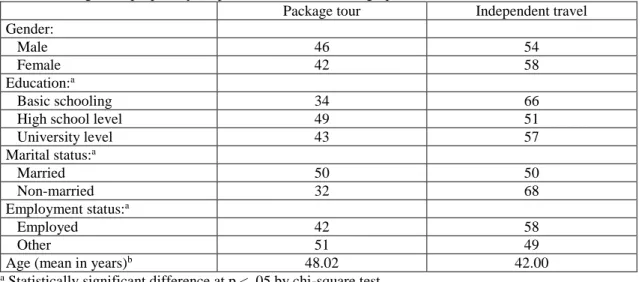
Table 1 shows that the package tour propensity is more or less evenly distributed among the sexes with a difference of only four percentage points. This is rather unsurprising in light of the prior research (e.g. Hsieh et al., 1993; Sheldon & Mak, 1987). By contrast, choosing package tours as opposed to independent travel unexpectedly appears to be somewhat associated with educational level; that is, slightly more typical among the two highest educational categories. Furthermore, package tourists tend to be married, whereas employed people are to some extent less typical package travelers than those in the “other” category. Finally, package tourists are on average six years older than the independent travelers (48 – 42 = 6). This finding is in keeping with most of the extant research (Hsieh et al., 1993; Sheldon & Mak, 1987; Yamamoto & Gill, 1999; Mehmetoglu, 2006).
(Table 1 in about here.)
The differences between package tourists and independent tourists are rather small in socio-demographic terms, except for the noticeable age difference (cf. Table 1). Table 2 displays the same differences with regard to the tourists’ country-of-residence. The main impression from this table, by contrast, is that country-of-residence plays an important role in terms of explaining “variance” in package tour propensity (and thus, by default, also in independent travel propensity): Whereas more than three out of four tourists from South-America (75%), Finland and Sweden (both 77%) are package travelers, only 27% of the Portuguese and 20% of the North American tourists fall into this category. Midway between these figures are Germany (49%) and “Other” countries (55%).
(Table 2 in about here.)
5.2 Multivariate results
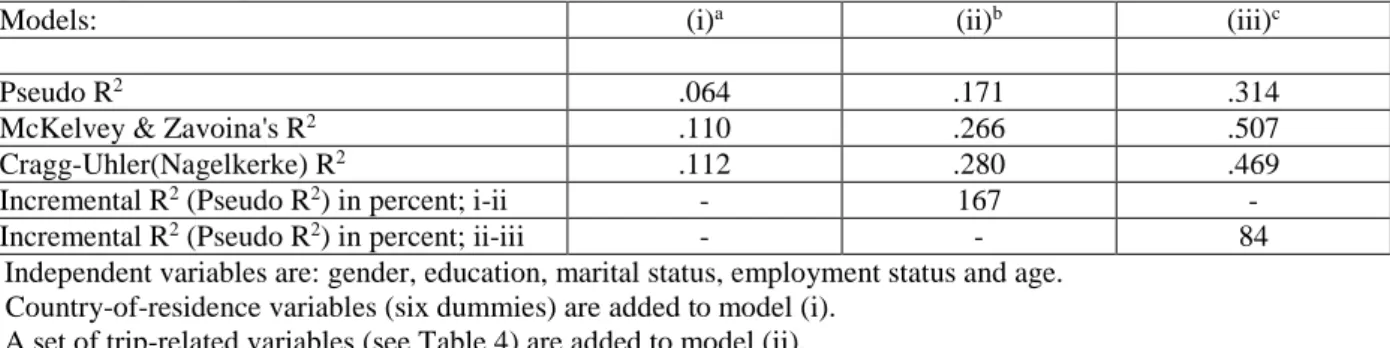
Table 3 compares the explanatory power of three multivariate logistic regression models in which the package tour (coded 1) versus independent travel (coded 0) comprises the dependent variable.4 In model (i) the independent variables are the
socio-demographic variables considered in Table 1 (gender, education, marital status, employment status and age); in model (ii) the country-of-residence variable (a set of dummies) is added to model (i); and in model (iii) a number of trip-related variables (which will be scrutinized in detail in Table 4) is added to model (ii). Three things are worthy of note when it comes to Table 3’s results: (1) The socio-demographic variables in and by themselves appear to explain little of the inclination to choose a package tour
over independent travel – a feature also evident in Table 1. In all the socio-demographic variables explain only about 10% of the “variance” in the choice between the two travel modes in question. (2) Country-of-residence adds a significant – both in strictly statistical terms, but more importantly also in terms of practical relevance – amount of predictive power to the ability of explaining package tour preference. Model (ii) explains in a similar manner about 27% of this “variance” – a 167% increment from model (i) (.171 - .064)/.064 = 1.67). This finding is not surprising in light of the profound nationality differences noted in Table 2. (3) Finally, it is also evident that the trip-related variables (added in model (iii)) matters a great deal for the travel mode choice; combined these variables add 84% to the explanatory power of model (ii). The “net” or ceteris paribus effects of all the independent variables considered so far – i.e. model (iii) – are more comprehensively displayed in Table 4.
(Table 3 in about here.)
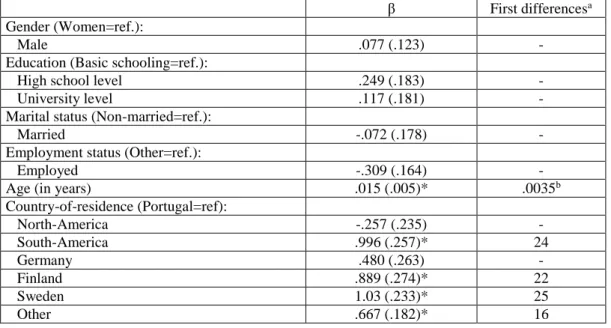
The first thing to note about the results of Table 4 is that, save for age, the socio-demographic variables no longer have any significant effects on the package tour propensity. As for age, the positive and significant logistic coefficient (p < .01) tells us that the older a tourist is, the more likely it is that he or she chooses a package tour as opposed to traveling independently. This is in accordance with the impression made from Table 1, which tentatively suggested that package tourists were older than the independent travelers. Other than this, the logistic regression coefficient for age says little or nothing about the age effect’s magnitude (cf. Long, 1997; Thrane, 2005). To rectify this, we have also computed the marginal effect for the age coefficient, which translates into .035 points for a ten-year increase in age (.0035 x 10 = .035). In other words, a typical tourist at age
65 has a 14 percentage point higher probability of being a package traveler than a typical 25 year old tourist (0.035 x 4 = .14). The similar difference between the youngest and the oldest tourist in the sample (i.e. the maximum effect) is 24 percentage points. See Long (1997) or Thrane (2005) on how to calculate these differences.
(Table 4 in about here.)
The reference category for the country-of residence dummies is Portuguese tourists. As expected from Table 2, the North-American tourists have a slightly lower probability than the Portuguese tourists in terms of being a package traveler. However, this difference is not significantly different from zero at conventional levels. By contrast, the remaining “nationalities” all have significantly higher probabilities of being package tourists than the Portuguese tourists. Other than this, however, the logistic coefficients for the country-of-residence dummies say little or nothing about the differences in terms of probabilities (cf. Long, 1997; Thrane, 2005). To shed some light on this issue, Table 4 also reports so-called “first differences”; i.e. the predicted probability change (as measured in percentage points) in choosing a package tour when the independent variable changes value from 0 to 1 holding all other variables constant at their means (i.e. ceteris paribus). In the present context, this means that South-American tourists’ probability of being a package traveler is 24 percentage points higher than the analogous probability for Portuguese tourists. The parallel differences for Fins and Swedes are, respectively, 22 and 25.
Regarding the trip-related independent variables, Table 4 shows that repeat visitation matters for choosing a package tour over independent travel. First-time visitors
have a 13 percentage point higher likelihood of being package tourists than repeat visitors, ceteris paribus. This result is in accordance with most of the findings in the aforementioned studies (Bai et al., 2001; Pearce, Reid & Schott, 2009; Sheldon & Mak, 1987; Yamamoto & Gill, 1999). Length of stay has a marginally significant negative effect, indicating that longer stays reduces the probability of being a package tourist. Again we have computed a marginal effect, which suggests that a ten-day increase in length of stay entails a -.058 point decrease in the likelihood of being a package tourist. That is, an average tourist staying for three weeks have a 8 percentage point lower probability than a similar tourist staying for one week (-.0058 x 14 = -.081). Since most prior studies seem to conclude that length of stay is negatively associated with package tour propensity (Bai et al., 2001; Hsieh et al., 1994; Mehmetoglu, 2006; Sheldon & Mak, 1987; Yamamoto & Gill, 1999), our findings tentatively conform this pattern. However, it must be stressed that the effect of length of stay noted here is rather weak. Travel party size does not appear to affect the package tour probability in our study. Given this variable’s equivocal effects in prior research, this should not be surprising. By contrast, compared with those travelling alone (i.e. the reference category), the ones traveling with someone all appear to have an increased probability of choosing the package tour (cf. Bai et al., 2001; Hsieh et al., 1994). Yet only the “spouse/partner” category is statistically significantly different from the reference category at p < .05. Regarding purpose of trip, the difference between tourists on vacation and tourists with other purposes is 26 percentage points, ceteris paribus (see Hsieh et al., 1993; Hsieh et al., 1994; Mehmetoglu, 2006; Pearce, Reid & Schott, 2009; Yamamoto & Gill, 1999). Tourists who had the Azores as their first destination choice, as opposed to not having this, have a smaller probability of being a package tourist – the difference being 9 percentage points. The effect of staying in hotels also has an impact: one night in a hotel, as opposed to none,
corresponds to a 30 percentage point difference in the probability of being a package tourist. About the same difference is observed for two nights in a hotel, whereas the effect of three or more nights in hotels is somewhat larger. Finally, the winter tourists are more typically package tourists than the summer visitors – the percentage point difference being 18.
6. Conclusions and implications
The package tour has a profound historical importance in the emergence of modern tourism as a phenomenon. Despite this pivotal role, however, very few scholarly papers have dealt empirically with the micro-level determinants of choosing package tours as opposed to traveling independently. The purpose of this study has therefore been to examine the variables explaining tourists’ propensity of choosing package tours over independent travel in the upcoming tourist destination of the Azores using micro data. The econometric model employed suggests that socio-demographic variables play a minor role in explaining the choice between preferring a package tour versus taking part in independent travel. By contrast, country of residence and trip-related variables play major roles, being important predictors of the propensity of choosing package tours over independent travel. Our results also shed some light on some of the unanswered questions in the literature; by illuminating the quantitative effects of some individual covariates of package tour propensity. We find that aging increases package tour propensity, a result which may be due to the fact that older people generally are more risk averse and therefore prefer to choose a package, most likely endorsed by a well-known third party such as a tour operator. By the same line of reasoning, we find that being a first time visitor
significantly increases the package tour propensity. We also find that Nordic tourists – ceteris paribus – tend to exhibit higher package tour propensity when compared to mainland Portuguese tourists. This may be due to the fact that Nordic tourists are not so well versed in the Azorean tourist infrastructure and therefore seek a third party endorsement, such as buying from a well-known Nordic tour operator with a stronghold in the Azores.
These results are also of practical and first order importance to policy makers. Tourism is an important economic sector, providing jobs and tax revenue in the Azores. Together with economic benefits, however, tourism may bring environmental costs. The main environmental pressure is associated with the extensive use of cars and boats in the region. Therefore, regional policy measures aimed at promoting new tourism products and services, compatible with the principles of sustainable development are desirable. Agri-tourism and recreational facilities developed near villages for the group of visitors choosing package tours, for example, can contribute to the reduction of environmental pressure and the use of cars and boats. Further, promoting education and information on nature, conservation, local environment, cuisine and culture in these agri-tourism based facilities would facilitate environmentally friendly attitudes and locally beneficial tourism in the region. Policy makers should target specifically tour operators in order to educate and if possible design eco-friendly products and services in order to actively manage the environmental impact of tourists, as tour operators are an important channel of distribution and promotion of the islands.
If the governmental tourism promotion strategy hinges on targeting older people from Nordic countries (or Central Europe), where the Azorean climate is rightly perceived as year-round amiable, the tourism promotion strategy should realize that tour operators will be a distribution channel to reckon with. It is also the case that one finds not that
many repeaters in the Azores (Menezes, Moniz & Vieira, 2008). This may be due to the infancy of the Azores as a tourism destination or to its amiable but unstable weather and lack of top-end-quality tourist infrastructures specifically built to target repeaters, like residential tourists and vacation clubs fractional owners. In any event, the chronically persistently high incidence of first-time visitors suggests that policy makers should specifically address tour operators as an important distribution and sales channel. Future research should more thoroughly address the theoretical mechanisms underpinning package tour propensity to allow for a deeper and fuller understanding of the demand side of this phenomena. Future research should also consider supply side issues, including market structure, to uncover how such issues condition the choices made by tourists in their respective markets.
Notes:
1 In the literature a distinction is sometimes made between basic package tours and all-inclusive package tours (e.g., Sheldon & Mak, 1987). No such distinction is made in this study, however, since our data do not address this feature.
3 The islands are Corvo, Faial, Flores, Graciosa, Pico, Sao Jorge, Santa Maria, Sao Miguel and Terceira. All the figures in this section, unless explicitly stated otherwise, were retrieved from http://www.ine.pt.
4 It should be mentioned that the various R2 measures with regard to logistic regression analysis cannot be considered as strictly equivalent to R2 in OLS regression.
References:
Askari, H. (1971). Demand for Package Tour. Journal of Transport Economics and
Policy, 5(1), 40-51.
Bai, B., Jang, S., Cai, L., & O’Leary, J.T. (2001). Determinants of Travel Mode Choice of Senior Travelers to the United States. Journal of Hospitality & Leisure Marketing, 8(3/4), 147-168.
Barros, C.P., Gil-Alana, L., & Santos, C. (2008). Tourism in Azores Islands: Persistence in the Monthly Arrivals. Instituto Superior de Economia e Gestão, DE, Working papers, 9.
Cohen, S. (1972). Toward a Sociology of International Tourism. Social Research, 39 (2), 164-182.
Enoch, Y. (1996). Contents of Tour Packages: A cross-cultural comparison. Annals of
Tourism Research, 23 (3), 599-616.
Grey, P. (1970). International Travel International Trade. Massachusetts: Heath Lexington Books, Lexington.
Hsieh, S., O'Leary, J.T., Morrison, A.M., & Chang, S. (1993). Modelling the Travel Choice of Australian Outbound Travellers. The Journal of Tourism Studies, 4 (1), 51-61.
Hsieh, S., O'Leary, J.T., & Morrison, A.M. (1994). A Comparison of Package and Non-package Travellers from the United Kingdom. Journal of International Consumer Marketing, 6, 3 (4), 79-100.
Hyde, K. & Lawson, R. (2003). The Nature of Independent Travel. Journal of Travel
Research, 42 (1), 13-23.
Long, J. S. (1997). Regression Models for Categorical and Limited Dependent Variables. Thousand Oaks, CA: Sage Publications.
Mehmetoglu, M. (2006). Segmenting the Nature-Based Tourists Based on Travel Mode Choice. Journal of Hospitality & Leisure Marketing, 14, 4, 47-67.
Menezes, A., Moniz, A., & Vieira, C. (2008). The Determinants of Length of Stay of Tourists in the Azores. Tourism Economics, 14 (8), 205-222.
Pearce, G.D., Reid, L., & Schott, C. (2009). Travel Arrangements and the Distribution Behaviour of New Zealand Outbound Travellers. Journal of Travel and Tourism
Marketing, 26 (1), 80-97.
Plog, S.C. (1973). Why Destination Areas Rise and Fall in Popularity. Cornell Hotel and
Restaurant Administration Quarterly, November, 13-16.
Poon, A. (1993). Tourism, Technology and Competitive Strategies. Wallingford, Mountain: CAB International Books.
Quiroga, I. (1990). Characteristics of Package Tours in Europe. Annals of Tourism
Research, 17 (2) 2, 185-207.
Sheldon, J. P. & Mak, J. (1987). The Demand for Package Tours: a Mode Choice Model.
Journal of Travel Research, 25 (3), 13-17.
Statistics of Portugal (2012). Statistical Yearbook of the Azores Region: 2002-2011. http://www.ine.pt.
Thrane, C. (2005). Hedonic Price Models and Sun-and-Beach Package Tours: The Norwegian Case. Journal of Travel Research, 43 (3), 302-308.
Thrane, C. (2007). Examining the Determinants of Room Rates for Hotels in Capital Cities: The Oslo Experience. Journal of Revenue and Pricing Management, 5, 315-323.
Thrane, C. & Farstad, E. (2012). Nationality as a Segmentation Criterion in Tourism Research: the Case of International Tourists’ Expenditures while on trips in Norway.
Tourism Economics, 18 (1), 203-217 (15).
Vieira, C.J., Couto, G., Pimentel, P., Menezes, A., Moniz, A., & Sousa, F. (2012). The Satisfaction of the Nordic Tourist with the Azores as a Destination. CEEAplA Working Paper Series, 8.
Wong, C.S & Kwong, W. Y (2004). Outbound Tourists' Selection Criteria for Choosing All-inclusive Package Tours. Tourism Management, 25, 581-592.
Yamamoto, D. & Gill, M. A. (1999). Emerging Trends in Japanese Package Tourism.
Journal of Travel Research, 38 (2), 134-143.
Yoon, J. & Shafer, L. E. (1997). An Analysis of Sun-spot Destination Resort Market Segments: All-inclusive Package Versus Independent Travel Arrangements. Journal of
Hospitality and Tourism Research, 21 (1), 141-159.
Table 1 Package tour propensity (in percent) and socio-demographic variables. N = 1,808 – 1,853. Package tour Independent travel Gender:
Male 46 54
Female 42 58
Education:a
Basic schooling 34 66 High school level 49 51 University level 43 57 Marital status:a Married 50 50 Non-married 32 68 Employment status:a Employed 42 58 Other 51 49
Age (mean in years)b 48.02 42.00 a Statistically significant difference at p < .05 by chi-square test.
Table 2 Package tour propensity (in percent) and country-of-residence. N = 1,853.
Package tour Independent travel Country-of-residence:a Portugal 27 73 North-America 20 80 South-America 75 25 Germany 49 51 Finland 77 23 Sweden 77 23 Other 55 45
Table 3 Explanatory power of three multivariate logistic regression models. N = 1,723.
Models: (i)a (ii)b (iii)c
Pseudo R2 .064 .171 .314
McKelvey & Zavoina's R2 .110 .266 .507
Cragg-Uhler(Nagelkerke) R2 .112 .280 .469
Incremental R2 (Pseudo R2) in percent; i-ii - 167 -
Incremental R2 (Pseudo R2) in percent; ii-iii - - 84 a Independent variables are: gender, education, marital status, employment status and age.
b Country-of-residence variables (six dummies) are added to model (i). c A set of trip-related variables (see Table 4) are added to model (ii).
Table 4 Package tour propensity by socio-demographic variables, country-of-residence and trip-related variables. Logistic regression analysis. N = 1,723.
β First differencesa
Gender (Women=ref.):
Male .077 (.123) - Education (Basic schooling=ref.):
High school level .249 (.183) - University level .117 (.181) - Marital status (Non-married=ref.):
Married -.072 (.178) - Employment status (Other=ref.):
Employed -.309 (.164) - Age (in years) .015 (.005)* .0035b
Country-of-residence (Portugal=ref): North-America -.257 (.235) - South-America .996 (.257)* 24 Germany .480 (.263) - Finland .889 (.274)* 22 Sweden 1.03 (.233)* 25 Other .667 (.182)* 16
First-time visit (1=yes; 0=no) .577 (.156)* 13 Length of stay (in days) -.048 (.0126)* .0058b
Travel party size .146 (.087) - Travel companion(s) (Travel alone=ref.)
Family with kids .545 (.291) - Spouse/partner .742 (.244)* 17 Other .309 (.260) - Purpose of trip is vacation (1=yes; 0=other) 1.26 (.230)* 26 Azores is first choice (1=yes; 0=no) -.361 (.149)* 9 Accommodation (0 nights in hotel=ref.)
One night 1.34 (.177)* 30 Two nights 1.30 (.250)* 31 Three or more nights 1.80 (.273)* 42 Season (Summer=ref.) Winter .776 (.149)* 18 Constant -4.31 (.501) - Log pseudo-likelihood -811.60 399.7 (p < .00001) Wald chi-square (24)
Note: Unstandardized logistic regression coefficients (β). Robust standard errors are in parentheses.
a The predicted probability change (measured in percentage points) in choosing a package tour when the
independent variable changes value from 0 to 1 holding all other variables constant at their means.
b Marginal effect.