A Work Project, presented as part of the requirements for the award of a Master’s degree in Management from the NOVA – School of Business and Economics
Vegan Ice-Cream: A consumer trend or the future?
A case-study of the ice-cream category in Portugal
Mariana da Costa Valente Simões Franco, 26041
A Project carried out on the Master’s in Management Program, under the supervision of: Catherine da Silveira and Lena Kemna
Abstract
Worldwide consumption of vegan products has substantially increased in the last decade, as consumers become more aware of the health, environmental and ethical consequences of consuming animal products. Leveraging on this trend, well-known retail brands decided to invest and created their range of vegan products, including vegan versions of their best-sellers. The ice-cream category is one of these categories. In this Work Project, by combining multiple research techniques, it was possible to understand how veganism has evolved, and how this reflects on shopper's behaviours and motivations. The insights collected made it possible to identify the most appropriate group of consumers brands should target in Portugal, as well as propose some marketing recommendations for them to take advantage of this growing trend. These recommendations are not directed to one company only, but rather it is a case study that can be an example for other categories in Portugal and abroad.
Keywords: Veganism, Ice-cream, Brand Management, Strategic Marketing
This work used infrastructure and resources funded by Fundação para a Ciência e a Tecnologia (UID/ECO/00124/2013, UID/ECO/00124/2019 and Social Sciences DataLab, Project 22209), POR Lisboa (LISBOA-01-0145-FEDER-007722 and Social Sciences DataLab, Project 22209) and POR Norte (Social Sciences DataLab, Project 22209).
Table of Contents
1. Introduction ... 1
2. Contextual Background ... 2
2.1. Veganism Worldwide ... 2
2.1.1. Historic Origin of Veganism ... 3
2.1.2. The Difference Between Western and Non-Western Societies ... 4
2.1.3. The Evolution of Veganism and Its Impact on Society ... 4
2.1.4. The Influence of Social Media on Veganism ... 6
2.2. The Rise of Veganism in Portugal ... 7
2.3. The Ice-Cream Market in Portugal ... 8
3. Addressing the Work Project Objectives ... 10
3.1. Methodology ... 10
3.2. Research Limitations ... 12
3.3. Main Research Insights ... 13
3.3.1. General Ice-Cream Category Insights ... 13
3.3.2. Market Segments ... 14
3.3.3. Customer Insights on Vegan Ice-cream ... 20
4. Recommendations to the category ... 20
5. References ... 25 7. Appendices
1. Introduction
“2019 is the year of veganism” (Parker, n.d.). Even though it has been present in society since ancient times, mostly out of necessity, it was only recently that it became an attractive lifestyle in developed countries. In here, especially millennials have manifested an increasing interest in the vegan lifestyle, motivated not only by environmental issues but also because they are aware of the benefits it can bring to their health (Loria, 2018). For example, in America, “a quarter of 25- to 34-year-old people say they are vegans or vegetarians” (Parker, n.d.). In Portugal, although it has not yet achieved as high levels of adhesion as in other Western countries, it is gaining popularity. However, it should be highlighted that different perspectives on this phenomenon exist: for some people, veganism is only considered a type of diet, with people only avoiding the consumption of animal derived food products. For others, it is much more than that: it is a way of living. The latter mentioned group of people besides the consumption of animal derived food products, also avoid leather, wool, silk and other animal derived items (Greenebaum, 2012).
Faced with the increasing demand for vegan products, companies started creating alternatives for those who adopted this lifestyle, satisfying at the same time those who for health reasons are not able to consume animal-based products or the ones who believe “vegan” is a synonym of “healthy”. One of the categories in which the vegan offer has grown is the ice-cream category. There are various new brands emerging worldwide in this specific market under the signal of veganism, but this movement has proven to be so strong that even the most reputable ice-cream brands, such as Magnum, Cornetto, and Solero are investing in producing vegan versions of their best-sellers.
Therefore, to study if this is just a trend, or a long-term shift in consumer behaviour, this Work Project focuses on understanding this specific market, the existing brands, and the consumers themselves, to evaluate the potential of vegan ice-cream in Portugal. It was found relevant to
study this topic because it appeared to be a relatively unresearched topic in general, and particularly in Portugal, where no research focused on the consumer point of view on veganism and how it affects their purchasing choices, has been conducted. Secondly, the interest of the Portuguese population for vegan products is growing, which has led companies to continuously invest in this specific market. Therefore, this case study could serve as a guidance on how brands may leverage on this movement with Portuguese consumers. To fully understand this issue, apart from secondary research, several research techniques were used to segment the market and find who are the consumers of this specific ice-cream, as well as their behaviours and perceptions towards this category and the different brands. Finally, recommendations will be given to mass market ice-cream brands with regards to the ideal consumer segment to target and the way they should present their vegan ice-cream to them.
2. Contextual Background
To better understand veganism and its impact on society, a careful analysis of its origin, evolution, and associations was carried out, both worldwide and in Portugal. The objective is to gain a current and comprehensive understanding of what leads people to choose vegan options, specifically vegan ice-cream. After that, an analysis of the Portuguese ice-cream market was conducted. Since the existence of academic resources focused on the consumer point of view of veganism is quite limited, due to the recent importance people have given to it, non-academic resources (specifically online articles and blogs) were also used to have a full understanding of the market and complement information.
2.1. Veganism Worldwide
“Veganism is a way of living which seeks to exclude, as far as is possible and practicable, all forms of exploitation of, and cruelty to, animals for food, clothing or any other purpose” (The Vegan Society, n.d). Based on this definition, it is possible to state that veganism is much more
than following a plant-based diet, but a lifestyle that aims to reduce animal suffering and environmental damage (The Vegan Society, n.d.).
2.1.1. Historic Origin of Veganism
Even though the term “vegan” originated only 75 years ago, there are records of veganism in ancient times (The Vegan Society, n.d.). Anthropologists believe that at that time, diets were predominantly plant-based and that humans turned to animal flesh only when “there were shortages of nut, seed and wild cereal staples”, making clear that meat was only consumed out of necessity (Timmins, 2017).
However, at a certain point in time, about 800 BC, plant-based diets were no longer a matter of necessity, but rather a matter of ethics, promoted especially by Hindus, Buddhists, and Jains, who defended principles such as “non-violence to living forms” (Timmins, 2017). This idea became stronger, in the 5th century BC, when Pythagoras, a very well-known Greek
mathematician, advocated that all animals had immortal souls, having decided, consequently, to follow a vegetarian diet to avoid animal suffering (Butler, 2014). His influence on the society led to him being named as "the father of vegetarianism” (Butler, 2014) and any diet free of animal products was even called a “Pythagorean” diet (Kamin, 2013). He was able to influence generations of academics and religious thinkers, and it was a group of these like-minded individuals who were responsible for the foundation of the Vegetarian Society in England in the mid-1800s.
Later on, some people, namely William Lambe and Percy Bysshe, decided to exclude from their diets not only fish and meat but also eggs and dairy – being called, at that moment, “non-dairy vegetarians” (Davis, 2010). This idea of “non-“non-dairy vegetarianism” persisted for years, until Donald Watson, and five other non-dairy vegetarians, decided in 1944 to create a more concise concept to describe them. It is when veganism arises, being defined as “the principle of the emancipation of animals from exploitation by man” (Suddath, 2008).
2.1.2. The Difference Between Western and Non-Western Societies
Veganism is viewed differently by different regions in the world. In some African or Indian regions, such as Nigeria or Tibet, people tend to be “vegan by chance, not by choice” (Ugochukwu, 2017). In Western societies the scenario is quite different. In the latter, it is the people themselves, who for countless reasons, decide to be vegan or not, while in the former, the main reasons lie in poverty or religion issues (Ugochukwu, 2017). Due to the differences that exist between the two groups mentioned above, and since the focus of this Work Project is the Portuguese market, all the analysis from here onwards is based on information about Western societies. In here, according to some studies, women are twice as likely as men to be vegan or vegetarian (Love & Sulikowski, 2018). This might be justified by a prevalent social norm that associates vegan men as less masculine than omnivorous men (Thomas, 2016).
2.1.3. The Evolution of Veganism and Its Impact on Society
Until now, it is possible to conclude that veganism exists for a long time. But today, its relevance in Western societies is greater than ever. Based on data from the search engine from Google, which indicates the frequency a word is mentioned online, and therefore identify trends from this, it is possible to conclude that the number of people around the world who show interest in this lifestyle has grown significantly in the past decade: “In 2008, the word “veganism” had a popularity score of only 17 out of 100 but it has increased to 88 only 10 years later” (Jones, 2018). This data is aligned with data that reveals that the number of vegans in Western societies is increasing: for example, in the USA, the number of vegans grew by 600% between 2014 and 2017 (The Vegan Society, n.d.). In the UK, veganism is also booming: the number of vegans increased from 150,000 in 2014 to 600,000 in 2018, which means a growth of 300% (The Vegan Society, n.d.). In Australia, the same is happening: “the demand for plant-based products has surged in recent years” (Faint, 2019). Once understood that the interest in this lifestyle is growing a lot, even though it is still followed by a small fraction of the
population, it became relevant to understand what the main reasons are driving this great evolution of veganism, which are presented in table 1 below.
Table 1: Main reasons behind the adoption of a vegan lifestyle Animal Welfare
A study based in the UK reveals that animal welfare is the main reason for people to adopt a vegan diet, as they consider factory farming cruel. 43% of the respondents (people of all ages, but mostly concentrated on millennials) mentioned animals as the main reason for them to go vegan. They believe the only way to stop it is to entirely exclude animal-based products from their diets (Purtill, 2018).
Health Reasons
Health reasons are also pointed out as one of the main reasons for the adoption of veganism. Several authors have studied the impact of plant-based diets on a person’s health, and benefits have been outlined, such as the reduction of chronic disease-related risks, and the increase in overall health (Dyett, Sabaté, Haddad, Rajaram, & Shavlik, 2013). These claims are thus in agreement with the American Dietetic Association that states “appropriately planned vegetarian diets, including total vegetarian or vegan diets, are healthful, nutritionally adequate, and may provide health benefits in the prevention and treatment of certain diseases” (Craig, Mangels, & American Dietetic Association, 2009). Therefore, some people believe that following a vegan diet is healthier than following an omnivorous one (Janssen, Busch, Rödiger, & Hamm, 2016).
Environmental Reasons
Nowadays, the negative impact of human activity is increasingly evident (Shende, Janbandhu, & Patil, 2015). Therefore, aiming at reducing their carbon footprint, there are a lot of people who turn to veganism. According to a study developed by the University of Oxford, by excluding meat and dairy products from his diet, an individual will be able to reduce their carbon footprint by up to 73% (Carrington, 2018). Indeed, it is proven that if everyone stopped eating animal-based products and animal flesh, greenhouse gas emissions would reduce drastically, one of the main phenomena that is damaging the world (Petter, 2018).
Other reasons
In spite of being mentioned with much less frequency in the existing studies, religion and culture are also referred to as reasons to go vegan. Indeed, in Eastern countries dominate religions such as Buddhism and Jainism, which promote a lifestyle without animal-derived products. However, in Western countries, people following these religions are a minority, as Catholicism or non-religious people predominate (Jacobs, 2019).
Despite having strengthened its presence in society, vegans are still a narrow proportion of the world’s population. Nonetheless, it is believed that “its influence on the food sector and general consumption patterns will continue to grow” (Janssen, Busch, Rödiger, & Hamm, 2016). Even more impressive than the number of people who switched to veganism, is the rise of a group of people called “flexitarians”. Flexitarian is a recent term that refers to those people who decided to reduce, instead of excluding, the consumption of animal-derived products from their diets, motivated by the same reasons mentioned above, with a special focus on health (Gorman, n.d.). This group is also considered part of the main drivers of the vegan market as they are constantly
plant-based food when they want to eat healthy. That is why “at present, the appetite for vegan products is far larger than the appetite for veganism” since not all of these consumers are willing to fully embrace this lifestyle (Tait, 2019).
After realizing the demand for vegan products is increasing, companies recognized it as a market opportunity and reacted with the addition of vegan products and product lines to their range (Hammet, 2019). By doing so, they were not only satisfying vegans, but flexitarians and those sporadic consumers just looking for an alternative to traditional meals too, thus expanding their customer base to these valuable market segments (Krawiec, 2018).
2.1.4. The Influence of Social Media on Veganism
Platforms such as Instagram, Twitter, Facebook, and Youtube have played an important role in putting veganism in the spotlight (Bukina, 2016). Social media has been presented by some authors as a powerful tool used by people to learn and adopt norms, as well as change values and behaviours (McQuail, 2010), in an era where they are more aware than ever about the impact their decisions might have on themselves and the environment.
Mainly due to social media, “the vegan movement is not only picking up people who want to learn about animal rights but also those who wish to know about how plant-based diets can affect personal health and the environment” (Pevreall, 2018). It is exactly when investigating the topic that individuals have the first contact with a “demystified” veganism (Chain, n.d.): by frequently sharing pictures, articles and recipes, the vegan community has been able to not only raise awareness about this lifestyle but stimulate interest on it as well, since they have managed to make it look affordable and attainable (Bukina, 2016). By integrating veganism into posts of their daily routine, influencers have helped people relate to it and understand that plant-based diets may not be boring or limited to certain ingredients. On the contrary, they may be delicious and vibrant (Petter, 2018) and many ingredients may be used to make a good vegan meal, without spending much money. Moreover, they have also informed people about the different
vegan products that exist today in many other industries and that are part of a vegan lifestyle, such as leather, showing that it will not prevent them from to have access to a varied range of alternatives (Chan, n.d.).
2.2. The Rise of Veganism in Portugal
Focusing on Portugal, it is concluded that veganism has also had fast acceptance, especially in the last five years (Appendix A.2). According to the Portuguese Vegetarian Association, in 2017 it was estimated that “120,000 people follow a vegetarian diet, while at least 60,000 of them practice a vegan diet”, which represents an increase of 400% over the past 10 years. These results clearly emphasize the importance these diets and lifestyles are having to the Portuguese population. Additionally, results from the same study indicate that even though 95% of the Portuguese population still follows an omnivorous diet, the consumption of meat, fish and dairy products seem to have reduced in the same period (Portuguese Vegetarian Association, n.d). Veganism and vegetarianism still represent a minority but today most of the population “do care about the environment and want to do their bit” (n.d, 2018), which drove the demand for vegan alternatives. To meet this trend head-on, companies in Portugal also decided to extend their range of products to this market, thus contributing to its development and growth. In 2008, there were only 28 vegan or vegetarian stores or restaurants while in 2018 it grew to more than 172 (de Noronha, 2018). A very good example is Unilever, a giant in the FMCG industry, which has already more than 700 vegan and veggie products included in their brands range, namely Ben&Jerrys, Knorr, Hellmans, Cornetto, Magnum, and most recently, “Talho Vegetariano”, a Dutch brand of vegan and veggie meat (Portuguese Vegetarian Association, n.d.).
Nevertheless, this reaction does not only come from companies in the FMCG sector, but it also extends to other categories, such as cosmetics, apparel or cleaning products. Besides the alternatives created in the private sector, “all Portuguese schools, canteens, universities, hospitals, prisons, and all other public buildings are legally required to serve plant-based food”
(Murray-Ragg, 2018). This measure was implemented by the Parliament in 2017 and aimed to promote the diversity of eating habits and motivate more people to choose the vegan option as it becomes more available thus “positively impacting population’s health foremost, but also animals and the environment in the long-run” (Murray-Ragg, 2018).
Due to the increasing interest demonstrated by the Portuguese population in veganism, numerous initiatives have also come up, especially in the form of festivals, to provide information on how easy it can be to follow this lifestyle. Usually, these festivals aim to make people aware of what exists, in terms of vegan alternatives, in the most varied industries. Therefore, the attendees can find exhibitors with environmentally friendly products in different industries, as well as participate in workshops and talks about the topic (Lima, 2019). Some examples of these events are the Eco-Vegan festival in Braga and the “Vegan Festival”, one of the most famous vegan festivals in Europe that was expanded to Lisbon as the organization considered the Portuguese capital a city with vast potential to be considered a “veggie city” (Manso, 2018).
2.3. The Ice-Cream Market in Portugal
The Portuguese ice-cream market has grown overtime at a rate of 3% per year. It is estimated it worth approximately 250 million euros, of which 60% is the responsibility of Unilever Jerónimo Martins, with the Olá brand. (Costa, 2015). Divided into two main categories – out-of-home ice cream and take-home ice cream – the ice cream market has changed over time. Before exploring this change, it is important to clearly understand these two categories. The out-of-home is the category where are included not only all the ice creams that are produced at huge scales and that are of satisfactory quality, but also the so-called artisanal ice-cream, characterized by their high quality and high price. These ice creams are usually available in the HoReCa (hotel, restaurant and cafe) channel and local street stores. The take-home ice-cream
includes all the ice-cream sold in hyper- and supermarkets in boxes with the main purpose of being consumed at home.
Overall, 60% of ice-cream sales in Portugal have been registered during the summer, in the HoReCa channel (Costa, 2015). For many years, the idea that ice-cream was only supposed to be consumed during the summer dominated. However, this has changed, and nowadays, even though the market is oriented to the out-of-home channel, there has been an increase in the take-home consumption, showing that consumer’s attitude towards the ice-cream category is changing and that now, ice-cream is also consumed as a dessert during the winter (Santos, 2018). Emphasizing this last idea is the fact that instead of affordable ice-cream, consumers are now opting for natural and healthier alternatives, what goes along with the increasing concern about health and well-being. The preference for these healthier alternatives is then responsible for the boom that has taken place in the artisanal ice-cream category, which came up quite recently but that immediately gained lots of fans, as this specific ice-cream is made up of natural ingredients, which people identify with “good for health” (Santos, 2018).
With the main purpose of understanding what already exists in terms of vegan ice-cream, there was the need to evaluate the different brands' pricing strategy and store placement. For that purpose, some brands were chosen and consequently evaluated. The chosen brands were the following: in the mass-market, Magnum Vegan, Cornetto Vegan, PuraVida, Continente, Ben&Jerry’s, Alpro and Naturattiva; regarding artisanal ice-cream, the chosen evaluated brands were Santini, Nanarella, Amorino and Davvero.
Regarding their pricing strategy, as it is possible to see in appendix A.4, vegan ice-cream in the mass-market is more expensive than the non-vegan ones. Focusing on the vegan offer, Magnum is undoubtedly the brand that charges the highest price per millilitre. The other observed brands are similarly priced, except the private label ones (from Continente and Pingo Doce), which are by far the cheapest alternatives. When it comes to artisanal ice-cream stores, the scenario is
quite different. In the observed stores, as expected, prices do not depend on whether a flavour is vegan or not. Rather, it solely depends on the size of the cone or the cup the customer chooses: the bigger the serving size, the more flavours a customer can usually choose, and the higher the price is. Among the analysed brands, Santini revealed to be the brand offering the most expensive alternative, contrarily to Nananrella and Davvero, which offer the least expensive. In addition to price, store placement was also analysed, and for that purpose, different ice-cream points-of-sale were visited. The results are summarized in Table 2 below.
Table 2: Vegan Ice-cream store placement Supermarkets and Hypermarkets
Nowadays it is possible to find a wide range of ice-cream at supermarkets. Regarding their physical availability, it was found that it is inconsistent: in Continente, brands such as Magnum, Cornetto and Ben&Jerry’s can be found in the regular frozen area, but then, other brands such as Valsoia and Alpro are only available in the Bio Area
Specialized Stores (e.g. Celeiro and Go Natural)
Contrary to what happens at supermarkets, the presence of vegan ice-cream in specialized stores might be considered much more consistent. In here, ice-cream is easily found in the frozen area, at the back of the store
Cafés and Kiosks
At cafés and kiosks, the variety of vegan ice-cream is limited. Apart from Solero, consumers will not be able to find vegan versions of other brands, even though they do exist, as it is the case of Magnum and Cornetto
Source: Author’s analysis
3. Addressing the Work Project Objectives 3.1. Methodology
With this Work Project, our declared objective was to evaluate the potential of vegan ice-cream in the Portuguese market. Firstly, to become familiar with veganism secondary data was collected and presented above. The main objective was to understand its roots, how it has evolved and how companies have reacted to it. To complement this approach and suitably address the Work Project's challenge, primary research was conducted, now to understand the ice-cream consumers and their behaviours towards the ice-cream category and the different existing brands in Portugal. For this, four different research techniques were carefully chosen (further detailed in table 3 below) to ensure a deep understanding of the topic.
Table 3: Work Project Methodology – Qualitative Research In-store observations
Store observation is key to shopper research, as ‘what
Details: 20 hours in the ice-cream section in supermarkets, hypermarkets, specialized stores (e.g. Celeiro) and discount retailers (Aldi and Lidl) during busy hours (after 18h on weekdays, and anytime during the weekend). To guarantee
shoppers say’ is not always ‘what shoppers do’. In-store decisions are largely physiological: shoppers honestly don’t know how and why they made decisions; rather, it is driven by what they see in their trips down the aisle (Nielsen, 2019)
well-diversified information, different regions in Lisbon were covered such as Ericeira, Amadora, Cascais, Arroios, Terreiro do Paço, Algés, and Belém. This selection of stores was carefully chosen to guarantee different areas would be covered and only stores with vegan ice-cream were considered.
Period collection: September
Objectives: Understand shopper behaviour and journey towards the ice-cream category and identify key attributes considered in the decision-making process. See observation grid in the appendix B.1
Interviews with Store Staff
Details: 10 interviews with store employees in different stores covering different points of sale: supermarkets, hypermarkets, discount retailers, artisanal ice-cream shops, cafés, and kiosks. The chosen ones were: Pingo Doce Telheiras, Olá Kiosk Terreiro do Paço, Santini Belém, Celeiro Alegro Alfragide, Continente Vasco da Gama, Continente Bom dia Carnaxide, Jumbo Setúbal, Continente Amadora, Amorino Chiado, Artisani Carcavelos
Period collection: September
Objectives: Understand differences between vegan and non-vegan ice-cream buyers, frequently asked questions, concerns, and doubts; to identify which kind of ice-cream/brands buyers ask for most
In-depth interviews with buyers
In-depth interviews are useful when you want detailed information about a person’s
thoughts and behaviours in-depth (Boyce & Neale, 2006)
Details: 30 face-to-face interviews with ice-cream consumers (both vegan and non-vegan, from all ages and different levels of education, who have been living in Portugal for at least 5 years and who have bought at least 1 ice-cream in the last 6 months). The main purpose of this criteria is to ensure different points-of-view would be collected. Moreover, the consumers we need to interview are the ones who have bought, at least once, an ice-cream over the last six months, to guarantee the results are the more current possible. Someone who does not consume ice-cream would not be interested in this research since he/she would not feel this is a question related to them
Period collection: September and October
Objectives: Segment consumers according to their opinion of vegan products, the behaviour of purchase and consumption, image and perception of vegan ice-cream. Understand expectations, obstacles, and incentives when selecting brands; understand sources of influence and information; assess what kind of labels are important
With in-store observations, followed by interviews to store staff and in-depth interviews with consumers, we were able to get general consumer insights and, consequently, segment the market in groups of homogenous people in terms of behaviours, and perceptions towards veganism, the category, and the different brands. Then, in order to detail understand the dimension of each segment and analyse deeper specific insights got from interviews, an online quantitative questionnaire was applied, as detailed in Table 4 below.
Table 4: Work Project Methodology - Quantitative research Online quantitative
questionnaire
Details: 257 responses, with 207 suitable respondents (living in Portugal for at least 5 years, and who have bought at least 1 ice-cream in the past 6 months). The questionnaire was shared on social media, both on vegan and non-vegan
past, around 87% of the questionnaire respondents who classify themselves as vegan, identify themselves as females, and 95% of the respondents have high levels of education, with 12 or more years of studies.
Period collection: December
Objectives: To quantify the different segments identified with in-depth semi-structured interviews and characterize them demographically; to gather more detailed insights from the different segments.
In the end, social listening was performed with the focus on the vegan community, as table 5 below details to deep.
Table 5: Work Project Methodology – Social Listening Social Listening
Social media listening refers to analysing the
conversations and trends happening not just around your brand, but around your industry as a whole, and using those insights to make better marketing decisions. (Sprout Social, 2019)
Details: analysis of social media conversations regarding ice-cream and, specifically, about vegan ice-cream in 9 different Facebook groups and online forums. The main goal was to collect vegans' insights/opinions on ice-cream brands.
Period collection: October
Objectives: to extract genuine feedback and perceptions on vegan ice-cream brands by vegans; identify motivations and purchasing drivers; spot patterns in mentions. It was found relevant to understand what this small niche think about vegan ice-cream in concrete and understand which kind of criteria they use to make their choices.
3.2. Research Limitations
When doing this Work Project, some limitations arose. First, the subjectivity of the topic might have led to distorted results. Veganism is a very personal topic, and each person has a different understanding of what is really like to be vegan. Therefore, some people might have been treated as vegans, when they are not. Secondly, the non-representativeness of the sample (both in qualitative and in the quantitative questionnaire) might have led to distorted results. The online quantitative questionnaire was posted in many online vegan groups and communities, and since people in these groups tend to be extremely active online, this might have resulted in an overestimation of vegans in total. Finally, as this Work Project is not directed to a specific brand, and since brands are usually very different from each other, finding recommendations suitable to all of them was not easy. Besides, if more than one brand decides to create its community, the given recommendations are not a point of difference anymore, but rather a point of parity.
3.3. Main Research Insights
Through the usage of the different research techniques mentioned above, several key insights were extracted. First, insights about how respondents behave towards the ice-cream category will be presented. Secondly, with the objective of better understanding the different behaviours across the market, a segmentation was performed, followed by a detailed description of each segment. Lastly, shopper’s impressions and opinions about some brands will be mentioned. Throughout the analysis, quotes from interviews were used to clearly show interviewees’ understanding and position towards the different topics.
3.3.1. General Ice-Cream Category Insights
Table 6 below exhibits the insights that were common to a great majority of the respondents, regarding the Ice-Cream category in general.
Table 6: General Ice-Cream Category Insights
1. Seasonality: Even though people already eat ice-cream during the winter, summer is still the favourite time for their consumption
• “For many years, I only consumed ice-cream during the summer […]. Nowadays, […] during the winter I’m also used to eat ice-cream as a dessert” (Non-vegan, 23)
• “Summer is undoubtedly the time of the year where I eat more ice-cream, nonetheless, in the winter, I have always an ice-cream box at home to eat at movie evenings” (Non-vegan, 30)
2. Artisanal ice-cream associated with special moments
• If I am at the beach and I want an ice-cream I am not going to Artisani or Nanarella. It would be “misused”. On that “normal” occasions I usually buy Solero or Magnum. However, if I want to pamper myself, artisanal ice-cream is my option (Non-vegan, 26)
3. Sugar is not an issue because ice-cream is seen as a “treat”
• “Usually, sugar is important as a deciding factor for me: I prefer food with less sugar. However, in what concerns ice-cream, it’s not an issue at all as I consider them a treat” (Non-vegan, 24)
4. Recommendations are important sources of information
• “[…] I am not that kind of person who tries out new ice-cream if not recommended by someone close to. In that occasions, I usually try it because it’s a recommendation from someone who knows exactly what I look for” (Vegan, 22)
5. Ice-cream is considered snack if eaten out-of-home and a dessert when eaten at home
• "My attitude towards an ice-cream is different depending on the occasion. I’m not willing to spend much money if it’s only a snack. In case it’s a dessert I’m much more demanding […] (Non-vegan, 50)
• “I eat ice-cream on two different occasions: either as a snack in the middle of the afternoon when I’m out-of-home or as a dessert if I am at out-of-home (Vegan, 23)
6. Ice-cream is usually mentioned as an impulsive purchase
• “[…] 99% of the times I buy an ice-cream I do it on impulse in both supermarkets and street stores (Vegan, 26).”
• “I can’t say that my consumption of ice cream is a thing of thought. It’s something when I feel like it, I just buy it (Non-vegan, 30)
7. Previous experience, brand, and price as the main key decision factors
• “For me, previous experience is really important. If I have a bad experience with a specific brand, I certainly won’t try any other ice-cream of that brand” (Non-Vegan, 27)
• “The brands I buy are almost always the same: an ice-cream for me is a moment of pleasure, so I always prefer to choose what I know will give me that” (Vegan, 25)
• “Price is undoubtedly an important decision factor for me, especially as far as it concerns the first time, I buy a specific ice-cream […] (Non-vegan, 21)
Source: Author’s, based on primary research 3.3.2. Market Segments
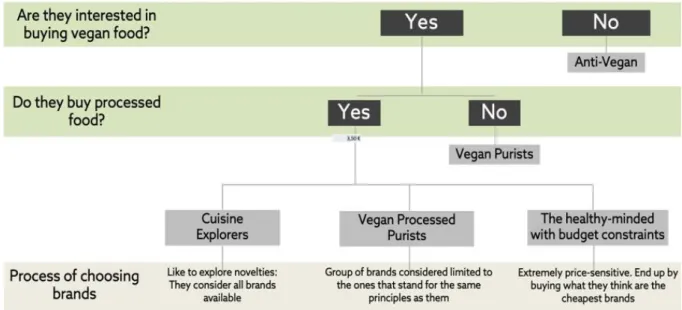
From qualitative in-depth interviews, it was possible to conclude that the market is composed of people with very different behaviour patterns. Given this heterogeneity, to understand those differences, there was the need to group consumers into smaller homogeneous clusters. Since the main objective of this work project is to evaluate the potential of vegan ice-cream, the segmentation process was performed based on two different steps, which were mentioned during the interviews as part of the decision-making journey to this specific market.
First of all, interviewees were classified according to their opinion on veganism: in case it is negative, and they never consider vegan products as an option, they were not considered for further analysis and were classified as “Anti-vegans”. Secondly, those who proceeded, the ones who have a positive opinion on veganism, and who are interested in buying vegan products, were classified into two groups: one group who buys processed food and another group who never consider its purchase. The latter group of people resulted in what was called “Vegan Purists” and did not proceed to the next segmentation stage, while the former was then classified according to other criteria: the process of choosing a brand. People who are interested in vegan products and who buy processed food were classified into three different smaller groups: one
group who is selective in terms of brands, meaning that at the moment of the purchase, the group of brands they consider is limited to the brands they believe that are in line with the principles they defend; then, there is another group who is interested in vegan processed food, but who do not buy them regularly because it tends to be more expensive and they are extremely price-sensitive; and, thirdly, there is another group composed by people who like to explore the novelties there are in the market. They are both vegans and non-vegans that at the moment of the purchase are not limited by anything: they consider all the brands and products. Non-vegans included in this segment are people who like to try out different things, ending up buying what satisfies them the most.
Figure 1: Segmentation process
Source: Author’s, based on primary research
Therefore, after the segmentation process, it is concluded that the market is divided into five different segments: “Anti-Vegan”, “Vegan Purists”, “Vegan Processed Purists”, “The Healthy-Minded with Budget Constraints” and “Cuisine Explorers”.
3.3.2.1. Market Segments Overview
In order to clearly understand each segment, in this section, each of them will be described with regards to its weight in the total quantitative questionnaire (n=207), to the frequently purchased
products and brands, purchase channels and store areas where they mostly shop in, main purchase drivers, their involvement with the ice-cream category and other relevant insights. Before proceeding to the detailed description of each segment, it is important to highlight that even though gender and level of education seem to influence the adoption of veganism, no significant demographic relation among segments was encountered.
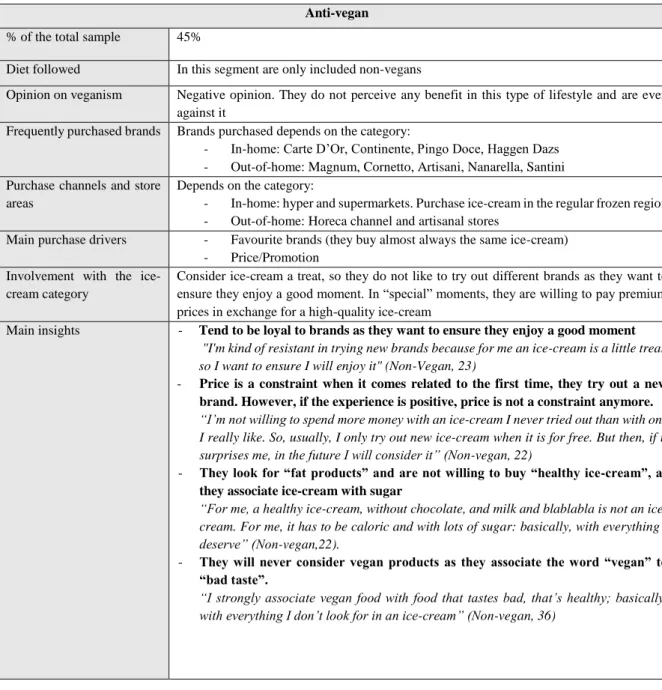
Starting with Anti-Vegans, this segment is composed of all those people who never consider vegan processed food as an option, mostly because they strongly associate it with less tasty food (see table 7 below for further details).
Table 7: “Anti-vegan” overview
Anti-vegan % of the total sample 45%
Diet followed In this segment are only included non-vegans
Opinion on veganism Negative opinion. They do not perceive any benefit in this type of lifestyle and are even against it
Frequently purchased brands Brands purchased depends on the category:
- In-home: Carte D’Or, Continente, Pingo Doce, Haggen Dazs - Out-of-home: Magnum, Cornetto, Artisani, Nanarella, Santini Purchase channels and store
areas
Depends on the category:
- In-home: hyper and supermarkets. Purchase ice-cream in the regular frozen region - Out-of-home: Horeca channel and artisanal stores
Main purchase drivers - Favourite brands (they buy almost always the same ice-cream) - Price/Promotion
Involvement with the ice-cream category
Consider ice-cream a treat, so they do not like to try out different brands as they want to ensure they enjoy a good moment. In “special” moments, they are willing to pay premium prices in exchange for a high-quality ice-cream
Main insights - Tend to be loyal to brands as they want to ensure they enjoy a good moment "I'm kind of resistant in trying new brands because for me an ice-cream is a little treat, so I want to ensure I will enjoy it" (Non-Vegan, 23)
- Price is a constraint when it comes related to the first time, they try out a new brand. However, if the experience is positive, price is not a constraint anymore. “I’m not willing to spend more money with an ice-cream I never tried out than with one I really like. So, usually, I only try out new ice-cream when it is for free. But then, if it surprises me, in the future I will consider it” (Non-vegan, 22)
- They look for “fat products” and are not willing to buy “healthy ice-cream”, as they associate ice-cream with sugar
“For me, a healthy cream, without chocolate, and milk and blablabla is not an ice-cream. For me, it has to be caloric and with lots of sugar: basically, with everything I deserve” (Non-vegan,22).
- They will never consider vegan products as they associate the word “vegan” to “bad taste”.
“I strongly associate vegan food with food that tastes bad, that’s healthy; basically, with everything I don’t look for in an ice-cream” (Non-vegan, 36)
- They don’t believe in veganism: for them, it’s a trend followed by fanatical people “Veganism is undoubtedly a trend that appeared and that nowadays everyone wants to follow just to be considered “nice”. However, for me, it’s exaggerated. It’s impossible to have all the necessary nutrients with this diet” (Non-vegan, 45)
Source: Author’s, based on primary research
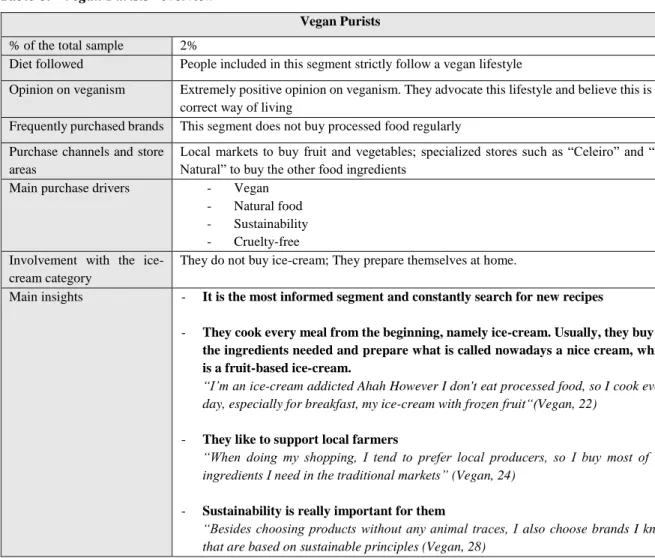
Proceeding to Vegan Purists, this is a segment only composed of vegan people. People included in this segment are usually authentic promoters of this lifestyle. They fully comply with the universal principles of veganism. For further details, see table 8 below.
Table 8: “Vegan Purists” overview
Vegan Purists % of the total sample 2%
Diet followed People included in this segment strictly follow a vegan lifestyle
Opinion on veganism Extremely positive opinion on veganism. They advocate this lifestyle and believe this is the correct way of living
Frequently purchased brands This segment does not buy processed food regularly Purchase channels and store
areas
Local markets to buy fruit and vegetables; specialized stores such as “Celeiro” and “Go Natural” to buy the other food ingredients
Main purchase drivers - Vegan - Natural food - Sustainability - Cruelty-free Involvement with the
ice-cream category
They do not buy ice-cream; They prepare themselves at home.
Main insights - It is the most informed segment and constantly search for new recipes
- They cook every meal from the beginning, namely ice-cream. Usually, they buy all the ingredients needed and prepare what is called nowadays a nice cream, which is a fruit-based ice-cream.
“I’m an ice-cream addicted Ahah However I don't eat processed food, so I cook every day, especially for breakfast, my ice-cream with frozen fruit“(Vegan, 22)
- They like to support local farmers
“When doing my shopping, I tend to prefer local producers, so I buy most of the ingredients I need in the traditional markets” (Vegan, 24)
- Sustainability is really important for them
“Besides choosing products without any animal traces, I also choose brands I know that are based on sustainable principles (Vegan, 28)
Source: Author’s, based on primary research
Similar to Vegan Purists, there is another segment called Vegan Processed Purists, which is a segment composed only by vegans, but vegans who buy processed food. They fully comply with the universal principles of veganism, but they allow themselves to buy processed food, always ensuring they are buying from brands that stand for the same principles as to them, as it is further detailed in table 9 below.
Table 9: “Vegan Processed Purists” overview
Vegan Processed Purists % of the total sample 1%
Opinion on veganism Positive: this segment strictly follows the vegan lifestyle. Even though they buy processed food, they are extremely careful, ensuring always the brands they are buying follow the principles they defend.
Frequently purchased brands - Naturattiva, Valsoia, made with luve - Scoop ‘n Dough,
Purchase channels and store areas
- Specialized stores such as Celeiro and Go Natural. They also do shopping at hyper and supermarkets
- Vegan ice-cream shops, and sometimes, with less frequency, artisanal ice-cream shops such as Amorino and Santini
Main purchase drivers - “Vegan” mark
- Free from animal-derived products - “not tested on animals”
Involvement with the ice-cream category
They are very selective in the brands they buy, so they spend some time reading labels and ensuring the brand fulfil all their requirements
Main insights - This segment refers to those people who are very selective and only buy brands that meet the principles of veganism
“I only buy products from brands I know that is 100% governed by vegan principles” (Vegan, 24)
- They carefully read all the labels, to ensure the product, besides not having any animal trace, is from a brand that does not test on animals
“Much more important than the yellow sign in the front packaging saying “vegan”, it’s the product composition. I read a lot of things on the internet to enable myself to understand what exactly the product’s composition is” (Vegan, 25)
- When there are not labels available, they always ask the staff about the production process and the ingredients
Source: Author’s, based on primary research
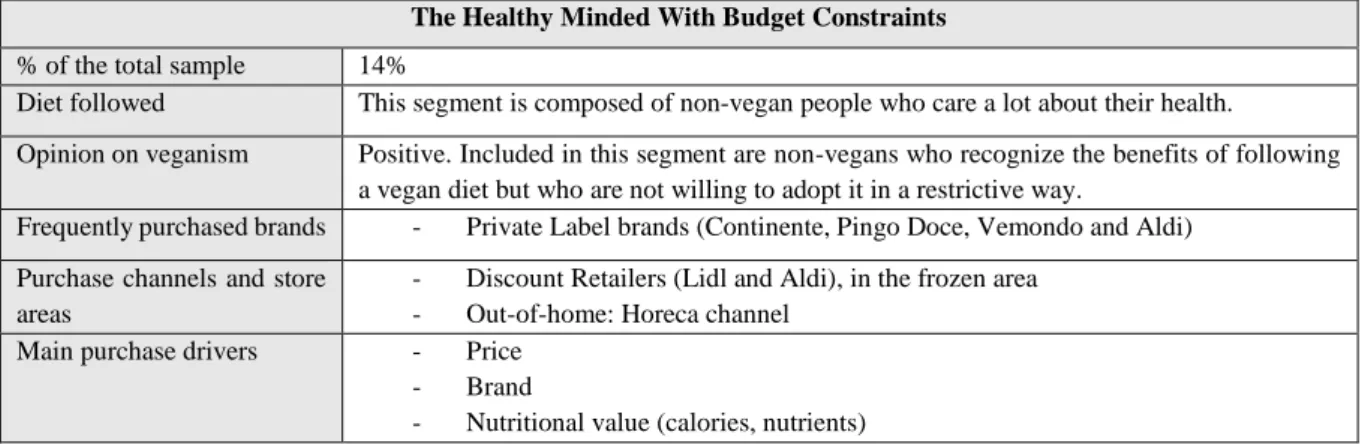
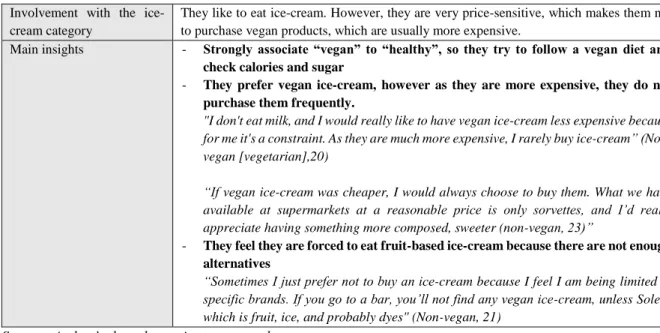
Also included in the group of people who are interested in veganism and who do buy processed food, there is the segment that was called “The Healthy-Minded with Budget Constraints". According to the data gathered, even though this segment is composed of both vegans and non-vegans, most of them are vegetarians and flexitarians. For further details about this segment, see table 10, presented below.
Table 10: “The healthy-minded with budget constraints” overview
The Healthy Minded With Budget Constraints % of the total sample 14%
Diet followed This segment is composed of non-vegan people who care a lot about their health. Opinion on veganism Positive. Included in this segment are non-vegans who recognize the benefits of following
a vegan diet but who are not willing to adopt it in a restrictive way.
Frequently purchased brands - Private Label brands (Continente, Pingo Doce, Vemondo and Aldi) Purchase channels and store
areas
- Discount Retailers (Lidl and Aldi), in the frozen area - Out-of-home: Horeca channel
Main purchase drivers - Price - Brand
Involvement with the ice-cream category
They like to eat ice-cream. However, they are very price-sensitive, which makes them not to purchase vegan products, which are usually more expensive.
Main insights - Strongly associate “vegan” to “healthy”, so they try to follow a vegan diet and check calories and sugar
- They prefer vegan ice-cream, however as they are more expensive, they do not purchase them frequently.
"I don't eat milk, and I would really like to have vegan ice-cream less expensive because for me it's a constraint. As they are much more expensive, I rarely buy ice-cream” (Non-vegan [vegetarian],20)
“If vegan ice-cream was cheaper, I would always choose to buy them. What we have available at supermarkets at a reasonable price is only sorvettes, and I’d really appreciate having something more composed, sweeter (non-vegan, 23)”
- They feel they are forced to eat fruit-based ice-cream because there are not enough alternatives
“Sometimes I just prefer not to buy an ice-cream because I feel I am being limited to specific brands. If you go to a bar, you’ll not find any vegan ice-cream, unless Solero which is fruit, ice, and probably dyes" (Non-vegan, 21)
Source: Author’s, based on primary research
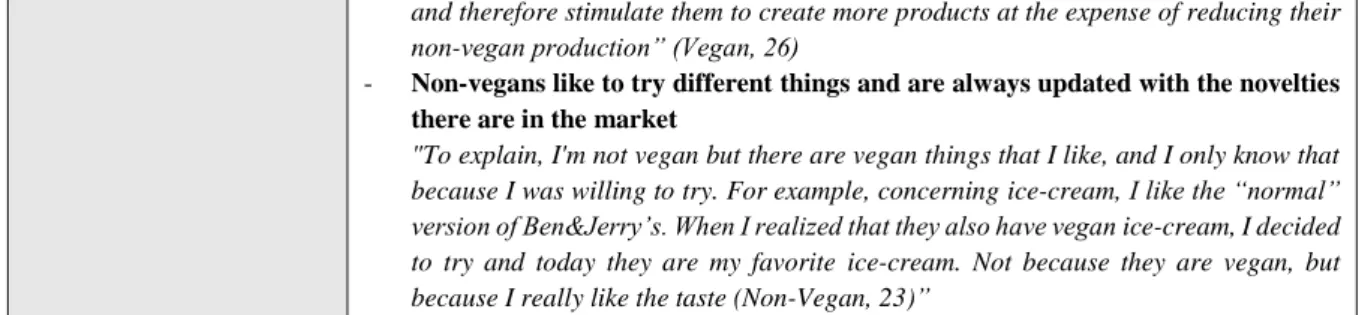
Finally, there are the Cuisine Explorers, a segment composed by non-vegans who like to always be updated to the novelties there are in the market. They like to explore new brands and new products, independently if they are vegan or not. Below, there is a detailed characterization of this segment.
Table 11: “Cuisine Explorers” overview
Cuisine Explorers % of the total sample 38%
Diet followed “Cuisine explorers” are composed by both vegans and non-vegans
Opinion on veganism Positive. The non-vegans included in this segment understand the benefits associated with veganism, but they are not willing to fully adopt this lifestyle. However, they like to explore what exists in the market, and so they also buy vegan food
Frequently purchased brands
Brands purchased depends on the category:
- In-home: Cornetto Vegan, Alpro, Vemondo and Naturattiva - Out-of-home: Sorvettes from Artisani and Nanarella Purchase channels and store
areas
Depends on the category:
- In-home: hyper and supermarkets. They look for ice-cream both in the regular frozen area and in the bio/vegan area
- Out-of-home: artisanal ice-cream shops Main purchase drivers - “Vegan” mark
- Brand - Price Involvement with the
ice-cream category
Their choice of ice-cream takes some minutes because they like to see the novelties
Main insights - In this segment are included both vegans and non-vegans, who are trying to adopt a healthier lifestyle
- Vegans in this segment buy any brand as they believe by doing so, they will contribute for the brand to understand there is demand for vegan products, and therefore invest in extending their product offering at the same time they reduce their production of non-vegan ice-cream
and therefore stimulate them to create more products at the expense of reducing their non-vegan production” (Vegan, 26)
- Non-vegans like to try different things and are always updated with the novelties there are in the market
"To explain, I'm not vegan but there are vegan things that I like, and I only know that because I was willing to try. For example, concerning ice-cream, I like the “normal” version of Ben&Jerry’s. When I realized that they also have vegan ice-cream, I decided to try and today they are my favorite ice-cream. Not because they are vegan, but because I really like the taste (Non-Vegan, 23)”
Source: Author’s, based on primary research
3.3.3. Customer Insights on Vegan Ice-cream
Except when directly asked, vegan ice-cream was never mentioned spontaneously during interviews by non-vegans. On the contrary, vegans referred themselves to this type of ice-cream all the time, clearly sharing their opinion on different brands and always making reference to the way they end up choosing one brand over another. Therefore, since all the interviewees end up being asked about this new typology of ice-cream, some key findings were obtained and summarized in table 12 below.
Table 12: Customer Insights on Vegan Ice-cream Insight 1: Low Awareness
Apart from vegans, most of the non-vegans interviewed associate vegan ice-cream to sorbets (fruit-based ice-cream) and ice-cream without any flavour. Almost all of them do not know that today there are vegan versions of best-selling ice-cream, such as Magnum and Cornetto. When directly asked, they mentioned never seeing any advertising to this type of ice-cream from these brands, neither vegan ice-cream in-store.
Insight 2: Low physical availability and inconsistent store placement
During in-store observations, it was found that vegan ice-cream of brands is not available in all stores and they even have poor physical availability. This might be one of the reasons behind the low awareness of their existence, as people mentioned they have never been exposed to those products
“I’m that kind of person who likes to see the novelties there are in the market, and to be honest I’ve never seen a Magnum or Cornetto vegan. Are they sold in the bio area?” (Non-Vegan, 36)
Insight 3: High price perception
By analysing the in-depth semi-structured interviews and the online quantitative questionnaire, it was possible to conclude that those people who know the existence of vegan ice-cream associate them to higher prices, prices that some of them are not willing to pay, because there are other alternatives, they already know that are cheaper.
“I think vegan ice-cream is more expensive, right? And honestly, I won't pay more for something that I have a cheapest alternative" (Non-vegan, 31)
"I know most of the vegan ice-cream is more expensive than the non-vegan ones, but the point is to know how to search because there is very good vegan ice-cream at the same price as the others" (Vegan, 25)
Source: Author’s, based on primary research 4. Recommendations to the category
Overall, by conducting this research, it was possible to understand how the evolvement of the vegan trend has been reflected in terms of behaviours and choices of the different groups of
consumers. Based on the obtained results, some recommendations will be given to the mass-market ice-cream category in general.
The first strategic choice brands have to do is related to the target selection. In order to evaluate the potential of vegan ice-cream in Portugal, with a special focus on the mass-market, there was the need to understand to which extent the existence of vegan ice-cream in the mass-market is attractive to each segment, as it is summarized in table 13 below. This need emerged from the fact that the market is composed of five groups of consumers with behaviours and attitudes towards veganism and vegan products very different. By doing so, it was possible to identify potential buyers of vegan ice-cream and understand which consumers brands should target.
Table 13: The potential of mass-market ice-cream brands to each segment Segment Potential of each segment
Anti-Vegans
This segment never considers vegan packaged food at the moment of the purchase. They do not see any added value in packaged vegan food, and they are even against its purchase. As they strongly associate “vegan” to “tastes bad”, they will never buy vegan ice-cream. For this reason, the potential of mass-market vegan ice-cream to this segment is very low.
Vegan Purists
Mass market retail brands are not attractive to this segment. “Vegan Purists” are mainly characterized by the fact they prepare all their meals at home from scratch. They buy the ingredients from local producers, and when something more is needed, they rarely consider the mass-market. Therefore, the potential of mass-market vegan ice-cream to this segment is extremely low.
Vegan Processed Purists
“Vegan processed purists” are very selective with the brands they buy. Even though they also shop in the mass-market, they always make sure that all the products they buy are from brands they identify with, and that they know that do not violate the principles they stand for. Therefore, the potential of mass-market vegan ice-cream is considered medium, since there are specific brands they will never consider.
The Healthy Minded with Budget Constraints
"The healthy-minded with budget constraints" is a segment that is extremely interested in vegan packaged food, as they strongly associate "vegan" to "healthier". Since they always try to follow a healthy diet, they prefer vegan alternatives to non-vegan food, when they are cheaper. However, they rarely purchase it because it tends to be more expensive, and they are price sensitive. Nonetheless, if there was a vegan ice-cream cheaper, they would consider it at the moment of the purchase. So, the potential of vegan ice-cream in the mass-market is considered high.
Cuisine Explorers
This could represent potential buyers for mass-market brands with vegan ice-cream. Indeed, they like to explore what is new in the market and are not limited by anything. They consider all the products and all the brands, without any restriction. The only thing that is required is for the product to attract them. Therefore, the potential of mass-market vegan ice-cream is considered high.
Source: Author’s, based on primary research
With the table presented above, it is possible to infer that the most relevant target segments are “Vegan Processed Purists”, “The Healthy Minded with Budget Constraints” and “Cuisine Explorers”, as these are the segments who go to the supermarket to do their shopping and that
consider vegan ice-cream at the purchase moment. However, “Vegan Processed Purists” end up by not being a suitable target to mass-market retail brands as this segment is mainly characterized by being extremely selective with the brands they buy, almost always preferring artisanal ice-cream, which might constitute a constraint to brands such as Unilever, and Nestle, the two top companies when it comes to the ice-cream category in the retail market in Portugal. Consequently, the segments brands should target are “Cuisine explorers” and “The Healthy Minded with Budget Constraints”, representing these two segments together more than half of the market, according to the studied sample (~52%). It is believed that by targeting “The Healthy-Minded with Budget Constraints”, companies will manage to also attract “Cuisine Explorers”, as the latter segment is not so demanding. As they like to explore what does exist, they consider all the brands at the purchase moment without any restriction, and they are strongly influenced by external opinions. Then, having identified their target market, there are other issues that ice-cream brands should overcome in order to thrive in the ice-cream category. As previously mentioned, with the quantitative questionnaire, it was possible to conclude that the low awareness of vegan ice-cream existence in the mass-market has been a problem, representing at the same time an opportunity. Almost half of the respondents (~49%) do not know that vegan ice-cream is being sold at supermarkets and hypermarkets, from which almost 40% show interest in trying at least once these products. According to the data obtained, the main drivers behind this issue are the lack of advertisement, low physical availability and the inconsistent store placement.
Having said that, there is no doubt that companies should invest in trying to make their offer more visible to their customers, and it should be done both through specific advertisement and change the way products are positioned in-store. In addition to the previously mentioned points, there is still another issue that needs to be addressed: people’s perception that vegan ice-cream is more expensive. Indeed, most of the ice-cream buyers when asked to classify the importance
of price as a key decision factor, with a scale from 1 to 7, mentioned that this variable does influence their decisions (average ~5,4). So, what brands can do to improve their results is to make people understand the extra price they are paying is worth it, and this should be a point to consider when advertising.
The next step is to define how to do it. Results from this research show that consumers are willing to try out different ice-cream, which represents an opportunity for well-known brands, which already have a distinctive place in consumer's minds, to influence their consumers to try their new offer. Moreover, respondents also mentioned they are willing to pay an extra price to a product they know is of higher quality and produced sustainably. Therefore, in order to make people understand the reasoning behind the premium price that is charged for vegan ice-cream, and consequently increase engagement with the vegan brand itself, companies should have a clear message conveying these claims.
Recommendation of a message: Nowadays, indulgence is for anyone. Even those who are very focused on their health and wellbeing may enjoy indulgent moments with their friends, without any guilt feeling. With vegan ice-cream, you can enjoy the best of both worlds: you enjoy the indulgence of a non-vegan ice-cream, without sacrificing your principles and ideals.
An advertisement based on this message should be created and posted on social media to increase awareness. Even though TV works much better when it comes to increasing awareness, people mentioned that in this category social media work much better with them. Concepts such as health, sustainability, indulgence, social moments, pleasure should be advertised. They tend to follow influencers and social media groups and communities according to their interests, and “The Healthy-Minded with Budget Constraints” is a good example of a segment that is active online. As this is a segment extremely price-sensitive, they are constantly looking for cheaper ways and alternatives to satisfy their needs.
Besides creating an ad, there is another important tool that might positively influence brands’ results and that also involves social media: the creation of an online brand community. Some authors suggest that social media has played a very important role in connecting brands with consumers (Beukeboom, Kerkhof, Vries, 2015). However, this tool is only considered powerful if carefully thought to constantly share relevant content and get sufficient reach (Labrecque et. al., 2013) in an era where consumers constantly look for that sense of connection amongst members and brands themselves. It is believed that by creating an online community advocating the main message of the brand, brands will be able to justify the premium price charged to their vegan products, at the same time they are creating closer relationships to their customers, as they end up by proving that both are standing for the same principles and values. It is not only the content that matters. It has to be created a movement around this idea. The focus of this community would be sharing content on sustainability, make people understand that both themselves and the brand stand for the same principles, and finally stimulate the interaction and the contact between all the consumers. Being recommendations mentioned as an important part of the decision journey, there are reasons to believe that social media will help individual consumers to more easily influence each other's decisions.
Brands’ strategy should not only be based on online channels, but rather in a combination of the latter with an effective offline presence. In-store free trials are a good example of something brands can do in this matter. As sometimes store placement does not only depend on the brands themselves, brands may opt to increase their visibility by giving consumers a trial of their ice-cream at supermarkets. Even though it represents huge costs to companies, it is believed the value of this investment will be easily returned, as the majority of people mentioned if they see a brand at a supermarket giving trials, they tend to stop, and in case they like the product, they usually end up by buying it, and include it in the initial consideration set for future purchases. Finally, and also related with this last idea of combining an online strategy with offline
presence, established companies such as Unilever, may also negotiate with supermarkets to have there a chest freezer with this type of ice-cream. Its decoration should be colourful and contain a message able to engage and attract people.
5. References
1. Parker, J. (2019). The World in 2019. [online] Worldin2019.economist.com. Available at: https://worldin2019.economist.com/theyearofthevegan [Accessed 12 Sep. 2019].
2. (n.d.). Definition of veganism. Retrieved from https://www.vegansociety.com/go-vegan/definition-veganism 3. Suddath, C. (2008). A Brief History of Veganism. Time. [online] Available at:
https://time.com/3958070/history-of-veganism/ [Accessed 12 Sep. 2019].
4. Timmins, B. (2017). Who were the world’s very earliest vegans?. [online] The Independent. Available at: https://www.independent.co.uk/life-style/who-were-the-world-s-very-earliest-vegans-a7668831.html [Accessed 12 Sep. 2019].
5. Petter, O. (2018). The reason why veganism started going mainstream. [online] Available at: https://www.independent.co.uk/life-style/food-and-drink/veganism-rise-uk-why-instagram-mainstream-plant-based-diet-vegans-popularity-a8296426.html [Accessed 12 Sep. 2019]
6. Jones, L. (2018). Is social media behind the rise of veganism?. [online] Available at https://www.bbc.com/news/business-44488051 [Accessed 12 Sep. 2019]
7. (n.d). Statistics. Retrieved from https://www.vegansociety.com/news/media/statistics
8. Janssen, M., Busch, C., Rödiger, M., & Hamm, U. (2016). Motives of consumers following a vegan diet and their attitudes towards animal agriculture. Appetite, 105, 643–651. https://fesrvsd.fe.unl.pt:2084/10.1016/j.appet.2016.06.039
9. Petter, O. (2018). Veganism is ‘single biggest way’ to reduce our environmental impact on planet, study finds. Independent. [online]. Available at: https://www.independent.co.uk/life-style/health-and-families/veganism-environmental-impact-planet-reduced-plant-based-diet-humans-study-a8378631.html [Accessed 12 Sep. 2019]
10. Drayer, L. (2019). Change your diet to combat climate change in 2019. CNN. [online] Available at:
https://edition-m.cnn.com/2018/10/18/health/plant-based-diet-climate-change-food- drayer/index.html?r=https%3A%2F%2Fedition.cnn.com%2F2018%2F10%2F18%2Fhealth%2Fplant-based-diet-climate-change-food-drayer%2Findex.html [Accessed 12 Sep. 2019]
11. Crawford, E. (2015). Vegan is going mainstream, trend data suggests. [online]. Available at: https://www.foodnavigator-usa.com/Article/2015/03/17/Vegan-is-going-mainstream-trend-data-suggests [Accessed 12 Sep. 2019]
12. Smithers, R. (2018). Third of Britons have stopped or reduced meat – report. The Guardian [online]. Available at: https://www.theguardian.com/business/2018/nov/01/third-of-britons-have-stopped-or-reduced-meat-eating-vegan-vegetarian-report [Accessed 12 Sep. 2019]
13. Harvard Health Publishing. (2018). Becoming a vegetarian. Available at: https://www.health.harvard.edu/staying-healthy/becoming-a-vegetarian [Accessed 12 Sep. 2019]
14. Pevreall, K. (2018) How Digital Media has transformed the vegan movement. Livekindly [online] Available at: https://www.livekindly.co/digital-media-vegan-movement/amp/ [Accessed 12 Sep. 2019]
15. (n.d). (2017). Number of vegetarians in Portugal rises by 400 percent in 10 years. The Portugal News [online] Available at: https://www.theportugalnews.com/news/number-of-vegetarians-in-portugal-rises-by-400-
percent-in-10-years/43482#targetText=The%20number%20of%20vegetarians%20in,sent%20to%20The%20Portugal%20 News. [Accessed 12 Sep. 2019]