2018 EULAR recommendations for physical activity in
people with inflammatory arthritis and osteoarthritis
Anne-Kathrin Rausch Osthoff,
1,2Karin Niedermann,
1Jürgen Braun,
3,4Jo Adams,
5Nina Brodin,
6,7Hanne Dagfinrud,
8Tuncay Duruoz,
9Bente Appel Esbensen,
10,11Klaus-Peter Günther,
12Emailie Hurkmans,
13Carsten Bogh Juhl,
14,15Norelee Kennedy,
16Uta Kiltz,
3,4Keegan Knittle,
17Michael Nurmohamed,
18Sandra Pais,
19Guy Severijns,
20Thijs Willem Swinnen,
21,22Irene A Pitsillidou,
23Louise Warburton,
24Zhivko Yankov,
25Theodora P M Vliet Vlieland
2AbstRAct
Regular physical activity (PA) is increasingly
promoted for people with rheumatic and
musculoskeletal diseases as well as the general
population. We evaluated if the public health
recommendations for PA are applicable for people
with inflammatory arthritis (iA; Rheumatoid
Arthritis and Spondyloarthritis) and osteoarthritis
(hip/knee OA) in order to develop evidence-based
recommendations for advice and guidance on
PA in clinical practice. The EULAR standardised
operating procedures for the development of
recommendations were followed. A task force (TF)
(including rheumatologists, other medical specialists
and physicians, health professionals,
patient-representatives, methodologists) from 16 countries
met twice. In the first TF meeting, 13 research
questions to support a systematic literature review
(SLR) were identified and defined. In the second
meeting, the SLR evidence was presented and
discussed before the recommendations, research
agenda and education agenda were formulated.
The TF developed and agreed on four overarching
principles and 10 recommendations for PA in people
with iA and OA. The mean level of agreement
between the TF members ranged between 9.8
and 8.8. Given the evidence for its effectiveness,
feasibility and safety, PA is advocated as integral
part of standard care throughout the course of these
diseases. Finally, the TF agreed on related research
and education agendas. Evidence and expert opinion
inform these recommendations to provide guidance
in the development, conduct and evaluation of
PA-interventions and promotion in people with iA and
OA. It is advised that these recommendations should
be implemented considering individual needs and
national health systems.
IntRoductIon
Physical activity (PA) is defined as ‘any bodily
movement produced by skeletal muscles that
results in energy expenditure above resting
(basal) levels. PA broadly encompasses exercise,
sports and physical activities done as part of
daily living, occupation, leisure and active
trans-portation’.
1 2Exercise is a subcategory of PA
‘that is planned, structured and repetitive and
[that] has, as a final or intermediate objective,
the improvement or maintenance of one or more
dimensions of physical fitness’.
1 2PA-interven-tions can be provided or performed individually
or in groups, supervised or non-supervised, in
acute or chronic health states, but should always
include behavioural change techniques (BCT) to
promote long-term adherence.
3 4To promote the health benefits of PA in the
general population, the WHO
5and American
College of Sports Medicine (ACSM)
2have provided
internationally accepted recommendations for
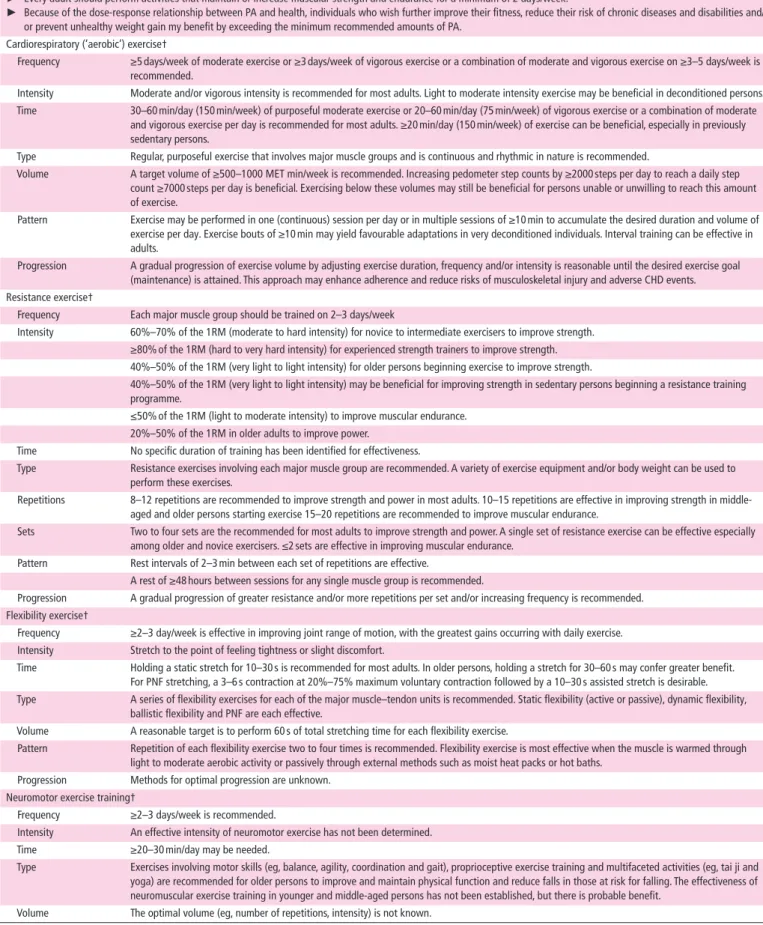
PA (
table 1
). In this manuscript, the term PA
always includes both physical activity and exercise
according to the definitions above.
Inflammatory arthritis (iA, in this manuscript
encompassing rheumatoid arthritis (RA) and
spon-dyloarthritis (SpA)) and osteoarthritis (OA) (in this
manuscript encompassing hip/knee OA (HOA/
KOA)) are major causes of pain and disability
world-wide.
6There is strong evidence for the benefits of
PA on improvements on disease activity,
7activities
and participation; however, people with rheumatic
and musculoskeletal diseases (RMDs) are in general
less active compared with healthy controls.
8–10Possible underlying reasons could be that healthcare
providers (HCP, including rheumatology health
professionals (eg, physiotherapist (PT),
occupa-tional therapist (OT), nurse, podiatrist,
psycholo-gist), physical education professions and medical
doctors (rheumatologists and other specialists)) and
people with iA and OA may be reluctant towards
engaging in PA, fearing flare-up or joint damage by
exercising.
11Furthermore, current clinical
manage-ment recommendations such as the European
League Against Rheumatism (EULAR)
recommen-dations on the management of RA,
12SpA
13or HOA/
KOA
14and the ACSM guidelines for exercise testing
and prescription
15recommend exercise and/or PA,
but none of these is specific regarding the required
type and dosage. Therefore, it is not clear how these
recommendations should be used in routine clinical
care. In particular, the evidence on the effectiveness
and safety of exercise and PA to a level that meets
public health (PH) recommendations has not yet
been clearly examined and defined in people with
RMDs. A EULAR task force (TF) was therefore set
up (1) to evaluate if the PH recommendations for
PA are applicable for people with iA and OA; (2) to
to cite: Rausch Osthoff A-K, Niedermann K, Braun J, et al. Ann Rheum Dis 2018;77:1251–1260. Handling editor Josef S Smolen
►Additional material is published online only. To view please visit the journal online (http:// dx. doi. org/ 10. 1136/ annrheumdis- 2018- 213585). For numbered affiliations see end of article.
correspondence to Professor Karin Niedermann, School of Health Professions, Institute of Physiotherapy, Zurich University of Applied Sciences, Winterthur, Switzerland;
karin. niedermann@ zhaw. ch A-KRO and KN contributed equally.
Received 14 April 2018 Revised 5 June 2018 Accepted 16 June 2018 Published Online First 11 July 2018
© Author(s) (or their employer(s)) 2018. No commercial re-use. See rights and permissions. Published by BMJ.
on 18 January 2019 by guest. Protected by copyright.
table 1 Public Health recommendations for PA
the AcsM-AHA primary physical activity recommendations*
► All healthy adults aged 18–65 years should participate in moderate intensity aerobic PA for a minimum of 30 min on 5 days/week or vigorous intensity aerobic activity for a minimum of 20 min on 3 days/week.
► Combinations of moderate and vigorous intensity exercise can be performed to meet this recommendation.
► Moderate intensity aerobic activity can be accumulated to total the 30 min minimum by performing bouts each lasting ≥10 min. ► Every adult should perform activities that maintain or increase muscular strength and endurance for a minimum of 2 days/week.
► Because of the dose-response relationship between PA and health, individuals who wish further improve their fitness, reduce their risk of chronic diseases and disabilities and/ or prevent unhealthy weight gain my benefit by exceeding the minimum recommended amounts of PA.
Cardiorespiratory (‘aerobic’) exercise†
Frequency ≥5 days/week of moderate exercise or ≥3 days/week of vigorous exercise or a combination of moderate and vigorous exercise on ≥3–5 days/week is recommended.
Intensity Moderate and/or vigorous intensity is recommended for most adults. Light to moderate intensity exercise may be beneficial in deconditioned persons. Time 30–60 min/day (150 min/week) of purposeful moderate exercise or 20–60 min/day (75 min/week) of vigorous exercise or a combination of moderate
and vigorous exercise per day is recommended for most adults. ≥20 min/day (150 min/week) of exercise can be beneficial, especially in previously sedentary persons.
Type Regular, purposeful exercise that involves major muscle groups and is continuous and rhythmic in nature is recommended.
Volume A target volume of ≥500–1000 MET min/week is recommended. Increasing pedometer step counts by ≥2000 steps per day to reach a daily step count ≥7000 steps per day is beneficial. Exercising below these volumes may still be beneficial for persons unable or unwilling to reach this amount of exercise.
Pattern Exercise may be performed in one (continuous) session per day or in multiple sessions of ≥10 min to accumulate the desired duration and volume of exercise per day. Exercise bouts of ≥10 min may yield favourable adaptations in very deconditioned individuals. Interval training can be effective in adults.
Progression A gradual progression of exercise volume by adjusting exercise duration, frequency and/or intensity is reasonable until the desired exercise goal (maintenance) is attained. This approach may enhance adherence and reduce risks of musculoskeletal injury and adverse CHD events. Resistance exercise†
Frequency Each major muscle group should be trained on 2–3 days/week
Intensity 60%–70% of the 1RM (moderate to hard intensity) for novice to intermediate exercisers to improve strength. ≥80% of the 1RM (hard to very hard intensity) for experienced strength trainers to improve strength. 40%–50% of the 1RM (very light to light intensity) for older persons beginning exercise to improve strength.
40%–50% of the 1RM (very light to light intensity) may be beneficial for improving strength in sedentary persons beginning a resistance training programme.
≤50% of the 1RM (light to moderate intensity) to improve muscular endurance. 20%–50% of the 1RM in older adults to improve power.
Time No specific duration of training has been identified for effectiveness.
Type Resistance exercises involving each major muscle group are recommended. A variety of exercise equipment and/or body weight can be used to perform these exercises.
Repetitions 8–12 repetitions are recommended to improve strength and power in most adults. 10–15 repetitions are effective in improving strength in middle-aged and older persons starting exercise 15–20 repetitions are recommended to improve muscular endurance.
Sets Two to four sets are the recommended for most adults to improve strength and power. A single set of resistance exercise can be effective especially among older and novice exercisers. ≤2 sets are effective in improving muscular endurance.
Pattern Rest intervals of 2–3 min between each set of repetitions are effective.
A rest of ≥48 hours between sessions for any single muscle group is recommended.
Progression A gradual progression of greater resistance and/or more repetitions per set and/or increasing frequency is recommended. Flexibility exercise†
Frequency ≥2–3 day/week is effective in improving joint range of motion, with the greatest gains occurring with daily exercise. Intensity Stretch to the point of feeling tightness or slight discomfort.
Time Holding a static stretch for 10–30 s is recommended for most adults. In older persons, holding a stretch for 30–60 s may confer greater benefit. For PNF stretching, a 3–6 s contraction at 20%–75% maximum voluntary contraction followed by a 10–30 s assisted stretch is desirable. Type A series of flexibility exercises for each of the major muscle–tendon units is recommended. Static flexibility (active or passive), dynamic flexibility,
ballistic flexibility and PNF are each effective.
Volume A reasonable target is to perform 60 s of total stretching time for each flexibility exercise.
Pattern Repetition of each flexibility exercise two to four times is recommended. Flexibility exercise is most effective when the muscle is warmed through light to moderate aerobic activity or passively through external methods such as moist heat packs or hot baths.
Progression Methods for optimal progression are unknown. Neuromotor exercise training†
Frequency ≥2–3 days/week is recommended.
Intensity An effective intensity of neuromotor exercise has not been determined. Time ≥20–30 min/day may be needed.
Type Exercises involving motor skills (eg, balance, agility, coordination and gait), proprioceptive exercise training and multifaceted activities (eg, tai ji and yoga) are recommended for older persons to improve and maintain physical function and reduce falls in those at risk for falling. The effectiveness of neuromuscular exercise training in younger and middle-aged persons has not been established, but there is probable benefit.
Volume The optimal volume (eg, number of repetitions, intensity) is not known.
Continued
on 18 January 2019 by guest. Protected by copyright.
develop evidence-based recommendations on PA-promotion and
-delivery in the management of people with iA and OA and (3)
formulate an educational and research agenda.
These EULAR recommendations for PA in people with iA and
OA are for HCPs, patient organisations and policy makers.
MetHods
The EULAR standardised operating procedures for the
develop-ment of recommendations were followed.
16The AGREE
II-in-strument
17was used to structure this manuscript.
The multidisciplinary TF consisted of a selection of 22
Euro-pean PA-experts (six medical doctors, including three
rheuma-tologists, one of them specialised in cardiovascular diseases, one
GP), one orthopaedic surgeon; nine PTs, a psychologist, an OT, a
nurse and a human movement scientist) and three patient
repre-sentatives. A steering group managed the process (convenor KN,
methodologist TVV, expert JB, fellow AR).
During the first TF meeting, definitions of exercise and PA were
clarified and the TF agreed to follow the ACSM position stand.
2The TF agreed that RA and SpA as predominant iA conditions,
and HOA/KOA as most relevant for PA recommendations would
represent the field of iA and OA, respectively. Clinically relevant
questions on the provision of advice and guidance regarding
exercise and PA, from which 13 research questions were defined
by consensus to guide the subsequent detailed systematic
litera-ture review (SLR) (online supplementary table S1).
Two SLRs were performed by AR with the support of two
librarians and under the supervision of the convenor and
meth-odologists. The questions were written according to the
Popu-lation, Intervention, Comparison, Outcome (PICO) format,
18resulting in two PICOs: (1) on effectiveness, safety and feasibility
of PA and (2) on facilitators and barriers towards PA
(online-sup-plementary table S2). For the first PICO, the fellow searched for
key meta-analyses (MAs) or systematic reviews (SRs) including
randomised controlled trials (RCTs) that investigated the
effec-tiveness of PA-interventions in adults with RA/SpA/HOA/KOA.
The SLR was performed in PubMed/Medline, Cochrane Library,
Embase, Web of Science, Emcare and PsycInfo, using both MeSH
terms and freetext, covering the time frame until 4/2017. For the
second PICO, a SLR, covering the time frame until 7/2017, was
performed in PubMed/Medline and Cochrane Library including
qualitative studies if they described facilitators and barriers
regarding PA (including exercise) in people with RA/SpA/HOA/
KOA. Experts in the field of RA (EH), SpA (HD), OA (CJ) and
behaviour change (KK), respectively, checked if all relevant titles
and abstracts were included.
Based on the PICOs, the same author (AR) screened the titles
and abstracts according to inclusion and exclusion criteria.
Potentially relevant articles were identified and full text versions
evaluated. Studies including adults (>18 years) with RA/SpA/
HOA/KOA that included PA interventions that met the PH
recommendations according to the ACSM principles
2regarding
frequency, intensity and duration for effective interventions
were eligible for inclusion. All data extractions were checked by
experts from the TF.
Studies measuring the effectiveness of PA-interventions
were meta-analysed. These results and detailed descriptions of
the methods are reported elsewhere.
19Studies were used for
answering more than one research question if appropriate. For
clinical studies evaluating the effectiveness of PA, the Cochrane
Risk of Bias Assessment Tool was used to assess selection bias,
performance bias, detection bias, attrition bias and reporting
bias
20by two independent assessors (AR, CH). An additional
person (KN) helped to resolve any differences in rating between
the assessors. The research evidence was categorised according
to the Oxford levels of evidence.
21During the second TF meeting, the results from the SLR
were presented, and the experts developed ‘overarching
prin-ciples’ (background statements to preface recommendations)
and drafted 10 recommendations through an iterative process of
discussion and consensus. After the meeting, the
recommenda-tions were collated and sent to the TF members by email, to rate
the level of agreement (LoA) independently and anonymously on
a 0–10 point scale (0=totally disagree, 10=totally agree). Mean
LoA >8 would be considered a ‘high’ LoA. Furthermore, the TF
formulated a research agenda and education agenda based on
identified gaps in the evidence.
Results
The search yielded 3471 references, 96 of which were included
in the SLR: Four MA/SR
7 22–24and 66 RCTs
25–93investigated the
effects of exercise interventions, 11 RCTs
94–106investigated the
effects of a PA-promotion-intervention, 11 qualitative studies
and literature reviews
3 11 107–115described barriers and facilitators
regarding PA (
figure 1A,B
). The included RCTs were published
between 1985 and 2017. Most information is from studies with
low (48%) or unclear (39%) risk of bias (online-supplementary
figure S1).
The TF agreed on four overarching principles and 10
recom-mendations for PA in people with RA/SpA/HOA/KOA based on
SLR and expert opinion. High loA was achieved for 9 out of
10 recommendations and 2 recommendations were graded as
strength level A.
Table 2
summarises the overarching principles
and recommendations with their associated level of evidence,
strength of recommendation and LoA.
Recommendation 1: PA as integral part of standard care
Given the evidence for effectiveness, feasibility and safety,
the PH recommendations for PA are applicable, and thus,
PA should be an integral part of standard care for people
with RA/SpA/HOA/KOA. PA according to PH
recommen-dations
2is effective on PA level, physical fitness as well as
disease-specific and general outcomes in people with RA/
SpA/HOA/KOA (category l evidence
16). Our MA including
16 RCTs
26 35 36 42 43 50 54 56 57 61 70showed that cardiovascular
exer-cises have a moderate beneficial effect on cardiovascular fitness
the AcsM-AHA primary physical activity recommendations*
Pattern The optimal pattern of performing neuromotor exercise is not known. Progression Methods for optimal progression are not known.
*ACSM, American College of Sports Medicine; AHA, American Heart Association; extracted from the ACSM Guidelines for Exercising Testing and Prescription, chapter 1, p. 4.15
†Extracted from ACSM position stand,2table 2, p. 1336.
1 RM, one-repetition maximum; CHD, coronary heart disease; MET, metabolic equivalent of task; PA, physical activity; PNF, proprioceptive neuromuscular facilitation.
table 1 Continued
on 18 January 2019 by guest. Protected by copyright.
(evaluated in VO2 max) in all three conditions. Our MA including
25 RCTs
25 28 31 34 38 39 44 47 49–51 59 62–66 72 75–78 81–83 85 86 88 90 91showed that muscle strength exercises have a moderate
bene-ficial effect for muscle strength in people with RA and HOA/
KOA. Our MA including seven RCTs
52 55 58 78 88 90 116showed
that combined exercises (aerobic or strength exercises plus
flex-ibility exercises) had no effect on flexflex-ibility in people with SpA
or HOA/KOA. However, exercise conditions, assessments and
outcome measures varied greatly. There is no study comparing
the effect of flexibility exercises alone versus no exercises. In
one RCT,
48the effect of a neuromotor-exercise programme on
neuromotor performance was investigated in people with RA
showing a positive effect. Eleven RCTs described the promotion
of daily PA. Our MA including six RCTs
95 98 101 102 104 117applying
BCTs for the counselling intervention showed a small beneficial
effect.
Feasibility of interventions can be captured by adherence to
the intervention or the study protocol.
118Adherence to
inter-ventions (number of sessions attended/total number of sessions)
has been reported in 26 RCTs (35%) and the mean adherence
was 69% in people with SpA, 71% in people with RA and 79%
in people with HOA/KOA. However, the (self-) reported
adher-ence to intervention might be overestimated due to recall bias or
social desirability. In 68 RCTs (94%), protocol violations were
reported, with approximately 10% of these being disease-related
or intervention-related.
PH recommendations for PA can be considered safe. No
detri-mental effects were reported, rather beneficial effects on disease
activity and symptoms in iA.
7Forty-four per cent of all included
RCTs reported on adverse events (AE), of those 62% described
no AE and 38% describe minor AE such as transitional exercise
related joint or muscle pain.
Figure 1
Flowcharts of the literature search related to PICO_1 (A) and PICO_ 2 (B). ACSM, American College of Sports Medicine; OA, osteoarthritis;
PA, physical activity; PICO, Population, Intervention, Comparison, Outcome; RA, rheumatoid arthritis; RCT, randomised controlled trial; SpA,
spondyloarthritis; SR, systematic review.
on 18 January 2019 by guest. Protected by copyright.
Recommendation 2: Responsibility for PA promotion
All HCPs should have a responsibility for PA promotion and
collab-orative working that facilitate a close cooperation between different
professions to support appropriate disease management. This
state-ment was based on the finding that 66% of the included studies
reported the profession of the HCP providing the intervention, of
which 75% were PTs.
25 31 36 40 44 45 48 50 53 55 58 61 64–66 70 73–79 81 84 87 88 91 94 96 101–105 119 120However, the functions and responsibilities of
HCPs vary across Europe.
121 122Therefore, the TF agreed that PA
advice should be provided by all HCPs.
Recommendation 3: delivery of PA
The delivery of interventions should be performed by HCPs
competent in the field of PA principles and rheumatic conditions.
The reporting of training on PA guidelines was rare. One study
59described a ‘4 hours education session on cardiovascular training’,
others described the instructing person as ‘trained’
25 50 69 70 84 88 123or ‘experienced’.
31 49 76 77 88Some studies with focus on the
promo-tion of daily PA described training sessions on behaviour change
skills like Motivational Interviewing.
94 96 104Recommendation 4: evaluation of PA
The PA level (active or non-active) and the exercise domains
(cardiorespiratory, muscle strength, flexibility and neuromotor)
should be routinely assessed. Of 11 trials investigating the effect
of PA promotion interventions, three RCTs
94 96 105described
baseline screening to distinguish between active and non-active
persons before starting the tailored PA-intervention. Specific
tools are needed to assess each domain.
15,p. 68Recommendation 5: General and disease-specific
contraindications
Tools for specific contraindications (CIs) were found;
15 94 124however, available general or national guidelines defining
abso-lute or relative CIs should be followed as a priority.
Recommendation 6: Personalised aims and evaluation
The PA-interventions should be based on individual aims, which
should be regularly evaluated. This can be done by PA
assess-ments and any other assessassess-ments related to the individual aims.
As PA assessments, performance–based tests, patient-reported
outcome measures (eg, SQUASH,
104PASE
94) and self-monitoring
table 2 Recommendations for PA and exercise in people with inflammatory arthritis and OA
overarching principles
1. PA is part of a general concept to optimise health related quality of life. 2. PA has health benefits for people with RA/SpA/HOA/KOA.
3. General PA recommendations, including the four domains (cardiorespiratory fitness, muscle strength, flexibility and neuromotor performance) are applicable (feasible and safe) to people with RA/OA/SpA.
4. The planning of PA requires a shared decision between healthcare providers and people with RA/SpA/HOA/KOA, which takes people’s preferences, capabilities and resources into account.
Recommendations category of evidence strength of recommendation
level of Agreement mean (sd) Median (Range)
1. Promoting PA consistent with general PA recommendations should be an integral part of standard care throughout the course of disease in people with RA/SpA/HOA/KOA.
1B A 9.81 (0.39)
10 (9–10) 2. All healthcare providers involved in the management of people with
RA/SpA/HOA/KOA should take responsibility for promoting PA and should cooperate, including making necessary referrals, to ensure that people with RA/SpA/HOA/KOA receive appropriate PA-interventions.
4 D 9.14 (0.98)
9 (7–10)
3. PA interventions should be delivered by healthcare providers competent in their delivery to people with RA/SpA/HOA/KOA.
4 D 8.86 (1.48)
10 (5–10) 4. Healthcare providers should evaluate the type, intensity, frequency
and duration of the people’s actual PA by means of standardised methods to identify which of the four domains of general PA recommendations can be targeted for improvement.
3 C 9.05 (1.04)
9 (6–10)
5. General and disease-specific contraindications for PA should be identified and taken into account in the promotion of PA.
4 D 9.10 (1.41)
10 (5–10) 6. PA interventions should have clear personalised aims, which should
be evaluated over time, preferably by use of a combination of subjective and objective measures (including self-monitoring when appropriate).
4 D 9.05 (1.25)
9 (5–10) 7. General and disease-specific barriers and facilitators related to
performing PA, including knowledge, social support, symptom control and self-regulation should be identified and addressed.
3 C 9.19 (1.13)
10 (6–10) 8. Where individual adaptations to general PA recommendations
are needed, these should be based on a comprehensive assessment of physical, social and psychological factors including fatigue, pain, depression and disease activity.
4 D 9.24 (0.86)
9 (7–10)
9. Healthcare providers should plan and deliver PA interventions that include the behavioural change techniques self-monitoring, goal setting, action planning, feedback and problem solving.
1A A 9.48 (0.79)
10 (7–10) 10. Healthcare providers should consider different modes of delivery of
PA (eg, supervised/not-supervised, individual/group, face-to-face/online, booster strategies) in line with people’s preferences.
4 D 9.00 (1.30)
9 (5–10) HOA, hip osteoarthritis; KOA, knee osteoarthritis; OA, osteoarthritis; PA, physical activity; RA, rheumatoid arthritis; SpA, spondyloarthritis.
on 18 January 2019 by guest. Protected by copyright.
tools (eg, wearables such as Fitbit,
100pedometer
99or
acceler-ometer
101) were identified. However, we did not evaluate the
validity and reliability of the assessments applied.
Recommendation 7: General and disease-specific barriers and
facilitators
General and disease-specific barriers (that are not CI per
se) and facilitators should be addressed as described in 11
studies.
11 107–115 125Disease-specific barriers included lack of
knowledge about the disease, lack of knowledge about safe
exer-cising (both in people with iA/OA and HCPs) and symptoms
like pain, fatigue, stiffness, reduced mobility, fear of flare-ups
or causing damage. Disease-specific facilitators included positive
impact of exercise in symptoms or disease control, information
about disease and correct exercising, the use medication for pain
prior to exercising, using self-regulation techniques, supportive,
but not controlling encouragement from HCPs and a supportive
social background.
Recommendation 8: Individual adaptations to PA following
individualised assessment
Adaptations to PA should be made on a comprehensive individual
assessment. However, no evidence on the necessity of general
adaptations in people with RA/SpA/HOA/KOA was found. In
some RA studies the ‘24 hour-rule’ was applied, that is, the
exer-cise intensity was reduced when the increased pain persisted for
more than 24 hours.
23 40 50ACSM provides adaptations to
exer-cise testing in people with arthritis (eg, no high-intensity testing
if acute inflammation) and training such as exercising when pain
is typically least severe or to train carefully in order to reduce risk
of associated injuries, although no clear evidence that
high-im-pact activities cannot be engaged during active inflammation.
15, pp. 298–301Individual disease-related barriers (eg, symptoms) may
determine these adaptations.
Recommendation 9: behaviour change techniques
BCTs should be an integral component of PA-interventions.
Several behaviour change theories were used in PA promotion
interventions in the field of RA and HOA/KOA,
4 126but the
reporting was poor. Future research based on theories in design,
evaluation and interpretation of findings is needed.
A meta-analysis of six RCTs
94 95 98 101 102 104investigating the
effects of a PA promotion intervention according to general PA
recommendations
2and based on counselling interventions that
apply BCTs showed a small beneficial effect on PA level.
19Coun-selling interventions show a small beneficial effect if BCTs are
applied.
19Recommendation 10: Modes of delivery
HCPs should consider the whole range of modes to deliver
inter-ventions. No evidence on the superiority of specific delivery
modes was found. The delivery modes of PA-interventions
vary considerably and are mostly described as ‘land-based and/
or water-based’ and ‘supervised and individualised’, the latter
usually applied to group settings. As booster strategies phone
calls,
36 96 98 105devices (eg, pedometer,
98 99wearable
100 101), home
visits,
63 70log book,
36 51 76 98web-based instructions,
127written
material,
51 54 103visual instructions (eg, video
103) were reported.
Research and education agendas
Based on the gaps identified in the literature, the TF discussed
and proposed a research agenda (
box 1
) with the prioritised
research topics and an education agenda (
box 2
) with topics for
education and training in PA promotion for HCPs. Evidence
on impact of (reducing) sedentary behaviour emerged as an
important future research topic.
dIscussIon
The TF agreed on 4 overarching principles and 10
recom-mendations for PA in people with RA/SpA/HOA/KOA, which
integrated the perspectives of the TF members from different
professional, cultural and personal backgrounds. This led to a
broad consensus on the principles and recommendations within
the group and ought to foster its feasibility and practicability in
the diverging health systems across Europe.
box 1 Research agenda for physical activity (PA) in
people with inflammatory arthritis and osteoarthritis
1. To evaluate the long-term effectiveness of PA at different
intensities and types and monitoring of adverse events (AE).
2. To evaluate links between PA behaviour and disease-specific
outcomes.
3. To evaluate the long-term effectiveness of sedentary
behaviour reduction, including the monitoring of AE.
4. To evaluate links between sedentary behaviour and
disease-specific outcomes.
5. To identify which PA-intervention strategies work best to
increase PA level and adherence in various subgroups.
6. To identify markers of response and non-response to PA
treatment.
7. To identify disease-specific contraindications on different
exercise domains (cardiovascular, strength, flexibility,
neuromotor).
8. To further develop and evaluate strategies to reduce and
monitor a change in sedentary behaviour.
9. To develop PA-interventions targeting all exercise
dimensions simultaneously with special focus on feasibility.
10. To evaluate and recommend valid PA assessments feasible
for the use in clinical practice.
11. To study how to facilitate PA behaviour change immediately
from screening onwards and how to address facilitators and
barriers.
12. To identify facilitators and barriers of healthcare providers
towards applying the PA recommendations.
13. To perform long-term effectiveness trials on combined
interventions including other health behaviours.
box 2 education agenda for physical activity (PA) in
people with inflammatory arthritis and osteoarthritis
1. Increase knowledge about PA among health professionals
(HPs), physicians and people with inflammatory arthritis and
osteoarthritis.
2. Increase HPs’ and physicians’ skills in communicating the role
of PA in managing general health and disease-specific issues.
3. Include knowledge and skills on PA promotion in all HPs’ and
physicians’ undergraduate training curricula.
4. Develop a EULAR training module on PA for HPs and
rheumatologists.
5. Propose a session on PA at every EULAR congress.
6. Develop education materials for people with inflammatory
arthritis and osteoarthritis.
on 18 January 2019 by guest. Protected by copyright.
The LoA on the recommendations among the TF members
was very high. The only exception was about the competency
of HCP, which may be due to country specific differences in the
availability of HCP competent in PA promotion.
Although the PH recommendations for PA are well
estab-lished, the feasibility and applicability of these for people with
iA and OA has not been assessed so far. Accordingly, the
devel-opment of the recommendations was needed. Expectedly, they
emphasise the importance of PA and will guide future
PA-inter-ventions in people with chronic rheumatic conditions.
PA promotion is a behavioural intervention and therefore
BCT are central components in PA-interventions. Identifying
effective and cost-effective BCT within PA promotion
interven-tion in people with chronic condiinterven-tions is currently a hot topic
in research and for example a research priority of the National
Institute for Health and Care Excellence, UK.
128We decided a priori to include only studies fulfilling the
PH recommendations for PA according to ACSM principles.
2This was a far-reaching decision, which allowed drawing
stronger conclusions on the effectiveness and especially the
safety of correctly dosed PA-interventions. We followed a
pragmatic search strategy with the plan to answer all RQs
related to PICO 1 with findings of available SR/MA. However,
there were no SR/MA on all exercise dimensions and all
conditions available; this led to extracting single RCTs from
high-quality SR/MA. This, however, excluded high-quality
reviews (eg, Cochrane reviews) and RCTs that did not fulfil
the ACSM principles and affected the potential to report 1A
evidence according to Oxford levels of evidence.
21Further-more, only one reviewer screened the abstracts and decided
on unclear abstracts together with a second reviewer, which
is not fully in line with standard procedures of a SLR.
129However, we applied a double-check by experts to ensure
that no relevant studies were missed.
A major problem for data extraction and interpretation
was that the reporting of interventions in most studies
was incomplete. Manuscripts that applied TIDieR
130(Template for Intervention Description and Replication)
guidelines reported more precisely the PA-interventions
and substantially improved the objective evaluation of the
PA-interventions.
For the research questions related to the effectiveness and
safety of PA-interventions and BCT, the PICO scheme was
applied, resulting in 1A level of evidence. All other research
questions we had to answer in a descriptive way limiting the
level of evidence to 3 to 4. However, this limitation is due to
the nature of the research questions. Nevertheless, the
qual-itative studies may provide valuable insight into important
PA-related fields, such as assessments, barriers and
facilita-tors, PA promotion strategies.
The recommendations focused on the conditions RA/SpA/
HOA/KOA, the most prevalent RMD conditions to increase
the generalisability and applicability of the recommendations.
However, large heterogeneity between these conditions may
limit the precision of the recommendations. Therefore,
tional disease-specific recommendations are desirable. In
addi-tion, not all subconditions were considered and represented (eg,
juvenile arthritis).
The research agenda highlights several areas where scientific
evidence is lacking. It is a clear ambition to implement these
recommendations into daily clinical routine. Due to the different
health systems across Europe, development and evaluation of
target group and culture-specific implementation strategies are
needed and should involve all stakeholders.
Author affiliations
1School of Health Professions, Institute of Physiotherapy, Zurich University of Applied Sciences, Winterthur, Switzerland
2Department of Orthopaedics, Rehabilitation and Physical Therapy, Leiden University Medical Center, Leiden, Netherlands
3Rheumazentrum Ruhrgebiet, Herne, Germany 4Ruhr University, Bochum, Germany
5Faculty of Health Sciences and Arthritis Research UK Centre of Excellence for Sport, Exercise and Osteoarthritis, University of Southampton, Southampton, UK 6Department of Orthopaedics, Danderyd University Hospital Corp., Stockholm, Sweden
7Department of Neurobiology, Care Sciences and Society, Division of Physiotherapy, Karolinska Institutet, Huddinge, Sweden
8National Advisory Unit on Rehabilitation in Rheumatology, Diakonhjemmet Hospital, Oslo, Norway
9PMR Department, Rheumatology Division, Marmara University, School of Medicine, Istanbul, Turkey
10Copenhagen Center for Arthritis Research, Center for Rheumatology and Spine Diseases, Centre for Head and Orthopaedics, Rigshospitalet., Glostrup, Denmark 11Department of Clinical Medicine, Faculty of Health and Medical Sciences, University of Copenhagen, Copenhagen, Denmark
12University Center of Orthopaedics and Traumatology, University Medicine at Technische Universität Dresden, Dresden, Germany
13Department Social Affaire and Health, ECORYS Nederland BV, Rotterdam, Netherlands
14Department of Sports Science and Clinical Biomechanics, University of Southern Denmark, Odense, Denmark
15Departmentof Occupational and Physical Therapy, University of Copenhagen, Herlev and Gentofte Hospital, Copenhagen, Denmark
16School of Allied Health, Faculty of Education and Health Sciences and Health Research Institute, University of Limerick, Limerick, Ireland
17Department of Social Psychology, Faculty of Social Sciences, University of Helsinki, Helsinki, Finland
18Department of Rheumatology, Amsterdam Rheumatology and immunology Center, VU University Medical Center, Amsterdam, The Netherlands
19Centre for Biomedical Research, University of Algarve, Faro, Portugal 20EULAR PARE Patient Research Partner, ReumaNet, Leuven, Belgium
21Department of Development and Regeneration, Skeletal Biology and Engineering Research Center, KU Leuven, Leuven, Belgium
22Division of Rheumatology, University Hospitals Leuven, Leuven, Belgium 23EULAR Patient Research Partner, Cyprus League Against Rheumatism, Nicosia, Cyprus
24Primary Health Care Sciences, Keele University, Keele, UK
25PRP (Patient Research Partner EULAR), Bulgarian Ankylosing Spondylitis Patient Society, Sofia, Bulgaria and ASIF (Ankylosing Spondylitis International Federation), London, UK
Acknowledgements We thank the librarians Mrs José Plevier and Mr Jan W Schoones, Walaeus Library, Leiden University Medical Center, the Netherlands, for supporting our literature search, and Christian Horvath, Zurich University of Applied Sciences, Switzerland, MSc student for his help in the Cochrane risk of bias assessment.
contributors AR and KN contributed equally. AR was the research fellow for the project, undertaking the SLR. The fellow was supervised by the steering group consisting of KN (convenor), TPMVV (methodologist), JB (expert). KN and TPMVV supervised the process of the SLR. KN organised and chaired the TF meetings. AR and KN drafted the manuscript with advice from TPMVV and JB. All authors have contributed to the recommendations by participating in the TF meetings; during discussion and agreement on the recommendations; revising and approving the manuscript for publication.
Funding The TF would like to thank EULAR for financial support of this work. competing interests None declared.
Patient consent Not required.
Provenance and peer review Not commissioned; externally peer reviewed.
RefeRences
1 Caspersen CJ, Powell KE, Christenson GM. Physical activity, exercise, and physical fitness: definitions and distinctions for health-related research. Public Health Rep 1985;100:126–31.
2 Garber CE, Blissmer B, Deschenes MR, et al. American College of Sports Medicine position stand. Quantity and quality of exercise for developing and maintaining cardiorespiratory, musculoskeletal, and neuromotor fitness in apparently healthy adults: guidance for prescribing exercise. Medicine and science in sports and exercise 2011;43:1334–59.
on 18 January 2019 by guest. Protected by copyright.
3 Larkin L, Gallagher S, Cramp F, et al. Behaviour change interventions to promote physical activity in rheumatoid arthritis: a systematic review. Rheumatol Int
2015;35:1631–40.
4 Keogh A, Tully MA, Matthews J, et al. A review of behaviour change theories and techniques used in group based self-management programmes for chronic low back pain and arthritis. Man Ther 2015;20:727–35.
5 Organization WH. Global recommendations on physical activity for health. Geneve: Organization WH, 2010.
6 Al Maini M, Adelowo F, Al Saleh J, et al. The global challenges and opportunities in the practice of rheumatology: white paper by the World Forum on Rheumatic and Musculoskeletal Diseases. Clin Rheumatol 2015;34:819–29.
7 Sveaas SH, Smedslund G, Hagen KB, et al. Effect of cardiorespiratory and strength exercises on disease activity in patients with inflammatory rheumatic diseases: a systematic review and meta-analysis. Br J Sports Med 2017;51:1065–72. 8 Hernández-Hernández V, Ferraz-Amaro I, Díaz-González F. Influence of disease
activity on the physical activity of rheumatoid arthritis patients. Rheumatology
2014;53:722–31.
9 Swinnen TW, Scheers T, Lefevre J, et al. Physical activity assessment in patients with axial spondyloarthritis compared to healthy controls: a technology-based approach.
PLoS One 2014;9:e85309.
10 de Groot IB, Bussmann JB, Stam HJ, et al. Actual everyday physical activity in patients with end-stage hip or knee osteoarthritis compared with healthy controls.
Osteoarthritis Cartilage 2008;16:436–42.
11 Iversen MD, Scanlon L, Frits M, et al. Perceptions of physical activity engagement among adults with rheumatoid arthritis and rheumatologists. Int J Clin Rheumtol
2015;10:67–77.
12 Agca R, Heslinga SC, Rollefstad S, et al. EULAR recommendations for
cardiovascular disease risk management in patients with rheumatoid arthritis and other forms of inflammatory joint disorders: 2015/2016 update. Ann Rheum Dis
2017;76:17–28.
13 van der Heijde D, Ramiro S, Landewé R, et al. 2016 update of the ASAS-EULAR management recommendations for axial spondyloarthritis. Ann Rheum Dis
2017;76:978–91.
14 Fernandes L, Hagen KB, Bijlsma JW, et al. EULAR recommendations for the non-pharmacological core management of hip and knee osteoarthritis. Ann Rheum Dis
2013;72:1125–35.
15 American College of Sports M. Guidelines for exercise testing and prescription, 2017.
16 van der Heijde D, Aletaha D, Carmona L, et al. 2014 Update of the EULAR standardised operating procedures for EULAR-endorsed recommendations. Ann Rheum Dis 2015;74:8–13.
17 Brouwers MC, Kho ME, Browman GP, et al. AGREE II: advancing guideline development, reporting and evaluation in health care. Can Med Assoc J
2010;182:E839–E842.
18 Health P. PICO Framework Secondary PICO Framework. 2017.
19 Rausch Osthoff AK, Juhl C, Knittle K, et al. Effects of exercise and physical activity promotion: meta-analysis informing the 2018 EULAR recommendations for physical activity in people with rheumatoid arthritis spondyloarthritis and hip/knee osteoarthritis. under revision, RMD open, 2018.
20 Higgins J, Green S. Cochrane Handbook for Systematic Reviews of Interventions. Version 5.1.0, 2011.
21 Group OLoEW. The Oxford Levels of Evidence 2. Oxford Centre for Evidence-Based Medicine 2011.
22 Bartholdy C, Juhl C, Christensen R, et al. The role of muscle strengthening in exercise therapy for knee osteoarthritis: A systematic review and meta-regression analysis of randomized trials. Semin Arthritis Rheum 2017;47:9–21.
23 Swärdh E, Brodin N. Effects of aerobic and muscle strengthening exercise in adults with rheumatoid arthritis: a narrative review summarising a chapter in Physical activity in the prevention and treatment of disease (FYSS 2016). Br J Sports Med
2016;50:362–7.
24 Moseng T, Dagfinrud H, Smedslund G, et al. The importance of dose in land-based supervised exercise for people with hip osteoarthritis. A systematic review and meta-analysis. Osteoarthritis Cartilage 2017;25:1563–76.
25 Baillet A, Payraud E, Niderprim VA, et al. A dynamic exercise programme to improve patients’ disability in rheumatoid arthritis: a prospective randomized controlled trial.
Rheumatology 2009;48:410–5.
26 Baslund B, Lyngberg K, Andersen V, et al. Effect of 8 wk of bicycle training on the immune system of patients with rheumatoid arthritis. J Appl Physiol
1993;75:1691–5.
27 de Jong Z, Munneke M, Zwinderman AH, et al. Is a long-term high-intensity exercise program effective and safe in patients with rheumatoid arthritis? Results of a randomized controlled trial. Arthritis Rheum 2003;48:2415–24.
28 de Jong Z, Munneke M, Kroon HM, et al. Long-term follow-up of a high-intensity exercise program in patients with rheumatoid arthritis. Clin Rheumatol
2009;28:663–71.
29 Durcan L, Wilson F, Cunnane G. The effect of exercise on sleep and fatigue in rheumatoid arthritis: A randomised controlled study. Irish Journal of Medical Science 2014;1:S110–S11.
30 Flint-Wagner HG, Lisse J, Lohman TG, et al. Assessment of a sixteen-week training program on strength, pain, and function in rheumatoid arthritis patients. J Clin Rheumatol 2009;15:165–71.
31 Häkkinen A. Effectiveness and safety of strength training in rheumatoid arthritis. Curr Opin Rheumatol 2004;16:132–7.
32 Häkkinen A, Häkkinen K, Hannonen P. Effects of strength training on neuromuscular function and disease activity in patients with recent-onset inflammatory arthritis.
Scand J Rheumatol 1994;23:237–42.
33 Häkkinen A, Sokka T, Kotaniemi A, et al. A randomized two-year study of the effects of dynamic strength training on muscle strength, disease activity, functional capacity, and bone mineral density in early rheumatoid arthritis. Arthritis Rheum
2001;44:515–22.
34 Hansen TM, Hansen G, Langgaard AM, et al. Longterm physical training in rheumatoid arthritis. A randomized trial with different training programs and blinded observers. Scand J Rheumatol 1993;22:107–12.
35 Harkcom TM, Lampman RM, Banwell BF, et al. Therapeutic value of graded aerobic exercise training in rheumatoid arthritis. Arthritis Rheum 1985;28:32–9. 36 Hsieh LF, Chen SC, Chuang CC, et al. Supervised aerobic exercise is more effective
than home aerobic exercise in female chinese patients with rheumatoid arthritis. J Rehabil Med 2009;41:332–7 http:// onlinelibrary. wiley. com/ o/ cochrane/ clcentral/ articles/ 945/ CN- 00687945/ frame. html.
37 Janse van Rensburg DC, Ker JA, Grant CC, et al. Effect of exercise on cardiac autonomic function in females with rheumatoid arthritis. Clin Rheumatol
2012;31:1155–62.
38 Komatireddy GR, Leitch RW, Cella K, et al. Efficacy of low load resistive muscle training in patients with rheumatoid arthritis functional class II and III. The Journal of rheumatology 1997;24:1531–9.
39 Lemmey AB, Marcora SM, Chester K, et al. Effects of high-intensity resistance training in patients with rheumatoid arthritis: a randomized controlled trial. Arthritis Rheum 2009;61:1726–34.
40 Lyngberg KK, Harreby M, Bentzen H, et al. Elderly rheumatoid arthritis patients on steroid treatment tolerate physical training without an increase in disease activity.
Arch Phys Med Rehabil 1994;75:1189–95.
41 Melikoglu MA, Karatay S, Senel K, et al. Association between dynamic exercise therapy and IGF-1 and IGFBP-3 concentrations in the patients with rheumatoid arthritis. Rheumatol Int 2006;26:309–13.
42 Minor MA, Hewett JE, Webel RR, et al. Efficacy of physical conditioning exercise in patients with rheumatoid arthritis and osteoarthritis. Arthritis Rheum
1989;32:1396–405.
43 Neuberger GB, Aaronson LS, Gajewski B, et al. Predictors of exercise and effects of exercise on symptoms, function, aerobic fitness, and disease outcomes of rheumatoid arthritis. Arthritis Rheum 2007;57:943–52.
44 Sanford Smith S, MaxcKay-Lyons M, Nunes-Clement S. Therapeutic benefits of aquaerobics for individuals with rheumatoid arthritis. Physiotherapy Canada 1998;50:40–6.
45 Seneca T, Hauge EM, Maribo T. Comparable effect of partly supervised and self-administered exercise programme in early rheumatoid arthritis-a randomised, controlled trial. Danish medical journal 2015;62:A5127.
46 Shapoorabadi YJ, Vahdatpour B, Salesi M, et al. Effects of aerobic exercise on hematologic indices of women with rheumatoid arthritis: A randomized clinical trial. Journal of research in medical sciences: the official journal of Isfahan University of Medical Sciences 2016;21:9.
47 Siqueira US, Orsini Valente LG, de Mello MT, et al. Effectiveness of Aquatic Exercises in Women With Rheumatoid Arthritis: A Randomized, Controlled, 16-Week Intervention-The HydRA Trial. American journal of physical medicine & rehabilitation 2017;96:167–75.
48 da Silva KN, Teixeira LE, Imoto AM, et al. Effectiveness of sensorimotor training in patients with rheumatoid arthritis: a randomized controlled trial. Rheumatol Int
2013;33:2269–75.
49 Strasser B, Leeb G, Strehblow C, et al. The effects of strength and endurance training in patients with rheumatoid arthritis. Clin Rheumatol 2011;30:623–32.
50 van den Ende CH, Hazes JM, le Cessie S, et al. Comparison of high and low intensity training in well controlled rheumatoid arthritis. Results of a randomised clinical trial.
Ann Rheum Dis 1996;55:798–805.
51 Westby MD, Wade JP, Rangno KK, et al. A randomized controlled trial to evaluate the effectiveness of an exercise program in women with rheumatoid arthritis taking low dose prednisone. The Journal of rheumatology 2000;27:1674–80.
52 Altan L, Korkmaz N, Dizdar M, et al. Effect of Pilates training on people with ankylosing spondylitis. Rheumatol Int 2012;32:2093–9.
53 Fang H, Cai W, Pan Y, et al. Six-month home-based exercise and supervised training in patients with ankylosing spondylitis. International Journal of Clinical and Experimental Medicine 2016;9:6635–41.
54 Hsieh LF, Chuang CC, Tseng CS, et al. Combined home exercise is more effective than range-of-motion home exercise in patients with ankylosing spondylitis: a randomized controlled trial. Biomed Res Int 2014;2014:1–9.
55 Ince G, Sarpel T, Durgun B, et al. Effects of a multimodal exercise program for people with ankylosing spondylitis. Physical Therapy 2006;86:924–35.
on 18 January 2019 by guest. Protected by copyright.
56 Jennings F, Oliveira HA, de Souza MC, et al. Effects of Aerobic Training in Patients with Ankylosing Spondylitis. J Rheumatol 2015;42:2347–53.
57 Karapolat H, Eyigor S, Zoghi M, et al. Are swimming or aerobic exercise better than conventional exercise in ankylosing spondylitis patients? A randomized controlled study. European journal of physical and rehabilitation medicine 2009;45:449–57. 58 Kjeken I, Bø I, Rønningen A, et al. A three-week multidisciplinary in-patient
rehabilitation programme had positive long-term effects in patients with ankylosing spondylitis: randomized controlled trial. J Rehabil Med 2013;45:260–7.
59 Niedermann K, Sidelnikov E, Muggli C, et al. Effect of cardiovascular training on fitness and perceived disease activity in people with ankylosing spondylitis. Arthritis Care Res 2013;65:1844–52.
60 Roşu MO, Ţopa I, Chirieac R, et al. Effects of Pilates, McKenzie and Heckscher training on disease activity, spinal motility and pulmonary function in patients with ankylosing spondylitis: a randomized controlled trial. Rheumatol Int
2014;34:367–72.
61 Sveaas SH, Berg IJ, Provan SA, et al. Efficacy of high intensity exercise on disease activity and cardiovascular risk in active axial spondyloarthritis: a randomized controlled pilot study. PLoS One 2014;9:e108688.
62 Anwer S, Alghadir A. Effect of isometric quadriceps exercise on muscle strength, pain, and function in patients with knee osteoarthritis: a randomized controlled study. J Phys Ther Sci 2014;26:745–8.
63 Baker KR, Nelson ME, Felson DT, et al. The efficacy of home based progressive strength training in older adults with knee osteoarthritis: A randomized controlled trial. Journal of Rheumatology 2001;28:1655–65.
64 Bennell KL, Egerton T, Pua YH, et al. Efficacy of a multimodal physiotherapy treatment program for hip osteoarthritis: a randomised placebo-controlled trial protocol. BMC Musculoskelet Disord 2010;11:238.
65 Börjesson M, Robertson E, Weidenhielm L, et al. Physiotherapy in knee osteoarthrosis: effect on pain and walking. Physiother Res Int 1996;1:89–97. 66 Bruce-Brand RA, Walls RJ, Ong JC, et al. Effects of home-based resistance training
and neuromuscular electrical stimulation in knee osteoarthritis: a randomized controlled trial. BMC Musculoskelet Disord 2012;13:118.
67 Cheung C, Wyman JF, Bronas U, et al. Managing knee osteoarthritis with yoga or aerobic/strengthening exercise programs in older adults: a pilot randomized controlled trial. Rheumatol Int 2017;37:389–98.
68 Cheung C, Wyman JF, Resnick B, et al. Yoga for managing knee osteoarthritis in older women: a pilot randomized controlled trial. BMC Complement Altern Med
2014;14:160.
69 da Silva FS, de Melo FE, do Amaral MM, et al. Efficacy of simple integrated group rehabilitation program for patients with knee osteoarthritis: Single-blind randomized controlled trial. J Rehabil Res Dev 2015;52:309–22.
70 Ettinger WH, Burns R, Messier SP, et al. A randomized trial comparing aerobic exercise and resistance exercise with a health education program in older adults with knee osteoarthritis. The Fitness Arthritis and Seniors Trial (FAST). JAMA
1997;277:25–31.
71 Fernandes L, Storheim K, Sandvik L, et al. Efficacy of patient education and supervised exercise vs patient education alone in patients with hip osteoarthritis: a single blind randomized clinical trial. Osteoarthritis Cartilage 2010;18:1237–43. 72 Foroughi N, Smith RM, Lange AK, et al. Lower limb muscle strengthening does not
change frontal plane moments in women with knee osteoarthritis: A randomized controlled trial. Clin Biomech 2011;26:167–74.
73 Fransen M, Nairn L, Winstanley J, et al. Physical activity for osteoarthritis management: a randomized controlled clinical trial evaluating hydrotherapy or Tai Chi classes. Arthritis Rheum 2007;57:407–14.
74 Henriksen M, Klokker L, Graven-Nielsen T, et al. Association of exercise therapy and reduction of pain sensitivity in patients with knee osteoarthritis: a randomized controlled trial. Arthritis Care Res 2014;66:1836–43.
75 Hermann A, Holsgaard-Larsen A, Zerahn B, et al. Preoperative progressive explosive-type resistance training is feasible and effective in patients with hip osteoarthritis scheduled for total hip arthroplasty–a randomized controlled trial. Osteoarthritis Cartilage 2016;24:91–8.
76 Jan MH, Lin JJ, Liau JJ, et al. Investigation of clinical effects of high- and low-resistance training for patients with knee osteoarthritis: a randomized controlled trial. Phys Ther 2008;88:427–36.
77 Jorge RT, Souza MC, Chiari A, et al. Progressive resistance exercise in women with osteoarthritis of the knee: a randomized controlled trial. Clin Rehabil
2015;29:234–43.
78 Juhakoski R, Tenhonen S, Malmivaara A, et al. A pragmatic randomized controlled study of the effectiveness and cost consequences of exercise therapy in hip osteoarthritis. Clin Rehabil 2011;25:370–83.
79 Kim H, Suzuki T, Saito K, et al. Effectiveness of exercise with or without thermal therapy for community-dwelling elderly Japanese women with non-specific knee pain: a randomized controlled trial. Arch Gerontol Geriatr 2013;57:352–9. 80 Lee HJ, Park HJ, Chae Y, et al. Tai Chi Qigong for the quality of life of patients with
knee osteoarthritis: a pilot, randomized, waiting list controlled trial. Clin Rehabil
2009;23:504–11.
81 Lim JY, Tchai E, Jang SN. Effectiveness of aquatic exercise for obese patients with knee osteoarthritis: a randomized controlled trial. Pm R 2010;2:723–31.
82 Lin DH, Lin CH, Lin YF, et al. Efficacy of 2 non-weight-bearing interventions, proprioception training versus strength training, for patients with knee osteoarthritis: a randomized clinical trial. J Orthop Sports Phys Ther 2009;39:450–7.
83 Mikesky AE, Mazzuca SA, Brandt KD, et al. Effects of strength training on the incidence and progression of knee osteoarthritis. Arthritis Rheum 2006;55:690–9. 84 Røgind H, Bibow-Nielsen B, Jensen B, et al. The effects of a physical training
program on patients with osteoarthritis of the knees. Arch Phys Med Rehabil
1998;79:1421–7.
85 Salli A, Sahin N, Baskent A, et al. The effect of two exercise programs on various functional outcome measures in patients with osteoarthritis of the knee: A randomized controlled clinical trial. Isokinetics and Exercise Science 2010;18:201–9. 86 Sayers SP, Gibson K, Cook CR. Effect of high-speed power training on muscle
performance, function, and pain in older adults with knee osteoarthritis: a pilot investigation. Arthritis Care Res 2012;64:46–53.
87 Steinhilber B, Haupt G, Miller R, et al. Exercise therapy in patients with hip osteoarthritis: Effect on hip muscle strength and safety aspects of exercise-results of a randomized controlled trial. Mod Rheumatol 2017;27:493–502.
88 Svege I, Fernandes L, Nordsletten L, et al. Long-Term Effect of Exercise Therapy and Patient Education on Impairments and Activity Limitations in People With Hip Osteoarthritis: Secondary Outcome Analysis of a Randomized Clinical Trial. Phys Ther
2016;96:818–27.
89 Tsai PF, Chang JY, Beck C, et al. A pilot cluster-randomized trial of a 20-week Tai Chi program in elders with cognitive impairment and osteoarthritic knee: effects on pain and other health outcomes. J Pain Symptom Manage 2013;45:660–9.
90 Wang TJ, Belza B, Elaine Thompson F, et al. Effects of aquatic exercise on flexibility, strength and aerobic fitness in adults with osteoarthritis of the hip or knee. J Adv Nurs 2007;57:141–52.
91 Weng MC, Lee CL, Chen CH, et al. Effects of different stretching techniques on the outcomes of isokinetic exercise in patients with knee osteoarthritis. Kaohsiung J Med Sci 2009;25:306–15.
92 Munneke M, de Jong Z, Zwinderman AH, et al. Effect of a high-intensity weight-bearing exercise program on radiologic damage progression of the large joints in subgroups of patients with rheumatoid arthritis. Arthritis Rheum 2005;53:410–7. 93 Jan MH, Lin CH, Lin YF, et al. Effects of weight-bearing versus
nonweight-bearing exercise on function, walking speed, and position sense in participants with knee osteoarthritis: a randomized controlled trial. Arch Phys Med Rehabil
2009;90:897–904.
94 Bennell KL, Campbell PK, Egerton T, et al. Telephone Coaching to Enhance a Home-Based Physical Activity Program for Knee Osteoarthritis: A Randomized Clinical Trial.
Arthritis Care Res 2017;69:84–94.
95 Bieler T, Siersma V, Magnusson SP, et al. OP0006-HPR Even in The Long Run Nordic Walking Is Superior To Strength Training and Home Based Exercise for Improving Physical Function in Older People with Hip Osteoarthritis - An RCT. Ann Rheum Dis
2016;75:55.1–55.
96 Brodin N, Eurenius E, Jensen I, et al. Coaching patients with early rheumatoid arthritis to healthy physical activity: a multicenter, randomized, controlled study.
Arthritis Rheum 2008;59:325–31 http:// onlinelibrary. wiley. com/ o/ cochrane/ clcentral/ articles/ 538/ CN- 00630538/ frame. html.
97 Sjöquist ES, Brodin N, Lampa J, et al. Physical activity coaching of patients with rheumatoid arthritis in everyday practice: a long-term follow-up. Musculoskeletal Care 2011;9:75–85 http:// onlinelibrary. wiley. com/ o/ cochrane/ clcentral/ articles/ 704/ CN- 00799704/ frame. html.
98 Brosseau L, Wells GA, Kenny GP, et al. The implementation of a community-based aerobic walking program for mild to moderate knee osteoarthritis: a knowledge translation randomized controlled trial: part II: clinical outcomes. BMC Public Health
2012;12:1073.
99 Hiyama Y, Yamada M, Kitagawa A, et al. A four-week walking exercise programme in patients with knee osteoarthritis improves the ability of dual-task performance: a randomized controlled trial. Clin Rehabil 2012;26:403–12.
100 Katz P, Margaretten M, Gregorich S, et al. Physical Activity to Reduce Fatigue in Rheumatoid Arthritis: A Randomized Controlled Trial. Arthritis Care Res
2018;70:1–10.
101 Lc L, Sayre EC, Xie H, et al. A Community-Based Physical Activity Counselling Program for People With Knee Osteoarthritis: Feasibility and Preliminary Efficacy of the Track-OA Study. JMIR Mhealth Uhealth 2017;5:e86.
102 O’Dwyer T, Monaghan A, Moran J, et al. Behaviour change intervention increases physical activity, spinal mobility and quality of life in adults with ankylosing spondylitis: a randomised trial. J Physiother 2017;63:30–9.
103 Rodriguez-Lozano C, Juanola X, Cruz-Martinez J, et al. Outcome of an education and home-based exercise programme for patients with ankylosing spondylitis: a nationwide randomized study. Clinical and experimental rheumatology 2013;31:739–48.
104 Knittle K, De Gucht V, Hurkmans E, et al. Targeting motivation and self-regulation to increase physical activity among patients with rheumatoid arthritis: a randomised controlled trial. Clin Rheumatol 2015;34:231–8.
105 van den Berg MH, Ronday HK, Peeters AJ, et al. Engagement and satisfaction with an Internet-based physical activity intervention in patients with rheumatoid arthritis.
Rheumatology 2007;46:545–52.
on 18 January 2019 by guest. Protected by copyright.
106 Hurkmans E, van der Giesen FJ, Vliet Vlieland TP, et al. Dynamic exercise programs (aerobic capacity and/or muscle strength training) in patients with rheumatoid arthritis. Cochrane Database Syst Rev 2009;4:Cd006853.
107 Veldhuijzen van Zanten JJ, Rouse PC, Hale ED, et al. Perceived Barriers, Facilitators and Benefits for Regular Physical Activity and Exercise in Patients with Rheumatoid Arthritis: A Review of the Literature. Sports Med 2015;45:1401–12.
108 Baxter S, Smith C, Treharne G, et al. What are the perceived barriers, facilitators and attitudes to exercise for women with rheumatoid arthritis? A qualitative study.
Disabil Rehabil 2015;38:773–80.
109 Halls S, Law RJ, Jones JG, et al. Health Professionals’ Perceptions of the Effects of Exercise on Joint Health in Rheumatoid Arthritis Patients. Musculoskeletal Care
2017;15:196–209.
110 Larkin L, Kennedy N, Fraser A, et al. ’It might hurt, but still it’s good’: People with rheumatoid arthritis beliefs and expectations about physical activity interventions. J Health Psychol 2017;22.
111 O’Dwyer T, McGowan E, O’Shea F, et al. Physical Activity and Exercise: Perspectives of Adults With Ankylosing Spondylitis. J Phys Act Health 2016;13:504–13.
112 Dobson F, Bennell KL, French SD, et al. Barriers and Facilitators to Exercise Participation in People with Hip and/or Knee Osteoarthritis: Synthesis of the Literature Using Behavior Change Theory. Am J Phys Med Rehabil
2016;95:372–89.
113 Carmona-Terés V, Moix-Queraltó J, Pujol-Ribera E, et al. Understanding knee osteoarthritis from the patients’ perspective: a qualitative study. BMC Musculoskelet Disord 2017;18:225.
114 Petursdottir U, Arnadottir SA, Halldorsdottir S. Facilitators and barriers to exercising among people with osteoarthritis: a phenomenological study. Phys Ther
2010;90:1014–25.
115 Loeppenthin K, Esbensen B, Ostergaard M, et al. Physical activity maintenance in patients with rheumatoid arthritis: a qualitative study. Clin Rehabil 2014;28:289–99. 116 FANG F-fu, Han G, Zhou F, et al. Physical therapy in grassroot military medical units
of PLA: current situation. Academic Journal of Second Military Medical University 2015;36:65–8.
117 Nicolson PJA, Hinman RS, French SD, et al. Improving Adherence to Exercise: Do People With Knee Osteoarthritis and Physical Therapists Agree on the Behavioral Approaches Likely to Succeed? Arthritis Care Res 2018;70:388–97.
118 Keogh JWL, Grigg J, Vertullo CJ, et al. High-Intensity Interval Training Cycling Feasible and Safe for Patients With Knee Osteoarthritis?: Study Protocol for a Randomized Pilot Study. Orthopaedic Journal of Sports Medicine 2017;5.
119 Karapolat H, Akkoc Y, Sari I, et al. Comparison of group-based exercise versus home-based exercise in patients with ankylosing spondylitis: effects on Bath Ankylosing Spondylitis Indices, quality of life and depression. Clin Rheumatol 2008;27:695–700. 120 Bieler T, Magnusson SP, Kjaer M, et al. SAT0451 Supervised Strength Training,
NORDIC Walking or Unsupervised Home Based Exercise in Older People with Hip Osteoarthritis? A Randomized Trial. Ann Rheum Dis 2014;73:757.1–757. 121 van Eijk-Hustings Y, van Tubergen A, Boström C, et al. EULAR recommendations for
the role of the nurse in the management of chronic inflammatory arthritis: Table 1.
Ann Rheum Dis 2012;71:13–19.
122 Stamm T, Hill J. Extended roles of non-physician health professionals and innovative models of care within Europe: results from a web-based survey. Musculoskeletal Care 2011;9:93–101.
123 Bennell KL, Hunt MA, Wrigley TV, et al. Hip strengthening reduces symptoms but not knee load in people with medial knee osteoarthritis and varus malalignment: a randomised controlled trial. Osteoarthritis Cartilage 2010;18:621–8.
124 Riebe D, Franklin BA, Thompson PD, et al. Updating ACSM’s Recommendations for Exercise Preparticipation Health Screening. Medicine & Science in Sports & Exercise
2015;47:2473–9.
125 Larkin L, Kennedy N, Gallagher S. Promoting physical activity in rheumatoid arthritis: a narrative review of behaviour change theories. Disabil Rehabil 2015;37:2359–66. 126 Demmelmaier I, Iversen MD. How Are Behavioral Theories Used in Interventions to
Promote Physical Activity in Rheumatoid Arthritis? A Systematic Review. Arthritis Care Res 2018;70:185–96.
127 Hurkmans EJ, van den Berg MH, Ronday KH, et al. Maintenance of physical activity after Internet-based physical activity interventions in patients with rheumatoid arthritis. Rheumatology 2010;49:167–72.
128 NICE. Behaviour change: individual approaches. Secondary Behaviour change: individual approaches, 2014.
129 Higgins JP, Green S. Cochrane Handbook for systematic reviews of interventions. Secondary 2011.
130 Hoffmann TC, Glasziou PP, Boutron I, et al. Better reporting of interventions: template for intervention description and replication (TIDieR) checklist and guide.
BMJ 2014;348:g1687.