Rev. Caatinga
INSECT DIVERSITY IN AN EXPERIMENTAL VINEYARD IN THE STATE OF
RIO GRANDE DO NORTE, BRAZIL
1JEFFERSON BRUNO CARVALHO SOARES2, EWERTON MARINHO COSTA3*, FRANCISCO EDIVINO LOPES DA
SILVA3, ELTON LUCIO ARAUJO3
ABSTRACT- The objective of this work was to survey the entomofauna in an experimental vineyard (Vitis spp.) in the semiarid of the State of Rio Grande do Norte (RN), Brazil. The survey was conducted from November 2012 to January 2013 at the Rafael Fernandes experimental farm of the Universidade Federal Rural
do Semi-Árido (UFERSA), Mossoró, RN, in an area of 2,500 m2, cultivated with the Italia, Niagara Rosada
and Isabel grapevine varieties. The insect collection was performed weekly during the grapevine flowering and fruiting periods, through a passive method, using four Pitfall traps, and an active method, collecting insects from the tree canopies (branches, leaves, flowers and fruits) using entomological net, tweezers and brushes. In the passive collection, 1,598 insects from five orders and 25 families were collected, especially from the Formicidae (83%), Dolichopodidae (5.9%) and Cicadellidae (1.9%) families, which were the most abundant. In the active collection, 288 insects from five orders and 14 families were collected, especially from the Vespidae (160 specimens) and Apidae (78 specimens) families, which were the most abundant, representing 82.7% of the total collected insects. The greater diversity (13 families) and greater number of insects collected (186
specimens) were observed in the grapevine variety Isabel.
Keywords: Semiarid. Natural enemies. Vitis spp.
DIVERSIDADE DE INSETOS EM UM VINHEDO EXPERIMENTAL NO ESTADO DO RIO GRANDE DO NORTE, BRASIL
RESUMO - O objetivo deste trabalho foi realizar o levantamento da entomofauna em um vinhedo
experimental (Vitis spp.) no semiárido do Estado do Rio Grande do Norte (RN), Brasil. O levantamento foi
conduzido de novembro de 2012 a janeiro de 2013 na fazenda experimental Rafael Fernandes, da Universidade
Federal Rural do SemiÁrido (UFERSA), Mossoró, RN, em uma área de 2500 m2, cultivada com videiras das
variedades Itália, Niagara Rosada e Isabel. A amostragem dos insetos foi realizada semanalmente durante os
períodos de florescimento e frutificação das videiras, através de um método passivo, usando quatro armadilhas Pitfall, e um método ativo, coletando insetos das copas das árvores (ramos, folhas, flores e frutos), usando rede entomológica, pinças e pincéis. Na amostragem passiva foram coletados 1.598 insetos de cinco ordens e 25 famílias, especialmente das famílias Formicidae (83%), Dolichopodidae (5,9%) e Cicadellidae (1,9%), as quais foram as mais abundantes. Na amostragem ativa foram coletados 288 insetos de cinco ordens e 14 famílias, especialmente das famílias Vespidae (160 espécimes) e Apidae (78 espécimes), as quais foram as mais abundantes, representando 82,7% do total de insetos coletados. A maior diversidade (13 famílias) e o maior
número de insetos coletados (186 espécimes) foram observados nas videiras da variedade Isabel.
Palavras-Chave: Semiárido. Inimigos naturais. Vitis spp.
_____________________ *Corresponding author
1Received for publication in 06/24/2014; accepted in 10/16/2015.
Paper extracted from the monograph of graduation of the first author.
2Department of Animal Sciences, Universidade Federal Rural do Semi-Árido, Mossoró, RN, Brazil; [email protected].
3Department of Plant Sciences, Universidade Federal Rural do Semi-Árido, Mossoró, RN, Brazil; [email protected],
Rev. Caatinga
INTRODUCTION
Grape (Vitis spp.) is one of the most
appreciated and produced fruit in the world. More than 1,4 million tons of grape were produced in Brazil in 2014, especially in the South (960,772 Mg) and Northeast (314,796 Mg), the country's main producing regions (IBGE, 2015). The vitiviniculture has been highlighted in some semiarid regions of Brazil due their high yields and grape quality (SILVA et al., 2009).
Despite economic importance of this fruit, information regarding insect diversity in grapevines in the Northeast region, especially in Rio Grande do Norte, are scarce. The entomofaunistic studies in cultivated areas with grapevine in Brazil are concentrated in the states of Minas Gerais and Rio
Grande do Sul (FADINI et al., 2001; BISOTTO-DE
-OLIVEIRA et al., 2007; RINGENBERG et al., 2010). Studies on insect diversity in grapevines are fundamental, since insect population surveys are essential for ecological studies and development of Integrated Pest Management (IPM) programs (SILVA; CARVALHO, 2000).
Therefore, the objective of this work was to survey the entomofauna in an experimental vineyard (Vitis spp.), in the semiarid of the State of Rio Grande do Norte (RN), Brazil, in order to generate the first information on the topic in the region and support future IPM programs in this culture.
MATERIAL AND METHODS
The survey was conducted from November 2012 to January 2013 at the Rafael Fernandes experimental farm of the Universidade Federal Rural
do Semi-árido (UFERSA) (05º03'37''S; 37º23'50''W
and altitude of 72 m), Mossoro, RN, in an area of
2,500 m2, cultivated with the Italia, NiagaraRosada,
and Isabel grapevine varieties, planted spaced 3m x 2m. The plants were distributed in the area in blocks (72 blocks), each block consisting of three plants of each variety. The sampled area was surrounded by preserved native vegetation (Caatinga) and a wood
of Sabia (Mimosa caesalpiniaefolia Benth).
The insect collection was performed weekly during the grapevine flowering and fruiting periods, through active and passive methods, totaling nine collections for the survey. The passive method consisted of four Pitfall traps, made of plastic (15 cm diameter and 10 cm high), buried at ground level and filled with water (500 ml) and neutral detergent (2%). The traps were distributed in parallel in the two central planting rows, distant 30m from one another and 20m from the edge of the area. The substance inside the traps was renewed at every collecting. The active collection method was performed in the mornings with entomological net,
tweezers and brushes, sampling three plants of each variety per planting row. Collections were performed in the tree canopies (branches, leaves, flowers and fruits) in each set of three plants for 10 minutes.
The collected insects were stored in plastic containers containing alcohol (70%), labeled (date, collection site, geographical coordinates and collector), and then transported to the Applied Entomology Laboratory of the UFERSA for screening and identification. Subsequently, the bees
were identified at genus-species level and the other
insects at family level, using a stereoscopic microscope and the taxonomic key proposed by Triplehorn and Johnson (2011). All identified specimens were deposited in the entomological collection of the UFERSA, Mossoro, RN.
The relative abundance (RA) was calculated for each identified family by formula RA (%) = n/N x 100, in which: RA = Abundance percentage; n = number of specimens of the family; and N = Total number of captured specimens.
RESULTS AND DISCUSSION
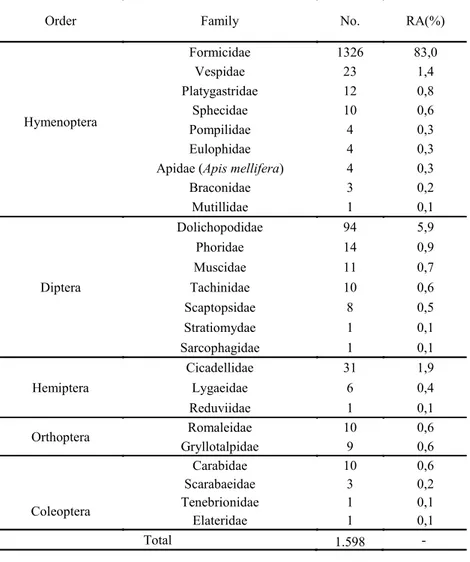
Passive collectionA total of 1,598 insects were collected, belonging from five orders (Coleoptera, Diptera, Hemiptera, Hymenoptera and Orthoptera) and 25 families. The Formicidae (83%), Dolichopodidae (5.9%) and Cicadellidae (1.9%) families were the most abundant. The Tachinidae, Pompilidae,
Eulophidae, Braconidae, Platygastridae and
Mutillidae families were noted for presenting many
parasitoid species. The Formicidae and
Dolichopodidae, and also the Carabidae, Reduviidae, Vespidae and Sphecidae families was noted for cover specimens that are predators of other arthropods (Table 1).
The highest abundance of Formicidae is probably associated with the capture form with Pitfall traps, which collect usually insects with edaphic habits, so it is one of the most used to survey the myrmecofauna (VARGAS et al., 2007; CERDA et al., 2009). In addition, Formicidae species has dominance in most terrestrial ecosystems and are present in almost all regions of the world, except the Arctic and Antarctic (WILSON, 1987).
Rev. Caatinga
Dolichopodidae was the second most abundant family, but information on the presence of this family in vineyards in Brazil are scarce. This family consists of important predator species of pest insects (ULRICH, 2005; SUJII et al., 2007), with potential for biological control agents to be used in future IPM programs on vineyards in the Rio Grande
do Norte semi-arid. Regarding the Cicadellidae,
Ringenberg et al. (2010), in a study conducted in Rio Grande do Sul, emphasized the importance of surveying this family on grape production areas, since Cicadellidae species may be vectors of the
bacteria Xylella fastidiosa (REDAK et al., 2004),
responsible for the Pierce's disease on grapevines. The Tachinidae, Pompilidae, Eulophidae, Braconidae, Platygastridae and Mutillidae families are commonly observed in parasitoid fauna surveys in agricultural areas, which together have a wide host range, and act in regulating populations of other arthropods, especially pests (HANSON, 2006; CANTOR et al., 2006). There is little information related to the diversity of natural enemies in
vineyards in Brazil, however, Bisotto-de-Oliveira et
al. (2007) reported the presence of parasitoids of the Braconidae family associated with the honeydew
moth (Cryptoblabes gnidiella)
(Lepidoptera:Pyralidae) in vineyards in Rio Grande do Sul and emphasized the importance of knowing the natural enemy fauna for pest management in the culture.
The presence of Carabidae, Reduviidae, Vespidae and Sphecidae specimens among the collected insects in this work should also be noted, since they have species of voracious predators of pest insects (MOURA et al., 2000; CIVIDANES; CIVIDANES, 2008; TRIPLEHORN; JOHNSON, 2011), and together with the other parasitoid families mentioned, are probably assisting in regulating populations of other arthropods in the studied area, generating perspectives for further studies that aim to promote the biological control of pests on vineyards in Rio Grande do Norte.
The other families found (Tenebrionidae, Elateridae, Scarabaeidae, Phoridae, Muscidae,
Stratiomydae, Sarcophagidae, Scaptopsidae,
Lygaeidae, Apidae, Romaleidae and Gryllotalpidae) also include species that play important roles in nature, such as pollination, organic matter decomposition in the soil and seed dispersal.
Table 1. Quantity (No.) and relative abundance (RA%) of insects captured through passive collections in the Italia, Niagara Rosada and Isabel grapevine varieties, from
Order Family No. RA(%)
Hymenoptera
Formicidae 1326 83,0 Vespidae 23 1,4 Platygastridae 12 0,8 Sphecidae 10 0,6 Pompilidae 4 0,3 Eulophidae 4 0,3 Apidae (Apis mellifera) 4 0,3 Braconidae 3 0,2 Mutillidae 1 0,1
Diptera
Dolichopodidae 94 5,9 Phoridae 14 0,9 Muscidae 11 0,7 Tachinidae 10 0,6 Scaptopsidae 8 0,5 Stratiomydae 1 0,1 Sarcophagidae 1 0,1
Hemiptera
Cicadellidae 31 1,9 Lygaeidae 6 0,4 Reduviidae 1 0,1
Orthoptera Romaleidae 10 0,6 Gryllotalpidae 9 0,6 Carabidae 10 0,6 Scarabaeidae 3 0,2
Rev. Caatinga Active collection
A total of 288 insects were collected, belonging from five orders (Coleoptera, Diptera, Hemiptera, Hymenoptera and Neuroptera) and 14
families. The Vespidae (160 specimens) and Apidae (78 specimens) were the most abundant families in
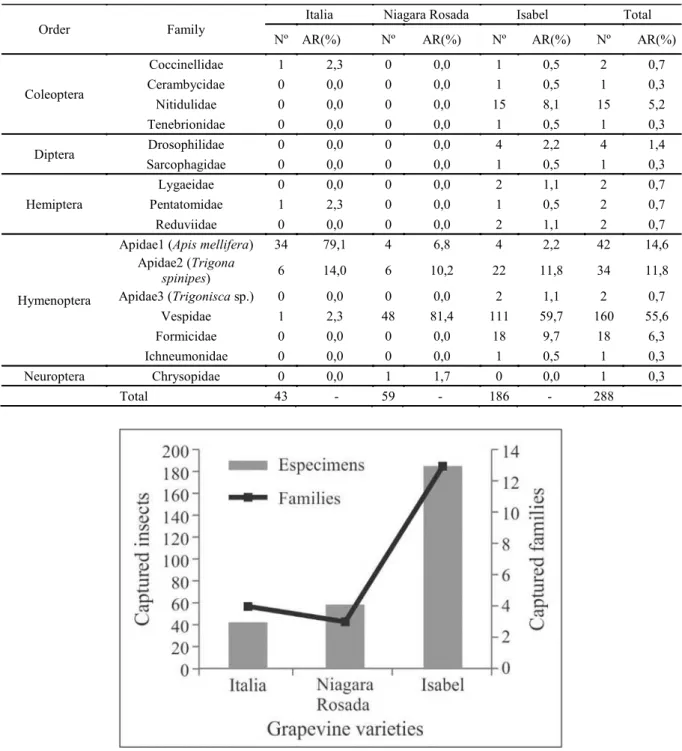
the active collection, representing 82.7% of the collected insects. Regarding the diversity of insects in each variety, three families were captured on Niagara Rosada, four on Italia and thirteen in Isabel plants (Table 2 and Figure 1).
Table 2. Quantity (No.) and relative abundance (RA%) of insects captured through active collections in the Italia, Niagara Rosada and Isabel grapevine varieties, from November 2012 to January 2013 in Mossoro, RN, Brazil.
Order Family
Italia Niagara Rosada Isabel Total
Nº AR(%) Nº AR(%) Nº AR(%) Nº AR(%)
Coleoptera
Coccinellidae 1 2,3 0 0,0 1 0,5 2 0,7 Cerambycidae 0 0,0 0 0,0 1 0,5 1 0,3 Nitidulidae 0 0,0 0 0,0 15 8,1 15 5,2 Tenebrionidae 0 0,0 0 0,0 1 0,5 1 0,3
Diptera Drosophilidae 0 0,0 0 0,0 4 2,2 4 1,4 Sarcophagidae 0 0,0 0 0,0 1 0,5 1 0,3
Hemiptera
Lygaeidae 0 0,0 0 0,0 2 1,1 2 0,7 Pentatomidae 1 2,3 0 0,0 1 0,5 2 0,7 Reduviidae 0 0,0 0 0,0 2 1,1 2 0,7
Hymenoptera
Apidae1 (Apis mellifera) 34 79,1 4 6,8 4 2,2 42 14,6 Apidae2 (Trigona
spinipes) 6 14,0 6 10,2 22 11,8 34 11,8
Apidae3 (Trigonisca sp.) 0 0,0 0 0,0 2 1,1 2 0,7 Vespidae 1 2,3 48 81,4 111 59,7 160 55,6 Formicidae 0 0,0 0 0,0 18 9,7 18 6,3 Ichneumonidae 0 0,0 0 0,0 1 0,5 1 0,3 Neuroptera Chrysopidae 0 0,0 1 1,7 0 0,0 1 0,3 Total 43 - 59 - 186 - 288
Figure 1. Number of specimens and families captured in the canopies of the Italia, Niagara Rosada and Isabel grapevine varieties, from November 2012 to January 2013 in Mossoro, RN, Brazil.
The highest abundance of Vespidae in the
grapevine canopies, especially in the Isabel variety
(Table 2), can be explained by their habit of building their nests in the branches of this variety. The
Rev. Caatinga
can be used in future IPM programs in vineyards in the Rio Grande do Norte semiarid.
The Vespidae had the greatest potential for biological control of pests in vineyards among the families found by Fadini et al. (2001), in a study conducted in Minas Gerais. However, due to food shortages during certain times of the year, some Vespidae species can use the grape clusters at ripening for food and consequently cause injury to fruits and losses to producers (BUTTON et al., 2005).
Apidae was the second most abundant family in the grapevine canopies, represented by two
species, Apis mellifera (14.6%) and Trigona spinipes
(11.8%), and the Trigonisca (0.7%) genus. Apidae,
especially A. mellifera, have an important role in
pollination of many economically exploited plant species, however, Botton et al. (2005) reported that in the absence of food (nectar) due to the lack of native forests at flowering near the production areas, A. mellifera and T. spinipes species can cause damage to grape clusters at ripening.
In the present work, the studied area was surrounded by native forest (Caatinga), and bees attacking grape clusters were not observed.
Regarding Trigonisca, there is no information about
this genus association with the grapevine culture. The Trigonisca genus, widely distributed in the Neotropics, and in Brazil, are found mainly in the northern region (Silveira et al., 2002). Little
information about Trigonisca species in Rio Grande
do Norte is found, there are only reports of bees from this genus nesting in tree trunks (Leguminosae and Burseraceae) in a Caatinga fragment (DIAS et al., 2007). Therefore, this is the first record of a
representative of the Trigonisca genus in grapevines
in Brazil.
The presence of the Formicidae, Nitidulidae, Coccinellidae, Reduviidae and Chrysopidae families was also noted for cover species with predatory habits, and also the Ichneumonidae, a family consisting of important parasitoid species
(BEZERRA et al., 2009; AZEVEDO;
NASCIMENTO, 2009; TRIPLEHORN; JOHNSON 2011; DE BORTOLI et al., 2014). Among these families, only Formicidae and Ichneumonidae were already been reported in cultivated areas with grapevine in Brazil, the later associated with
honeydew moth (C. gnidiella), an important
grapevine pest in Rio Grande do Sul (FADINI et al.,
2001; BISOTTO- DE-OLIVEIRA et al., 2007).
The greater diversity and quantity of insects
found in the Isabel variety in this study is probably
associated with better development of this variety compared to the others in the area evaluated and the nesting of Vespidae in the branches of this variety. The most vigorous development (vegetative and productive) probably provided greater availability of food and shelter for the insects. According to Assis
et al. (2011), the Isabel variety is rustic and highly
fertile, which explains the best development in the
semi-arid conditions of Rio Grande do Norte.
Regardless the collection method (passive or active), this is the first record of insect diversity in a cultivated area with grapevine in the Caatinga biome, in the Rio Grande do Norte semiarid. The presence of families with parasites and predatory habits is important for pest management in vineyards, indicating possible natural biological control of other arthropods in the studied area and, consequently, the maintenance of ecological balance.
CONCLUSION
Six orders (Hymenoptera, Diptera,
Hemiptera, Orthoptera, Coleoptera e Neuroptera) and 32 families (Tenebrionide, Elateridae,
Carabidae, Scarabaeidae, Coccinellidae,
Cerambycidae, Nitidulidae, Drosophilidae,
Dolichopodidae, Phoridae, Muscidae, Tachinidae,
Stratiomydae, Sarcophagidae, Scaptopsidae,
Pentatomidae, Reduviidae, Cicadellidae, Lygaeidae, Formicidae, Vespidae, Pompilidae, Eulophidae, Apidae, Braconidae, Sphecidae, Platygastridae,
Mutillidae, Ichneumonidae, Romaleidae,
Gryllotalpidae e Chrysopidae) of insects were identified in the cultivated area with grapevine in the
Rio Grande do Norte semi-arid.
AKNOWLEDGEMENTS
To D. Sc. Celso Valdevino Pommer for providing the experimental area to conduct the survey, to D. Sc. Django Jesus Dantas for assistance in the collections, and to D. Sc. Airton Torres Carvalho for the identification of the bees.
REFERENCES
ASSIS, A. M. et al. Evolução da maturação e
características físico-químicas e produtivas das
videiras ‘BRS Carmem’ e ‘Isabel’. Revista
Brasileira de Fruticultura, Jaboticabal, v. 33, n.
esp1, p. 493-498, 2011.
AZEVEDO, R. L.; NASCIMENTO, A. S. Observações sobre o comportamento predatório de Cosmoclopius nigroannulatus (Stal, 1860) (Hemiptera, Reduviidae) em plantas de feijão
guandu. EntomoBrasilis, Vassouras, v. 2, n. 1, p. 25
-26, 2009.
BEZERRA, C. E. S. et al. Crisopídeos (Neuroptera: Chrysopidae): aspectos biológicos, potencial de
Rev. Caatinga
Mossoró, v. 22, n. 3, p. 1-5, 2009.
BISOTTO-DE-OLIVEIRA, R. et al. Parasitóides
associados a Cryptoblabes gnidiella (Lepidoptera,
Pyralidae) em videira, RS. Arquivos do Instituto
Biológico, São Paulo, v. 74, n. 2, p. 115-119, 2007.
BOTTON, M.; SORIA, S. J.; HICKEL, E. R. Sistema de produção de uvas rústicas para processamento em regiões tropicais do Brasil. Embrapa Uva e Vinho, 2005. Disponível em:<http:// sistemasdeproducao.cnptia.embrapa.br/
FontesHTML/Uva/UvasRusticasParaProcessamento/ pragas.htm>. Acesso: 11 maio. 2014.
CANTOR, F.; CURE, J. R.; LÓPEZ-ÁVILA, A.
Hymenoptera (Parasitica) como agentes de control biológico em Colombia. IN: FERNÁNDEZ, F.;
SHARKEY, M. (Ed.). Introducción a los
Hymenoptera de la Región Neotropical. Bogotá: Sociedad Colombiana de Entomologia y Universidad
Nacional de Colombia, 2006, p. 143-176.
CERDÁ, X.; PALACIOS, R.; RETANA, J. Ant community structure in citrus orchards in the mediterranean basin: Impoverishment as a
consequence of habitat homogeneity.
Environmental Entomology, Annapolis, v. 38, n. 2,
p. 317-324, 2009.
CIVIDANES, F. J.; CIVIDANES, T. M. S. Flutuação populacional e análise faunística de Carabidae e Staphylinidae (Coleoptera) em
Jaboticabal, São Paulo. Arquivos do Instituto
Biológico, São Paulo, v. 75, n. 4, p. 449-456, 2008.
DE BORTOLI, S. A. et al. Resposta funcional da
joaninha Cryptolaemus predando cochonilha branca
em diferentes temperaturas e substratos vegetais. Revista Caatinga, Mossoró, v. 27, n. 3, p. 63-71,
2014.
DIAS, V. H. P.; FILGUEIRA, M. A.; OLIVEIRA, F.
L. Ocorrência de abelhas do gênero Trigonisca na
região oeste do Rio Grande do Norte. Revista Verde
de Agroecologia e Desenvolvimento Sustentável,
Mossoró, v. 2, n. 1, p. 167-168, 2007.
FADINI, M. A. M. et al. Efeito da cobertura vegetal do solo sobre a abundância e diversidade de inimigos
naturais de pragas em vinhedos. Revista Brasileira
de Fruticultura, Jaboticabal, v. 23, n. 3, p. 573-576, 2001.
HANSON, P. E. La importancia económica de los
himenópteros. p. 101-117. In: HANSON, P. E.;
GAULD, I. D. (Eds.). Hymenoptera de la Región
Neotropical. Gainesville: The American
Entomological Institute, 2006. 994 p.
INSTITUTO BRASILEIRO DE GEOGRAFIA E ESTATÍSTICA (IBGE). Disponível em: <http:// www.sidra.ibge.gov.br/bda/prevsaf/default.asp? t=1&z=t&o=26&u2=1&u3=1&u4=1&u1=6>. Acesso em: 17 set. 2015.
LUTINSKI, J. A.; GARCIA, F. R. M. Análise faunística de Formicidae (Hymenoptera: Apocrita) em ecossistema degradado no município de
Chapecó, Santa Catarina. Biotemas, Florianópolis, v.
18, n. 2, p. 73 - 86, 2005.
MOURA, M. F. et al. Seletividade de inseticidas a
três Vespidae predadores de Dione juno juno
(Lepidoptera: Heliconidae). Pesquisa Agropecuária Brasileira, Brasília, v. 35, n. 2, p. 251-257, 2000.
PETERNELLI, E. F. O.; DELLA-LUCIA, T. M. C.;
MARTINS, S. V. Espécies de formigas que
interagem com as sementes de Mabea fistulifera
Mart. (Euphorbiaceae). Revista Árvore, Viçosa, v.
28. n. 5. p. 733-738, 2004.
REDAK, R. A. et al. The Biology of xylem fluid
-feeding insect vectors of Xylella fastidiosa and their
relation to disease epidemiology. Annual Review
Entomology, Palo Alto, v. 49, p. 243-270, 2004.
RINGENBERG, R. et al. Análise faunística de cigarrinhas (Hemiptera: Cicadellidae) na cultura da
videira no Rio Grande do Sul. Neotropical
Entomology, Londrina, v. 39, n. 2, p. 187-193, 2010.
SILVA, P. C. G.; CORREIA, R. C.; SOARES, J. M. Histórico e importância socioeconômica. In:
SOARES, J. M.; LEÃO, P. C. S; (Ed). A
vitivinicultura no semiárido brasileiro. Brasília: Embrapa Informação Tecnológica; Petrolina:
Embrapa Semi-Árido, 2009. p. 21-34.
SILVA, R. A.; CARVALHO, G. S. Ocorrência de insetos na cultura do milho em sistema de plantio
direto, coletados com armadilhas-de-solo. Ciência
Rural, Santa Maria, v. 30, n. 2, p. 199-203, 2000.
SILVEIRA, F. A.; MELO, G. A. R.; ALMEIDA, E.
A. B. Abelhas brasileiras: Sistemática e
Identificação. 1. ed. Belo Horizonte, MG: IDM Composição e Arte, 2002. 253 p.
SUJII, E. R. et al. Comunidade de inimigos naturais
e controle biológico natural do pulgão, Aphis
gossypii Glover (Hemiptera: Aphididae) e do
curuquerê, Alabama argilácea Hübner (Lepidoptera:
Noctuidae) na cultura do algodoeiro no Distrito
Federal. Arquivos do Instituto Biológico, São
Paulo, v. 74, n. 4, p. 329-336, 2007.
Rev. Caatinga
dos insetos: Tradução de Borror and Delong’s introduction to the study of insects. 7. ed. São Paulo, SP: Cengage Learning, 2011. 809 p.
ULRICH, H. Predation by adult Dolichopodidae (Diptera): a review of literature with an annotated
prey-predator list. Studia Dipterologica, Halle an
der Saale, v. 11, n. 2, p. 369-403, 2005.
VARGAS, A. B. et al. Efeitos de fatores ambientais sobre a mirmecofauna em comunidade de restinga no
Rio de Janeiro, RJ. Neotropical Entomology,
Londrina, v. 36, n. 1, p. 28-37, 2007.
WILSON, E. O. Causes of ecological successes: the
case of the ants. Journal of Animal Ecology,