Engineering
ISSN: 1809-4430 (on-line)
_________________________
2 Universidade Federal de São João del-Rei (UFSJ)/ São João del-Rei - MG, Brasil.
3 Escola Superior de Agricultura "Luiz de Queiroz", Universidade de São Paulo (ESALQ/USP)/ Piracicaba - SP, Brasil. 4 Faculdade de Zootecnia e Engenharia de Alimentos, Universidade de São Paulo (FZEA/USP)/ Pirassununga - SP, Brasil. 5 Escola de Engenharia de São Carlos, Universidade de São Paulo (EESC/USP)/ São Carlos - SP, Brasil.
TECHNICAL PAPER
TIMBER BEAM REPAIR BASED ON POLYMER-CEMENTITIOUS BLENDS Doi:http://dx.doi.org/10.1590/1809-4430-Eng.Agric.v37n2p366-375/2017
ANDRÉ L. CHRISTOFORO1*, TULIO H. PANZERA2, VICTOR A. DE ARAUJO3,
JULIANO FIORELLI4, FRANCISCO A. R. LAHR5
1*Corresponding author. Universidade Federal de São Carlos (UFSCar)/ São Carlos - SP, Brasil.
E-mail: [email protected]
ABSTRACT: This study aims to manufacture and apply polymer-cementitious blends based on a combination of epoxy polymer and Ordinary Portland Cement (OPC) for timber beam repair. The
material was used to repair timber beams of “Maçaranduba” (Manilkara sp.) and “Cedro doce”
(Cedrella spp) wood species. A full factorial design was conducted to investigate the effect of
cement particle content (0wt%, 30wt%, 40wt% and 50wt %), type of cement (II and ASTM-III), and pigment addition (0wt% and 0.2wt%) on the physical and mechanical properties of the blend. The cement content factor affected all properties investigated. The highest elastic modulus was achieved by the blends produced with 50wt% of cement and 0.2wt% of pigment inclusion. This condition was used to repair the timber beams evaluated under four-point bending test. The insertion of the blends in timber beams achieved superior load levels to the unreinforced woods in
both species, inferior load levels to the reference condition (without defects) in “Cedro doce”, and superior to the reference condition in “Maçaranduba”. These results were justified by the low density of “Cedro doce”, providing a better blend-wood interface adhesion.
KEYWORDS: Wood, bending, beams, composite section, connectors.
INTRODUCTION
Beams and columns are structural elements present in most of architectural designs, which are commonly made of timber in both rural and urban buildings. Wood is a renewable resource which has the most suitable properties depending of its application, despite of its lightness as material. ALMEIDA et al. (2014) have reported the wood strength-density ratio is up to four times higher
than steel. As reported for other materials, constructions made with timber beams require appropriate utilization and maintenance (CHRISTOFORO et al., 2013). Improper treatment can
lead to problems which may compromise the purposes for which the wood beams were designed (FERREIRA et al., 2014). Repairs or reinforcements of certain areas may be necessary to increase
the structural support capacity, so that the whole structure remains intact. Other factors, such as design or construction errors, strength degradation, aging of materials and changes in design standards (stricter provisions or accidents) have motivated the development of new materials for repairing. Composites have been widely used to repair structural beams (MARQUES et al., 2015),
with immunity to corrosion, high strength and a simple application technique (aesthetics is not greatly affected).
Laminate composite materials made with natural (sisal, palm fibre, jute, etc.) and synthetic fibres (glass and carbon) have been used to reinforce timber beams, as indicated in the literature (LYONS & AHMED, 2005; BORRI et al., 2005; CORRADI et al., 2006; ALAM et al., 2009;
CAMPILHO et al., 2009; JANKOWSKI et al., 2010; MOHAMAD et al.,2011; FIORELLI &DIAS,
2011; CARVALHO et al.,2012; GARCÍA et al.,2013; FERREIRA et al., 2014; and, MIOTTO &
The use of particulate composites as reinforcement for timber beams has also been investigated in the literature. BRAZ et al. (2013) have reported the use of a polymer-ceramic blend
(PANZERA et al., 2010) to repair the compressive zone of timber beams. The finite element
analysis (FEA) has pointed out the polymer-cementitious blend as an alternative solution for reinforcement of timber beams, presenting excellent strength and stiffness properties in compression.
Cementitious composites have been reinforced with synthetic and natural fibres. A thermoset polymer phase has also been added to enhance the mechanical properties of cementitious composites. PANZERA et al. (2010) have evaluated the effect of the epoxy polymer combined with
the white Portland cement. The incorporation of 50wt% (weight fraction-wt%) of epoxy polymer into a Portland cement paste resulted in superior mechanical properties compared to the reference condition.
PANZERA et al. (2012) have also reported the effect of carbon nanotube (CNT) inclusions
into polymer-cementitious composites. The CNTs must be treated to avoid the clustering effect, in which hinders the mechanical properties of the composites. Composites made with 25wt% of polymeric phase, without water and CNTs inclusions have exhibited superior mechanical strength. CNTs can be applied as a piezoresistive sensor being able to monitor the stress-strain field of civil structures.
Cement mortars have been prepared with steatite (soapstone) particles and epoxy polymer for restoration proposals. A higher compressive strength (43 MPa) and a lower porosity level (0.19%) have been achieved when steatite particles ranging from 0.42 mm to 1.41 mm and 40wt% of epoxy polymer have been added. This setup condition presented similar aesthetic features when compared to a natural soapstone surface (COTA et al., 2012).
The reinforcement and restoration of timber beams has also been conducted by using laminated composites. A similar research has been carried out on the use of particulate composites and blends for timber repairing proposal. Based on the previous research performed by PANZERA
et al. (2010), this study evaluates the physical and mechanical properties of a polymer-cementitious
blend manufactured with epoxy polymer and Ordinary Portland Cement (OPC) in order to repair or to reinforce timber beams. A powder pigment was added to the mixture to attain similar aesthetic characteristics of wood beam surface. The effect of the pigment particles into the physical and mechanical properties of the manufactured material was also assessed in this study.
MATERIAL AND METHODS
Epoxy resin (Araldite-M) and hardener (HY 956) were supplied by Huntsman Company (Brazil). They were manually mixed based on a ratio of 1:0.4 (resin:hardener) ratio, and the manufactured blend were inserted into silicone moulds (compressive test) and drawn after 72 hours of curing time. The Ordinary Portland Cement (OPC-Type II and III) was supplied by Cauê Company (Brazil). Brown-coloured powder pigment was supplied by Xadrez Company (Brazil).
Compressive tests on the repairing material were carried out based on the American Standard D695-02 (ASTM, 1998) by the use of a universal testing machine Shimadzu AG-X Plus (100 KN load capacity) with a non-contacting video extensometer. Physical tests were conducted based on British Standard BS10545-3 (1997). Ten cylindrical specimens of 40mm in height and 20mm in diameter (H/D = 2) (ASTM, 1998) were fabricated for each experimental condition and replicate to perform the physical (five specimens) and the mechanical (five specimens) tests. Two replicates were considered in this experiment, with a total of 320 specimens.
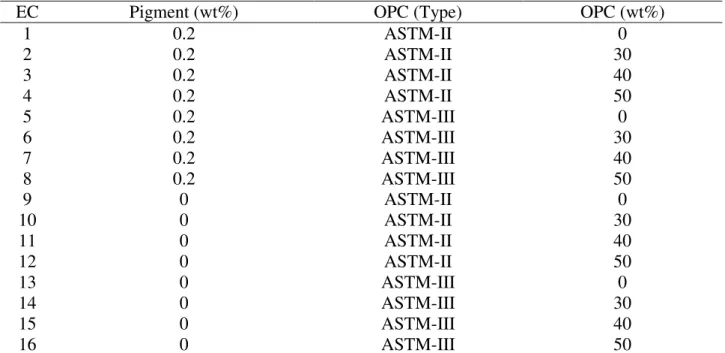
Experimental factors (levels) investigated in this research were: OPC content (0wt%, 30wt%, 40wt% and 50wt%), OPC type (ASTM-II and ASTM-III), and pigment addition (0wt% and 0.2wt%). A full factorial design of 4122 was conducted to evaluate the effect of the factors on the
following response variables: modulus of elasticity (E) and compressive strength (S), apparent
conditions (Table 1). The bulk density was obtained via Archimedes principle following the recommendations of BS10545-3 (1997). The bulk density was calculated by the quotient of dry mass (m1) divided by the external volume (V), including pores. The external volume (V) is
determined subtracting the wet specimen mass (m2) by the suspended wet specimen mass (m3), both
impregnated by immersion under vacuum. The apparent porosity, expressed as a percentage, is the relationship of the volume of the open pores of the test specimen to its exterior volume. The apparent porosity (P) is calculated using the equation:
TABLE 1. Experimental conditions of the blend material.
EC Pigment (wt%) OPC (Type) OPC (wt%)
1 0.2 ASTM-II 0
2 0.2 ASTM-II 30
3 0.2 ASTM-II 40
4 0.2 ASTM-II 50
5 0.2 ASTM-III 0
6 0.2 ASTM-III 30
7 0.2 ASTM-III 40
8 0.2 ASTM-III 50
9 0 ASTM-II 0
10 0 ASTM-II 30
11 0 ASTM-II 40
12 0 ASTM-II 50
13 0 ASTM-III 0
14 0 ASTM-III 30
15 0 ASTM-III 40
16 0 ASTM-III 50
Experimental conditions (EC); weight fraction (wt%); ordinary Portland cement (OPC); American Society for Testing and Materials standards II and III (ASTM).
The analysis of variance (ANOVA) at 5% of significance level (α) was applied to identify the main and interaction effects on the response-variables. Equivalence among mean values was assumed as a null hypothesis (H0), and non-equivalence as an alternative hypothesis (H1). P-values
equal to or less than 0.05 imply rejection of H0, which reveals that the factor significantly affected
the evaluated properties. ANOVA was evaluated with the support of Minitab® software, version 14.
ANOVA was validated by the Anderson-Darling test, which evaluates the normal distribution of the data, and Bartlett and Levene tests, which verify the homogeneity of variances between treatments. The Anderson-Darling test considers a normal distribution as null hypothesis and non-normality as alternative hypothesis. A P-value greater than the significance level of (0.05) implies to accept H0, rejecting it otherwise. Bartlett and Levene test considers the equivalence of variances
among treatments as the null hypothesis, and non-equivalence as alternative hypothesis. P-value greater than the significance level of (0.05) implies to accept H0, rejecting it otherwise.
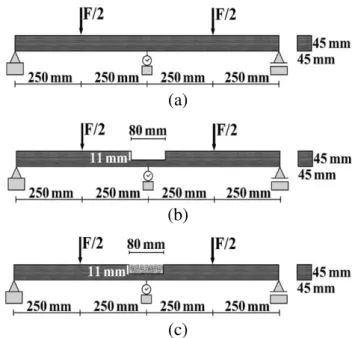
Timber beam dimensions were set at 1000 × 45 × 45 mm3 (Figure 1), which were evaluated
via four-point static bending test to analyse the behaviour of the reinforcing material. A cavity of 1 mm × 80 mm was made in the middle of the timber beam (Figure 1b) to insert a structural defect. The best setup condition (Table 1) which results in the highest compressive modulus of elasticity
was used to repair the timber beams (Figure 1c) of “Maçaranduba” (Manilkara sp) and “Cedro
(a)
(b)
(c)
FIGURE 1. Experimental conditions for timber beams: reference-RC (a), with failure-WF (b) and repaired failure-RF (c).
Four-point bending tests were conducted in a non-destructive way, following the recommendations of the Brazilian Standard ABNT NBR 7190 (1997). The largest displacement value was limited to L/200 ratio (L is the support distance, L=1000 mm in Figure 1), in which ensured the serviceability limit state (SLS). The load was recorded when 5 mm of displacement was achieved. This methodology enabled to perform three consecutive tests in the same specimen for each experimental condition. Ten specimens per wood species with 12% moisture content were evaluated, running a total of 60 bending tests. The ANOVA was conducted to investigate the effect of the experimental conditions (RC, WF and RF) on the load values related to the limit displacement of 5 mm. After the load recording at L/200, the bending test was performed until failure in order to compare and evaluate the failure modes at reference (RC), with failure (WF) and repaired failure (RF) conditions (see Figure 1).
Besides the bending tests, six specimens for each wood species were manufactured to be evaluated in compressive tests. The modulus of elasticity (Ec0) and the compressive strength (fc0) in
a parallel direction to the grain were determined. Six specimens were also used to obtain the apparent density (ρ12%- density obtained for moisture content of 12%) and porosity (P) following
the prescriptions of the Brazilian standard (ABNT NBR 7190:1997). These properties were useful to better assess the results achieved for the static bending tests.
A micro structural analysis was conducted by scanning electron microscopy with energy dispersive spectroscopy (EDS) to verify the polymer-ceramic blends. Hitachi TM-3000 microscope was used in backscattered electron mode operating at 15 kV.
RESULTS AND DISCUSSION Blend Evaluation
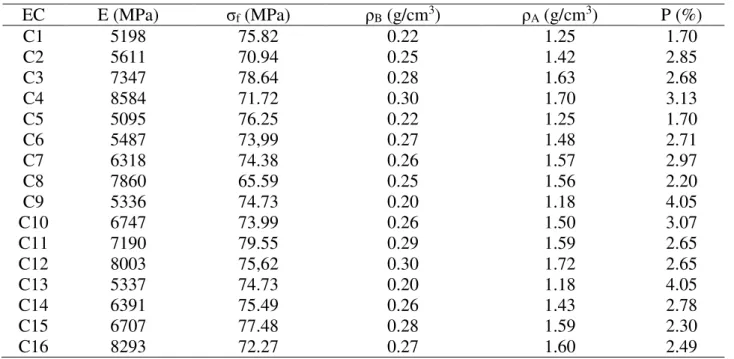
Table 2 indicates the physical and mechanical properties attained for the polymer-cementitious blends (C1-C16). It is also presented the variation coefficient (VC %) of the E, σf, ρB,
ρA, and P ranged in the intervals [6%, 13%], [6%, 19%], [2%, 7%] [2%, 6 %], [5%, 15%] and [3%,
TABLE 2. Physical and mechanical properties of the blends.
EC E (MPa) σf (MPa) ρB (g/cm3) ρA (g/cm3) P (%)
C1 5198 75.82 0.22 1.25 1.70
C2 5611 70.94 0.25 1.42 2.85
C3 7347 78.64 0.28 1.63 2.68
C4 8584 71.72 0.30 1.70 3.13
C5 5095 76.25 0.22 1.25 1.70
C6 5487 73,99 0.27 1.48 2.71
C7 6318 74.38 0.26 1.57 2.97
C8 7860 65.59 0.25 1.56 2.20
C9 5336 74.73 0.20 1.18 4.05
C10 6747 73.99 0.26 1.50 3.07
C11 7190 79.55 0.29 1.59 2.65
C12 8003 75,62 0.30 1.72 2.65
C13 5337 74.73 0.20 1.18 4.05
C14 6391 75.49 0.26 1.43 2.78
C15 6707 77.48 0.28 1.59 2.30
C16 8293 72.27 0.27 1.60 2.49
Experimental conditions (EC); modulus of elasticity (E); compressive strength (σf), bulk density (ρB) apparent density (ρA); apparent
porosity (P).
Table 3 shows the results for normal distribution (Anderson-Darling), homogeneity of variances (Barlett and Levene) and ANOVA (159 degrees of freedom) for the mechanical and physical properties. The nomenclatures such as, Pig, T, and %C represent the mains factors pigment, type of cement, and cement content, respectively; and Pig×T, Pig×%C, T×%C and Pig×T×%C represent the interactions between factors. The P-values obtained from the Anderson-Darling, Barlett and Levene tests (Table 3) were higher than 0.05 (confidence level), being in accordance to the normality and homogeneity conditions, consequently validating the ANOVA model.
TABLE 3. Anderson-Darling, Barlett, Levene, and ANOVA Results.
P-value ≥ 0.05 ANOVA (P-value ≤ 0.05)
Responses Anderson-Darling Bartlett Levene Pig T %C
E 0.412 0.283 0.493 0.254 0.146 0.000
σf 0.239 0.164 0.270 0.000 0.000 0.000
ρB 0.591 0.331 0.419 0.972 0.000 0.000
ρA 0.476 0.368 0.526 0.491 0.308 0.000
P 0.799 0.458 0.603 0.000 0.083 0.006
P-value (ANOVA)
Responses Pig×T Pig×%C T×%C Pig×T×%C
E 0.000 0.000 0.000 0.000
σf 0.061 0.000 0.000 0.003
ρB 0.570 0.000 0.000 0.173
ρA 0.002 0.000 0.000 0.000
P 0.974 0.000 0.083 0.028
Modulus of elasticity (E); compressive strength (σf), bulk density (ρB) apparent density (ρA); apparent porosity (P); pigment (Pig);
type of cement (T); cement content (%C); factor interactions (Pig×T, Pig×%C, T×%C, Pig×T×%C).
treatment with the second largest mean value by the letter B, and so on; thus identical letters for different treatments indicate the statistical equivalence between means.
The compressive modulus of elasticity (MOE) was affected only by the OPC content (Tab. 4), presenting the best result when the blend was made with 50wt% of cement. All main factors were significant for the compressive strength response. The powder pigment reduced the strength of the blends, since these particles cannot be considered a reinforcing phase; the OPC type II showed better results when compared to Brazilian cement ASTM-III; and 50wt% of cement content provided the best compressive strength.
TABLE 4. Tukey test for the physical and mechanical properties of the blends. Modulus of elasticity (E)
Pig (wt%) OPC (Type) OPC (wt%)
0.2% 0% ASTM-II ASTM-III 0% 30% 40% 50%
Grouping A A A A D C B A
Compressive strength (S)
Pig (wt%) OPC (Type) OPC (wt%)
0.2% 0% ASTM-II ASTM-III 0% 30% 40% 50%
Grouping B A A B B C D A
Bulk density (ρB)
Pig (wt%) OPC (Type) OPC (wt%)
0.2% 0% ASTM-II ASTM-III 0% 30% 40% 50%
Grouping A A A B C B A A
Apparent density (ρA)
Pig (wt%) OPC (Type) OPC (wt%)
0.2% 0% ASTM-II ASTM-III 0% 30% 40% 50%
Grouping A A A A D C B A
Apparent porosity (P)
Pig (wt%) OPC (Type) OPC (wt%)
0.2% 0% ASTM-II ASTM-III 0% 30% 40% 50%
Grouping B A A A B AB A A
Weight fraction (wt%); ordinary Portland cement (OPC); American Society for Testing and Materials standards II and III (ASTM);
modulus of elasticity (E); compressive strength (σf), bulk density (ρB) apparent density (ρA); apparent porosity (P); pigment (Pig);
type of cement (T); cement content (%C).
The pigment incorporation did not affect the bulk and apparent densities. The OPC ASTM-III provided better results for the bulk density (lower mean value), and the progressive cement content led to increased apparent and bulk densities of the blends.
(a) (b)
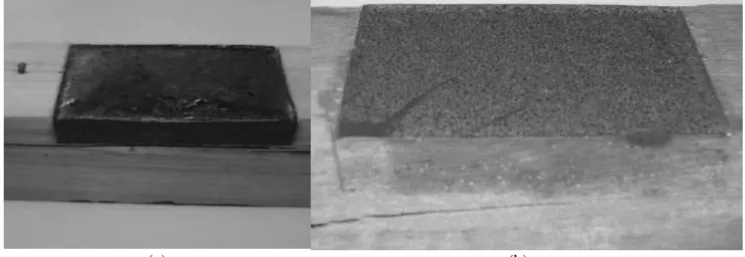
FIGURE 2. Polymer-cementitious blends: (a) without pigment–C16 and (b) with 0.2% of pigment-C8.
Tukey test showed that the best setup material used to repair damaged timber beams was the experimental condition C4 (Table 4), made with 0.2wt% of pigment and 50wt% of ASTM-II OPC, considering that the use of the pigment did not cause significant changes in the blend stiffness values.
Timber Repair Evaluation
Table 5 shows the load values obtained via bending test for both wood species, with sample mean (x), variation coefficient (VC) and Tukey test results (grouping). Table 6 presents the sample
mean and the variation coefficients of the physical (ρ12%) and mechanical properties (Ec0; fc0)
obtained for both wood species.
TABLE 5. Load results (FL/200) obtained via bending tests.
“Maçaranduba” – FL/200
RC WF RF
x (kN) 13.55 9.15 11.86
VC (%) 18 19 17
Grouping A C B
“Cedro doce” – FL/200
RC WF RF
x (kN) 6.43 4.32 6.17
VC (%) 21 23 23
Grouping A B A
Reference condition (RC); condition with failure (WF); repaired failure condition (RF); variation coefficient (VC); sample mean (x).
TABLE 6. Physical and mechanical properties obtained for the wood species.
Maçaranduba
Stat. fc0 (MPa) Ec0 (MPa) ρ12% (kg/m3)
x 106.32 23546 1228
VC (%) 15.34 13.21 2.26
Cedro doce
Stat. fc0 (MPa) Ec0 (MPa) ρ12% (kg/m3)
x 28.76 7623 473
VC (%) 18.51 16.22 3.45
- variation coefficient (VC); sample mean (x); modulus of elasticity (Ec0); compressive strength (fc0); apparent density at 12% of
moisture content (ρ12%).
Table 6 shows that the mean apparent density for “Maçaranduba” wood was 2.60 times higher
than the apparent density for “Cedro doce” and 3 and 3.70 times higher than the compressive
modulus and strength data, respectively.
×1001mm
P-values lower than 0.05 presented by RC and RF factors indicate the repair effect was significant. P-values reached for Maçaranduba wood load response were superior to 0.05 for both Anderson-Darling (0.275) and Bartlett (0.538) tests. For Cedro doce wood, P-values of 0.153 and 0.349 corresponds to the normality and homogeneity testing, respectively, which validates the ANOVA model. Tukey test (Table 5) indicated that the blend was not able to recover the load
capacity of “Maçaranduba” timber beam; however, only 12% reduction on the load value (FL/200)
was achieved when compared to the reference condition. Furthermore, blend repairing led to 30% increasing in load capacity over the beams in reference condition (RC) and without reinforcement (WF), indicating an enhancement effect. Tukey test (Table 5) revealed that the polymer
cementitious blend was able to recover beam load capacity for “Cedro doce” wood. This material
provided an appropriate characteristic for wood beams repair, as pointed out by BRAZ et al. (2013),
and this fact can be attributed to the lower density of “Cedro doce” wood, allowing a major
penetration of the epoxy polymer as compared to “Maçaranduba” wood species. Figure 3 shows the rupture modes obtained for “Maçaranduba” and “Cedro doce” wood specimens after four-point bending test. The rupture of the pieces presented the same profile behaviour, in which the crack was initiated by tension at the bottom side of the beam, and subsequently it was propagated at the blend-wood interface with no damage across the blend and no delamination process, revealing a promising material for such application.
(a) (b)
FIGURE 3. Rupture modes with the blend: (a) “Maçaranduba” and (b) “Cedro doce”.
CONCLUSIONS
The main conclusions of this study are following described:
- In general, the pigment inclusion and the cement type revealed different behaviours on the investigated mechanical and physical properties. The cement content factor significantly affected all the response variables.
- The highest modulus of elasticity in compression was achieved when the polymer-cementitious blend was made with 50% of cement (ASTM-II) and 0.2wt% of powder pigment (C4). This setup was used to repair the timber beams under bending test.
- The repaired “Maçaranduba” timber beam provided superior values of load (FL/200) when
compared to those of reference conditions. Once more, the efficiency of the wood repair was revealed being considered acceptable.
- The repair of “Cedro doce” wood by C4 blend presented similar strength values compared to the reference condition. This behaviour can be attributed to the higher compressive modulus of the
blend in comparison to “Cedro doce” wood. A lower density of “Cedro doce” specie might
contribute to enhance the polymer-wood adhesion.
- The repair of both beam species by the use of the polymer-cementitious blend was considered appropriated under four-point bending test. The crack was initiated at the bottom beam side where high tensile loadings are reached, and subsequently the fracture was propagated toward the blend-wood interface due to the shear stress in the parallel direction to the grain of the blend-wood.
REFERENCES
ABNT - ASSOCIAÇÃO BRASILEIRA DE NORMAS TÉCNICAS. NBR 7190. Projeto de
estruturas de madeira. Rio de Janeiro: ABNT, 1997.
ALAM, P.; ANSELL, M. P.; SMEDLEY, D. Mechanical repair of timber beams fractured in flexure using bonded-in reinforcements. Composites Part B: Engineering, Oxford, v. 40, p. 95-106, 2009.
ALMEIDA, D. H.; CAVALHEIRO, R. S.; FERRO, F. S.; ALMEIDA, T. H.; CHRISTOFORO, A.
L.; CALIL JR, C.; LAHR, F. A. R. Hardness of the Schizolobium amazonicum wood. Advanced
Materials Research, Zurich, v. 912-914, p. 2018-2021, 2014.
ASTM - AMERICAN SOCIETY FOR TESTING MATERIALS. D 695-02.Compressive
properties of rigid plastics. West Conshohocken: ASTM, 1998.
BORRI, A.; CORRADI, M.; GRAZINI, A. A method for flexural reinforcement of old wood beams with CFRP materials. Composites Part B: Engineering, Oxford, v. 36, p. 143-153, 2005.
BRAZ, J. C. F.; LAYBER, R. B.; LAURO, C. H.; CHRISTOFORO, A. L.; PANZERA, T. H.; LAHR, F. A. R.; SILVA, V. R. V. Numerical evaluation of the mechanical behavior of a particulate
composite material as reinforcement in timber beams. International Journal of Composite
Materials, Rosemead, v. 3, p. 83-91, 2013.
BSI - BRITISH STANDARDS INSTITUTE. EN ISO 10545-3. Ceramic tiles - Part III.
Determination of water absorption, apparent porosity, apparent relative density and bulk density. London: BSI, 1997.
CAMPILHO, R. D. S. G.; MOURA, M. F. S. F.; BARRETO, A. M. J. P.; MORAIS, J. J. L.;
DOMINGUES, J. J. M. S. Fracture behaviour of damaged wood beams repaired with an
adhesively-bonded composite patch. Composites Part A: Applied Science and Manufacturing, Oxford, v.
40, p. 852-859, 2009.
CARVALHO, S. S.; DUTRA, J. R.; CARVALHO, A. L. C.; VIEIRA, L. M. G.; CHRISTOFORO, A. L. Experimental evaluation of the employment of a laminated composite material with sisal fibres as reinforcement in timber beams. International Journal of Composite Materials, Rosemead, v. 2, p. 97-100, 2012.
CHRISTOFORO, A. L.; BLECHA, K. A.; CARVALHO, A. L. C.; RESENDE, L. F. S.; LAHR, F. A. R. Characterization of tropical wood species for use in civil constructions. Journal of Civil Engineering Research, Rosemead, v. 3, p. 98-103, 2013.
CORRADI, M.; SPERANZINI, E.; BORRI, A.; VIGNOLI, A. In-plane shear reinforcement of
wood beam floors with FRP. Composites Part B: Engineering, v. 37, p. 310-319, 2006.
FERREIRA, M. B.; CORREA, G. F.; PANZERA, T. H.; FIORELLI, J.; SILVA, V. R. V.; LAHR, F. A. R.; CHRISTOFORO, A. L. Numerical and experimental evaluation of the use of a glass fiber laminated composite materials as reinforcement in timber beams. International Journal of
Composite Materials, Rosemead, v. 4, p. 73-82, 2014.
FIORELLI, J.; DIAS, A. A. Glulam beams reinforced with FRP externally-bonded: theoretical and experimental evaluation. Materials and Structures, London, v. 44, p. 1431-1440, 2011.
GARCÍA, P. R.; ESCAMILA, A. C.; GARCÍA, N. G. Bending reinforcement of timber beams with composite carbon fiber and basalt fiber materials. Composites Part B: Engineering, Oxford, v. 55, p. 528-536, 2013.
JANKOWSKI, L. J.; JASIEŃKO, J.; NOWAK, T. P. Experimental assessment of CFRP reinforced wooden beams by four point bending testes and photo elastic coating technique. Materials and Structures, London, v. 43, p. 141-150, 2010.
LYONS, J. S.; AHMED, M. R. Factors affecting the bond between polymer composites and wood.
Journal of Reinforced Plastics & Composites, Westport, v. 24, p. 404-405, 2005.
MARQUES, F. A. Z.; SILVA, C. E. G.; CHRISTOFORO, A. L.; LAHR, F. A. R.; PANZERA, T. H.; CANTO, R. B. Influence of Portland cement addition in the physical and mechanical properties of epoxy resin. Advanced Materials Research, Zurich, v. 1088, p. 411-414, 2015.
MIOTTO, J. L.; DIAS, A. A. Structural efficiency of full-scale timber-concrete composite beams strengthened with fiberglass reinforced polymer. Composite Structures, Barking, v. 128, p. 145-154, 2015.
MOHAMAD, G.; ACCORDI, J.; ROCA, L. E. Avaliação da associação de compósito de fibra de vidro e carbono no reforço de madeira de Eucalyptus in natura e autoclavada. Matéria, Rio de Janeiro, v. 16, p. 621-637, 2011.
PANZERA, T. H.; SABARIZ, A. L. R.; STRECKER, K.; BORGES, P. H. R.; WASCONCELOS, D. C. L.; VASCONCELOS, W. L. Propriedades mecânicas de materiais compósitos à base de cimento Portland e resina epóxi. Cerâmica, São Paulo, v. 56, p. 77-82, 2010.