Journal of Eye tracking, Visual Cognition and Emotion Volume 2, Number 1 36
Visual Strategies used during the performance of an obstacle course
Inês P Santos
1, Leonor M Pereira
2 1,2Centro Interdisciplinar para o Estudo da Performance Humana (CIPER), Faculdade de Motricidade Humana, Universidade Técnica de Lisboa,
PORTUGAL
1
[email protected], 2[email protected]
ABSTRACT
Vision is the sense that provides precise information about one’s position in the environment in relation to objects. The visual system is essential to guide people safely when moving around in the environment. The perception that an individual gets from a particular scene of her/his surroundings is accomplished by eye movements.
The current study aims to identify differences in visual strategies between 15 women and 15 men within the age range of 18-24 years, who have been given a task to walk through an obstacle course drawn on the laboratory´s floor. They should start and finish at a predefined location. Twelve pylons were used as obstacles to be avoided during the walking.The participants' eye movements were recorded using the Mobile Eye model 1.35.
The Wilcoxon-Mann-Whitney Test was used for the statistical analysis. Significant differences occurred between men and women, in the duration of fixations: the men spend more time observing the finishing area than women (z=-1.929, p=.054); and in the number of fixations: before starting the task, the men fixate more often the middle phase of the obstacle course (z=-2.085, p=.037). Once they commence, the women fixate more the points outside the obstacle course than the men (z=-2.093, p=.036).
Key Words: Eye Movements, Number of Fixation, Fixation Duration, Visual Search, Visual Attention.
1. INTRODUCTION
Vision is the only sense that provides precise information about one’s surroundings, including people and objects. The visual system is essential to guide people safely around their environment. In order to create a detailed representation of a scene, the human visual system uses a dynamic process for scanning research the environment, using a set of eye movements (Bovik et al., 2004).
The perception individuals build from a particular scene or surroundings, is accomplished by eye movements and is usually modeled by a process called visual search. Visual search includes the scanning process of the scene observed and the formation of the conceptual image in the brain (Rayner, 1998).
The behavior of eye movements while viewing a scene can be divided into two moments: fixations, periods in which observation of an item is relatively stable; and saccades, periods in which the eyes move quickly to reorient between two different points. The eyes are moved in different directions, aiming at capturing images of the world around the subject, with the highest quality possible, so that it can be perceived and analyzed by cortical structures, contributing to the motor response (Turano et al., 2001).
In the traditional studies of perception of scenes, the eyes performance during ofdifferent tasks have been studied, using a static image or images displayed for a short period of time. It seems not to exist an appropriate way to look at particular objects, images or scenes, although Rayner and Pollatsek (1992) established that the position at which the eyes fixate is not random. Individuals tend to establish areas in the scene that they feel are informative. The human visual system uses a dynamic process of visual search, in which representations are constructed over time from multiple eye fixations.
The gaze behavior during locomotion was studied for tasks where the environment or the instruction determinethe action, such as stepping over an obstacle (Patla e Vickers, 1997 in Patla et al., 2007), changing direction of locomotion (Hollands et al., 2002 in Patla et al., 2007), or stepping on specific targets (Holland et al., 1995 in Patla et al. 2007). The published research that has empirically examined gaze behavior during
Journal of Eye tracking, Visual Cognition and Emotion Volume 2, Number 1
2012 JETVCE; ISSN 1647-7677
37 path selection in a cluttered environment is scarce. According to Turano et al., (2001) individuals with normal vision spend most of the time fixating the path ahead or fixating the goal position. According to Wann and Wilkie, (2008) an individual can look to distance targets, to realize the future obstacles and identify potential hazards, and, in a short time, changes the fixation point for just one meter or two away and focus, for example, on how to make a tight turn with high accuracy.Marigold (2008) found that individuals make local fixations about two steps ahead when these fixations were directly related to relevant areas of the task, or to locations that are likely to be stepped on. Finally, Patla et al. (2007) came to the conclusion that individuals spend most of the time fixating the target, rather than moving toward it and going through the obstacles.
1.1 Rationale
Until now just de study of Patla et al. (2007) document spatio-temporal patterns of gaze behavior while individuals walked through a cluttered environment. When the task only specifies the end goal there's not much information on what are the visual strategies used during the performance of the course.
Hence, our primary objective in the current study is to document the patterns of gaze behavior (fixations number and time) while individuals to walk through an obstacle course towardsa goal position that was visible from the starting point.
The study of visual strategies will allow to realize what information is used in motor tasks and how it is important to regulate locomotor patterns, like avoid obstacles. Therefore, studying the behavior of eye fixations when viewing a scene contributes to the understanding of how information from the visual environment is dynamically acquired and represented.
Furthermore, the current study intends too, analyze whether there are sex differences in visual strategies used in gait, because were not easy to find studies that describing visual search of men and women. The sex differences just has been studied in navigation regarding to physical navigation strategies (like position and orientation with respect to both local and distant landmark) and not the visual strategies (Galea & Kimura, 1993; Holding & Holding, 1989; Moffat, Hampson, & Hatzipantelis; Sandstrom, Kaufman, & Huettel, 1998
in Saucier, Green, Leason et al, 2002).
2. METHODS AND MATERIALS
2.1 Participants
Thirty healthy students volunteered for the study. They had normal visual acuity (15 females, 15 males; Age range: 18-25 years, average 20.6 years).
2.2 Experimental protocol
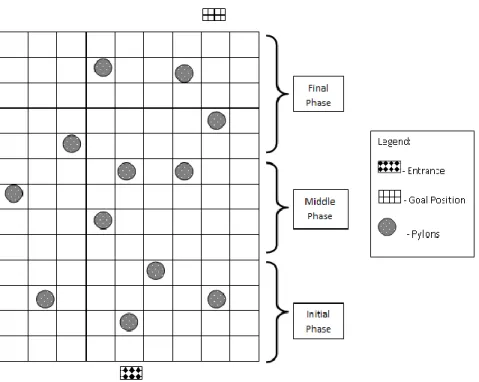
The individuals had to move freely in an obstacle course, drawn on the laboratory’s floor with a predefined start and a finishing point. Twelve pylons were used as obstacles that had to be avoided during walking. A 9x13 grid with square cells (l=0.35m) was marked on the laboratory floor. The entire grid measured 3.15m x 4,55m. The 12 pylon locations on the grid cells were randomly generated with the following conditions: (1) All the eight adjacent cells arounda pylon must be empty; (2) pylons were not placed directly in front of the exit point. There was just one entrance and one exit point. A schematic diagram of the obstacle course is shown in Figure 1.
The participants were informed that they had to walk from the starting position to the end point avoiding the pylons, without touching them. The participants were guided to the starting point without the knowledge of the pylon arrangement. They were instructed to maintain their eyes closed until the moment they heard the starting signal.
During the task, gaze location wasmonitored by an Applied Sciences Laboratories (ASL) Mobile Eye 1.35. This eye-tracker is designed specifically for applications in which lightweight, completely un-tethered eye gaze tracking is required.
The Mobile Eye records data at 60Hz by interleaving images taken from two cameras. The eye camera records the eye being tracked while the scene camera records the environment being observed by the user. Both image streams are recorded on the same digital videotape medium by alternating frames. Therefore, the actual functional sampling of point of gaze data is 30Hz. The Mobile Eye Hardware interfaces either after or during recording operations with a standalone PC (desktop or laptop) for data processing. The PC runs ASL EyeVision software and Captiv L-2100 software for these operations. The MobileEye uses a technique of eye tracking known as Dark Pupil Tracking. This method uses the relationship between two eye features, the
Journal of Eye tracking, Visual Cognition and Emotion Volume 2, Number 1 38
pupil and a reflection from the cornea (Corneal Reflection, CR), to compute gaze within a scene (Operation Manual MobileEye, 2008).
Figure 1. A schematic of the obstacle course with the 12 randomly arranged pylons.
3. DATA ANALYSES AND RESULTS
For each participant, was traced their travel path and then analyzed the gaze fixations data. The results of gaze fixations will be presented separately in duration and number of fixations, for women and men, according to the various locations where they may look (initial phase: path and pylons; middle phase: path and pylons; final phase: path and pylon; goal position of the obstacle course; and points outside the obstacle course). Fixations on initial phase are fixations on the first four rows, fixations on the middle phase are fixations on the subsequent four rows and fixations on the final phase are fixations on the last four rows of obstacle course, those that occurred on path were fixations on any point of the obstacle course, excluding the pylons, and those that occurred on the pylons were the fixations above on any pylons. Fixations on the goal position are fixations on the exit or an area slightly ahead of the exit. Fixations on other spatial locations outside the travel path were categorized as points outside the obstacle course.
Only the data on the number of fixations was analyzed in two categories: those occurring before the participants start gait initiation; and those occurring once they commence walking.
Concerning the duration of fixation, these two categories weren´t differentiated in the analysis.
Then the statistical Test, Wilcoxon Mann-Whitney was carried out on the duration of fixations and on the number of fixations, to determine if there are significant differences between men and women. The same test was used to realize if there are significant differences, on selection of path, between men and women. Significance levels were set at 0.05 for all analyses.
3.1 Duration of fixations
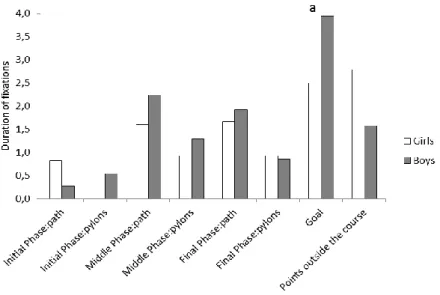
Women spent more time looking at points outside the obstacle course (mean: 2.789s, SD: 2.793s) followed by the goal position (mean: 2.499s, SD: 1.525s) while the path (mean: .834s; SD: 1.836s) and pylons (mean: .316s, SD: .655s) of the initial phase where those they spent the least time looking at.
On other hand, men spent more time looking at the goal position (mean: 3.944s, SD: 3.222s) followed by the path of middle phase (mean: 2.240s, SD: 1.365s), and lastly they spent less time looking at the path of the
Journal of Eye tracking, Visual Cognition and Emotion Volume 2, Number 1
2012 JETVCE; ISSN 1647-7677
39 initial phase (mean: .279s, SD: .502). These results show that both men and women spent more time looking at places where they plan toarrive at the end of task.
Also statistical analyses revealed a significant difference in the duration of fixations between men and women just inthe goal position/ finishing area (z=-1.929, p=.054); the men spent more time observing the finishing area than women.
Graphic 1. Values of duration of fixations, on average, for different parts of obstacle course, for women
and men. The letter “a”, on the bar, show the results from the post statistical analysis that indicate significant difference between men and women.
3.2 Number of fixations before gait initiation
The number of fixations on the various locations of the obstacle course, before participant´s gait initiation is summarized in Graphic 2.
The women looked a greater number of times to the path of final phase (mean: 2.67, SD: 1.988), and then to the path of middle phase (mean: 1.73, SD: 1.710). They made a fewer number of fixations on the pylons of initial phase (mean: .13, SD: .352).
As for the men, they looked more times to the path of middlephase (mean: 3.47, SD: 2.326), and then to the pylons of final phase (mean: 2.53, SD: 2.446). They made a few number of fixations on the path of initial phase (mean: .60, SD: .986).
Significant differences occurred only for the path of middle phase, between men and women (z=-2.085,
p=.037). The men fixated the middle phase of the obstacle course more often than women.
Graphic 2. Values of number of fixations before gait initiation, on average, for different parts of
obstacle course, for women and men. The letter “a”, on the bar, show the results from the post statistical analysis that indicate significant difference between men and women.
Journal of Eye tracking, Visual Cognition and Emotion Volume 2, Number 1 40
3.3 Number of fixations during task performance
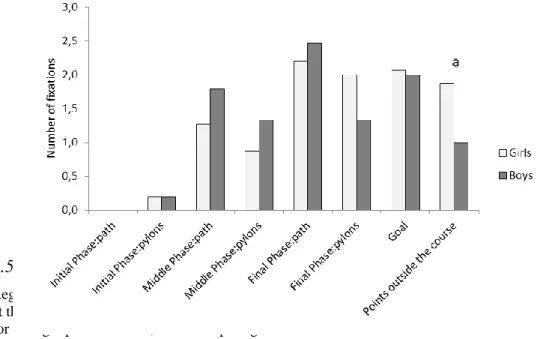
The number of fixations on the various locations of the obstacle course, during task performance is summarized in Graphic 3.
Women and men looked more times to the final phase of the path (women mean: 2.20, SD: 2.007; men mean: 2.47, SD: 1.246), and then to the goal position (women mean: 2.07, SD: 1.033; men mean: 2.00, SD: 1.464). No significant differences were found between women and men.
Once they commenced, significant differences occurred only in the fixation of the points outside the obstacle course. The women fixated the points outside the obstacle course more often than the men (z=-2.093, p=.036).
Graphic 3. Values of number of fixations during task performance, on average, for different parts of
obstacle course, for women and men. The letter “a”, on the bar, show the results from the post statistical analysis that indicate significant difference between men and women.
3.5
Discussion
Regarding the duration of the fixations, the results reveal that both women and men spent more time looking at their ultimate goal as Patla et al. (2007) pointed out; however, in our study men looked at the goal position for a longer period of time, when comparing with women.
In general, before gait initiation women and men did not make the same number of fixations. The women gave special attention to the path they were going to take in the final phase, followed by the middle phase of the obstacle course, and, at last, to the obstacles that theyhad toavoid, especially in the final phase. On the other hand, men were mostly concerned with the path they were going to take, first in the middle phase, and afterwards in the final phase. The men made more fixations on the path of middle phase than the women.
It turns out that before gait initiation individuals look to the middle phase (located about two steps ahead of the start position of the individual), and the initial phase does not need so many fixations. Thus, it seems that our study follows the results of Turano et al. (2001) and Marigold (2008).
Once the men and women initiated the gait, ie, during the performance of the task, they made almost the same number of fixations. The women gave special importance to the path they were going to take in the final phase and then to the goal position. The same was true for the men. For both women and men there is evidence that it doesn’t exist any fixation on the path of initial phase. The difference was that women fixate more often the points outside of the obstacle course than the men.
In the current study, the number of fixations and their duration were analyzed. The findings that the points fixated the greatest number of times (final phase and middle phase) are not those that are fixated for the longest period of time (goal position) lead to the conclusion that possibly the highest number of fixations can be made in one phase of the obstacle course while the duration of the longest fixation will not necessarily be in the same phase.
The differences found between women and men, namely where they made more fixations or where they looked for a longer period of time, constitutes a difficult issue to explain and may be related with sample dimension and or with the task characteristics, since it was not found in the literature sufficient information regarding those differences.
Journal of Eye tracking, Visual Cognition and Emotion Volume 2, Number 1
2012 JETVCE; ISSN 1647-7677
41
4. CONCLUSIONS
Gaze fixation data reveal how visual information is used for safe passage around obstacles during goal-directed locomotion.
The results of the current study reveal the occurrence of fixations in the relevant elements of the task, like: the obstacles, the path, the target/goal, or ahead of the goal.
The duration and number of fixations are influenced by the different phases of the obstacle course. The findings point to the existence of differences in the visual strategies used by women in relation to men during the performance of obstacle courses; it seems that the individual's gender influences the duration and the number of fixations.
Although the women and men do not spend the same time looking at the different phases of the course, the fixations seem to be oriented to the positions for which more detailed and accurate information is required.
The findings of this research contribute to perceive that the control of walking for healthy individuals is not completely automatic but requires some degree of attention, and study visual strategies allows us to understand what are the locations or objects that need more attention during walking.
In future studies of visual strategies we think it's relevant identify differences between the elderly and adults walking through an obstacle course, as well as the relationship of these visual strategies with healthy lifestyles and risk of falls. These studies could contribute to autonomy of elderly in the ability to move around in different contexts.
Acknowledgements: We express our gratitude to the Foundation for Science and Technology (FCT) for
providing the Introduction to Research Scholarship inserted within the Interdisciplinary Center for Human Performance (Ciper) and financial support that made possible this research work, which took place at the Faculty of Human Kinetics.
5. REFERENCES
Bovik, A C, Cormack, L K and Rajashekar, U. (2004), Point of Gaze Analysis Reveals Visual Search Strategies. The University of Texas at Austin, Austin, TX 78712, USA.
Covre, P, Macedo, E, Oliveira, M, Orsati, F and Schwartzman, J (2007), Análise dos padrões dos movimentos oculares em tarefas de busca visual: efeito da familiaridade e das características físicas do estímulo. Arquivo Brasileiro Oftalmologia, São Paulo, 70, 1.
Wann, J. P. e Wilkie, R. M. (2008). Eye Movements aid the control of locomotion. Journal of Vision, 3, pp. 677-684.
Marigold, D S (2008), Role of Peripheral Visual Cues in Online Visual Guidance of Locomotion. Exercise
and Sport Sciences Reviews, 36, 3, pp. 145-151.
Operation Manual MobileEye (2008), Manual Version 1.35, Eyetracking Expertise, Applied Science Laboratories.
Patla, A E (1998). How is human gait controlled by vision? Ecol. Psychol. 10, pp. 287-302.
Patla, A E, Greig, M, Novak, A and Tomescu, S S (2007), Gaze fixation patterns during goal-directed locomotion while navigating around obstacles and a new route-selection model. Eye Movements: A
Window on Mind and Brain, University of Waterloo, Canada, 32, pp. 677-695.
Rayner, K (1998). Eye Movements in Reading and Informative Processing: 20 Years of Research.
Psychological Bulletin, 124, 3, pp. 32-422.
Rayner, K and Pollatsek, A (1992). Eye Movements and Scene Perception. Canadian Journal of Psychology,
46, 3, pp. 342-376.
Saucier, D., Green, S., Leason, J., MacFadden, A., Bell, S. & Elias, LJ. (2002). Are Sex Differences in Navigation Caused by Sexually Dimorphic Strategies or by Differences in the Ability to Use the Strategies? Behavioral Neuroscience. 116, 3, pp. 403–410.
Turano, K A, Baker, F H, Geruschat, D R, Shapiro, M D, and Stahl, J W (2001). Direction of gaze while walking a simple route: persons with normal vision and persons with retinitis pigmentosa. Optom. Vis.