GEAMA Journal
Environmental Sciences
Analysis of the procedural and wastewater treatment at a
beverage bottling industry in the state of Pernambuco, Brazil
Emmanuelle Maria Gonçalves Lorena B.Sc.
a, Ítala Gabriela Sobral dos Santos B.Sc.
b,
Fabrício Ãngelo Gabriel B.Sc.
c*, Ana Paula Xavier de Gondra Bezerra B.Sc.
d, Mercy
Astrid Moreno Rodriguez B.Sc.
c, Alex Souza Moraes D.Sc.
da,b,c,d Departamento de Tecnologia Rural, Universidade Federal Rural de Pernambuco, Recife, Brasil. __________________________________________________
*Corresponding author: E-mail: [email protected]
ABSTRACT
Currently, the issue of the conscious use of water is highlighted in worldwide discussion. This natural resource is consumed inappropriately generating waste and, in most cases, to discharge to the environment outside the minimum standards of acceptance. Great part of the industries need treated water as a resource to be incorporated in their processes, generating waste that should not be left as environmental liabilities, identifying legal action to act and reduce environmental impacts. Thus, the purpose of this study was to investigate the treatment of wastewater in a beverage industry in the bottling process in the countryside of Pernambuco. a case study was performed through technical visit, the beverage bottling industry, as well as an exploratory research for collection of secondary data. The technical visit consisted of observe the water treatment steps, as well as prevailing environment laws. Analysis of the results, the industry performs preliminary treatment, primary and secondary, common process and sufficient for this type of effluent. Furthermore, there is the process of treating the effluent from the bottle washing process for use in beverage Industry "A" meets the recommendations of studied authors. In turn, the data of the test results have not been studied in this way, it is not possible to draw conclusions about the efficiency of the treatment process. Adding to this the need for further research for analysis of pollutants and hence the creation of effective methods to mitigate impacts from these industries.
Keywords: water reuse, good practices, water treatment plant.
INTRODUCTION
The problem of the conscious use of water remains under discussion in the world, this natural resource is its use inappropriately as to waste as well as disposal after use to the environment in polluted
form. In line with this, it has the shortages caused by rising demand from industrial activities, considered one of the main sources of pollution of this resource (CRUZ, 2007). Water is an essential resource for life on the planet, and due to population
growth and disordered use is increasingly scarce (LIRA et al., 2015).
Great part of the industries need treated water as a resource to be incorporated into its processes, it is noted that about 22% of all water is consumed by industrial activities (BRASIL, 2005). The use of water in these processes occurs from inclusion in products to washing machines and installations, used in refrigeration systems and steam generation (BRASIL, 2005).
Depending on the type of industry operation and also the techniques applied, the residual water can carry toxic waste, and disposal in the environment without due treatment, it causes environmental pollution (BRASIL, 2005).
Environmental liabilities caused by the toxic effects of the discharge of industrial effluents into water bodies must be monitored, analyzed and treated, since they can affect the ecosystem through contamination and the needs of people seeking this your drinking water supply (LEMOS et al . 1992 cited JERONIMO, 2012).
Water is the raw material most used in the production of beverages and is also a basic need of the community and ecosystem (DIFANE; SILVA, 2007). In the beverage industry, more specifically in traffic jams companies, the packaging of beverage bottles should occur properly and within the standards established by the sanitary surveillance for food security, the framework now the food industry.
The bottles washing process occurs primarily in the following sequence: rinse, alkaline wash, rinse, acid wash and rinse (SANTOS; RIBEIRO, 2005). After the washing process, the bottles are inspected, and those with dirt removed or are damaged
(SANTOS; Ribeiro, 2005). The water and energy consumption during the washing process is high, as well as the generation of waste: cellulosic stock, glass coming from the bottles and liquid effluents washing (SANTOS; RIBEIRO, 2005).
Federal law 9.433 of January 8, 1997, establishing the National Water Resources Policy with one of the foundations that the management of these resources should always provide the multiple use of water (BRASIL, 1997), thus the planned reuse of water waste becomes an alternative that has been practiced for a few years in the world (CROOK 1993 apud WEBER; CYBIS; BEAL, 2010). Water is a resource which appears predominantly in the environmental management of organizations (LORENA et al., 2016 apud MACHADO JUNIOR, 2012). In addition to waste reduction, reuse has the potential ability to reduce the emission of industrial pollutants to water bodies when the reuse of water is incorporated into the product, preventing pollution (RULKENS 2005 apud WEBER; CYBIS; BEAL, 2010).
On the other hand, the reduction of loads can also cause negative impacts on wastewater treatment processes (WEBER; CYBIS; BEAL, 2010). When the recycled water does not come out of the circuit system is considered closed, being considered direct reuse, however, if treatment is not effective may result in increased pollutant concentration during the use cycle (WEBER; CYBIS; BEAL, 2010 ).
The objective of this study was to analyze the process of treatment of process and waste water from industrial activity bottling drinks, a case study in a beverage bottling industry in the countryside of Pernambuco.
MATERIALS AND METHODS
The work consisted of an exploratory research, to collect information about the issue to provide more knowledge on the subject, in order to make it more explicit and provide the basis for further discussions. It was performed survey of secondary data on the subject of the treatment of industrial effluents, seeking sources in journals, books, theses and dissertations. Secondly we conducted a case study through technical visit, the beverage bottling industry, considered here as "The Industry A", to preserve the corporate identity that is located in a city in the state of Pernambuco. In this study, the steps were observed treatments performed by the company in the effluent, and concern service existing environmental laws.
RESULTS AND DISCUSSION
Some peculiarities in the treatment of water reported in Industry "A", should take into consideration that these are own stations, in order to meet the requirements of environmental legislation. Another point to be noted, Industry "A" has a damming of a water body adjacent where draws water to be treated in a water treatment plant (WTP) for own thus be incorporated into the production process. Subsequently, the process output water with waste is directed to Effluent Treatment Plant (WWTP) with the gathering of all wastewater Industry "A" and, after treatment, the treated water is returned to the same local river, downstream of the damming. Treatment for water in glass bottle washing process follows in compliance with food safety laws, as water contact with food should be considered as drinking water (BRASIL, 2011).
In Water Treatment Plant (WTP) (figure 1), the water is collected from the local river (1),
subsequently adding hydrogen peroxide (H2O2) (2), then sent to the mixer (3), according to the two flocculant and decanter (4), sent to filtering in two sand filters (5), and following the flow of clarified water tank (6), also scaled in two units, active carbon tank (7), the resin tank (8 ) and softener tank (9) and thus be used in the washing process of beverage bottles.
It begins with the primary treatment, by applying hydrogen peroxide (2) acting as oxidant has the function of making the biodegradable effluent (LORA, 2010), continuing to secondary treatment, usually consisting of a biological process, the mixer (3), as the use of flocculant and decanter (4) consisting of a physical process in which the particles are placed in contact with each other to allow increasing its physical size, changing their particle size distribution, increasing also the decanting speed (NUNES, 2012).
The sand filter (5) has the function of retaining the larger solid particles, serves as the main filter to retain the first impurities (OLIVEIRA, 2010). Then the water is intended for the clarified water tank (6). The tertiary treatment occurs through activated charcoal tank (7) and resin (8) which, in turn, is the removal of color and impurities present in the effluent which were not removed in the secondary treatment (RODRIGUES, 2007 cited HINOJOSA, 2014), (PEREIRA, 2014). The use of adsorption processes is associated with low operating costs and high removal rates, being used: activated carbon, silica gel, bauxite, ion exchange resins, cellulose derivatives and low-cost materials such as shell nuts, red earth , clay, chitin, agricultural waste, which remove organic matter, odour and generate
good quality effluent (FURLAN, 2008 apud HINOJOSA, 2014; PEREIRA, 2014).
Activated carbon is one of the adsorbents used in industry to remove color, odor, smell, organic matter as a catalyst for treating atmospheric pollutants adsorption of organic compounds, pesticides remover, heavy metals, organic compounds dissolved and others (LEGROURI et al., 2005 cited HINOJOSA, 2014).
Figure 1 - Water Treatment Plant (WTP)
river 1 Peroxide oxygen 2 3 the mixer 6
Clarified water tank
7
Activated carbon tank
8
resin tank v
4 Flocculant and decanter 5 Sand filter
v 9
Softener tank
10
Cleaning process of the bottles sun
SOURCE: Author, 2016
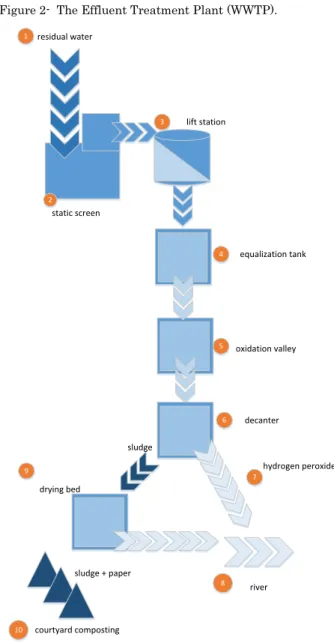
The whole of the Effluent Treatment Plant (WWTP) (Figure 2) Industry "A" consists of primary, primary and secondary treatment, and Cruz (2007) describes the process to secondary treatment as ordinary and enough process for this type effluent. Figure 2- The Effluent Treatment Plant (WWTP).
1 static screen 2 3 equalization tank 4 5 oxidation valley 6 decanter residual water lift station hydrogen peroxide 7 river 8 9 drying bed sludge 10 courtyard composting sludge + paper SOURCE: Author, 2016
Thus, in Industry "A", the effluent from the treatment process begins when the waste water (1) are grouped, and arising out of process effluents and sewage which are directed to the screening (2) is transported by the station lifting (3). Then, to the
equalization steps (4), oxidation (5), settling (6) and added hydrogen peroxide (7), and finally returns to the river (8), the solid, still damp, goes to bed drying (9) and then to the composting area (10).
The sieving (2) consists of a pre-treatment process which aims at the removal of larger and pourable solid particles, being carried out by means of a static stainless steel sieve (Rodrigues et al, 2016.); (PORTO, SCHOENHASLS, 2013); LORA, 2010). With the function of removing solids having a diameter larger than 0.25 mm through several static sieve allowing passage of finer solids and liquids than the diameter of the mesh (Nunes, 2012). This step is intended to reduce possible cloggings in the piping necessary for the process of effluent treatment.
The static and manual cleaning sieve, the effluent flows at the top, descends through the screen and falls into the meshes (NUNES, 2012); (LORA, 2010). This process is recommended for possible removal of fibers and yarns, used in from cellulose and paper industry, textile, manufacturing of fruit juices, potato starch manufacturers and also for removing suspended solids from sewage (NUNES, 2012).
In the case addressed in this study, it is positioned before equalization tank, serving recommendation NUNES (2012).
The equalization tank (4) have the purpose of regulate the flow should be constant in the subsequent drives, brusque variations preclude the operating pH correction tank, Flocculation and sedimentation tanks, causing shock loads in the activated sludge aeration tanks . In addition to regulating the flows, the equalization tank serves the purpose of homogenizing the effluent, making uniform pH, temperature, turbidity, solids, BOD,
COD, color and other variables (NUNES, 2012), which ensures the best dosage of different reactive (LORA, 2010).
The purpose of oxidation (5) consists in the reduction of BOD and nitrogenous compounds, obtaining the final or intermediate products with higher propensity biodegradable or can be removed by adsorption (LORA, 2010).
The decantation (6) is the act of separating, by gravity, the sedimented solids contained in a liquid, sludge sedimented in the decanter of the fund is carried out by this process removed, leaving the liquid portion (NUNES, 2012); (LORA, 2010).
The sludge is sedimented material is removed from the bottom of the decanter while the liquid present in the upper part goes to be further treated (NUNES, 2012).
The drying beds (9) generally low cost is recommended for industry with little space in your infrastructure, it has the function of removing the sludge water (NUNES, 2012). In hot weather, there is a favoring of this kind of process, since it accelerates the drying process, and thus the liquid is removed through drains. If the concentration of BOD keep high, it is recommended to return to the equalization tank (NUNES, 2012).
Thus, going to be considered a solid, the dewatered sludge is sent to the following destinations: landfill, composting, incineration, provided they are not classified as waste Class I - dangerous, but it requires special care to the sewage effluent, not recommended for use in the garden because of the risk because it is human waste (NUNES, 2012).
Rubinger (2009), points out that among the most common determinations to characterize the
industrial wastewater there are the physical variables such as temperature, color, turbidity, solids, chemical variables, hydrogen potential (pH), alkalinity, acidity, hardness, heavy metals, nitrogen compounds and phosphate, and other biological variables and the presence of microorganisms such as bacteria, protozoa, viruses, bloom cyanobacteria. (CONAMA, 2011).
In this context, we emphasize that the effluent treatment process arises from the bottle washing for use in beverages Industry "A" meets the recommendations of studied authors. Data for the analysis results have not been studied in this way, it was not possible to draw conclusions about the efficiency of the treatment process.
It is noteworthy that the company does not make direct reuse of wastewater from so it is considered an important alternative to reduce environmental impacts, with a view to use in the process, leading to company sustainability indicators. Would add to it, improve the company's image, as consumers are more discerning in their choice of products, especially those that have the footprint, managing to reach the financial return for employee use of direct reuse.
Incidentally, the environmental point of view, it is essential studies aimed at the treatment of effluents from industries, particularly with regard to polluting particles. It is recommended that research be conducted to produce minimization techniques of pollutants and contaminants in procedural and wastewater treatment processes.
REFERENCES
BRASIL, Lei federal 9.443 de 8 de janeiro de 1997. Política nacional de recursos hídricos. Brasília-DF. 1997.
BRASIL, Ministério da educação e ministério do meio ambiente. Manual de educação para o consumo sustentável. Brasília, DF. 2005.
BRASIL, Ministério da Saúde. Portaria n. 2.914, de 12 de dezembro de 2011. Dispõe sobre os procedimentos de controle e de vigilância da qualidade da água para consumo humano e seu padrão de potabilidade. Brasília, DF. 2011.
CONAMA, CONSELHO NACIONAL DE MEIO AMBIENTE. Resolução nº 430 de 13 de maio de 2011. Dispõe sobre as condições e padrões de lançamento de efluentes, complementa e altera a Resolução no 357, de 17 de março de 2005.
CRUZ, J. G. B. D’A. Utilização de reatores microbianos com células imobilizadas no tratamento de efluente de uma indústria de bebidas. Tese
(Doutorado em Ciências dos alimentos).
Universidade Estadual de Campina. Campinas, SP. 2007.
DIFANTE, J. DOS S. SILVA, R. F. Conservação de água no sistema de produção em indústria de refrigerantes. Disc. Scientia Série: Ciências naturais e tecnológicas, Santa Maria, v.8, n.1, p.39-54, 2007.
HINOJOSA, E. A. L. Remoção de matéria orgânica e cor de efluente kraft por adsorção usando carvão ativado e argila. Dissertação (Mestrado em Ciência e Tecnologia ambiental). Universidade Tecnológica Federal do Paraná, 2014. 86p.
JERÔNIMO, C. E. Uso de técnicas combinadas para o tratamento de efluentes têxteis: separação físico-química e fotodegradação UV- H2O2. Revista
eletrônica em Gestão, Educação e Tecnologia Ambiental. v.8, n.8, p.1626-16438, set/dez, 2012.
LIRA, R. M. de; SANTOS, A. N. dos; SILVA, J. S. da; BARNABÉ, J. M. C.; BARROS, M. da S.; SOARES, H. R. A utilização de águas de qualidade inferior na agricultura irrigada. Revista Geama, v.3, n.1, dezembro, 2015.
LORA, E. E. S. Prevenção e controle da poluição nos setores energéticos, industrial e de transporte, Brasília, DF. 2000.
LORENA, E. M. G.; PAZ, Y. M.; HOLANDA, R. M.; ARAÚJO, V. D. de. Análise da gestão ambiental nas lavanderias têxteis de Caruaru, PE. v. 1. 2016. NUNES, J. A. Tratamento físico-químico das águas residuárias, Aracaju, SE. 2012.
OLIVEIRA, T. F. de. Tratamento de água para abastecimento público por sistema de separação por membrana de ultrafiltragem: estudo de caso na ETA Alto da Boa Vista, SP. Dissertação (Mestre em Engenharia). Universidade de São Paulo, SP. 2010. 104p.
PAZ, Y. M.; ALMEIDA, M. M., EL-DIER, S. G. Monitoramento de efluentes industriais através do uso da carpa-comum (cyprinus carpio linnaeus, 1758) como bioindicador. XXXIII Encontro nacional de engenharia de produção, Salvador, BA, 2013. Outubro, 2013.
PEREIRA, P. B. Adsorvente obtido de fonte renovável industriais para diminuição da DQO em
efluentes. Monografia (Químico Indústrial).
Universidade Federal do Rio Grande do Sul. RS, 2014, 38p.
PORTO, A. EL. B.; SCHOENHASLS, M. Tratamento de efluentes, reuso de água e legislação aplicada em lavanderia têxtil industrial. Revista engenharia ambiental. Espírito Santo do Pinhal, São Paulo. v.10, n.2, p. 68-80, mar/abr, 2013.
RODRIGUES, L. S.; LOPES, B.C.; LIMA, C. A.; RIBEIRO, M. C.; SANOS, R. P.; SILVA, I. J. Tratamento de efluentes de abatedouro de frangos por meio de reator UASB seguido de filtro anaeróbio. Arquivo Brasileiro de medicina veterinária e getzootecnia. v.68, n.1. Belo Horizonte, Minas Gerais. jan/fev, 2016.
SANTOS, M. S. dos, RIBEIRO, F. M. Cervejas e refrigerantes. São Paulo, SP. 2005.
WEBER, C. C.; CYBIS, L. F.; BEAL, L. L. Reúso da água como ferramenta de revitalização de uma estação de tratamento de efluentes. Engenharia sanitária ambiental. v.15, n.2. Rio de Janeiro-RJ. Junho, 2010.