Exogenous sucrose effects on carbohydrate level, flower respiration and
longevity of potted miniature rose (Rosa hybrida) flowers during
postproduction.
José A. Monteiroa✶,Terril A. Nellb and James E. Barrettb
a
F.E.R.N., University of Algarve, 8000-117 Faro, Portugal
b
Environmental Horticulture Department, University of Florida, Gainesville, FL 32611, USA
Abstract
The effect of continuous injection of exogenous sucrose on single flower postproduction longevity of attached flowers of potted ‘Meijikatar’ miniature roses was studied. At bud showing color, with sepals starting to unfold, plants were moved to interior conditions and started being continuously injected with a solution of 3% sucrose or distilled water. Carbohydrate levels, flower respiration and single flower longevity were assessed.
The method presented some variability in the amounts of solution supplied to the plants. Infusion of exogenous sucrose increased attached miniature rose flower longevity by 1.5 days and also increased flower respiration rate. The higher the uptake rate of sucrose solution the longer the flowers lasted. Exogenously supplied sucrose was consumed by increased respiration and consequently, at day 6 after anthesis, no differences were found in nonstructural carbohydrate levels between water and sucrose treatments. However, stem percent of soluble sugars was
✶
Corresponding author. Tel. 351-289-800966, fax:351-289-818419. E-mail address:[email protected] (J.A. Monteiro)
higher in the sucrose infused plants, suggesting that exogenous sucrose supply not only served as an extra source of respirable carbohydrates but also released stored carbohydrates to flower respiration.
At flower death, leaf soluble sugars and total non-structural carbohydrates were higher in the sucrose infusion treatment and, independently of infusion treatment flower soluble sugars and total non-structural carbohydrates positively correlated with flower longevity.
Keywords: Keeping quality, Postharvest, Postproduction, 14C-Sucrose, Infusion, Injection, Methods.
1. Introduction
Carbohydrates are known to be important for flower postproduction longevity and it is a common practice to supply exogenous carbohydrates to cut flowers to increase their longevity. Several positive correlations have been established between carbohydrate levels in potted plants, or plant parts, and flower postproduction longevity (Miller and Heins, 1986; Monteiro, 1991; Fjeld, 1992). This suggests a carbohydrate limitation (and influence) on flower postproduction longevity in intact plants.
The importance of this restriction is unknown since endogenous carbohydrate levels are a poor estimate of carbohydrate availability, as they do not reflect the proportion of sequestered carbohydrates as well as the rate of import from other plant parts. Heithold et al. (1986) could not relate soybean flower carbohydrate levels with flower abscission but found that soybean flowers that abscise have low import rates of assimilates. Supplementing with exogenous carbohydrates should remove the carbohydrate limitation and allow for maximum postproduction flower longevity. A continuous injection system (infusion), using modified mammal intravenous kits, has been used
successfully in plants (Boyle et al., 1991a, 1991b) to provide nutritional or regulatory chemicals to maize plants, in quantities physiologically significant, to prevent reproductive failure. Although the solution apparently enters vascular tissue rapidly (Boyle et al., 1991a) the distribution among the different plant parts was not quantified and probably depends on site of injection and species. The goals of this research are twofold: a) to test the infusion method, slightly modified, on potted miniature roses, with emphasis on the destination of the injected sucrose and changes in the carbohydrate levels; and b) to investigate the effect of a continuous carbohydrate stem injection on attached flower longevity and the relationship among carbohydrate levels, flower respiration and flower longevity.
2. Materials and Methods 2.1. General procedures
Plants of ‘Meijikatar’ miniature roses were received as liners from Yoder Brothers, Parrish, (Florida, U.S.A.). Individual plants were planted in 0.4 liter plastic pots using Metro-mix 500 (Scotts, Marysville, Ohio, U.S.A.) growing medium and grown in a glass, fan-and-pad cooled greenhouse in Gainesville (Florida, U.S.A.), under natural days. The greenhouse was covered with shade cloth to provide 30% light reduction, and maximum irradiance levels at plant canopy at noon and on a sunny day ranged from 900 to 1000 µmol m-2 s-1 Photosynthetically Active Radiation (PAR). Greenhouse environmental control system was set to start heating at 21 ºC and to start cooling at 27 ºC. Relative humidity ranged from approximately 50% to 98%.
Flower buds were removed at planting and plants were pruned to 4 cm above pot edge when the new flower buds were showing color. Plants were pruned to 4 cm a second or third time, depending on the experiment, to obtain vigorous flowering shoots. Unless stated otherwise, plants were moved to interior conditions when they had one flowering stem with a minimum
diameter of 4 mm and the flowering bud began to show color, with sepals separating from the bud. One flowering stem was used per pot and all other flowers in the plant were removed. Anthesis of the flowering buds (i.e. first row of petals perpendicular to the stem) took place under interior conditions.
Plants were fertilized at every watering with 150 mg liter-1 N (12% nitrate, 8% ammoniacal) from a 20N-4.8P-16K water soluble fertilizer (Peters Fertilizer Products, Fogelsville, Pennsylvania, U.S.A.) supplemented with magnesium sulfate (225 mg liter-1 of Mg) and phosphoric acid for pH adjustment. Fertilization was terminated one week before petals started to separate to avoid high salt levels in the pots. Similar plants were chosen for the experiments.
Interior rooms were maintained at 12 µmol m-2 s-1 of irradiance (PAR) for 12 hr daily from cool white fluorescent lamps, 21 ± 1 ºC and 50 ± 5% relative humidity.
Data were analyzed by analysis of variance and, when needed, mean separation for each factor was performed with Duncan's Multiple Range Test at p=0.05. When suitable, linear regression was performed between some of the variables, the corresponding coefficient of determination (r2) was computed and analysis of variance was performed to test if the slope was different from zero. Statistical analysis was performed using the SAS software (SAS Inst., Inc., Cary, N.C., U.S.A.)
2.2 14C-Sucrose (Experiment 1)
Four days after anthesis, the 14C-sucrose was injected. One flowering stem was used per pot and all other flowers on the plant were removed. The injections were done at the axil of the first or second leaf of the flowering stem and needles were inserted until stem pith was reached. Plants were injected with 10 µl of 14C-sucrose (Du Pont, Wilmington, DE, U.S.A., diluted to 0.025 µCi per 10µl; Hamilton 50 µl syringe with a BD 26G 3/8 needle). One, two, four, 12 and 24 h after injection four plants were harvested. To assess the effect of acclimatization, four plants were left in the
greenhouse until anthesis and, four days after anthesis, went directly to the lab where they were injected with the 14C-sucrose. These plants were harvested 24 h after injection time.
At harvest, several plant parts were collected including: flower (Flower), leaves from the flowering stem above injection site (Leafup), flowering stem above injection site (Stemup), leaves from other stems (Leaf), other stems in the plant (Stem) and roots (Root). The portion of the flowering stem from point of insertion in the other stem to 1 cm above the actual point of injection (including one or two leaves) was discarded.
Plant material was dipped in liquid nitrogen immediately after harvest, dried in a ventilated oven at 70 ºC and then ground. The dry powder was extracted by boiling in 80% ethanol for 2 minutes, shaking 20 minutes, and centrifuging at 5500 rpm for 10 minutes. The residue was re-extracted two additional times by shaking 20 minutes and then centrifuging. The supernatants were combined and aliquots were counted in a liquid scintillation counter (LKB Wallac, 1214 Rackbeta `Excel') using Scintiverse II (Universal LS Cocktail, Fisher Scientific, Fairlawn, New Jersey, U.S.A.). The same procedure was used to count the residues. The scintillation counter estimates counting efficiency and presents data directly in desintegrations per minute (dpms). Dpms of residues were added to dpms of supernatants and radioactivity distribution (% of total activity recovered, injection site excluded), radioactivity concentration (% dpms per mg of dry weight) and Relative Specific Activity (RSA, % dpm per % dry weight) were calculated for each plant part and harvest time.
A factorial experiment with six plant parts and five harvest times, arranged in a completely randomized design, was used with 4 replicates of one plant each.
2.2 Exogenous sucrose, solution uptake, carbohydrate levels, flower respiration and flower longevity.
The continuous injection system was aseptically assembled using plastic syringes as solution reservoirs, to allow for precise measurement of solution uptake. The syringe pistons were replaced with sterile rubber stops and the syringe tip, usually inserted in the needles, was inserted in the upper part of Baxter (Baxter Healthcare Corporation, Deerfield, Illinois, U.S.A.), 10 drops/ml, 1.80 m, intravenous (IV) tubes. Disposable needles, connected with tuberculin syringes without the pistons and filled with sterilized glasswool, were inserted in the rubber stops on the syringe-reservoirs to function as a breathing element.
At anthesis or 4 days after anthesis, depending on the experiment, plants were connected with the IV tubes using BD 26G 3/8 disposable needles (Becton Dickinson, Franklin Lakes, New Jersey). The needles were inserted in the axil of the first or second leaf of the flowering stem until stem pith was reached. Rigid plastic tags 25 cm long were inserted in the pots and I.V. tubes and stems were taped to the tags for physical support. The syringe-reservoirs were hung at 1m above the containers and solution uptake was measured daily. Solution uptake rates are averages for the days plants were connected, after the solution uptake stabilized. Plants with leaky injection sites were discarded.
Treatments consisted of two aseptic solutions: distilled water and (3% w/v) 30 g.liter-1 sucrose (Sigma Chemical Comp., St. Louis, Missouri, U.S.A.) solution. Whenever solution uptake was going to be related with flower respiration or flower longevity, blue food dye (McCormick & Co. Inc., MD) was added (4.5% v/v) to the water and sugar solutions and only the plants showing blue color in the petals were considered. Previous tests showed that the dye did not interfere with flower longevity.
Whole flower respiration was measured 6 days after anthesis, using a LI-COR 6250 portable infra-red gas analyzer (LI-COR inc., Lincoln, NB) connected with a 0.25 liter chamber. After flower respiration measurements, or at flower death, flowering shoots were harvested from four
plants of each treatment to assess carbohydrates. Shoots were divided into flower, leaves and stem, cut in 1 cm long pieces and dipped in liquid nitrogen, then dried in a ventilated oven at 70 ºC. The dry samples were ground in a cyclone sample mill (Model MS, U.D.Y. Corporation, Fort Collins, Colorado, U.S.A.) and a 0.10 g sample for each tissue was utilized. Total non-structural carbohydrates were assessed (soluble sugars and starch separately, and then added) with the phenol-sulfuric method (Dubois et al., 1956) following the procedure described by Stamps (1984). Percent of soluble sugars in the total non-structural carbohydrates were computed to assess the priority given to the storage mode. Finally, to have an idea of the sucrose infusion weight on the carbohydrate balance, at day 6 after anthesis, respiration rate and solution uptake (mg of glucose equivalents per day) were calculated for the average plant in each treatment.
Flowers were considered dead when the petals lost turgidity, flower abscised or petals became brown. Flower longevity is the time between flower anthesis and flower death (flower drop, petal wilting or petal browning).
Experiment 2 studied the sucrose effect on flower longevity and used a randomized complete block design, blocked over time, with a minimum of 8 replications. The blocks were the plant maturity dates: August 1991 (Block 1), September 1992 (Block 2), October 1992 (Block 3), December 1992 (Block 4) and February 1993 (Block 5).
Experiments 3 (relationship between solution uptake and flower longevity, February 1993), 4 (flower respiration, solution uptake and carbohydrates, February 1993) and 5 (carbohydrate levels at flower death, December 1992) had completely randomized designs, with 6 replications of one plant each.
3. Results 3.1 14C-Sucrose
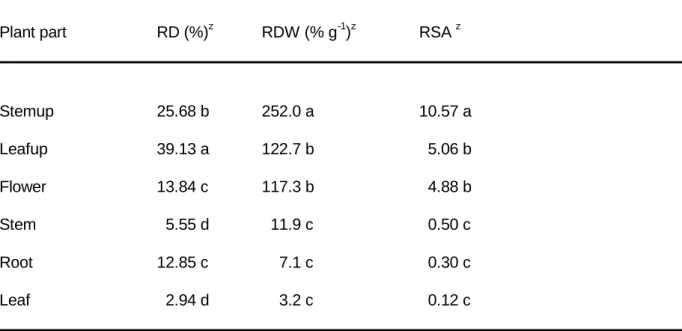
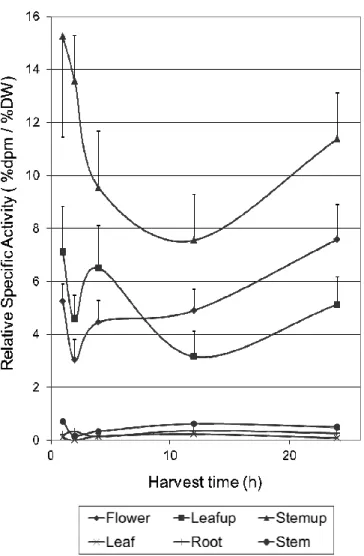
The 14C-sucrose experiment demonstrated that injected sucrose reached the flower in considerable amounts. Radioactivity concentration and RSA followed the same pattern over time and only RSA is presented (Fig. 1). The percent of radioactivity recovered above the injection site was approximately 78%, with Leafup and flower accounting for 53% and Stemup for 25% (Table1). The lowest radioactivity concentrations (and RSA) were found in plant parts below the injection site. No differences were found in radioactivity distribution, radioactivity concentration or RSA among the harvest times or between the acclimatized versus non-acclimatized plants.
3.2 Flower longevity, carbohydrates and flower respiration.
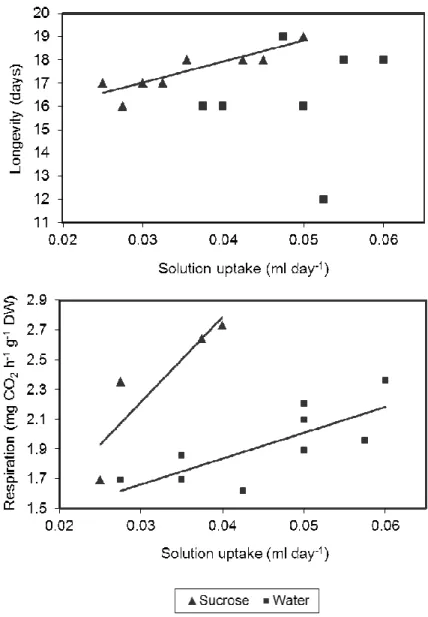
Under interior conditions, the type of senescence for ‘Meijikatar’ flowers is predominantly flower abscission (no petal drop and some petal wilting just before flower abscission). Sucrose infusions increased flower longevity by 1.5 days (Table 2). Flower longevity increased as sucrose solution uptake increased but there was no correlation between water uptake and longevity (Fig. 2A). Solution uptake rate was higher (significant at P<0.01) in the water treatment (0.049 ml day-1) compared to the sucrose treatment (0.036 ml day-1). Solution uptake rate was also higher in the first two to three days (approximately 0.2-0.5 ml day-1) and then decreased to approximately 0.02-0.05 ml day-1 for the remaining of the experiment. The blue dye appeared in the flowers three to four hours after start of infusion. If it was not apparent at that time it would not appear at all. Flower respiration at day 6 after anthesis was positively correlated with water and sucrose solution uptake (Fig. 2B). However, for the same increment in solution uptake, sucrose treated plants increased flower respiration more than 3 times (regression slopes different at P=0.001) than the water infused plants (Fig. 2B).
At day 6 after anthesis in the stem, percent of soluble sugars in sucrose treated plants was 6.3 % higher than in water treated plants (significant at P=0.04). This effect was due to a considerable
decrease in the starch levels (less 2.9 mg of glucose equivalents g-1 DW) and a very small increase in the levels of soluble sugars (more 0.2 mg of glucose equivalents g-1 DW) in the sucrose treated plants. No other differences in the carbohydrate levels were found, at this time point between these two treatments in the other plant parts.
Flower respiration was positively correlated with flower starch and stem starch for the sucrose treatment 6 days after anthesis (Fig. 3), however, no correlations could be found for the water treatment (Fig. 3).
The average plant absorbed 1.01 mg of glucose equivalents of infused sucrose per day. Based on the labeled carbon studies, 78% was translocated above the injection site. Therefore 0.79 mg of glucose equivalents were supplied exogenously to the flowering stem, which is approximately equal to the differential in daily respiration between the sugar and water treated plants (4.6 and 3.8 mg of glucose equivalents respired per day, respectively, at day 6 after anthesis).
At flower death, leaf soluble carbohydrates (and as a consequence, percent of soluble sugars and total nonstructural carbohydrates) were higher (significant at P=0.026) in the sucrose treated plants (44.8 mg of glucose equivalents g-1 DW), compared to the water treated plants (40.1 mg of glucose equivalents g-1 DW) but no other differences in carbohydrate levels were found between treatments, at this stage. Pooling the data from the two infusion treatments, positive correlations were obtained between flower longevity and: levels of flower soluble sugars, percent of soluble sugars and total non-structural carbohydrates, at flower death (Fig. 4). However, these correlations should be taken with appropriate reserve, since they rely on a limited amount of data.
4. Discussion 4.1 The method
shortly after infusion started, suggest an initial sucrose transport through the transpiration stream and a posterior transport through the phloem. This suggestion agrees with the works of Sacalis (1975) and Kaltaler and Steponkus (1974) on cut roses 14C-sucrose uptake, as well as with the work of Boyle et al. (1991a) with sucrose infusion on maize.
Considerable variability was observed in RSA of 14C-sucrose, solution uptake in the infusion experiments and, appearance or not of the dye in the flowers. Possibly, the causes were plant variability, variations in establishment of good injection sites and/or, partial clogging of the needles.
It is unclear whether the solution uptake was over abundant and the sucrose was being forced into the plants or whether the plants were actively limiting the uptake as a function of their needs. Also, perhaps the plants could use more solution, but the infusion system exerted limitations on the uptake. Most probably a combination of these three types of supply took place. In the first two to three days, solution uptake was probably over abundant, only limited by the transpiration stream, the area of vessels in contact with the needle and some occasional clogging (uptake was high and the dye would appear in the flower). After this initial period, xylem occlusions became important and a considerable part would be transported via the phloem or some callus originating in the injection site. When this occurred, uptake was greatly reduced, the dye was not translocated and, in some plants a callus could be seen at the injection site. At this stage, solution uptake was probably lower than the overall need of the plant, partially controlled by the tissue export rate, by the degree of xylem occlusion and by the amount and type of cells in contact with the needle aperture. Anyway, after the initial two to three days, solution uptake was rather constant, probably excluding a control of solution uptake through carbohydrate needs. Since uptake rates were higher for water than for sucrose solution osmotic potential seems to play a role. As noticed on irrigation frequency, plant transpiration rates strongly decreased during the
first days under interior conditions, in a somewhat similar way to solution uptake, suggesting a possible role for plant transpiration on solution uptake. It would be interesting to assess the effect of transpiration rate on solution uptake.
4.2 Exogenous carbohydrates, flower respiration, carbohydrate levels and flower longevity
Sucrose infusion increased postproduction flower longevity. The 1.5 days increase in flower longevity is probably not significant for the commercial ground. In this work only one flower was allowed to develop by plant, strongly reducing competition for carbohydrates. Most probably, the effect of the sucrose infusion would have been stronger if more flowers had been left in the plant. Nevertheless, the correlation between flower longevity and solution uptake suggests that if a higher amount of exogenous sucrose is supplied a greater increase in flower longevity may occur. Thus, in an intact rose, flower longevity is controlled, at least in part, by carbohydrate availability in the flower and the upper limit for flower longevity (i.e. under a continuous over abundant supply of carbohydrates) is still unknown.
Exogenous sucrose increased flower longevity, increasing or sustaining flower respiration, as found previously for cut roses (Marousky, 1969). In potted miniature roses, higher respiration rates correlated to decreased longevity, for Spring/Summer grown plants (Monteiro et al., 2001a). In the present study, the sucrose infusions allowed for longer longevities, as well as, higher respiration rates which may seem contradictory to the previous report (Monteiro et al., 2001a). However no contradiction exists, since flower respiration of Spring/Summer grown plants is believed to measure the velocity of flower development of the different cultivars (genetically determined and, under no considerable environmental restraints). The present study assessed the effects of adding an extra amount of carbohydrates to that development event (evaluating the response of a specific genetic program).
At day 6 after anthesis, all the carbohydrates exogenously supplied were respired by the flower, as confirmed by no differences in the carbohydrate levels between treatments. It is also possible that the exogenous supply of carbohydrate made available some of the stored carbohydrates in the plant. This thought is supported by a) the rise in the percent of soluble sugars in the stem six days after anthesis and b) the positive correlations found only for the sucrose infused plants, between flower respiration and flower starch or stem starch six days after anthesis. Additionally, the data indicates that all the infused sucrose was respired by the flower, based on the assumption that all the sucrose was transported above the injection site to the flower, which is not necessarily true. It is possible that stem and leaves above the injection site may have also increased their respiration.
At flower death, leaf soluble carbohydrate, percent of soluble sugars and total nonstructural carbohydrates were higher in the sucrose treated plants, which was not expected assuming that all exogenous sucrose was respired by the flowers. Most probably, close to flower death, or even at flower death but before external symptoms were visible, carbohydrate consumption by the flowers ceased, and as a consequence of continuous exogenous supply, carbohydrate levels could be expected to increased in other translocation destinies, or organs where they would usually be in transit, i.e. leaves. This agrees with previous reports (Sacalis, 1975) for cut roses, where the 14C-sucrose from the vase solution moved first to leaves and stems and, only later it was translocated from leaves and stems to the flowers. This same line of thought may explain why flower soluble sugars, percent of soluble sugars and total non-structural carbohydrates, at flower death, positively correlated (although based on a limited amount of data and with small r2) with flower longevity (Fig. 4). If flowers ceased carbohydrate consumption before carbohydrate unloading stopped, then carbohydrate levels in the flowers, at death, would relate to the allocation rate of carbohydrates to the flower. Carbohydrate allocation rate to the flower was not detected in
flower carbohydrate levels, at day 6 after anthesis, probably because of carbohydrate consumption through flower respiration.
It is unknown whether the exogenous sucrose overcomes an already existent carbohydrate limitation as in cut flowers or somehow overcomes normal regulation of rose’s flower longevity. Nevertheless, the importance of an abundant carbohydrate supply to the flower, during postproduction, is clear. Growing conditions that will increase this supply will benefit miniature rose postproduction longevity. In attached roses in this area, little has been reported, however, increased production temperature is known to increase longevity of miniature roses (Monteiro et al., 2001b), most probably through increased carbohydrate partitioning to the flowers (Khayat and Zieslin, 1989 ). Plant, or plant organ carbohydrate levels, per se, seem of limited value since they only relate to the amount of carbohydrates available to the flower in very specific situations.
Further research is needed, with improved methods, to evaluate how far attached flower longevity can be extended with an exogenous carbohydrate supply.
5. Acknowledgements
This research was supported in part by grants from American Floral Endowment and Junta de Investigação Científica e Tecnológica (Programa Ciência, Portugal). We thank Yodder Brothers (Parrish, Florida, U.S.A.) for supplying the plants and Dr. Rebecca Darnell for providing laboratory equipment and advice for the 14C-sucrose experiment.
References
Boyle, M.G., Boyer, J.S., Morgan, P.W., 1991a. Stem infusion of maize plants. Crop Sci. 31, 1241-1245.
reproductive failure of maize at low water potential. Crop Sci. 31, 1246-1252.
Dubois, M., Giles, K.A., Hamilton, J.K., Rebers, P.A., Smith F., 1956. Colorimetric method for determination of sugars and related substances. Analytical Chemistry 28, 350-356.
Fjeld, T., 1992. Effects of temperature and irradiance level on carbohydrate content and keeping quality of Christmas begonia (Begonia x cheimantha Everett). Scientia Hortic. 50, 219-228. Heitholt, J.J., Egli, D.B., Leggett, J.E., MacKown, C.T., 1986. Role of assimilate and carbon-14 photosynthate partitioning in soybean reproductive abortion. Crop Sci. 26, 999-1004.
Kaltaler, R.E.L., Steponkus, P.L., 1974. Uptake and metabolism of sucrose in cut roses. J. Amer. Soc. Hort. Sci. 99, 490-493.
Khayat, E., Zieslin, N., 1989. Translocation of 14C, carbohydrate content and activity of the enzymes of sucrose metabolism in rose petals at different night temperatures. Physiol. Plant. 76, 581-585.
Marousky, F.J., 1969. Vascular blockage, water absorption, stomatal opening, and respiration of cut `Better times' roses treated with 8-Hydroxyquinoline citrate and sucrose. J. Amer. Soc. Hort. Sci. 94, 223-226.
Miller, S.H., Heins, R.D., 1986. Factors influencing premature cyathia abscission in poinsettia 'Annette Hegg Dark Red'. J. Amer. Soc. Hort. Sci. 111, 114-121.
Monteiro, J.A., 1991. Potted chrysanthemum postproduction longevity: carbon exchange rates, dry matter and nonstructural carbohydrates. M. S. Thesis, University of Florida, Gainesville. Monteiro, J. A., Nell, T.A., Barrett, J.E., 2001a. Postproduction of potted miniature rose: flower respiration and single flower longevity. J. Amer. Soc. Hort. Sci. 126, 134-139.
Monteiro, J. A., Nell, T.A., Barrett, J.E., 2001b. High production temperature increases postproduction flower longevity and reduces bud drop of potted miniature roses 'Meirutral' and 'Meidanclar'. HortScience 36, 953-954.
Sacalis, J.N., 1975. Sucrose: patterns of uptake and some effects on cut flower senescence. Acta Horticulturae 41, 45-55.
Stamps, R.H., 1984. Production temperature effects on anatomy, morphology, physiology and postharvest longevity of leatherleaf fern (Rumorha adaintiformis Forst. Ching). Ph.D. Dissertation, University of Florida, Gainesville.
Table 1 - Radioactivity distribution (RD = % dpm on total translocated), radioactivity concentration (RDW = % dpm g-1 DW) and relative specific activity (RSA = % dpm per % DW) per plant part of ‘Meijikatar’ potted miniature roses (Experiment 1). Average from 5 harvest times (1, 2, 4, 12 and 24 h after injection).
Plant part RD (%)z RDW (% g-1)z RSA z
Stemup 25.68 b 252.0 a 10.57 a Leafup 39.13 a 122.7 b 5.06 b Flower 13.84 c 117.3 b 4.88 b Stem 5.55 d 11.9 c 0.50 c Root 12.85 c 7.1 c 0.30 c Leaf 2.94 d 3.2 c 0.12 c z
Duncan's Multiple Range Test: means followed by the same letter (in columns) are not different at P=0.05.
y
Stemup = injected stem 1 cm above the injection site; Leafup = all leaves 1 cm above the injection site; Flower = terminal flower of the injected stem; Stem = all other stems in the plant; Root = all roots; Leaf = all leaves not included in Leafup.
Table 2 - Flower longevity of ‘Meijikatar’ potted miniature roses for two infusion treatments (Experiment 2).
Block-Date Longevity (days)z
____________________________ Water 3% Sucrose _____________________________________________________ 1- August 1991 18.1 ± 0.3 20.6 ± 2.5 2-September 1992 19.8 ± 1.7 23.4 ± 1.7 3-October 1992 16.4 ± 0.8 17.0 ± 0.6 4-December 1992 13.4 ± 0.8 15.1 ± 0.4 5-February 1993 16.5 ± 0.9 17.6 ± 0.3 Significant at P= Experiment 16.8 18.3 0.015 z
Figure 1 – Time evolution of Relative Specific Activity on the different plant parts, for plants kept under interior conditions. Symbols represent means of four replicates. For plant parts above the injection site, standard errors are presented as vertical bars. Stemup = injected stem 1 cm above the injection site; Leafup = all leaves 1 cm above the injection site; Flower = terminal flower of the injected stem; Stem = all other stems in the plant; Root = all roots; Leaf = all leaves not included in Leafup.
Figure 2 - Correlations between solution uptake rate and (A) flower longevity or (B) flower respiration rate at day 6 after anthesis, of ‘Meijikatar’ potted miniature roses. Each point represents an individual plant. Flower longevity positively correlated with sucrose solution uptake (Y=14.32+90.37x, r2=0.73, significant at p=0.003). Flower respiration positively correlated with water uptake (Y=25.88+394.30x, r2=0.58, significant at P=0.017) and with sucrose solution uptake (Y=11.35+1297.536x, r2=0.79, significant at P=0.109), the two slopes being different at P<0.001.
Figure 3 - Correlations between flower respiration at day 6 after anthesis and starch levels of ‘Meijikatar’ potted miniature roses (Experiment 5, February 1993). In the sucrose infusion treatment, flower respiration positively correlated with (A) flower starch (Y=-74.23+11.58x, r2=0.83, significant at P=0.08) and with (B) stem starch (Y=-142.10+21.11x, r2=0.93, significant at P=0.032). Each point represents an individual plant.
Figure 4 - Correlations between flower longevity and flower non-structural carbohydrate levels at flower death, of ‘Meijikatar’ potted miniature roses. Data were pooled over treatments. Each point represents an individual plant. Flower longevity positively correlated with (A) percent of soluble sugars (Y=-20.18+0.41x, r2=0.47, significant at P=0.041), (B) soluble sugars (Y=6.37+0.18x, r2=0.69, significant at P=0.005) and total non-structural carbohydrates (Y=6.08+0.17x, r2=0.58, significant at P=0.016).