
O
riginal Article
1Department of Physical Chemistry, Faculty of Chemistry, University of Santiago, 15782, Santiago de Compostela, Spain, 2CIQA and DQF,Faculty of Science and Technology, University of Algarve, Campus of Gambelas, 8005-139 Faro, Portugal
Address for correspondence: Dr. José A. Moreira, E-mail: [email protected]
Received : 13-07-10 Review completed : 03-08-10 Accepted : 09-12-10
E
xposure of humans to excess nitrosating species from the diet, cosmetics, pharmaceuticals, the environment or from overproduction of endogenous nitric oxide (NO) is commonly linked to mutagenic and carcinogenic events.[1,2] The reactive nitrogen species (RNS), which comprise of nitric oxide, dinitrogen trioxide, nitrite, nitroxyl and nitrosonium ions, and nitrous acid, are interconnected through a series of reactions that can be admitted to start either with the generation of NO from arginine by nitric oxide synthase or with the transformation of nitrite ions into nitrous acid in the acidic environment ofthe stomach.[1,3] It was recently proven that dinitrogen trioxide has a biological relevance, as it originates not only from the reaction of nitric oxide with oxygen, but can also be formed by the reaction of nitric oxide with a superoxide.[4]
Nitrosative deamination of the DNA bases, involving either a direct reaction with RNS or a nitroso group transfer from NO donors such as N-nitrosamides and N-nitrosamines,[5-8] can lead to mutagenesis through misincorporation by DNA polymerase, misrepair, or no repair of the resulting deamination products, which may result in the formation of abasic sites. The diazonium ions thus formed in the bases with aminic nitrogen may undergo nucleophilic substitution by water, leading to the transformation of cytosine, guanine, and adenine in uracil, xanthine, and hypoxanthine, respectively.[5-7,9,10] Published results point to guanine being more reactive than adenine toward sodium nitrite in acidic medium and to cytosine not reacting at all.[11] Moreover, N-nitrosamines, upon metabolic activation by cytochrome P450, form DNA oxidizing and alkylating agents.[12]
Importance of phenols structure on their activity
as antinitrosating agents: A kinetic study
Márcia Pessêgo1,2, Ana M. Rosa da Costa2, José A. Moreira2
ABSTRACT
Objective: Nitrosative deamination of DNA bases induced by reaction with reactive nitrogen species (RNS) has been pointed out as a probable cause of mutagenesis. (Poly)phenols, present in many food items from the Mediterranean diet, are believed to possess antinitrosating properties due to their RNS scavenging ability, which seems to be related to their structure. It has been suggested that phenolic compounds will react with the above-mentioned species more rapidly than most amino compounds, thus preventing direct nitrosation of the DNA bases and their transnitrosation from endogenous N-nitroso compounds, or most likely from the transient N-nitrosocompounds formed in vivo. Materials and Methods: In order to prove that assumption, a kinetic study of the nitroso group transfer from a N-methyl-N-nitrosobenzenesulfonamide (N-methyl-N-nitroso-4-methylbenzenesulfonamide, MeNMBS) to the DNA bases bearing an amine group and to a series of phenols was carried out. In the transnitrosation of phenols, the formation of nitrosophenol was monitored by Ultraviolet (UV) / Visible spectroscopy, and in the reactions of the DNA bases, the consumption of MeNMBS was followed by high performance liquid chromatography (HPLC). Results: The results obtained point to the transnitrosation of DNA bases being negligible, as well as that of phenols bearing electron-withdrawing groups. Phenols with methoxy substituents in positions 2, 4, and / or 6, although they seemed to react, did not afford the expected product. Phenols with electron-releasing substituents, unless these blocked the oxygen atom, reacted with our model compound at an appreciable rate. O-nitrosation of the phenolate ion followed by rearrangement of the C-nitrosophenol seemed to be involved. Conclusion: This study provided evidence that the above compounds might actually act as antinitrosating agents in vivo.
KEY WORDS: Antinitrosating action, DNA bases, Kinetics, N-methyl-N-nitrosobenzenesulfonamides, Phenols, Transnitrosation
How to cite this article: Pessêgo M, Rosa da Costa AM, Moreira JA. Importance of phenols structure on their activity as antinitrosating agents: A kinetic study.
J Pharm Bioall Sci 2011;1:128-34
Access this article online
Quick Response Code:
Website: www.jpbsonline.org DOI:
Pessêgo, et al.: Phenols antinitrosating activity
Phenolic compounds are known to act as natural antioxidants and antinitrosating agents. A regular intake of (poly)phenolic compounds widely found in fruits, vegetables, tea, and red wine is believed to decrease the incidence of certain forms of cancer, and for that reason they are commonly regarded as chemopreventive agents.[1,13] The antioxidant properties of phenols are determined by their radical scavenging ability and consequent inhibitory action on lipid peroxidation under oxidative stress conditions, which correlate with their substitution pattern.[14]
The antinitrosating activity of phenols is thought to be due to their action as RNS scavengers, thus preventing both direct nitrosation of DNA bases[11] and endogenous formation of carcinogenic N-nitroso compounds,[15,16] by reacting with the above-mentioned species more rapidly than most amino compounds. However, along with this long-known inhibitory effect on the formation of N-nitrosamines, phenols and some polyphenols have been reported to act as catalysts rather than inhibitors of such reactions.[17] A mechanism is proposed, in which the quinone monoxime tautomer of a nitrosophenol reacts with nitrous acid to produce an intermediate nitrosating agent, which undergoes an attack by the amine to produce N-nitrosamine and regenerate the catalyst,[18] although it has been stressed that catalytic activity is only observed when the nitrosating agent concentration significantly exceeds the concentration of phenol, which is rare in vivo or in environmentally significant situations.[19] It has also been observed that the introduction of a nitroso group in phenols brings about a loss in their antioxidant activity.[14]
The purpose of this study is to acquire a deeper understanding of the mechanism of DNA base transnitrosation by NO donors, and on the possible action of phenols in avoiding that reaction, by comparing the relative rates of the nitroso group transfer to both classes of nucleophiles, using N-methyl-N-nitroso-4-metilbenzenesulfonamide (MeNMBS) as model compound. This and other N-methyl-N-nitrosobenzenesulfonamides have been used before as nitrosating agents in the study of the transnitrosation of amines[20] and phenols.[21] In addition, we expect to collect more evidence on the mechanism of nitrosophenol formation, as there has been some discussion on whether the reaction occurs directly at the carbon atom[19,22,23] or the previous formation of an O-nitroso intermediate is involved.[21,24] The nitrosation of OH-blocked ‘phenols,’ such as anisole, is possible when the mechanism involves the nitrosonium ion polar reaction,[25] but it will not be observed when the reaction follows the oxidative pathway via the phenoxy radicals, because the formation of those are hindered, as observed by Daiber et al.[26]
We must also remark that the team of Luis García-Rio was developed a rather elegant methodology to distinguish reactivity in ambident nucleophiles. In their case they have been able to determine that for the nitrosation of enols, the reaction follows two parallel pathways, one involving C-nitrosation and the other O-nitrosation.[27]
Materials and Methods
Reagents and equipment
Reagent grade guanine, cytosine, adenine, uracil, hypoxanthine, guaicol (2-methoxyphenol), 3-methoxyphenol, 2-bromophenol, 3-bromophenol, 2,3-dimethoxyphenol, 2-chlorophenol, 2-fluorophenol and 2,6-di-tert-butylphenol, sulfanilamide and N-1-naphtylethylenediamine from Aldrich, xanthine from Sigma, 4-methoxyphenol, 4-chlorophenol and N-methyl-N-nitroso-4-metilbenzenesulfonamide (MeNMBS) from Merck, carvacrol (2-methyl-5-isopropylphenol), 4-bromophenol, 3,5-dimethoxyphenol and syringol (2,6-dimethoxyphenol) from Fluka, 3,5-di-tert-butylphenol from Enamine, N-methyl-4-metilbenzenesulfonamide (MeMBS) from Ega-Chemie were used; thymol (5-methyl-2-isopropylphenol) and anisole were from Riedel-de-Haën; the latter was previously distilled and the second fraction (41–42ºC) [24] was used. HPLC grade acetonitrile and methanol were from Lab-Scan, and 1,4-dioxane from Riedel-de-Haën and bidistilled water from a quartz bidistiller. An UV-Vis spectrophotometer (Varian Cary 50 Bio), an HPLC (Agilent 1100) with RP-18 LiChrospher column (250 × 4 mm, 5 µm), and diode array UV-Vis detector, a thermostated bath (Julabo F12), with ± 0.1ºC precision and a pH meter (Thermo Orion 4 Star pH-ISE Benchtop) were used. In the kinetic studies, the experimental points were adjusted to equations using GraFit® 5.0.5. (Erithacus Software Limited).
Solutions
The following solutions were prepared: phosphate buffer 50 mM, pH 3 and 4, and 0.1 M, pH 9.5, 10, 10.25, 10.75, 11, and 11.5; guanine 1.75 × 10⁻⁴, 2.6 × 10⁻⁴, 3 × 10⁻⁴, and 3.5 × 10⁻⁴ M, in pH 3 and pH 4 phosphate buffer; cytosine 1.75 × 10⁻⁴, 2.5 × 10⁻⁴, 3.5 × 10⁻⁴, 1 × 10⁻³, 5 × 10⁻³, and 1 × 10⁻² M, in pH 3 phosphate buffer; adenine 2 × 10⁻⁴, 1 × 10⁻³, 3 × 10⁻³, 5 × 10⁻³, 7 × 10⁻³, and 1 x 10⁻² M, in pH 3 phosphate buffer; 0.1 and 0.3 M of each phenol in dioxane; 0.01 M of MeNMBS in dioxane; 0.01 M of 2,2,6,6-tetramethyl-1-piperidinyloxy (TEMPO) in water.
Kinetic study of the acidic transnitrosation of DNA bases
In the study of the DNA base concentration effect on the reaction rate, the appropriate volumes of pH 3 solutions were placed in a vial in order to get the following final concentrations: guanine 1.74 × 10⁻⁴ to 3.48 × 10⁻⁴ M; cytosine 1.74 × 10⁻⁴ to 9.93 × 10⁻³ M; and adenine 1.99 × 10⁻⁴ to 9.93 × 10⁻³ M. After stabilization at 35ºC for 10 minutes, MeNMBS solution was added, to a final concentration of 6.67 × 10⁻⁵ M, in a total volume of 3 mL. To determine the pH effect on the reaction between guanine and MeNMBS, the previous study was repeated at pH 4. The decay of MeNMBS concentration with time was obtained from the peak areas at 247 nm in the HPLC chromatograms of the reaction mixture. In the analysis of the reaction mixtures of guanine and cytosine, a step gradient from a sodium phosphate buffer (50 mM, pH 3), to a mixture of 40% buffer and acetonitrile was used. Retention times were: guanine 7.0 minutes, xanthine 11.2 minutes, cytosine 3.1 minutes,
uracil 5.0 minutes, MeMBS 19.9 minutes, and MeNMBS 22.9 minutes. For the reactions of adenine, elution was carried by a step gradient from a mixture of 87.5% phosphate buffer (50 mM, pH 4 and 2 mM in triethylamine) with methanol to 30% buffer. Retention times were: hypoxanthine 3.7 minutes, adenine 9.3 minutes, MeMBS 15.6 minutes, and MeNMBS 17.9 minutes.
Kinetic study of the basic transnitrosation of phenols
In the study of the phenol concentration effect on the reaction rate, appropriate volumes of solutions to get final concentrations ranging from 1 × 10⁻³ to 6 × 10⁻³ M, were pipetted to a spectrophotometer quartz cell containing pH 10.75 buffer solution. The cells were placed in the spectrophotometer and allowed to stabilize for 15 minutes at 25ºC and MeNMBS solution was added to the final concentration of 1 × 10⁻⁴ M, in a total volume of 3 mL. To determine the pH effect, the study was carried in buffer solutions from pH 9.5 to 11.5. The formation of nitrosophenol was monitored by measuring the solution absorbance at the appropriate wavelength [Table 1]. The quantification of the by-product phenol p-toluenesulfonate was made by HPLC analysis of the reaction mixture in a 60% acetonitrile / 40% water mixture and the product distribution was established by conjugation of this data, with quantification of the initial MeNMBS, using the Shin’s method.[29] Retention times were: NO-thymol 2.7 minutes, thymol 6.7 minutes, NO-carvacrol 3.7 minutes, carvacrol 6.3 minutes, 3-methoxyphenol 2.8 minutes, 3-methoxyphenol tosylate 9.3 minutes, 3,5-dimethoxyphenol 2.9 minutes, 3,5-dimethoxyphenol tosylate 10.5 minutes, and MeMBS 3.1 minutes.
Synthesis of nitrosophenols and phenyl p-toluenesufonates
In order to determine the appropriate wavelength to follow the
transnitrosation reactions, authentic samples of nitrosophenols were synthesized by acidifying a mixture of phenolate and sodium nitrite with sulfuric acid.[30a] In the reaction of 3,5-di-tert-butylphenol no isolable product was formed. The hindered 2,6-dimethoxyphenol was nitrosated by dissolution in an ethanolic hydrochloric acid solution, to which sodium nitrite was gradually added.[30b] Nitrosation of anisole was performed with sodium nitrite in a mixture of dichloromethane and trifluoroacetic acid.[30c] The product had a λ
max at 350 nm. Phenols were tosylated with p-toluenesulfonyl chloride in pyridine to afford the corresponding phenyl p-toluenesufonate to be used as standards in HPLC analysis of the reaction mixtures.[30d]
Kinetic study of the basic transnitrosation of phenols in the presence of a radical trap (TEMPO)
Volumes of 50 µL of 0.3 M solution of 3-metho x yphenol, 90 µL of TEMPO solution, 70 µL of 1,4-dio x ane, and 2760 µL of pH 10.75 phosphate buffer solution were pipetted to a quartz cell. After temperature stabilization, 30 µL of MeNMBS solution was added and the formation of 4-nitrosophenol monitored. A control experiment was set at the same time and the radical trap solution replaced by the same volume of buffer, which amounted to 2850 µL. The same tests were made with thymol.
Results and Discussion
The transnitrosation of DNA bases [Figure 1] was studied in acidic medium due to their low solubility at higher pH values, guanine being the least soluble of them, which limited the range of concentrations that could be used. At low pH, N-Nitrosobezenesulfonamides undergo hydrolysis, so a competition between both processes is expected. The observed rate constant for the consumption of MeNMBS should be the sum of the two contributions: transnitrosation (kT) and hydrolysis (kH+), according to eq. 1.
kobs=kT [DNA base]+kH+[H+] (1)
Although UV / Vis spectroscopy is broadly used to monitor the progress in organic reactions, mainly due to spectral similarities of the involved species, HPLC with diode array detection proved to be a more reliable quantitative methodology.
Reaction of MeNMBS (66.7 µM) with excess guanine (174 to 348 µM), corresponding to pseudo first-order conditions, was carried out in dioxane/water (~1 : 150), at 35ºC and a pH 3 phosphate buffer. The decay of the former was monitored by
Figure 1: Transnitrosation step in the nitrosative deamination of
guanine
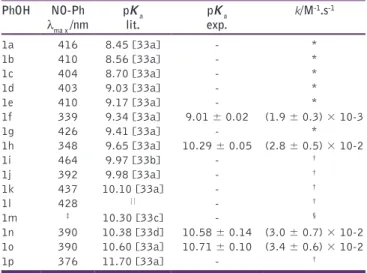
Table 1: Rate constants for reactions between MeNMBS and phenols PhOH NO-Ph λma x /nm pKa lit. pexp.Ka k/M -1.s-1 1a 416 8.45 [33a] - * 1b 410 8.56 [33a] - * 1c 404 8.70 [33a] - * 1d 403 9.03 [33a] - * 1e 410 9.17 [33a] - * 1f 339 9.34 [33a] 9.01 ± 0.02 (1.9 ± 0.3) × 10-3 1g 426 9.41 [33a] - * 1h 348 9.65 [33a] 10.29 ± 0.05 (2.8 ± 0.5) × 10-2 1i 464 9.97 [33b] - † 1j 392 9.98 [33a] - † 1k 437 10.10 [33a] - † 1l 428 || - † 1m ‡ 10.30 [33c] - § 1n 390 10.38 [33d] 10.58 ± 0.14 (3.0 ± 0.7) × 10-2 1o 390 10.60 [33a] 10.71 ± 0.10 (3.4 ± 0.6) × 10-2 1p 376 11.70 [33a] - †
*The reaction proceeded very slowly and the data did not fit properly. A first order integrated equation; †Product formation was not observed; ‡Failed to react with acidic nitrite; §Impossible to solubilize in the
Pessêgo, et al.: Phenols antinitrosating activity
HPLC analysis of the reaction mixture. The corresponding peak areas in the chromatograms were adjusted to a first-order integrated equation for each guanine concentration and the corresponding value of kobs calculated.
The plot of kobs against the guanine concentration proved the reaction to be independent of DNA base concentration, which meant that MeNMBS was being hydrolyzed and no transnitrosation occurred, at least to a measurable extent. The estimated value of kH+ compares to the value determined in our laboratory following the hydrolysis of MeNMBS at the same temperature by UV/Vis spectroscopy, 5.5×10⁻² M-1 s-1. At pH 4, although hydrolysis was slower, it still prevailed over transnitrosation.
The same procedure was applied to cytosine and adenine, but because of their higher solubilities, wider ranges of concentrations could be used: 174 µM to 9.93 mM for the former and 199 µM to 9.93 mM for the latter. In both cases results were the same as those obtained with guanine.
In the reaction of phenols with nitrosating agents, the major product is the corresponding 4-nitrosophenol 2, the most stable isomer, due to a tautomeric equilibrium with the quinone monoxime form. A small percentage of the 2-nitroso compound may also form, except when position 4 holds a substituent, in which case the latter is formed exclusively. When the phenol bears a methoxy substituent in position 3, and because of electronic factors, the opposite distribution of products is observed.[31]
It has been discussed whether the reaction occurs directly at the carbon atom or if the previous formation of an O-nitroso intermediate is involved. Casado et al,[19,22,23] have shown
unambiguously that the reaction with nitrous acid occurs by the first of these mechanisms. However, other nitrosating agents, like nitrososulfonamides[21] and alkyl nitrites,[24] in basic media, present a different behavior. In both cases, the possibility of the formation of an unstable aryl nitrite, which, upon homolysis followed by recombination, afforded the C-nitroso product, was invoked. A similar combination between nitroso and pheno x y radicals was observed by EPR.[32]
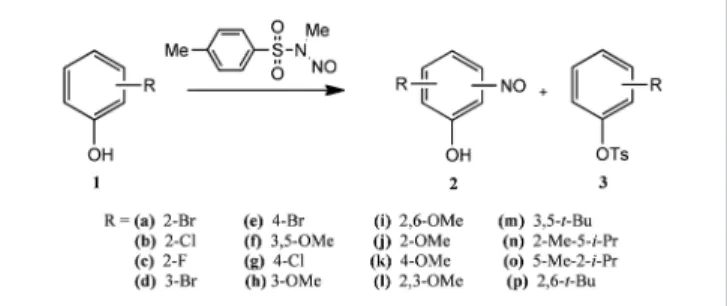
In order to further enlighten the reaction mechanism, kinetic experiments involving the transnitrosation of a series of substituted phenols 1 by N-Methyl-N-Nitroso-4-metilbenzenesulfonamide (MeNMBS) were run at 25ºC in 5% dioxane / water in the pH range 9.5 – 11.5. The ambident character of the electrophile leads, in some cases, to the occurrence of the phenol p-toluenesulfonate 3 along with 2 [Figure 2]. In such cases, the product distribution was established by the conjugation of HPLC analysis of the reaction mixture with quantification of the initial MeNMBS, using Shinn’s method.[29] The obtained results are summarized in Table 1.
Nitrosation of chloro- and bromophenols was reported to be negligible.[19] In fact, the halogenated phenols studied (1a-e and 1g) reacted very slowly with MeNMBS and the absorbance-time data deviated significantly from the best-fitting first order integrated equation. Kinetic constants estimated from the available data were in the order of 10-4 M-1.s-1, which was the magnitude of the basic hydrolysis constant of MeNMBS determined in our laboratory, so a competition between the two reactions should be expected.
In the case of phenols with methoxy substituents in positions 2, 4, and / or 6 (1i-l), the corresponding nitrosophenol (2i-l) was not detected. A probable cause would be a stabilization effect of the intermediate radical, formed by homolysis of the initial aryl nitrite, preventing the recombination step [Figure 3]. Another possible explanation was the fact that methoxy substituents in these positions put a negative charge by resonance in the carbon bearing the hydroxyl group, thus destabilizing the phenoxide ion, although that effectis not very patent in the order of pKa values.
As for 3,5- and 2,6-t-buthylphenols (1m and 1p), the former did not react due to steric hindrance and the latter was not soluble in the medium basicity media. A pH of 12.5 was
Figure 3: Possible stabilization of the pheno x yl radical by the metho x y groups Figure 2: Nitroso group transfer from MeNMBS to substituted phenols
needed to achieve complete solubilization, at which point hydrolysis of MNTS was much faster than transnitrosation. The fact that 2,6-t-buthylphenol was nitrosated by nitrous acid, but the 3,5-isomer was not, clearly emphasizes the difference in mechanism operating in acidic nitrosation and basic transnitrosation.
3,5-dimetho x y- and 3-metho x yphenols as well as carvacrol and thymol (1f, 1h, 1n, and 1o) exhibited fittable absorbance-time data and measurable rate constants. In the last two compounds, nitrosophenol (2n and 2o) was the only product, while in the
Figure 4: None
Figure 6: Brønsted plot for the reactions of phenolates with MeMNTS nitroso group (Insert: Brønsted relationship for monophenols)
Figure 5: Reaction of 3,5-dimetho x yphenol with MeNMBS in 5% dio x ane / water [MNTS] = 1 × 10⁻⁴ M, 25°C. (a) First-order plot relative to
phenol concentration, pH = 11.38; (b) Influence of acidity on the pseudo-first-order rate constant, [PhOH] = 5 × 10⁻³ M
first two formations, p-toluenesulfonate (3f and 3h) was also observed.
In a basic medium [Figure 4], MeNMBS may get hydrolyzed (kOH-), transfer its nitroso group to the phenolate ion (k
N) or undergo attack by the former in its sulfonyl group (kS): The observed rate constant for the formation of nitrosophenols should account for all the processes (eq 2):
kobs= kNuKa [PhOH]+k
OH¯[OH¯] (2)
[H+]+ K a with kNu = kN +kS.
The plot of the pseudo-first-order rate constant against the concentration of phenol showed that the reaction was first-order in the former. The existence of an intercept was indicative of the occurrence of hydrolysis [Figure 5 (a)]. The influence of the medium pH on the reaction rate was accounted for in the first term of the previous equation. A linear plot of such term,
Pessêgo, et al.: Phenols antinitrosating activity
according to eq. 3, showed a decrease in the rate constant with increasing acidity, meaning that the phenolate ion was the active nucleophile. From the slope and intercept, values of pKa consistent with those reported in the literature were found [Figure 5 (b) and Table 1].
1
= 1 + 1 [H+] (3)
kobs kNu [PhOH] kNuKa [PhOH]
The existence of a linear relation between kN and the pKa of those phenols and four others, whose reaction with MeNMBS was reported[21] is patent in Figure 6. The 3-MeO derivative was out of the correlation, as observed by Leis et al.,[24] in the case of nitrosation by alkyl nitrites. The obtained value for βnucl. (1.4 ± 0.2), and the P value (-1.7 ± 0.2) obtained from the Hammett plot [Figure 7] showed that all the reactions of monophenols occurred by the same mechanism, involving the development of a positive charge at the transition state. The fact that no reaction occurred between MeNMBS and anisole (metho x ybenzene) under the same conditions, strongly suggested the involvement of the oxygen atom, with the formation of an aryl nitrite, followed by a Fisher-Hepp-like rearrangement. However, when the reaction was run in the presence of TEMPO, a radical trap, no difference in the values of kobs was noticed, indicating that either radical species were not involved in the O-nitroso to C-nitrosophenol rearrangement or that this occurred after the rate limiting step. The choice of TEMPO as a radical trap could be tricky, as the parent compound TEMPOL could show catalytic activity in the nitrosation of phenols, namely, in reactions with peroxynitritrite.[34] Nevertheless, absence of the kinetic influence of the radical trap supported our previous remark. In fact the possibility of reaction via the nucleophilic carbon cannot be ruled out, and this subject should be considered in further studies.
References
1. d’Ischia M, Panzella L, Manini P, Napolitano A. The chemical basis of the antinitrosating action of polyphenolic cancer chemopreventive agents. Curr Med Chem 2006;13:3133-44.
2. Marletta MA. Mammalian synthesis of nitrite, nitrate, nitric oxide, and n-nitrosating agents. Chem Res Toxicol 1988;1:249-57. 3. Olomos A, Giner RM, Máñez S. Drugs modulating the biological
effects of peroxynitrite and related nitrogen species. Med Res Rev 2007;27:1-64.
4. Daiber A, Schildknecht S, Muller J, Kamuf J, Bachschmid MM, Ulrich V. Chemical model systems for cellular nitros(yl)ation reactions. Free Radic Biol Med 2009;47:458-67.
5. Caulfield JL, Wishnok J, Tannenbaum SR. Nitric oxide-induced deamination of cytosine and guanine in deoxynucleosides and oligonucleotides. J Biol Chem 1998;273:12689-95.
6. Jourd’heuil D, Kang D, Grisham MB. Interactions between superoxide and nitric Oxide: Implications in DNA damage and mutagenesis. Front Biosci 1997;2:d189-96.
7. Nakano T, Terato H, Asagoshi K, Masaoka A, Mukuta M, Ohyama Y,
et al. DNA-protein cross-link formation mediated by oxanine. A novel
genotoxic mechanism of nitric oxide-induced DNA damage. J Biol Chem 2003;278:25264-72.
8. Wang PG, Xian M, Tang X, Wu X, Wen Z, Cai T, et al. Nitric Oxide donors: Chemical activities and biological applications. Chem Rev 2002;102:1091-34.
9. Qian M, Glaser R. 5-Cyanoamino-4-imidazolecarboxamide and nitrosative guanine deamination: Experimental evidence for pyrimidine ring-opening during deamination. J Am Chem Soc 2004;126:2274-5.
10. Lucas LT, Gatehouse D, Jones GD, Shuker DE. Characterization of DNA damage at purine residues in oligonucleotides and calf thymus dna induced by the mutagen 1-nitrosoindole-3-acetonitrile. Chem Res Toxicol 2001;14:158-64.
11. Oldreive C, Zhao K, Paganga G, Halliwell B, Rice-Evans C. Inhibition of nitrous acid-dependent tyrosine nitration and dna base deamination by flavonoids and other phenolic compounds. Chem Res Toxicol 1998;11:1574-9.
12. Lin H, Hollenberg PF. N-Nitrosodimethylamine-mediated formation of oxidized and methylated dna bases in a cytochrome p450 2e1 expressing cell line. Chem Res Toxicol 2001;14:562-6.
13. Craig WJ. Health-promoting properties of common herbs. Am J Clin Nutr 1999;70:491S-9.
14. Rigobello MP, Stevanato R, Momo F, Fabris S, Scutari G, Boscolo R, et al. Evaluation of the antioxidant properties of propofol and its nitrosoderivative. comparison with homologue substitutes phenols. Free Radic Res 2004;38:315-21.
15. Santhosh KT, Swarnam J, Ramadasan K. Potent suppressive effect of green tea polyphenols on tobacco-induced mutagenecity. Phytomedicine 2005;12:216-20
16. Lu MJ, Chen C. Enzymatic tannase treatment of green tea increases
in vitro inhibitory activity against N-nitrosation of dimethylamine.
Process Biochem 2007;42:1285-90.
17. Challis BC, Bartlett CD. Possible cocarcinogenic effects of coffee constituents. Nature 1975;254:532-3.
18. Walker EA, Pignatelli B, Castegnaro M. Catalytic effect of
p-nitrosophenol on the nitrosation of diethylamine. J Agric Food
Chem 1979;27:393-6.
19. González-Mancebo S, García-Santos MP, Hernández-Benito J, Calle E, Casado J. Nitrosation of phenolic compounds: Inhibition and enhancement. J Agr Food Chem 1999;47:2235-40.
20. García-Río L, Leis JR, Moreira JA, Norberto F. Nitroso group transfer from substituted n-methyl-n-nitrosobenzenesulfonamides to amines. Intrinsic and apparent reactivity. J Org Chem 2001;66:381-90. 21. Leis JR, Ríos A. Reactivity of phenolic nucleophiles towards nitroso
compounds. J Chem Soc Perkin Trans 2 1996;5:857-63.
22. González-Mancebo S, Lacadena J, García-Alonso Y, Hernández-Benito J, Calle E, Casado J. Nitrosation of phenolic componds: Effects of alkyl substituents and solvent. Monatsh Chem 2002;133:157-66. 23. Fernández-Liencres MP, Calle E, González-Mancebo S, Casado J.
Nitrosation kinetics of phenolic components of foods and beverages. Int J Chem Kinet 1997;29:119-25.
24. Leis JR, Ríos A, Rodríguez-Sanchez L. Reactivity of phenolic nucleophiles toward nitroso compounds. Part 2. Reaction with alkyl nitrites (O-nitroso compounds). J Chem Soc Perkin Trans 2 1998;12:2729-33.
25. Williams DH. Nitrosation reactions and the chemistry of nitric oxide. Amsterdam: Elsevier; 2004.
26. Daiber A, Mehl M, Ullrich V. New Aspects in the Reaction Mechanism of Phenil with Peroxynitritre: The Role of Phenoxy Radicals. Nitric Oxide 1998;2:259-69.
27. (a) García-Rio L, Mejuto JC, Parajó M, Pérez-Lorenzo M. First kinetic
Figure 7: Hammett plot for the reactions of phenolates with the
Source of Support: Nil, Conflict of Interest: None declared.
discrimination between carbon and oxygen reactivity of enols. J Org Chem 2008;73:8189-205. (b) García-Rio L, Mejuto JC, Parajó M, Pérez-Lorenzo M. Enol nitrosation revisited: Determining reactivity of ambident nucleophiles. EurJOC 2009;26:4525-33.
28. Challis BC, Lawson AJ. The chemistry of Nitroso-compounds. Part II. The nitrosation of phenol and anisole. J Chem Soc 1971;30:770-5. 29. Garcia-Río L, Iglesias E, Leis JR, Peña ME, Ríos A. Reactivity of
nucleophilic nitrogen compounds towards the nitroso group. J Chem Soc Perkin Trans 2 1993;1:29-37.
30. (a) Leonard NJ, Curry JW. The conversion of of p-quinonemonoxime to p-azoxyphenol. J Org Chem 1952;17:1071-6. (b) Kharasch MS, Joshi BS. Reactions of hindered phenols. III. reactions of nitrous acid with hindered phenols. J Org Chem 1962;27:651-3. (c) Radner F, Wall A, Loncar M. Nitrosation of anisole and related compounds. direct synthesis of 4-nitrosoanisole. Acta Chem Scand 1990;44:152-7. (d) Vogel AI. Vogel’s textbook of practical organic Chemistry. 5th ed.
New York: Longman Scientific and Technical; 1989. p. 1248. 31. Hodgson HH, Clay H. The nitrosation of phenols. Part VII. Resorcinol
monomethyl ether and m-cresol. J Chem Soc 1929;2775-8. 32. Oh SMNYF, Williams LH. Nitrosation by Alkyl Nitrites. Part 7.
Comparison with thionitrites: Reactions with phenols. J Chem Soc
Perkin Trans 2 1991;5:685-8.
33. (a) Howard P, Meylan W. Physical/Chemical Property Database (PHYSPROP). syracuse research corporation, environmental science center. NY: North Syracuse; 1999. (b) Chemical Book [homepage on the internet]. Chemical Book; c2008. Available from: http:// www.chemicalbook.com/ProductMSDSDetailCB0112026_EN.htm. [Last cited on 2010 Jul 8]. (c) Varhanickova D, Shiu WY, Mackay D. Aqueous Solubilities of Alkylphenols and Methoxyphenols at 25 ºC. J Chem Eng Data 1995;40:448-51. (d) Galluci MN, Oliva M, Casero C, Dambolena J, Luna A, Zygadlo J, et al. Antimicrobial combined action of terpenes against the food-borne microorganisms Escherichia
coli, Staphylococcus aureus and Bacillus cereus. Flavour Fragr J
2009;24:348-54.
34. Bonini MG, Manson RP, Augusto O. The Mechanism by which 4-Hydroxy-2,2,6,6-tetramethylpiperidine-1-oxyl (Tempol) Diverts peroxynitrite decomposition from nitrating to nitrosating species. Chem Res Toxicol 2002;15:506-11.
![Figure 5: Reaction of 3,5-dimetho x yphenol with MeNMBS in 5% dio x ane / water [MNTS] = 1 × 10 -4 M, 25°C](https://thumb-eu.123doks.com/thumbv2/123dok_br/18657502.912877/6.918.214.707.801.1078/figure-reaction-dimetho-yphenol-menmbs-dio-water-mnts.webp)
