7 77 7 7 Mem Inst Oswaldo Cruz, Rio de Janeiro, Vol. 93(1): 7-13, Jan./Feb. 1998
Ecotopes, Natural Infection and Trophic Resources of
Triatoma brasiliensis
(Hemiptera, Reduviidae, Triatominae)
Jane Costa/
+, Josimar Ribeiro de Almeida*, Celia Britto**, Rosemere
Duarte**, Verônica Marchon-Silva, Raquel da S Pacheco***
Coleção Entomológica, Departamento de Entomologia ***Departamento de Bioquímica e Biologia Molecular, Instituto Oswaldo Cruz, Av. Brasil 4365, 21045-900 Rio de Janeiro, RJ, Brasil *Departamento de Ecologia, Universidade Federal do Rio de Janeiro, Rio de Janeiro, RJ, Brasil **Departamento de Ciências Biológicas,
Escola Nacional de Saúde Pública-Fiocruz, Rio de Janeiro, RJ, Brasil
Triatoma brasiliensis is considered as one of the most important Chagas disease vectors in the north-eastern Brazil. This species presents chromatic variations which led to descriptions of subspecies, syn-onymized by Lent and Wygodzinsky (1979). In order to broaden bionomic knowledge of these distinct colour patterns of T. brasiliensis, captures were performed at different sites, where the chromatic pat-terns were described: Caicó, Rio Grande do Norte (T. brasiliensisbrasiliensis Neiva, 1911), it will be called the “brasiliensis population”; Espinosa, Minas Gerais (T. brasiliensis melanica Neiva & Lent 1941), the “melanica population” and Petrolina, Pernambuco (T. brasiliensis macromelasoma, Galvão 1956), the “macromelasoma population”. A fourth chromatic pattern was collected in Juazeiro, Bahia the darker one in overall cuticle coloration, the “Juazeiro population”. At the sites of Caicó, Petrolina and Juazeiro, specimens were captured in peridomiciliar ecotopes and in wilderness. In Espinosa the specimens were collected only in wilderness, even though several exhaustive captures have been per-formed in peridomicile at different sites of this municipality. A total of 298 specimens were captured. The average registered infection rate was 15% for “brasiliensis population” and of 6.6% for “melanica population”. Specimens of “macromelasoma” and of “Juazeiro populations” did not present natural infection. Concerning trophic resources, evaluated by the precipitin test, feeding eclecticism for the different colour patterns studied was observed, with dominance of goat blood in household surround-ings as well as in wilderness.
Key words: Triatoma brasiliensis - ecotopes - trophic resources - natural infection - different colour patterns
Triatoma brasiliensis Neiva, 1911 has a wide geographical distribution (Alagoas, Bahia, Ceará, Goiás, Minas Gerais, Paraíba, Pernambuco, Piauí, Rio Grande do Norte, Sergipe, Tocantins). It is re-garded as one of the most important vectors of Chagas disease in the northeastern region (Silveira et al. 1984). The different melanic forms have been described as subspecies: T. b. brasiliensis Neiva, 1911; T. b. melanica Neiva & Lent, 1941 and T. b. macromelasoma Galvão, 1956. These subspecies were described on the basis of the pronotum, legs and hemelytron chromatic characters (Galvão 1956). Lent and Wygodzinsky (1979) have con-sidered them as synonymous. A fourth chromatic
pattern was collected by us in Juazeiro, Bahia, and will be referred to in this study as “Juazeiro popu-lation”.
In order to broaden bionomic knowledge on T. brasiliensis, field captures were performed at dif-ferent localities where the distinct chromatic varia-tions were collected: Caicó, Rio Grande do Norte (“brasiliensispopulation”); Espinosa, Minas Gerais (“melanica population”); Petrolina, Pernambuco (“macromelasoma population”) and in Juazeiro, Bahia (“Juazeiro population”). Comparative data among these different melanic forms were obtained regarding ecotopes, trophic resources and natural infection by T. cruzi.
The present study complements morphologi-cal (Costa et al. 1997a), biologimorphologi-cal (Costa & Marchon-Silva 1996, Costa et al. 1996a) and bio-chemical analysis which have detected phenotypi-cal differences among the distinct chromatic pat-terns mentioned (Costa et al. 1997b). The aim was to clarify the taxonomic status at intra- or interspe-cific levels of different populations of T. brasiliensis utilizing multidisciplinary studies.
Presented at the XXII Annual Meeting on Basic Research of Chagas Disease, Caxambu, MG, Brazil and supported by Fundação Nacional de Saúde and CNPq.
+Corresponding author. Fax: +55-21-590.3545 Received 2 December 1996
9 99 9 9 Mem Inst Oswaldo Cruz, Rio de Janeiro, Vol. 93(1), Jan./Feb. 1998 8
88 8
8 Bionomy of T. brasiliensis - Distinct Populations Jane Costa et al.
MATERIALS AND METHODS
Field collections were carried out at different sites: Caicó, Espinosa, Petrolina and Juazeiro. Specimens were obtained by exhaustive and indi-vidual captures, utilizing a pyrethroid (pirisa, 5ml/ 500ml of water). The specimens were carefully picked up with tweezers. Collected insects were housed in flasks with filter paper. All captures were carried out during daytime. Domiciliar, peridomiciliar and silvatic ecotopes were exam-ined.
For the precipitin test the standard protocols were carried out according to Weitz (1956) and Siqueira (1960). Rabbit serum immunized with total proteins of human blood and of domestic and silvatic animals was employed: bird (Gallus gallus), goat (Capra aegagrus), dog (Canis familiaris), horse (Equus caballus), pig (Sus scrofa), opossum (Didelphis marsupialis), rodent (Rattus norvegicus) and armadillo (Dasypus novemcinctus). Each triatomine captured was pressed dorsoventrally at the abdominal region and the faeces drops were deposited over strips of fil-ter paper Klabin no. 80. This procedure allowed to keep the insects alive for further lab tests. After drying the samples, the chromatic pattern and the capture site were registered and all the material was stowed away at 2-8oC. For the test, a 0.5 cm
diam-eter cut was made in the papers containing the samples, and those were eluted by 500 ml of PBS
(phosphate-buffer-solution) and left ovenight in the refrigerator. Each sample was tested with the nine antisera mentioned above. To begin with, 50 ml of
antiserum were poured in a glass capillary. Next, the same volume of the sample was slowly poured so the two wouldn’t mix, but rather formed a con-tact surface with each other. It is in this interface that the sample antigenes get into contact with the antiserum antibodies. When they have an adequate concentration, a precipitation ring is formed. The reading was performed every 30 min for 2 hr.
Each sample was read by two technicians and, whenever necessary the test were repeated to con-firm the results. Positive controls (antiserum + homologous proteine) and negative controls (anti-serum + PBS) were added in each test.
To determine the natural infection rate, the specimens captured were examined through ab-dominal compression, in order to obtain the faeces drops which were deposited on slides, diluted in PBS and observed by light microscopy.
Specimens that presented negative results were fed on normal mice and reexamined 10 days after the blood meal.
The positive specimens were bathed with White solution for 2 hr and later their digestive tubes were
individually dissected, macerated and diluted in PBS. Part of this material was injected in mice and part of it was employed for isolation in culture (BHI) so that the strains could later be typed phe-notypically and gephe-notypically.
RESULTS
Caicó - Domiciliary and peridomiciliary col-lections were carried out in various sites: Sobra-dinho, Salgadinho and Fazendinha. In Sobradinho only one colony was found, with 34 specimens that lived on a stone wall, 5 m from a domicile and another colony, where 13 specimens were captured among rocks near another house in the same site. In the wild, 73 specimens were taken in six sites (Bairro Nova Descoberta, Serraria, São Bernardo Elias, Salgadinho, Pedra do Sino and Seridó). The ecotopes where these specimens were found always presented the same characteristic features: hollow spaces between and under rocks where wild ro-dents find shelter and goats and other breeding animals eventually pass through.
Espinosa - Captures were performed in domi-ciliar and peridomidomi-ciliar ecotopes in various sites (Monte Azul, Charco, São Pedro, Faca 2, Teú and Urandi, the latter in Bahia). Only T. sordida speci-mens were found in abundance in a great variety of peridomiciliar ecotopes, i.e. among roof tiles, wood fences around stables or chicken coops, un-der tree barks, among leaves of palm trees that covered animal shelters of various species (dogs, chicken, pigs). The 95 T. sordida specimens ex-amined were negative for T. cruzi.
In the wild, searches were conducted in rock cavy nests. In these ecotopes 75 specimens were captured from the following sites: Poço, Cana Brava, Sussuarana and Teú.
The specimens captured were found most of the time in deep rock fissures, that were inacces-sible, rendering necessary the use of unhousing. Otherwise, whenever possible, rock fragments, under which the triatomines sheltered, were re-moved. However, some hungry specimens exposed themselves spontaneously, showing the rostrum in readiness to obtain food.
Petrolina and Juazeiro - In the peridomiciliar ecotopes of Petrolina (Catinguinha and Serrote do Urubu) 38 specimens were collected and 27 in Juazeiro (Junco and Aldeia). All the specimens were colonizing the most various ecotopes: under rocks, in wood fences around stables or animal shelters and in bundles of dry wood. In these sites, the household surrounding areas were more re-stricted than those of Espinosa or Caicó, and they presented many shelters for birds, pigs and goats near one another. The common presence of T. sordida and of T. pseudomaculata in the same
habi-tat where specimens of T. brasiliensis were found was observed in Junco, Juazeiro.
In wilderness, the specimens were collected in ecotopes with similar features as those already de-scribed. In Petrolina, the captures were carried out in Catinguinha and in Serrote do Urubu, where 10 and 23 specimens respectively were captured. In Juazeiro captures were carried out in Sacrabetó, Junco, Tapera and Aldeia and only at the first site five specimens were collected.
Regarding the trophic resources, 46 specimens of “brasiliensis population” from peridomiciliar ecotopes and 57 from wilderness were examined. The feeding sources most often observed were goats (56% and 54%, respectively), followed by
dogs (37%) in the peridomicile and armadillos (51%) in wilderness (Table I).
In Espinosa, 47 specimens of “melanica popu-lation” were examined, all of them captured in wilderness where the most explored feeding re-source was goat (57%), followed by armadillo (36%) and opossum (28%) (Table II).
In Petrolina, for the 58 specimens examined in household surroundings and in wilderness, goat blood was the most reacting feeding resource (59 and 61%, respectively), followed by human blood in peridomicile (44%) and bird and armadillo (35%) in wilderness (Table III).
In all studied sites, each triatomine presented a positive reaction for more than one feeding source.
TABLE I
Blood meal sources of Triatoma brasiliensis Neiva, 1911. The “brasiliensis population”, in the locality of Caicó, Rio Grande do Norte
No. of positive reactions for anti-seruma
No. of
Locality specimens Bird Goat Dog Horse Opossum Human Pig Rodent Armadillo examined
In the peridomicile
Sobradinho 46 15 26 17 2 5 14 2 6 13
% 32 56 37 4 11 30 4 13 28
In the wild
Bairro Nova Descoberta 20 6 3 7 9 0 6 4 2 12
Pedra do Sino 5 2 3 1 0 0 0 0 0 2
Serraria 13 4 11 5 0 5 0 0 1 6
São Bernardo Elias 16 4 11 8 1 0 3 0 1 6
Seridó 3 0 3 1 1 0 0 0 1 3
Total 57 16 31 22 11 5 9 4 5 29
% 28 54 39 19 9 16 7 9 51
a: 100 of 103 examined specimens reacted for more than one blood meal; 13 specimens presented no reaction to the anti-serum used.
TABLE II
Blood meal sources of Triatoma brasiliensis Neiva, 1911. The “melanica population”, in the locality of Espinosa, Minas Gerais
No. of positive reactions for anti-seruma
No. of
Locality specimens Bird Goat Dog Horse Opossum Human Pig Rodent Armadillo examined
In the wild
Poço 13 4 6 4 1 7 5 1 1 6
Sussuarana 17 2 12 1 0 2 4 4 1 7
Cana Brava 14 1 9 1 0 1 3 2 1 3
Teú 3 3 0 1 0 3 0 0 1 1
Total 47 10 27 7 1 13 12 7 4 17
% 21 57 15 2 28 26 15 9 36
11 11 11 11 11 Mem Inst Oswaldo Cruz, Rio de Janeiro, Vol. 93(1), Jan./Feb. 1998 10
10 10 10
10 Bionomy of T. brasiliensis - Distinct Populations Jane Costa et al.
DISCUSSION AND CONCLUSIONS
The “brasiliensis population”appears to be the most important chromatic pattern from the epide-miological point of view. Comparing specimens from the Herman Lent collection this pattern pre-sents the most wide geographical distribution: Ceará, Paraíba, Piauí e Rio Grande do Norte; it was not observed simpatry among the different colour patterns (Costa et al. 1997b); the “brasiliensis population” have been captured natu-rally infected in wilderness and in peridomicile ecotopes; this pattern can also occurs indoors in Caicó (Fundação Nacional de Saúde - FNS pers. com.).
The “macromelasoma” and the “Juazeiro popu-lations” were also found in wilderness and in peri-domiciliar environments. However, the natural in-fection rate for T. cruzi was negative for both. Even though, Petrolina and Juazeiro are located in dif-ferent states (Pernambuco and Bahia, respectively). These two populations belong to neighboring sites which are separated by the São Francisco river, thus, sharing a parapatric condiction with the same environmental support capacity.
The “melanica population” was found only in wilderness, showing a different behavior from the other patterns examined. This pattern is clearly in-volved in the maintenance of the wild cycle of T. cruzi.
TABLE III
Blood meal sources of Triatoma brasiliensis Neiva, 1911. The “macromelasoma population”, in the locality of Petrolina, Pernambuco
No. of positive reactions for anti-seruma
No. of
Locality specimens Bird Goat Dog Horse Opossum Human Pig Rodent Armadillo examined
In the peridomicile
Catinguinha 18 2 7 4 0 0 8 0 2 7
Serrote do Urubu 9 4 9 1 0 2 4 0 3 2
Total 27 6 16 5 0 2 12 0 5 9
% 22 59 18 0 7 44 0 18 33
In the wild
Catinguinha 10 2 6 3 0 0 0 0 2 3
Serrote do Urubu 21 9 13 7 2 3 1 0 4 8
Total 31 11 19 10 2 3 1 0 6 11
% 35 61 32 6 10 3 0 19 35
- 5 specimens presented no reaction to the anti-serum used; a: 44 of 58 specimens examined reacted for more than one blood meal.
TABLE IV
Blood meal sources of Triatoma brasiliensis Neiva, 1911. The “Juazeiro population”, in the locality of Juazeiro, Bahia
No. of positive reactions for anti-seruma
No. of
Locality specimens Bird Goat Dog Horse Opossum Human Pig Rodent Armadillo examined
In the peridomicile
Junco 6 3 5 1 0 3 1 0 0 1
Aldeia 21 5 11 6 0 6 12 0 0 8
Total 27 8 16 7 0 9 13 0 0 9
% 30 59 26 0 33 48 0 0 33
In the wild
Sacrabetó 5 2 4 4 1 3 1 0 1 5
% 40 80 80 20 60 20 0 20 100
a: all 32 examined specimens reacted for more than one blood meal.
In Juazeiro, the 27 specimens from the peridomicile ecotopes examined also presented a higher percentage for goat blood (59%), followed by human blood (48%). In wilderness, the five triatomine examined were positive for armadillo blood (Table IV).
Even in wilderness, we usually found traces of human activities related to the breeding of animals, especially caprines.
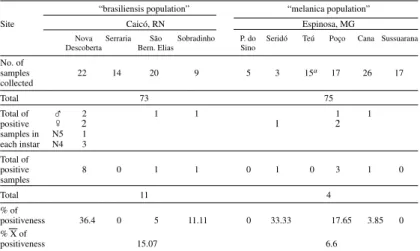
The average natural infection rate for a total of 298 specimens varied for each chromatic pattern among different sites. In the peridomicile, only the “brasiliensis population” have presented natural infection for T. cruzi. Forty-seven specimens from
Sobradinho site were examined and seven were positive, with an average of 14.9%. In wilderness, the “brasiliensis population” showed an average of natural infection rate of 15.1%. The highest in-fection rate was observed in the site of Nova Descoberta (36%). For “melanica population”,
which was only found in the silvatic environment, the rate was 6.6% (Table V). All specimens col-lected in Petrolina and Juazeiro presented a nega-tive rate for T. cruzi.
From positive specimens, 15 strains were iso-lated, 14 of which were typed and biochemically characterized, confirming natural infection by T. cruzi (Costa et al. 1996b).
TABLE V
Rates of natural infection with Trypanosoma cruzi of Triatoma brasiliensis Neiva, 1911 accordingto distinct colour patterns in wild environment at different sites
“brasiliensis population” “melanica population”
Site Caicó, RN Espinosa, MG
Nova Serraria São Sobradinho P. do Seridó Teú Poço Cana Sussuarana Descoberta Bern. Elias Sino
No. of
samples 22 14 20 9 5 3 15a 17 26 17
collected
Total 73 75
Total of G 2 1 1 1 1
positive E 2 1 2
samples in N5 1 each instar N4 3 Total of
positive 8 0 1 1 0 1 0 3 1 0
samples
Total 11 4
% of
positiveness 36.4 0 5 11.11 0 33.33 17.65 3.85 0 % X of
positiveness 15.07 6.6
a: specimens have died few minutes after capture, in response to the concentration of the pyrethroid utilized as unhousing, and for this reason they were not scorable.
TABLE VI
Natural infection rate with Trypanosoma cruzi of the different populations of Triatoma brasiliensis Neiva, 1911 in the peridomicile and wild environment
No. of “brasiliensis “melanica “macromelasoma “Juazeiro specimens population” population” population” population”
Collected 120 75 71 32
Examined 120 60 56 30
Infected with T. cruzi 18 4 0 0
13 13 13 13 13 Mem Inst Oswaldo Cruz, Rio de Janeiro, Vol. 93(1), Jan./Feb. 1998 12
12 12 12
12 Bionomy of T. brasiliensis - Distinct Populations Jane Costa et al.
Regarding trophic resources, feeding eclecti-cism was observed for all different populations of
T. brasiliensis. However, goat blood stood out in wilderness as well as in peridomiciliar areas for the four population samples analyzed. These data agreed with observations of Lent and Wygodzinsky (1979) and also with observations in field captures related to caprine herds, that roam from household surrounding areas to wilderness. This feature has shown the interconnection between these two ecotopes and perhaps the arbitrariness in discrimi-nating their boundaries.
Several authors registered the occurrence of triatomine that presented positivity to more than one trophic resouce (Siqueira 1960, Pinto Dias et al. 1989, Salvatella et al. 1994). Romoser et al. (1989) emphasized the value to the knowdledge of the local fauna and the detection of any evidence of a host presence to obtain a better evaluation of the positive results for the different trophic resourses, mainly for phylogenetically related ani-mals.
The fact that in Caicó, Petrolina and Juazeiro the different chromatic patterns have been found both in household and wild environments, indicates the possibility that in these sites the natural envi-ronment (rock cavy nests) could be suffering im-pact pressure and the feeding sources may not be fulfilling the basic needs, which would stimulate the invasion of new environments, as emphasized by Aragão (1975) concerning feeding opportun-ism. The wilderness is much poorer in vegetation in Caicó, Petrolina and Juazeiro than in Espinosa. Furthermore, in the three former sites, the high population density of T. sordida observed in Espinosa was not found. Thus the household sur-rounding areas at those sites offer less competitive conditions to allow colonization by T. brasiliensis. According to information received from FNS, the low population density of triatomines found the peridomicile areas in Caicó results from the fact that it had recently been sprayed and is under permanent control, due to the high level of triatomine infestation found in the mentioned area. No other species were found during the searches. FNS records show that this species is frequent in household surroundings.
It was in the sites of Petrolina and Juazeiro that the species was found most remote from its natu-ral environment. Indeed, it was collected in vari-ous human ecotopes, such as stables, chicken coops and other human artifacts. In Caicó, the specimens were collected in household surroundings, in en-vironments that resemble natural ecotopes, i.e., stone walls, that somehow reproduced the rock cavy nests where they are found in wilderness.
These walls are characteristic and frequently found in this region. They abundantly reproduce the fea-tures of the natural shelter of “brasiliensis popula-tion”, because all housing units are bounded by this type of construction.
The “melanica population” seldom invades households in Espinosa (inhabitants and FNS, pers. com.). When the population density in the natural shelters at rock cavy nests increases rapidly at a certain time of the year, it becomes necessary to promote a burning of the nests, because the insects voraciously attack people who approach them, of-ten to work with the rocks or in connection with agricultural activities.
Studies carried out by Gomes (1993) in two sites at São Raimundo Nonato, in Piauí, concern-ing the feedconcern-ing profile and the mobility of T. brasiliensis and other triatomine species, have dem-onstrated that this species presents ample mobility and is found in household surroundings as well as indoors (bedrooms). Through the precipitin test, they demonstrated a high positivity for the arma-dillo blood (72.1%). Subsequently these specimens were examined concerning the chromatic patterns that define the T. brasiliensis populations. They were characterized as “brasiliensis population”.
The broad ecological valence disclosed for different analyzed chromatic patterns of T. brasiliensis, through different colonized ecotopes, through variety of trophic resources and through natural infection rates stresses the need to increase environmental knowledge on the vectorial poten-tial of T. brasiliensis in different areas not yet ana-lyzed.
ACKNOWLEDGMENTS
To Drs Fernando Dias de Avila Pires, Ortrud Monika Barth and Maria Goreti Rosa Freitas-Sibajev for sug-gestions and for critical reading of the manuscript.
REFERENCES
Aragão MB 1975. Sobre o comportamento de alguns insetos hematófagos. Arq Biol Tecnol 18: 3-23. Costa J, Marchon-Silva V 1996. Studies on the
starva-tion period of melanic forms of Triatoma brasiliensis
Neiva, 1911 (Hemiptera, Reduviidae, Triatominae).
Mem Inst Oswaldo Cruz 91 (Suppl.): 167. Costa J, Marchon-Silva V, Almeida JR 1996a. Does
hybridization clarify the taxonomic status of differ-ent melanic forms of Triatoma brasiliensis Neiva, 1911 (Hemiptera, Reduviidae, Triatominae). Mem Inst Oswaldo Cruz 91 (Suppl.): 128.
Costa J, Marchon-Silva V, Brito CM, Pires MQ, Pacheco RS 1996b. Caracterização genotípica de cepas de
Trypanosoma cruzi isoladas de diferentes padrões cromáticos de Triatoma brasiliensis Neiva, 1911 (Hemiptera, Reduviidae, Triatominae). Rev Soc Bras Med Trop 29 (Suppl I): 128-129.
Costa J, Barth OM, Marchon-Silva V, Almeida CE, Freitas-Sibajev MGR, Panzera F 1997a. Morpho-logical studies on the Triatoma brasiliensis Neiva, 1911 (Hemiptera, Reduviidae, Triatominae) genital structures and eggs of different chromatic forms.
Mem Inst Oswaldo Cruz 92: 493-498. Costa J, Freitas-Sibajev MGR, Marchon-Silva V, Pires
MQ, Pacheco RS 1997b. Isoenzymes detect varia-tion in populavaria-tion of Triatoma brasiliensis (Hemi-ptera, Reduviidae, Triatominae). Mem Inst Oswaldo Cruz 92: 459-464.
Galvão ABG 1956. Triatoma brasiliensis macro-melasoma n. sp. (Reduviidae - Hemiptera). Rev Bras Mal D Trop 7: 455-457.
Gomes MAT 1993. Potencial de Transmissão da Tripanosomiase Americana nas Localidades Sítio do Mocó Borda, Município de São Raimundo Nonato, Piauí, MSc Thesis, Escola Nacional de Saúde Pública, Rio de Janeiro, 168 pp.
Lent H, Wygodzinsky P 1979. Revision of the triatominae (Hemiptera Reduviidae) and their sig-nificance as vectors of Chagas’ disease. Bull Amer Mus Nat His 163: 123-520.
Pinto Dias JC, Feitosa VR, Ferraz Filho AN, Rodrigues VLC, Alencar SA, Sessa PA 1989. Fonte alimentar
e potencial vetorial de Triatoma vitticeps (Stal 1859) com relação à doença de Chagas humana no estado de Espírito Santo, Brasil (Hemiptera, Reduviidae).
Men Inst Oswaldo Cruz 84 (Suppl. IV): 165-173. Romoser WS, Edman JD, Lorenz LH, Scott TW 1989.
Histological parameters useful in the identification of multiple bloodmeals in mosquitoes. Am J Trop Med Hyg 41: 737-742.
Salvatella R, Calegari L, Puime A, Basmadjan Y, Rosa R, Guerreiro J, Martinez M, Mendaro M, Briano D, Montero C, Wisnivesky-Coli 1994. Perfil alimentario de Triatoma rubrovaria (Blanchard 1843) (Hemi-ptera, Triatominae) en ambitos peridomiciliarios, de una lacalidade rural de Uruguay. Rev Inst Med Trop São Paulo 36: 311-320.
Siqueira AF 1960. Estudos sobre a reação de precipitina aplicada a identificação de sangue ingerido por triatomíneos. Rev Inst Med Trop São Paulo 2: 41-53.
Silveira AC, Feitosa VR, Borges R 1984. Distribuição de triatomíneos capturados no ambiente domiciliar, no período 1975/83, Brasil. Rev brasil Malariol D trop 36: 15-312.
Weitz B 1956. Identification of bloodsucking arthropods.
14 14 14 14