Acta Cir. Bras. 2018;33(9):834-841 DOI: http://dx.doi.org/10.1590/s0102-865020180090000012
Eduardo CremaI, Júverson Alves Terra JúniorII, Marisa Carvalho BorgesIII, Carlos Alfredo Salci QueirozIV,
Luciana Arantes SoaresIII, Alex Augusto da SilvaV
Preservation of the vagus nerves in subtotal
esophagectomy without thoracotomy
1Abstract
Purpose: To evaluate the outcome of transhiatal esophagectomy without thoracotomy and
with preservation of the vagal trunks for the treatment of advanced megaesophagus.
Methods: Between March 2006 and September 2017, it was performed 136 transhiatal
esophagectomies without thoracotomy by laparoscopy, with preservation of the vagus nerves. All patients were evaluated pre and postoperatively for respiratory and nutritional aspects Post operatively, some surgical aspects were evaluated like radiology and endoscopy of the digestive tract.
Results: Follow-up for 7 months to 12 years by clinical, radiologic, endoscopic and pH
monitoring revealed satisfactory and encouraging outcomes of the procedure.
Conclusion: The laparoscopic transhiatal esophagectomy is a feasible and safe technique
with good postoperative outcomes.
Key words: Laparoscopy. Esophagectomy. Vagus Nerve.
IPhD, Full Professor, Division of Digestive Surgery, Universidade Federal do Triângulo Mineiro (UFTM), Uberaba-MG,
Brazil. Conception of the study, analysis and interpretation of data, manuscript writing, critical revision.
IIPhD, Assistant Professor, Division of Surgical Technique and Experimental Surgery, UFTM, Uberaba-MG, Brazil.
Conception of the study, analysis and interpretation of data, manuscript writing, critical revision.
IIIPostdoctoral Fellow, Postgraduate Program in Health Sciences, UFTM, Uberaba-MG, Brazil. Conception of the study,
analysis and interpretation of data, manuscript writing, critical revision.
IVAssistant Professor, Division of Surgical Technique and Experimental Surgery, UFTM, Uberaba-MG, Brazil. Conception of
the study, analysis and interpretation of data, manuscript writing, critical revision.
VPhD, Associate Professor, Division of Digestive Surgery, UFTM, Uberaba-MG, Brazil. Conception of the study, analysis
of the abdominal and thoracic esophagus, and
left cervicotomy for removal of the specimen and esophagogastric anastomosis, a widely used technique for the treatment of advanced
megaesophagus in referral centers.
The truncal vagotomy performed during esophagectomy leads to high rates of chronic diarrhea, Dumping syndrome, gastric emptying
problems, weight loss, and cholelithiasis.
A decrease in the inflammatory response resulting from inflammatory sepsis has also
been described. The use of the laparoscopic
approach and preservation of the vagal trunks have substantially improved the outcomes of esophagectomy during the early and late postoperative period, maintaining gastric emptying and pancreatic and gastric secretion close to preoperative values. Indications for subtotal esophagectomy with preservation of the vagal trunks include high-grade dysplastic
lesions, intramucosal carcinoma, Barret’s
esophagus with high-grade dysplasia, and advanced or relapsed megaesophagus.
The objective of this study was to evaluate the outcome of transhiatal esophagectomy without thoracotomy and with preservation of the vagal trunks for the treatment of advanced megaesophagus.
■
Methods
The patients received information
about the surgical procedure performed and
the study protocol was approved by the Ethics Committee on Research Involving Humans of the Universidade Federal do Triângulo Mineiro.
Between March 2006 and September 2017, we performed 136 transhiatal esophagectomies without thoracotomy by laparoscopy, with preservation of the vagus nerves. Of these, 123 (90.45%) patients had chagasic megaesophagus and 13 (9.55%) had
idiopathic megaesophagus. The mean age was
59.3 (17-79) years and 81 (59.55%) patients
were male.
■
Introduction
The aim of surgical treatment of any condition is to relieve and/or abolish symptoms and to prevent progression of the disease with the lowest complication and mortality rates possible. Subtotal esophagectomy without thoracotomy has been proposed as the best surgical approach to the treatment of advanced
megaesophagus.
Radiologically, advanced megaesophagus is characterized by elongation of the esophagus and axis deviation in relation to the spine (dolichol-megaesophagus). From a functional point of view, advanced megaesophagus is defined when manometry reveals a contraction wave amplitude of the esophagus less than 20 mmHg, regardless of esophageal diameter1. In
the advanced forms, the esophagus becomes an inert pouch, which almost always exhibits stasis. Consequent chronic dysplastic and/or neoplastic alterations in the esophageal wall are observed at a rate that is up to 140 times higher than that seen in the general population2. The persistence of stasis causes bacterial
proliferation and changes in the intraluminal flora of the esophagus3, which is aggravated
in the presence of bronchoaspiration. The production of weak acids changes the esophageal pH and increases the prevalence of HPV4, a virus that has been associated with a higher incidence of malignant neoplasms at other sites of the organism5-7.
Historically, Câmara Lopes and Ferreira Santos used subtotal esophagectomy by cervicotomy, right thoracotomy and laparotomy as surgical approaches to the treatment of advanced megaesophagus8.
Eugênio Bueno and Pinotti9,10 proposed
resection of the esophagus by laparotomy and cervicotomy. De Paula11 and Crema12
Before surgery, all patients were submitted to Trypanosoma cruzi serology,
esophageal contrast examination, upper endoscopy, electromanometry, 24-hour pH monitoring, and gallbladder ultrasonography. Pre- and postoperative nutritional and physiotherapeutic assessments were performed on all patients. The following data were obtained: anthropometric (weight, height, arm muscle circumference, skinfold, and creatinine/height index), biochemical (total proteins, albumin, and transferrin), immunological (total lymphocytes and tuberculin purified protein derivative), and physiotherapeutic. All patients were submitted to ambulatory preoperative preparation for 7 to 21 days, which consisted of respiratory physiotherapy and enteral nutrition support (1.5g protein/kg/day) through a nasoenteral
tube placed into the stomach.
Preoperative preparation
Clinical evaluation, especially cardiological, pulmonary and nutritional assessment, should be performed routinely since patients with megaesophagus usually exhibit comorbidities and are malnourished at the time of treatment. The evaluation of gastric emptying time by Tc99 scintigraphy and with
barium contrast introduced through the tube placed into the stomach is important to rule
out an association with megastomach, which is observed at our service in 8% of patients with
chagasic megaesophagus.
Abdominal ultrasonography is also
useful for the diagnosis of cholelithiasis, which is associated with chagasic megaesophagus in
14 to 26% of cases13,14. In a study conducted
at our service, cholelithiasis was associated with chagasic megaesophagus in 28.5% of the patients15.
On the day before surgery, a thick Fouchet or Levin oroesophageal catheter
is passed and the esophagus is cleaned
mechanically with 0.9% saline.
Surgical technique
The position of the patient is
the same as that used for laparoscopic
esophagocardiomyotomy. The patient is placed in the lithotomy position, with the legs extended, separated and adequately
supported on a leg holder. The surgeon stands
between the legs and the assistants on the left side of the patient (camera and presentation). The monitor, if only one, is positioned at the headrest to the right of the operating table.
Five ports are used: a) a 10-mm trocar placed above the umbilical scar, approximately 15 cm from the xiphoid appendix (30-degree optics); b) a 10-mm trocar placed in the left subcostal region at the midclavicular line (right hand of the surgeon); c) a 5-mm trocar
placed in the right subcostal region at the
midclavicular line (left hand of the surgeon); d) a 5-mm trocar placed in the midline subxiphoid position (assistant separating the left lobe of the liver), and e) a 5-mm trocar placed to the left of the scar (assistant pushing the junction and esophagus), with a 5-mm trocar being sufficient. When associated with cholelithiasis, the fifth port can be placed to the right, facilitating presentation of the gallbladder at the time of cholecystectomy.
At a pneumoperitoneum of 12 mmHg, the procedure is initiated by opening the
phrenoesophageal membrane and greater
omentum, providing access to the right branch of the right pillar of the diaphragm. From this point onwards, the periesophageal tissue
is released around the terminal esophagus,
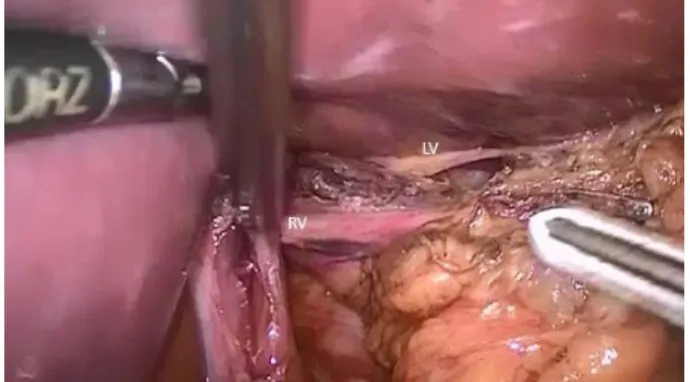
preservation during esophageal resection (Figures 1 and 2). At this stage, dissection is continued under direct vision of the esophageal body, identifying the pleura, pericardium, azygos vein and vagal trunks throughout the thoracic extension. Hemostasis is performed by monopolar cauterization and/or clipping of the
greater esophageal branches, but an ultrasonic
scalpel is the preferred method and is frequently used. It is important that the surgical plane is close to the esophagus to avoid injury to the pleura and mediastinal structures. For better access to the mediastinum during dissection of
the thoracic esophagus, we perform a midline
transection of the diaphragm and place the operating table in the Trendelenburg position, as used in the abdominal cervical approach during open surgery.
Figure 1 - Completely dissected esophageal
segment. Details of the right and left vagal trunks. RV: right vagal trunk; LV: left vagal trunk.
Figure 2 - Completely dissected esophageal
segment. Details of the right and left vagal trunks. RV: right vagal trunk; LV: left vagal trunk.
After dissection of the abdominal and
thoracic esophagus is completed, the stomach is prepared with release of the greater
curvature. Mono- or bipolar electrocautery or, preferentially, a harmonic scalpel is used for sectioning of the short vessels and of the
gastrocolic omentum. Double clipping is used
for ligation of the gastroepiploic artery and vein and of the left gastric artery and vein, preserving the arcade of the greater and lesser curvature.
We do not perform pyloroplasty during surgical treatment of advanced megaesophagus
in the case of chagasic or idiopathic
esophagopathy. Once preparation of the stomach is complete, dissection of the cervical esophagus is performed by left cervicotomy. By gently pushing the surgical specimen, the
esophagus and proximal part of the stomach
in the cervical region are exteriorized and the gastroesophageal junction is cut with a linear cutting stapler with a green load. During cervical traction of the previously dissected
esophagus, the passage of the esophagus and
stomach through the mediastinum must be monitored under direct vision with the optic placed in the inferior mediastinum.
An esophagogastric anastomosis
is performed with manual continuous polypropylene monofilament suture in a single
plane. A nasoenteral tube is placed into the duodenum, when possible, or into the gastric antrum for enteral feeding as described for
preoperative preparation, 24 hours after the surgical procedure. We do no use cervical or
abdominal drainage.
It should be noted that dissection of the anterior and posterior vagal trunks should be performed before dissection of the esophagus and preparation of the stomach to avoid inadvertent sectioning of the vagal trunks during the cervical time. The absence of pyloroplasty in patients with megaesophagus who do not have megastomach prevents the reflux of
now positioned in the posterior mediastinum, a region of negative pressure. Another
important factor is that the esophagogastric
anastomosis remains in the cervical region, which is characterized by positive pressure, thus preventing the reflux of gastric fluid into the esophagus and consequent esophagitis. The latter may occur when the anastomosis is in an intrathoracic position.
The use of the whole stomach as a plasty organ is justified by the better vascularization of the gastric fundus since it avoids interruption of the submucosal vascular network of the gastric body and fundus, maintaining the vascular communication with the arcade of the lesser and greater curvature. Thus, maintenance of the gastric innervation is also facilitated.
■
Results
The mean duration of surgery was 120 minutes (90-150) and improvement was observed in all parameters analyzed. Only five patients (8.34%) required ventilation support after surgery and three received blood transfusion during or after surgery. Early complications were observed in 19 patients (13.97%). There were nine cases (6.61%) of hemopneumothorax that required a peri- or postoperative chest drain. Early gastric stasis (3 months) was observed in three cases (2.2%), a cervical fistula in five (3.67%), which resolved clinically by exclusive enteral nutrition and cervical drainage through removal of the cervical incisions, and dysphonia in eight (5.88%). Late complications occurred in 10 cases (7.35%). Five patients (3.67%) had dysphonia that improved only after 3 months. Dysphagia due to anastomotic stricture was observed in four cases (2.94%), three of them requiring endoscopic dilatation and one submitted to plasty of the anastomosis.
When gastric emptying was compared with the historical series in which the vagus nerve was not preserved, we found early
gastric emptying problems in three (2.2%) of
the 136 cases with vagus nerve preservation and in eight (8.42%) of the 95 cases without preservation, with this difference being statistically significant. Late gastric stasis was not observed in any case of the group with vagus nerve preservation and in four cases (4.21%) without preservation.
Two patients (1.47%) died, one patient with a pacemaker due to cardiac arrhythmia on postoperative day 12 and one due to mediastinitis on postoperative day 28.
Histopathological examination of the surgical specimen and polymerase chain reaction (PCR) for T. cruzi confirmed chagasic esophagopathy in 123 cases (90.45%) and idiopathic disease in 13 (9.55%). Cases with
associated neoplasms diagnosed before
surgery or in the surgical specimen were
excluded from this series.
Contrast examination of the esophageal
stump, stomach and duodenum was
performed 10 days, 3 months and one year after surgery and revealed the presence of the esophagogastric anastomosis in the cervical
region, good passage of the contrast through
the anastomosis, and good gastric emptying. Endoscopy performed 3 months and one year after surgical treatment detected 20 cases (14.7%) of mild esophagitis in the esophageal stump, although manometry showed that the anastomosis was situated in a high-pressure region and 24-hour pH monitoring with the sensor placed 2 cm above the esophagogastric anastomosis did not detect acid reflux in any patient.
Follow-up for 7 months to 12 years by clinical, radiologic, endoscopic and pH monitoring revealed satisfactory and
encouraging outcomes of the procedure.
■
Discussion
is based on the stage of esophagopathy. In
the non-advanced stage, cardiomyotomy combined with a partial antireflux valve has been found to be the best surgical option.
In the advanced stage of esophagopathy, contrast examination reveals an esophageal diameter of 10 cm and/or tortuosity of the esophagus with axis deviation (dolichol-esophagus)16,17.
From a functional point of view, megaesophagus is characterized manometrically by a contraction wave amplitude of the body of less than 20 mmHg. Previous studies have shown peristaltic waves less than 20 mmHg in all patients with radiologically advanced megaesophagus1,
while 38.4% of patients with radiologically non-advanced megaesophagus have low-amplitude waves. These patients were therefore classified as functionally advanced megaesophagus.
Surgical treatment of this form of the disease (non-advanced stage) using any technique targeting the gastroesophageal junction has shown unsatisfactory results18;
therefore, subtotal esophagectomy with removal of this inert pouch filled with stasis fluid rich in enterobacteria3 and with important
mucosal alterations (stasis esophagitis, dysplasia, and/or neoplasm) is indicated19.
The advent of the laparoscopic approach has led to a reduction in pulmonary dysfunction and consequently in postoperative complications, which had reached rates of 30%10 with the open technique, rates higher than that
found in the present series (13.97%). Mortality was 1.47% in this study. In a meta-analysis of 17 articles involving 1.422 patients submitted to esophagectomy, Aiolfi et al.20 found a mortality
rate of 2.6%. A similar mortality rate (2.69%) has been reported by Molena et al.21 in 963 subtotal esophagectomies for benign disorders
in the United States.
Herbella et al.22 described anatomically
the presence of two vagal trunks in 83.4%; these trunks were separated in 26.7% and
communications between them were detected in 56.7%. One or two bifurcated trunks occurred in only 13.3% of cases.
In the present study, esophagogastric anastomotic fistulas were observed in five cases (3.67%). Similar rates have been reported by Oninger et al.23 (4%) and much lower rates
by Tank et al.24 (13.3%) and Devaney et al.25
(10%).
The use of the whole stomach as a
plasty organ facilitates preservation of the vagal trunks and innervation of the stomach. Peyre and Demeester26 used a gastric tube
and proposed preservation of the vagal trunks and innervation of the antrum and pylorus, which resulted in a reduction of postoperative morbidity and mortality. Preservation of the vagal trunks has been shown to favor the maintenance of gastric emptying during the early and late postoperative period. In the present study, only three (2.2%) of the 136 cases with vagus nerve preservation exhibited early gastric emptying problems and none of the patients had late problems. Among the 95 cases submitted to surgery without vagus nerve preservation, eight (8.42%) had early gastric emptying problems and four (4.21%) had late problems. Similar results have been reported by Banki et al.27.
An increase in the incidence of
transient dysphonia has been described
for the laparoscopic transhiatal approach
(25%-66.6%)19. An increase of dysphonia in the laparoscopic transhiatal technique was
also detected at our service. This increase compared to the cervicoabdominal approach (4.8%) is probably due to local manipulation of the cervical region where the esophagus is sectioned and removal of the surgical specimen, which usually has a large volume. A reduction of dysphonia in the last 30 cases (6.67%) was
noted when compared to the beginning of the
series (23.3%).
In the absence of stenosis of the
esophagectomy completely abolishes
dysphagia. By taking care of maintaining the esophagogastric anastomosis in the cervical region, an area of positive pressure, the intensity of gastroesophageal reflux and consequently moderate and severe esophagitis of the esophageal stump are reduced, especially in cases in which the pylorus is preserved and duodenogastric reflux is lower.
The secretion of pancreatic peptide was studied in 46 cases and confirmed functional preservation of the vagus nerves. This fact was also observed by Banki et al.27 who detected an
increase in pancreatic peptide 30 minutes after stimulation in patients submitted to subtotal esophagectomy with preservation of the vagus nerves28.
According to Mormando et al.29, vagus
nerve preservation is a good option to improve the quality of life of patients submitted to esophagectomy for the treatment of benign
disorders.
■
Conclusion
Laparoscopic transhiatal esophagectomy
is a feasible and safe technique with excellent
postoperative outcomes.
■
References
1. Crema E, Cruvinel LAF, Werneck AM, Oliveira RM, Silva AA. Correlação manométrico-radiológica e sua importância no tratamento cirúrgico do megaesôfago chagásico. Rev Soc Bras Med Trop. 2003;36(6):665-9. doi: 10.1590/S0037-86822003000600004. 2. Brücher BL, Stein HJ, Bartels H, Feussner H,
Siewert JR. Achalasia and esophageal cancer: incidence, prevalence and prognosis. World J Surg. 2001;25(6):745-9. PMID: 11376410. 3. Crema E, Madureira AB, Lima VGF, Castro
AMV, Silva AA, Junqueira IS. Estudo da microflora do megaesôfago chagásico. Rev Soc Bras Med Trop. 2002;35(1):39-42. PMID: 11873260.
4. Zhu LZ, Su XL, Chen KN, Yang RJ, Xing HP,
Cui JG, Ke Y. Detection rate of human papillomavirus 16 in esophageal squamous cell carcinoma from different Chinese population. Ai Zheng. 2005;24(7):870-3. PMID: 16004818.
5. Crema E, De Lima TS, Junqueira IS, Rodrigues Júnior V, Terra Junior JA, Silva AA. Prevalence study of esophageal HPV infection in patients with megaesophagus and correlation with
in situ and 24-hour PH measurement. Bras J. Videosurg. 2010;3(4):181-5.
6. König F, Krekeler G, Hönig J, Cordon-Cardo C, Fischer G, Korabiowska M. Relation between human papillomavirus positivity and p16 expression in head and neck carcinomas—a tissue microarray study. Anticancer Res. 2007;27(1A):283-8. PMID: 17352245.
7. Ferreira-Santos R. Tratamento cirúrgico da aperistalse esofágica (megaesôfago) [Tese]. Universidade de São Paulo, Ribeirão Preto; 1963.
8. Pinotti HW, Zilberstein B, Pollara W, Raia A. Esophagectomy without thoracotomy. Surg Gynecol Obstet. 1981;152(3):344-6. PMID: 7466588.
9. Pinotti HW, Ellenbogen G, Rodrigues JG, Raia A. Surgical treatment of the megaesophagus. Chir Gastroent. 1997;11(1):7-14.
10. DePaula AL, Hashiba K, Ferreira EAB, de Paula RA, Grecco E. Laparoscopic transhiatal esophagectomy with esophagogastroplasty. Surg Laparosc Endosc. 1995;5(1):1-5. PMID: 7735533.
11. Crema E, Ribeiro LB, Juverson AT, Silva AA. Laparoscopic transhiatal subtotal esophagectomy for the treatment of advanced megaesophagus. Ann Thorac Surg. 2005;80(4):1196-201. doi: 10.1016/j. athoracsur.2004.10.059.
12. De Oliveira LC, Nascimento RS, Rocha A, Gonçalves EG, Silva JM, Oliveira VA, Ferreira RMS, Buso AG. Colelitíase em chagásicos crônicos. Arq Gastroenterol. 1997;34(4):222-6. PMID: 9629316.
13. Rocha A, Almeida H, Teixeira VPA, Silva AM. Prevalência da colelitiase em chagásicos
crônicos necropsiados no Triangulo
Mineiro – correlação com o megaesôfago, o megacolon e a insuficiência cardíaca. Arq Gastroenterol. 1985;22(1):3-6.
14. Pinotti HW, Felix VN, Zilberstein B, Cecconello I. Surgical complications of
of the pylorus, and cholelithiasis. World J Surg. 1991;15(2):198-204. PMID: 1903232. 15. Crema E, Silva ECRS, Franciscon PM,
Rodrigues Júnior V, Martins Júnior A, Teles CJO, Silva AA. Prevalence of cholelithiasis in patients with chagasic megaesophagus. Rev Soc Bras Med Trop. 2011;44(3):324-6. doi: 10.1590/S0037-86822011005000043. 16. Rezende JM, Lauar KM, Oliveira AR. Aspectos
clínicos e radiológicos da aperistalse do esôfago. Rev Bras Gastroenterol. 1960;12(2):247-62.
17. Herbella FAM, Del Grange JC, Lourenço LG, Mansur NS, Haddad CM. Resultados tardios da operação de Heller associada
à fundoplicatura no tratamento do
megaesôfago: análise de 83 casos. Rev Assoc Med Brasil. 1999;45(4):317-22. PMID: 10752238.
18. Loviscek LF, Cenoz MC, Badaloni AE, Agarinakazato O. Early cancer in achalasia. Dis Esophagus. 1998;11(4):239-47. PMID: 10071806.
19. Swanstrom LL, Hanson P. Laparoscopic total esophagectomy. Arch Surg. 1997;132(9):943-7. PMID: 9301605.
20. Aiolfi A, Asti E, Bonitta G, Bonavina L. Esophageal resection for end-stage achalasia. Am Surg. 2018. Apr 1;84:506-11. PMID: 29712597.
21. Molena D, Mungo B, Stem M, Feinberg RL, Lidor AO. Outcomes of esophagectomy for esophageal achalasia in the United States. J Gastrointest Surg. 2014;18:310-7. doi: 10.1007/s11605-013-2318-y.
22. Herbella FA, Regatieri CV, Moreno DG, Matone J, Del Grande JC. Vagal integrity in
vagal-sparing esophagectomy: a cadaveric study. Dis Esophagus. 2006;19(5):406-9. doi: 10.1111/j.1442-2050.2006.00595.x. 23. Orringer MB, Stirling MC. Esophageal
resection for achalasia: indications and results. Ann Thorac Surg. 1989;47(3):340-5. PMID: 2649031.
24. Tank AK, Kumar A, Babu TL, Singh RK, Saxena R, Kapoor VK. Resectional surgery in achalasia cardia. Int J Surg. 2009;7(2):155-8. doi: 10.1016/j.ijsu.2002009;7(2):155-8.11.006.
25. Devaney EJ, Iannettoni MD, Orringer MB, Marshall B. Esophagectomy for achalasia: patient selection and clinical experience. Ann Thorac Surg. 2001;72(3):854-8. PMID: 11565670.
26. Peyre CG, Demeester TR. Vagal-sparing esophagectomy. Adv Surg. 2008;42:109-16. doi: 10.1016/j.yasu.2008.04.004.
27. Banki F, Mason RJ, DeMeester SR, Hagen JA, Balaji NS, Crookes PF, Bremner CG, Peters JH, DeMeester TR. Vagal-sparing esophagectomy: a more physiologic alternative. Ann Surg. 2002;236(3):324-36. doi: 10.1097/01.SLA.0000027081.93085.
BB.
28. Crema E; Castro LGP, Junqueira IS, Gomes RAS, Terra GA, Terra Junior JA, Silva AA. Integridade vagal em pacientes submetidos à esofagectomia laparoscópica no tratamento do megaesôfago. Braz J Videosurg. 2013;6(3):97-102. doi: 10.1590/ S0100-69912009000200005.
29. Mormando J, Barbetta A, Molena D. Esophagectomy for benign disease. J Thorac Dis. 2018 Mar;10(3):2026-33. doi: 10.21037/jtd.2018.01.165.
Correspondence: Dr. Eduardo Crema
Departamento de Cirurgia, UFTM 38025-440 Uberaba – MG Brasil [email protected]
Received: May 13, 2018 Review: July 16, 2018 Accepted: Aug 12, 2018
Conflict of interest: none Financial source: none
1Research performed at Division of Digestive