SY
STEMA
TIC REVIEW
Study developed at the Universidade Federal do Rio Grande do Sul (UFRGS), Porto Alegre, Rio Grande do Sul, Brazil.
Presentation at scientific event: 2nd South Brazilian Congress of Posture and Movement Reeducation, Porto Alegre (RS), Brazil, 2016.
1Graduate Program in Human Movement Sciences, Universidade Federal do Rio Grande do Sul (UFRGS) – Porto Alegre (RS), Brazil. 2Physical Therapy course, UFRGS – Porto Alegre (RS), Brazil.
3Physical Education course, UFRGS – Porto Alegre (RS), Brazil.
4Ph.D. Professor of the Graduate Program in Human Movement Sciences, UFRGS – Porto Alegre (RS), Brazil.
444
Methods used to evaluate the en dehors or turnout
of dancers and classical ballet dancers: a literature
review
Métodos usados para avaliar o en dehors ou turnout de dançarinos e bailarinos clássicos:
revisão da literatura
Métodos utilizados para evaluar el
en dehors
o
turnout
de bailarines y bailarines clásicos:
revisión de la literatura
Kaanda Nabilla Souza Gontijo1, Maiane Almeida do Amaral2, Gabriela Cristina dos Santos3,
Claudia Tarragô Candotti4
Corresponding address: Kaanda Nabilla Souza Gontijo – Rua Felizardo, 750, Jardim Botânico – Porto Alegre (RS), Brazil – Zip Code: 90450-190 – E-mail: kaandagontijo@ gmail.com. Phone number: (51) 3308-5817 – Finance source: Nothing to declare– Conflict of interests: Nothing to declare– Presentation: 25 Oct. 2016 – Accepted for publi-cation: 30 Nov. 2017.
ABSTRACT | The classical ballet technique requires the maximum en dehors or turnout, which is the lower limbs external rotation. Considering its importance, several evaluation and measurement protocols have been proposed. This review aims to investigate systematically which methods were used to assess the classical dancers’ or classical ballet practitioners’ turnout. A systematic search was made in the Scopus, Science Direct, and PubMed databases in February 2016 for studies written in English that evaluated classical dancers or ballerinas, and the en dehors or turnout was measured. We found 593 articles, of which 25 were pre-selected for this review, featuring fifteen different methods and instruments for measuring turnout: kinemetry; inclinometer; Turnout Protractor, or protractor to measure the turnout; goniometer; dupuis tropometer; original protractor; subjects photos; rotational discs; Nicholas flexibility test; fleximeter; clinical drawing of the feet; subject standing on a piece of paper, or soil, or whiteboard; magnetic resonance; filming the subject during a sequence of dance steps; Dasco pro angle finder. This review provides convincing evidence that there is not a method or gold-standard instrument for measuring dancers’ turnout, therefore such measurement is usually adapted and chosen according to each study objectives.
Keywords | Dance; Evaluation Studies; Evaluation.
ou instrumento padrão-ouro para mensuração do turnout de bailarinos, de modo que esta costuma ser adaptada e escolhida de acordo com o objetivo de cada estudo.
Descritores | Dança; Estudos de Avaliação; Avaliação.
RESUMEN | La técnica del ballet clásico exige la realización máxima del en dehors o turnout, caracterizado por la rotación externa de miembros inferiores. Considerando su importancia, varios protocolos para su evaluación y medición han sido propuestos. El objetivo de esta revisión ha sido investigar sistemáticamente los métodos utilizados para evaluar el turnout de bailarines clásicos y/o practicantes de ballet clásico existentes actualmente. Se hizo la búsqueda en las bases de datos Scopus, Science Direct y PubMed, en el mes de febrero de 2016, y los artículos encontrados deberían: estar redactados en la lengua inglesa, evaluar bailarines clásicos o bailarines que
practicaran ballet clásico y medir el en dehors o turnout. Se encontraron 593 artículos, de los cuales se preseleccionaron 25 para esta revisión, presentándose 15 diferentes métodos e instrumentos de medición del turnout: cinemetría; inclinómetro; turnout protactor o transferidor para medir el turnout; goniómetro; Dupuis Tropometer; transferidor original; fotos de los sujetos; discos rotacionales; prueba de flexibilidad de Nicholas; flexímetro; diseño clínico de los pies; sujeto sobre un pedazo de papel o suelo o cuadro blanco; resonancia magnética; filmación del sujeto ejecutando secuencia de pasos; Daco Pro Angle Finder. Esta revisión presenta una fuerte evidencia para afirmar que no hay, hasta el momento, un método o instrumento estándar-oro para la medición del turnout de bailarines, de modo que ésta suele ser adaptada y elegida de acuerdo con el objetivo de cada estudio.
Palabras clave | Danza; Estudios de Evaluación; Evaluación.
INTRODUCTION
The classical ballet technique requires the maximum
realization of the en dehors, or turnout1, considering
that an ideal turnout should be performed exclusively
by the hips2-4, through an external 90° rotation of the
hip joints, bilaterally, while the feet are in an angle of
180° between them1. Nevertheless, there has been a
substantial influence of compensatory rotations of knees, tibia, and feet to achieve this 180° angle. This is characterized as a fake turnout since it is not performed
exclusively by the hips5-7.
Given this context, it has also been described that this “fake” (or compensatory) action is characterized by a technical glitch causing acute and chronic injuries in dancers, as it causes the bones, muscles, tendons, ligaments, and nerves to be under constant stress in
an extreme anatomical position1,8-13. Epidemiological
studies report that 90% of the dancers have lesions, with approximately 75% of these occurring in the lower limbs,
being 40% in feet, ankles, and tibia10-12,14-19. This occurs
because the lack of a good and natural external rotation of the hips lead to external rotations of knees, tibia, ankles, and feet to achieve the 180° angle on the ground, as a compensation. Also, the most common injurious compensatory movements are the pronation or fall of the feet longitudinal arch, the knee twisting, and even the
increase or rectification of the lumbar lordosis1,8-13.
Considering the importance of the turnout to the
classical ballet, various protocols have been proposed
to its evaluation and measurement. While some
recommend the use of measurement protocols that include all the lower limb to assess the individual
participation rate of each segment and joint20-22,
others defend the use of measurements that simulate functional dance movements, based on the assumption that those measures will be more useful for doctors,
teachers, and the dancers themselves1,23-25. This
discrepancy suggests there is no consensus on which protocol to follow in the turnout evaluation. The aim of this systematic review was to answer the following question: Which are the methods used to evaluate
the turnout of classical dancers and or classical ballet
practitioners that currently exist?
METHODOLOGY
OR “Outward Rotation” OR “Lower Extremity Rotation” OR “Lower Extremity” OR “Lower Limb” OR “Turnout Angle” OR “Leg Rotation” OR “Tibial Torsion”.
To compose this review, the articles found should meet the following inclusion criteria: (a) being written in English; (b) evaluate classical dancers or who
practiced classical ballet; and (c) evaluate and measure
the en dehors, or turnout. The exclusion criterion was
not describing the method used to assess the en dehors,
or turnout.
All procedures for search, selection, quality evaluation, data reading and collection from the articles were performed by two independent assessors. In cases of divergence among assessors, a third evaluator was invited to conduct the article evaluation.
Initially, the studies were selected from the reading of titles and abstracts, and the articles that had potential to be included in the search were read and analyzed in full. Then, were finally included those that complied with all inclusion criteria. The bibliographies of each article were also investigated to find studies not located in the electronic search.
To assess the studies’ quality was used the STROBE scale, which consists of a 22-item checklist that should be contained in observational articles for them to be considered of excellent quality. These items are related to title and abstract, methods,
results, discussion, and other information26. However,
the STROBE scale was modified, i.e., the items 1(b), 4, 9, 15, 16 (a) (b) (c), 17, and 21 were excluded, considering they did not apply to this study. A similar procedure was also performed in other systematic
reviews27-31. For insertion of the article in this
review, it was intentionally set as minimum criteria a minimum of five points in the modified STROBE scale, whose maximum score is 17 points.
Scientific evidence strength of this review was analyzed by the Best Evidence Synthesis (BES), an alternative to the meta-analysis that proposes a studies’ quantitative analysis, in which the evidence strength is determined by the number and quality of the studies and the consistency
of their results32. The criteria used to rank evidence strength
were: strong evidence, obtained through many high-quality studies; moderate evidence, obtained through one high-quality study and one or more low-quality studies; limited evidence, obtained through a high-quality study of many low-quality ones; and no evidence, obtained through
a low-quality study or contradictory results33.
This study is registered on the PROSPERO under the number CRD42016027856.
RESULTS
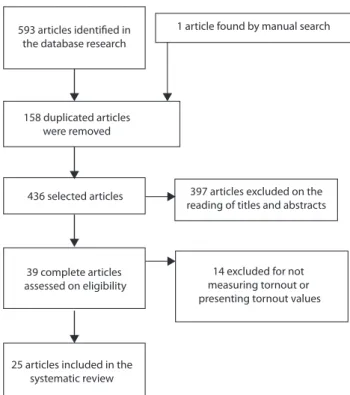
Initially, 593 articles were found from the data search, of which 39 were included. After eligibility evaluation, thirteen were excluded for not measuring the turnout or not presenting the values of the turnout measurements. Thus, 25 articles were pre-selected to compose this systematic review (Figure 1).
593 articles identified in the database research
158 duplicated articles were removed
397 articles excluded on the reading of titles and abstracts
14 excluded for not measuring tornout or presenting tornout values 1 article found by manual search
436 selected articles
39 complete articles assessed on eligibility
25 articles included in the systematic review
Figure 1. Flowchart of article selection
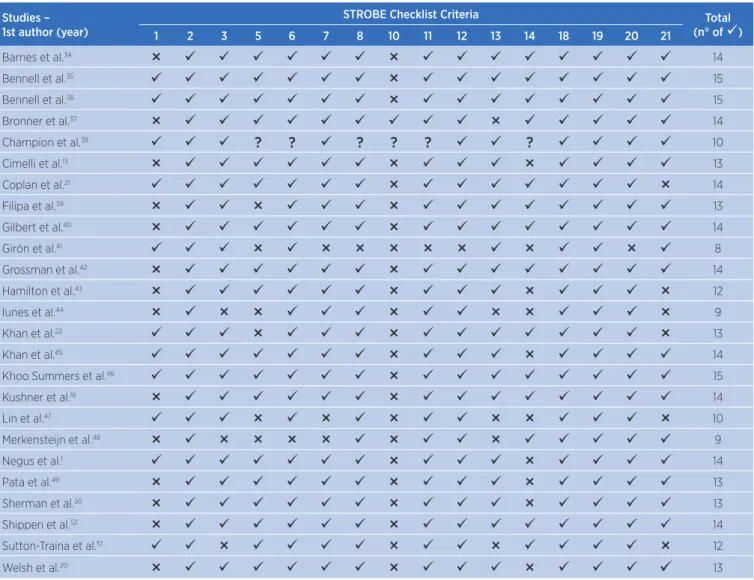
The pre-selected studies were evaluated on methodological quality using the modified STROBE criteria (Table 1), and only three out of the 25 studies presented a score inferior to 10.
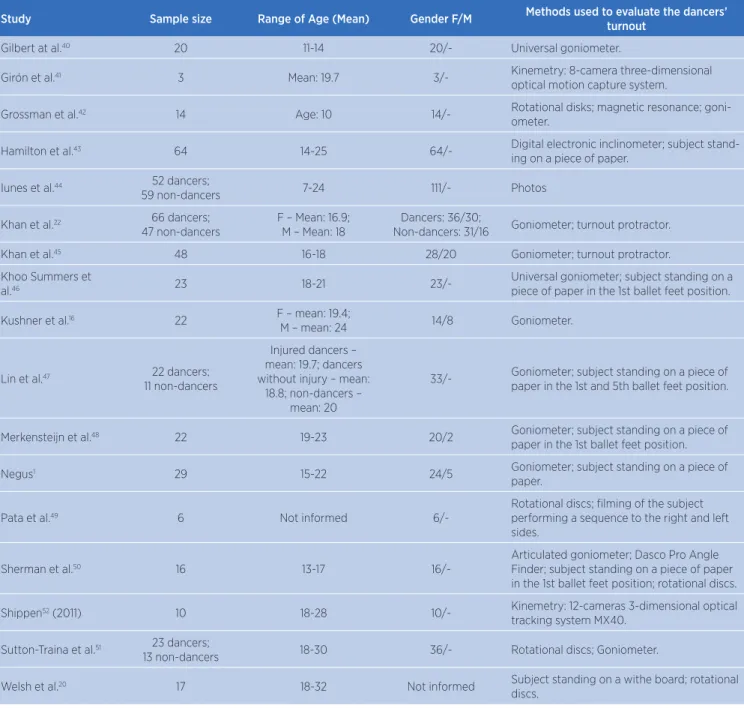
Table 2 shows the 25 studies included, discerned by first author, year, sample size, mean or variation of age, gender, and instruments used in the turnout evaluation.
Table 1. Results of the studies methodological quality assessment through the modified STROBE checklist
Studies – 1st author (year)
STROBE Checklist Criteria Total
(n° of )
1 2 3 5 6 7 8 10 11 12 13 14 18 19 20 21
Barnes et al.34 × × 14
Bennell et al.35 × 15
Bennell et al.36
× 15
Bronner et al.37
× × 14
Champion et al.38 ? ? ? ? ? ? 10
Cimelli et al.13 × × × 13
Coplan et al.21
× × 14
Filipa et al.39
× × × 13
Gilbert et al.40 × × 14
Girón et al.41 × × × × × × × × 8
Grossman et al.42
× × 14
Hamilton et al.43
× × × × 12
Iunes et al.44 × × × × × × × 9
Khan et al.22 × × × 13
Khan et al.45
× × 14
Khoo Summers et al.46
× 15
Kushner et al.16 × × 14
Lin et al.47 × × × × × × 10
Merkensteijn et al.48
× × × × × × × 9
Negus et al.1 × × 14
Pata et al.49 × × × 13
Sherman et al.50
× × × 13
Shippen et al.52
× × 14
Sutton-Traina et al.51 × × × × 12
Welsh et al.20
× × × 13
Table 2. Characteristics of the studies included
Study Sample size Range of Age (Mean) Gender F/M Methods used to evaluate the dancers’
turnout
Barnes et al.34 14 17-34 14/- Kinemetry: 3D technology and analyses.
Bennell et al.35 77 dancers;
63 non-dancers 8-11 140/- Inclinometer; turnout protractor.
Bennell et al.36 53 dancers;
40 non-dancers 8-11 93/- Inclinometer; turnout protractor.
Bronner et al.37 17 18-27 10/7 Kinemetry: 5-camera motion capture system
Champion et al.38 Review article: 24 published articles that reported original turnout
mea-surement methods in dancers
Standard goniometer; modified goniometer with a level; inclinometer; Dupuis Tropometer; original protractor; photos of the subjects standing on pedal free of feet friction; flexibil-ity test: Nicholas lower extremflexibil-ity tourniquet; fleximeter.
Cimelli et al.13 12 21-36 5/7 Clinical outlying/drawing of the feet.
Coplan et al.21 30 16-50 27/3 Goniometer; subject standing on a piece of
paper in the 1st ballet feet position.
Filipa et al.39 10 5-9 10/- Subject standing on a piece of paper.
Study Sample size Range of Age (Mean) Gender F/M Methods used to evaluate the dancers’ turnout
Gilbert at al.40 20 11-14 20/- Universal goniometer.
Girón et al.41 3 Mean: 19.7 3/- Kinemetry: 8-camera three-dimensional
optical motion capture system.
Grossman et al.42 14 Age: 10 14/- Rotational disks; magnetic resonance;
goni-ometer.
Hamilton et al.43 64 14-25 64/- Digital electronic inclinometer; subject
stand-ing on a piece of paper.
Iunes et al.44 52 dancers;
59 non-dancers 7-24 111/- Photos
Khan et al.22 66 dancers;
47 non-dancers
F – Mean: 16.9; M – Mean: 18
Dancers: 36/30;
Non-dancers: 31/16 Goniometer; turnout protractor.
Khan et al.45 48 16-18 28/20 Goniometer; turnout protractor.
Khoo Summers et
al.46 23 18-21
23/-Universal goniometer; subject standing on a piece of paper in the 1st ballet feet position.
Kushner et al.16 22 F – mean: 19.4;
M – mean: 24 14/8 Goniometer.
Lin et al.47 22 dancers;
11 non-dancers
Injured dancers – mean: 19.7; dancers without injury – mean:
18.8; non-dancers – mean: 20
33/- Goniometer; subject standing on a piece of paper in the 1st and 5th ballet feet position.
Merkensteijn et al.48 22 19-23 20/2 Goniometer; subject standing on a piece of
paper in the 1st ballet feet position.
Negus1 29 15-22 24/5 Goniometer; subject standing on a piece of
paper.
Pata et al.49 6 Not informed
6/-Rotational discs; filming of the subject performing a sequence to the right and left sides.
Sherman et al.50 16 13-17
16/-Articulated goniometer; Dasco Pro Angle Finder; subject standing on a piece of paper in the 1st ballet feet position; rotational discs.
Shippen52 (2011) 10 18-28 10/- Kinemetry: 12-cameras 3-dimensional optical
tracking system MX40.
Sutton-Traina et al.51 23 dancers;
13 non-dancers 18-30 36/- Rotational discs; Goniometer.
Welsh et al.20 17 18-32 Not informed Subject standing on a withe board; rotational
discs.
DISCUSSION
When systematically reviewing the studies included in this research, we observed that there is no consensus in the literature on a standard procedure to measure the turnout in dancers, with a series of procedures and protocols available. Fifteen different methods and instruments for measuring turnout were found: kinemetry (4 studies); inclinometer (4 studies);Turnout Protractor, or a protractor to measure the turnout (4
studies); goniometer (13 studies); dupuis tropometer (1
study); original protractor (1 study); subjects photos (2
studies); rotational discs (6 studies); Nicholas flexibility test (1 study); fleximeter (1 study); feet clinical drawing (1 study); subject standing on a piece of paper or soil or whiteboard (9 studies); magnetic resonance (1 study); filming of the subject performing a steps sequence (1 study); Dasco Pro Angle Finder (1 study). Of these fifteen, six methods/instruments were used by four or more studies: kinemetry; inclinometer; Turnout Protractor, or protractor to measure the turnout; goniometer; rotational discs; and subject standing on a piece of paper, or on the soil, or a whiteboard. Among these six, three methods/instruments stood out by the
amount of found studies that used them: goniometer (13 studies), subjects standing on a piece of paper or soil or whiteboard (9 studies), and rotational discs (6 studies).
Studies that used goniometers to evaluated dancers’ turnout focused their measurements in isolated joint motion ranges of hips, tibia, and feet. However, Gilbert
et al.40 suggest that the hips external rotation motion
range, for example, is not the best alternative to predict the dancers’ turnout, as these measures are considered as relating to a passive turnout because its measurements are made with subjects in different decubitus, and not in orthostasis. Reinforcing this non-prediction, Welsh et
al.20 found in their study a tendency of several dancers
using less active turnout than they are passively capable, showing greater turnout values in passive than in active measurements (in orthostasis or in rotational discs without friction). Still on the lack of correlation between passive measures and real values of turnout when the
dances are in orthostasis, Negus et al.1 did not find, in their
study, a correlation between external rotation movement range of the hips (passive turnout, measured through goniometry) and functional turnout (measured by them with the subject standing on a piece of paper).
The measurement of the dancers’ turnout with the subject standing on a piece of paper or soil or whiteboard, used by 9 out of the 25 studies found by this systematic
review1,20,21,39,43,46-48,50, is characterized as a static evaluation
and, considering the friction of the subjects’ feet with the soil, can interfere with the found values for turnout. Therefore, to dynamically evaluate the turnout and to eliminate the influence of this friction on its values, six studies used no-friction rotational discs to measure it20,38,42,49-51. We highlight the study of Pata et al.49, which
suggests that rotational discs (without friction) are the best strategies to predict real turnout angles, as they allow a visualization of the most real, active, dynamic, and complete turnout of each dancer.
Kinemetry, used by four of the 25 studies found in
this review34,37,41,52, also has been used to evaluate the
turnout more dynamically. Given that static methods have not shown much efficiency nor presented results concordance (being also insufficient to the analysis of dancers’ complete turnout), this alternative is highlighted among the other ones found.
On turnout types, many denominations were found for the angles measured in the studies, according to the method type or instrument used. Among these denominations we can quote: passive turnout, active
turnout, functional turnout, fake turnout, and total
turnout, for example. Of the 25 studies in this review,
we highlight that of Sherman et al.50, for presenting
clear definitions on each type of turnout, in accordance with the method chosen for each type. In their study, four methods were presented, considered to be practical and easy to use in clinic, being them: (1) measuring of passive turnout: the evaluator mobilizes the limbs of the subject, who can be in dorsal or abdominal decubitus, or sitting, to obtain an external rotation of the hips with the knee flexed at 90°, being then measured with a goniometer; (2) static measuring of active turnout: the subject must achieve, over a piece of paper, its maximum turnout in the first feet position, keeping the ankles together to mark on the paper the center of the posterior calcaneus region and the second metatarsus of each foot, enabling the calculation of the angle created by the two lines obtained by the connection of this points (one for each foot), thus obtaining the angle of active static turnout on the floor through a goniometer, (3) dynamic measuring of active turnout: the subject must climb a set of rotational discs that has a rolling mechanism between disc surface and ground, eliminating the friction with the latter and, soon after, align the second metatarsus and the center of each heel with the line in the center of the two discs. Both discs must be over great paper sheets, which allows the demarcation of final positions
(maximum first position of feet in classical ballet) of
each foot on the discs, after the evaluator solicitation. The points demarcated on the sheets of paper, referring to the final positions of the calcaneus center and the second metatarsal on the disc, should be joined by straight lines to measure the intersection angles between them, thus obtaining dynamically the active turnout angle on the discs with the use of a goniometer; (4) measurement of the tibia external passive rotation: the subjects should be positioned in ventral decubitus, with knees and ankles flexed at 90° on a table to enable, after performing an external rotation of the tibia with the goniometer over the calcaneus center, the measurement of the angle between thigh and foot since one of the goniometer arms should point to the second metatarsal and the other to the ischial tuberosity.
However, even though these methods are clearly
described by Sherman et al.50, they lead to turnout
which suffers with static and dynamic changes38.
Furthermore, another problem identified is the absence of a normative pattern for measuring segments composing the lower limb, and for the sum of measures
that compose the total turnout50.
The own International Association for Dance Medicine and Science, since 2008, recognized the necessity of standardizing these measurements and the registry of normative data, and incentive the use of the
studies of Chatfield38, Grossman et al.42, and Welsh et
al.20 as references for future studies. In short, these three
studies show that measuring only the hips external rotation does not predict the dancers’ turnout since no correlations were found among these measures and those regarding functional or total turnout angles. This
measurement, according to Champion and Chatfield38,
still has at least eight issues that can affect its results: (1) the type of procedure, active or passive; (2) the position of measuring (prone, supine, sitting, or standing); (3) the pelvic position (stabilized and corrected pelvic tilt degrees); (4) hip position (hip flexion and extension degrees); (5) contralateral limb position (neutral or abducted); (6) the presence of knee flexion or extension; (7) sample warming up before collection; and (8) the presence of friction, which increases in contact with the soil when the subject is in orthostasis.
Similarly, Negus et al.1 also believe the angular
measures of a functional turnout are more relevant to understand the dancer itself and its associated lesions, since the injuries that affect classical dancers are associated with “fake” (or compensatory) performance of total turnout (maximum of 180° between the feet medial edges when in the first feet position). Thus, if the hip is not the only responsible for the final angle obtained between the medial edges of the feet in a total turnout, compensatory movements of external rotation in the knees, tibia, ankles, or feet end up occurring.
Grossman et al.42 measured the external rotation angles
of hips, tibia, and feet and demonstrated that the tibial torsion, specifically, when measured by magnetic resonance imaging, is the primary contribution outside the hip to the total turnout angle, corresponding to more than 20% of its value when knee stress is not induced by rotational stress. Therefore, tibial torsion is understood as a factor of potential influence on the
dancers’ total turnout, and seeking its relationship with
the external rotation of hip, ankles, and feet is a more coherent tendency in the study of turnout angulation,
directing its measures towards a standardization that, until this moment, was not yet established.
Finally, only one study was found using dynamic
filming of ballet steps, with only one camera49. In
such study, the dancer executed a specific sequence of steps (adagio) for both sides, while being filmed for posterior verification of differences before and after the intervention proposed by the authors. Given the existence of only this study in the active evaluation of turnout, it is suggested that future studies prioritize this kind of measurement approach. It is believed that, thus, the research can approach increasingly the practical reality of dance studies and schools, allowing even more professionals involved with dancers use the methods and instruments developed and used in the scientific realm. As a limitation of this review, we cite the fact that the STROBE checklist, although used in other systematic reviews, is not an appropriate scale to assess the methodological quality of the included studies since its main objective is to provide the authors with evidence about their own methodological procedures.
CONCLUSION
This literature review provides compelling evidence to assert that there is not, until now, a method or gold-standard instrument for measuring dancers’ turnout; hence, the measurement is usually adapted and chosen according to the objective of each study. The methods and instruments found for turnout evaluation were: kinemetry; inclinometer; Turnout Protractor, or protractor to measure the turnout;
goniometer; Dupuis Tropometer; original protractor;
subjects’ pictures; rotational discs; Nicholas flexibility test; fleximeter; clinical drawing of the feet; subject standing on a piece of paper or white board; magnetic resonance; filming of the subject performing a sequence of steps; Dasco Pro aAgle Finder.
REFERENCES
1. Negus V, Hopper D, Briffa NK. Associations between turnout and lower extremity injuries in classical ballet dancers. J Orthop Sports Phys Ther. 2005;35(5):307-18. doi:10.2519/ jospt.2005.35.5.307
3. Kravitz SR, Murgia CJ, Huber S, Saltrick K. Biomechanical implications of dance injuries. In: Shell C, editor. Dancer as athlete. Champaign: Human Kinetics; 1984. p. 43-51.
4. LiGreci-Mangini LA. Comparison of hip range of motion between professional ballerinas and age-/sex-matched non-dancers. Kinesiol Med Dance. 1993-1994;16:19-30.
5. Grossman G, Waninger KN, Voloshin A, Reinus WR, Ross R, Stoltzfus J, et al. Reliability and validity of goniometric turnout measurements compared with MRI and retro-reflective markers. J Dance Med Sci; 2006 Oct 19-21; West Palm Beach Marriot, West Palm Beach. West Palm Beach: Int Assoc J Dance Med. Sci. 2008;12(4):142-52.
6. Hamilton W, Hamilton L, Marshall P, Molnar M. A profile of the musculoskeletal characteristics of elite professional ballet dancers. Am J Sports Med. 1992;20(3):267-73. doi:10.1177/036354659202000306
7. Grossman G. Measuring dancer’s active and passive turnout. J Dance Med Sci. 2003;7:49-55.
8. Stephens RE. The etiology of ijuries in ballet. In: Ryan AJ, Stephens RE, editors. Dance Medicine: a comprehensive guide. Chicago: Pluribus Press; 1987. p. 16-50.
9. Gupta A, Fernihough B, Bailey G, Bombeck P, Clarke A, Hopper D. An evaluation of differences in hip external rotation strength and range of motion between female dancers and non-dancers. Br J Sports Med. 2004;38(6):778-83. doi: 10.1136/bjsm.2003.010827
10. Shah S, Weiss D. Survey of injuries among professional modern dancers: prevalence, risk factors and management. Clin J Sports Med. 2006;16(5):437-49.
12. Schon LC, Weinfield SB. Lower extremity musculoskeletal problems in dance. Curr Opin Rheumatol. 1996;8(2):130-42. 13. Cimelli SN, Curran SA. Influence of turnout on foot posture
and its relationship to overuse musculoskeletal injury in professional contemporary dancers: a preliminary investigation. J Am Podiatr Med Assoc. 2012;102(1):25-33. doi: 10.7547/1020025
14. Weiss DS, Shah S, Burchette RJ. A profile of the demographics and training characteristics of professional modern dancers. J Dance Med Sci. 2008;12(2):41-6.
15. Stretanski MF, Weber GJ. Medical and rehabilitation issues in classical ballet. Am J Phys Med Rehabil. 2002;81(5):383-91. doi: 10.1097/00002060-200205000-00013
16. Kushner S, Saboe L, Reid D, Penrose T, Grace M. Relationship of turnout to hip abduction in professional ballet dancers. Am J Sports Med. 1990;18(3):286-91. doi: 10.1177/036354659001800312
17. Thomas H, Tarr J. Dancer’s perceptions of pain and injury: positive and negative effects. J Dance Med Sci. 2009;13(2):51-9.
18. Macintyre J, Joy E. Foot and ankle injuries in dance. Clin Sports Med. 2000;19(2):351-68. doi: 10.1016/j.pmr.2006.06.006 19. Ahonen J. Biomechanics of the foot in dance: a literature
review. J Dance Med Sci. 2008;12(3):99-108.
20. Welsh RTM, Rodriguez M, Beare LW, Barton B, Judge T. Assessing turnout in university dancers. J Dance Med Sci. 2008;12(4):136-41.
21. Coplan JA. Ballet dancer’s turnout and its relationship to self-reported injury. J Orthop Sports Phys Ther. 2002;32(11):579-84. doi: 10.2519/jospt.2002.32.11.579
22. Khan K, Roberts P, Nattrass C, Bennell K, Mayes S, Way S, et al. Hip and ankle range of motion in elite classical ballet dancers and controls. Clin J Sport Med. 1997;7(3):174-9. doi: 10.1097/00042752-199707000-00004
23. Liederbach M, Welsh T, Hagins M. Analysis of dancer screening forms used in the dance medicine community. In: Solomon R, Solomon J, editors. Proceedings of the 16th Annual Meeting of the International Association for Dance Medicine & Science; 2006 Oct 19-21; West Palm Beach Marriot, West Palm Beach. West Palm Beach: IADMS; 2006. p. 146-50.
24. Molnar M. Dynamic evaluation of the student dancer: enhancement of healthy functioning and movement quality. Impulse. 1995;3(4):287-95.
25. Watkins A, Woodhull-McNeal AP, Clarkson PM, Ebbeling C. Lower extremity alignment and injury in young, preprofessional, college and professional ballet dancers: part I. Turnout and knee-foot alignment. Med Probl Perform Art. 1989;4(4):148-53.
26. von Elm E, Altman D, Egger M, Pocock SJ, Gotzsche PC, Vanderbroucke JP, et al. Strengthening the Reporting of Observational Studies in Epidemiology (STROBE) statement: guidelines for reporting observational studies. BMJ. 2007;335(7624):806-8. doi: 10.1016/j.jclinepi.2007.11.008 27. Fortin M, Stewart M, Poitras M-E, Almirall J, Maddocks H. A
systematic review of prevalence studies on multimorbidity: toward a more uniform methodology. Ann Fam Med. 2012;10(2):142-51. doi: 10.1370/afm.1337
28. Ayres ARG, Silva GA. Prevalência de infecção do colo do útero pelo HPV no Brasil: revisão sistemática. Rev Saúde Pública. 2010;44(5):963-74. doi: 10.1590/ S0034-89102010000500023
29. Padilha PC, Rocha HF, Alves N, Peres WAF. Prevalência de doença hepática não-alcoólica em crianças e adolescentes obesos: uma revisão sistemática. Rev Paul Pediatr. 2010;28(4):387-93.
30. Castaneda L, Bergmann A, Bahia L. A Classificação Internacional de Funcionalidade, Incapacidade e Saúde: uma revisão sistemática de estudos observacionais. Rev Bras Epidemiol. 2014;17(2):437-51. doi: 10.1590/1809-4503201400020012ENG
31. Mendes KG, Theodoro H, Rodrigues AD, Olinto MTA. Prevalência de síndrome metabólica e seus componentes na transição menopáusica: uma revisão sistemática. Cad Saúde Pública. 2012;28(8):1423-37. doi: 10.1590/ S0102-311X2012000800002
32. Trinh K. Summaries and recommendations of the global impression method. J Acupunc Tuina Sci. 2009;7(5):296-302. doi: 10.1007/s11726-009-0296-0
34. Barnes MA, Krasnow D, Tupling SJ, Thomas M. Knee rotation in classical dancers during the Grand Plié. Med Probl Perform Art. 2000;15(4):140-7.
35. Bennell K, Khan KM, Matthews B, et al. Hip and ankle range of motion and hip muscle strength in young novice female ballet dancers and controls. Br J Sport Med. 1999;33(5):340-6. 36. Bennell KL, Khan KM, Matthews BL, Singleton C. Changes in
hip and ankle range of motion and hip muscle strength in 8-11 year old novice female ballet dancers and controls: a 12 month follow up study. Br J Sport Med. 2001;35(1):54-9. doi: 10.1136/bjsm.35.1.54
37. Bronner S, Ojofeitimi S. Pelvis and hip three-dimensional kinematics in grand battement movements. J Dance Med Sci. 2011;15(1):23-30.
38. Champion L, Chatfield S. Measurement of turnout in dance research: a critical review. J Dance Med Sci. 2008;12(4):121-35. 39. Filipa AR, Smith TR, Paterno MV, Ford KR, Hewett
TE. Performance on the Star Excursion Balance Test predicts functional turnout angle in pre-pubescent female dancers. J Dance Med Sci. 2013;17(4):165-9. doi:10.12678/1089-313X.17.4.165
40. Gilbert CB, Gross MT, Klug KB. Relationship between hip external rotation and turnout angle for the five classical ballet positions. J Ortho Sports Phys Ther. 1998;27(5):339-47. doi: 10.2519/jospt.1998.27.5.339
41. Girón EC, McIssac T, Nilsen D. Effects of kinesthetic versus visual imagery practice on two technical dance movements: a pilot study. J Dance Med Sci. 2012;16(1);36-8.
42. Grossman G, Waninger KN, Voloshin A, Reinus WR, Ross R, Stoltzfuz J, et al. Reliability and validity of goniometric turnout measurements compared with MRI and retro-reflective markers. J Dance Med Sci. 2008;12(4):142-52. 43. Hamilton D, Aronsen P, Løken J, Berg IM, Skotheim R, Hopper
D, et al. Dance training intensity at 11-14 years in associated with femoral torsion in classical ballet dancers. Br J Sports Med. 2006;40(4):299-303. doi: 10.1136/bjsm.2005.020941 44. Iunes DH, Elias IF, Carvalho LC, Dionísio VC. Postural
adjustments in young ballet dancers compared to age
matched controls. Phys Ther Sport. 2016;17:51-7. doi: 10.1016/j. ptsp.2015.04.004
45. Khan KM, Bennell K, Ng S, Matthews B, Roberts P, Nuttrass C, Way S, et al. Can 16-18-year-old elite ballet dancers improve their hip and ankle range of motion over a 12-month period? Clin J Sport Med. 2000;10(2):98-103.doi: 10.1097/00042752-200004000-00003
46. Khoo-Summers LC, Prather H, Hunt DM, Van Dillen. Predictors of first position turnout in collegiate dancers: the role of tibiofemoral esternal rotation and hip external rotation. Am J Phys Med Rehabil. 2013;92(2):136-42. doi: 10.1097/ PHM.0b013e3182465dff
47. Lin CF, Lee IJ, Liao JH, Wu HW, Su FC. Comparison of postural stability between injured and uninjured ballet dancers. Am J Sports Med. 2011;39(6):1324-31. doi: 10.1177/0363546510393943
48. van Merkensteijn GG, Quin E. Assessment of compensated turnout characteristics and their relationship to injuries in university level modern dancers. J Dance Med Sci. 2015;19(2):57-62. doi: 10.12678/1089-313X.19.2.57
49. Pata D, Welsh T, Bailey J, Range V. Improving turnout in university dancers. J Dance Med Sci. 2014;18(4):169-77. doi: 10.12678/1089-313X.18.4.169
50. Sherman A, Mayall E, Tasker S. Can a prescribed turnout conditioning program reduce the differential between passive and active turnout in preprofessional dancers? J Dance Med Sci. 2014;18(4):159-68. doi: 10.12678/1089-313X.18.4.159.
51. Sutton-Traina K, Smith JA, Jarvis DN, Lee SP, Kulig K. Exploring active and passive contributors to turnout in dancers and non-dancers. Med Probl Perform Art. 2015;30(2):78-83.