for the Climate Finance
Introducing a Debate
Authors
Leonardo Paz Neves
Gabriel Aleixo Prata
Publisher
Dr. Christian Hübner
Konrad-Adenauer-Stiftung e.V
Regional Programme Energy Security and Climate Change in Latin America (EKLA)
Design
Presto Design
Director of FGV IIU
Renato Galvão Flôres Junior
International Intelligence Analyst of FGV IIU
Leonardo Paz Neves
Head of EKLA - KAS
Dr. Christian Hübner
Project Manager of EKLA - KAS
Karina Marzano Franco
FUnDAção GEtULIo VArGAS
International Intelligence Unit
210 Praia de Botafogo – 12th floor Rio de Janeiro
Brazil
This publication is licensed under the terms of Creative Commons Attribution-Share Alike Conditions 4.0 international “, CC BY-SA 4.0 (available at: https://creativecommons.org/wlicenses/by-sa/4.0/legalcode.de)
KonrAD-ADEnAUEr-StIFtUnG
Regional Programme Energy Security and Climate Change in Latin America (EKLA)
Calle Cantuarias 160 Of. 202 Miraflores, Lima 18 - Perú Phone +51 13 20 28 70 [email protected]
Introducing a Debate
Realized by: Supported by:
Blockchain Contributions
for the Climate Finance
Blockchain contributions for the climate finance [recurso eletrônico] : introducing a debate / Leonardo Paz Neves, Gabriel Aleixo Prata. – Rio de Janeiro : FGV, International Intelligence Unit, 2018.
1 recurso online (74 p.) : PDF, il.
Dados eletrônicos.
Em parceria com Konrad-Adenauer-Stiftung. Inclui bibliografia.
1.Blockchains (Base de dados). 2. Instituições financeiras - Inovações tecnológicas. 3. Transferência eletrônica de fundos. 4. Mudanças climáticas - Aspectos econômicos. I. Fundação Getulio Vargas. Núcleo de Prospecção de Inteligência Internacional. II. Título. 1. Blockchain. 2. Emerging Technologies 3. Climate Finance. 4. Climate Change. 5. Public Policy
CDD – 332.178
Disclaimer: The views presented are those of the authors alone and do not necessarily reflect those of the FGV IIU or KAS EKLA.
Foreword
Executive Summary
1. Climate Change and Finance
2. Blockchain technology
3. Blockchain Contributions Applied to Climate Finance
a. Public and Private Blockchains b. Blockchain Main technical Features
i. Key Benefits ii. Transparency
iii. Privacy (and Opacity) iv. Immutability
v. Trust-Minimizing
vi. Reliable Data Storage & Compliance vii. Identity (Information) Management viii. Time Stamp and Traceability ix. Decentralized and Democratic Use
4. Blockchain Limitations
a. Legal Framework b. Environmental Impact c. Quality of Data d. Privacy Dilemma
5. Considerations regarding Adoption
a. technical Dimension
i. Maturity of the Technology and its Features b. Social Dimension
i. Civil Society Role and Addressing Needs c. Political Dimension
i. Trust and Advocacy ii. Power and Privileges iii. Rules and Bureaucracy
6. recommendations
a. Bridging the Institutional Gap b. Strengthening the Political Debate c. Enhancing Civil Society role d. Fostering new Solutions e. Caveats
f. Collateral Benefits
7. Glossary of Concepts and Players
8. Annexes
6
8
10
18
26
27 27 27 28 28 29 29 29 30 31 3134
35 36 39 4042
43 43 45 45 47 47 49 4950
51 51 52 52 53 5354
62
Foreword
Dear Readers,
The Climate Issue continues to be a main concern for the global society. Many American countries, south of the Rio Grande, are owners of invaluable natural assets while still struggling to find a stable development path. A path which, combined with credible and adequate political institutions, would lead them to more prosperity and less unequal, fairer communities; with a wise use of their resources, endowments and environment.
The Konrad Adenauer Stiftung, always aware of the major public governance problems facing societies constructing a better future for their generations, within a true spirit of liberty and social dialogue, has established in Lima, Peru, a Latin American Centre, KAS EKLA, for discussing and fostering modern, constructive debate and solutions to the Climate Issue.
It is with enormous pleasure that the International Intelligence Unit, FGV IIU, a think tank directly linked to the FGV Presidency, in Rio, Brazil, has started a partnership with KAS EKLA on the extremely challenging topic of the uses of Blockchain technology in climate finance,
The Report, an outcome of workshops, discussions with experts and needed research work on this new field, opens a window on the problem. Blockchain itself is promising though full of uncertainties, not least on its privacy and data protection -from a global citizen’s viewpoint- aspects; the climate narrative needs no words to describe how emotional and complex it continues to be today. I’m sure that KAS EKLA and FGV IIU are aware of the Pandora box they have opened with this pilot Project. But it lies entirely within their objectives: my congratulations for the initial work here completed.
I wish both institutions lots of good luck in further exploring such a challenging theme, always for the benefit of our planet, and, particularly, our South and Central American, Mexican and Caribbean societies.
renato G. Flôres Jr
Director of FGV IIUDear Readers
In recent years, the politics on climate finance have gained a lot of attention from very different perspectives. It became a crucial measure to incentivize finance flows to fight climate change as a whole. Meanwhile, a global climate finance architecture has been created, facilitated by major events like the Paris Agreement. Currently, institutions like The Green Climate Fund are working on the implementation of concrete projects to adapt to the impacts of climate change, or to reduce CO2 emissions.
As the global activities and the amounts on climate finances are increasing, questions regarding transparency and efficiency are being raised and new
technologies are coming to the focus of major stakeholders. Blockchain Technology seems to be a very promising new approach to overcome centralized structures and remain reliable. Especially for climate finances, it can help to earn the donors’ trust by offering a maximum of transparency. In addition, it increases the efficiency of climate finance flows as a whole. May be the most important issue is that it can bring a lot of new stakeholders into the climate finance circle by reducing
complexity. Startups are developing smart phone apps that allow everybody to work on climate finance. To fight against climate change it could be the next level for being much more effective, as climate finance becomes a very decentralized issue, concerning more and more people.
The enclosed study is part of the starting debate on crossing climate finances with Blockchain-technology. It gives the context and shows the connection. And more importantly, it gives certain recommendations on how it can be used to improve climate finances. The study was born from the first Workshop on this topic, which was held in Rio de Janeiro, together with our partner the FGV International Intelligence Unit. This Workshop was a starting point for our Regional Programme to find out how Blockchain can be used in environmental governance. I wish you all an interesting read.
Dr. Christian Hübner
Head of EKLA - KASExecutive Summary
the consequences of climate change have rapidly become one of the most important issues of the global agenda. Along with the consequences of global warming, the current course of climate change is directly related to a series of environmental impacts such as: the rising of sea levels, increased frequency of extreme weather events, the shifting patterns of rainfall, increased risks for the wildlife, economic instability (especially in the agricultural sector), to name a few. the dimension of the expected impacts, combined with the speed of the climatic events, poses a significant challenge not only to countries, but to the international community as a whole, in designing a set of actions to adapt to and to mitigate those consequences.
In order to address these challenges, a significant amount of resources is needed. For instance, under the logic of the concept ‘Common but Differentiated Responsibilities’ the developed countries have pledged, under the UNFCC, to mobilize 100 billion US dollars yearly until 2020 to fund adaptation and mitigation efforts, especially in the developing world.
The international flows of capital aimed to fund climate initiatives have gained a lot of attention recently and has been at the center of the climate change debate. The massive volume of resources and its multiples financing channels have posed an enormous challenge in managing and guaranteeing the efficiency of the funding. Amidst the main challenges in the Climate Finance sector, we would highlight: difficulties to establish Standards and Definitions, lack of transparency and Accountability; low frequency of Monitoring/tracking and Evaluation processes;
and overlapping and Double Counting.
The Urgency in spending to curb the environmental impact in time; the
Fragmentation, of the players involved in funding and operating the climate funds; and the Volume of resources, which is necessary to promote change in a global scale are fundamental characteristics of the Climate Finance process. Nonetheless, those are unchangeable features. Combined with the issues aforementioned, they provide a serious combination that allows delays, inefficiency and corruption to thrive in the way Climate Finance is managed. In that sense, tackling those issues seems paramount to the success of the international efforts to deal with climate change. Encouraged by the UNFCC and the Paris Agreement recognition of the importance that technology has on mitigation and adaptation, and their call for the critical role that innovation has to foster and enable those technological solutions – a variety of actors has searched for alternatives.
The Distributed Ledger Technologies (among which Blockchain has gained world-wide recognition) is undoubtedly one of the forerunners in this process. The recent successes of one of its applications, the Bitcoin and other cryptocurrencies, have propelled the Blockchain technology to be considered one of the Top 10 Emerging Technologies by the World Economic Forum, besides Nanotechnology, Artificial Intelligence and others cutting-edge innovations.
The process in which the Blockchain technology operates relies on a number of characteristics that offers us a compelling case by the impressive complementarity between what Blockchain has to offer and what the Climate Finance needs. Blockchain applications generally provide gains in several areas that seems to be critical for dealing with the challenges experimented by Climate Finance. From those, worth mentioning the following: transparency; time Stamp and traceability; trust-Minimizing; Identity Management; Privacy; Immutability; Decentralization; and reliable Data Storage & Compliance.
It is true, however, that the adoption of Blockchain solutions might bring with it several challenges, some even seems to go in the opposite direction of “saving the climate”, such as the issue of the energy consumption. Nonetheless, rather than barriers, those challenges, if carefully addressed, could even strengthen the adoption of the technology. Therefore, further research are required to help in identifying the strengths and weakness of the Blockchain technology and assess to which extend it could provide a valuable contribution to the climate sector.
This report is one of the frontrunners in this regard. It hopes to foster an informed debate in order to demystify some general ideas regarding the technology and to deepen the level of the debate. This report takes a policy oriented approach, that goes further than providing a context, it also offers several recommendations in critical areas, such as: the importance in Bridging the Institutional Gap focus
on countries and Civil Society Organizations; how to Enhance Civil Society role; Foster new Solutions; and Strengthen the Political Debate.
Above all, we hope with this report to shed light to the issue at hand. By focusing the debate in a positive agenda, we expect that adoption may thrive in an environment where regulation would take an enabling approach, rather than a prohibitive one. If so, we believe that soon Blockchain-based solutions would greatly improve the Climate Finance processes and thus our effort in coping with the Climate Change.
Climate Change
and Finance
the consequences of climate change have rapidly become one
of the most important issues of the global agenda. Along with
the consequences of global warming, the current course of
climate change is directed related to a series of environmental
impacts such as: the rising of sea levels, increased frequency
of extreme weather events, the shifting patterns of rainfall,
increased risks for the wildlife, economic instability (especially
in the agricultural sector), among others.
The dimension of the expected impacts, combined with the speed of the climatic events, poses a significant challenge to the international community in designing a set of actions to adapt to and to mitigate those consequences. Under the international efforts to cope with the climate change, the United Nations Framework Convention on Climate Change (UNFCCC) was adopted in the 1992 Earth Summit in Rio de Janeiro, aiming to limit the man-made interference in the climate. It sought to manage the greenhouse gas emissions in order to limit its interference on climate. Since then, the Conference of Parties (COP) has been organizing the Convention on Climate, yearly, to determine the international strategies, approaches and solutions to the matter. Among the main achievements of the COP meetings, it is important to highlight:
Kyoto Protocol (1997)
It determined legally binding emission targets for developed countries on major greenhouse gases. It also established mechanisms to aid countries in achieving those targets;
Marrakesh Accords (2001)
It created The Special Climate Change Fund (SCCF) and The Least Developed Countries Fund. The former aimed to finance projects related to adaptation initiatives in various sectors, such as: agriculture, waste management, technological transfers, among others. The latter expected to support the least developed countries in their effort to develop their national adaptation programs.
Copenhagen Accord (2009)
Despite the fact that the Copenhagen COP failed to reach an agreement on the Kyoto Protocol matter, it succeed in recognizing the 2°C rising limit to the
global temperature, which, according to most of the scientific community, has been consistently rising to dangerous levels. It also managed to get commitments from the develop countries for a US$ 100 billion voluntary collaboration to finance projects that aimed to reduce the emission of greenhouse gases.
Paris Climate Agreement (2015)
Among its chief achievements, the Paris Agreement distinguishes itself by reaffirming the concept of the ‘Different Starting Points and the Common but Differentiated Responsibilities’. In that sense, it acknowledges that developed countries should still take the lead in the international effort to mitigate the climate change and support developing countries in their initiatives. For that, the Agreement established the need of a US$ 100 billion yearly contribution by developed countries, to fund mitigation and adaptation efforts in developing countries, to be extended until 2025. Moreover, in a shift to a “bottom-up approach”, it also established the ‘Nationally Determined Contributions’ (NDCs), in which each country would determine their own targets and actions on how to reduce their emissions and fight climate change.
The clarity of how advanced the global warming process is and the consciousness of the amount of resources needed to be invested to address the adaptation and mitigation efforts required have been an essential part of the debate, especially in the COP meetings. The debate regarding the need for a financial instrument to foster the sustainable development, especially in developing countries is a constant presence in the COP meetings. It also brings up an important question of who would make available the resources for this these instruments. The challenge of the funding matter also derives
from the additionality concerns and the wide variety of actors, both private and public, operating in this context – which, in many cases, lacks coordination, transparency, generates overlaps and are oriented by vested interests.
The logic of financial additionality determines that the funding commitments directed to climate change initiatives could not occur at the expense of ODA commitments; additional resources would be necessary for the climate change action. The diversity of the funding sources and initiatives operators has been a particular point of concern, both for the aforementioned issues and for the multiplicity of standards and divergence in the governance used by the funding sources. That matter has become a major issue for many local project operators, and even some governments, since the complexity of this context has generated a demand for many ‘third’ parties and/or
intermediaries, which has reduced the transparency and accountability of the resource flows.
Players
The climate finance ecosystem has
been growing rapidly and one of the
main indicators for this expansion is the
number of players, which greatly varies in
functions and nature.
Regarding financing players, it is important to mention the multilateral players, which control the bulk of the climate finance resources, to wit: Multilateral Development Banks, Development Finance Institutions, Climate Bonds, Multilateral and Bilateral Funds, National Funds, among others. The major players in this field are the Multilateral Trust Funds. Created through intergovernmental processes, those funds amass an important amount of resources dedicated to climate change. Beyond financing projects and programs, those funds also distinguish themselves by, occasionally, providing innovative standards in governance and accountability, which could bolster a positive spillover on other institutions in their effort to develop transparency and compliance mechanisms. Among the major climate related Multilateral
Funds, we may highlight the following:
Global Environmental Facility (GEF)
One of the oldest initiatives regarding multilateral trust funds, it was created in 1991 as a pilot project from the World Bank. Soon after, in 1994, it was restructured as a result of a joint venture of the World Bank with the United Nations Development Program and the United Nations Environmental Program. The GEF initiative is a byproduct of the 1992 Rio Summit context, which defined the role of the GEF as a major supporter of the developing countries in meeting the goals established by the major international environmental treaties.
the Climate Investment Funds (CIFs)
Created in 2008 by multilateral development banks, such as the World Bank, the CIFs stands for two funds: the Clean Technology Fund and the Strategy Climate Fund. The Clean Technology Fund aims to support emerging countries in financing projects related to low carbon technologies in order to aid in their transition. The resources of this particular fund usually support projects in clean transport, renewable energy and energy efficiency. The Strategic Fund, also concerned in supporting developing countries, comprises three different funding areas: Climate Resilience, Scaling up Renewable Energy and Forestry Management.
the Adaptation Fund
Created in the context of the Kyoto Protocol, the Adaptation Fund is a financial instrument under the UNFCCC that aims to finance adaptation projects, especially in developing countries that are considerably exposed to climate change consequences. The Adaptation Fund became notorious by facilitating the access to their funding schemes, simplifying and accelerating the process and reducing the number of intermediaries.
Green Climate Fund (GCF)
The GCF is also a financial instrument under the UNFCCC, but it was created in the context of the Paris Agreement, aiming to aid developing countries in developing projects to mitigate and adapt to the effects of climate change. An interesting feature of the GCF is that it also provides technical assistance to developing countries, especially for the development of their institutional capabilities, so they may be better prepared to access the GCF funding schemes.
An important second group of players, considered one of the major delivery channels for climate finance, is the Development Finance Institutions (DFIs), which accounts for a significant share of climate finance management. Multilateral Development Banks have an important role that goes beyond mere financial intermediaries between Climate Funds and countries. They also generate qualified knowledge and relevant information on regional experiences, foster replicable best practices, help build institutional capacities in recipient
countries, assist them in developing their national and sectorial plans, create financial mechanisms more suitable for countries with capacity gaps, among other things.
Image 01: Landscape of Climate Finance in 2015/2016
Source: Climate Policy Initiative
Countries and Implementing Agencies (National or Regional) are also part of this core group of players. They are on the recipient side of the equation, accessing funding from Trust Funds and, generally, through Development Finance Institutions, to invest on their programs and projects. Although Countries and Implementing Agencies usually feature as recipients, they also have the role of ‘donors’ since a part of the funds raised internationally is often redirected to Civil Society Organizations that are the players operating the projects.
Climate Finance
Climate finance generally refers to the financial resource flows
used to support a broad spectrum of initiatives related to climate
change and sustainability.
They may foster both adaptation and mitigation activities. Adaptation activities focus on actions that reduce the impacts from the current climate change risks and consequences that are bound to happen. Adaptation efforts aim to improve the resilience of human and natural systems to such changes. Mitigation, in the other hand, seeks to moderate and alleviate the consequences of the climate change, mainly by reducing or limiting the emissions of Greenhouse Gases.
While there is no single definition of climate finance, the one provided by the United Nations Framework Convention on Climate Change (UNFCCC) offers a helpful insight into its meaning: “finance that aims at reducing emissions, and enhancing sinks of greenhouse gases and at reducing vulnerability and maintaining and increasing the resilience of human and ecological systems to negative climate change impacts.” 1 This definition refers to the financing channeled by local, national, regional and international entities for climate change projects and programs. They include climate-specific support mechanisms and financial assistance for mitigation and adaptation activities to spur and enable the transition towards low-carbon, climate-resilient growth and development through capacity building, R&D and economic development. The term has been used in a narrow sense to refer to transfers of public resources from developed to developing countries, in light of their UN Climate Convention obligations to provide “new and additional financial resources”, and in a wider sense to refer to all financial flows relating to climate change
mitigation and adaptation initiatives, from both private and public actors.
The international flows of capital aimed to fund climate initiatives have gained a lot of attention recently and have been at the center of the climate change debate. The massive volume of resources and its multiple financing channels have posed an enormous challenge in managing and guaranteeing the efficiency of the funding. To operate this large stream of climate resources, a wide array of mechanisms and financial instruments are necessary, aimed to fund the climate change initiatives (Forstater, 2012). Among the Mechanisms, the National Climate Funds are a fundamental tool. National Funds are generally the way in which countries assemble, blend and manage all the resources incoming from national sources and international grants, loans, etc.
These resources will then be allocated accordingly to the country national strategy, funding multilevel programs and projects, which will be carried out by either National Implementing Agencies or Civil Society Organizations.
Carbon Market is also an important Mechanism. It was the first international financial mechanism developed to mitigate global greenhouse gas emissions, by efficiently reducing emissions by setting limits on emissions and allowing the trading
1 United Nations Framework Convention on Climate Change. UNFCCC Standing Committee on Finance 2014 Biennial Assessment and Overview of Climate Finance Flows Report. 2014.
there is no single definition of climate finance
the massive volume of resources and its multiple financing channels have posed an enormous challenge
of emission units. The Carbon Market established the conditions to a whole new trading environment that created innovations such as: carbon and emissions trading, emissions allowances, carbon offset, etc. Regarding financial instruments, among the most popular ones we could highlight: i. Multilateral and Bilateral Grants, which are non-repayable funds that are generally directed to non-economic activities; ii. Non-Concessional and Concessional loans, which are mainly operated by the private sector and development financial institutions, and have played a critical role in supporting large projects and sustainable economy initiatives; iii. Insurance Instruments, often related to risk management from both investments and natural disasters; and iv. Guarantees, also a tool to mitigate risk, generally involving the government role in creating a safer environment to attract investments to ensure the viability of a given program or public policy (Transparency International, 2017).
Beyond the traditional financing approaches,
currently it is possible to identify different innovative climate finance instruments and products. Those innovative ideas generally aim to seek funding for new initiatives that manage to overcome the ordinary risks and close market gaps, and usually have a difficult time in accessing traditional climate funds. Equity Funds, for example, are generally more flexible instruments, allowing, for instance, to fund smaller projects that are usually not eligible
Audit, Financial Management
and Control Framework Project/Activity Processes and oversight Investigations
for Climate Funds due to their size. Equities are also able to invest in a wider range of asset classes. Eco-Enterprises and Davos Timberland are two interesting examples from this alternative. Bond issuance is also a flexible alternative that manages to mobilize long-term capital, and it could easily be accessed by a large variety of funding sources, such as pension funds, hedge funds, governments, and other investors. The Climate Awareness Bonds from the European Investment Bank is an interesting example of Green Bonds.
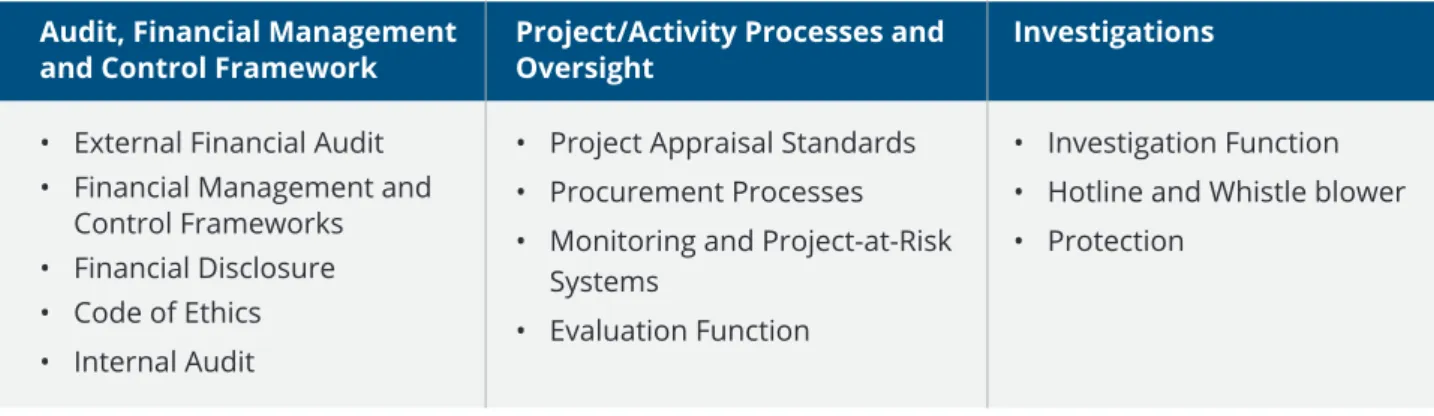
Despite the variety of institutions, mechanisms and instruments, accessing climate funds is a burdensome process that only a few of players are able to grasp, generally due to their capacity gaps – a scenario that has strengthened the role of intermediary institutions. The process of a given country accessing directly resources from the Trust Funds is long and complex. The accreditation process of the country or its designated National Implementing Agency requires their ability to demonstrate that they have adequate institutional, technical, and financial performance to implement the projects, properly manage the project resources and the capacity to comply with the Fund´s
fiduciary standards. These processes require the applicant to have an organizational structure and a qualified team to provide extensive supporting documentation for the accreditation and the bid, which conditions are generally absent in developing and least developed countries.
Table 01: Minimum Fiduciary Standards from the Global Environment Facility (GEF)
Source: Druce, Gruning and Menzel, 2013
• External Financial Audit • Financial Management and
Control Frameworks • Financial Disclosure • Code of Ethics • Internal Audit
• Project Appraisal Standards • Procurement Processes • Monitoring and Project-at-Risk
Systems
• Evaluation Function
• Investigation Function • Hotline and Whistle blower • Protection
Despite the leading role that intermediaries institutions, such as UN Agencies and International Development Banks, have in facilitating the access to Trust Fund resources and distributing them to countries and their Implementing Agencies, many countries have shown desire to access those resources directly. That aspiration was met with decisions by most Trust Funds to not only facilitate and simplify the processes of accreditation and of direct access to funding, but also to provide capacity building for countries with institutional and technical capacity gaps. In addition to the principle of Direct Access, the concept of Enhanced Direct Access has been gaining ground in the last few years. This concept resides in the idea that the delegation of decision-making power to sub-national/local level entities, capable of making those decisions and implementing actions, may provide a greater level of ownership and need-driven to projects funded by climate resources.
Sectors
Regarding sectors, renewable energy
generation is becoming a regular “winner”
in capturing investment both from public
and private sources.
Both in 2015 and 2016, the amount of private investment in renewable energy generation has far surpassed the investment in fossil fuel energy generation. In 2015, US$ 299 billion were directed to renewables, versus US$ 111 Billion for fossil fuel. Following the trend, in 2016, once again, renewables investment managed to double the amount
invested in fossil fuels, US$242 billion against 118 US$ billion (Buchner, Oliver, Wang, Carswell, Meattle, Mazza, 2017).
The levels of spending in climate finance have been steadily increasing in the last few years, although it was possible to identify a significant decrease from the 2015 to the 2016 levels. In the 2015, a record high was achieved in terms of climate finance flows, reaching US$ 437 billion dollars. This surge was largely driven by the private investment, especially in China, the US and Japan.
Although we watched a decrease in the investment levels in 2016, the scenario could not be considered all pessimistic. According to the Global Landscape of Climate Finance 2017, two main reasons helped to explain the lower levels of investment of this year. The first reason is connected to the falling costs of the renewable technologies, which decreased by 10% in average. The second reason is related to the capacity of many countries to assimilate further investments in their economies. Positive expectations, thus, arise from the fact that only recently few players started to operate at nearly their full capacity, such as the Green Climate Fund, which was launched in 2015 and the New Development Bank, which funded its first activities in 2016.
Mitigation efforts have been receiving the lion’s share of the climate investment. In the 2015/2016 period, it accounted for nearly 93% of the total investment. From the volume directed to mitigation activities, the largest beneficiary was the renewable energy sector, having received 74% in the same period. This was a considerable increase, if compared to the last few years. This increase was propelled by heavy investments by United States, Japan and especially China, who was responsible for a surge in investment on its generational renewable capacity (Buchner, Oliver, Wang, Carswell, Meattle, Mazza, 2017).
Conversely, despite the fact that Adaptation initiatives received a considerably smaller share of climate investment, according to the Global Landscape of Climate Finance 2017 report, some of the decrease in investment could be explained due to methodological changes in climate
finance reporting done by Development Finance Institutions. In the Adaptation case, water and wastewater projects were the most “popular” allocations for the public finance, accounting for 51% of the adaptation investment.
CC Steve Wilson
Challenges
The nature of the Climate Finance ecosystem brings with it
several central issues that must be addressed presently.
As noted before, the climate finance environment has grown tremendously in complexity, due either to the volume flow of money, or to the increasing number of players – each of them operating in a dense web of rules, standards and processes. In this highly complex and rapidly growing environment, some challenges arise as stumbling blocks, hindering the chances of success of the international efforts. Among these major challenges, we could highlight:
1. Standards and Definitions
To date, there is no universally agreed definition on what should count as ‘Climate Finance’. The lack of definition and standards is a byproduct of the multitude of players, each one with its own rules and procedures. This issue lies in the foundation of the problem, since it affects several others important topics and hinders the coordination efforts. This matter affects how each player processes: the funding operation, the initiatives eligible for funding, the reporting system, etc.
2. transparency and Accountability
One of the biggest concerns for the climate finance environment is the transparency of the resource flows and operations. Here several dimensions must being highlighted, such as: assess the fulfillment of the pledges made by the developed countries and thus ensuring ‘Additionality’; access to better data, which would be paramount to the assessment of the initiatives and to better inform agents responsible for decision making; avoid waste and misuse of the resources; and combat corruption.
3. Monitoring/tracking and Evaluation
Both issues 1 and 2 have a direct impact on M&E initiatives. The lack of definitions and transparency make it very hard to identify the path that the climate finance resources have taken and their final destination. All this heavily impacts the consolidation of data (and its quality) – much needed to conduct evaluation processes and to assess the efficacy and efficiency of the initiatives.
4. overlapping and Double Counting
In a scenario with a wide array of players, each of them following their own rules and procedures and with limited exchange of information between them, funding overlapping and double counting contributions is not that rare. The lack of transparency (from donors and recipients) coupled with the difficulty to track the financial flows, allow that different funding players end up supporting the same initiative. Or, on the other hand, also allow that the same resource be accounted for twice.
The Urgency in spending to curb the environmental impact in time; the
Fragmentation of the players involved in funding and operating climate
resources; and the Volume of resources necessary to promote change in a
global scale are fundamental characteristics of the Climate Finance process.
Those are unchangeable features. Combined with the aforementioned issues,
they provide a serious combination that allows inefficiency and corruption to
thrive in the way Climate Finance is currently managed. In that sense, tackling
those issues seems paramount to the success of the international efforts to
deal with climate change.
Blockchain
technology
Blockchain is a technology designed to work as a trust
machine
2. there are three key elements needed to establish
trust: identity, ownership and verification. Blockchains allow
users to easily prove their identities, protect ownership of
digital assets and verify transactions without intermediaries.
2 https://www.economist.com/leaders/2015/10/31/the-trust-machine
Identity:
Blockchain is based on the use of digital signatures through asymmetric cryptography. Each user is given a set of two digital codes: a “public key,” similar to an account number, and a “private key”, similar to a password.
ownership:
Blockchain maintains a continuously growing database of records, protecting the whole transaction history of what is operating from being tampered with, even by their operators. In addition to the huge computational power that usually protects the database accounting the values each user possesses, there are also economic disincentives, making frauds financially pointless in most cases.
Verification:
For each Blockchain network, there is a common database to which all parties can propose changes and the network itself will validate, rejecting fraudulent or wrong data from being recognized as valid and propagating only the proper information, periodically establishing consensus throughout the whole network. Everyone connected to the network sees the same information, as each and every peer has the exact same copy of the database, with verified new information being added to it. This public audit capability provides the system with an indisputably groundbreaking level of transparency.
How Blockchain technology
Works and Why It Was Created
at First
In October 31, 2008 an individual or group of people using the pseudonym Satoshi Nakamoto started a discussion in the cypherpunks mailing list, an online tech forum devoted mostly to computer scientists and alike, focused on social transformation through encryption tools. Satoshi said that he had been working on a novel system for electronic cash named Bitcoin, allegedly capable of working in an entirely decentralized way, in the sense that it did not rely on any trusted third party (like banks or States) to function properly. These ideas were put together and firstly introduced in the form of the whitepaper Bitcoin: a Peer-to-Peer Electronic Cash System, with direct references to predecessors like Wei Dai’s b-Money and Adam Back’s Hashcash. Satoshi was clear about the main intentions behind his creation at that time, by emphasizing that Bitcoin would allow any two or more parties to interact financially without any kind of intermediary, as trust would be automatically established by Bitcoin’s distributed network of computers running the same piece of software to maintain the system.
Two months after publishing the Bitcoin whitepaper in a Cryptography mailing list, Satoshi Nakamoto released the first version of the Bitcoin software as an entirely open source protocol. For the first time in more than 25 years of research (Lamport, Pease, Shostak, 1982) and theoretical proposals in the field, the electronic cash idea was successfully implemented as a real protocol. With limited use cases for the first 4 years of its existence, it was in 2013 that Bitcoin reached the mainstream, through a combination of macroeconomic, political and media factors. Since then, it has been evolving by the attention and the investments of large enterprises, startups and hedge funds focused
on developing the Bitcoin ecosystem of financial applications. Moreover, especially from 2015 on, many markets (Bheehmaiah, 2015)3 have been showing an even larger interest on the underlying technology that made it possible for Bitcoin to work as a digital currency under a distributed network of nodes, with no public or private intermediary needed: the Blockchain.
Blockchain is a technology that relies on
cryptography to maintain a continuously growing database of records, protecting all the registered information from being tampered with, even by their operators. Blockchain requires a software that allows computers to communicate with each other directly through a distributed network of peers, where no one has special powers over the others. Thus, these databases are periodically updated with new information comprising new transactions or registries, and consensus is automatically reached, guaranteeing that everyone connected to the network sees the same information. In other words, each and every peer has the exact same copy of the database, with verified new information being added to it after passing through a decentralized validation process.
3 Further information at: https://papers.ssrn.com/sol3/papers.cfm?abstract_ id=2596465
Taking Bitcoin as an example, its Blockchain works as a sort of public ledger that accounts the number of coins that belongs to each user. A new block of transactions added to the chain resembles new pages being filled on an accounting book, in order to preserve both the whole history of all the coins that changed hands in the network and the current holdings of all the users (i.e., the final sum that they possess at any given time). Blockchain is the term commonly used to describe the technology itself and the public database it generates and maintains. As mentioned, it is focused primarily on the maintenance of consensus between any users connected through its decentralized network. In practical terms, consensus means that there is a common database to which all parties can propose changes and the network itself will validate, rejecting fraudulent or wrong data from being recognized as valid and propagating only the proper information, periodically establishing consensus among the whole network. The main achievement of this technology is to be constructed from an intricate mechanism that, based on computational power and economic incentives, makes any attempt to circumvent the validation process prohibitively costly. Basically, there are no intermediaries responsible for ensuring the integrity or the trustworthiness of the data, since this systematic is regulated by software voluntarily executed by users from any part of the globe connected to the network.
As explored in the aforementioned example, Blockchain was originally programmed in Bitcoin (Nakamoto, 2008) in the form of a shared database that represents a public record of the whole history of its transactions, by constantly counting how many bitcoins (the system’s digital value units) are owned by each user of the system at any given time. In legacy systems, strictly speaking there are one or more institutions, generally considered intermediaries, responsible for taking care of this permanent update. In systems based on the Blockchain technology, this process is operationalized by ensuring that the network is updated by the users themselves, and they are the only ones responsible for adding the information that accounts for new exchanges being made and the consequent changes that must be made to the copy each one holds of the Blockchain.
Blockchain is a technology that relies on
cryptography to maintain a continuously growing database of records
In addition, there is a mechanism based on
asymmetric cryptography4 which uses pairs of public and private keys (Nakamoto, 2008), ensuring that, roughly speaking, only the proper user can change the information concerning him in the network. That is, only the holder of that balance in bitcoins can propagate to the network the information needed to transfer them to another person, since any other (malicious) attempt will be rejected by the code that regulates the system. From this, it is possible to conclude that the consensus between the parties is maintained even in a very dynamic sphere, since this common database also grows whenever new exchanges of information (such as Bitcoin transaction) are performed.
In short, what Blockchain provides is based on a sequence of factors:
1. “Proof-of-Work”:
It means that if you are a miner (a jargon for the users that connect to the network as a validating node), you need to offer a solution to a mathematical puzzle that demands a lot of computational power to be solved, in order to be able to add new information to the database that constitutes a Blockchain per se.
2. Encryption:
This is based on cryptographic functions, ensuring an important feature of the system: information, as well as its authenticity and authorship, is easy to verify, but it is practically impossible for a single entity or individual to circumvent it, as massive computational power would be needed and there are also huge economic disincentives to do so.
3. Audit:
Once validated by the system’s code, run
concurrently by a whole network of thousands of peers and propagated over the network in order to be added to their own copies of the Blockchain, this information has its validity publicly audited by everyone, according to the information itself, its author and also the date and the time it was created.
4 For further information, refer to: Hirsch, Frederick J. “SSL/TLS Strong Encryption: An Introduction”. In Apache HTTP Server.
It is precisely because of this technical rigor and the consequent open possibilities that it becomes possible to see Blockchain as a foundational technology with real transformative potential, especially due to what it allows in terms of transparency, reliability, security and efficiency of transactions. New uses for Blockchain, whose code or motivations owe much to the original implementation launched in Bitcoin, begin in the financial field but extend across the most varied fields in which intermediation had been an absolute necessity. The potential of Blockchain technology lies in its ability to offer censorship-free in a decentralized fashion, guaranteeing new fields for a more equitable set of digital institutions (Radu, 2015), no matter if they allow to carry out votes, payments or one of its most promising features: smart contracts.
For Blockchain researchers Aaron Wright and Primavera De Filippi (2015), the paradigm shift brought by the diffusion of the Blockchain, followed by the increasing implementation of decentralized systems based on it, will lead to the rise of lex cryptographia (De Filippi, Wright, 2015), which means a set of rules administered through self-executing smart contracts. If, instead of data corresponding to numbers or financial information, as in the case of Bitcoin, a database built and generated by Blockchain technology stores data of other kinds, it is possible to maintain a wide range of new services, much wider than those strictly monetary, with the same qualities of Bitcoin: inviolable, irreversible, secure, independent and decentralized. The report Blockchain Technology and Legal Implications of ‘Crypto 2.0’ from Bloomberg BNA indicates that this growing trend started to get traction in 2015, with the phenomenon dubbed “Blockchain 2.0” impacting major industries.
Property records, proofs of authorship and intellectual property, digitization and automation of contracts, international remittances, issuance of private titles, mechanisms for decentralized control of institutions, remote and distributed storage of cloud data and various financial products are some of the first among a diverse set of markets being transformed. The logic behind these new Blockchain-based technologies that have been emerging, in addition to being responsible for making them operational in most cases, is written in the form of
smart contracts. In different cases and moments, they should be responsible for disrupting certain a lot of ineffective or inefficient processes.
In Formalizing and Securing Relationships on Public Networks (1997), American cryptographer and lawyer Nick Szabo introduced the seminal idea of smart contracts and what they could become. Since 2014, it has been going from mere vision to practical implementations, mostly with the emergence of Ethereum. It is a decentralized system that operates a Blockchain-based network to be a global supercomputer whose smart contracting capabilities are jointly maintained by its users.
A relationship between two minds (Szabo, 1997), as well as its formalization, is the starting point for the concept of “contract”. In practical terms, it can be understood as the establishment of actions and the possible criteria applicable to judge or regulate them, once a common agreement has been made between two or more parties. In this case, adding “intelligence”, in the computational sense, to contracts consists of the ability to make them digital, more automated and based on commonly used hardware and software (Szabo, 1997). This could significantly reduce human failure, making the control protocols surrounding contracts less costly, as in smart contracts they are automatically designed to assess whether certain clauses were complied with or not. In a digital environment marked by large automation, control procedures such as auditing, for example, would require much less time and financial resources than traditional options. This would also make room for the “self-execution” of digital contracts, arguably the main benefit of a smart contract, whenever the validation of its clauses had been automatically processed. As pointed out by De Filippi and Wright, the Blockchain is closely related to the implementation of smart contracts:
Using a distributed database, like the blockchain, parties can confirm that an event or condition has in fact occurred without the need for a third party. As a result, the technology has breathed life into a theoretical concept first formulated in 1997: digital, computable contracts where the performance and enforcement of contractual conditions occur automatically, without the need for human intervention [...]. In some cases, smart contracts represent the implementation of a contractual agreement, whose legal provisions have been formalized into source code. Contracting parties can thus structure their relationships more efficiently, in a self-executing manner and without the ambiguity of words. Reliance on source code enables willing parties to model contractual performance and simulate the agreement’s performance before execution. In other cases, smart contracts introduce new codified relationships that are both defined and automatically enforced by code, but which are not linked to any underlying contractual rights or obligations. To the extent that a blockchain allows for the implementation of self-executing transactions, parties can freely transact with one another, without the technical need to enter into a standard contractual arrangement.
(DE FILIPPI, WRIGHT, 2015).
American cryptographer and lawyer nick Szabo introduced the seminal idea of smart contracts and what they could become
In terms of large open networks based on Blockchain today, the main highlights are the Bitcoin and Ethereum protocols. In different but equally valid ways, both allow the implementation of smart contracts. Ethereum allows any user to create and run smart contracts deployed in its Blockchain, associated with its own programming language, aimed to make the whole process as straightforward as possible. While each of the dozens of serious Blockchain projects operating nowadays has particular advantages and limitations, it is especially important to emphasize that Ethereum was the first to be created explicitly in order to maintain a Blockchain on top of which it is easy to deploy smart contracts or to create an entire decentralized application based on them. What Ethereum maintains, in short, is a Blockchain network optimized for general use cases. The opening section of the original Ethereum whitepaper, describing the project, includes points of special interest for the present report:
Commonly cited alternative applications of blockchain technology include using on-blockchain digital assets to represent custom currencies and financial instruments (“colored coins “), the ownership of an underlying physical device (“ smart property “), non-fungible assets such as domain names (“ Namecoin “), (“smart contracts”) [...] What Ethereum intends to provide is a blockchain with a fully-fledged Turing-complete programming language that can be used to create “contracts” that can be used to encode arbitrary state transition functions, allowing users to create any of the systems described above, as well as many others that we have not yet imagined, simply by writing up the logic in a few lines of code. (https: //ethereum.org) Beyond the native platform, given that it operates as a kind of backbone on which large-scale projects can be built, new applications are already beginning to affect markets once dominated by few players: Augur (decentralized prediction markets), Maker (stable digital currencies and standalone banking services), Dharma Protocol (a permissionless protocol for issuing, underwriting, and administering debt instruments as cryptographic tokens), DAOstack (an operating system for massive collaboration) and Aragon (a project that aims to disintermediate the creation and maintenance of organizational structures), to name a few.
Ethereum allows any user to create and run smart contracts deployed in its Blockchain, associated with its own programming language
Why Blockchain and the Decentralization it
Promotes are Important
From 2000 onward, greater decentralization proved to be paramount for the resilience of many innovative technologies. Services such as Napster, which although decentralized had a central company as co-responsible, ended up being completely shut down as a result of legal battles involving copyright and other issues. Some of these services were stopped regardless of the nature of the content being shared, thus harming the full range of users, including those who made legal use of them. However, successor alternatives were created with a focus on greater decentralization, providing users with point-to-point connection without the need for large fault-prone central points, making tools such as the Gnutella network “unstoppable” from a technological perspective, although the illegal use of these and other networks is duly combated in the traditional legal sphere.
With regard to the evolution of decentralized networks from the 2000s onwards, it is important to recognize the permanent legacy that such systems have left in the digital economy universe. By proposing changes in a way that became known as “permissionless innovation”, entrepreneurs and activists set some opposition to the way certain businesses were traditionally conducted. Either by the inefficiency of the old models on which they were based or by ideological issues which led some to propose a greater democratization in the access to culture and information. The accelerated cycle of innovation that has marked the growth of the internet in the last decade and its consequences are largely responsible for the inevitable assimilation of some of the recent changes by the mainstream.
The yearning for constant user innovation, combined with the challenges of decentralized technologies, whether fair or otherwise, has forced large businesses to adapt their models and practices completely. Thus, it can be said that the new model of streaming multimedia content, such as music and movies paid by monthly subscription, as proposed by companies such as Spotify or Netflix, was a response largely influenced by the assimilation of recent changes in the consumption of these goods impact on market demands. Or, clearly pointing out: without the controversial transformation initiated by Napster, it is likely that, even with the advent of the Internet, the market would still be stuck in old-fashioned models for trading multimedia content, emulating the analog world in the digital
Entrepreneurs and activists set some opposition to the way certain businesses were traditionally conducted
Without the controversial transformation initiated by Napster, the market would still be stuck in old-fashioned models for trading multimedia content
universe, and without taking full advantage of the advantages brought by the latter. Thus, even with the alternation of companies or projects as market leaders or referrals, decentralization and its impact on business models are configured as growing trends. The strongest wave and the new frontier of this phenomenon at the moment are precisely the diffusion of services based on Blockchain, given the substantially broader impact it can generate in a wide scope.
In Why Business Schools Need to Teach About the Blockchain, researcher Kariappa Bheemaiah (2015) clearly exposes the pillars that make Blockchain a great asset to innovation, both for the unprecedented technical aspects it has and for the power it has to accelerate and amplify the positive effects of other decentralized arrangements that preceded it:
Blockchain is clearly being singled out as a top trend
[...] the Internet of Everything is increasingly becoming part of business reality. Today businesses and societies are noticing that the line between physical and virtual existence is beginning to blur at an increasing rate. A secondary effect of the internet of everything is that it will also create an economy of everything (Panikkar, 2015), the every device capable of connecting to the internet becomes a point of transaction and economic value generation for consumers and prosumers in a sharing economy . [...] the possibilities that are offered by the Blockchain technology begin to make economic sense. [...] In addition, decentralized architectures offer better cost benefits to companies as the peer-to-peer sharing of resources in the distributed network removes dependency on a central server, optimizes
resource use and reduces costs. [...] The distributed networks begin to act as channel of value-based transactions and in light of the aforementioned advantages, a new breed of Blockchain-based businesses are now beginning to show signs of disruption in various domains of the market.
(Bheemaiah, 2015)
The transformative potential of Blockchain technologies, however, is not limited to promoting a closer approximation, or in some cases even the merger itself, between the figures of the service provider and the consumer of the service provider. Nor is it limited to the enormous economy and consequent simplification in the cost structure of any given application, made possible by the elimination of several intermediaries, expensive auditors or related services. By impacting new business dimensions, such as customer relationships (from automation via smart contracts), value proposition (by enabling services that were not possible before) and revenue sources (given the reach digital currencies can have), Blockchain is clearly being singled out as a top trend, providing the world with new services, as well as the potential it has for improving traditional services that assimilate and implement it.
Blockchain
Contributions
Applied to
a. Public and Private
Blockchains
A DLT (distributed ledger technology) is a general acronym referring to a group of technologies capable of maintaining, updating and storing a database by multiple independent parties. Even though Blockchain has been considered a pioneer and foundational technology in many aspects, technically speaking it is nowadays understood as one out of a few DLTs. More specifically, a subset of this macro category, which at the same time comprises completely different informational architectures such as IOTA’s Tangle or R3’s CORDA, for example. We should note that this does not stop, however, some people from labelling everything related to these topics, both the multiple technologies involved and the benefits from its adoption, as simply “Blockchain” instead of DLTs, as the second term can be confusing to some at the time being.
Transfers on a distributed ledger are generally made final when the ledger is updated. In this sense, a Distributed Ledger can be permissioned or permissionless5. Permission refers to how the system works with respect to validating transactions. In a permissioned system, you need to be verified to validate a transaction, which means that, to some degree, the nodes know each other. On the other hand, for permissionless Blockchain such as Bitcoin and Ethereum networks, all the peers can act freely (entering or leaving the network at any time), without identifying or authenticating themselves, without causing any disruption. The single major exception being the security of a permissionless Blockchain, which is generally accepted to be greater: the more distributed it its, the more nodes/peers it has as part of the network6.
5 http://coala.global/uploads/COALA-GLOSSARY-DEC-2015.pdf 6 https://www.bis.org/publ/arpdf/ar2018e5.pdf
b. Blockchain Main technical
Features
Blockchain’s potential is rooted in providing data with the following qualities:
i. Key Benefits
The key benefits are related to the promotion of transparency, security and accountability, thus reducing fraud and corruption, as well as adding to a stronger traceability. Immutability, inviolability, and resilience are one of the key factors that fuels excitement about technology. The decentralization character of the system allows only data verified by independent nodes to be accepted, which makes it impractical and prohibitively costly to attempt an inconsistent data entry or fraudulent changes to already confirmed transactions.
CarbonX (Cost Efficiency)
CarbonX offers financial incentives for individuals to reduce their carbon footprint. The Canadian startup CarbonX first buys carbon offsets, then converts the carbon credits into a cryptocurrency token called CxT. It then sells the tokens to retailers and manufacturers, who in turn use them to encourage consumers to make more sustainable choices. Consumers using the CarbonX platform might earn tokens for choosing locally-grown produce instead of flown in from a distant country, or for buying an energy-saving washing machine. These tokens can then be exchanged for carbon-friendly goods and services, other reward program points, or other digital currencies. The loyalty scheme uses Blockchain technology to seamlessly keep track of the transactions. Retailers will decide how many tokens a given purchase will earn, and the tokens will be tradable on the CarbonX platform. Retailers and service providers signing up to CarbonX will also be able to take advantage of transaction data and information on customers’ energy usage to help them target products and services to customers who are most likely to purchase them.
ii. transparency
Anyone with access to the network can view the history of all transactions operated and being operated in real time. Blockchain records work through a common database, to which all parties can propose changes. The network automatically validates new information at the same time everyone connected to it can audit the entire process, securing the rejection of any wrong data and the propagation of proper information, periodically re-establishing the public consensus. Everyone sees the all the data, as each and every peer has the exact same copy of the database, with verified new information being added to it. This public audit capability makes for the system indisputable groundbreaking level of transparency. Potential impact: the money trail can be tracked and monitored more accurately in areas like aid distribution.
iii. Privacy (and opacity)
Usually, participants of a Blockchain can be pseudonymous by default, without putting the network and its operations at risk, even though they can choose to reveal their real-world identities at different levels, according to the needs of the technology being used or of any application built on top of it. They can communicate their decisions merely by using of their pairs of public and private keys, disclosing any information tying these keys to any specific individual or organization being optional, at the technical level. In Bitcoin’s Blockchain for example, the user does not have to be identified a priori, by giving away any personal data, whereas this is needed when the Blockchain application touches traditional institutions, which is the case when you are exchanging bitcoins for dollars in your regular bank account. Just as some degrees of privacy are perfectly possible, the exact same opposite is also true, with full transparency being reachable to all the three pillars mentioned before: identity, ownership and verification. We can even ensure the identity of any set of specific members without risking the privacy of the others. Because each participant has access to one or more unique private keys that identify them, anyone can digitally sign their transaction using it so that it is only possible to mathematically conclude that whoever executed this signature was the holder of that key. Authentication is a field that undoubtedly presents a wide range of applications.
BnDES token & truBudget (transparency)
The Brazilian Bank for Economic and Social Development (BNDES) held its first experience with Blockchain in early 2018. After a long period in which the bank had been studying the potential use cases, both in national and international fields, the Blockchain Initiative is being developed through two projects. The first is based on a private network developed in partnership with the German Development Bank KfW, whereas the second is creating tokens for the Bank’s public financing processes using the Ethereum network. BNDES established a MoU with KfW in February 2018, allowing them to use and improve the German’s Blockchain based tool called TruBudget. KfW provides BNDES with consulting and technical support, working in parallel with the National Institute of Information Technology. KfW also intends to consolidate its open source software licenses. As a proof of concept, the new Amazon Fund website was announced in mid-April. The idea is to use tokenized assets for money transactions originated from non-refundable foreign funds, which is exactly the case of the Amazon Fund. In their new portal, citizens can access the summarized project and the respective procedures, in line with the indicators of effectiveness.
The BNDES Token was started with a simple but very impactful idea. When a loan is released, it is done through a tokenized backed asset, in such a way that the monitoring of all transactions can be done in real time, both by BNDES agents and by civil society as a whole. It is important to emphasize that, although there are some trade-offs in any application like this, the use of Blockchain technology in this case guarantees the added transparency and full traceability benefits for everyone involved in these processes. That is, these benefits are not only restricted with regard to financial operations at national and supranational levels, but also have clear and positive impacts for all the final beneficiaries.