1
A Work Project, presented as part of the requirements for the Award of a Masters Degree in Management from the NOVA – School of Business and Economics.
A BUSINESS MODEL FOR AN ENTERTAINMENT SOLUTION TO THE IN-VEHICLE INFOTAINMENT INDUSTRY
FILIPE DE JESUS SILVA PEREIRA AGOSTINHO, 1548
A project carried out under the supervision of: Prof. João Silveira Lobo
2
A Business Model for an entertainment solution to the in-vehicle infotainment industry
Filipe Agostinho
ABSTRACT
The evolution of mobile technologies that make its presence something ubiquitous and the idea of internet connectivity in every device, often called as the Internet of Things, are pushing a disruption in other industry: the in-vehicle infotainment (IVI). Many companies are trying to enter this new industry that comprises information (weather, news, location services) and entertainment solutions in just one. For that purpose, company X developed a new entertainment solution and intends to bring it to market. This Work Project focuses on creating a business model and an entry mode for the company.
3
Contents
1. Overview ... 4
2. Methodology and Literature Review ... 6
3. Companies description and product features ... 8
4. Discussion ... 9
Industry Challenges ... 9
4.1. Attractiveness Analysis ... 10
The In-Vehicle Infotainment Industry ... 10
Entertainment substitutes ... 13
Automotive Consumer Insights ... 14
Summary ... 15
4.2. Resource platform evaluation ... 16
4.3. Recommendations ... 18
5. Conclusion ... 19
5.1. The Business Model ... 19
5.2. Limitations ... 21
6. Appendices ... 23
4 1. Overview
Technological developments in the handset industry have changed the connectivity,
integration and business models of many industries, ranging from software development, to creative industries, telecommunications, and so on. Nevertheless, there is a market that has remained practically unchanged, which is about to enter in a disruptive path: the radio industry of the automotive sector. Today, new functionalities are appearing in car consoles
(the so called head units) such as navigation systems with integrated GPS and weather forecasts. Entertainment features integrated with smartphone connectivity are on the move to be the next step to further support the transition to a new industry: the in-vehicle
infotainment (IVI). This is a high-tech/high-growth industry and many companies are
entering it, such as head unit manufacturers as Harman, Panasonic, or Alpine, technological companies as Apple and Google, as well as other tier-one automotive suppliers.
From a user standpoint, people keep on listening radio in their cars in the same way they use to listen for more than 50 years: listeners are subject to what others choose to
broadcast with their own schedules. Despite the increasing connectivity of many devices,
there is still a chasm between the content consumption experience that users have through web/mobile media and the radio experience when they enter their cars. Although there is already the possibility to connect smartphones and tablets to cars, safer solutions for drivers are still under development.
It is in this context that Company X has come up with a safe and user-friendly
entertainment solution (solution E) to supply either the IVI or, directly, the automotive
industry that will allow users to have a continuous content consumption experience integrated among devices. The driver will have access to an embedded platform that
5
allows connecting its smartphone with its car head unit and selecting content according to its preferences, synchronizing it with apps as Spotify, Pandora or Flipboard, and sharing its favorite songs, news and podcasts on social networks, just as it is done outside cars. For this purpose, the company has already established its first approach to the market, identifying Company P as its first potential partner to introduce its new solution. P’s core business is developing personal and automotive (OEM and tier-one) white label navigation solutions with the strategic intent to expand its service offering and enter the IVI industry. In the automotive market, its services run on about 20 million units worldwide and can be updated with new solutions through a universal, online portal connected to the head unit
through the driver’s mobile phone. For that purpose, the company developed a patented technology that allows communication between devices using the smartphone’s internet
connectivity with a bi-directional feature (Appendix 1).
Meanwhile, car manufacturers do not want to lose control of what happens inside cars with the expense of losing the strategic differentiation they had for years. As car connectivity increasingly gains importance, the frame of competition shifts from what is inside the hood to what is behind the dashboardi and thus, these industry players need to find software solutions that meet their requirements with implications for suppliers to be discussed in the next chapters.
Considering this disruptive framework and after a Directed Research Internship in company X, the purpose of this Work Project is to develop a Business Model for Company X’s new entertainment solution. To do so, an Entry Mode will be recommended.
6 2. Methodology and Literature Review
As the main goal of this Work Project is to propose a Business Model for a new product to be introduced in the market, this Work Project is based on the academic field of Strategy, covering diverse topics as industry attractiveness, resource based view of the firm (in order to evaluate the probability of success of a company), strategic alliances and business modelling.
Michael Porter (1979) proposed a framework to analyze industry attractiveness through the understanding of how economic factors drive industry competitiveness. He argues that competitive forces go well beyond the established combatants in a particular industry and that the collective strength of these forces determines the ultimate profit potential of an industry. Porter proposed five competitive forces and then analyzes the economic sources of each: bargaining power of suppliers and buyers, threat of entry and substitutes, and industry rivalryii.
In order to assess the success probability of the company to tackle the new market opportunity, the resources were evaluated based on a taxonomy that comprises Core Competences, Specialized Assets and Architecture of Relationships. The term Core Competence was first used in 1990 by Gary Hamel and C. K. Prahalad in their paper The
Core Competence of the Corporation published by Harvard Business Review. It was
defined as «the company’s collective knowledge about how to coordinate diverse
production skills and technologies»iii. Robert M. Grant in his book Contemporary Strategy
Analysis first published in 1991 provides a summary about the foundations of the
resource-based view of the firm and argues that for a company to have competitive advantage it has to have superior resources support the its market positionsiv.
7
Yves L. Doz and Gary Hamel (1998) provide, in their book Alliance Advantage: The Art of
Creating Value with Partnering, both conceptual and practical tools for analyzing the
design and performance of alliances. Drawing on principles of strategy, organizational design, organizational learning, and collaborative management, they argue the primary principles of alliance creation are co-option (where potential competitors become allies),
cospecialization (value creation through combining different resources, positions, skills,
and knowledge sources), and learning and internalizing new skills, in particular those that are tacit, collective and embeddedv.
Alexander Osterwalder and Yves Pigneur (2010) in their book Business Model Generation:
A Handbook for Visionaries, Game Changers, and Challengers propose a framework to
assess and design innovative business models, the Business Model Canvas, and to position them in a highly competitive environment. It comprises nine building blocks, grouped in four main areas of business: customers, offer, infra-structure, and financial viability. The building blocks are customer segments, value propositions, channels, customer
relationships, revenue streams, key resources, key activities, key partnerships and cost structurevi.
This Work Project was based both on primary and secondary research. Company insights on the product features and on revenue streams were used as a source of primary research, as well as the managers’ evaluation of the resource platform. The industry analysis and the customer insights were developed based on secondary research from specialized press and industry reports.
8 3. Companies description and product features
Company X is a fast growing venture created in 2010 that currently operates in the music streaming industry as a B2B company. It is present in five countries and it is working on its further internationalization. In 2013, its revenues went up to around 3 million euros with a growth rate of approximately 45%. By the end of 2013, it had 11 employees and currently counts with around 30. As an expansion strategy, it is currently looking for diversification opportunities.
Company P is a company created in 2006 that operates in the automotive and navigation sectors, as well as in the Telematics area. It has 20 million units shipped globally with presence in 168 countries and has a network of 150 business partners worldwide. It is also a high-tech/high-growth company with a revenue growth of 46% in 2013.
Solution E provides its users with functionalities as the access to AM/FM radio, web radios, podcasts, and news and to a music catalog. It allows sharing favorite content on social networks, as well as messaging and it includes a song recognition system that gives the possibility to identify what is playing and to integrate it with other applications and to save it in an offline mode. By using Company P’s technology, the entertainment solution will have a bi-directional feature that enables bilateral communication between the two devices: the smartphone and the head unit.
9 4. Discussion
Industry Challenges
The average time drivers spend on their cars (for example in the US, it is 10% of waking time, around 600 hours per yearvii) and the connected experience provided by ubiquitous mobile technologies are pushing automotive manufacturers to adopt in-vehicle
infotainment that comprises navigation systems, fuel and weather information, radio and
other entertainment services. Although drivers are already using these services, they use them separately (one uses for example Pandora, Financial Times and BBC Radio 1 in
separate applications) without an integrated experience, except in luxury vehicles. These disruptive innovations bring several challenges transversal to the automotive value chain. The automotive industry is driven by a strong competitive differentiation and OEMs need solutions that allow them to differentiate from their competitors. Google with Android Auto and Apple with CarPlay have been making efforts to bring their systems to cars, which are the most mature solutions available. Although car manufacturers are not blocking them, this is not the ideal scenario since this does not satisfy the need for differentiation as these systems will always have the same infotainment portfolio and user interface regardless the car brand. Besides that, OEMs do not want to give up the gatekeeping position that implies giving away the access to valuable data regarding customer utilization
of the infotainment component of the broader telematics system. End-to-end connected car platforms enable automotive manufacturers to centralize and simplify the creation,
deployment, and on-going management of their connected car programsviii which is a value proposition that the tech giants cannot offer.
10
For now, IVI is lagging behind mobile technologies. Car Manufacturers are not specialized in building software, so they do not have enough knowledge to compete in proprietary products with tech giants such as Apple and Google, which results in
infrequently updated infotainment systems. Company P and Company X are committed
to address this future-proofing challenge, on the one hand, through software updates via mobile devices using P’s patented technology and, on the other, by developing a frequently updated platform with new functionalities and improved operability.
Based on the aforementioned challenges, many industry players are on the move to tackle the market opportunities which will be discussed in the following section.
4.1. Attractiveness Analysis
The In-Vehicle Infotainment Industry
Driven by the growth of the development of smartphone integration systems, IVI services will be very popular and, according to GSMA and SBDix will experience a strong and sustained growth. In 2014, these services containing traffic information and navigation solutions was worth around 13.565 billion euros and it is forecasted a 81% growth to 24.526 billion euros in 2018 including services as call center support and web-based entertainment (Appendix II). This means the industry revenues will grow at a compounded annual growth rate of approximately 16%.
However, the automotive industry is keen to keep supplier diversification in order to both customize its in-car offerings and to drive down costs via its bargaining power. This results in a high IVI industry rivalry with many players struggling to get market share.
11
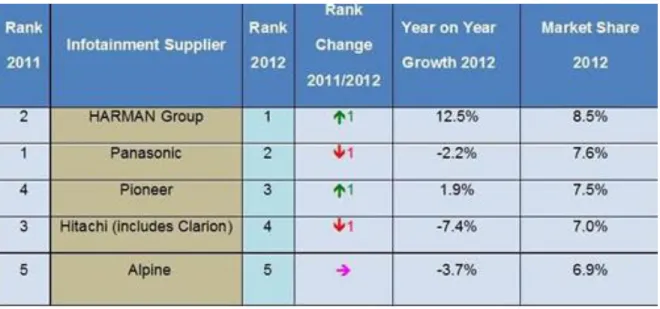
accounted for approximately 37,5% of the whole industry revenuesx (see table below), of which the number one got 8,5% market share, winning auctions to supply BMW, Chrysler, Hyunday, Mercedes Benz, Toyota, the Volkswagen Group, among others.
Table I – Market Share and Growth of the IVI Industry
Besides the companies presented in the table above, other powerful infotainment suppliers are Continental AG, Bose, Delphi, Kenwood Corp., among othersxi. Basically, most of these firms were already positioned as Tier-one automotive suppliers, offering radio hardware, rear-seat entertainment, sound systems, among other products, and they are trying to tackle the broader infotainment opportunity. Hence, these are experienced incumbents that have been working with OEMs for several years and had already established learning curves and trust relationships with their customers.
A good part of tier-two suppliers, meaning the suppliers of the IVI industry, are companies that provide operating systems and code standards that are common to the whole industry so that tier-ones and OEMs can bring customization to the infotainment usersxii. Other suppliers may include map developers, and hardware parts as chips and screens. Most of
12
these products/services are undifferentiated and compete on cost efficiency. However, an industry that supplies specifically the entertainment part of the infotainment solution is the music industry, which has high upstream concentration levels that usually make music
distributors incur in very high fixed costs through up front and/or minimum payments for catalog licensing, most favored nation clauses and non-disclosure of the terms of
contractsxiii.
An IVI system is one of the most complex software parts of a car, usually requiring around 40 million lines of codexiv, and collaboration between several firmsxv. Despite the high specialization of players through the whole value chain, vertical integration is prone to happen as the example of Harman’s acquisition of Aha Radio shows usxvi
.
At the same time tier-one suppliers are trying to embed systems in cars head units, Google with Android Auto and Apple with CarPlay are following a different approach. A user physically plugs a phone into a car’s console and the head unit becomes a larger-screened interface for the phonexvii, which means the OS is not embedded in the head unit but it is on the Smartphone. At the beginning, many industry specialists believed Google and
Apple were going to build an OS from scratch but they just created a screen display that plays a similar role of an IVI system.
Although the two companies historically have been trying to differentiate from one another, Android Auto and Car Play present several similarities in respect to the features they
provide. Both will have a voice-controlled message and navigation systems, as well as content apps to have access to news, music and podcasts. In the case of the former, some partners were announced such as Major League Basketball, Spotify, Pandora and
13
iHeartRadio. The latter announced they will put on board Beats Radio, iHeartRadio, Spotify and Stitcher. These apps serve as complements to the overall system.
Many OEMs are allowing these tech giants to implement such platforms in their cars (Google has even created the OAA – Open Automotive Alliance -, with around 40 car manufacturers), sometimes simultaneously, pushing to the driver the one that best suits them (see Appendix). Until new solutions appear in the marketplace, these platforms have a temporary competitive advantage since they leverage already existing mobile ecosystems and the development lifecycle is shorter bringing software updates more often.
Entertainment substitutes
Company X will not walk alone in the quest to get in the head units’ landscape. Harman’s proprietary radio application Aha Radio, Omniphone’s MusicStation and Gracenote’s new car audio platform launched in November 2014 are trying to provide similar functionalities. Aha aims to convert web-based content into streaming in a radio-like format offering its customers a broad choice of radio stations, podcasts, news, music, social media feeds and location-based services using the phone’s data. All the content is free and supported by advertisingxviii. Besides its presence in Harman’s IVI, Aha already closed deals to be present in Ford Sync, Chrysler’s UConnect, and in aftermarket providers as Pioneer and Alpine.
Gracenote has been providing metadata solutions to the automotive industry, enabling drivers to recognize songs through fingerprinting and deliver text and image information about the song title, album and cover artxix. The company wants to give one step forward by creating a common interface that unifies several music sources including AM/FM radio,
14
music streaming and web radio. By unifying, an option to create playlists and to play songs on different services is also created.
Omniphone launched its dedicated MusicStation Automotive Partner Programme to deliver a cloud-based digital music solution tailored to the automotive industry needs. It intends to offer its service through a one-off payment option in overall car packages. MusicStation is already in the PC and mobile arena as a white label player present through partners such as Sony Music Unlimited, rara.com, Guvera, HP and Blackberry.
A summary comparing the different solutions features is presented in the appendix.
Automotive Consumer Insights
While the greatest part of the attractiveness analysis dwelled on the IVI industry dynamics and the requirements of OEMs, it is important to take a brief look at car drivers’ insights since they will be one important customer segment.
In its Global Automotive Consumer Studyxx conducted on US Generation Y drivers, Deloitte discovered that 46% of Generation Y consumers believe that there are significant benefits from cars being fully connected to the internet and 52% expect to connect their smartphone to use all its application from the vehicle’s dashboard interface. Moreover, it seems that there is some willingness to pay for new car technologies, with 27% of the respondents saying they would be willing to pay more than $2500 (see figure I in the appendix).
In its study named The Cars We Want Tomorrowxxi based on surveys made by GfK in countries that represent 68% of the European automotive market, AutoScout24 concluded that 48,9% of European individuals in the income range of [1500€-2000€[ are interested in
15
entertainment features in their cars and that number increases to 58,6% in the income category of 3000+€. However, when it comes to actually wanting an entertainment system, «respondents also seem to take into account whether they can ultimately afford the service it enables». In fact, the study finds out that only 13.4% of the respondents are willing to pay up to 10% more than they do today for extensive entertainment and information features and that number shrinks to 3.3% when it comes to pay more than 10% than they do today.
Summary
To conclude this section, a synthesized market attractiveness analysis is presented in the table below.
Market Dimension 24.5 billion € in 2018
CAGR of 16%
Rivalry Increasing, competition based on innovation
Bargaining Power Low towards suppliers
Low towards buyers
Substitutes Yes, Android Auto and CarPlay
Attractiveness (1-10; 1-Low, 10-High) 6
Table III – Market attractiveness analysis summary
The industry features a considerable size with high revenues and respective growth rate when compared to Company X’s revenues and high growth ambitions, despite the predictable intense competition among incumbents and potential entrants.
16
When looking upstream in the industry, most of the suppliers will not predictably constrain the potential profitability of the company with the exception of record labels. These
particular industry players exercise a very strong bargaining power charging high prices for licensing their music catalogs. As this particular relation constitutes a heavy burden on the company’s cost structure, it was attributed, in general terms, a low bargaining power towards suppliers.
Whatever the entry mode the company choses to operate in the industry, either through supplying tier-ones by, for example, licensing and managing the head unit platform, or through being a tier-one itself in a strategic alliance with other companies, it will face buyers that exercise a strong bargaining power based on the aforementioned industry dynamics.
Finally, the threat of substitution is high, since Google and Apple already presented an alternative strategy to approach the IVI industry, through a screen display of their most recent mobile operating systems with its respective adaptation to meet safety requirements. After analyzing the industry dynamics and attractiveness we proceed to the analysis of the company’s resource platform to determine the ability of appropriating industry rents.
4.2. Resource platform evaluation
In order to assess the success probability of Company X in tackling the new market
opportunity, a resource evaluation was made according to three different types of resources: core competences, specialized assets and architecture of relations.
Recalling the literature review, we define core competence as «the company’s collective knowledge about how to coordinate diverse production skills and technologies».
17
Specialized assets refer to the technologies the company developed that are not available in the factor markets at feasible costs. The architecture of relations is the network of relations that allows the company to create knowledge for the company and its members.
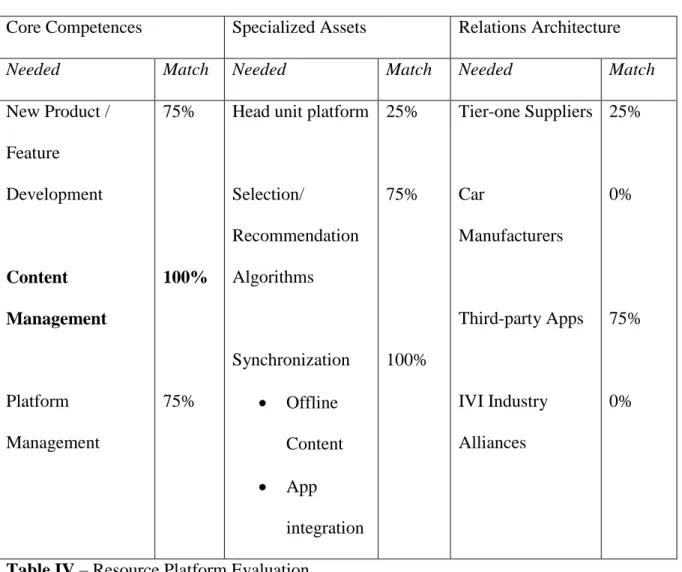
For each resource, managers were asked which level of match exists between the current situation and the company’s needs. The classifications were given in an approximate scale. Core Competences Specialized Assets Relations Architecture
Needed Match Needed Match Needed Match
New Product / Feature Development Content Management Platform Management 75% 100% 75%
Head unit platform
Selection/ Recommendation Algorithms Synchronization Offline Content App integration 25% 75% 100% Tier-one Suppliers Car Manufacturers Third-party Apps IVI Industry Alliances 25% 0% 75% 0%
Table IV – Resource Platform Evaluation
The Content Management competence can be considered the most valuable resource the company possesses, not only by its level of match but also because it is a scarce resource that has been accumulated over the years through operating in the music streaming
18
industry. The competence includes the knowledge both in worldwide content selection and in the negotiation of music catalog licensing, operating as a B2B company.
Although the head unit platform is still in its roots, the company has already planned its resource allocation for the investment in R&D that needs to be performed in order to reach a higher level of match with its competitive needs.
Overall, although the company has a good level of match on core competences and
specialized assets, its architecture of relationships with the automotive value chain is almost inexistent, since the company is entering in a new industry.
4.3. Recommendations
Following the industry and resource platform analysis we are now able to draw
implications. First of all, we can conclude that the automotive value chain is extremely hierarchical. A representation is depicted below.
Figure II – Automotive Value Chain
The automotive industry has high bargaining power relatively to its tier-one suppliers, requiring at the same time customization in order to obtain differentiation (this includes integration with many vehicle sensors), affordable IVI platforms and data “locked” from third-party operators. Whilst it is in the tier-two arena that undifferentiated products are developed, it is in the tier-one sector that happen the efforts for differentiation. Hence,
Tier-one suppliers: in-vehicle infotainment (IVI) - several players
Automotive industry Tier two suppliers:
OS, Maps, Screens and other components
19
Company X should try to focus on strategic alliances with tier-one suppliers to work as close as possible with OEMs, while taking advantage from potential partners’ specialized assets and architecture of relations in order to deliver a competitive service offer and to increase its success probability in the industry. Company P seems a good partner due, on
the one hand, to its already available telematics knowledge, Human Machine Interfaces and smartphone connectivity technology and, on the other, to their need for capabilities
developed by Company X. In other words, it seems there is a strategic fit and
complementarity between each company’s resources, skills and knowledge sources that
constitute an opportunity to bundle them and deliver a higher value creation than if each company operated by itself. Moreover, both companies can take advantage of the alliance to learn from each other by internalizing new skills and core competencies that can further be applied to create other business opportunities.
5. Conclusion
5.1. The Business Model
After the previous analysis and the proposal of the entry mode, the company’s intent to enter the new industry is validated. Recalling the customer insights regarding connected vehicles, we are now able to define a business model for the entertainment solution developed by Company X. The Business Model Canvas framework is presented in appendix with special emphasis on Customer Segments, Value Propostions, Revenue Streams, Key Activities, Key Partnerships and Cost Structure.
20 Customer Segments
The companies will have two main customer segments: on the one hand, car manufacturers and car drivers, on the other.
Value Propositions
The value proposition for Car Manufacturers lies in addressing their needs for an
infotainment solution fully-integrated with smartphones, for competitive differentiation and to leverage the big data generated and captured by car sensors by maintaining the gatekeeping position. On the other hand, customers will have a continuous content consumption integrated among devices.
Customer Channels: OEM distributors and Car Dealers.
Revenue Streams
The solution will entail three main revenue streams. In an ideal scenario, car manufacturers will pay a licensing fee for the head unit platform and the drivers will have access to a pay-per-use freemium model. While the free version will be supported by advertising
revenue and will have features that are already present in the mobile media industry such
as free access to news, AM/FM radio and to a music catalog, the premium version will include premium features such as the Offline Mode, the Bi-Directional Connectivity and the App Integration and they will be charged as a one-off fee in car extras at the moment of the purchase. Although alternative ways were considered to charge for premium features, such as a monthly subscription similar to what happens in with mobile media
21
entertainment, the former alternative is more adequate since it will ease the adoption by the car drivers, as it will be pre-installed, ready to use and in a way that customers are already used to customize their vehicle.
Key Resources: Head unit platform and P’s patented technology technology.
Key Activities
The activities that are fundamental to support the solution are content management and platform management that include new feature development and licensing contracts for the music catalog.
Key Partnerships: Company P and External App Developers.
Cost Structure
The main cost components will be related to development costs of new features and keeping the platform updated and to content licensing costs from record labels.
5.2. Limitations
Although the business model was built taking into consideration all the key industry players and the fast adoption of the entertainment solution, there is not a perfect business model and certainly this one has its limitations both strategic and financial wise. We can clearly identify three of them.
22
First of all, despite the advertising revenue being an ongoing revenue stream as long as the user uses the service regularly it is not predictable that it will be the biggest slice of the pie. That one is forecasted to be the one-off fee the driver will pay for premium features. This makes the company dependent on new customer acquisitions to keep a constant and less volatile revenue stream.
The business model was conceptualized under the assumption of a successful partnership with . Although there is a strategic fit between the two companies and Company X possesses scarce competences that are not easy to acquire in the market, there might be substitutes for the entertainment solution such as Gracenote’s solution that is not currently competing with in other markets, as opposed to Harman’s Aha Radio. Hence, the strategic alliance is a very sensitive issue for the success of the business model.
Finally, the existence of a “middleman” that will make the solution available to car drivers – the automotive manufacturer – brings a limitation of control of the revenues. Although regular auditing may be included in the contracts with the OEMs, the relationship is mostly based on trust of the duties of the different parties.
23 6. Appendices
Appendix I: Bi-directional feature representation:
24
Appendix III: Table II - Summary of features of entertainment substitutes
Appendix IV: Figure I - Gen Y consumers’ willingness to pay for new car technologies. AM/FM Web Radios & Podcasts News Social Media & Messaging Song Recognition Music streaming App Integration Bi-direct feature
Aha Radio Yes Yes Yes Yes No Yes Yes No
MusicStation No No No No No Yes No No
Gracenote Yes Yes No No Yes Yes No No
25 Appendix V: Figure III - The Business Model Canvas for Solution E
26 7. References
i
Newcomb, Doug; The Next Big OS War Is In Your Dashboard; Wired; March 2012 ii Porter, Michael. 1979. “How Competitive Forces Shape Strategy”. Harvard Business
Review; March-April: 137-145 iii
Prahalad, C. K.; Hamel, Gary. 1990. “The Core Competence of the Corporation”.
Harvard Business Review; May-June: 80-90 iv
Grant, Robert M.. 1991. Contemporary Strategy Analysis. Cambridge, UK: Blackwell Business
v
Doz, Yves L.; Hamel, Gary. 1998. Alliance Advantage: The Art of Creating Value
through Partnering. Boston: Harvard Business Review Press vi
Osterwalder, Alexander; Pigneur, Yves. 2010. Business Model Generation: A Handbook
for Visionaries, Game Changers, and Challengers. Hoboken, New Jersey: John Wiley &
Sons, Inc.
vii
MarketsandMarkets; Global In-Car Entertainment (Infotainment) [ICE] System Market
worth $14.4 Billion by 2016; Press Release; March 2012 viii
Airbiquity; Airbiquity White Paper – Ready for Connected Car Prime Time?; Airbiquity Blog; March 2014
ix
GSMA Connected Living Programme: mAutomotive; Connected Car Forecast: Global
Connected Car Market to Grow Threefold Within Five Years; February 2013 x
Strategy Analytics; HARMAN becomes top Automotive Infotainment Supplier in 2012; April 2013
27
xi
Technavio, Top 12 Infotainment Suppliers, June 2014
xii
Telematics Updates; Telematics and In-Car Apps: making infotainment cost-effective; October 2010
xiii
Robertson, Michael; Why Spotify Can Never Be Profitable: The Secret Demands of
Record Labels; Gigaom; Deceber 2011 xiv
Mearian, Lucas; Why Ford is dumping Microsoft for Blackberry’s QNX OS; Computer World; February 2014
xv
Kuchinskas, Susan; What Telematics firms can learn from Web 2.0; Telematics Update, June 2010
xvi
Harman Group; HARMAN Acquires Palo Alto-Based Web Content Pioneer to Transform
the Mobile Infotainment Experience; Press Release, September 2010 xvii
Moynihan, Tim; Google Announces Android Auto, Its Answer to Apple’s Car Play; June 2014
xviii
Barry, Keith; Aha Radio: At the Intersection of Streaming Audio and Social Media; May 2013
xix Lawler, Ryan; Gracenote’s New Car Audio Platform Looks To Unify Online And Offline
Services; Tech Crunch, November 2014
xx
Global Automotive Consumer Study, Exploring consumer’s mobility choices and
transportation decisions, Deloitte, 2014 xxi
The Cars We Want Tomorrow, What do Europeans want from the cars of Tomorrow?, AutoScout24, 2013/2014