Linear Programming knowledge in First Stage Higher Education
Courses
Barros, P. M. 1, Pereira, A. I.2, Teixeira, A.3
1
[email protected], Polytechnic Institute of Bragança
2
[email protected], Polytechnic Institute of Bragança
3
[email protected], University of Trás-os-Montes e Alto Douro
Abstract
In this work we will describe an experimental study with approximately fifty Portuguese students of the 2nd year of the BSc Degree of Biomedical Engineering as well as Chemical and Biological Engineering Higher Education Courses. The aims of this study are to identify which knowledge of Linear Programming (LP) taught in High School the students acquired and still remember, which tools they used in that stage of education when learning the theme of LP and their opinion about the significance of LP in daily life problem resolution. We also propose to investigate if the students are able to use WinQSB software to solve LP problems. In addition, we intend to identify not only the versatility of this software but also the opinion of the students about the resolution of LP problems with WinQSB, as well as their main difficulties during this experience.
Key-words: Linear Programming, WinQSB, First Stage Higher Education Courses
AMS Classification: 90C05, 97M40, 97U70
1.Introduction
In Portugal, Linear Programming (LP) is a compulsory part of the Mathematics program in some High School curricular units since the school year 2004/05, being important that real life problems or its adaptations are solved [2]. As these problems aren’t, in general, easy and fast to solve, the use of technologic surrogates, such as WinQSB [3], is very important. The use of this type of software, although not usually exploited in High School, helps the students to solve a broader type of problems and it also helps them to focus in the analysis and interpretation of the obtained results. Therefore, we think that the use of software to solve LP problems should be broadly promoted not only in High School but also in First Stage Higher Educational Courses.
With this study we intend to present an experience performed with approximately fifty Portuguese students of the 2nd year of the BSc Degree of Biomedical Engineering as well as Chemical and Biological Engineering Higher Education Courses. We proposed to the students the resolution of a practical activity involving the resolution of LP problems (adapted from [4,7]) using the free software WinQSB.
2.Study Description
This experience took place in April of school year 2009/10 and involved approximately fifty Portuguese students of the 2nd year of the BSc Degree of Biomedical Engineering and Chemical and Biological Engineering Higher Education Courses from Polytechnic Institute of Bragança.
This experience was performed in two sessions of two hours each. The researchers directed the activities in both sessions. The first one took place in a regular classroom, while for the second session a computer laboratory (with 15 computers) was used. We chose to use WinQSB software because it is a free and, in our opinion, friendly software. As the number of computers available was inferior to the number of students, they executed all tasks in pairs. Nevertheless, each student got:
• a working sheet with the text of two problems (that includes some questions that not
only make the students focus on some particular aspects of the studied problem but also help them to explore the edit potential of WinQSB);
• a short guide to use WinQSB software;
• two inquiries,
having all the students filled the inquiries individually.
Now we will describe the development of the activities for both sessions:
1st Session: The first hour was used to make a brief revision of the LP concepts taught in High School. After that, the students were asked not only to write a LP formulation for the first problem of the working sheet but also to solve it using the graphic method (30 minutes were given to let them fulfill both tasks). Then we explored the LP formulation and resolution of the proposed problem with the students. During the last 10 minutes of this session the students filled the first inquiry.
2nd Session: The working sheet and the WinQSB short guide were given to the students. The resolution of the first problem of the working sheet using WinQSB was asked to the students (that were reminded that had already solved it using the graphic method in the first session). The computational resolution of the problem was superintended by the researchers that explained the necessary procedures to do it (to help the students the computational resolution of this problem was done step by step and was projected on a canvas). This problem was also used to show to the students what WinQSB edit menu allows us to do (this task took approximately 45 minutes).
After that, the students analyzed the second problem of the working sheet and wrote the LP formulations. The formulations were discussed/corrected and the students solved them using WinQSB. The results were discussed (this task took approximately 1 hour).
During the last 10 minutes of this session the students filled the second inquiry.
3.Presentation and Analysis of the Results
As already mentioned, with this study we mainly want to identify which knowledge/concepts taught in High School about the theme of LP the students still remember and also to understand if the students are able to use WinQSB software to solve LP problems. With this purpose, after both working sessions each student filled an inquiry.
The analysis of the students’ opinions, about the work proposed, and the shown knowledge is based on their answers to the questions in the two given inquiries.
To ease the reading and clarify the analysis of the results, we will present graphics to summarize the collected information.
Relative Frequency %
25%
45% 30%
Sometimes Almost always Always
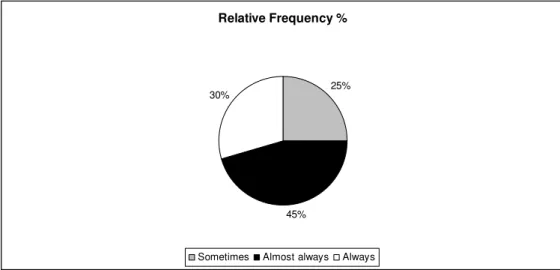
Graphic 1 – “Can LP be useful to solve real life problems?”
As we can observe, from Graphic 1, all the students consider LP useful to solve real life problems, being that most of them (three quarters) think that it happens always or almost always.
Relative Frequency %
32 43
5
66 41
80 2
16 15
0% 10% 20% 30% 40% 50% 60% 70% 80% 90% 100%
I II III
Questions
True False Don't know
Graphic 2 – Knowledge of the students about LP problems.
From Graphic 2, is possible to see that most of the students (more than 65%) know that LP problems may admit non integer solutions, 41% of them have the notion that LP problems may not admit a solution, while 80% know that LP problems may involve more than three variables.
Questions:
All LP problems:
I- just admit integer solutions.
II- admit, at least, one solution.
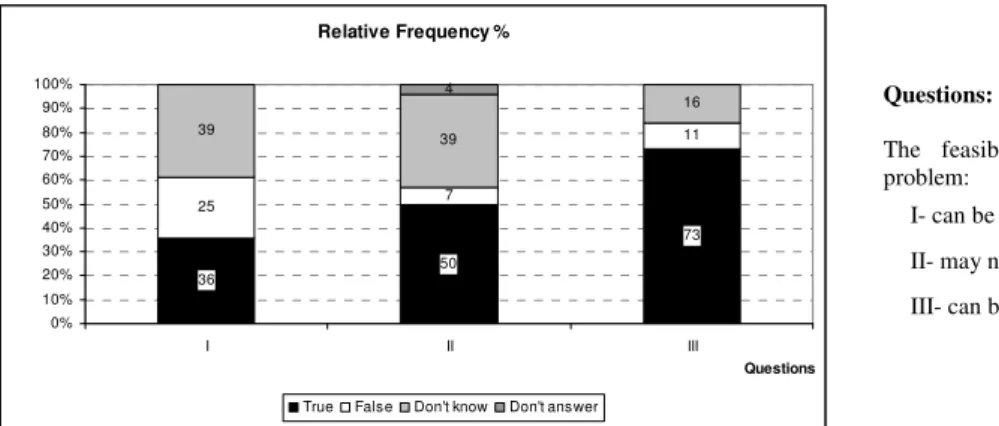
Relative Frequency % 36 50 73 25 7 11 39 39 16 4 0% 10% 20% 30% 40% 50% 60% 70% 80% 90% 100%
I II III
Questions
True False Don't know Don't answer
Graphic 3 – Knowledge of the students about LP problems feasible region.
Graphic 3 allows us to observe that most of the students don’t know that the feasible region of a LP problem must be convex and have to include the border or don’t answer, but more than 70% recognize that that the feasible region may be non limited.
Relative Frequency %
77
5
70 84
21 23 16
2 2 0% 10% 20% 30% 40% 50% 60% 70% 80% 90% 100%
I II III
Questions
True False Don't know Don't answer
Graphic 4 – Knowledge of the students about the relation between LP and Geometry.
Almost 80% of the students know that LP problems can be solved by the Graphic method, 70% of them have the notion that LP is more than an application of Geometry and almost 85% of them know that the Graphic method isn’t the only method that can be used to solve LP problems, as it can be seen in Graphic 4.
Relative Frequency %
18 16 18
66 80 71
16 4 11
0% 20% 40% 60% 80% 100%
I II III
Questions
True False Without opinion
Graphic 5 – Difficulties felt by the students when formulating LP problems. Questions:
The feasible region of a LP problem:
I- can be non-convex. II- may not include the border.
III- can be non limited.
Questions:
I- Geometry can be used as a tool to solve LP problems.
II- LP is just an application of Geometry.
III- Geometric representation is the only way to solve LP problems.
Questions:
When we formulate LP problems, it is difficult to:
I- interpret the text and understand what the data is.
II- write the mathematical expression of the objective function.
From Graphic 5, we can observe that more than 65% of the students didn’t fell difficulties interpreting the text of the problem, understanding what the data is, writing the mathematical expressions of the objective function and of the problem’s constraints.
Relative Frequency %
96
34 2
43 2
23
0% 20% 40% 60% 80% 100%
I II
Questions
False True Don't know
Graphic 6 – The use of technology to solve LP problems.
More than 95% of the students didn’t have any contact with LP software in High School and less than 45% of them say having used the calculator to solve LP problems at that stage of education, as it can be confirmed in Graphic 6.
Relative Frequency %
5%
30%
65%
Sometimes Almost always Always
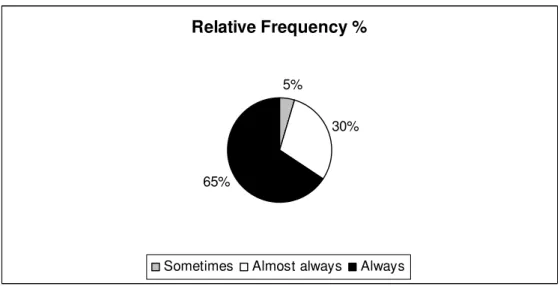
Graphic 7 – “Do you think that the use of software to solve LP problems is useful?”
As we can observe, from Graphic 7, all the students consider useful using software to solve LP problems, being that almost all of them (95%) think that it happens always or almost always.
From Graphic 8, we can observe that approximately 95% of the students think that using software to solve LP problems is faster than using Analytic or Graphic methods (A&Gm), more than 80% feel that it requires less effort than these two methods and approximately 70% of them think that it is more general than A&Gm. More than 80% of the students consider that the use of software allows changing the data easily. Nevertheless, only 45% of the students think that the user of this type of software needs quite some knowledge in the area and more than 80% of them consider that the results obtained with this software are more exact than the ones got with A&Gm.
Questions:
In High School:
I- did you have contact with any LP software?
Relative Frequency %
96
39
82 84 71 82
0
45
2 2
11 7
2
11 11 12 16 9
2 5 5 2 2 2
0% 20% 40% 60% 80% 100%
I II III IV V VI
Questions
True False Without opinion Don't answer
Graphic 8 – Reasons to use software to solve LP problems.
Relative Frequency %
2 2
71 64 89 89
55 46
27 36 11 9
45 52 2 0% 20% 40% 60% 80% 100%
I II III IV V VI
Questions
Always Never Sometimes Don't answer
Graphic 9 – About the use of WinQSB software.
More than 95% of the students considered that it was simple to use WinQSB. As we can observe, from Graphic 9, more than 70% of the students never felt difficulties introducing the problem data, approximately 65% of them considered easy to execute the required procedures in the different windows of the software and 90% of them considered easy to obtain the graphic and the results. Furthermore, 55% of the students never felt difficulties interpreting the results, being that 45% of them only felt them sometimes. Finally, 46% of the students completely understood the LP concepts necessary to use WinQSB, while 52% only weren’t able to do it so sometimes.
Relative Frequency %
13 7 11 16
55 59 73 48
30 32 14 34
2 2 2 2
0% 20% 40% 60% 80% 100%
I II III IV
Questions
No Yes Without opinion Don't answer
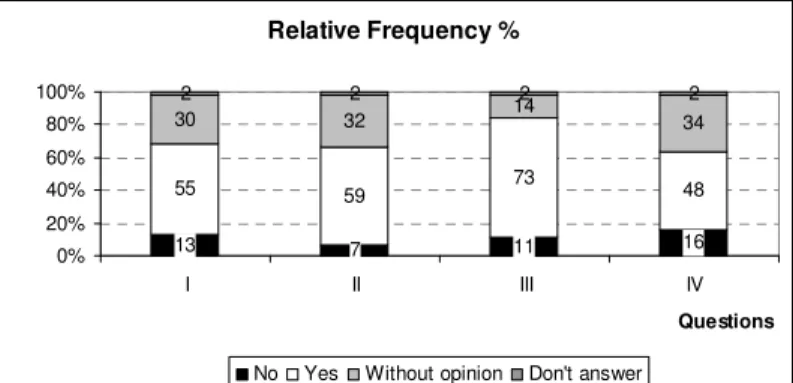
Graphic 10 – Changes in WinQSB software.
Questions:
The use of software to solve LP problems is useful because:
I- it is faster than analytic or graphic methods (A&Gm).
II- the user doesn’t need much knowledge.
III- the results are more exact than the ones obtained with A&Gm.
IV- it requires less effort than A&Gm. V- it is more general than A&Gm.
VI- it allows to change the data easily.
Questions:
WinQSB wasn’t simple to use because you felt difficulties to:
I- introduce the problem data.
II- execute the required procedures in the different windows of the software.
III- obtain the graphic.
IV- obtain the results.
V- interpret the results.
VI- understand the LP concepts necessary to be able to use of the software.
Questions:
In WinQSB I would:
I- add an iterative graphic resolution, allowing accompanying all the process.
II- add the graphic resolution for problems with three variables.
III- like that Portuguese would be the used language.
From Graphic 10, we can observe that more than 55% of the students would add to WinQSB an iterative graphic resolution (allowing accompanying all the process) and graphic resolution for problems with three variables. More than 70% of the students would like Portuguese language to be an option in this software. Finally, nearly half of them considers important to have a result option that gives just the optimal solution and optimal value.
4.Final Conclusions
Most of the students still remember the main concepts of LP learnt on High School (being the only exception not knowing that the feasible region of a LP problem as to be convex and includes the border) and are able not only to interpret the text of the problem but also to formulate it as a LP problem. All of them consider LP useful to solve real life problems.
Almost none of the students had any contact with LP software on High School, having less than 50% of them admitted to have used the calculator to solve LP problems at that stage of education.
Most of the students consider that the use of software to solve LP problems is a more generic, faster and effortless process than Analytic or Graphic methods that, also, allows changing the data easily.
Although only approximately half of the students recognize that the user needs quite some knowledge in the area to use WinQSB, more than 50% of them would like it to present some extra features, such as an iterative graphic resolution (that allows accompany all the resolution process) graphic resolution for problems with three variables and to be written in Portuguese.
Almost all the students consider simple to use WinQSB. They think that it is easy to obtain the graph and the results. Most of them said that didn’t fell difficulties introducing the data and executing the required procedures in the different windows. Approximately half of them didn’t fell difficulties interpreting the results and understood the concepts necessary to use this LP software. So, we think that, in general, the students are able to use WinQSB to solve LP problems.
5.Bibliography
[1] Filipe, J. (1998). Programação Linear: relato de uma experiência, Educação e Matemática, 49, 25-27, 32.
[2] http://sitio.dgidc.min-edu.pt/secundario/Paginas/Programas_ES_M.aspx , Nov. 2009. [3] http://winqsb.10001downloads.com, Nov. 2009.
[4] M.A., Pereira, A., Leite, A., Guerreiro, L., Silva, M.C. (2008). Matemática Módulo A10 - Optimização. Ensino Profissional - Nível 3. Porto: Porto Editora.
[5] Monteiro, H., Teixeira, A. (2009). Estudo experimental relativo à utilização de software de Programação Linear no Ensino Secundário. Livro de Actas do 14º Congresso da
Associação Portuguesa de Investigação Operacional, APDIO, 211-218.
[6] Monteiro, M H., Teixeira, A. (2009). An experimental study on the resolution of Linear Programming problems on High School classrooms. Actas do IX Congreso Galego de Estatística e Investigación de Operacións, 53-58.
[8] Ramalhete, M., Guerreiro, J., Magalhães, A. (1984). Programação Linear (Vol. I). McGraw-Hill de Portugal, Lda.
[9] Valadares, L., Oliveira, R. C., Themido, I. H., Correia, F. N. (1996). Investigação
Operacional, Portugal, McGraw Hill.
[10] Silva, J. C., Fonseca, M. G., Martins, A. A., Fonseca, C. M., Lopes, I. M. (2002).
Matemática A - 11º Ano. Lisboa: ME-DES. January 2010, from
http://www.dgidc.min-edu.pt/secundario/Paginas/Programas_ES_M.aspx
[11] Silva, J. C., Fonseca, M. G., Martins, A. A., Fonseca, C. M., Lopes, I. M. (2002).
Matemática B - 12º Ano. Lisboa: ME-DES. January 2010, from