Vol. 52, Special Number: pp. 241-248, November 2009
ISSN 1516-8913 Printed in Brazil BRAZILIAN ARCHIVES OF
BIOLOGY AND TECHNOLOGY
A N I N T E R N A T I O N A L J O U R N A L
Genetic Relationships among Strains of the
Aspergillus niger
Aggregate
Lara Munique Ferracin
1, Jens Christian Frisvad
2, Marta Hiromi Taniwaki
3, Beatriz Thie
Iamanaka
3, Daniele Sartori
1, Maria Elena Schapovaloff
1and Maria Helena Pelegrinelli
Fungaro
1*1
Centro de Ciências Biológicas; Universidade Estadual de Londrina; C. P.: 6001; 86051-990; Londrina - PR - Brasil. 2Center for Microbial Biotechnology; BioCentrum-DTU; Building 221; Technical University of Denmark; DK-2800; Kgs Lyngby – Denmark. 3Instituto de Tecnologia de Alimentos; C. P.: 139; 13070-178; Campinas - SP - Brasil
ABSTRACT
We analyzed the genetic relationships between 51 fungal isolates previously identified as A. niger aggregate, obtained from dried fruit samples from worldwide origin and 7 A. tubingensis obtained from Brazilian coffee beans samples. Greater fungal diversity was found in black sultanas. Aspergillus niger sensu stricto was the most prevalent species. It was found in all fruit substrates of all geographical origins. Based on Random Amplification of Polymorphic DNA (RAPD) and β-tubulin sequences data two groups of A.niger were found. In spite of the small number of isolates from Group IV an association between extrolite patterns and molecular clustering is speculated. A. tubingensis were the second most frequent species and this species were clearly subdivided into two groups. The finding of two groups for A. tubingensis strains could not yet explain the contradictions found in the literature about the capability this species for ochratoxin production, because both of them were formed by only non-ochratoxin-producing strains.
Key words: Aspergillus niger aggregate, ochratoxin A, dried fruits, toxigenic fungi
*
Author for correspondence: [email protected]
INTRODUCTION
Ochratoxin A (OTA) is a mycotoxin that has been detected in a variety of food products. Human exposure to this mycotoxin should be avoided or kept to minimal concentration because it has nephrotoxic effects and carcinogenic activity. Several authors reported the presence of OTA in dried fruit samples exceeding 10µg kg -1, which is the maximum limit recommended by the European Union for this kind of substrate (Abarca et al.,
2003; MacDonald et al., 1999; Iamanaka et al., 2005; Verstraete, 2008). Equally this mycotoxin has been found in roasted and instant coffee (Fujii et al., 2007).
The black Aspergilli species (Aspergillus section
Nigri) are the main source of OTA in dried fruits (Cabañes et al., 2002; Abarca et al., 2003; Magnoli et al., 2004 Iamanaka et al., 2005).
Because there are minor differences between some
species belonging to section Nigri the
DNA-based analyses. The species A. niger sensu stricto,
A. tubingensis, A. foetidus, and A. brasiliensis are morphologically identical and altogether have been called A. niger aggregate (Parenicova et al., 2001).
With the exception of A. niger sensu stricto, the potential of species within the A. niger aggregate to produce OTA is uncertain, probably due to the difficulty of species identification. For instance, Ueno et al. (1991) described an A. foetidus strain (CBS 618.78) that was able to produce OTA. Very recently, two research groups found OTA-producers isolates of A. tubingensis (Medina et al., 2005; Perrone et al., 2006). Nevertheless, according to Samson et al. (2004), no strains of A. tubingensis and A. foetidus sensu stricto produce OTA, and CBS 618.78 was in fact A. niger but not
A. foetidus.
Recently, our research group performed an extensive work searching for the presence of toxigenic fungi in dried fruits from worldwide origin, and A. niger aggregate was found as the most common (Iamanaka et al., 2005). In the
present study, we analyzed by Random
Amplification of Polymorphic DNA (RAPD) and
β-tubulin sequences, the genetic relationships among fungal isolates collected from black sultanas, dates, dried figs and prunes with the aim to enlighten the taxonomical position of the isolates previously identified as belonging to the
A. niger aggregate.
MATERIALS AND METHODS
Strains
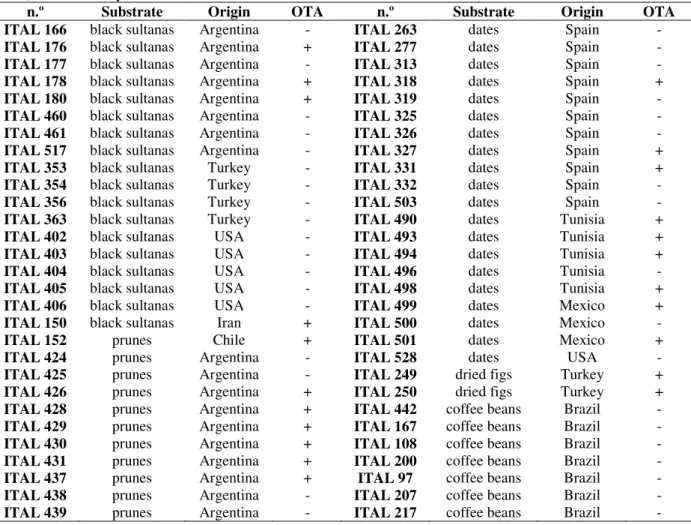
A total of 51 isolates, previously identified by morphological data as A. niger aggregate, obtained from dried fruit was analysed. Another seven A. tubingensis strains, isolated from Brazilian coffee beans were used to confirm the subdivision of this species in two groups (Table 1). The dried fruit samples from worldwide origin (Argentina, Chile, Iran, Turkey, Spain, Tunisia, USA, and Mexico) were purchased from different markets in Campinas and São Paulo, Brazil, as described by Iamanaka et al. (2005).
Genomic DNA extraction
Mycelium recovered from the culture fluid by filtration was pulverized to a fine powder under liquid nitrogen in a mortar. Approximately 400 mg
of the ground mycelium was suspended in 800 µL of lysis buffer (200 mM Tris-HCl; 250 mM NaCl; 25 mM EDTA; 1% wv-1 SDS) and maintained at 65°C for 20 min. The DNA was purified in phenol: chloroform (25:24) and chloroform: isoamyl alcohol (24:1), precipitated in a 3M NaCl solution in the presence of 95% ethanol, then washed with 70% ethanol, and resuspended in ultrapure water.
PCR and sequencing
Amplification of the ITS1-5.8S-ITS2 region was performed using the ITS1 and ITS4 as forward and reverse primers, respectively (White et al., 1990). Two portions ofthe β-tubulin genewere amplified using the primer-pairs Bt1 and Bt2, as described by Glass and Donaldson (1995). Amplifications were performed in a Thermocycler (PTC 100, MJ Research). PCR products were directly sequenced in both forward and reverse directions in a MegaBACE TM 1000 sequencer (Amersham Biosciences). The quality of the sequences was examined using Phred/Phrap/Consed package. The sequences were aligned using the software BioEdit version 1.6.6 (Hall, 1999). Phylogenetic analyses were performed by ClustalW multiple-sequence alignment program, version 1.6 (Thompson et al., 1994).
RAPD analysis
DNA amplifications were carried out by using arbitrary primers (QIAGEN-Operon) in a PTC-100 thermocycler (MJ Research, Inc.) according to Fungaro et al. (1996). Each isolate was scored for the presence or absence of DNA bands. An UPGMA (Unweighted Pair Group Method with Arithmetic Mean) cluster based on the similarity Dice index (Sneath and Sokal, 1973) was
generated using the NTSYS (Numerical
Taxonomy System, Applied Biostatistics)
computer application software (Rohlf, 1987).
Characterization of OTA-producing isolates
nm excitation and 477 nm emission. The HPLC was fitted with a Shimadzu CLC G-ODS (4 x 10 mm) guard column and Shimadzu Shimpack CLC-ODS (4.6 x 250 mm) column. The mobile phase was methanol: acetonitrile: water: acetic acid (35:35:29:10) and the flow rate was 0.8mL/min. An ochratoxin A standard (Sigma) was used for the construction of the 5-point calibration curve linear, peak areas versus mass (ng). The OTA concentration in the sample extract was determined by interpolation of resulting peak areas from the calibration graph.
Extrolite analyses
The fungi were grown for 7 days on CYA and
YES agar at 25°C in the dark and five agar plugs were cut out of the colonies. These plugs were extracted for the extrolite analysis using ethyl acetate/ dichloromethane/ methanol 3:2:1 (v:v:v) added 1% formic acid (volume basis).
Extrolites were analysed by HPLC using alkylphenone retention indices and diode array UV-VIS detection as previously described by Frisvad and Thrane (1987). Authentic analytical standards were employed for the retention time index comparison with the extrolites detected. Extrolites with a characteristic UV spectrum retention index of unknown chemical structure were given a four letter code (“SPUT” and “KOTN”).
Table 1 - Isolates of the Aspergillus niger aggregate analysed in this study. Potential to produce ochratoxin A
(OTA) is indicated by + or -.
n.º Substrate Origin OTA n.º Substrate Origin OTA
ITAL 166 black sultanas Argentina - ITAL 263 dates Spain -
ITAL 176 black sultanas Argentina + ITAL 277 dates Spain -
ITAL 177 black sultanas Argentina - ITAL 313 dates Spain -
ITAL 178 black sultanas Argentina + ITAL 318 dates Spain +
ITAL 180 black sultanas Argentina + ITAL 319 dates Spain -
ITAL 460 black sultanas Argentina - ITAL 325 dates Spain -
ITAL 461 black sultanas Argentina - ITAL 326 dates Spain -
ITAL 517 black sultanas Argentina - ITAL 327 dates Spain +
ITAL 353 black sultanas Turkey - ITAL 331 dates Spain +
ITAL 354 black sultanas Turkey - ITAL 332 dates Spain -
ITAL 356 black sultanas Turkey - ITAL 503 dates Spain -
ITAL 363 black sultanas Turkey - ITAL 490 dates Tunisia +
ITAL 402 black sultanas USA - ITAL 493 dates Tunisia +
ITAL 403 black sultanas USA - ITAL 494 dates Tunisia +
ITAL 404 black sultanas USA - ITAL 496 dates Tunisia -
ITAL 405 black sultanas USA - ITAL 498 dates Tunisia +
ITAL 406 black sultanas USA - ITAL 499 dates Mexico +
ITAL 150 black sultanas Iran + ITAL 500 dates Mexico -
ITAL 152 prunes Chile + ITAL 501 dates Mexico +
ITAL 424 prunes Argentina - ITAL 528 dates USA -
ITAL 425 prunes Argentina - ITAL 249 dried figs Turkey +
ITAL 426 prunes Argentina + ITAL 250 dried figs Turkey +
ITAL 428 prunes Argentina + ITAL 442 coffee beans Brazil -
ITAL 429 prunes Argentina + ITAL 167 coffee beans Brazil -
ITAL 430 prunes Argentina + ITAL 108 coffee beans Brazil -
ITAL 431 prunes Argentina + ITAL 200 coffee beans Brazil -
ITAL 437 prunes Argentina + ITAL 97 coffee beans Brazil -
ITAL 438 prunes Argentina - ITAL 207 coffee beans Brazil -
RESULTS AND DISCUSSION
Based on RAPD data the 51 isolates from the A. niger aggregate collected from dried fruit samples e.g. black sultanas, dates, dried figs, and prunes in different countries were divided into four major groups (I, II, III, IV). Greater fungal diversity was found in black sultanas. The 18 isolates from this substrate spanned in all four groups. The isolates collected from prunes, dates, and dried figs
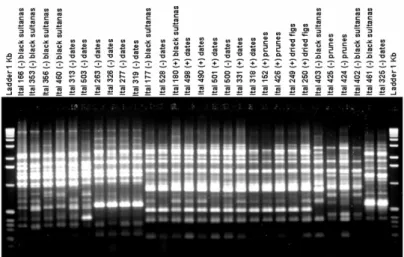
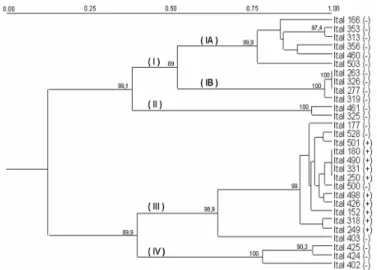
spanned into two, three, and one group, respectively. Group III accommodated the majority of the isolates (69%). Only group III comprised toxigenic and non-toxigenic isolates. In the other three groups, non-ochratoxigenics were found. Fig 1 exemplifies the distinct RAPD profiles of a sample of 29 random selected isolates. As shown in Fig 2, the clustering was not related to fruit type or country origin.
Figure 1 - Amplification of polymorphic DNA of 29 isolates de Aspergillus niger aggregate using
the 10-mer OPX-7 primer. Isolates number are present above each lane. The isolates ITAL 166, ITAL 353, ITAL 356, ITAL 460, ITAL 313, ITAL 503, ITAL 263, ITAL 326, ITAL 277, and ITAL 319 were classified as Aspergillustubingensis; the isolates ITAL 177, ITAL 528, ITAL 180, ITAL 498, ITAL 490, ITAL 501, ITAL 500, ITAL 331, ITAL 318, ITAL 152, ITAL 426, ITAL 249, ITAL 250, ITAL 403, ITAL 425, ITAL 424, and ITAL 402 were classified as A.niger; and the isolates ITAL 461 and ITAL 325 were classified as A. foetidus. Toxigenic and nontoxigenic strains are denoted (+) and (-), respectively.
Isolates from each of the RAPD-groups were submitted to sequencing analysis of a portion of the β-tubulin gene (β-tub2) for species identification. Moreover, details on the relationships among the A. niger aggregate isolates were of interested. Altogether, 430 nucleotides were involved in the analysis. In summary, good consensus was found between RAPD and β-tub2 sequences data (Fig 3).
The isolates from RAPD group I were recognized as A. tubingensis, which were clearly subdivided into two subgroups IA and IB. Three single nucleotide polymorphisms discriminated the two groups of A. tubingensis: one deletion (T) at position 290 and two substitutions at position 48 (A instead of G) and 63 (T instead of G). Both subgroups (IA and IB) were formed by ochratoxin
not producing strains According to the literature, the potential of A. tubingensis to produce OTA is uncertain, probably due to the difficulty of species identification. Accensi et al. (2001) evaluated 48
Figure 2 - Dendrogram of 29 isolates of Aspergillus niger aggregate based on cluster analysis with UPGMA method using Dice genetic similarity index on RAPD data obtained with three primers. The number of each node indicates the percentage bootstrap support (out of 1,000). Toxigenic and nontoxigenic strains are denoted (+) and (-), respectively.
Figure 3 - Phylogenetic tree based analysis of β-tubulin gene sequences, using Aspergillus flavus
as the outgroup. Bootstrap values (based on 1,000 bootstrap samples) are placed on the tree nodes. Species with numbers represent sequences obtained from GenBank.
Due to the small number of isolates (n=5) that were clustered into subgroup IB, and their homogeneity concerning substrate and country
origin (dates from Spain), we extended our analysis to include several other A. tubingensis
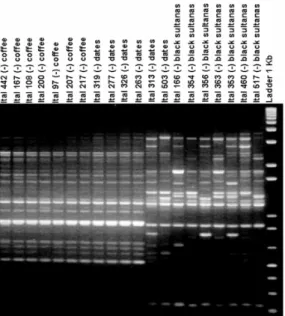
isolates collected from coffee beans (n=7), dates (n=6), and black sultanas (n=7) are shown in Fig. 4. Together with five isolates from dates, all from coffee beans were included in subgroup IB.
Subgroup IA integrated exclusively dried fruit derived isolates i.e. from dates and black sultanas, from different countries (Argentina, Turkey, and USA).
Figure 4 - RAPD profiles from 20 isolates of Aspergillus tubingensis using the 10-mer primer
OPX-7. Isolates number are present above each lane. The isolates ITAL 442, ITAL 167, ITAL 108, ITAL 200, ITAL 97, ITAL 207, and ITAL 217 were obtained from coffee beans; and the isolates ITAL 319, ITAL 277, ITAL 326, ITAL 263, ITAL 313, ITAL 503, ITAL 166, ITAL 354, ITAL 356, ITAL 363, ITAL 353, ITAL 460, and ITAL 517 were obtained from dried fruits.
Even if β-tub2 data clearly indicated that A. tubingensis isolates were accommodated into two groups, we tried to get more evidence to support their separation. Another region of the β-tubulin gene (β-tub1) was sequenced and analyzed. Three nucleotide polymorphisms were found between the two groups: Group IA differ from group IB at the following positions: 148 (C→T); 300 (G→C); 402 (C→T).
Recently a PCR-RFLP analysis for the ITS region using NlaIII restriction enzyme was described in order to distinguish A. niger, A. tubingensis, A. carbonarius, and A. aculeatus isolates from grape
(Martinez-Culebras and Ramón, 2007).
Interestingly, one profile (denoted as type T2) that included 30 isolates did not correspond to any referenced species, and the ITS sequence of one type T2 isolate was nearly identical to the sequences of A. tubingensis CBS 643.92 and CBS 127.42, except for a single nucleotide (G→T). Because of this type T2 isolates were denoted as
A. tubingensis-like species (Martinez-Culebras and
Ramón, 2007). Nevertheless, in the present study no group-specific nucleotide polymorphisms were found in the ITS sequences.
The production of secondary metabolites is usually consistent in a species, and they are commonly useful for species identification (Samson et al., 2007). Asperazine, funalenone, malformins, naphtho-γ-pyrones, pyranonigrin A, and tensidol A and B are extrolites expected to be produced by A. tubingensis. The extrolite profiles of the isolates belonging to Group IA and IB were investigated to find possible association between secondary metabolite and molecular patterns. All isolates
from both groups produced asperazine,
pyranonigrin A, funalenone, and naphtho-γ -pyrones. Tensidol B was not found in all isolates, but no association between the presence of this extrolite and molecular clustering were found. In addition, the extrolite KOTN was only found in two isolates from Group IA.
two distinctly groups, it is still premature to assign a new taxonomic rank for one of them as no association between extrolite and molecular profiles was found. Additional molecular studies are necessary for it may be useful for explaining the incongruence reported about the capability of
A. tubingensis for OTA production.
Only two isolates were gathered into RAPD-group II, both being unable to produce OTA. After β -tub2 sequence analysis, they were recognized as A. foetidus, which agrees with a previous publication that described A. foetidus as OTA non-producer (Samson et al., 2004). The extrolite patterns found in both isolates were really compatible with A. foetidus species, e.g. asperazine, pyranonigrin A, naphtho-γ-pyrones, and “SPUT” were found. Based on β-tubulin sequences all isolates clustered into RAPD-group III were equally similar to
A.niger and A. lacticoffeatus. The description of A. lacticoffeatus as a new species is recent (Samson et al., 2004). Although A. niger sensu stricto and
A. lacticoffeatus could not be separated by their β -tubulin sequences, there are evident differences in their colony colour and extrolite patterns. Differently to A. niger sensu stricto, A. lacticoffeatus has sulpher yellow mycelium on YES agar and do not produce naphtho-γ-pyrones (Samson et al., 2004). The morphological and extrolite pattern observed on YES agar showed that all RAPD-group III isolates are A. niger sensu stricto.
Isolates clustered into RAPD-group IV were identified as A. niger based on β-tub2 sequences and their colony color. The β-tub2 sequences from group IV-isolates characterized in our laboratory were aligned with other A. niger sequences available in GenBank (http://ncbi.nlm.nig.gov). In spite of the small number of isolates from group IV (also identified as A. niger sensu stricto), it is important to note that the three isolates were not able to produce OTA. Additionally, all Group IV isolates do not produce orlandin and kotanin and the production of pyranonigrin A is very weak contrasting with the isolates of Group III that produce pyranonigrin A, tensidol B, funalenone, orlandin, kotanin, and naphtho-γ-pyrones. Therefore, an association between extrolite patterns and molecular clustering is here speculated.
One single nucleotide polymorphism (A→ T) into the intron 5 of β-tub2 sequence was found to differentiate Groups III and IV, but no differences
were found in β-tub1 sequences. Gene faster-evolving analysis need to be performed to confirm the genetic divergence between these two groups.
ACKNOWLEDGMENTS
Our study was supported (grants and fellowships) by the following Brazilian institutions: Fundação Araucária, Conselho Nacional de Pesquisa (CNPq), Financiadora de Estudos e Projetos (FINEP), Coordenadoria de Aperfeiçoamento de Pessoal do Ensino Superior (CAPES), Rede
Integrada de Biotecnologia Aplicada ao
Desenvolvimento sustentável da Agricultura Familiar no contexto do Agro-negócio Paranaense (BIOAGROPAR) and Laboratório de Apoio à Pesquisa Agropecuária (LAPA).
RESUMO
Neste trabalho foi analisada a relação genética entre 51 isolados obtidos de amostras de frutas secas provenientes de diferentes regiões do previamente identificados como pertencentes ao agregado A. niger e 7 isolados de Aspergillus tubingensis obtidos de amostras de café do Brasil. Maior diversidade fúngica foi encontrada em uvas passas escuras. Aspergillus niger sensu stricto foi a espécie mais frequente. Esta espécie foi encontrada em todos os substratos e origens geográficas analisadas. Baseando-se nos dados de Polimorfismo de DNA Amplificado ao Acaso (RAPD) e sequências de nucleotídeos do gene da
β-tubulina, dois grupos de A. niger foram observados. Apesar do pequeno número de isolados do grupo IV uma associação entre padrão de extrólitos e agrupamento molecular foi encontrada. A. tubingensis foi a segunda espécie mais frequente e foi claramente subdivida em dois grupos. Como os grupos de A. tubingensis são formados somente por linhagens não produtoras de ocratoxina A, a identificação destes grupos não explica a controvérsia encontrada na literatura sobre a capacidade desta espécie em produzir a referida toxina.
REFERENCES
the main source of ochratoxin A contamination in dried vine fruits from the Spanish market. J. Food Protect., 66, 504-634
Accensi, F.; Abarca, M. L.; Cano, J.; Figuera, L.; Cabañes, F. J. (2001), Distribution of ochratoxin A producing strains in the A. niger aggregate. Antonie van Leeuwenhoek, 79, 365-370
Cabañes, F. J.; Accensi, F.; Bragulat, M. R.; Abarca, M. L.; Castellá, G.; Minguez, A. P. (2002), What is the source of ochratoxin A in wine? Int. J. Food Microbiol., 79, 213-215
Frisvad, J. C.; Thrane, U. (1987), Standardized high performance liquid chromatography of 182 mycotoxins and other fungal metabolites based on alkylphenone retention indices and UV-VIS spectra (diode array detection). J Chromatogr., 404, 195-214 Fujii, S.; Ono, E. Y. S.; Ribeiro, R. M. R.; Assunção, F.
G. A.; Takabayashi, C. R.; de Oliveira, T. C. R. M.; Itano, E. N.; Ueno, Y.; Kawamura, O.; Hirooka, E. Y. (2007), A comparison between enzyme immunoassay and HPLC for ochratoxin A detection in green, roasted and instant coffee. Braz. Arch. Biol. Tech., 50, 349-359
Fungaro, M. H. P.; Vieira, M. L. C.; Pizzirani-Kleiner, A. A.; Azevedo, J. L. (1996), Diversity among soil and insect isolates Metarhizium anisopliae var.
anisopliae detected by RAPD. Lett. Appl. Microbiol., 22, 389-392
Glass, N. L.; Donaldson, G. C. (1995), Development of primer sets designed for use with the PCR to amplify conserved genes from filamentous ascomycetes.
Appl. Environ. Microbiol., 61, 1323-1330.
Hall, T. A. (1999), BioEdit: a user-friendly biological sequence alignment editor and analysis program for Windows 95/98/NT. Nucleic Acids Symposium, 41, 95-98
Iamanaka, B. T.; Taniwaki, M. H.; Menezes, H. C.; Vicente, E.; Fungaro, M. H. P. (2005), Incidence of toxigenic fungi and ochratoxin A in dried fruits sold in Brazil. Food Addit. Contam.,22, 1258-1263 MacDonald, S.; Wilson, P.; Barners, K.; Damant, A.;
Massey, R.; Mortby, E.; Shepherd, M. J. (1999), Ochratoxin A in dried vine fruit: method development and survey. Food Addit. Contam., 16, 253-260
Magnoli, C.; Astoreca, A.; Ponsone, L.; Combina, M.; Palacio, G.; Rosa, C. A.; Dalcero, A. M. (2004), Survey of mycoflora and ochratoxin A in dried vine fruits from Argentina markets. Lett. Appl. Microbiol.,
37, 179-184
Martinez-Culebras, P. V.; Ramón, D. (2007), An ITS-RFLP method to identify black Aspergillus isolates responsable for OTA contamination in grapes and wine. Int. J. Food Microbiol., 113, 147-153
Medina, A.; Mateo, R.; Lopez-Ocana, L.; Valle-Algarra, F. M.; Jimenez, M. (2005), Study of Spanish Grape Mycobiota and Ochratoxin A Production by Isolates of Aspergillus tubingensis and Other
Members of Aspergillus Section Nigri. Appl. Environ. Microbiol., 71, 4696-4702
Parenicova, L.; Skouboue, P.; Frisvad, J.; Samson, R. A.; Rossen, L.; ten Hoor-Suykerbuyk, M.; Visser, J. (2001), Combined molecular and biochemical approach identifies Aspergillus japonicus and
Aspergillus aculeatus as two species. Appl. Environ. Microbiol., 67, 521-527
Perrone, G.; Mulé, G.; Susca, A.; Battilani, P.; Pietri, A.; Logrieco, A. (2006), Ochratoxin A Production and Amplified Fragment Length Polymorphism Analysis of Aspergillus tubingensis, and Aspergillus niger Strains Isolated from Grapes in Italy. Appl. Environ. Microbiol., 72, 680-685
Rohlf, F. J. (1987), NTSYS-pc: Microcomputer programs for numerical taxonomy and multivariate analysis. Am. Stat., 41, 330.
Samson, R. A.; Jos Houbraken, A. M. P.; Kuijpers, A. F. A.; Frank, J. M.; Frisvad, J. C. (2004), New ochratoxin A or sclerotium producing species in
Aspergillus section Nigri. Stud Mycol., 50, 45-61 Samson, R. A.; Noonim, P.; Meijer, M.; Houbraken, J.;
Frisvad, J. C.; Varga, J. (2007), Diagnostic tools to identify black aspergilli. Stud. Mycol., 59, 129-145 Sneath, P. H. A.; Sokal, R. R. (1973), Numerical
Taxonomy: the principles and practice of numerical classification. San Franciso: W. H. Freeman and Company Publishers, pp. 573
Thompson, J. D.; Higgins, D. G.; Gibson, T. J. (1994), CLUSTAL W: improving the sensitivity of progressive multiple sequence alignment through sequence weighting, positions-specific gap penalties and weight matrix choice. Nucleic Acids Res., 22, 4673-4680
Ueno, Y.; Kawakura, O.; Sugiura, Y.; Horiguchi, K.; Nakajima, M.; Yamamoto, K.; Sato, S. (1991), Use of monoclonal antibodies enzyme-linked immunosorbent assay and immunoaffinity column chromatography to determine ochratoxin A in porcine sera, coffee products and toxin-producing fungi. In- Castegnaro, M.; Plestina, R.; Dirheimer, G.; Chernozemsky, I. N.; Bartsch, H. (Eds.), Mycotoxins, Endemic Nephropathy and Urinary Tract Tumours.
International Agency for Research on Cancer, Lyon, France, pp. 71-75
Verstraete, F. (2008), European Union Legislation on Mycotoxins in Food and Feed: Overview of the Decision-making Process and Recent and Future Developments. In- Leslie, J. E.; Bandyopadhyay, R.; Visconti, A. (Eds), Mycotoxins: Detection Methods, Management, Public Health and Agriculture Trade. CAB International, pp. 77-100
White, T. J.; Burns, T.; Lee, S.; Taylor, J. (1990), Amplification and direct sequencing of fungal ribosomal RNA genes for phylogenetics. In- PCR Protocols: A guide to methods and applications.