Notes on the frog fauna of the Amazon Basin
Abstract
The natural hístory of the frog fauro of the Amazon Basin is c on s ~dered , based on data C'bt<~.ined
!rom four major collections . Population structures in both forest and optn environrnents are compared. Associations or spec1es pairs in open f::>rmations are studied . It is estimated that at least 100 species are present in the Amazon Basin . Five speciation models are proposed to explain the hígh diversity
ot species.
I have had the opportunity to particlpate in two expeditions to the western Amazon region . This report dea ls wlth the natural history observations made on these trips together with an ecological analysis of the collections from these trips and collections from two other expeditions . Ali natural history observations and analyses on frogs are in· cluded here, rather than fragment the infor· mation . Taxonomic matters will be discussed in another paper .
The four expeditions on which this report is based are summarized briefly as:
1) Porto Velho: Departamento de Zoolo· gia da Secretaria da Agricultura (now Museu de Zoologia, Universidade de São Paulo (MZUSP) expedition to Porto Velho. Rondônia , Brasil. from 28 October to 6 November 1954. This collection is represented by 17 species and 4086 individuais.
2) Expedição Permanente da Amazônia (EPA), supported by MZUSP, Fundação de Am· paro à Pesquisa do Estado de São Paulo and Museu Goeldi: in 1973 a collaborative venture with the Museum of Comparativa Zoology, Harvard University (Russell A. Mittermeler). from 20 August to 5 December 1973 along major rivers from Belém to Letícia, Colombia. Russell Mittermeier purchased 8238 individuais of 40 species incidental to the main purpose of the expedition.
W. Ronald Heyer ( *)
3) Joint MZUSP and Smithsonian (USNM) expedition on the rio Purus , Brasil, from 2 December 1974 to 19 January 1975 . This collection contains 811 specimens of 58 species .
4) Joint EPA-MZUSP and USNM expedition on the rio Madeira, Brasil from 31 Oct ober to 19 December 1975. The collection is repre-sented by 1232 specimens ot 53 species
The itineraries of these trips Nill be described in the taxonomic paper where they are more appropriate.
EcoLOGICAL GENERALIZATIONS
Fauna/ - Habitat Associations: At any locality in the Amazon basin , two major types of habitats are cvident: forest and open . O f course, neither is a clear cut category fo~r
they grade intn one another smoothly or abruptly, depending more or less on the human activity of the region . Open habitat ~ have always been present, particularly at the edges of rivers . For ali of the specimens collected by scientific personnel on the Madeira and Purus expeditions , the major habitat type was recorded for each specimen collected Cate· gories were e1ther : (1) forest, (2) modified torest. such as selective logging or old second growth, and (3) open formations , such as river edges and human clearlngs. For purposes of analysis , any intermediate habitat, recorded in the field notes, was scored as the more forested category. The results of percent of individuais taken from each habitat type for the common species are presented in Table 1 . The criterion used for common species in this case is 10 or more individuais (pooled localities). except for Adenomera hylaedacty/a and Hyla boans
for which calling specimens (not coilected) supplement the actual specimens in the col·
( • ) - Divlslon o f Reptlles and Amphlblans . National M useum of Natural Hlstory . Smlthsonlan lnstitutlon . Washington. D. C. (U .S .A. ) .
lection. lf the rather rigid guideline cf 80 % occurrence in a single category is used, ali but
4 species can be categorized JS forest as-sociated species (9) or open formation associ-ated species (20) . The four remaining species are primarily forest associated (Phyllobates píctus), primarily open formation associated
(Hyla lanciformís and perviceps) or distributed in both forest and open formations (Sphaenor-hynchus eurhostus). The association of most Amazonian frogs with one or the other major habitat type suggests thàt the species have evolved In either forests or open habitats, not both . Only in one case for those species tabled is the particular part of the breeding habitat for which the species is adapted found in both forests and open formations . This breeding habitat for Sphaenorhynchus eurhos-tus is a vegetation covered pond, either grass or Pistia.
The numbers of forests and open habitat associated species (Table 1) are not an accu-rate reflection of the true percentages of
forests and open habitat associated species in the Amazonlan anuran fauna . Tho open formation assocíated species were better
sampled, because most specimen~ were
collected from breeding chorus aggregations in open habitat ponds. In contrast, most forest associated species were collected individually from transects taken through the f orest. This forest cruisíng technique produces few speci-mens but yields a high diversity. The di stri-butions (Table 1) indicate that even with few habitat data, habitat association is reasonably accurate . lncluding the species with fewer than 10 individuais collected, there are presumable 38 forest associated species, 33 open formation <~ssociated species, and 2 species associated with both habitat types . As discussed below. the 73 species collected on the Madeira and Purus expeditions do not represent the total diverslty of the Hylaean anuran fauna. As the open formation fauna is easier to collect, I assume that most of the Hylaean species not collected on the expe-ditions will be forest associated species.
Ali diurnal frogs are forest floor leaf litter species . Ali open formation associated frogs are nocturnal species. Most forest litter frogs
370-share t he same type of nocturnal resting sites, i. e. leaves o f herbaceous plants from 5 to 100 em above the forest floor (Bufo typhonius, Dendrophryniscus minutus, both c.ommon
Phyllobates , Physalaenus petersi) . No Adeno-mera andreae were taken on leaves at n:ght. Additional members of the forest litter fauna include Dendrobates. quinquevittatus, Phyllo-bates trivittatus, and perhaps Edalorhina and one species of Eleutherodactylus. An approxi-mation is that the forest litter frog fauna comprises about one quarter of the entire forest associated frog fauna.
TABLE 1 . Dlstribution of innividuals (in percen-tages) of common species among major habitat types. A
=
forest, B=
modified forest,=
open formation. Also see text.SPECIES A
Adenomera andreae . . . 97
A. hylaedactyla . . . O Bufo granulosus . . . O B . marinus . . . 4
B. typhonius . . . 89
Colostethus peruvianus . . . 86
Dendrophrynlscus minutus . . . . 100
l{yla sp . . . . . . . 100
H. boans . . . O H. fasciata . . . 84
H . garbei . . . 83
H. granosa . . . 8
H . lancitormis . . . . . 26
H. leali . . . O H. leucopbyUata . . . 11
H . parviceps . . . 11
H. puoctata . . . . . . O H. ranicep s . . . .. . .. . ... . . O H. hodopepla . . . 6
H . riveroi . . . O H. rubra . . . 1
H . trlangulum . . . O H. waldorfi . . . O Leptodactylus bolivianos . . . 12
L. fuscus . . . O L. oceUatus . . . O L. wagneri . . . 13
Lysapsu s limellus . . . O Phrynohyas venulosa . . . O PhyUobates femoralis . . . .. . . 91
P . pictus . . . .. . . 72
Physalaemus petersi . . . .. . . 100
Sphaenorhynchus eurhostus . . . 45
B
C
1 1
o
100o
100 2 93 9 214
o
o
o
o
o
o
1004 11
17
o
o
92 6 68 3 97 4 86 11 78 () 100 2 98o
94o
100 2 97o
100 2 982 86
6 93
o
100 5 81o
100o
100 9o
28o
o
o
o
55Species - Breeding Pond Associations:
lf species share the same types of breeding ponds, the species assemblage prnbably evolved in the same environment.
Few forest ponds were found with
breeding frogs. In those few forest ponàs with breeding choruses, the species present are in museum collections. Many forest ponds . whích I assumed to be ideal for anuran reproduction lacked any breeding frogs . Forest ponds may be used either for a brief time or be largely unsatisfactory. Both possible explanations may result from fish predation. Many ponds which are isolated at the beginnlng of the raíny season may become flooded and connected with ri ver backflows . lt is these flooded areas where many river fish also breed and would likely feed on any anuran larvae in the water. Also, erythrinid fishes occur in isolated ponds and creeks (Vanzolini, pers. comm.) Thus, many of the seemingly ideal breeding pools conta in carnivorous fishes. One evolutionary response by the forest associated pond breeders would bn to reproduce as soon as ponds develop and to have a brief larvai life.
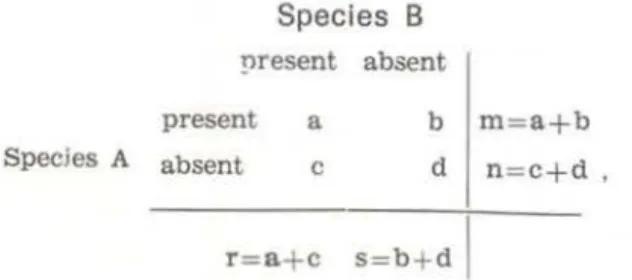
Data were recorded on species breedíng in 28 open habitat ponds. The association between each species pair was evaluated by computing a coefficient of association . V, where
ad-bc
V= (mnrs).S
where the right hand terms come from a 2X2 contigency table set up as
Species A
Specles B
r>resent absent present a b
absent c d
r = a + c S=b+ d
I
m = a+bD= C+d ,
where a, b, c, d are observed frequencies of species at breeding ponds (Pielou, 1969). V ran-ges from -1 (maximum negative association) to
+
1 (maximum positive association). Zero is no association . For the analysis herein, association values were calculated for on lyNotes on the frog fauna ..
those species recorded from 5 or mor€ ponds. The results are presented in Table 2 . Collins r1975) reported
v
values for breeding associations in a series of ponds in M1chigan. He found that af1er applying differ-ant sta· tistical tests to the contigency table. V values greater than . 3 represented statistically valid association. I f that criterion is used on the spec ies data in Table 2, there are only 2 posi-tive correlations: S. eurhostus - H. leuco-phyllata and H. leali - L. wagneri. This repre-sents only 7% of the possible assoc!ations. In contrast, 25% of the temperate zone associations (Collins, 1975) were strongly posí-tive. This difference suggests that the diversi-ty of breeding ponds is lower and the available breeding period is shorter in Michigan than in Amazonia, a not unexpected explanation.For the strongly negative associatlons ( <- . 3) in Table 2, there are 5 pairs, but only one of them, H. /ea/i - H. riveroi, involves closely related members.
The absence of positive and presence of negative associations that characterize Table 2 are consistent with a recent study that concluded that interspecific competition is evolutionarily unimportant in tadpole com· munities (Heyer. in press). One would expect evolution to act on biological lnteractions only where positive associations between species occur .
TABLE 2. Associatlons between the common open habitat species. Number in parentheses ls the number or breeding ponds where the specles was present.
t.s
-<11
=
'e
::I ;>,...
<ll:::
..
.c-
..
...
..
o s::a. 'õ
..
"'
....
o o CJ o'éj :::: Q
..
.e '1:3e,
Q,l
c;
.cs:;
~
::: >...
loo~ ~ 'i: ,Q ~ C'il !:l
e
~ Q,):C :C
::é
::é ::é
::!: ..j uiH. lanciformis (7) 0 . 0 -. 16- 12 .22 -.03 04 -. 33 H . leali (8) . 13 -. 36 0 .0 . 11 36 0 .0 H. leucophyllata (8) . 19 -.46 -.07 0 .0 .55 H. rlveroi (7) -. 07 · . 27 . 33 .25 H. rubra (14) . 43 07 . . 25
H. waldorfi (5 ) 15 . 27
L. wagneri (7) 25
S. eurhostus (7)
lt appears that the open formation fauna does not have a t!ghtly integrated community structure . aosuming breeding habitats are a reflection of the total community organization of frog communities.
River Edge Frogs: The following species are characteristic of the gragsy river banks:
Adenomera hylaedactyla, Bufo granulosus, Hyla boans, Hyla ;}ranosa, Hyla punctata, Hyla raniceps and Leptodactylus fuscus. Of these,
B. granulosus, H. punctata. H. raniceps, and
L. fuscus also occur in other open habitats away from the nver edge. Apparently only
Hyla boans and Hyla granosa breed in the river itself . Of the several fish seine samples taken in the Madeira and Purus rivers tadpoles were taken only once. As argued elsewhere (Heyer, McDiarmid, and Weigmann, 1975). tha river tadpoles must have specific adaptations that allow them to occur with predatory tish.
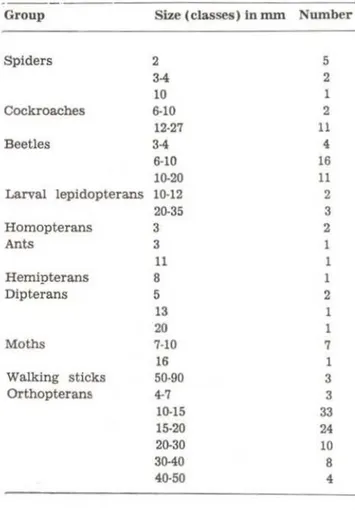
Adult Frog Food Resources: One of the perplexing problems in analyzing resource utilization by adult frogs is the difficulty of gathering information on non-breeding indi-viduais. With such data, one might examine ecological problems in frogs in the same successful manner as West lndian anotes have been studied. One approacli appears to be a potentially fruitful one, and very preliminary results are offered in hopes that others might find the problem worth further study. When one searches the forest by night with flashlight, one finds frogs sitting on leaves, as well as arthropods sitting on leaves. One night, M. Heyer and I attempted to capture every arthropod and frog from leaf surfaces within reach for a one hour time period . Two frogs
and 159 arthropods (Table 3) were collected.
Hyla lanciformis had a 5 mm beetle and 25 mm preying mantis in the gut and Hyla sp. had a 7 mm grasshopper in the gut . The food items did not appear to be the same species as found in the general collections, but were comprised of the same kinds of potential prey items we collected . We collected about 80 arthropods per hour per person - it superficially appears as though food resources are superabundant in the fores" for frogs . No palatability, catchability or digestive studies have been dane for tropical forest frogs, howeve:-, so it
372-is not known what the true availability of food resources is for the frogs. A reasonable assumption at this point is that the nocturnal frogs seen on leaves at night in the forest are feeding on the arthropods also found on leaves at night (excluding diurnally active frogs which are resting on leaves at night, see above). 8oth the frogs and the arthropods are samplable resources.
TABLE 3. Arthropods collected on leaves at nlght in the forest.
· -
--Group Size (classes) in mm Number
Spiders 2 5
3-4 2
10
Cockroaches 6-10 2
12-27 11
Beetles 3-4 4
6·10 16
10-20 11
Larval lepidopterans 10-12 2
20·35 3
Homopterans 3 2
Ants 3 1
11 1
Hernipterans 8 1
Dipterans 5 2
13 1
20 1
Moths HO 7
16 1
Walking sticks 50·90 3
Orthopterans 4-7 3
10·15 33
15-20 24
20-30 10
30-40 8
40-50 4
ANALYSIS OF RANDOM COLLECTIONS
The collections from the Made1ra and Purus expeditions are not truly random col-lections because sampling was biased against the most common species. For examole not ali adult Bufo marinus seen were collected.
The Porto Velho - MZUSP and EPA -Mittermeier collections are as random in nature as frog collections can be. Ali speci-mens collected were preserved, ali specispeci-mens
possible were collected. The Porto Velho -MZUSP expedition did not have a herpetologist along, and Mittermeier purchased frogs from local children, a proven technique for lizards (e . g . Vanzolinl, 1974) .
One practical question to raise is whether the purchase technique is an effective way to sample the frog féouna of Amazonia . A com-parison of the Porto Velho - MZUSP and EPA - Mittermeier collections with the Madeira and Purus collect10ns show the former two collections have many more specimens than that of the Purus - Madeira collections; however, the latter two have a greater specles diversity . The major discrepancy occurs with the forest associated fauna . Less than O. 01 %
of the specimens from the Porto Velho -MZUSP collection are forest associated species . No more than 5% of the EPA -Mittermeier specimens are forest associated species; these carne from about half of the localities where Mittermeier purchased speci-mens . I f the diurna! forest litter species are excluded, then less than 1% of the EPA -Mittermeier specimens are forest associated species from about one qua~ter of the localities. The Porto Velho - MZUSP and EPA - Mittermeier collections are mostly represented by open formation assoclated species . The purchasing technique in Amazo-nia, thus, is good for large samples of open formation associated species, we2k for sampling forest associated species.
The most ccmmon (
>
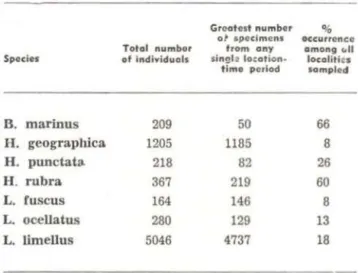
100 specimens) randomly collected open formation asscciated species can be analyzed in terms of relativa abundance among collecting sltes (T~ble 4). lt is immediately obvlous that what is common at one site is rare at another . Of the 280 Leptodactylus ocellatus collected, 254 carne from a single site , Coari : 125 on 19 September 1973, 129 on 16-17 October 1973 . Within a single season , it would appear that common species rema in common . Of ali the common species, Bufo marinus is the only one to approach a ubiquitous pattern of abundance and distribution.T-flis phenomenon of local rarity or a-bundance of species holds true over ve~ small distances . At Borba, one hillside had many
Notes on the frog fauna ...
forest floor frogs , the hillside opposite a small stream had almost none. At Puruzinho, we transected large areas of forest floor and found one very small area where we collectE1d many more specimens than anywhere else , yet ali the forest floor appeared s1milar.
TABLE 4. Common open habitat associated species
in the EPA-Mittermeier collectioo.
Specler
B. marinus H. geographica. H. punctats. H. rubra L. fuscus L. ocellatus L. limellus
Totol number of Individuais
209 1205 218 367 164
280
5046
ANURAN DIVERSITY
Greot ost numbor
ot apcclmens trom ony singl a locotion·
time period
50
1185
82 219 146 129 4737
~ '
occurtencc
omong c.ll locolitlts sompled
66 8 26 60 8 13 18
Two general questions concerning the Hylaean fauna are : (1) ls the fauna un:formly distributed throughout the basin? and (2) ls the Andean Amazonian slope fauna more di-verse than the basin fauna?
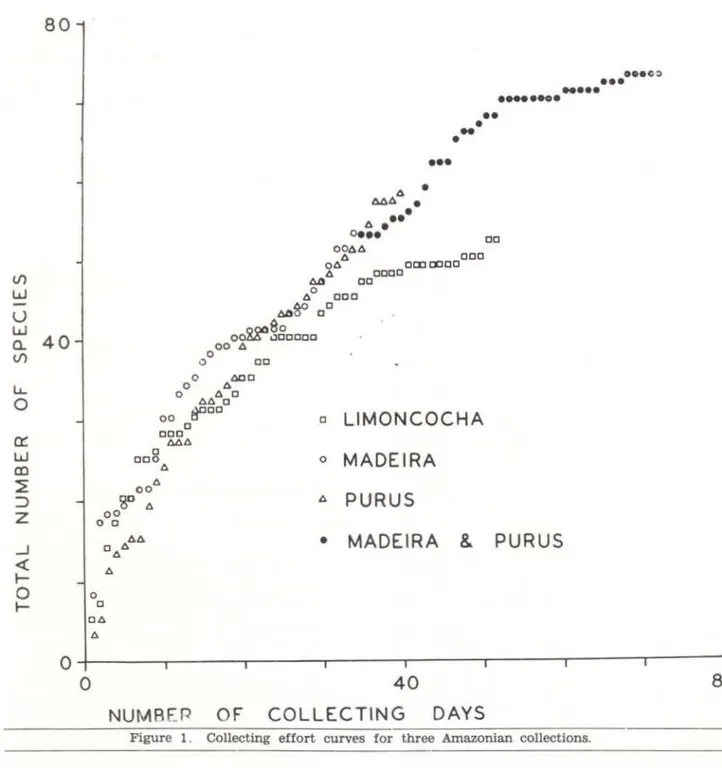
The Amazonian Andean slope frog fauna is among the most diverse faunas in the world. One site, Santa Cecilia, Ecuador, has been intensively sampled by field partias frcm the University of Kansas (e . g .. Crump, 1974). The total of 81 species of frogs reported f:-om San· ta Cecilia is probably close to the true number of species present there . I worked at Limoncocha, Ecuador for two months, making collections of amphibians in the same way the Purus and Madeira collections were made . The known frog faunas of Limoncocha and Santa Cecilia are identificai . Collecting curves were constructed for the Limoncocha, Purus, and Madeira collections , by plotting the
number of frog species added per collecting day (Fig. 1 ) .
80
•••
6 •
Mó o
•
•
...
••
•
..
ooee:>
•••
...
6 • • •
o ••• co
0066
6 000
06 0000000
C/)
w
A/)6 oooooo
u
w
a.
40
C/)
u_
o
o0 oco 61)80 00
ooa8o
OOM <100000 o 00 6
o 00
o 600
o 6
o 6 c
66 o
00
tF
00o o
LIMONCOCHA
coe
M6
a::
w
CI) o
MADEIRA
~
:::>
z
6
PURUS
...J <{
l-o
I-• MADEIRA
& PURUS
o o 06
6
0+---~----~-- -- ~----~----.---.---~----,
o
40
80
NUMAF:n
OF
COLLECTING
DAYS
Figure l o Collecting e!fort curves for three Amazonian collectionso
The collecting curves for the Limoncocha, Madeira, and Purus collections ali stert out similarly, but the Purus and Madeira curves are visibly steeper than the Llmoncocha curve, indicating that the Madeira and Purus frog faunas contai n more species than the Limoncocha fauna o Many of the species of the Madeira and Purus collections are the same, but there are several species repre-sented in one collection and not the othero Most of these differences are due to seasonal differences in collecting times o The Madeira
374-collection was made in the transition period between the dry and wet seasono Species such as Bufo granulosus and Leptodactylus fuscus ,
which breed at the very beginning of the wet season are well represented in the Madeira collection and absent in the Purus collections. Alternatively, several forest breeding hylids are represented in the Purus collections that are not present in the Madeira collections. The
Madeira and Purus collections, back to back, span the transition from dry season to wet season, the greatest period of anuran breeding
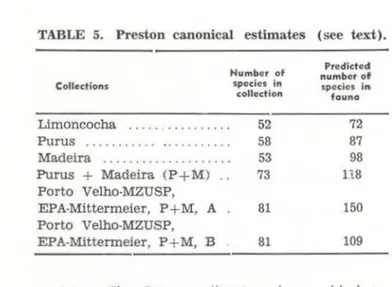
TABLE 5. Preston canonical estimates (see text).
Collections
Limoncocha
Purus . . ... . .. . ... .
Numbor of speciC!s In
colledion
Madeira ... . 52 58 53 73 Purus + Madeira CP + M} ..
81 81
Predlctod number of
species in
founo
72 87 98 118 150 109 Porto Velho·MZUSP,
EPA-Mittermeier, P + M, A Porto Velho·MZUSP, EPA-Mittermeier, P + M, B
~----~--- -- --- ----
---activity. The Purus collection data, added to the Madeira data, forms a smooth coilecting curve (Fig. 1) also indicating the two samples are from the same fauna . There is also the first indication of a leveling off
at
the end of this combined curve .Preston (1962) proposed a formula for predicting the actual number of species based on a random sample of the fauna . As already discussed, the collections are not truly random, so any predictions will be approximate at best . The Preston canonical estimate is:
N= Yo
6V2f • whereN
=
the predicted number of species, &=
log standard deviation (Preston, 1962. p. 203 provides a table for this value based on the actual number of species in the collection). andYo
=
the nllmber of species in the modal octave. where the octaves are set up by ranking the numbers of individuais of eachspecies collected. The estimated results for the co llections are presented in Table 5. The one estimate for which the probable value is known (limoncocha) is underestimated. The last two values of the table are estimated from combined data of the Porto Velho -MZUSP, EPA - Mittermeier, Madeira and Pu-rus collections. The first estimate is using the
modal octave, which in this case is the f irst octave, containing species represented by one or two specimens . The second estimate is based on the octave containing the next highest number of species and is included because it is more consistent with the other estill'fates.
At the moment. it would appear t hat a reasonable estimate of the number of species
Notes on the fr og fauna . . .
in the Hylaean frog fauna is at least 100 . This is higher than the diversity at Santa Cecilia, but the geographic extent of the Hylaea is obviously much great er than Santa Cecilia . As
is clear from Figure 1, collecting data for at least 40 days are needed from a single site in the basin proper to determine whether the diversity at a basin site is comparable to the slope fauna diversity .
ZOOGEOGRAPHY
The anuran fauna at Santa Cecilia is to date the most diverse studied Crump. (1974). Recent revisionary studies have suggested that certain species have distributions as-sociated with the upper Amazon basin of Colombia, Ecuador and Peru (e . g . Duellman , 1973, 1974a, b, Duellman and Crump , 1974) . Groups of species with such distribution patterns would add to the overall diversity of the upper Amazon basin, contrasting with the presumed lower diversity of the iowland Amazon basin .
The four collections reported here are from the western half of the Brasilian Amazo-nian lowlands . Duellman and his associates (Duellman. 1973, 1974a, b, Duellman and Crump, 1974} have recently published studies based on previously available museum ma-teriais. In those studies. the following species were not known from the lowland Amazon basin and characterized as having upper Amazon distribution patterns : Hyla fasciata, H. parviceps, H. sarayacuensis, Phyllomedusa pal/iata, P. tarslus. and Sphaenorhynchus carneus. Ali of these species are represented in the collections from the western half of the Brasilian Amazonian lowlands . lt !s obvi-ously prematura to characterize individual distribution patterns as upper Amélzonian . However. when one compares the total species lists of Santa Cecilia against the 4 co ilections of this report, the differences are appreciable. About 49 % of the species recorded from Santa Cecilia are not found in the lowiand Amazon collections. About 45% of the species in the lowland Amazon collections are not recorded from Santa Cecilia . Some of these differences are accounted for by differences in taxonomic opinion. These amount to no more than 7%
of the observed differences. Some of the species recorded from Santa Cecilia are known previously from the lowland Amazor. basín. These account for at least 6% of the díffer-ences with respect to the Santa Cecília fauna. For one group, the centrolenids, I am confident they are not present in the lowland .A.mazon basín due to lack of proper bre~ding habitat. The centroleníds comprise 3% of the Santa Cecília frog fauna. There are no other obvious habitat dífferences that would explain fauna! differences between the upper and iowland portíons of the Amazon basín. Thus, 33 % of the fauna! dífferences observed can not be readily explained at present . Sampling errar certainly ís contributing to this figure, but the degree ís unknown. At this point, the available data suggest the following zoogeographic conclusions: (1) Any zoogeographic fauna! analysis is premature at present due to im-perfect sampling of the Amazonian frog fauna; but (2) lt appears that the upper Amazon slope fauna differs in degree from the lowland Amazon frog fauna. Precisely how and why the faunas differ is unanswerable with the present data base.
Another apparent difference between the slope and the lowland basin faunas involvet. a combination of population densities an':! microhabitat usage. I wanted to gather com-parative data along the Purus on the tree buttress herpetofauna to compare with the Limoncocha tree butress herpetofauna (Heyer and Berven , 1973) . On the th it·d working day of the Purus expedítion , I worked severa! of the kinds of buttresses whích almost always had animais at Limoncocha. Enough buttresses were sampled that a similar search at Limoncocha would always yield specímens. No amphibians or reptiles were found in tht:: tree buttresses along the Purus.
lt is difficult to interpret dístributional differences between the Madeira and Purus collections owing to the seasonal differences between the collections . The following , baseei more on impression than on data, is offered as a hypothesis . The Madeira river systern appears to ~ave a greater role in fauna' exchange than the Purus river. That !s, sup· posed Bolivian elements of the fauna penetrate
376-much further along the Madeira toward the Amazon River than along the Purus , and open formatíon specíes which apparently fcllowe cl open habitats from the mouth of the Amazon inland, penetrate much closer to Bolívia along the Madeira than the Purys.
SPECULATIVE CONCLUSIONS
The role of competition in the organi-zation and structure of tropical wet forest
communitíes has received considerable at-tention. Current views range from a com-munity characterízed by competition to a competition free community. Data beDring on the questíon are precious few and generally inconclusive. Unfortunately, no direct
evi-dence was gathered on the expeditions
reported here . Two circumstantial pi eces of evidence argue (rather convincíngly, to me) that interspecific competition is neglígible within the wet tropical forests sampl ed. The first argument is that the distríbution of each species is a patchwork of locally common and locally rare populations . Thus any competítíon that occurs is a local phenomenon, probably for one season, with interspecific interactione changing from one year to the next. Even though natural selection can operate w1th a small rate of population gene fr equency change, the rate must be consistent to be effective . lt is difficult to envision a constant levei of interspecific competition for any Amazonian species over any significant portion of its range. The second argument is that the densities of even the common forest :::pecies are very low. These data on forest species are important because the captures in the forest represent largely nonbreeding individuais . Thus , frogs collected in the forest should reflect potential competition for food andl space unrelated to breeding site competition . The average capture rate of forest frogs at night was approximately 1 . 5 frogs / person/ hour. The average capture rate of forest floor frogs in the daytime was approximately 2. 3 frogs / person/ hour. lt is difficult to envision competition occurring among animais with such apparently low densitles.
The frog diversity of the Amazon basin is high , and the diversity at any given place in
the basin proper probably approaches the diversity recorded at Santa Cecilia, Ecuador. Not ali specíes appear to be dístributed throughout the Amazon basin , but many more collections will have to be made before negative evidence can be trusted. One pastime ali workers who have been overwhelmed by the Hylaean fauna have indulged in is trying to explain the origin of the faunal diversity . The following speciation models seem to be involved in the history of the Hylacan frog fauna. The degree to which each is involved is totally unknown at present . The importance of each model in explaining the total diversity will provide a fruitful challenge for future work on the Hylaean frog fauna. I believe any synthesis will have to take into account the basic dichotomy of forest vs. open formation associated species and diurna! vs . nocturnal forest species.
Refugia model. Ever since the pioneer work of Haffer (1969) and Vanzolini and Williams (1970) the refugia model has been used to explain many patterns in specific groups, not always correctly (e.g. Heyer, 1973 for Adenomera hylaedactyla). As shown by Vanzolini and Williams (1970). the model can account for some of the diversity of the forest assocíated species faunal segment in Ama-zonia.
Open formation model A. Some species presently associated with open formations had their evolutionary origin in open formations outside the Hylaea and subsequently invaded the open formations of the Hylaea.
Leptodacty-lus fuscus seems a likely candidate for this model.
Open formation model B . Other ~pecies
presently associated with open formations had their evolutionary origin in the Hylaean open formations. Adenomera hy/aedactyla is an example of this model (present habitat
information superimposed on Heyer, 1973). Vicariant speciation model. This model is the least understood with respect to mecha-nism, but the result is species distributions that appear to replace each other. This model may acutally be involved in the refugia! model, where species distributions replace each other geographically, not ecologically, and in the
Notes on the frog fauna ...
open formation model B where species may replace each other ecologically. An example of the latter is the forest associated species
Adenomera andreae and its close relative, the open formation associated Adenomera hyla-edacty/a. I find it interesting, but presently unexplainable , that one of these is diurna!
(A. andreae), the other nocturnal .
Hylaean-Atlantic forest faunal interchange model . Species that evolved in one of these wet forest units subsequently invaded the other. This model is included as a possible conjecture at this point . Much of the Atlantic forest fauna is distinct from the Hylaean frog fauna, vice versa. The present taxonomic knowledge of the most promising groups that would exemplify this pattern, the bufonids and
hylids, is so poor that nothing can be sa!d either in support of the model or against it.
ACKNOWLEDGMENTS
Dr. Paulo E. Vanzolini kindly invited me to join him on the Purus and Madeira expe-ditions. The expeditions were most profitable and enjoyable under Dr. Vanzolini's careful guidance . My insights on the nature of the Amazonian fauna are due to Vanzolini's constant and unselfish sharing of his more than 20 years experience.
Without the help of the following friends who joined in the field work, the co!lections would be considerably less important: Carlos Roberto F. Brandão , Miriam Heyer, Francisca Carolina do Vai, P. E. Vanzolini.
The manuscript has been carefully read by P. E. Vanzolini and G. R. Zug.
My participation was supported by MZUSP and the Smithsonian Research Fourdation. This is a contribution of the Amazon Ecosystem Research Program (Smithsonian lnstitution).
Resumo
Apresenta-se mformação biológica derivada do estudo de 4 coleções grandes de anuros, feitas na bacia amazônica. A maior parte das espécies está associada a determinados subconjuntos ambientais associados a formações abertas ou a florestas, mas não a ambos os tipos simultaneamente . Todos os anuros diurnos são espécies do !olhiço do chão da mata; todas as espécies de formações abertas são noturnas.
Há, entre as coleções de água das formações abertas, poucas associações positivas de pares de espécies em reprodução, o que indica que a fauna de anuros de formações abertas não tem uma es-trutura comunitária estreitamente integrada. Qua-se todas as espécies Qua-se reproduzem fora dos rios maiores; apenas duas espécies possivelmente se re-produzam no leito principal dos rios . As espécies encontradas na floresta à noite, sobre folhas, estão aparentemente à caça de insetos .
Na Amazônia, a técnica de comprar exempla-res de crianças fornece amostras grandes de espé-cies associadas a formações abertas, mas poucas espécies associadas à floresta. As espécies são ca-racterizadas por estruturas populacionais de abun-dância e de raridade locais. Isto é verdade em ter-mos de distâncias geográficas desde grandes até muito pequenas.
A fauna de anuros da hiléia contém pelo me-nos 100 espécies. Uma análise zoogeográfica seria atualmente prematura, pois a amostragem faunís-tica é incompleta, mas quer parecer que a fauna das encostas orientais andinas difere em qualidade da fauna da planicie. Provas circunstanciais mili-tam contra a hipótese de que a competição interes-pecífica seja importante nas florestas úmidas pes-quisadas .
Cinco modelos de especiação podem ser invoca. dos para explicar a alta diversidade da fauna de anuros da hiléia.
1) Modelo de refúgios. Este modelo, explicado por Vanzolini & Williams (1970), explica parte da diversidade das espécies associadas a florestas;
2) Formações abertas, modelo A. Algumas es-pécies atualmente associadas a formações abertas tiveram sua origem evolutiva em formações aber-tas fora da hiléia e subseqüentemente invadiram as formações abertas da biléia;
3) Formações abertas, modelo B . Outras espé-cies atualmente associadas com formações abertas tiveram sua origem nas formações abertas da hi-léia;
4) Modelo de especiação vicariante . Este mo-delo ainda não está bem elucidado no que diz res-peito a mecanismos, mas o resultado são distribui-ções de espécies que parecem substituir-se geográ-fica ou ecologicamente;
5) Modelo de permuta entre hiléia e mata atlân-tica. Espécl.es que evoluíram em uma dessas flo-restas úmidas subseqüentemente invadirDm a ou-tra.
L ITERATURE CIT.ED
COLLINs, J . P.
1975 - A Qempara tive study of the life history strategies in a community of frogs. ix
+
148 pages . Unpublished Ph. D. Dissertation, University of Micnigan.
378-CRUMP, M .L.
1974 - Reproductive strategies in n tropical anurao community . University of Kan· sas Museum of Natural History Mis. cellaneous Publications, 61 : 1-68. 0UELLMAN, W .E.
1973 - F rogs of the Hyla geographica group. Copeia, 1973 : 515-533.
1974a- A reassessment of the taxonomic status of some neotropical hylid frogs. Occa-sional Papers of tbe Musewn of Natural History, University of Kansas, 27 : 1-27. 1974b - Taxonomic notes on Phyllom edusa (Anura: Hylidae) from the upper Amazon basin . Herpet ologica, 30 : 105·112.
O UELLMAN, W.E. & CRUMP, M.L.
1974 - Speciation in frogs of the Hyla parviceps group in the upper Amazon basin. Occasional Paper s of the Museum ot
Natural History, University of Kansas, 23: 1-40.
HAFFER, J.
1969 - Speciation in Amazonian forest. birds. Science, 165 : 131-137.
HEYER, W.R.
1973 - Systematics of the Marmoratus group of the frog genus Leptodactylus (Amphibia, Leptodactylidae) . Contribu· tions in Science, Natural History Mu. seum, Los Angeles County, 251 : 1-50. 1976 - Studies in larva! amphibian habitat
partitioning . Smithsonian Contributions to Zoology, in press.
HEYER, W. R . & BERVEN, K.A.
1973 - Species diversities of herpetofaunal samples from similar microhabitats at two tropical sites. Ecology, 54:642-645.
HEYER, W.R .; MCDIARMl.O, R.W . & WEIOMANl'l, D .L.
1975 - Tadpoles, predation and pond habitats in the tropics. Biotropica., 7: 100-111. PtELOU, E.C.
1969 - An Jntroduction to Mathematical Eco. logy. New York. Wiley-Interscience, viii
+
286 pages.PREsroN, F.W.
1962 - The canonical distribution of common-ness and rarity . I. Ecology, 43:185·215. V ANZOL.lNI, P. E.
1974 - Ecological and geograpbical distribu· tion of lizards in Pernambuco, nor-tbeastern Brasil (Sauria) . Papéis Awl-s oAwl-s de Zoologia, São Paulo, 28 : 61-90. V ANZOLINI, P . E. & WILLIAMS, E. E.
1970 - South American anoles: The geographic díffer entiation and evolution of the Anolis chrysolepis species group (Sau-ria, Iguanidae). Arquivos de Zoologia. São Paulo, 19 : 1-298.