REVISTA
UNIMONTES CIENTÍFICA
(ISSN 2236-5257) I Congresso Nacional de Oncologia
da Associação Presente - Agosto de 2017.
BREASTFEEDING IN THE SCOPE OF THE JOINT ACCOMMODATION:
AN INTEGRATIVE REVIEW
Aleitamento materno no âmbito do alojamento conjunto: Uma revisão integrativa
Adélia Dayane Guimarães Fonseca1
Pâmella Nafttaly Ramos Flores Gomes1
Eliene Pinheiro Nascimento1
Joanilva Ribeiro Lopes2
Ana Izabel de Oliveira Neta1
Claudiana Donato Bauman2
Lucinéia de Pinho2
Carla Silvana de Oliveira e Silva2 Abstract: the objective of this study was to carry out a review in order to know the issues that permeate the practice of Breastfeeding in the context of Joint Accommodation. This is an integrative review of the literature. Data collection was carried out by means of a search in the electronic databases MEDLINE, LILACS and BDENF, using joint accommodation and breastfeeding descriptors. Studies published between 2007 and 2013 were selected. According to the inclusion criteria, the articles should be available in full, aimed at the study objective, published in the Portuguese language, with the abstracts available in the selected databases. The final sample of this study consisted of 15 articles that strictly met the established inclusion criteria. From the reading of the same it was possible to construct 3 thematic categories: Knowledge of the puerperas on the Breastfeeding; Factors associated with early weaning and Care and role of the multiprofessional team. This review made possible the knowledge about the aspects that permeate Breastfeeding within the Joint Housing. However, it is understood that breastfeeding is a much broader phenomenon than the aspects that were explored and discussed in the analyzed scientific literature.
Keywords: Breastfeeding; Maternal Breastfeeding. Joint accommodation.
________________
Corresponding author: Adélia Dayane Guimarães Fonseca. E-mail: [email protected]
1 Faculdades Santo Agostinho de Montes Claros. 2 Universidade Estadual de Montes Claros.
REVISTA UNIMONTES CIENTÍFICA
Montes Claros, I Congresso Nacional de Oncologia da Associação Presente - Agosto de 2017.
125
Resumo: o presente trabalho teve como objetivo realizar uma revisão a fim de se conhecer as questões que permeiam a prática do Aleitamento Materno no âmbito do Alojamento Conjunto. Trata- se de uma revisão integrativa da literatura. A coleta de dados foi realizada por meio de pesquisa nas bases eletrônicas MEDLINE, LILACS e BDENF, utilizando-se os descritores Alojamento Conjunto e Amamentação de forma combinada. Foram selecionados estudos publicados entre 2007 a 2013. De acordo com os critérios de inclusão, os artigos deveriam estar disponíveis na integra, voltados ao objetivo de estudo, publicados no idioma português, com os resumos disponíveis nas bases de dados selecionadas. A amostra final desse estudo constituiu-se de 15 artigos que atenderam rigorosamente aos critérios de inclusão estabelecidos. A partir da leitura dos mesmos pôde-se construir 3 categorias temáticas: Conhecimento das puérperas sobre o Aleitamento Materno; Fatores associados ao desmame precoce e Cuidado e papel da equipe multiprofissional. A revisão possibilitou o conhecimento acerca dos aspectos que permeiam o Aleitamento Materno no âmbito do Alojamento Conjunto. Entretanto, compreende-se que o Aleitamento Materno é um fenômeno mais amplo que os aspectos que foram explorados e discutidos na literatura científica analisada. Palavras-chave: Amamentação; Aleitamento materno; Alojamento conjunto.
Breastfeeding in the scope of the joint accommodation: an integrative review FONSECA, A. D. G; GOMES , P. N. R. F.; NASCIMENTO, E. P.; LOPES, J. R.;
NETA, A. I. O.; BAUMAN, C. D.; PINHO, L.; SILVA, C. S. O. ISSN 2236-5257
126
REVISTA UNIMONTES CIENTÍFICA
INTRODUCTION
Breastfeeding is the most important event in the first months of the baby’s life. According to the World Health Organization, the promotion and sup-port of Maternal breastfeeding (AM) is one of the public health priorities, being that the advantages of AM have already been widely documented, and are usually, claimless. In developing countries, AM is strongly tied to the reduction of infantile mortali-ty and morbidimortali-ty. In developed countries, evidences suggest that AM provides the newly-born protec-tion against sudden death and diabetes in youth. Other studies suggest that there is a reduction of risk of development of gastrointestinal, urinary and respiratory infections, besides a better neurological development. When talking about AM it is impor-tant to consider the importance of the scope of the Joint Accomodation (AC). 1,2
Joint accommodation is a hospital sys-tem where the healthy newly-born baby, right af-ter birth, remains by the mother’s side, 24 hours a day, in the same environment until the hospital discharge. AC is considered an advantage due to stimulating the maternal breastfeeding upon pro-viding constant contact between mother and child, an important aspect for the breastfeeding success. This environment, where the mother/child dyad are in the first birth moments, becomes an adequate space to professional attention. In this scenario, the nurse can allow the woman to rescue her autonomy in search of conditions necessary for the devel-opment of maternal care, enabling the absorption of new understandings about the moment experi-enced. The main care focus is education and guid-ance to health with the aim of transmitting security and tranquility to the women who take their role
as a mother. However, it is required from the pro-fessional great communication skills, availability, monitoring, evaluation and acceptance. The care to be provided to the mother and the newborn involve knowledge about the phases of the puerperium, in which the woman goes through accelerated physio-logical and psychophysio-logical changes which influence their relationships. In this sense, particularly, the act of breastfeeding involves a series of psychological, sociological, physical factors as well as from the newborn that interfere in the favorable outcome of maternal breastfeeding.3
The Ministerial Order MS/GM Number 1016 dated from August 26th 1993 explains about the advantages of breastfeeding: to stimulate and motivate the breastfeeding, according to the child’s needs, making breastfeeding more physiologi-cal and natural; the early breastfeeding causes the contraction of the uterus and its vessels, acting as prophylaxis of bleeding after delivery; promote the precocity, intensity, frequency of breastfeeding, and its maintenance for longer periods; strengthen the bonds of affection between mother and child, through the early relationship; allow the constant observation of the newborn by her mother, what makes her better know her son, and allow imme-diate communication of any abnormality; provide conditions for nurses to promote the maternal train-ing, through practical demonstrations of care essen-tial to the newborn and the puerpera.4
In view of so many benefits, the World Health Organization (WHO) recommends that breastfeeding should be held at least until 2 years of age, being that during the first six months it must be practiced in an exclusively. Even with this recom-mendation, it is possible that the maternal breast-feeding rates, in special those of exclusive maternal
REVISTA UNIMONTES CIENTÍFICA
Montes Claros, I Congresso Nacional de Oncologia da Associação Presente - Agosto de 2017.
127
breastfeeding, have not reached satisfactory rates in Brazil and in the world, since that mothers who have little information believe that they can feed the children with other kinds of food.5
The Brazilian Constitution has several laws which guarantee the mothers’ law who wish to breastfeed their children. However, the promotion and encouragement of the breast feeding depends much more of health professionals’ commitment responsible for the women care during the pre and post-natal care. Mothers should be informed, dur-ing pregnancy, on the advantages of breastfeeddur-ing in its various aspects and negative factors related to the use of substitutes or complements to breast milk, especially in the first half of the suckling’s life. They must also receive notions on lactation, stimuli for breastmilk production and support to overcome difficulties and seek solutions to possible problems during the breastfeeding process. Some women still receive, on the occasion of discharge from the maternity ward, if necessary, artificial milk prescription to supplement the breast milk. This fact is easily identified when the baby care’s appointment is performed and the suckling exhibit a decrease in the curve of weight, as well as diar-rhea or constipation caused many times by artificial milk, its preparation and storage. 5 In this context, it is assured the importance of care provided by health care professional to the puerperal women in AC.
Nevertheless, the advantages that the scien-tific community has discovered about breastfeed-ing, and that have been circulated in society, seem not to be sufficient or capable of reversing the pro-gressive tendency to early weaning, perhaps by the fact that the woman during her hospitalization re-ceives guidance on breastfeeding, but after being discharged from the hospital, at home, she needs more support from health professionals, family and community. Although many maternity ward want
the title Amigo da Criança Hospital, many women come out of these institutions without receiving support and guidance necessary begin a new phase in their lives and perform the function of woman-mother with security, fully breastfeeding her child.6 The health professionals involved in the women’s care must be attentive to the needs pre-sented, reinforcing the importance of breastfeed-ing (which certainly was presented to the pregnant women at the prenatal), listening to them, offering support and guidance relevant to these and other is-sues. The professionals should help them to find the answers to their questions, observing this period of constant updates and great sensitivity, always con-sidering the prior knowledge presented, their cul-ture and values.7
In addition, AM has an impact on the chil-dren’s mortality. A study performed in 42 countries showed that breastfeeding could prevent 13% of deaths in children under five years of age if 90% of the children were exclusively breastfed up to six months and if breastfeeding was continued after the introduction of healthy complementary diet.8
In this sense, it is believed that investigating what the scientific literature has discussed about breastfeeding in the context of the Joint Accomo-dation an contribute in the direction of educational actions and in the reorientation of the practices ad-opted by health professionals, so that mothers un-derstand and learn how important it is to breastfeed her child and how her health will have a better quality of life for both, ending with the doubts and the lack of information.
Before the facts aforementioned, the study herein aimed to carry out a review in order to know the issues that permeate the practice of Breastfeed-ing in the context of Joint Accommodation.
REVISTA UNIMONTES CIENTÍFICA
Montes Claros, I Congresso Nacional de Oncologia da Associação Presente - Agosto de 2017.
128
According to the inclusion criteria, the ar-ticles should be totally available, aimed at studies, published in Portuguese language, with the ab-stracts available in the databases selected and pub-lished in the last 10 years which as between 2000 and 2017 in order to identify the changes along the 10 years elapsed.
The articles were selected initially in the form of abstracts and were later totally analyzed. In the survey of studies, the cross-section was performed, in conjunction with the Descriptors in Health Sciences (DECS) using the Boolean opera-tor and to the following schemes: Alojamento
Con-junto and Amamentação and Alojamento ConCon-junto and Aleitamento Materno.
Data collection took place between March and June 2016. In the search performed found with cross-section Alojamento Conjunto and
Amamen-tação and Alojamento Conjunto and Aleitamento Materno 325 articles in three data bases , being 128
in the LILACS, 114 in MEDLINE, 83 in BDENF; of these, 54 were totally available as shown in Fig-ure 1.
After eliminating the duplicates, the publi-cations were pre-selected based on the title and the abstract reading. In this context, it was possible to select 21 articles with the potential to compose the final sample, however, only 15 had answer to the question previously formulated.
METHODOLOGY
This is an integrative review of the litera-ture, which is a wide form of researching studies that already exist, in order to draw conclusions re-garding a specific topic. It is considered a relevant strategy to identify the evidences, establishing the health practice in different specialties. 9
For the preparation of the integrative review, the methodological procedures were followed rec-ommended in the literature, namely: 1) formulation of the question and the objectives of the review; 2) establishment of criteria for selection of articles; 3) categorization of studies; 4) Assessment of studies included in the integrative review; 5) Interpretation of results; 6) Synthesis of knowledge
In order to carry out this review, the follow-ing guidfollow-ing question was elaborated: What has the scientific literature produced about breastfeeding in the context of Joint Accomodation?
The search for studies was carried out in three electronic databases, in order to enlarge the scope of the research, minimizing potential biases at this stage of the process of drafting of the integra-tive review, namely: LILACS (Latin American and Caribbean Health Sciences Literature h); MED-LINE (Medical Literature Analysis and Retrieval System Online); BDENF (Data Base in Nursing).
Breastfeeding in the scope of the joint accommodation: an integrative review FONSECA, A. D. G; GOMES , P. N. R. F.; NASCIMENTO, E. P.; LOPES, J. R.;
NETA, A. I. O.; BAUMAN, C. D.; PINHO, L.; SILVA, C. S. O. ISSN 2236-5257
129
REVISTA UNIMONTES CIENTÍFICA
RESULTS AND DISCUSSION
Even though the promotion of breastfeeding is considered one of the main strategies of child sur-vival and pointed out as crucial for the prevention of risks and health hazards in different phases of life, the total breastfeeding duration and exclusive remains below what is recommended by WHO. The questions that guide the success of breastfeed-ing should be evaluated by different dimensions, such as: culture, knowledge about the subject, fam-ily support, among others, each one with its
particu-larities.10
Joint Accomodation provides constant con-tact between mother and child, being considered an important step for the breastfeeding success. Al-lowing the breastfeeding under free demand, and avoids that the newly-born to receive another food rather than breast milk and that the mothers take part of her child’s cares, under the guidance of the health team. 10,11
The health team must have an a goal to promote health and prevention of eventual prob-lems. The professional must be able to provide the mothers with information about the dyad’s current Figure 1 - Flowchart of articles selection in which focus on the Maternal Breastfeeding in the
context of Joint Accomodation 2016.
REVISTA UNIMONTES CIENTÍFICA
Montes Claros, I Congresso Nacional de Oncologia da Associação Presente - Agosto de 2017.
130 health state, evaluate their physical and emotional conditions, self-care and the cares with the newly-born baby. It is also up to the team to make it available the family, specially the father, to participate of the whole process.10,11
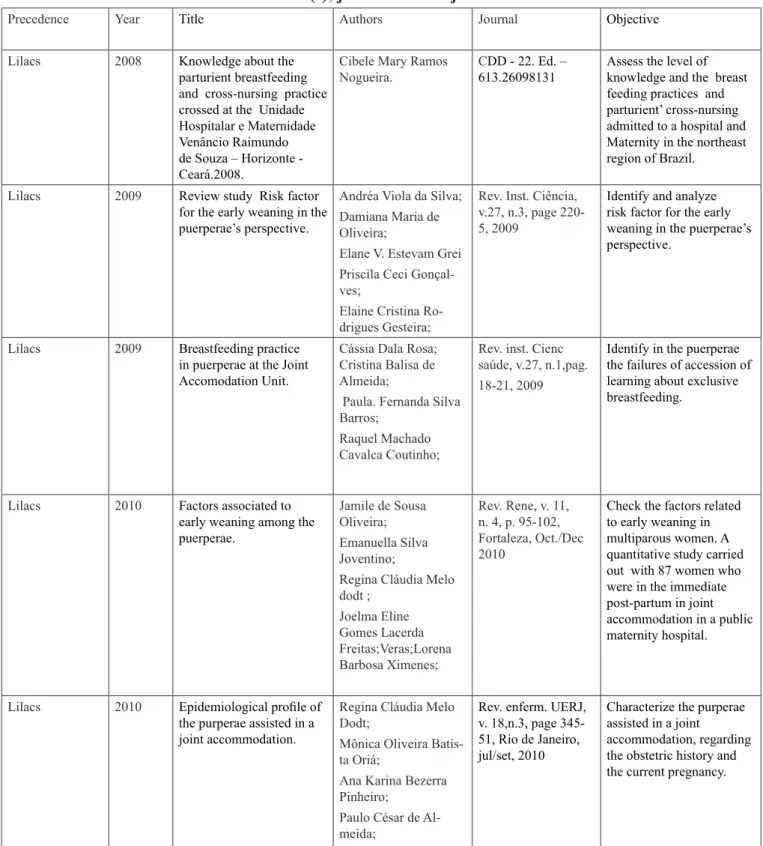
The analysis and further synthesis of the articles which complied with the inclusion criteria were performed through the construction of conditions specifically to this end, containing the items: procedence, year, publication year, authors, journals and goals.
Table 1. Distribution of articles studied according to precedence, year of publication, title, author(s), journal and objective.
Precedence Year Title Authors Journal Objective
Lilacs 2008 Knowledge about the
parturient breastfeeding and cross-nursing practice crossed at the Unidade Hospitalar e Maternidade Venâncio Raimundo de Souza – Horizonte - Ceará.2008.
Cibele Mary Ramos
Nogueira. C613.26098131 DD - 22. Ed. – Assess the level of knowledge and the breast feeding practices and parturient’ cross-nursing admitted to a hospital and Maternity in the northeast region of Brazil.
Lilacs 2009 Review study Risk factor for the early weaning in the puerperae’s perspective.
Andréa Viola da Silva; Damiana Maria de Oliveira;
Elane V. Estevam Grei Priscila Ceci Gonçal-ves;
Elaine Cristina Ro-drigues Gesteira;
Rev. Inst. Ciência, v.27, n.3, page 220-5, 2009
Identify and analyze risk factor for the early weaning in the puerperae’s perspective.
Lilacs 2009 Breastfeeding practice
in puerperae at the Joint Accomodation Unit.
Cássia Dala Rosa; Cristina Balisa de Almeida;
Paula. Fernanda Silva Barros;
Raquel Machado Cavalca Coutinho;
Rev. inst. Cienc saúde, v.27, n.1,pag. 18-21, 2009
Identify in the puerperae the failures of accession of learning about exclusive breastfeeding.
Lilacs 2010 Factors associated to early weaning among the puerperae.
Jamile de Sousa Oliveira; Emanuella Silva Joventino;
Regina Cláudia Melo dodt ; Joelma Eline Gomes Lacerda Freitas;Veras;Lorena Barbosa Ximenes; Rev. Rene, v. 11, n. 4, p. 95-102, Fortaleza, Oct./Dec 2010
Check the factors related to early weaning in multiparous women. A quantitative study carried out with 87 women who were in the immediate post-partum in joint accommodation in a public maternity hospital.
Lilacs 2010 Epidemiological profile of the purperae assisted in a joint accommodation.
Regina Cláudia Melo Dodt;
Mônica Oliveira Batis-ta Oriá;
Ana Karina Bezerra Pinheiro;
Paulo César de Al-meida;
Rev. enferm. UERJ, v. 18,n.3, page 345-51, Rio de Janeiro, jul/set, 2010
Characterize the purperae assisted in a joint
accommodation, regarding the obstetric history and the current pregnancy.
Breastfeeding in the scope of the joint accommodation: an integrative review FONSECA, A. D. G; GOMES , P. N. R. F.; NASCIMENTO, E. P.; LOPES, J. R.;
NETA, A. I. O.; BAUMAN, C. D.; PINHO, L.; SILVA, C. S. O. ISSN 2236-5257
131
REVISTA UNIMONTES CIENTÍFICA
Lilacs 2010 Joint Accomodation:
Concrete space of possibilities and the role of multiprofessional team. Kelly Karine Pasqual;Luzmarina Aparecida DorettoBraccialli; Mirela Volponi; CogitareEnferm, v.15, n.2, page 334-9, Apr/Jun 2010
Knowing the SAC’s possibilities and limits, as well as analyzing the role of the multiprofessional team inserted at this location.
Lilacs 2011 Evaluation of promotion
of maternal breastfeeding in Amigos da Criança Hospitals.
Mateus Freire L. Souza;
Priscilla Nunes Ortiz1; Poliana Louzada Soares; Tatiana de Oliveira Vieira; Graciete Oliveira Vieira; Luciana Rodrigues Silva;
Rev. Paul Pediatr, v.29 n.4, page 502-8, 2011
To evaluate the
performance of steps 4 to 10 among the Ten Steps to Successful Breastfeeding, recommended by Amigo da Criança Hospitals Initiative IHAC), created by the World Health Organization (WHO).
Lilacs 2011 Maternal Breastfeeding: mothers’ knowledge admitted to the joint accommodation in a university hospital.
Mariana de Oliveira Fonseca;
Bibiane Dias Miranda Perreira;
Douglas Coelho Ma-chado;
Ana Rita Marinho Machado;
Cienc Cuid Saúde, 10n.1, page 141-149, Jan/Mar, 2011
Identify the knowledge about breastfeeding to mothers admitted to the joint accommodation of a university hospital from Triângulo Mineiro region.
Lilacs 2012 Depression symptoms in
the puerperium period and its implication in the breastfeeding self-efficacy.
Anne Fayma Lopes
Chaves. CDD - 618.7 Investigate the relationship of depressive symptoms in the puerperium period with the self-efficacy of the breastfeeding mother.
Lilacs 2013 Factors evaluation
which interfere in the breastfeeding in the first hours of life.
Célia Regina V. Rossi Pereira;
Vânia de Matos Fonseca;
Maria Inês Couto de Oliveira;
Ivis Emilia de O. Souza;
Rosane Reis de Mello;
Revista Brasileira de epidemiologia, v.16, n.2, pages 525-34, 2013
Investigate how the Step 4 of Amigo da Criança Hospital Initiative was applied to evaluate the prevalence of breastfeeding in the first hour after birth and to analyze the factors associated with non-breastfeeding in this period of life.
Lilacs 2013 Nursing team care on the promotion of maternal breastfeeding in a joint breastfeeding. An experience report.
Kelen Cristina Ramos dos Santos; Márcia Luciane da Silva; Eveline Franco da Silva; REAS [Internet], v.2,n.1, page 99-105, 2013
Report the Nursing team care on the promotion of maternal breastfeeding in a joint breastfeeding. Continuação da tabela 1.
REVISTA UNIMONTES CIENTÍFICA
Montes Claros, I Congresso Nacional de Oncologia da Associação Presente - Agosto de 2017.
132
BDENF
2013
Protection cares for the breastfeeding in the first hours of life.
ThuanyKüster Will; Joyce Ghisolf Arndt; Gabrielle Guidoni Torres;
Juliana Rodrigues de Andrade;
Taísa Sabrina Silva Pereira;
Maria del Carmen Bisi Molina;
Rev. BrasPromoc Saúde, Fortaleza, v.26, n.2, pages 274-280, Apr./Jun. 2013.
Identify the factors associated with breastfeeding in the first hour (APH) of life of the children of pregnant women enrolled in the Family Health Care Clinics.
Lilacs 2013 Epidemiological evaluation of mother-child dyad in a reference maternal-infantile hospital . Mariane Cordeiro Alves Franco; Tatiana Maria Machado Moutinho; Revista Paraense de Medicina , v.27, n.3, jul- Sep 2013
Lilacs 2013 Comparison of knowledge
on Maternal Breastfeeding among women in the post-partum period.
Mariana de Oliveira Fonseca-Machado; Marina Stark Rezende de Paula;
Bibiane Dias Miranda Parreira;
JulianaStefanell;
Rev. enferm. [Journal] UERJ, v.21,n.1, page 66-72, Rio de Janeiro, jan/ mar, 2013 To compare the knowledge about maternal breastfeeding in the postpartum period, according to sociodemographic, obstetric and personal aspects.
BDENF 2015 Knowledge of purpurae
about breastfeeding. Viviane Mara M. Silva;Emanuella Silva
Joventino;
Denise Sales Arcanjo; Joelma Eline G.L. F. Veras;
Regina Cláudia Melo; Monica Oliveira Batista; Lorena B. Ximenes; Enferm. Foco, Brasilia, v. 6, n. ¼, page 12-16, Dec. 2015.
Check the influence between the educational level of the puerperae and the number of prenatal visits in the knowledge of the same about breastfeeding, as well as to characterize their sociodemographic and obstetric profiles.
Source: Research data, 2016. Continuação da tabela 1.
Following the main results are presented of the studies categorized as major findings with respect to the issues that permeate the practice of maternal breastfeeding within the joint accommo-dation context.
Knowledge of pueperae about Breastfeeding The identification of knowledge about breastfeeding of pregnant women and nursing mothers and their determinants, enables a new ap-proach to breastfeeding, thus contributing to the levels of mortality reduction, in so far as it
inter-feres with the prevalence and duration of breast-feeding. Regarding the pueperas’ knowledge about maternal breastfeeding, which according to them, the duration of exclusive breastfeeding should be six months. However, this response does not guar-antee the conduct of an adequate practice for these mothers, observing that despite the mothers already have knowledge of the importance of breastfeeding and many have practiced it, there is still a lack of value of exclusive breastfeeding, since several of them persist in offering other liquids, in addition to the breast milk, to their children, in the first months of life.10,11
Breastfeeding in the scope of the joint accommodation: an integrative review FONSECA, A. D. G; GOMES , P. N. R. F.; NASCIMENTO, E. P.; LOPES, J. R.;
NETA, A. I. O.; BAUMAN, C. D.; PINHO, L.; SILVA, C. S. O. ISSN 2236-5257
133
REVISTA UNIMONTES CIENTÍFICA
The option for breastfeeding is something complex and involves women’s knowledge on this practice, which is permeated by biomedical and cultural concepts, values, beliefs, previous experi-ences and interference of family, community and health professionals. It is observed that women with more than eight years of study have greater knowl-edge about the benefits of breastfeeding, i.e. the women’s low educational level may be a risk factor for early weaning, due to restrictions on knowledge and the less able to understand, properly, the infor-mation received, making the effectiveness of edu-cational actions difficult. On the other hand, wom-en with higher educational level, especially those with higher education, understand more easily the guidance received and are less influenced by other people’s information, rejecting harmful practices for breastfeeding. In addition, the greater schooling engenders in the woman self-confidence and secu-rity to deal with the discomforts and complications common to the period of lactation. However, there are divergences in the scientific literature regarding the association between educational level and the prevalence and duration of breastfeeding, reinforc-ing the fact that the success of this social practice is associated to multiple factors, and not just to the number of years of study.10
Knowing the aspects related to the practice of breastfeeding is essential so that the mother-child dyad can have this experience in an effective and quiet way, receiving from the health professional necessary and appropriate guidelines still in preg-nancy. All pregnant women need information and support to develop skills for the breastfeeding prac-tice. Health education is an important tool that aims to expand the individuals’ knowledge about their health, especially regarding breast feeding. Struc-tured educational interventions and duly drawn up contribute to the increase the duration of exclusive
maternal breastfeeding, some women, even not having a higher level of knowledge about breast-feeding, breastfeed their children for longer peri-ods. This fact raises awareness of the existence of other factors, in addition to knowledge, which may contribute to the success and duration of breast-feeding, which deserve to be studied to understand its relationships and implications.11
It was evidenced, that women in the post-partum period with greater knowledge about breastfeeding were those with 9 or more years of study, who made six or more prenatal consultations and received guidance on breastfeeding during pregnancy. In contrast, many women had correct knowledge concerning the recommendation of ex-clusive breastfeeding until the sixth month of life, the inexistence of weak milk and the ideal time for the first feeding, probably because they are issues really emphasized in health services, in the media and in national campaigns of breast feeding..10
In this context, it is necessary to raise aware-ness, sensitize and educate permanently health pro-fessionals in relation to breast feeding, so that ac-tions of promotion, protection and support of this social practice are really put into practice. There-fore, these actions must be integrated at all levels of health care through an effective system of reference and counter reference and information exchange and experiences among professionalss.10,11,12
Multiprofessional team care and role
According to the Ministry of Health, the service of Joint Accommodation must rely on a multidisciplinary team composed of one nurse for every 30 dyads, a nursing assistant for each 8 dyads, an obstetrician for 20 mothers, a pediatrician for 20 newborn babies, as well as social worker, psychologist and nutritionist. This team aims to
REVISTA UNIMONTES CIENTÍFICA
Montes Claros, I Congresso Nacional de Oncologia da Associação Presente - Agosto de 2017.
134
promote health and prevent possible problems. The professional should be able to provide the mother information about the current state of health of the dyad, assess their physical and emotional conditions, explain about the routines of the unit and on the care and care of the newborn. It is also important to the team to provide the family, especially the father, participation in the whole process; allow him to monitor the daily evolution of the dyad; strengthen guidance and detect early problems, in addition to preparing the mother and newborn’s discharge from the hospital, revising guidelines and providing the necessary follow-ups. It is possible, for the success of the care, that the professional keeps up to date regarding the educational actions and that there is integration, mingling, interest and mutual cooperation between the health team and the family, in order to provide greater quality in their guidelines. 12,13,14,15,16,17
Health education is an opportunity for the professional to educate in a meaningful way through activities, such as the educational games that seek to contribute to enlarge the mothers’ knowledge about the importance of breastfeeding, the self-care and the basic self-care to the newborn; they also provide more security and motivation, in addition to exchanges of experience and greater interaction among the participants, and also they do not require high costs, allow change of hospital routine and reveal the mothers’ motivation and interest. The verbal and non-verbal communication are strategies that should be used, through the silence, of touch, the patience and individuality, keeping their eyes on the same level or being face-to-face with the mother. They are a therapeutic action, a way of listening, paying attention or allowing to cry, mainly in the care of the mother-child dyad and the family that pass through moments of intense anxiety, tension, fear and insecurity.12
However, studies show that there are few
health professionals who know and practice the counseling skills. Most do not know how to listen to the woman, the do not conquer her confidence and so they cannot give the necessary support to the breastfeeding mother. Without these skills, health professionals may not be able to properly evaluate the breastfeeding, helping women to fully breastfeed and communicate efficiently with the pregnant woman, mother and family members.13-17
In addition, studies evidence that the health professionals, during their training, are not trained on the practical aspects of the lactation management, nor regarding concepts and techniques of breastfeeding counseling. Rarely the text books of higher level courses on the health area address the practical management of breast-feeding.12,13
Therefore, we must take into account the importance of professionals and health personnel’s training, in particular, with techniques of counseling, in any proposal for intervention for the promotion, protection and support of breastfeeding, used in prenatal, delivery or after hospital discharge. It is crucial that health professionals, who deal with the mother-child dyad, learn techniques of interpersonal relationships to be able to develop specific skills of counseling and breastfeeding, which provide support to the mother in the decision about what is best for her and her baby, as well as the acquisition of self-confidence, contributing, thus, for improvement of breastfeeding indicators.13 FINAL CONSIDERATIONS
It could be concluded that there is a strong evidence on the knowledge of puerperal women regarding breastfeeding, determining its practice and/or early weaning. In addition, it was possible to identify the importance of multiprofessional healthcare team in service to mother-child dyad
Breastfeeding in the scope of the joint accommodation: an integrative review FONSECA, A. D. G; GOMES , P. N. R. F.; NASCIMENTO, E. P.; LOPES, J. R.;
NETA, A. I. O.; BAUMAN, C. D.; PINHO, L.; SILVA, C. S. O. ISSN 2236-5257
135
REVISTA UNIMONTES CIENTÍFICA
in the context of the Joint Accomodation, from, mainly, education actions and acceptance to this combination.
The authors declare not having interest conflict.
REFERENCES
1. PEREIRA, C.R.V.R., et al. Avaliação de fa-tores que interferem na amamentação na pri-meira hora de vida. Rev. bras. epidemiol., São Paulo, v. 16, n. 2, June 2013. Disponível em <http://www.scielo.br/scielo.php?script=sci_ arttext&pid=S1415-790X2013000200525& lng=en&nrm=iso>. Acesso em Mai. 2016. 2. VISINTIN, A.B. et al. Conhecimento de puér-peras acerca da amamentação. , Brasília,Enferm.
foco v.6, n.1/4, 2015. Disponível em: <http://re-vista.portalcofen.gov.br/index.php/enfermagem/ article/viewFile/570/252> Acesso em Mai. 2016. 3. PASQUAL, K.K; DORETTO B.L.A; VOLPONI, M. Alojamento conjunto: espaço concreto de pos-sibilidades e o papel da equipe multiprofissional.
Cogitare Enfermagem, Paraná, v.15, n. 2, abr-jun,
2010. Disponível em: < http://www.redalyc.org/ pdf/4836/483648971003.pdf> Acesso em Mai. 2016. 4. FONSECA, M.O. et al. Aleitamento materno: co-nhecimento de mães admitidas no alojamento con-junto de um hospital universitário. Ciênc Cuid
Saú-de, v.10, n.1, Jan/Mar 2011. Disponível em: <http:// periodicos.uem.br/ojs/index.php/CiencCuidSaude/ article/view/11009/pdf> Acesso em Jun. 2016. 5. MACHADO, M.O.F. et al. Comparação do conhecimento sobre Aleitamento Materno en-tre mulheres no período pós-parto. Rev. enferm. UERJ, Rio de Janeiro, v.21, n.1, jan/mar 2013.
Disponível em: <
http://www.facenf.uerj.br/
v21n1/v21n1a11.pdf
> Acesso em Jun. 2016.6. OLIVEIRA, S.O. et al. Fatores associados ao
desmame precoce entre multíparas. Rev. Rene.
Fortaleza, v.11, n.4, out-dez 2010. Disponível em: < http://www.periodicos.ufc.br/rene/arti-cle/view/4618/3454> Acesso em Jun. 2016. 7. SILVA & SANTOS. Cuidado de enferma-gem na promoção do aleitamento materno em alojamento conjunto: Um relato de experiên-cia. REAS [Internet], v.2, n.1, 2013. Dispo-nível em: < file:///C:/Users/joao/Download-s/258-1954-1-PB.pdf> Acesso em Jun. 2016. 8. SOUZA, M.F.L. et al. Avaliação da promoção do aleitamento materno em Hospitais Amigos da Criança. Rev. paul. pediatr., São Paulo , v. 29, n. 4, Dec. 2011 . Disponível em: <http:// www.scielo.br/scielo.php?script=sci_arttext&pi- d=S0103=05822011000400006-llng=enlnrm-iso> Acesso em Jun. 2016. 9. GALVAO, C.M.; SAWADA, N.O.; TREVIZAN, M.A. Revisão sistemática: recurso que proporciona a incorporação das evidências na prática da enferma-gem. Rev. Latino-Am. Enfermagem, Ribeirão Preto , v. 12, n. 3, june. 2004. Disponível em: <http:// www.scielo.br/scielo.php?script=sci_arttext&pi- d=S0104=11692004000300014-llng=enlnrm-iso>. Acesso em 08 Apr. 2016. 10. NOGUEIRA, C.M.R. Conhecimento sobre aleitamento materno de parturientes e prática de aleitamento cruzado na Unidade Hospitalar e Ma-ternidade Venâncio Raimundo de Souza –
Hori-zonte - Ceará.2008. 59f. Dissertação de mestrado
– Fundação Oswaldo Cruz, Rio de Janeiro, 2008. 11. DODT, R.C.M. et al. Perfil epidemiológico das puérperas assistidas em um alojamento conjunto.
Rev. enferm. UERJ, Rio de Janeiro, v. 18, n.3, jul/
set. 2010. Disponível em: http://www.facenf.uerj.
br/v18n3/v18n3a02.pdf. Acesso em 08 Apr. 2016.
12. MENDES, K.D.S; SILVEIRA, PEREI-RA, R.C.C.; GALVAO, C.M. Revisão integra-tiva: método de pesquisa para a incorporação de evidências na saúde e na enfermagem.
REVISTA UNIMONTES CIENTÍFICA
Montes Claros, I Congresso Nacional de Oncologia da Associação Presente - Agosto de 2017.
136 4, Dec. 2008. Disponível em: <http://www.
scielo.br/scielo.php?script=sci_arttext&pi- d=S0104=07072008000400018-llng=enlnrm-iso>. Acesso em 08 Apr. 2016. 13. WILL, T.K. et al. Fatores de proteção para amamentação nas primeiras horas de vida. Rev.
BrasPromoc Saúde, Fortaleza, v.26, n.2abr./jun.
2013. Disponível em: <http://www.redalyc.org/ pdf/408/40828920016.pdf>. Acesso em 08 Apr. 2016. 14. FRANCO, M.C.A; MOUTINHO, T.M.M. Avaliação epidemiológica do binômio mãe-filho, em hospital de referencia materno-infantil. Rev. Paraense de Medicina, Pará,
v.27, n.3, jul-set, 2013. Disponível em: < http://files.bvs.br/upload/S/0101-5907/2013/ v27n3/a3870.pdf >. Acesso em 08 Apr. 2016. 15. SILVA, A.V. et al. Estudo de revisão Fato-res de risco para o desmame precoce na pers-pectiva das puérperas. Rev. Inst. Ciência
Saú-de, São Paulo, v. 27, n.3, 2009. Disponível em: <http://files.bvs.br/upload/S/0104-1894/2009/ v27n3/a005.pdf>. Acesso em 08 Apr. 2016. 16. ROSA, C.D. et al. Prática da amamenta-ção em puérperas na unidade de alojamen-to conjunalojamen-to. Rev. Inst. Ciência Saúde, São Paulo,v. 27, n.1, 2009. Disponível em: < http://files.bvs.br/upload/S/0104-1894/2009/ v27n1/a003.pdf>. Acesso em 08 Apr. 2016. 17. CHAVES, A.F.L. Sintomas depressivos no
puerpério e sua implicação no auto eficácia de amamentar. 2012. 101f. Dissertação de mestrado