AR
TICLE
1 Secretaria Municipal de Saúde do Rio de Janeiro, Prefeitura da Cidade do Rio de Janeiro. R. Afonso Cavalcanti 455, Cidade Nova. 20211-110 Rio de Janeiro RJ Brasil. joseprado.smsrio@ gmail.com
2 Faculdade de Medicina, UFRJ. Rio de Janeiro RJ Brasil.
Cure rates for tuberculosis in the municipality
of Rio de Janeiro, Brazil, in 2012 compared with coverage by,
and time of establishment of, Family Health units,
and socio-economic and demographic factors
Abstract Tuberculosis (TB) has high prevalence and is considered a world emergency by the World Health Organization (WHO), being the greatest cause of death from infectious diseases in adults. It is directly associated with access to health services and socio-economic factors. A reform of Primary Care in the municipality of Rio de Janeiro began in 2010, with coverage increasing from 7% in that year to 48.2% in 2014. This article compares the proportion of cures of TB, coverage by the Fami-ly Health Strategy (FHS), how long it has been in place, and socio-economic and demographic fac-tors in the municipality of Rio, based on new cases notified in the year 2012. An association was found between cure of TB and the variable gender, being 40% greater in females – odds ratio 1.4 (CI95% 1.21–1.62); and with residence in favelas – OR 0.86 (CI95% 0.73–1.02), but there was no associ-ation with coverage of the FHS (OR 1.06; CI95% 0.92–1.22), nor with the time for which the teams had been in place. FHS coverage in the municipal-ity of Rio was put in place as priormunicipal-ity in areas of greater vulnerability; at the time of this study, more than 91% of the teams had been in place for less than five years before the date of diagnosis. These factors probably contributed to it not being possible to detect better results in the cure of tuberculosis in areas covered by the FHS in the year 2012.
Key words Primary healthcare, Tuberculosis, Family Health Strategy, Family health system
José Carlos Prado Junior 1
Thiago Costa Virgilio 1
P
ra
d
o J
unio
Introduction
Tuberculosis (TB) is an infectious disease that occurs at an important level of magnitude in the world. In 1993 the World Health Organization declared it to be a world emergency disease, as the largest cause of adult death from infectious
diseases1.
Brazil is one of the 22 priority countries in the control of tuberculosis by the WHO. These coun-tries account for 80% of the world’s cases. Brazil
is 16th placed among these countries by absolute
number of new cases in 2014. The prevalence of TB in that year was 33.5/100,000 population and the death rate was 2.3 per 100,000 population. In spite of this position, there has been a trend of re-duction of 2.3% in annual average incidence, and 0.5 deaths/100,000 population, over the years
2005 to 20141.
In the same year of 2014, occurrence in the state of Rio de Janeiro was 60.9 per 100.000 pop-ulation, almost twice the national average. The proportion of cure of bacilliferous pulmonary TB in the state was 68%, compared to a national average of 72.5%, lower than the 85% expected
by the WHO2.
The illness has a direct relationship with pov-erty and social exclusion, and thus the people who are most socially vulnerable have the highest chance of this illness developing and proliferat-ing. A systematic review was published in 2013 correlating tuberculosis with socio-economic
factors3. The studies used the census sectors as a
level for aggregation of data, and found associa-tion with: a) households of more than five peo-ple; b) illiteracy; c) proportion of the population aged over 65; d) proportion of the population with low income; e) proportion of people over 15 with low schooling; f) proportion of immigrants, g) households with more than one resident per room; h) number of cases of re-treatment per census sector; and i) number of families with more than one case, per census sector.
Socio-economic factors also influence access to health services, resulting in more vulnerable
people having more difficulty of access4, which in
turn contributes to delay of diagnosis and treat-ment of TB, increasing the possibilities of aban-donment of treatment, one of the main obstacles
for the control of this disease4.
Primary Healthcare has a fundamental role in the cure of tuberculosis since it is the first level of access of a health system, presenting some of the basic principles of organization such as lon-gitudinality, integrality of care and coordination
of the care within the health system itself5. Thus,
primary healthcare makes possible greater access and adhesion to treatment of the TB, as well as
reaching the more vulnerable populations2.
The countries that have adopted primary healthcare as an ordering factor of the health sys-tem have shown the effect with evidences of im-provement in health indicators, as well as lower investments in health when compared with those that do not have a structured Primary Healthcare
system6,7.
The municipality of Rio had the worst Fam-ily Healthcare coverage of all Brazilian capitals, with approximately 7%.The reform of primary healthcare began in 2009, and increased this
cov-erage to almost 40% in 2012 and 48.2% in 20158.
Currently there are two primary healthcare models in Rio de Janeiro: (1) Family Health, with a wider offer of health services, based on the principles of Family Healthcare (access,
longi-tudinally, coordination of care, and integrality)5
– with generalist doctors and nurses and health responsibility defined in territorial terms; and (2) traditional primary care, with the presence of focal specialists (pediatricians, gynecologists, clinical practitioners, and others).
Considering tuberculosis to be an illness strongly related with socio-economic factors and also with access to health services, it becomes necessary to evaluate the relationship between expansion of coverage of Primary Healthcare and the cure of TB in the municipality.
The purpose of this article is to compare the proportion of cure of tuberculosis according to both the coverage and the time of existence of implementation of family health, and socio-eco-nomic and demographic factors in the munici-pality of Rio de Janeiro, based on the new cases notified in the year 2012.
Methods
This is a cross-sectional study, carried out in the municipality of Rio de Janeiro, correlating cure of tuberculosis with coverage by the Family Health system and socio-economic and demographic variables, having as a unit of analysis individu-als in new notified cases of TB. For some of the socio-economic explanatory variables, the census sectors were the level of aggregation. The munic-ipality is in the southeastern region of Brazil, between latitudes 22°44’45.59” and 23°04’58.34” and longitudes 43°05’48.89” and 43°47’43.79”. It
den-aúd
e C
ole
tiv
a,
21(5):1491-1498,
2016
sity of 5,265.82/km2 and an exclusively urban
population in 2015 estimated at 6,476,6319. It
is divided into 161 districts, 34 administrative regions, and 10 health regions (planning areas). It has great economic and social contrasts, with approximately 22% of the population living in
sub-normal agglomerations9.
The population of the study comprises new cases of tuberculosis in residents in the munici-pality notified in 2012 – a total of 5,794 reports.
For identification of the Family Health cov-erage the technique of geo-referencing was used based on the address of the household, attribut-ing a geographic position to each record (latitude and longitude). This made it possible to identi-fy in which polygon of Family Health coverage each case was located, by spatial consultation. The coverage maps were prepared by the Rio de Janeiro municipal health department and correspond to the coverage existing in 2012. To achieve the georeferencing of the addresses, the cases of institutionalized people (356 cases), and homeless people living in the streets (67cases), were excluded from this phase of the study since these people cannot be classified as belonging to the responsibility of the team, nor as not having Family Health coverage. This was necessary in view of the impossibility of characterizing the primary healthcare coverage for these cases. This georeferencing of addresses used the “Geocode” tool available on Google Maps through a free Application Programming Interface (API). This process used the basis of addresses and localities provided by Google. Its exactness can be assessed based on a score from 0 to 10, (0 – not found; 1 – country level; 2 – state level; 3 – sub-region; 4 – city; 5 – postcode; 6 – address name; 7 – street intersection; 8 – address; 9 – name of building or firm; 10 – maximum precision). Those with result below ‘5’ were considered lost. The records with result between ‘8’ and ‘10’ were considered to have acceptable precision. The other records were reviewed manually.
The software used for construction of the maps of coverage of the Family Health system and spatial consultation of data was ArcGIS, ver-sion 9.3 (Esri, Redlands, CA, USA) in projection
Latlong/WGS84, made available in the shapefile
extension. In 1,064of the 5,272 geo-referenced records (20.18%)it was not possible to determine the geographical coordinates with precision, char-acterizing losses to the geo-referenced sample.
The variable time of implementation of
Fam-ily Health teams was obtained from the data of the Health Ministry’s National Health
Establish-ments Records System (SCNES –Sistema de
Ca-dastro Nacional de Estabelecimentos de Saúde). For the purposes of classification of Family Health coverage all the records located in poly-gons of areas covered by the Family Health Sys-tem in which the diagnosis took place as from three months from implementation of the team were considered as having coverage, and all the other cases as not having coverage. Three months was used as a cutoff point because it is the min-imum reasonable time for a new Family Health team to carry out full registration of people res-ident in its territory of health responsibility and carry out an initial health diagnosis.
The epidemiological indicators and some socio-economic indicators such as age, gender, race/color and schooling were extracted from the records of the SINAN, representing each indi-vidual. The other socio-economic data were ob-tained from the polygons of the census sectors of
the IBGE of the year 20109, represent the averages
of the results of the residents in the same census sector. In this case the values were repeated for each individual in the same census sector.
The outcome variable considered in the pres-ent study was closing of the case by cure (yes/no), obtained from the SINANdatabase, and the ex-posure variables were COVERAGE – whether or not there was Family Health coverage (yes/no), and MONTHS_DIAG – time from implementa-tion of the team up to the diagnosis of TB, con-trolling for the other variables, even if they were not significant, but were recognizably important.
The following demographic and socio-eco-nomic variables were added for control:
(a) AGE, (b) GENDER, (c) RACE/COLOR (white/non-white),(d) SCHOOLING (level), (e) FAVELA –home in favela (yes/no), (f) INCOME– proportion of heads of household with average monthly income of twice the minimum wage, or
less3, (g) BATHROOM–average number of
bath-rooms per domicile, (h) DENSITY–average resi-dents per household, and (i) AGING–aging rate. Descriptive analysis of the data was carried out with the SPSS 20.0 software (SPSS Inc.,
Chi-cago, United States)10, through a bivariate logistic
regression (gross analysis) and subsequently the multiple logistic regression model was applied, with one of the categorical exit variables being dichotomous (dependent variable) and multi-ple explanatory variables (independent), based on the theoretical reference of association of TB
with socio-economic variables11,12. Termination
P
ra
d
o J
unio
variables: COVERAGE, MONTHS_DIAG, GEN-DER, RACE/COLOR, SCHOOLING, FAVELA, INCOME, BATHROOM, DENSITY, AGEING. The method of selection of variables used was theBackwardmethod, with verification of the significance of the likelihood ratio. For analysis of residuals the standardized form was selected with a confidence interval for the odds ratio. The significance of the variables was evaluated based on the Wald test and the effect measured by the Odds Ratio. Adjustment of the model was evalu-ated by the Hosmer-Lemeshow test.
To illustrate the spatial distribution of TB the point density analysis technique known as kernel density estimation was used. This consists of gen-erating a point density surface, within a region of influence, the points being weighted by the dis-tance of each one to the location of interest, for visual identification of the ‘hot spots’ on the map. A radius of 2,000mwas used with smoothing sur-face of 20 meters, through the ArcGIS program,
version 9.3 (Esri, Redlands, CA, USA)11, in
Lat-long/WGS84 projection. For this, the kernel ratio was used, which consisted of arbitrarily attribut-ing all the geo-referenced points in the centroid of the corresponding census sector, dividing the number of cases notified by the population of each census sector.
The study was approved by the Ethics Com-mittee of the Municipal Health Department of Rio de Janeiro and CAAE, in compliance with the recommendations of National Health Coun-cil Resolution 466/12.
Results
5,794 new cases of tuberculosis were identified in residents of the Municipality of Rio de Janeiro in 2012, resulting in an incidence rate of 90.67cas-es per 100,000 population. Of th90.67cas-ese, 5,436 new cases were closed (93.82%). The percentage of cure was70.42% (3,828 new cases) of the total of cases closed. In this period there were 369 cases of death from tuberculosis, resulting in an annu-al specific mortannu-ality coefficient of 5.77cases per 100,000 population, suggesting a death rate of 5.04% of the cases closed. If we consider only the cases closed notified by primary healthcare units (4,272 new cases), the percentage of cure rises to 74.58%.
Of the total of cases closed with cure, 83.23% were in primary healthcare notifying units.
Of all the new cases of residents in the mu-nicipality of Rio notified in 2012, 73.73% of
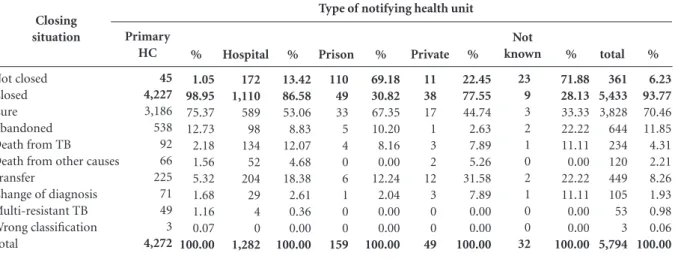
no-tifications took place in primary healthcare units, and only 159 cases (2.74%) in prison units, and 49 cases (0.85%) in private units. Practically all the cases notified from primary healthcare units were closed (98.95%), but in 69.18% of the cases in prison units (110 cases) and in 13.41% of the cases in hospital units (172 cases) they were not closed (Table 1).
Units other than primary healthcare units had 87.53% (316 cases) of all the 361 cases that were not in a situation of closure.
Of the total of 4,208 cases geo-referenced, 2,639 (62.7%) were covered by the Family Health System. The distribution of these cases, however, was not uniform over the municipality: there was a greater concentration in the regions with worse social development indicators.
To evidence the heterogeneous nature of the distribution the density ratio of the cases per population of each census sector was calculated using kernel estimation (Figure 1). It can be seen that the ‘hot spots’ are concentrated in the central regions of the municipality of Rio and the North
Zone (the Alemão Complex, Acari), followed by
the South Zone (the Rocinha favela) and the
East-ern Zone of the map (Santa Maria Community). Of the geo-referenced cases (N = 4,208), the median age was 36, the lowest age less than one year, and the highest age 102. The majority of the cases were in males (n = 2,651; 63.0%), people with race/color identified as white (n = 1,708; 43.4%) and with primary schooling (n = 1,628; 57.1%).
An association was found in the bivariate analysis between coverage by the Family Health
System and the variables age, gender, race/color,
schooling, and living in favela. People living in a favela had 3.65 (CI95%, 3.04-4.39) times more chance of having Family Health coverage than
those not living in a favela (p < 0.001). Those
considered to be illiterate had 2.23 (CI95%, 1.61-3.07) times more chance of being covered by a Family Health system than those with higher
education (p < 0.001). People of white race/skin
color had 0.57 (0.50-0.65) times the chance of
having Family Health coverage (p < 0.001)
com-pared to non-white people.
Family Health coverage was associated, also, with supervised treatment – OR 2.28 (CI95%: 1.96-2.54) and with search for contact parties– OR 1.38 (CI95%: 1.21-1.57).
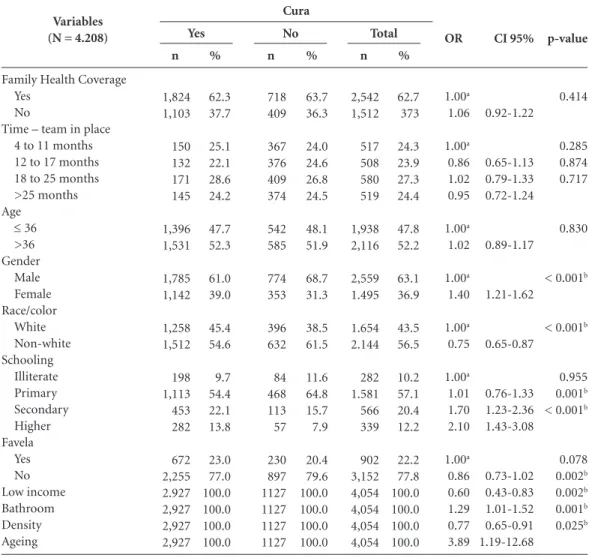
Further in the bivariate analysis, an associa-tion was found between cure of tuberculosis and
the variables gender, race/color, schooling, residents
bath-aúd
e C
ole
tiv
a,
21(5):1491-1498,
2016
rooms, density and aging rate (Table 1). Females had 1.40 (CI95%:1.21-1.62) times more chance
of cure of tuberculosis than males (p < 0.001).
People of white race/color had0.75 (CI95%:0.65-0.87) times the chance of cure compared to
non-white people (p < 0.001), and people with
high-er education had 2.10 (CI95%:1.43-3.08) times
more chance of cure than people who were
illit-erate (p < 0.001).
The socio-economic variables which in the gross analysis had association with cure of
tuber-culosis, and the variables Family Health coverage
and time of existence of Family Health teams were used for the binary and logistic regression model,
Closing situation
Not closed Closed Cure Abandoned Death from TB Death from other causes Transfer
Change of diagnosis Multi-resistant TB Wrong classification Total
Primary HC
45 4,227
3,186 538 92 66 225 71 49 3
4,272 %
1.05 98.95
75.37 12.73 2.18 1.56 5.32 1.68 1.16 0.07
100.00
Table 1. New cases of tuberculosis notified, by closing situation, and type of notifying unit. Rio de Janeiro (RJ), Brazil, 2012.
Source: SINAN municipal database (DATASUS/Health Ministry). Updated January 10, 2016. Hospital
172 1,110
589 98 134 52 204 29 4 0
1,282 %
13.42 86.58
53.06 8.83 12.07 4.68 18.38 2.61 0.36 0.00
100.00 Prison
110 49
33 5 4 0 6 1 0 0
159 %
69.18 30.82
67.35 10.20 8.16 0.00 12.24 2.04 0.00 0.00
100.00 Private
11 38
17 1 3 2 12 3 0 0
49 %
22.45 77.55
44.74 2.63 7.89 5.26 31.58 7.89 0.00 0.00
100.00 Not known
23 9
3 2 1 0 2 1 0 0
32 %
71.88 28.13
33.33 22.22 11.11 0.00 22.22 11.11 0.00 0.00
100.00 total
361 5,433
3,828 644 234 120 449 105 53 3
5,794 %
6.23 93.77
70.46 11.85 4.31 2.21 8.26 1.93 0.98 0.06
100.00 Type of notifying health unit
Figure 1. Kernel ratio of new tuberculosis cases. Municipality of Rio de Janeiro (RJ), Brazil, 2012.
Number of cases/population (Density/km²)
0 - 0,006 0,007 - 0,016 0,017 - 0,028 0,029 - 0,048 0,049 - 0,094
Acari
Alemão Complex
City center
Rocinha Santa Maria
Community
Source: Cartographic data: IPP Epidemiological data: SINAN Prepared by: SMSRIO/SUBGERAL
Projection UTM zone 23S
P
ra
d
o J
unio
with the variable cure of tuberculosis as the
dichot-omous (Yes/no) dependent variable (y) and the other variables as predictor variables (x) intro-duced in the same block. The chi-squared statistic of the residuals was 55.02, with p = < 0.001.
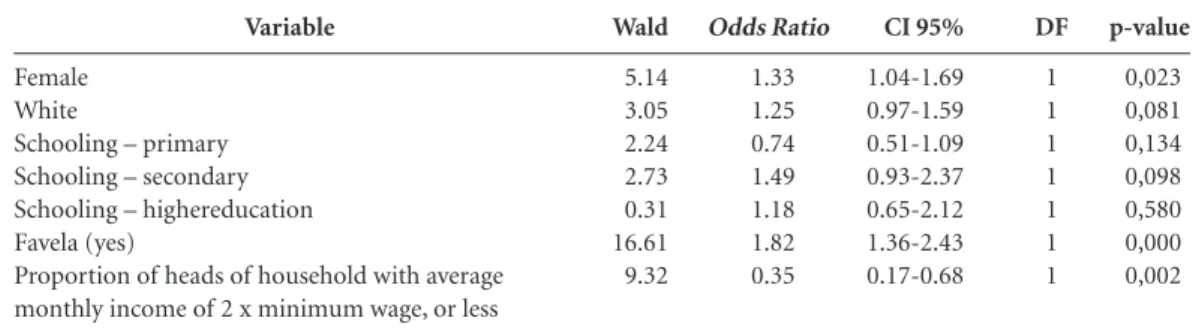
In the multivariate analysis (Table 3), the cure of tuberculosis was associated with the
vari-ables gender and residents in favela. Females had
1.33 (CI95%:1.04-1.69) times the chance of cure compared to males. People living in favelas had 1.82 (CI95%: 1.36-2.43) times the chance of cure than people not living in favelas. There was no statistically significant association with time of implantation of Family Health teams, nor with Family Health coverage.
The VIF did not show evidence of multicol-linearity for the adjusted model.
Discussion
Notifications in primary health units were 73.73% (4,272 cases) of the total of notified cases, evidencing primary care as an important point of entry to care in the municipality, even though it had an estimated coverage of 39.84% of the population in December 2012 in the
munic-ipality8. Of these cases, 98.95% have been closed,
while 69.18% of all the new cases notified in the prison system did not have closure, representing
Variables (N = 4.208)
Family Health Coverage Yes
No
Time – team in place 4 to 11 months 12 to 17 months 18 to 25 months >25 months Age
≤ 36
>36 Gender Male Female Race/color White Non-white Schooling Illiterate Primary Secondary Higher Favela Yes No Low income Bathroom Density Ageing
Table 2. Gross analysis of new casesclosed (N = 4,208), vs.cure of tuberculosis and socio-economic and assistential variables. Municipality of Rio de Janeiro (RJ), Brazil, 2012.
Source: SINAN municipal database (DATASUS/Health Ministry). Updated January 10, 2016.
Abbreviations: n = sample size; OR = unadjusted odds ratio; CI = confidence interval; p-valor = level of significance. a Reference category. b Statistical significance p < 0.05.
n 2,542 1,512 517 508 580 519 1,938 2,116 2,559 1.495 1.654 2.144 282 1.581 566 339 902 3,152 4,054 4,054 4,054 4,054 % 62.7 373 24.3 23.9 27.3 24.4 47.8 52.2 63.1 36.9 43.5 56.5 10.2 57.1 20.4 12.2 22.2 77.8 100.0 100.0 100.0 100.0 Cura n 718 409 367 376 409 374 542 585 774 353 396 632 84 468 113 57 230 897 1127 1127 1127 1127 % 63.7 36.3 24.0 24.6 26.8 24.5 48.1 51.9 68.7 31.3 38.5 61.5 11.6 64.8 15.7 7.9 20.4 79.6 100.0 100.0 100.0 100.0 OR 1.00a 1.06 1.00a 0.86 1.02 0.95 1.00a 1.02 1.00a 1.40 1.00a 0.75 1.00a 1.01 1.70 2.10 1.00a 0.86 0.60 1.29 0.77 3.89 CI 95% 0.92-1.22 0.65-1.13 0.79-1.33 0.72-1.24 0.89-1.17 1.21-1.62 0.65-0.87 0.76-1.33 1.23-2.36 1.43-3.08 0.73-1.02 0.43-0.83 1.01-1.52 0.65-0.91 1.19-12.68 p-value 0.414 0.285 0.874 0.717 0.830
< 0.001b
< 0.001b
0.955
0.001b
< 0.001b
0.078 0.002b 0.002b 0.001b 0.025b n 1,824 1,103 150 132 171 145 1,396 1,531 1,785 1,142 1,258 1,512 198 1,113 453 282 672 2,255 2.927 2,927 2,927 2,927 % 62.3 37.7 25.1 22.1 28.6 24.2 47.7 52.3 61.0 39.0 45.4 54.6 9.7 54.4 22.1 13.8 23.0 77.0 100.0 100.0 100.0 100.0
aúd
e C
ole
tiv
a,
21(5):1491-1498,
2016
a very high percentage, in view of the fact that it is a vulnerable population. Also, the very low number of notified cases in the prison system (159 cases) and in the private system (49 cas-es) attracts attention – representing respectively 2.74% and 0.85% of all the cases.
Souza et al.4 reported that in the city of
Salva-dor 41%of the cases were notified by the Primary Healthcare System, and in Recife, 45%. This high index (73.73%) in the municipality of Rio is in line with the policy of decentralization of actions on tuberculosis for primary healthcare promoted by the WHO and by the Brazilian Health
Minis-try2. Even so, the ideal is that every patient should
be first diagnosed and accompanied by primary healthcare.
The incidence rate of 90.67 and the mortal-ity coefficient of 5.77/100,000 population are considered to be high, compared to the Brazilian prevalence of 33.5 and death rate of 2.3/100,000, respectively.
The percentage of cure, 70.42%, is lower than the value found in other studies in other cities
of the country, such as Silva et al.13 which found
90.9% of the cases closed with cure in Maranhão. However, it is better than in Ceará, where Pinto et
al.14 found a cure percentage of 47.2%.
Many authors have studied the correlation between tuberculosis and socio-economic
indi-cators. Queiroga12 found a higher differentiation
of rates between the strata of regular and worst
conditions of life, in the municipality of Campi-na Grande (in the State of Paraíba), in which the rate in districts with the lowest QLI (Quality of Life Index) was 86% higher than the rate in the regular QLI stratum, but the district with the best
QLI had high incidence, possibly due to sub-no-tification of cases of tuberculosis in the other QLI strata.
In view of the results presented in this study, it is possible to see a higher concentration of cas-es of tuberculosis in the areas covered by a Fami-ly Health team (62.7% of the cases). Considering that tuberculosis is directly related with more vulnerable areas, with worse socio-economic in-dicators, supposedly the coverage of the Family Health strategy took place unevenly in the terri-tory of the municipality, giving priority to cover-age of areas with lower social development. This hypothesis is strengthened when we analyze the distribution of the families that are beneficiaries
of the Bolsa-Famíliaand the Rio de Janeiro
Car-tao-Família benefits, in which there is a larger concentration in the areas covered by the Fami-ly Health Strategy and a spatial superimposition with the distribution of tuberculosis. Analyzing statistically, it is possible to compare this associ-ation between Family Health coverage and worse socio-economic situation in the notified cases of tuberculosis in the year 2012. Considering that tuberculosis is also directly associated with socio-economic factors, these factors probably operate as confounding factors in the association between Family Health coverage and cure of tu-berculosis.
Of the total of new cases in areas with Fam-ily Health coverage (2,639cases), in 271 cases (10.26%) the Family Health teams had been im-plemented for up to and including three months, and 91% were implemented up to five years, from the date of diagnosis of tuberculosis, evidencing that they are very recent teams in the
municipal-Variable
Female White
Schooling – primary Schooling – secondary Schooling – highereducation Favela (yes)
Proportion of heads of household with average monthly income of 2 x minimum wage, or less
Table 3. Result of the explanatory model: logistical regression (Backward/Likelihood Ratio) (N = 4,208). Municipality of Rio de Janeiro (RJ), Brazil, 2012.
Sources: Municipal database of SINAN (DATASUS/MS); IBGE, 2010. Updated January 10, 2016.
Abbreviations: Wald = Wald statistic; DF = degrees of freedom; p-value = significance level. a statistical significance p < 0.05. Wald
5.14 3.05 2.24 2.73 0.31 16.61 9.32
Odds Ratio
1.33 1.25 0.74 1.49 1.18 1.82 0.35
CI 95%
1.04-1.69 0.97-1.59 0.51-1.09 0.93-2.37 0.65-2.12 1.36-2.43 0.17-0.68
DF
1 1 1 1 1 1 1
p-value
P
ra
d
o J
unio
ity of Rio. The time for which the Family Health team has been implemented probably influences care to patients with tuberculosis, especially in identification of new cases, early start of treat-ment, identification of contacts, and treatment compliance in the case of supervised treatment.
Conclusion
There has been a strong expansion in primary healthcare in the municipality of Rio de Janei-rosince 2010, but based on the results found for new cases of TB notified in 2012, it has not yet been possible to evidence better results for cure and abandonment than in areas not covered by the Family Health system, in spite of these areas with coverage having better results of closing of cases and supervised treatment of tuberculosis.
Family Health coverage took place preferentially in more vulnerable areas of the municipality of Rio; and also, the short time of implementation of the Family Health team probably contributed to it not yet being possible to detect a significant improvement in the cure of tuberculosis.
Collaborations
JC Prado Júnior took part in the conception, delineation, georeferencing, analysis and inter-pretation of the data, and writing of the paper; T Virgilio carried out the preparation of the maps and techniques of geoprocessing and revision; R Medronho participated in the conception, writ-ing and critical revision of the article.
IBGE. Instituto Brasileiro de Geografia e Estatísti-ca. [acessado 2015ago 11]. Disponível em: http:// www.ibge.gov.br/cidadesat/xtras/perfil.php?cod-mun=330455
IBM Corp. Released 2011. IBM SPSS Statistics for Win-dows, Version 20.0. Armonk: IBM Corp; 2011. ESRI 2011. ArcGIS Desktop: Release 10. Redlands: Envi-ronmental Systems Research Institute; 2011.
Queiroga RPF. Distribuição Espacial dos casos de Tu-berculose e seus determinantes sócio-econômicos na área urbana do Município de Campina Grande (PB) - 2004 a 2007. Rev Bras Epidemiol 2012; 15(1):222-232. Silva PF, Moura GS, Caldas AJM. Fatores associados ao abandono do tratamento da tuberculose pulmonar no Maranhão, Brasil, no período de 2001 a 2010. Cad Sau-de Publica 2014; 30(8):1745-1754.
Pinto ML, Silva TC, Gomes LCF, Bertolozzi MR, Villa-vicencio LMM, Azevedo KMFA, Figueiredo TMRM. Ocorrência de casos de tuberculose em Crato, Ceará, no período de 2002 a 2011: uma análise espacial de pa-drões pontuais. Rev. bras. epidemiol. 2015; 18(2):313-325.
Article submitted 30/11/2015 Approved 19/02/2016
Final version submitted 21/02/2016 9.
10. 11. 12.
13.
14. References
World Health Organization (WHO). Global tuberculo-sis report, 2015. Genebra: WHO; 2015.
Brasil. Ministério da Saúde. Secretaria de Vigilância em Saúde. Detectar, tratar e curar: desafios e estratégias brasileiras frente à tuberculose. Boletim Epidemiológico 2015; 46(9).
San Pedro A, Oliveira RM. Tuberculose e indicadores socioeconômicos: revisão sistemática da literatura. Rev Panam Salud Publica 2013; 33(4):294-301.
Souza MSPL, Aquino R, Pereira SM, Costa MCN, Bar-reto ML, Natividade M, Ximenes R, Souza W, Dantas OM, Braga JU. Fatores associados ao acesso geográfico aos serviços de saúde por pessoas com tuberculose em três capitais do Nordeste brasileiro. Cad Saude Publica 2015; 31(1):111-120.
Starfield B. Atenção primária: Equilíbrio entre necessi-dades de saúde, serviços e tecnologia. Brasília:Unesco, Ministério da Saúde (MS); 2002.
Macinko J, Starfield B, Shi L. The contribution of pri-mary care systems to health outcomes within Organi-zation for Economic Cooperation and Development (OECD) countries, 1970-1998. Health services research 2003; 38(3):831-865.
Paim J, Travassos C, Almeida C, Bahia L, Macincko J. The Brazilian health system: history, advances, and challenges. Lancet 2011; 377(9779):1778-1797. Brasil. Ministério da Saúde. Secretaria de Atenção à Saúde. Departamento de Atenção Básica. Histórico de Cobertura da Saúde da Família. [acessado 2016 jan4]. Disponível em: http://dab.saude.gov.br/portaldab/his-torico_cobertura_sf.php
1. 2.
3.
4.
5.
6.
7.