© 2013 Dental Press Journal of Orthodontics 6 Dental Press J Orthod. 2013 Jan-Feb;18(1):6-7 Matheus Melo Pithon1
LASER STRENGTHENS THE REPAIR OF
THE MIDPALATAL SUTURE AFTER RME
Widely spread, studied and used, rapid maxillary ex-pansion (RME) became an important ally of orthodon-tists. Basically, this procedure takes place with an active phase, where the expander is activated, and a passive phase, when the appliance is kept in place until com-plete restructuring of the expanded suture and forma-tion of bone tissue. Reducing the stabilizaforma-tion period of these appliances would help the reduction in total orthodontic treatment time and the discomfort caused by the presence of the appliance. While searching for a method that would strengthen this process, Brazil-ian researchers1 evaluated, through a study in animals, histological efects of applying the laser in the palatine sutures ater maxillary expansion. The results showed that the laser appears to stimulate the repair process of suturing and also osteogenesis. It is noteworthy that, al-though encouraging, results are primary and obtained in dogs, requiring conirmation in humans.
MINI-IMPLANTS AND MINIPLATES IN THE
PALATE ARE EXCELLENT MECHANISMS
FOR DISTALIZATION OF UPPER TEETH
It is already clear among us, orthodontists, the effectiveness of mini-implants and miniplates as an-chorage for distalization of upper teeth for correction of Class II malocclusion. However, there is still no
agreement regarding which method would be most effective for this procedure. The ones in favor of miniplates argue that the distalization would be more effective with this device, as these are more stable than the mini-implants, and are placed in a distant region of the alveolar bone. On the other hand, proponents of mini-implants argue that these would be equally effective, cost-effective and easily installed and re-moved by the professional. With these questions,
Turkish researchers2 aimed to evaluate in a clinical
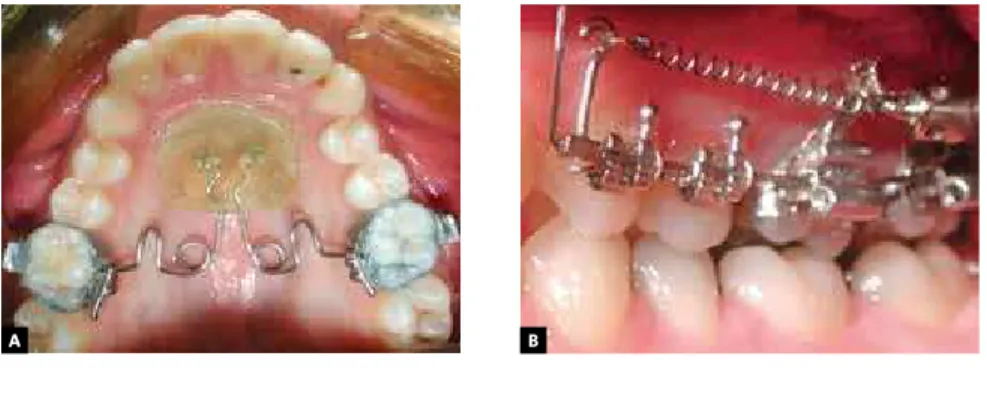
trial with 30 patients, the effectiveness of the pendu-lum type device supported by mini-implants inserted in the palate, comparing them to the zygomatic mini-plates. The results from this study prove the effec-tiveness of both methods in terms of distalization of upper teeth. However, the authors emphasize that in the presence of a more severe malocclusion, the zy-gomatic miniplates would be more effective (Fig 1).
MINI-IMPLANTS INSERTED MANUALLY
PRES-ENT LESS STABILITY THAN THE ONES
INSERT-ED WITH THE AID OF A MOTOR
Considered one of the most brilliant indings of Orthodontics, the mini-implants became popular and a consensus among orthodontists. Despite being an excellent anchorage mechanism, with many clini-cal possibilities, these devices are defective in terms of stability. The loss of stability of mini-implants hinders
Figure 1 - A) - Pendulum appliance supported in mini-implants. B) Zygomatic anchorage. Source: Kaya et al.2, 2012.
A B
How to cite this article: Pithon MM. Orthodontics highlights. Dental Press J Orthod. 2013 Jan-Feb;18(1):6-7.
Submitted: December 13, 2012 - Revised and accepted:December 19, 2012
Contact address: Matheus Melo Pithon E-mail: [email protected]
1 Professor of Orthodontics, State University of Southwest Bahia. MSc and PhD
in Orthodontics, UERJ. Diplomate by the Brazilian Board of Orthodontics and Facial Orthopedics.
© 2013 Dental Press Journal of Orthodontics 7 Dental Press J Orthod. 2013 Jan-Feb;18(1):6-7 orthodonticshighlights
Pithon MM
© 2013 Dental Press Journal of Orthodontics 7 Dental Press J Orthod. 2013 Jan-Feb;18(1):6-7 the progress of treatment and may take some degree
of discomfort to the patient, due to the need of a new insertion. In order to clarify the factors involved in
this process, Korean researchers3, from Yonsei
Uni-versity, have developed a retrospective clinical study to evaluate the success rate of mini-implants inserted by manual and motorized methods, besides the inlu-ence of gender, age, mini-implant length and inser-tion sites. The results found in this study revealed that, usually, the success rate was higher when the 8 mm screws were inserted with motor, however, there was no diference when the 6 mm screws were used. Still, the largest mini-implants had a higher success rate. Regarding the location, the highest success rates were found in mini-implants inserted in the maxilla.
SELF-LIGATING BRACKETS DO
NOT GENERATE LESS ROOT RESORPTION
Much has been heard about the advantages of the self-ligating brackets compared to conventional ones. Among these advantages, it has been reported: shorter clinical time and reduction in frictional forces, lead-ing therefore the greatest rate of movement at lesser biological damage. When thinking about biological damage from orthodontic treatment, the root resorp-tion — that torments orthodontists since the begin-ning of the specialty — come to our minds imme-diately. However, there are few available studies that prove these beneits of self-ligating brackets. Brazilian researchers4 at the University of Northern Paraná, de-veloped a study in which incisor root resorption was assessed, during the irst 6 months of treatment, in pa-tients treated with conventional pre-adjusted and self-ligating brackets. The results of the CT scan of incisors showed that the two types of brackets examined pro-duce root resorption of similar magnitude.
INCISOR RETRACTION LEADS
TO UPPER AIRWAYS NARROWING
Great attention has been paid to the efects of orth-odontic treatment on the upper airways, but what would really this inluence be? Could the orthodontist favor the improvement of nasal airlow, thus contrib-uting to a better life quality for their patients? Starting from the principle that orthodontics may bring some positive results, we can imagine that some negative ones may also come. During the correction of
den-1. Santiago VC, Piram A, Fuziy A. Efect of soft laser in bone repair after
expansion of the midpalatal suture in dogs. Am J Orthod Dentofacial Orthop. 2012;142(5):615-24.
2. Kaya B, Sar C, Arman-Özçirpici A, Polat-Özsoy O. Palatal implant versus
zygoma plate anchorage for distalization of maxillary posterior teeth. Eur J Orthod. 2012;Sept 11.
3. Kim JS, Choi SH, Cha SK, Kim JH, Lee HJ, Yeom SS et al. Comparison of
success rates of orthodontic miniscrews by the insertion method. Korean J Orthod. 2012;42:242-8.
4. Leite V, Conti AC, Navarro R, Almeida M, Oltramari-Navarro P, Almeida R.
Comparison of root resorption between self-ligating and conventional preadjusted brackets using cone beam computed tomography. Angle Orthod. 2012;82(6):1078-82.
5. Chen Y, Hong L, Wang CL, Zhang SJ, Cao C, Wei F, et al. Efect of large
incisor retraction on upper airway morphology in adult bimaxillary protrusion patients. Angle Orthod. 2012;82(6):964-70.
REFERENCES
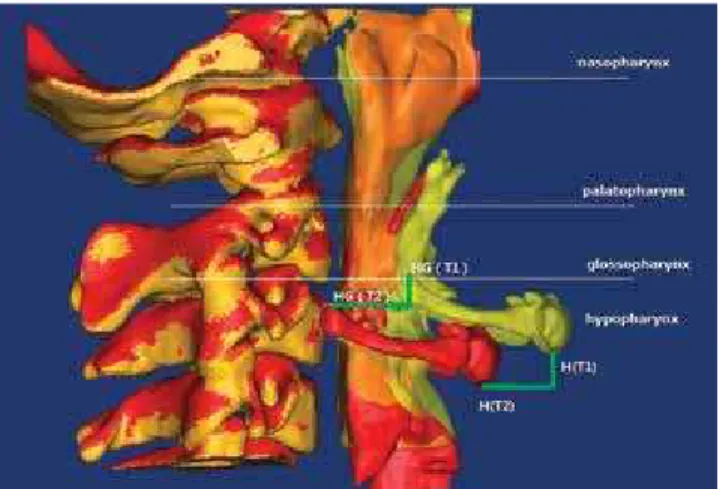
Figure 2 - 3D Model of four parts of pharynx, hyoid and cervical vertebrae, showing the distance between models in T1 and T2.
Source: Chen et al.5, 2012.
tal double protrusion, where the retraction of anterior teeth is necessary ater extractions of premolars, could size alterations occur in the upper airways? While
seek-ing for an answer to this question, Chinese
research-ers5 from the Department of Orthodontics, Shandong