http://dx.doi.org/10.1590/0104-07072017001450017
THE CONVERGENT CARE RESEARCH METHOD AND ITS APPLICATION
IN NURSING PRACTICE
Mercedes Trentini1, Lygia Paim2, Denise Maria Guerreiro Vieira da Silva3
1 Ph.D. in Nursing. Retired Professor, Nursing Department, Universidade Federal de Santa Catarina (UFSC). Florianópolis, Santa Catarina, Brazil. E-mail: [email protected]
2 Ph.D. in Nursing. Retired Professor, Anna Nery Nursing School, Universidade Federal do Rio de Janeiro. Rio de Janeiro, Rio de Janeiro, Brazil. E-mail: [email protected]
3 Ph.D. in Nursing. Retired Professor, Post-Graduate Program in Nursing, UFSC. Florianópolis, Santa Catarina, Brazil. E-mail: [email protected]
ABSTRACT
Objective: to relect on the diligence of three studies that followed the convention of Convergent Care Research (Pesquisa Convergente Assistencial - PCA) as a methodological reference.
Results: convergent Care Research is characterized by conducting improvements through introducing innovations in the context of nursing
and health care practice. It is guided by its own attributes: immersibility; simultaneity; expandability and dialoging. Three studies using the Convergent Care Research method were analyzed: Study A consisted of constructing an informative material (booklet) as a technology to be developed based on the participants’ knowledge and experiences regarding the computed Tomograpy scan; Study B proposed to develop educational practices with a group of female garbage/recyclable material collectors to alleviate their workload and thus prevent occupational accidents; Study C developed an education proposal for training nurses who work in palliative care by constructing an instrument regarding pain assessment in cancer patients.
Conclusion: all three studies showed that the Convergent Care Research method allows for the convergence between care actions and
research actions in order to create superposition spaces of these two activities, with the production of new knowledge and changes in care practice. This method allows both research and care practice to be developed in the same physical and temporal space, and therefore they need to be disarticulated by conducting a speciic analysis for each one.
DESCRIPTORS: Research. Nursing research. Research and new techniques. Research in Health Services. Nursing.
O MÉTODO DA PESQUISA CONVERGENTE ASSISTENCIAL E SUA
APLICAÇÃO NA PRÁTICA DE ENFERMAGEM
RESUMO
Objetivo: reletir sobre a diligência de três estudos que seguiram o convencionado na Pesquisa Convergente Assistencial como referencial metodológico.
Resultados: a Pesquisa Convergente Assistencial caracteriza-se pela realização de melhoramentos com introdução de inovações no contexto
da prática assistencial de enfermagem e saúde. É orientada por seus próprios atributos: imersibilidade; simultaneidade; expansibilidade e dialogicidade. Foram analisadas três pesquisas que utilizaram o método da Pesquisa Convergente Assistencial. O estudo A consistiu na construção de material informativo (cartilha) como tecnologia a ser desenvolvida com base nos saberes e experiências dos participantes em relação ao exame de Tomograia Computadorizada. O estudo B se propôs a desenvolver práticas educativas com um grupo de mulheres catadoras de lixo no sentido de aliviar as cargas de trabalho e, desse modo, evitar acidentes de trabalho. O estudo C desenvolveu uma proposta de educação no trabalho com enfermeiras que atuam em cuidados paliativos com a construção de um instrumento sobre a avaliação da dor em pacientes com câncer.
Conclusão: os três estudos mostraram que o método da Pesquisa Convergente Assistencial possibilita uma convergência entre ações de
assistência e ações de pesquisa de modo a criar espaços de superposição dessas duas atividades, com a produção de um novo conhecimento e a mudança da prática assistencial. Esse método permite que tanto a pesquisa como a prática assistencial, possam ser desenvolvidas no mesmo espaço físico e temporal e, para isso, precisam ser desarticuladas ao operacionalizar análise especíica de cada uma.
EL MÉTODO DE LA INVESTIGACIÓN CONVERGENTE ASISTENCIAL Y SU
APLICACIÓN EN LA PRÁCTICA DE ENFERMERÍA
RESUMEN
Objetivo: relexionar sobre la diligencia de tres estudios que siguieron lo convenido en la Investigación Convergente Asistencial como referencial metodológico.
Resultados: la Investigación Convergente Asistencial se caracteriza por la realización de mejoras con introducción de innovaciones en el
contexto de la práctica asistencial de enfermería y salud. Es orientada por sus propios atributos: inmersibilidad; simultaneidad; expansibilidad y diálogo. Se analizaron tres investigaciones que utilizaron el método de la Investigación Convergente Asistencial. El estudio A consistió en la construcción de material informativo (cartilla) como tecnología a ser desarrollada con base en los saberes y experiencias de los participantes en relación al examen de Tomografía computarizada. El estudio B se propuso desarrollar prácticas educativas con un grupo de mujeres recolectoras de basura para aliviar las cargas de trabajo y, de este modo, evitar accidentes de trabajo. El estudio C desarrolló una propuesta de educación en el trabajo con enfermeras que actúan en cuidados paliativos con la construcción de un instrumento sobre la evaluación del dolor en pacientes con cáncer.
Conclusión: los tres estudios mostraron que el método de la Investigación Convergente Asistencial posibilita una convergencia entre acciones
de asistencia y acciones de investigación para crear espacios de superposición de esas dos actividades, con la producción de un nuevo conocimiento y el cambio de la práctica asistencial. Este método permite que tanto la investigación como la práctica asistencial, puedan ser desarrolladas en el mismo espacio físico y temporal y, para ello, necesitan ser desarticuladas al operacionalizar análisis especíico de cada una.
DESCRIPTORES: Investigación. Investigación en enfermería. Investigación y nuevas técnicas. Investigación en los Servicios de Salud.
Enfermería.
INTRODUCTION
This article consists of a reflection on the diligence of three studies that followed Convergent
Care Research (Pesquisa Convergente Assistencial -
PCA) as a methodological reference. The elaboration of this theme is justiied based on the need felt by the authors in the PCA approach in order to show interested parties what is essential in characterizing a study according to this method. However, similar to what happens with other types of research, PCA
has at times been misinterpreted by some other
studies/authors, who may in turn declare that they
use a particular research method, but ultimately the
process and the strategies they implemented have little or nothing to do with the guidelines of the
proclaimed method.
The criticism that PCA and action research can be confused contains misconceptions, which
are easily recognized by focusing on the process described by the authors of the three studies that are
explored/analysed in the development of this text.
Fundamentally, in action research the researcher is more a facilitator or a consultant to the research
process and less directive. It is not necessary for this researcher to be an expert in the knowledge area of which the study is being carried out.1 In contrast,
in PCA the researcher is a health professional who works at that research site and who has expertise in that area of care knowledge, therefore they have a more proactive role, even though they need to necessarily count on the participation and approval
of the other members of the study. PCA arises from
health care practice and it comes up with theorized
solutions of a technological nature for the care. Soft, soft-hard and hard technologies are also generated
with this type of research which have already been classiied in published texts.2-4
PCA is a research approach that was formu -lated according to ideas from the faculty of Nursing
Graduate Program of the Federal University of Santa Catarina between the years 1980 and 1990. PCA is characterized by conducting improvements with the introduction of innovations in the context of nursing and health care practices. Innovative change in care practice is the speciicity of PCA, and also what necessarily gives it its identity. In metaphorical
language, this change in the care practice context is
leveraged by the development of a research project and is similar to what would be the “DNA” of a spe
-cies in biology, which is what determines the inal
scope of a PCA module by highlighting throughout the process.5 Thus, although some other aspects
compose a set of qualifying elements of PCA present
during the performance of research as a function of the care itself, this scope in care practice needs to be
distinguished as deinitive for this type of investiga
-tion, therefore known as convergent care.
Accordingly, if there is no need for
propos-ing improvements or results aimed at introducpropos-ing innovations to care practice through a research project, this would not characterized as a PCA de
together a set of attributes that need to be
rigor-ously followed throughout the research process. An environment of improvements/innovations
is constructed by reliable information obtained
throughout the research process; this is because involvement by the protagonists in this care prac -tice is essential in order to change the process of
care practice. This also includes a team relationship
in a dialogical and dialogic character among those
who develop this type of research, and of course being inserted in the comprehensive care scenario. The convergence of care practice actions and re -search actions occur simultaneously as a result of alternating a process of approaching moments and
distancing moments between care practice actions
and research actions, both intentionally arranged
in the care environment.6-7
The concept of convergence in PCA is under
-stood as the cross-linking of care actions with re
-search actions, an encounter that provides possibili
-ties for reading and discovering new phenomena. “The convergence construct is the core that guides
the other concepts that organize the theoretical
philosophical basis of the PCA deinition. The con
-cepts that are directed by this convergence have individualized properties and are compatibilized by the regency of the construct.”6:23 Thus, essential at
-tributes of PCA are constituted, which are: immers -ibility, simultaneity, expandability and dialoging.
Immersibility represents the researcher’s “dive” into the research actions and care practice
actions in the same physical and temporal space of
the study context. Simultaneity implies a “dance”, meaning the reciprocal convergence movement of
research actions and care practice actions during the
PCA process. Expandability is an attribute that gives PCA the power to expand the researcher’s initial
purpose, in addition to reconstructing the context
of the care practice itself when new knowledge to build new theories can also be discovered. Finally, dialoging will make the existence of uniduality comprehensible (care and research); implying the relationship of the two instances around a phenom
-enon without disiguring the unit in any of them.6
Research methods that are involved in trans -forming the reality, including some social and
economic inequalities, may have a more effective contribution in developing countries such as Bra
-zil, and have been gaining recognition for their relevance and contribution.8
MATERIALITY OF THE CONVERGENT
CARE RESEARCH ATTRIBUTES
Some studies characterized as master’s dis -sertations and/or doctoral theses represent concrete examples of the applicability of the PCA method.
The intent of exemplification in this text stems from the decision to show the diversity of studies in which care practices are evident, such as in offer -ing possibilities of apply-ing PCA in different health care spaces.6 Among several dissertations and theses
that use PCA, three were selected for mainly having pertinence for which they approached this method.
Study A
Study A9 used PCA as a methodological
ref-erence to introduce improvements in nursing care
practice in the sector of computed tomography
(CT) of a federal, public, and teaching hospital.
For this, the researcher planned the construction
of an illustrated booklet as a technology to be developed for the user, based on the knowledge
and experiences of the research participants
re-garding CT scanning. Therefore, we can state that the purpose of the research is in agreement with the speciicity of PCA. We sought guidance in the booklet to improve care for patients who would be undergoing a CT scan.
In order to reach its goal, the researcher began
the work by negotiating the research project by entering into dialogue with the nursing team and user candidates for CT scan examinations. In this way, the researcher and the team conquered a space conducive to the sharing of discussions and ideas for solving problems, which was fundamental to creating informative material for the users.
Based on the interest shown by the partici -pants, the researcher planned and conducted a pro-cess of producing data articulated by educational
actions with the PCA participants on a variety of aspects related to the CT scan. During this process, there were simultaneous research actions (data on knowledge and experiences regarding the CT ex -amination and suggestions regarding an elaboration
(clariications on the theory and practice of CT examination). This process consisted of six stages:
1st - Invitation to participate in the study and
sensitizing the participants to the research;
2nd - Meeting with participants in the CT sector
in order to obtain information on personal identii
-cation, sociocultural proile and personal health. The interviews were individual conversations in which participants conversed with the researcher; this was the inspiration for information about clients’ previous CT experiences obtained in the next step;
3rd - Consolidation of the partnership with the
users in the sense of sharing information about their
knowledge and their experiences with said proce
-dure (CT scan) and the willingness to participate in constructing the instrument (booklet). Thus, the researcher had deeper access to the participants’ experiences regarding the CT scan, while at the same time the researcher was able to share her knowledge on the subject through dialogue;
4th - Elaboration of the instrument (booklet)
by the researcher. To do so, she distanced herself from the ield in order to analyze and assimilate the information obtained along with the participants
regarding the theoretical content for the elaboration
of the instrument. This stage was characterized as a distancing movement between care practice actions and research actions, as advocated by PCA;
5th - The instrument - the booklet under con
-struction - was taken for participants’ assimilation and evaluation, then underwent some adjustments resulting from the dialogue and sharing of opinions;
6th - Still in this stage, the participants
conduct-ed an evaluation of the entire conduct-educational process through a new semi-structured interview with the purpose of providing feedback on the steps that had been developed in the PCA.
This educational process characterized an im
-mersion of the researcher into the nursing practice; convergence of research actions and of nursing care
actions occurred in the same physical and temporal
space; dialogue through which information and evaluation of the educational instrument on the CT examination were obtained; simultaneity that was materialized by articulating the data on the experiences and knowledge of the participants, who were treated with all ethical rigor of a scientiic
research and care practice, of the predominantly
educational practice in the care related to the CT
examination, culminating in the construction of
the informative-educational instrument. Regarding the expandability, the researcher was competent in reaching/achieving this attribute by discovering important data from the participants who contrib
-uted to constructing the material (booklet) with appropriate data for elaborating new knowledge such as: patients’ knowledge regarding the CT scan; previous experiences of the patients in performing/ undergoing a CT scan; knowledge demands brought
by the participants regarding the examination.9
Therefore, this study was characterized as
being PCA since it meets the main attributes of this
method. New constructed knowledge was born
from a necessity of the practice and returned as an important educational material, constituting an
ap-propriate technology in health. The inal product of the study, which will be inserted into the CT sector, could introduce improvements in the care of these
clients through the educational process in health,
in order to reduce the vulnerability and alleviate the tension of people undergoing CT scans. We can also consider the care merging with the research, especially for the value obtained by the living con -tribution of the PCA participants.
Study B
Study B10 used the PCA method to conduct a
survey with 11 female recyclable material/garbage collectors as a partial requirement to obtaining a Master’s Degree in Nursing.10 The researcher’s
interest in developing a PCA with this section of the population was based on her practical experi -ence during her academic study period of the
un-dergraduate course. She noted the frequency with which garbage/recyclable material collectors sought health care due to work related accidents, and after a short time they would return for health care with similar problems. This led the researcher to conclude that in order to help those individuals to avoid work accidents, nursing care/nurses should be aware of
the locus and the working conditions of these people.
In addition to these observations, the research
-er found that the studies available in the lit-erature only showed diagnoses of the life and work situa
they did not present proposals to solve the prob
-lem. With this set of information in mind, she felt the need to develop a study that would allow this group of people to avoid or reduce work accidents in their daily ield of action. In order to achieve this, the researcher was convinced that she needed to understand the collecting work/activities of these women, and therefore she needed to be involved in their work reality.
The researcher found PCA as the appropri
-ate method to produce knowledge rel-ated to the work and health situation of these women, using scientiic research based on immersion in this work reality alongside the female collectors. To do so, the researcher set out to irst investigate their per
-ceptions about the workloads related to recycling
recyclable materials/garbage, and from these data
she developed educational practices with the group of women in order to alleviate their workloads and thus avoid work-related accidents.
The reading of this dissertation led us to real
-ize that the study was developed according to the
set of principles and norms established by the PCA
approach. It shows the “dance” between research actions and care actions which are designed as mo
-ments of approaching/distancing and convergence, in order to create spaces of superposition between
research and care, interconnecting them and
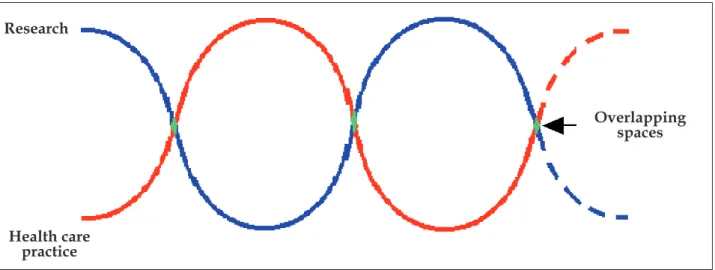
dis-covering new constructs and possible concepts (as shown in Figure 1). The parallel between study B10
and the main legacy of PCA is discussed below, ac -cording to the interpretation of Figure 1.
Figure 1 - Approaching, distancing and convergence movements of research and care practice, forming
overlapping spaces between these activities.5:73
The researcher started the study with one proposal in mind: being able to avoid or reduce work accidents involving female recyclable material collectors in their workspace. The irst step was to negotiate the project with the participants, where the researcher presented proposals for scientiic research together with the participants associated
to the practice of garbage collection. It is undeniable
that such a proposal involving changes to people’s daily work routines would require a lot of dialogue with the participation of those involved in the proj
-ect. In PCA, changes and/or innovations in practice need to be shared with the participating care team partners who commit to the continuity of changes
in the locus of care in which the PCA is developed. Even in the environment where the collectors survived on autonomous work, the researcher’s responsibility was not inished by completing the
recorded research for their collected data and then
analyzed for a scientiic conclusion. The technology that innovated the quality of life related to work was also organized and health care evolution was
implemented into the daily routine of the female
collectors’ labor activities.
The researcher’s encounter with the partici
-pants to negotiate the project was characterized as a super-positioned space that “tied” investigative
actions to the practice of collecting recyclable
gar-Research
Health care practice
bage and accident prevention actions outlined in the project objectives. Even with minor adjustments, the project’s approval marked the irst space of delib
-erate overlap between research and practice. This negotiation was successful because the researcher had previously been involved and shared in the activities of the participating collectors, and at the same time she added observations that contributed to adjusting the project.
In this overlapping space, the dialogue be
-tween the researcher and the female garbage collec
-tors inevitably took place, in which each party had the opportunity to share their experiences. Thus, there was an understanding of uniduality, meaning that the practice of female collectors was added to
the intentionality of educational practice for
pre-venting accidents, along with nursing research ac
-tions around the phenomenon of work accidents. In this irst overlapping space of the PCA process, the agreement to conduct joint work involving actions
of collecting recyclable materials, educational
ac-tions and research acac-tions was approved. After this
agreement, the researcher distanced herself in order
to adapt the project to reality and to again return (to approach) the reality with some other overlapping points between practice and research, followed by
re-distancing and approaching.
These other overlapping points are primarily characterized by the researcher’s immersibility in
the practice of gathering recyclable materials
togeth-er with the female collectors. During this immtogeth-ersion
in their practice, the researcher proceeded to collect information and to scrutinize, being characterized as a thorough and deep search of conditions for
changes. Therefore, the researcher participated in the practice/work of collecting recyclable materi
-als, along with the collectors sharing their experi
-ences. These moments of overlapping research with practice have resulted in an amount of information pointing to possible paths to be taken to reach the heart of the problem: ways of avoiding work-related accidents, ways of building a relationship of mutual trust and respect, to reine listening to the partici
-pants’ voices, and tuning the dialogical language.
During these approaching, distancing and
convergence movements of research from care
practice, in addition to dialogue and immersibility,
there was also simultaneity, which means the con
-vergence of investigative actions and care actions in
the same physical and temporal space during the
PCA process. Simultaneity was mainly character
-ized by the health education process developed with
the female garbage/recyclable material collectors
organized in a convergence group. The denomina
-tion of convergence groups consists of a technical
modality that aims to obtain information for
scien-tiic research in conjunction with the care practice.11
After short distancings and being provided with information obtained through observation and informal interviews with the female recyclable
material/garbage collectors, and from during her
involvement in the work of collecting recyclable
materials, the researcher proceeded to formulate
new approaches of research actions and care actions by performing three sessions with the convergence group. The group sessions were scheduled in order to provide spaces for dialogue, for discussions and
for exposing personal opinions about their actual
conditions of material-collecting work, as well as about the diversity of reactions suffered by each of their bodies. They also spontaneously brought up the impacts of the workload on their physical, cog
-nitive and psychic context. These collective debates provided repeated overlaps of research actions that were characterized by the information offered by the female collectors, both verbally as well as written, and by the process of shared education in prevent
-ing work accidents. This process of education shared between the researcher and female collectors was the “foundation” for the collective construction of strategies to be followed in order to reduce these workloads and work accidents.
At the end of this investigative and at the same
time educational, shared and registered process,
the researcher proceeded to “untie” the records referring to the research indings and actions of
the educational practice in order to enter into the
individualized analysis procedure of these two data sets. The PCA researcher understands the existence
of uniduality (research and care), meaning the
dialogue between the two instances, forming unity around the phenomenon of interest; which, none
-theless advocates preservation of the characteristics and values of each unit.5
the researcher, mainly in order to avoid or reducing work accidents among female garbage/recyclable material collectors in their ield of work using PCA. This result was conirmed by the researcher during the course of 12 visits, carried out after the end of the investigative-educational process during a six-month period, with the purpose of verifying the
perceptions and impacts of the actions carried out
in the dynamics and organization in the work of
collecting recyclable materials.
In addition to achieving PCA’s purpose of introducing innovations to the work of collecting recyclable materials, the researcher gave “wings” to expandability. In this respect, she advanced the research with the discovery and dismemberment of three constructs: workloads; work and subjectivity; vulnerability and work.
The researcher proceeded very diligently
throughout the PCA process, the approaching,
distancing and convergence movements of the in
-vestigative actions and care practice actions with the formation of several intersections by the superposi
-tion of these two instances: research and care. These overlaps characterize the essence of a PCA process, given the importance of reading and interpreting
constructs for possible theoretical constructs.
Still regarding the context of PCA, we can
note that the concept of health care is not limited to
the provision of professional health services within speciic health institutions, but rather that it is a broader concept in this case, covering nursing and acting wherever there are human groups aggregat
-ing socially. The care concept is widened, and in it the productive relationship with research and the response generating constructs by their interlocking or convergence.
Study C
A third example of PCA application is found in Study C.12 This study used PCA as a methodological
reference with the intention of developing an educa
-tion proposal for nurses who work in palliative care. The study’s focus on this care practice was given
to designing an instrument for pain assessment in
cancer patients. Although there are several studies
on pain assessment, this proposal has peculiarities
regarding pain assessment in palliative care from
the contribution of participants who presented themselves in support of the people who were in care. The study was based on an observation of a
problem made by the researcher, concerning that
care qualiication depended on the participation of those who were being treated, and was based
on the problematizing education assumptions of Paulo Freire.13
The interest in this theme originated from the
experience of the researcher in a specialized cancer
treatment institution, perceiving the reality of pain care in the scope of palliative care and the constant concern of the institution’s nurses to better qualify their performance in dealing with this pain, from the perspective of those providing the care.
The practice was carried out in ive educa -tional moments, and using the Arch of Maguerez as reference.14 The proposal negotiation was con
-sensual, since the nursing group was interested in implementing a study process which would enable
them to gain deeper understanding of pain and
its adequate assessment in order to support care for people in palliative care, and for the process to involve sensitivity through observation, interaction and dialogue with patients.
According to the Arch of Maguerez,14 the 1st
educational moment consisted of observing the reality by the nurses with past retrieval and pres
-ent evaluation regarding pain assessm-ent of people with cancer under palliative care; the 2nd educational
moment was deining the key points using a survey of questions for learning about pain assessment; the
3rd educational moment was theorizing the learning
questions raised; the 4th educational moment was
constructing solution-hypotheses for pain
assess-ment; and the 5th educational moment corresponded
to applying the designed proposal based on the
reality that involved enhancing knowledge about
pain assessment by the nurses, and systematizing
the nursing care related to pain. This is considering
that pain is manifested through different feelings and forms of expressing it according to the life his-tory and the health situation being faced, and it can
also be inluenced by various political, economic,
social and religious factors, among others.
The PCA principles became reality during the
expansibil-ity. The dialoging preceded the intention to develop the research, since the theme was the result of dia
-logues between the researcher and her colleagues, since they considered the pain of people with cancer in palliative care a problem that they could handle more effectively than they had been. This dialogue was intensiied throughout the whole educational process, also enabling that new knowledge on the meaning of the pain perceived by people receiving
cancer treatment to be constructed, either from the
point of view of the local nursing care team, or in the broad search for other strategies to evaluate pain, and even including the care possibilities envisioned by nurses in conducting pain assessment. It was also possible to identify an even more luid dialogue by
the end of the educational process, since the symbols
and meanings of pain from people being treated were
more openly shared in the shared experience they experienced during the research and implementation process carried out.
The researcher’s immersibility in the practice while conducting the research was a challenge, since her identiication as a nurse in the service allowed
her free access to all spaces of the institution and to
become acquainted with intricacies of the reality; it also represented a ilter for the construction of new knowledge that was born from the testimo
-nies of each participant. In this aspect, just as the
PCA proposes, this immersibility is a necessity for construction of shared changes. In this situation
with the researcher belonging to the care team, immersion in practice needs to be done with the expected bias, since it obviously exists. It would be false to assume that this nurse would be exempt from her daily function in taking on the PCA, her role as a researcher when an investigative project happens at the same place where she provides care
as a coordinator. In PCA, research ethics and prac-tice ethics are not confused, but rather they retain
the character of respect that each of them require. When the researcher immerses him/herself in care
practice the ethics of care is dominant, although re-search is simultaneously present and compatibility
is established. There are differences and similarities between care practice and research in care practice, and ethical requirements hold precepts that meet the prevailing requirements of life ethics.5 This is a
dominant set of ethics for both codes.
The researcher understood that the principle of simultaneity intertwined with that of immers -ibility, in the sense that conducting research oc-curred in the same space and time of care practice,
where in this case she was also a member of the team that served as a member of the institution’s nursing team. Operating educational moments in
-herent to nursing care was further facilitated by the recognition of available spaces, the most favorable
moments for its realization and for the constant
dia-logue between the researcher and the care practice members. Trying to remain a participant in both processes - practice and research - involved constant relection on what was happening and what places they should go to in order to make the desired
changes in practice, and at the same time to build
new knowledge that materialized in care technology
that could be consumed by these and other nurses
in the palliative care under study.
Expandability is a concept that is not always easy to unveil. However, this principle became evident in several moments in the PCA developed in Study C,12
with the nurses realizing that they had the opportu -nity, the freedom and the autonomy to express their
experiences and ideas on this subject. In this scope,
PCA comes to demystify the current idea that
nurs-ing research needs to be strictly carried out within the
teaching scope, attesting to executing the appropriate research by a care team member and in a study aimed
at the care ield in full luency. The framework associ
-ated to Paulo Freire’s concepts guided the educational process and was suitable for a certain transformation
of reality by promoting the freedom of participants/
professionals in palliative care. Participants felt re
-spected “as human beings, holders of knowledge as they recognized the opportunity to look at themselves and others in the search for a common goal, which meant transforming their reality of work through their own conscientiousness”.12:124 Another expansion
of the study was the nurses recognizing the need to
maintain continuous education in their day-to-day
work about the subject of the study, always broaden
-ing their knowledge about pain assessment and its operationalization with palliative care.
CONCLUSION
settings as their locus, and this diversity brings the
convergent way of supporting relection with the conceptual discussion of amplifying what is care. Thus, the commented texts of the three studies consider that care is a broad concept that covers more than just institutional settings of traditionally recognized oficial organization. In these concrete PCA experiences, one of them was located in en
-countering the work of garbage collectors; another in the CT scan sector; and the last in a palliative care sector. These differences conigure the possibility of renewing the meaning of care. Care was previously more narrowly and conceptually as the organs and
institutions of the health system, extends the concept
to care corresponding to the concept of health cover
-ing healthy population groups, often with people in regular situations without sickness. The idea of several health education groups is not new, however it gives support to the inherent nature of education in the nursing care context. Thus, the care concept in
the case of nursing care is expanded according to the records of the reported experiences. PCA raises this issue by exposing other care places and sustaining
this expandability to the ield according to reports from Convergent Care Research.
Also, in these summarized PCAs, some
technologies have been produced, namely: a) an informative booklet for people who will undergo CT scans. The construction started from informa -tion analyzed by the researcher and from the users
of these CT scans. The booklet sought to minimize the stress related to the unknown, transforming the fear into well-being through knowledge acquired to deal with the required situation during the CT examination; b) a system of occupational health education groups in the experience with female
garbage/recyclable material collectors. All
partici-pants learned to take into account their workload, and this changes the quality of the health care of the collectors; c) a pain assessment system for cancer patients under palliative care. People undergoing cancer treatment in the phase of palliative care have these technological ways available for pain assessment, technology that was constructed with the information and data from dialogues between
the researcher and the care participants during the
research who received palliative care and expressed their sensitive expression in the face of pain. This is
an instrument for palliative care that includes pain related to individualized sensitivity of each person in its considerations. These are social technologies that rely on the participant to construct the evalua
-tion, and therefore they are marked by individual
-ization of palliative care.
The allegedly singular care to each participant becomes the standard of care rather than just the consideration of standard care for all palliative care
participants.
Along with the progressing modes of PCA knowledge and its frequent improvements and
criticisms, the future of its increasing applicability
brings hope of a qualitative force in health care, in its concreteness in health services, particularly in the Uniied Health System, and its policy of com
-prehensive human rights to life and health. In addition, cross-linking between research
and care among all three studies brings forth an
ad-dition of constructs and concepts that will be added to new theories with technologies that transform through innovations or even updates of care modes, thus renewing the life of care practices in the profes -sional exercise of health care.
REFERENCES
1. Stringer ET. Action research. 2ª ed. Thousand Oaks (US): Sage; 1999.
2. Merhy EE. Saúde e cartograia do trabalho vivo. São Paulo (SP): Hucitec, 2002.
3. Merhy EE, Franco TB. Por uma Composição Técnica do Trabalho em saúde centrada no campo relacional e nas tecnologias leves. Apontando mudanças para os modelos tecno-assistenciais. Saúde em Debate [Internet]. 2003 Dec [cited 2017 Feb 15]; 27(65):316-23. Available from: http://www.arca. fiocruz.br/bitstream/icict/712/3/Travassos_ Viacava_Landmann_Alocacao%20equitativa_2003. pdf#page=141
4. Nietsche EA, Leopardi MT. O saber da enfermagem como tecnologia: a produção de enfermeiros brasileiros. Texto Contexto Enferm. 2000 Abr; 9(1):129-52.
5. Trentini M, Paim L. Pesquisa em enfermagem: uma modalidade convergente-assistencial. 2ª ed. Florianópolis (SC): UFSC; 2004.
7. Paim L, Trentini M, Silva DGV. Pesquisa convergente assistencial. In: Lacerda MR, Costenaro RGS, organizadores. Metodologias da pesquisa em enfermagem e saúde: da teoria à prática. Porto Alegre (RS): Moriá; 2016.
8. Breda KML. What is old is also new - participatory action research. Texto Contexto Enferm [Internet]. 2015 Mar [cited 2017 Feb 15]; 24(1):9-10. Available from: http://www.scielo.br/scielo.php?script=sci_ arttext&pid=S0104-07072015000100009&lng=pt 9. Oliveira MCM. Saberes e experiências de clientes sobre
o exame de tomograia computadorizada desvelados no diálogo com a enfermeira [dissertação]. Rio de Janeiro (RJ): Universidade Federal do Rio de Janeiro, Programa de Pós-Graduação em Enfermagem; 2016. 10. Coelho APF. Cargas de trabalho em mulheres catadoras
de materiais recicláveis: estudo convergente-assistencial
[dissertação]. Santa Maria (RS): Universidade Federal de Santa Maria, Programa de Pós-Graduação em Enfermagem; 2016.
11. Trentini M, Gonçalves LT. Pequenos grupos: um método no desenvolvimento de tecnologias na enfermagem. Texto Contexto Enferm. 2000 Abr; 9(1):63-78.
12. Waterkemper R. Concepções e contribuições de enfermeiras que atuam em cuidados paliativos sobre a avaliação da dor de pacientes com câncer: uma prática de educação no trabalho [dissertação]. Florianópolis (SC): Universidade Federal de Santa Catarina, Programa de Pós-Graduação em Enfermagem; 2008. 13. Freire P. Pedagogia do oprimido. 45ª ed. São Paulo
(SP): Paz e Terra; 2005.
14. Bordenave JED, Pereira AM. Estratégias de ensino-aprendizagem. 25ª ed. Rio de Janeiro (RJ): Vozes; 2004.
Correspondence: Denise Maria Guerreiro Vieira da Silva Rua Radialista Dakir Polidoro, n. 122, apt. 101B 88063-565 – Campeche, Florianópolis, SC, Brasil E-mail: [email protected]