http://dx.doi.org/10.1590/0037-8682-0138-2014
Major Article
INTRODUCTION
Address to: Dra Monica Ammon Fernandez. Laboratório de Malacologia/IOC/ FIOCRUZ. Av. Brasil 4365, 21040-900 Rio de Janeiro, RJ, Brasil.
Phone: 55 21 2562-1234 e-mail:[email protected] Received 9 June 2014 Accepted 14 August 2014
A malacological survey in the Manso Power Plant,
State of Mato Grosso, Brazil: new records of freshwater snails,
including transmitters of schistosomiasis and exotic species
Monica Ammon Fernandez
[1], Aline Carvalho de Mattos
[1], Elizangela Feitosa da Silva
[1],
Sonia Barbosa dos Santos
[2]and Silvana Carvalho Thiengo
[1][1]. Laboratório de Malacologia, Instituto Oswaldo Cruz, Fundação Oswaldo Cruz, Rio de Janeiro, RJ. [2]. Laboratório de Malacologia, Instituto de Biologia Roberto Alcantara Gomes, Universidade do Estado do Rio de Janeiro, Rio de Janeiro, RJ.
ABSTRACT
Introduction: Schistosomiasis is a parasitic disease of public health concern in Brazil, and the construction of hydroelectric dams, in addition to increasing permanent human settlement and tourism, has created conditions suitable for the establishment of mollusks that can transmit schistosomiasis. Such areas require a number of actions to prevent the establishment of schistosomiasis. This paper reports on a freshwater malacological survey carried out in the geographical area of the Manso Power Plant. Methods: Mollusks were collected in 18 municipalities in the State of Mato Grosso between February 2002 and February 2004 (qualitative study) and from April 2009 to February 2011 (quantitative study). Results: Thirty-one species of mollusks were collected, including newly recorded species (Antillorbis nordestensis and Burnupia ingae). In addition, the geographic distributions of known species, including Biomphalaria straminea, a snail vector of Schistosoma mansoni, were expanded. A total of 4,507 specimens were collected in the APM Manso reservoir (Usina Hidrelétrica de Aproveitamento Múltiplo de Manso) during the quantitative study, and Biomphalaria amazonica was found in six of the 10 localities analyzed. The
Afro-asiatic species Melanoides tuberculata, introduced after February 2009, was the dominant species (relative abundance 94.96%). Conclusions: The study area is epidemiologically important due to the occurrence of B. straminea and B. amazonica, which are
vectors of schistosomiasis, and M. tuberculata, a snail host of Centrocestus formosanus, which is responsible for centrocestiasis
transmission. Observations of M. tuberculata and the exotic freshwater clams Corbicula luminea and Corbicula largillierti raise
concerns about biodiversity.
Keywords: Distribution. Reservoir. Schistosoma mansoni. Exotic species of freshwater mollusk. Asiatic mollusks.
Schistosomiasis is an important endemic disease associated
with environmental changes caused by major economic development projects, such as the construction of hydroelectric power facilities (dams and lakes created by dams)1-4. The dificulty in predicting emerging outbreaks of schistosomiasis associated with these types of projects, and the existence of conditions unique to particular projects, require studies in each particular locality to implement appropriate preventive measures. The energy matrix of Brazil utilizes hydroelectric power5, and the increasing number of dams being built throughout the country is problematic because these dams create conditions suitable for the establishment of mollusk vectors
of schistosomiasis and lead to increased permanent human settlement and tourism6,7.
Environmental changes caused by dams affect water quality, produce eutrophic effects, and alter the hydrological pattern and ecological dynamics of the rivers and basins8. Despite the effects
of dams on the richness of the fauna, species density, and other aspects of biodiversity, longitudinal studies of invertebrate fauna in dam areas are still scarce in Brazil. In qualitative study carried out between 1997 and 2004 in the geographical area of the Serra da Mesa Power Plant, State of Goiás, Thiengo et al.9 noted the
spread of the schistosomiasis vector Biomphalaria straminea (Dunker, 1848) and the exotic snail Melanoides tuberculata (Müller, 1774), as well as a reduction in the local species Gundlachia ticaga (Marcus & Marcus, 1962) and Aylacostoma tenuilabris (Reeve, 1860). In the Itabapoana River, between
the States of Rio de Janeiro and Espírito Santo, an increase in
the population of Biomphalaria tenagophila (d’Orbigny, 1835) was observed in the geographical area of the Rosal Power Plant during the construction phase, mainly due to the change from a lotic to a lentic ecosystem and the eutrophication of the water4.
ResUlTs
MeTHODs
schistosomiasis to non-endemic areas in Brazil via the
introduction of vector snails was reported by Fernandez and
Thiengo10-11, who observed different degrees of susceptibility
to Schistosoma mansoni Sambon, 1907 in an experimental
infection of B. straminea from three different reservoirs in the Upper Tocantins river basin. Three species of Biomphalaria that play a role in the transmission of S. mansoni in Brazil were recently found in the Pampulha reservoir, which is a potential urban focus of schistosomiasis located in the municipality of
Belo Horizonte, State of Minas Gerais12.
The pathways of introduction and dispersion of exotic species in reservoirs have been poorly documented. In the three reservoirs of the Middle Tietê River, State of São Paulo, Suriani et al.13 registered eight species of mollusks that most likely compete with native species, including M. tuberculata
and Corbicula fluminea (Müller, 1774). Studies of these exotic species are urgently needed, as their impact on aquatic environments is unpredictable14,15.
This paper presents the results of qualitative and quantitative studies of freswater mollusks in the area of the Manso Power Plant (APM Manso, i.e., Usina Hidrelétrica de Aproveitamento Múltiplo de Manso). The paper also notes the distribution of two
species of medical importance, B. straminea and Biomphalaria amazonica Paraense 1966, as well as exotic species, in particular
the invasive Asiatic clams C. luminea and Corbicula largillierti (Philippi, 1844) and the gastropod M. tuberculata. In addition,
newly recorded mollusk species are reported.
APM Manso is located in the Cuiabá River basin, State of Mato Grosso, and covers an area of 427km2 between the municipalities of Chapada dos Guimarães and Nova Brasilândia. Freshwater snails were collected in the reservoir and surrounding municipalities in 2002 (February, April, August, October and December), 2003 (every two months from February to December), 2004 (February), 2009 (April, June, August, October and December), 2010 (February, April, June, August, October and December) and 2011 (February). Malacological collections were also performed at other sites (streams, ponds, lakes, ditches, etc.) in the following municipalities: Acorizal, Alto Paraguai, Chapada dos Guimarães, Cuiabá, Diamantino, Jaciara, Jangada, Juscimeira, Nobres, Nova Brasilândia, Nossa Senhora do Livramento, Pedra Preta, Poxoréu, Primavera do Leste, Rondonópolis, Rosário Oeste, São Pedro da Cipa and Várzea Grande. All sampling sites were georeferenced.
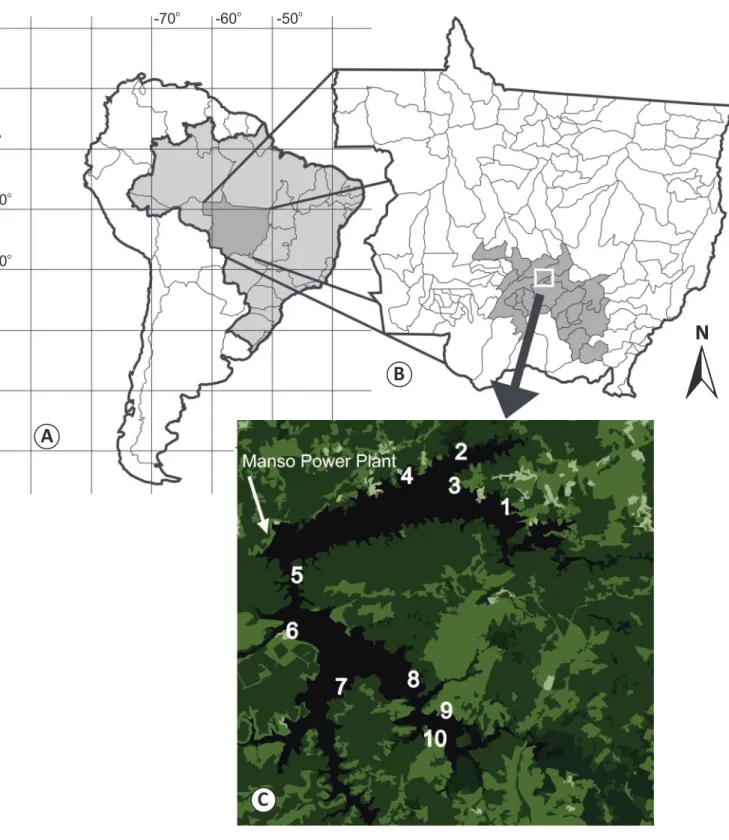
Between April 2009 and October 2010, the abundance of species in APM Manso was evaluated every two months in 10 sampling stations (quantitative study) distributed in the major
rivers of the reservoir (Figure 1) and georeferenced: two locations in the Manso River [(1) = 14o49’06”S, 55o37’02”W; (4) = 14o48’00”S, 55o40’10”W], two locations in the Palmeiras River [(2) = 14o48’22”S, 55o36’32”W; (3) = 14o48’53”S,
55o35’07”W], one stream at the junction of the Casca and Manso Rivers near the dam [(5) =14o54’39”S, 55o45’50”W], four
locations in the Casca River [(6) = 14o56’24”S, 55o47’33”W; (8) = 14o57’35”S, 55o40’12”W; (9) = 15o00’47”S, 55o35’51”W; (10) = 15o01’38”S, 55o36’14”W], and one location in the Quilombo River [(7) = 15o00’50”S, 55o43’35”W]. The mollusks were obtained by direct collection (three collectors performed 10-minute searches at each site) without interruption to calculate the number of snails collected per man per unit of time. The relative abundance of freshwater mollusks in the APM Manso reservoir was calculated by dividing the total number of individuals of a given species by the total number of individuals
of all species.
In the Laboratório de Malacologia of Instituto Oswaldo Cruz, Fundação Oswaldo Cruz, Rio de Janeiro, State of Rio de Janeiro, the specimens were placed in aquaria containing dechlorinated tap water with a thin bottom layer of a 2:1 mixture of screened soil and ground oyster shells as a source of mineral nutrients. For species identiication, the snails were anesthetized in Hypnol 0.05% solution (Cristália – Produtos Químicos e Farmacêuticos LTDA, Itapira, São Paulo) for ive hours, killed using hot water (70°C) and ixed in Railliet-Henry solution16.
Thirty-one freshwater mollusk species were collected (nine families and 17 genera) from 18 municipalities in the
State of Mato Grosso, Brazil (Table 1 and Table 2): Anodontites elongatus (Swainson, 1823); Anodontites tenebricosus (Lea, 1834); Anisancylus sp.; Antillorbis nordestensis (Lucena, 1954); B. amazonica; Biomphalaria occidentalis Paraense, 1981; Biomphalaria schrammi (Crosse, 1864); B. straminea; Biomphalaria sp.; Burnupia ingae Lanzer, 1991; C. luminea; C. largillierti; Drepanotrema anatinum (d´Orbigny, 1835); Drepanotremadepressissimum (Moricand,
1839); Drepanotremalucidum (Pfeiffer, 1839); Eupera tumida (Clessin, 1879); Eupera sp.; Ferrissia sp.; Gundlachia radiata (Guilding, 1828); G. ticaga; Gundlachia sp.; Idiopyrgus sp.;
Laevapex sp.; M. tuberculata; Physa marmorata Guilding, 1828; Pisidium sp.; Pomacea maculata Perry, 1810;Pomacea lineata (Spix in Wagner, 1827); Pomacea scalaris (d’Orbigny, 1835); Pomacea sp. and Uncancylus concentricus (d’Orbigny, 1835). The mollusk samples from all the municipalities were deposited in the Mollusk Collection of Instituto Oswaldo Cruz (CMIOC), Rio de Janeiro, Brazil.
Among the medically important species, B. straminea was found in nine localities of the three municipalities (Cuiabá, Diamantino and Várzea Grande): 15o35’59”S, 56o03’54”W;
15o34’08”S, 56o04’43”W; 15o35’53”S, 56o06’57”W;
15o33’58”S, 56o02’28”W; 15o36’54”S, 56o06’30”W;
15o39’21”S, 56o00’13”W; 15o32’56”S, 56o02’15”W 14o24’23”S,
56o26’59”W and 15o40’15”S, 56o04’32” W. Biomphalaria amazonica, a potential intermediate host of S. mansoni, was found in the Casca and Manso rivers, which form the reservoir, in six areas of the municipality of Chapada dos Guimarães. B. amazonica was frequently associated with the macrophytes Salvinia auriculata Aublet, 1775 and Pistia stratiotes Linnaeus,
0o
-10o
-20o
-70o o o -60 -50
A
B
C
FIGURE 1 - Location of study area. A: Map of South America showing Brazil and the State of Mato Grosso. B: Municipalities that
were surveyed for the presence of snails. C: APM Manso reservoir showing the sampling station of the quantitative study: 1 and
Alto Paraguai + +
Chapada dos Guimarães + * * * *+ *
Cuiabá + + + + + +
Jaciara +
Jangada +
Juscimeira +
Nobres + + + +
Nossa Senhora do Livramento +
Rosário Oeste + + + + +
Várzea Grande + + + +
São Pedro da Cipa +
APM Manso: Usina Hidrelétrica de Aproveitamento Múltiplo de Manso. +: occurrence in biotopes in the municipalities; *: occurrence in
biotopes in the APM Manso reservoir.
Bivalvia Gastropoda: Caenogastropoda
Anodontites elongatus Anodontites tenebricosus Eupera
tumida
Eupera
sp.
Pisidium
sp.
Corbicula lar
gillierti
Corbicula
luminea
Pomacea
maculata
Pomacea lineata Pomacea scalaris Pomacea
sp.
Idiopyr
gus
sp.
Melanoides tuber
culata
Mycetopodidae Sphaeriidae Corbiculidae Ampullariidae Pomatiopsidae Thiaridae TABLE 1 - Freshwater bivalves and gastropods (Order Caenogastropoda) and municipalities where mollusks were found in the area of APM Manso, State of Mato Grosso, Brazil, from February 2002 to February 2004 and from April 2009 to February 2011.
Municipalities
The quantitative study carried out in APM Manso revealed the occurrence of mollusks in all the surveyed localities during the dry
season (from June to November). M. tuberculata was obtained in
all the searches (Table 3). Three species were found only once:
P. maculata in the Casca River (Sampling station No. 10) in August
2010, and C. luminea and P. marmorata in the Manso River in
October 2009 (Nº 1) and April 2009 (Nº 4), respectively. During the qualitative study in the APM Manso reservoir from February 2002 to February 2004, when 38 collection sites were analyzed,
M. tuberculata was not found, but specimens of A. nordestensis, A. tenebricosus, B. amazonica, B. occidentalis, Biomphalaria
sp., C. luminea, D. anatinum, D. depressissimum, D. lucidum,
Eupera sp., Ferrissia sp., G. ticaga, G. radiata, Laevapex sp.,
P. maculata, P. marmorata and U. concentricus were obtained.
Considering the occurrence of species in 18 municipalities, the
most frequently found Biomphalaria species was B. occidentalis,
occurring in twelve municipalities, followed by B. amazonica
and B. straminea. The most frequently found Caenogastropoda
species were P. maculata and Pomacea sp., followed by
Melanoides tuberculata, which was found in ive municipalities.
Samples of P. scalaris and Idiopyrgus sp. were found only in the
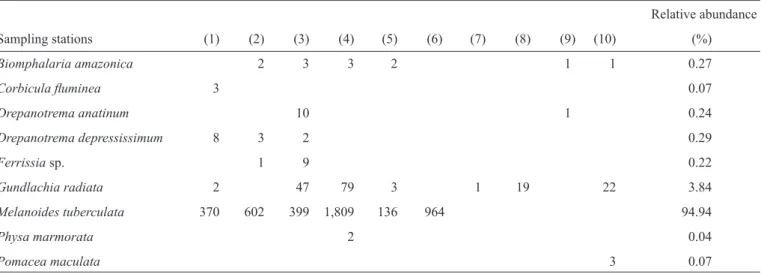
municipalities of Várzea Grande and Rosário Oeste, respectively. A total of 4,507 specimens were collected in the quantitative
study; M. tuberculata was the most common, comprising
94.96% of the overall population. The most representative
species was G. radiata, followed by M. tuberculata and
B. amazonica, found in six (60%) and seven (70%) sampling
stations, respectively (Table 4). In the qualitative study,
G. radiata was also the most frequent species, found in 41 out
of the 104 surveyed localities in eight municipalities. Among the
planorbids, D. anatinum was the most widespread in the study
area (36 localities in six municipalities) from 2002 to 2004; in
the quantitative study, D. anatinum was only found in two areas
(stations 3 and 9). The most common species found at the APM
Manso reservoir between 2002 and 2004 was D. anatinum,
which was collected from 25 out of the 31 surveyed localities (27 in the Chapada dos Guimarães and four in Nova Brasilândia);
Acorizal + + + +
Alto Paraguai + + + +
Chapada dos Guimarães *+ *+ *+ *+ *+ *+ *+ *+ + + * *+ *+ *+ *+
Cuiabá + + + + + + + + + + + + +
Diamantino + + +
Jaciara + +
Jangada + + + + + + +
Juscimeira + + +
Nobres + + + + + + + + + + +
Nossa Senhora do Livramento + + +
Nova Brasilândia * * *+ + + +
Pedra Preta + + + +
Poxoréu + +
Primavera do Leste + +
Rondonópolis + + + +
Rosário Oeste + + + + + + + + + +
Várzea Grande + + + + + +
Antillorbis nor
destensis
Biomphalaria amazonica Biomphalaria
sp.
Biomphalaria
occidentalis
Biomphalaria schrammi Biomphalaria straminea Dr
epanotr
ema anatinum
Dr
epanotr
ema depr
essissimum
Dr
epanotr
ema lucidum
Physa
marmorata
Anisancylus
sp.
Burnupia
ingae
Ferrissia
sp.
Gundlachia ticaga Gundlachia radiata Gundlachia
sp.
Laevapex
sp.
Uncancylus concentricus
TABLE 2 - Freshwater gastropods (Order Pulmonata: Suborder Basommatophora) and municipalities where mollusks were found in the area of APM Manso, State of Mato Grosso, Brazil, from February 2002 to February 2004 and from April 2009 to February 2011.
Planorbidae Physidae Ancylidae
APM Manso: Usina Hidrelétrica de Aproveitamento Múltiplo de Manso. +: occurrence in biotopes in the municipalities; *: occurrence in
biotopes in the APM Manso reservoir. Municipalities
DIsCUssION
The study area is epidemiologically important due to the environmental effects of the APM Manso project and the occurrence of B. straminea and B. amazonica in State of Mato
Grosso. Additionally, from a medical standpoint, the abundance
of M. tuberculata in the study area is a matter of concern. This exotic species,which is a natural host of Centrocestus formosanus (Nishigori, 1924) in Brazil17, is responsible for
centrocestiasis transmission. The biological interaction between M. tuberculata and C. formosanus has previously been found in China, Colombia, India, Iran, Japan, Malaysia, Mexico, Taiwan,
the United Statesand Venezuela18. Human transmission has
already been reported in Asia and occurs through the ingestion of ish that are infected with metacercariae, a larval stage that develops after the ish is exposed to Pleurolophocercous cercaria eliminated by infected snails. This type of cercariae, most likely C. formosanus, has also been obtained in specimens of
TABLE 4 - Number of specimens of mollusks collected in each sampling station in the APM reservoir during the quantitative study carried out between April 2009 and October 2010.
Relative abundance
Sampling stations (1) (2) (3) (4) (5) (6) (7) (8) (9) (10) (%)
Biomphalaria amazonica 2 3 3 2 1 1 0.27
Corbicula luminea 3 0.07
Drepanotrema anatinum 10 1 0.24
Drepanotrema depressissimum 8 3 2 0.29
Ferrissia sp. 1 9 0.22
Gundlachia radiata 2 47 79 3 1 19 22 3.84
Melanoides tuberculata 370 602 399 1,809 136 964 94.94
Physa marmorata 2 0.04
Pomacea maculata 3 0.07
APM Manso: Usina Hidrelétrica de Aproveitamento Múltiplo de Manso.
TABLE 3 - Freshwater mollusks collected in ten sampling stations in the reservoir of APM Manso, State of Mato Grosso, from April 2009 to October 2010.
2009 2010
April June August October December February April June August October
Biomphalaria amazonica (2) 2 (3) 1 (3) 2
(4) 3 (9) 1
(5) 2 (10) 1
Corbicula luminea (1) 3
Drepanotrema anatinum (3) 9 (9) 1 (3) 1
Drepanotrema depressissimum (1) 8 (3) 2 (2) 2 (2) 1
Ferrissia sp. (3) 6 (3) 3 (2) 1
Gundlachia radiata (4) 2 (3) 37 (8) 3 (1) 1 (1) 1 (3) 5
(8) 16 (4) 77 (3) 5
(10) 1 (5) 3
(7) 1 (10) 21
Melanoides tuberculata (3) 3 (2) 88 (2) 15 (1) 5 (1) 6 (6) 74 (3) 51 (1) 29 (1) 13 (1) 317
(5) 2 (3) 84 (3) 35 (2) 165 (2) 60 (4) 2 (2) 3 (2) 13 (2) 258 (6) 26 (4) 168 (4) 8 (3) 8 (3) 5 (6) 72 (3) 59 (3) 61 (3) 93
(5) 1 (5) 5 (4) 6 (4) 1 (4) 60 (4) 4 (4) 1560
(6) 201 (6) 236 (5) 17 5) 3 (6) 87 (5) 30 (5) 78
(6) 90 (6) 121 (6) 57
Physa marmorata (4) 2
Pomacea maculata (10) 3
Number of mollusks/month 41 572 306 420 76 78 127 238 279 2,370
APM Manso: Usina Hidrelétrica de Aproveitamento Múltiplo de Manso. Sampling stations: Manso River [(1) and (4)]; Palmeiras River [(2) and
The present study extends the known distribution of B. straminea in the State of Mato Grosso, as it has previously been reported in the municipalities of Diamantino and Várzea
Grande20. B. straminea is of great epidemiological importance because it is responsible for areas of active transmission of schistosomiasis in northeastern Brazil, and its occurrence in the Cuiabá River (municipality of Cuiabá) is signiicant because of the frequent presence of ishermen at this site. Experimental infection studies of B. amazonica populations from the APM Manso reservoir (collected from Chapada dos Guimarães) revealed infection rates of 2.02% and 9.09% with the BH and
EC strains of S. mansoni, respectively21. Although natural
infection of B. amazonica with S. mansoni has never been
described, since the 1970s experimental infection studies have raised concerns about the transmission of schistosomiasis in the
range of B. amazonica22. Considering these studies, in addition to environmental and social factors in the area, the possibility of the introduction of schistosomiasis in this reservoir, although low, cannot be ignored.
The results of this study conirm the report by Paraense23 of the widespread occurrence of the non-vector Biomphalaria
species B. occidentalis in the State of Mato Grosso. Six new localities were reported in our study, bringing the total number to 23 municipalities in the state: Alto Paraguai, Arenápolis, Barão de Melgaço, Cabaçal, Cáceres, Cachoeirinha, Chapada dos Guimarães, Cuiabá, Diamantino, Jaciara, Jangada, Jauru, Nobres, Nortelândia, Nossa Senhora do Livramento, Pedra Preta, Poconé, Pontes e Lacerda, Quatro Marcos, Rondonópolis, Rosário Oeste, Santo Antônio do Leverger, and Várzea Grande.
Reservoirs have been continually subject to the introduction and establishment of alien species, as reported by Rocha et al.24 in State of São Paulo. The authors showed that rapid invasion processes were ongoing on the Tietê River basin for three species of mollusks: C. luminea, Limnoperna fortunei (Dunker, 1857) and M. tuberculata. Similar indings were observed in the APM Manso reservoir for M. tuberculata; (between 2009 and 2010), introduced after February 2009, it became the most abundant species. As well as being an intermediate host of C. formosanus, M. tuberculata destabilizes the course of periphyton colonization, suggesting that it may also disrupt natural food chains25.
This study extends the known distribution of A. nordestensis
in 11 States (Alagoas, Goiás, Maranhão, Minas Gerais, Pará,
Paraná, Pernambuco, Rio Grande do Sul, Rio de Janeiro, Santa Catarina, and São Paulo) and Distrito Federal26-28 to include
eight municipalities in the State of Mato Grosso. However,
Drepanotrema cimex (Moricand, 1839), previously reported to be present in Cáceres and Cuiabá23, was not found in any of the surveyed municipalities. Drepanotrema heloicum (d’Orbigny, 1835) and Drepanotrema kermatoides (d’Orbigny, 1835), which have also previously been found in Mato Grosso26, were not found in the study area, conirming the results reported by Paraense in 21 municipalities of the state23.
With regard to the Ancylidae, the distribution of the genus Anisancylus Pilsbry, 1924 was extended to the Central-West
Region. Anisancylus dutrae Santos, 1994 occurs in northeastern
Brazil, from Pernambuco to Bahia29,30; Anisancylus obliquus (Broderip & Sowerby, 1832) has been recorded from southern Brazil to Uruguay, Argentina and Chile30,31. These species occur in shallow lotic waters, especially over stones, and seldom occur on the abaxial surface of leaves. Burnupia ingae was observed for the irst time in three municipalities (Chapada dos Guimarães, Cuiabá and Nobres) in the State of Mato Grosso. This inding of B. ingae in Mato Grosso extends its known range, as it was previously found only in southern Brazil, in the States of Santa Catarina and Rio Grande do Sul30-32. Lacerda
and Santos33 reviewed samples housed in the Malacological Collections, including the CMIOC, and a literature search estimating the current distribution of B. ingae in Brazil showed that it was present in 20 municipalities in seven states. The genus Laevapex Walker, 1903 was also recorded for the irst time in the State of Mato Grosso, in the municipalities of Chapada dos Guimarães, Cuiabá, Jangada and Rosário Oeste; it was previously cited as present in the Serra da Mesa dam9 as well
as other scattered locations in Brazil30,31.
The diversity of lentic habitats provided by dam construction seems to favor the expansion and establishment of G. radiata,
which has a wide distribution, from the southern United States,
Central America and Caribbean, to northern and northeastern Brazil30,31. Recently, this species has been found in the State of Rio de Janeiro, extending its known distribution to southeastern
Brazil34. The results of this quantitative study were similar to previous studies performed in the Serra da Mesa dam9 in central Brazil, where an intense colonization by G. radiata and the disappearance of G. ticaga was reported a few years after the
creation of the reservoir.
High densities of the macrophytes P. stratiotes and
S. auriculata were found in the Manso and Casca Rivers, respectively, which form the APM Manso reservoir, between
2002 and 20033. Takeda et al.35 noted 25 groups of invertebrates associated with ive different macrophytes in the loodplain of the high Parana River, with P. stratiotes having the largest invertebrate
density, followed by Salvinia sp. The present study conirmed the importance of these macrophytes in the establishment and colonization of mollusks in the APM Manso reservoir, as it was common to ind snails attached to macrophyte roots that were loating on the lake far from the edge of the reservoir.
The present study extends the distribution of some species of the Ampullariidae and Corbiculidae, including P. lineata, which occurs from northeastern to southeastern Brazil but generally in the coastal region and P. maculata, which is among the largest of the freshwater snails and, together with P. scalaris, occurs frequently in the basins of the Prata, Paraguay and Uruguay Rivers36.
In the Manso Power Plant area, the discovery of two Corbiculidae species, C. largillierti and C. luminea, is a major
problem, mainly because of the ecological and economic impact on local fauna and hydroelectric power. These Asiatic species were introduced in the State of Rio Grande do Sul in the 1980s, and, in 1998, they were reported in the looded area of Pantanal Mato-Grossense near Cuiabá37,38. The present paper
adds C. luminea tothree municipalities, including the reservoir
area. Recently, Pereira et al.39 listed the freshwater bivalve species of South America, including the families Corbiculidae, Mycetopodidae and Sphaeriidae, and commented that changes from lotic to lentic ecosystems interfere in the life cycle of these mollusks, which depend on ish for their dispersal.
Mollusks are particularly common in the dry season; in an analysis of the diversity of mollusks in a reservoir in Thailand,
Tesana40 reported that many species increased in population during the cold season. These species appear to hatch during the rainy season and grow large enough to be detected by the dry
season40. Furthermore, Paraense41 commented that populations decrease substantially at the peak of the rainy season, due to the effects of loods and other environmental disturbances.
Cercarial dermatitis42, which is considered an emerging disease, may be occurring in the study area because Ampullariidae and Planorbidae specimens have been found harboring Brevifurcate apharyngeate cercaria in the municipalities of Alto Paraguai, Poconé and Nobres43. According to Horák and Kolárová44, the dispersal of bird schistosomes to new regions and an increased availability of snail hosts, together with the use of new water reservoirs for recreational purposes, may contribute to a higher number of outbreaks of cercarial dermatitis. In the
State of Espirito Santo, Brevifurcate apharyngeate cercariae
were found in naturally infected P. marmorata and identiied
by morphological and molecular methods as Trichobilharzia
sp., the main etiological agents of cercarial dermatitis in
humans45. This observation suggests an increased possibility of the existence of unknown cases of avian cercarial dermatitis in Brazil, including the Central-West Region, due to the presence of well-established populations of P. marmorata in areas affected
by hydroelectric plants in the Tocantins9,46 and Araguaia47 Rivers, in addition to those found in this study. Given the increasing number of dams in the middle-west region of the country over the past few years, malacological surveys should be performed in such areas. Those studies are an important strategy to prevent new foci of schistosomiasis and other zoonoses and will provide data on the effect of dams on freshwater mollusk populations.
ACKNOWleDGMeNTs
The authors declare that there is no conlict of interest.
CONFlICT OF INTeResT
FINANCIAl sUPPORT
ReFeReNCes
To Furnas Centrais Elétricas for the facilities provided
during ield work; to Dr. Maria Cristina Dreher Mansur for the identiication of bivalve species, and to Ms. Anne Louise G. Nemer for the preparation of igure.
Fundação Oswaldo Cruz and Furnas Centrais Elétricas (Convênio 023/98 e Projeto IOC-002-CAC-09-2-2).
1. Southgate VR. Schistosomiasis in the Senegal river basin; before and after the construction of the dams at Diama, Senegal and Manantali, Mali and future prospects. J Helminthol 1997; 71:125-132.
2. Magalhães LA, Dias LCS, Piza JT, Takaku L, Pereira AA. Aspectos epidemiológicos da esquistossomose mansônica na região da Represa de Americana, Estado de São Paulo, Brasil. Rev Saude Publica 1973; 7:21-28.
3. Thiengo SC, Fernandez MA. Moluscos límnicos em reservatórios de Usinas Hidrelétricas no Brasil: aspectos biológicos e epidemiológicos.
In: Carvalho OS, Coelho PMZ, Lenzi H, editors. Schistosoma mansoni
& Esquistossomose: uma visão multidisciplinar. Rio de Janeiro: Editora FIOCRUZ; 2008. p. 435-457.
4. Rezende HR, Sessa PA, Ferreira AL, Santos CB, Leite GR, Falqueto A. Efeitos da implantação da Usina Hidrelétrica de Rosal, Rio Itabapoana, Estados do Espírito Santo e Rio de Janeiro, sobre anofelinos, planorbídeos e lebotomíneos. Rev Soc Bras Med Trop 2009; 42:160-164.
5. Bronzatti FL, Iarozinski Neto A. Matrizes energéticas no Brasil: cenário 2010-2030. XXVIII Encontro Nacional de Engenharia de Produção (16 a 18 de outubro). Rio de Janeiro, RJ: Associação Brasileira de Engenharia de Produção; 2008.
6. Leme FBM. As represas como lugares turísticos: novas signiicações e valorizações de uma paisagem sem memória. Cultur: Rev Cultura Turismo 2007; 1:65-85.
7. Lima SFS, Batista GT. Impacto da Represa Hidrelétrica de Paraibuna, SP, Brasil. Ambi-Água 2010; 5:208-221.
8. Nogueira MG, Henry R, Jorcin A. Ecologia de reservatórios: impactos potenciais, ações de manejo e sistemas em cascata. São Carlos: Editora Rima; 2005.
9. Thiengo SC, Santos SB, Fernandez MA. Freshwater molluscs of the lake of Serra da Mesa dam, Goiás, Brazil. I. Qualitative study. Rev Bras Zool 2005; 22:867-874.
10. Fernandez MA, Thiengo SC. Susceptibility of Biomphalaria straminea
(Dunker, 1848) from Serra da Mesa dam, Goiás, Brazil to infection with three strains of Schistosoma mansoni Sambon, 1907. Mem Inst Oswaldo
Cruz 2002; 97 (supl I):49-60.
11. Fernandez MA, Thiengo SC. Susceptibility of Biomphalaria straminea
from Peixe Angical dam, Tocantins, Brazil to infection with three strains of Schistosoma mansoni. Mem Inst Oswaldo Cruz 2010;
105:488-491.
12. Pinto HA, Mati VLT, Melo AL. The Pampulha reservoir remains a potential urban focus of schistosomiasis mansoni in Brazil: changes in the occurrence patterns of Biomphalaria species and a new record of the
parasite. Rev Soc Bras Med Trop 2013; 46:478-483.
13. Suriani AL, França RS, Rocha O. A malacofauna bentônica das represas do médio rio Tietê (São Paulo, Brasil) e uma avaliação ecológica das espécies exóticas invasoras, Melanoides tuberculata (Müller) e
Corbicula luminea (Müller). Rev Bras Zool 2007; 24:21-32.
14. Mansur MCD, Santos CP, Pereira D, Paz ICP, Zurita MLL, Rodriguez MTR, et al. Moluscos límnicos invasores no Brasil. Biologia, prevenção, controle. Porto Alegre, RS: Redes Editora Ltda; 2012.
15. Bagatini YM, Higuti J, Benedito E. Temporal and longitudinal variation of Corbicula luminea (Mollusca, Bivalvia) biomass in the Rosana reservoir, Brazil. Acta Limnol Bras 2007; 19:357-366.
16. Fernandez MA, Thiengo SC, Amaral RS. Técnicas malacológicas.
In: Amaral RS, Thiengo SC, Pieri OS, editors. Vigilância e Controle
de Moluscos de moluscos de Importância Médica: Diretrizes Técnicas. Brasília: Editora do Ministério da Saúde 2008; p. 43-70.
17. Pinto HA, Melo AL. Melanoides tuberculata (Mollusca: Thiaridae)
as an intermediate host of Centrocestus formosanus (Trematoda:
18. Pinto HA, Melo AL. A checklist of trematodes (Platyhelminthes) transmitted by Melanoides tuberculata (Mollusca: Thiaridae). Zootaxa
2011; 2799: 15-28.19.
19. Lopes BG, Fernandez MA, Thiengo SC. Parasitologic and biologic invasions aspects of the exotic freshwater snail Melanoides tuberculatus
from APM Manso, MT, Brazil. II Jornada de Espécies Invasoras. 13-16 de dezembro. São Carlos, SP: Universidade Federal de São Carlos; 2010. 20. Carvalho OS, Amaral RS, Dutra LV, Scholte RGC, Guerra MAM.
Distribuição espacial de Biomphalaria glabrata, B. straminea e
B. tenagophila, hospedeiros intermediários do Schistosoma mansoni no Brasil. In: Carvalho OS, Coelho PMZ, Lenzi H, editors. Schistosoma mansoni & Esquistossomose: uma visão multidisciplinar. Rio de
Janeiro: Editora FIOCRUZ; 2008. p. 393-418.
21. Fernandez MA, Thiengo SC. Susceptibility of Biomphalaria amazonica
and Biomphalaria occidentalis from Manso Dam, Mato Grosso, Brazil to infection with three strains of Schistosoma mansoni. Mem Inst Oswaldo Cruz 2006; 101 (supl I):235-237.
22. Corrêa LR, Paraense W. Susceptibility of Biomphalaria amazonica to infection with two strains of Schistosoma mansoni. Rev Inst Med Trop São Paulo 1971; 13:387-390.
23. Paraense WL. A survey of planorbid molluscs in the Amazonian region of Brazil. Mem Inst Oswaldo Cruz 1983; 78:343-361.
24. Rocha O, Espíndola LG, Rietzler AC, Fenerich-Verani N, Verani JR. Animal invaders in São Paulo state reservoir. Oecol Aust 2011; 15: 631-642.
25. Vasconcelos JF, Barbosa JEL, Azevêdo EL, Azevêdo DJS, Anacleto MJP. Predation effects of Melanoides tuberculatus (Müller, 1774) on
peryphytic bioilm colonization: an experimental approach. Biota Neotrop 2013; 13:96-101.
26. Paraense WL. Estado atual da sistemática dos planorbídeos brasileiros. Arq MusNac 1975; 55:105-128.
27. Santos SB, Monteiro DP, Fernandez MA, Thiengo SC. Primeiro registro de Antillorbis nordestensis (Lucena) (Mollusca, Gastropoda,
Planorbidae) para a Ilha Grande, Angra dos Reis, Rio de Janeiro. Rev Bras Zool 1999; 16:257-259.
28. Thiengo SC, Mattos AC, Santos SB, Fernandez MA. Freshwater snails and schistosomiasis mansoni in the state of Rio de Janeiro, Brazil: VI – Noroeste Fluminense Mesoregion. Mem Inst Oswaldo Cruz 2006; 101 (supl I):239-245.
29. Santos SB. Gundlachia dutrae n. sp. from north-eastern Brazil (Mollusca: Basommatophora: Ancylidae). Mem Inst Oswaldo Cruz 1994; 89:153-160.
30. Santos SB. Estado atual do conhecimento dos ancilídeos na América do Sul (Mollusca: Gastropoda: Pulmonata: Basommatophora). Rev Biol Trop 2003; 51 (supl III):191-224.
31. Lanzer RM. Ancylidae (Gastropoda: Basommatophora) na América do Sul: sistemática e distribuição. Rev Bras Zool 1996; 13:175-210. 32. Lanzer RM. Duas novas espécies de Ancylidae (Gastropoda:
Basommatophora) para o sul do Brasil. Rev Bras Biol 1991;51:703-719. 33. Lacerda LEM, Santos SB. Burnupia ingae Lanzer, 1991 (Gastropoda,
Ancylidae): current distribution on Brazil. Check List 2011; 7:862-864.
34. Lacerda LEM, Miyahira IC, Santos SB. First record and range extension of the freshwater limpet Gundlachia radiata (Guilding, 1828) (Mollusca,
Gastropoda, Planorbidae) in Brazil. Check List 2013; 9:125-128. 35. Takeda AM, Souza-Franco GM, Melo SM, Monkolski A. Invertebrados
associados às macróitas aquáticas da planície de inundação do alto rio Paraná (Brasil). In: Thomaz SM, Bini LM, editors. Ecologia e manejo
de macróitas aquáticas. Maringá: Editora da Universidade Estadual de Maringá; 2003. p. 243-260.
36. Hayes KA, Cowie RH, Thiengo SC, Strong EE. Comparing apples to apples: clarifying the identities of two highly invasive Neotropical Ampullariidae (Caenogastropoda). Zool J Linn Soc, 2012; 166:723-753. 37. Mansur MCD, Callil CT, Cardoso FR, Ibarra JAA. Uma retrospectiva e
mapeamento da invasão de espécies de Corbicula (Mollusca, Bivalvia,
Veneroida, Corbiculidae) oriundas do sudeste Asiático, na América do Sul. In: Silva JSV, Souza RCCL, editors. Água de Lastro e Bioinvasão.
Rio de Janeiro: Editora Interciência; 2004. p. 39-58.
38. Santos SB, Thiengo SC, Fernandez MA, Miyahira IC, Gonçalves ICB, Ximenes RF. Espécies de moluscos límnicos invasores no Brasil.
In: Mansur MCD, Santos CP, Pereira D, Paz ICP, Zurita MLL,
Rodriguez MTR, editors. Moluscos límnicos invasores no Brasil: biologia, prevenção e controle. Porto Alegre, RS: Redes Editora Ltda; 2012. p. 25-49.
39. Pereira D, Mansur MCD, Duarte LDS, Oliveira ASO, Pimpão DM, Callil CT, et al. Bivalve distribution in hydrographic regions in South America: historical overview and conservation. Hydrobiologia 2013; 735:15-44.
40. Tesana S. Diversity of mollusks in the Lan Ta Khong reservoir, Nakhon Ratchasima, Thailand. Southeast Asian J Trop Med Public Health 2002; 33:733-738.
41. Paraense WL. Fauna planorbídica do Brasil. In: Lacaz CS, Baruzzi
RG, Siqueira W, editors. Introdução à Geograia Médica do Brasil. São Paulo: Edgard Blücker & Universidade de São Paulo; 1972. p. 213-239. 42. Pinto HA, Mati VLT, Melo AL. Dermatite cercariana por
esquistossomatídeos de aves: é possível a ocorrência de casos no Brasil? Rev Patol Trop 2012; 41:1-14.
43. Mattos AC, Boaventura MFF, Fernandez MA, Thiengo SC. Larval trematodes in freshwater gastropods from Mato Grosso, Brazil: diversity and host-parasites relationships. Biota Neotrop 2013; 13:34-38. 44. Horák P, Kolárová L. Snails, waterfowl and cercarial dermatitis.
Freshwater Biol 2011; 56:779-790.
45. Pinto HA, Brant SV, Melo AL. Physa marmorata (Mollusca: Physidae)
as a natural intermediate host of Trichobilharzia (Trematoda:
Schistosomatidae), a potential causative agente of avian cercarial dermatites in Brazil, Acta Trop 2014; 138:38-43.
46. Fernandez MA. Variação espaço-temporal da malacofauna límnica em dois reservatórios no rio Tocantins, com ênfase na transmissão da esquistossomose, no período entre junho de 2004 e outubro de 2010. [Doctors Thesis] [Rio de Janeiro]: Instituto Oswaldo Cruz, Fundação Oswaldo Cruz; 2011.