467
Revista da Sociedade Brasileira de Medicina Tropical 43(4):467-468, jul-ago, 2010
Case Report/Relato de Caso
1. Division of Infectious and Parasitic Diseases, Hospital Universitário Evangélico de Curitiba, Curitiba, PR. 2. Division of Renal Transplant, Hospital Universitário Evangélico de Curitiba, Curitiba, PR.
Address to: Dr. Felipe Francisco Tuon. Infectious and Parasitic Diseases Clinic, Hospital Universitário Evangélico de Curitiba. Alameda Augusto Stellfeld 1908/3º andar, SCIH - Bigorrilho, 80730-150 Curitiba, PR, Brazil.
Phone: 55 41 3240-5055; Fax: 55 41 3240-5274 e-mail: [email protected]
Received in 08/12/2009 Accepted in 21/01/2010
INTRODUCTION
CASE REPORT
Recurrent
Acremonium
infection in a kidney transplant patient treated
with voriconazole: a case report
Infecção recidivante por
Acremonium
em paciente transplantado renal tratado com voriconazol:
relato de caso
Felipe Francisco Tuon
1, Carolina Pozzi
2, Sergio Ricardo Penteado-Filho
1, Ricardo Benvenutti
2and
Fabiana Loss de Carvalho Contieri
2ABSTACT
Acremonium infection is rare and associated with immunosuppression. A case of recurrent cutaneous Acremonium infection after short term voriconazole use is described. Surgical resection was the deinitive therapy. Oral voriconazole was used in the treatment of Acremonium infection, but recurrence was associated with short therapy. Prolonged antifungal therapy and surgical resection are discussed for the treatment of localized lesions.
Key-words: Voriconazole. Acremonium. Fungal infection.
RESUMO
Infecção por Acremonium é rara e pode estar associada com imunossupressão. Descrevemos um caso de infecção recorrente de pele por Acremonium após tratamento breve com voriconazol. Ressecção cirúrgica foi o tratamento deinitivo. Terapia prolongada com antifúngicos e ressecção cirúrgica são discutidas para o tratamento de doenças fúngicas localizadas.
Palavras-chaves: Voriconazol. Acremonium. Infecção fúngica.
Acremonium is a ubiquitously fungus present in the soil and human infection is extremely uncommon1,2. Dermatophytoses,
keratitis and mycetomas are the most common clinical presentation. Immunosuppressed patients show a large clinical spectrum, including pneumonia, arthritis, osteomyelitis, endocarditis, peritonitis, meningitis and sepsis1,3,4. Immunosuppressed patients can also present localized
cutaneous lesions1. A case of cutaneous lesion caused by Acremonium sp
with recurrence ater a short course of voriconazole is described.
A 47 year-old male farmer, living in Mabore (a southern city in Brazil) was admited to hospital due to skin lesion in the thigh on March 22, 2009. he patient has been a kidney transplant patient since November 7, 2007, using mycophenolate mofetil, tacrolimus and
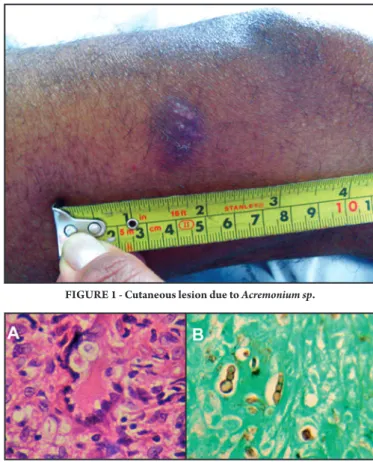
prednisone. he lesion, measuring 1.5cm in diameter, appeared two months before admission and presented purulent discharge (Figure 1). here was no history of trauma, the rest of the physical examination was normal and laboratorial tests were irrelevant. A skin biopsy showed a granulomatous reaction with giant cells, while Grocot stain showed phialide and phialoconidium (Figure 2). he culture was positive for
Acremonium sp, though species identiication was not performed.
FigURE 1 - Cutaneous lesion due to Acremonium sp.
Immunosuppressive therapy was suspended and voriconazole 200mg b.i.d. was used for 14 days. he lesion improved and drainage was suspended; however, ater one month, the lesion returned and a new culture showed Acremonium sp with histological analysis showing the same aspect of the irst biopsy. Surgical resection of the lesion was performed and immunosuppressive therapy was reintroduced. he lesion cured without recurrence ater six months.
468
Tuon FF et al - HTLV-1 associated myelopathy diagnosed during lepromatous leprosy reaction
DISCUSSION
This case suggested that short therapy with voriconazole is inadequate for the treatment of cutaneous lesions caused by certain yeasts occurring on transplant patients. We believe that prolonged therapy should be used for transplant patients. he improvement of the lesion ater two weeks of therapy demonstrated the eicacy of voriconazole against Acremonium, although no sensitivity test was performed. Nevertheless, short therapy (two weeks) was insuicient for fungus eradication from the skin. he fact that the cutaneous lesion was localized permited a surgical resection approach.
A previous review summarized clinical experience with infections caused by species of Acremonium5. Two cases of cutaneous lesions
have been published involving transplant patients. he irst was described by Strabelli et al in a heart transplant patient6. his patient
presented a lesion on the knee that was treated with surgery and local therapy. In another case, a subcutaneous infection in a kidney transplant patient was cured with surgical resection of the abscesses and ketoconazole7. In some instances, the particular species of
Acremonium cannot be determined by morphology, as described in
several reports and in this case5.
he drug of choice for treatment of Acremonium infections is amphotericin; however, the species presents low susceptibility to most antifungals, including imidazoles, fluorocytosine and amphotericin B. In vitro studies have shown that Acremonium can be susceptible to voriconazole, but resistant to other imidazoles8.
Voriconazole has been used in some cases of Acremonium infections with success9,10. his patient received voriconazole due to renal grat
and risk of renal failure.
In summary, Acremonium sp can cause skin lesions in kidney transplant patients. Voriconazole improved the lesion but recurrence occurred with short therapy. Considering the cost of new antifungal drugs, surgical resection is an adequate approach in these cases.
ACKNOWLEDGMENTS
The authors would like to thank Marcelo Dorneles for the microbiological study.
REFERENCES
1. Schell WA, Perfect JR. Fatal, disseminated Acremonium strictum infection in a neutropenic host. J Clin Microbiol 1996; 34:1333-1336.
2. Krcmery Jr V, Kunova E, Jesenska Z, Trupl J, Spanik S, Mardiak J, et al. Invasive mold infections in cancer patients: 5 years' experience with Aspergillus, Mucor, Fusarium and Acremonium infections. Support Care Cancer 1996; 4:39-45. 3. Guarro J, Gams W, Pujol I, Gene J. Acremonium species: new emerging fungal
opportunists-in vitro antifungal susceptibilities and review. Clin Infect Dis 1997; 25:1222-1229.
4. Warris A, Wesenberg F, Gaustad P, Verweij PE, Abrahamsen TG. Acremonium strictum fungaemia in a paediatric patient with acute leukaemia. Scand J Infect Dis 2000; 32:442-444.
5. Fincher RME, Fisher JF, Lovell RD, Newman CL, Espinel-Ingroff A, Shadomy HJ. Infection due to the fungus Acremonium (Cephalosporium). Medicine 1991; 70:398-409.
6. Strabelli TM, Uip DE, Amato Neto V, Bocchi EA, Higuchi ML, Stolf NA, et al. Acremonium infection ater heart transplant. Rev Soc Bras Med Trop 1990; 23:233.
7. Miro O, Fernando J, Lecha V, Campistol JM. Abcesos subcutaenos por Acremonium falciforme en un transplantado renal. Med Clin (Barc) 1994; 102:316.
8. Wildfeuer A, Seidl HP, Paule I, Haberreiter A. In vitro activity of voriconazole against yeasts, moulds and dermatophytes in comparison with luconazole, amphotericin B and griseofulvin. Arzneimitelforschung 1997; 47:1257-1263. 9. Keynan Y, Sprecher H, Weber G. Acremonium vertebral osteomyelitis: molecular
diagnosis and response to voriconazole. Clin Infect Dis 2007; 45: e5-e6. 10. Mattei D, Mordini N, Lo NC, Gallamini A, Osenda M, Pugno F, et al.