Original Article 379
-THE
(IN)DICA-SUS
GAME: A STRATEGY OF GAME-BASED LEARNING
ON THE UNIFIED HEALTH SYSTEM
Maria Raquel Gomes Maia Pires1, Dirce Guilhem2, Leila Bernarda Donato Göttems3
1 Ph.D. in Social Policy. Adjunct professor of the Department of Nursing at the University of Brasília (UnB). Federal District, Brazil. E-mail: [email protected]
2 Ph.D. in Health Sciences. Full professor of the Department of Nursing at the UnB. Federal District, Brazil. E-mail: guilhem@ unb.br
3 Ph.D. in Administration. Professor of the College of Health Sciences and of the Catholic University of Brasília. Federal District, Brazil. E-mail: [email protected]
ABSTRACT: This article questions whether educational gaming technology used in learning about the Uniied Health System (SUS)
beneits imagination, fun, spontaneity and relection in the training of health professionals. The objectives were to develop the (IN) DICA-SUS board game, centered on the dialog between health policies and play; to analyze the components of fun, pleasure, formative aspects of learning, the emotions and the game tactics in the development of the (IN)DICA-SUS game; and to identify indicator variables for playability in educational technologies for health. This was exploratory, descriptive research with a quantitative and qualitative approach, of the case study type. Test matches were undertaken with 160 participants, involving the administration of a questionnaire, participant observation, content analysis and the Pearson statistical test. The indicator variables for the playability of the educational technologies for health include the pleasure and tension in the game. The (IN)DICA-SUS game brings together inventive and sharing characteristics to optimize multiple learning and goes beyond teaching about the Uniied Health System, although it starts from that.
DESCRIPTORS: Professional education in public health. Learning. Nursing education.
JOGO
(IN)DICA-SUS
: ESTRATÉGIA LÚDICA NA APRENDIZAGEM SOBRE
O SISTEMA ÚNICO DE SAUDE
RESUMO: Questiona-se que tecnologia lúdico-educativa no aprendizado sobre o Sistema Único de Saúde favorece a imaginação, a descontração, a espontaneidade e a relexão na formação de proissionais de saúde. Os objetivos foram desenvolver o jogo de tabuleiro (IN)DICA-SUS, centrado no diálogo das políticas de saúde com o lúdico; analisar os componentes da descontração, do prazer, de aspectos formativos da aprendizagem, as emoções e as táticas do jogo no desenvolvimento do (IN)DICA-SUS; Identiicar variáveis indicativas da ludicidade em tecnologias educativas para a saúde. Pesquisa exploratória, descritiva, abordagem quantitativa e qualitativa, do tipo estudo de caso. Realizaram-se partidas testes com 160 participantes, com aplicação de questionário, observação participante, análise de conteúdo e teste estatístico Pearson. As variáveis indicativas da ludicidade de tecnologias educativas para a saúde incluem o prazer e a tensão no jogo. O (IN)DICA-SUS integra o caráter inventivo e de partilha como potencial para aprendizados múltiplos, para além do ensino do Sistema Único de Saúde, ainda que partindo-se dele.
DESCRITORES: Educação proissional em saúde pública. Aprendizagem. Educação em enfermagem.
JUEGO
(IN)DICA-SUS
: ESTRATEGIA LÚDICA EN EL APRENDIZAJE
SOBRE EL SISTEMA ÚNICO DE SALUD
INTRODUCTION
In the face of the changes stipulated in the National Curricular Guidelines (DCN) for cours-es in the health care area, consistent with the
principles of the Uniied Health Service (SUS), it
is necessary to invest in the human potential for reinvention, which is inherent to creative process-es.1-2 The challenges presented in training critical
and relexive health professionals lead to an urgent
need to investigate different means of facilitating learning processes, making them less disciplinar-ian of the irreverent spirit which is important for the entertainment of subjects who are thinking, alive, sensitive and active in the construction of a more egalitarian society.3-4
In a possible meeting between gaming and education, it may be asked whether educating for the autonomy of subjects based in the dynamics of the game is possible, without curbing its libertari-an, spontaneous and insubordinate character. Put
differently, when one inds in a gaming activity
an environment which is propitious to learning, such as fun and pleasure, at what point is it that disciplinary power, so characteristic of education-al processes, may imprison the game in its most irreverent points, that is, its frivolity and sponta-neity? When a game is proposed as an educational activity, principally in training institutions, the voluntary character which is intrinsic to games is inevitably submitted to the learning objectives, there being a tendency to reduce it to a teaching instrument or technique.
Various experiments and knowledges have related the use of gaming as a form of facilitating learning, including the recommendations for adapting it better to the objectives of the study or objectives of the study or activity. 5-10 The sys-tematic reviews on the issue have made efforts to measure games’ effects on the educational or clinical goals,5-7 with little attention being given to what happens to the game’s characteristics in the educational environment which is intrinsic to training processes, which makes dialog incom-patible between critical, inventive education and gaming.11 That is, few relections from the health area question how the libertarian characteristics of play behave in the excessively controlled envi-ronment of formal education.12-14
It is also necessary to analyze what happens to the irreverent, free, unproductive and inventive character of the game when this is used as an ed-ucational tool or instrument. Will the game not be negatively affected, when it is adapted to
educa-tional requirements, restricted to the objectives of learning content? Is an interface possible between a liberating, critical pedagogy and the emancipatory features of play,12-17 as authentic elements in sub-jects’ recreation? It can be seen that putting matters in these terms permits a different perspective for
relection on the concepts and paradigms which
guide the game dynamics and the educational activity, without subordinating one to the other, in search of interfaces capable of maximizing the exercising of human freedom.
On being subordinated to any interest other than its own, the game may lose its insubordinacy
– which is what best deines it as a principle – to
the purposes of utility and production.12-13,15-17 What is in play here, entering into the spirit of challenge and the seeking which that term
implies, is to ind a valid way for education to be
able to have the free characteristics of play, as a possibility for transcendence of the human. Any educational character which is sought through play needs to cultivate, as far as possible, a disin-terested link between the game and the education.
As a summary of the concept of gaming in human culture, many authors have converged, in reporting it as a free, conscious, frivolous activity, not undertaken for money, exterior to daily life, while intensely absorbing the player. Play occurs
in delimited spaces and times, following speciied
rules which are accepted among the participants, in an environment of enthusiasm which may be festive or sacred, amidst tension and pleasure, ambiguously. Repetition, situations of choice,
subject-speciic terminology, and the transience
between what is serious and banal are spoken of as characteristics which are inherent to the game.12,15-17
In the ambit of the breadth of the dialog be-tween play and education, this study asks whether it is possible to develop game-based-learning
tech-nology for teaching about the SUS which beneits imagination, fun, spontaneity, and relection in
inanced by the National Council for Scientiic and
Technological Development.18
METHODOLOGY
Type of study
This research is exploratory and descriptive, with a quantitative and qualitative approach (mixed methods), and is of the case study type, with triangulation of methods.19-21 An exploratory study was carried out for adapting the rules, the cards, and the board for (IN)DICA-SUS, based on
the game ‘Peril’, produced by the Brazilian toy
company ‘Grow’. The descriptive focus analyzed fun, pleasure, the formative aspects of learning, and the emotions and the game tactics in the conception, development and improvement of the (IN)DICA-SUS game. Case studies were made of the test games for identifying the relational characteristics of the game which strengthen its
formative, creative, relexive and free character for
the education of health professionals.21
The case study is an appropriate investiga-tive strategy for surveying, describing and analyz-ing the relationships, the phenomena, or the epi-sodes in question, which are useful for generating
knowledge about the signiicant characteristics of events, clarifying factors which inluence speciic
processes, or permitting the detailed examination of relationships.21 Accordingly, the case study tech-nique was used for the objective of identifying the players’ behaviors, the perceptions and gestures which suggested fun, pleasure, and formative as-pects of learning, emotions and tactics developed during the games using the (IN)DICA-SUS board game. Each game was treated as a single unit for analysis, followed by the others, until the game is perfected, these being multiple and sequenced case studies.22
Mixed methods research combines quan-titative and qualitative approaches in the same investigation with the aim of dialectically com-plementing the recurrences and intensity of the phenomena. This type of research is recommended to maximize the strength of the results originat-ing from different techniques, supported by the discussions of the complexity of the context and systematic approach.20-21 In building the
(IN)DI-CA-SUS game, the quantitative and qualitative methods complement each other to summarize the indicator variables for playability in educational technologies for health, capable of being used
both in the construction of questionnaires and in the adoption of pedagogical strategies mediated by the game.
The study’s setting and subjects
The study was undertaken in the Univer-sity of Brasília (UnB) and the Federal UniverUniver-sity of Minas Gerais (UFMG). The subjects were the
lecturers, the students and the scientiic initiation
bursary students from the undergraduate courses in the area of health and those invited who were willing to participate in the tests. The sample of respondents to the questionnaire was by
conveni-ence, in view of the applied and speciic character
of the research.19 The sampling of the cases was of the contrast-deepening type,22 in which each test made up one unit or ‘corpus’ of the study. An
analytical deepening of the speciic phenomena in
each match was made, along with comparison be-tween the groups in search of the self-explanatory character of the game. The criteria for the number of tests was the progressive strengthening of the
inventiveness and critical relection observed in
the players during the matches.
Instrument and data collection
The development of the (IN)DICA-SUS game occurred in steps of adaptations and successive
test matches, until a inalized version was obtained
which could be self-administered like any other board game. Data collection was supported by
free observation of the matches, the illing out of
the questionnaire by the players, and the records
made in a ield diary by the research team. In the
exploratory stage, the elaboration of the board
game was started by deining the rules, adapting
them to the aims of the (IN)DICA-SUS game, that is, to provide a ludic environment for learning about Brazilian Health Policy. Once the rules had been adjusted, the cards were elaborated with the hints for guessing the content on the SUS, based on topics addressed in the Management of the Health System and Services course in the UFMG’s undergraduate course in Nursing.
Three modes of tests were used for devel-oping the board game: a) consultation groups;
b) speciic groups; c) improvement groups. The
tests with consultation groups corresponded to the phase of the game’s development, which at that point was still incipient, in which ideas for its construction were exchanged between the
initiation bursary students. Following this, in the
phase of tests with speciic groups, matches took
place with different groups, with the aim of check-ing the game’s components: the board, the under-standing of the rules, the cards and principally the game dynamics, including how long the matches
took. In the inal stage, that of inalization, with
the game more developed, including graphically, a quantitative study was made of the spontaneity, fun, pleasure, and the formative components of the learning and of the emotions in the game, so as to understand the best way of placing it in the educational setting.
A semi-open questionnaire was developed to study the playability of games in the educational
context in the inal tests for perfecting the (IN)DI-CA-SUS game. Using a matrix, and based on the literature, the dimensions, concepts and variables
were constructed for the deinition of the items.
Fun and pleasure (dependent variables) made up the instrument’s two closed questions, using the Likert scale.19-20,23-26 A pilot stage was held with seven matches and 183 participants, followed by content analysis for extracting the empirical cat-egories based on responses to the questionnaire, with reviewing of the instrument’s variables and
items. The inal version of the collection instrument
resulted in 12 open items and two closed ones. The instrument’s dimensions and variables
were: a) player proile (sex, schooling, age, pro
-fession, afinity for board games, study habits); b)
formative components of the learning (perception of the learning, self-assessment, understanding of the concepts, learning by association, active participation, previous knowledge, theory-prac-tice contextualization, reconstruction of ways of understanding the SUS); c) emotions and attitudes during the game (motivation for study, tension in the game, desire to win, lack of interest in the game); d) game tactics (understanding of the rules, quality of the hints and cards; understanding the board; reinvention in the game).
In the data collection stage, eight test match-es took place for the development of the (IN) DICA-SUS game: two in the consultation groups,
three with speciic groups and three with the i -nalization group, involving a total of 160 players
(four scientiic initiation students, two professors,
92 undergraduate nursing students from the
UFMG, 12 inal year students from other areas of the UnB, 26 inal year students in Nursing and 24
in Medicine from the UnB). Of these participants, 94 students responded to the printed questionnaire
(44 nursing UFMG; 26 nursing UnB; 24 medicine UnB) in the classroom, immediately after the matches, during the Health System Management (UFMG), Community Health (Nursing/UnB) and Health Services Administration and Organization (Medicine/UnB) courses. The average time taken for the players to respond to the questionnaire
was 15 minutes, which facilitated the illing out
of the questions.
Analysis of data and ethical aspects
Content analysis was undertaken, a set of techniques which investigates the communication processes in delimited contexts, so as to investigate the playability of the (IN)DICA-SUS game.21 The empirical categories were extracted from the
re-sponses to the open questions using a codiication
sheet containing columns with the dimensions,
the predeined variables and the responses which
explained them. The responses which evidenced
the respective predeined variable were compiled
and systematized in simple and percentual
fre-quencies. During the process of loating analysis
of the material, categories emerged which were not
observed in the initial predeinition of variables, resulting in the redeinition of the same.
The responses to the questionnaires were analyzed independently by two researchers with later conferral and adjustment of the data.27 For the two metric variables, the Pearson statistical test was carried out so as to gauge the correlation and
decide about the best deinition of the dependent
variable, adopting the value of 0.30 (p=0.05) as a reference.24 Triangulation of the methods was then
undertaken to conirm the dimensions and the
indicator variables for playability in educational technology for health.
The research was approved by the UF-MG’s Research Ethics Committee (decision ETIC 0323.0.203.000-10) and by the Ethics Committee of the Federal District’s Health Department (CEP/ SES-DF 193/11). All the research’s subjects signed the Terms of Free and Informed Consent.
RESULTS
(IN)DICA-SUS
: health policies in the play
environment
game, the classiication of the hints related to the
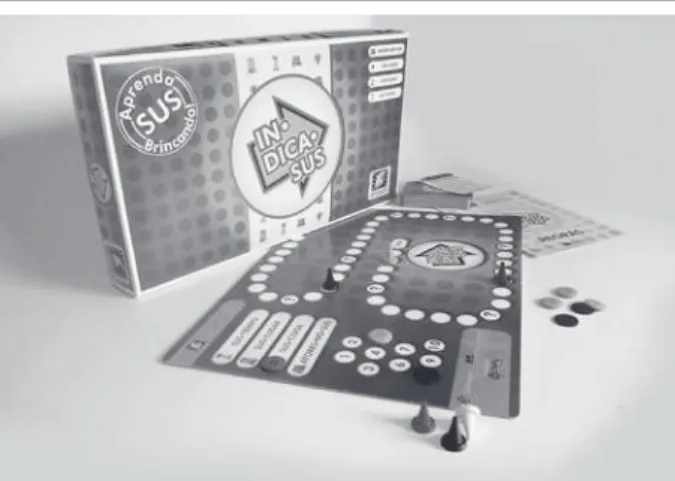
SUS (Thing, Actors, Place and SUS-Time), the number of hints contained on each card, and the inclusion of the pedagogic objective and the rule about helping colleagues during the game (Picture 1). The number of hints on each card was reduced, being restricted to ten, so as to maintain the game’s momentum. The matches lasted, on average, 1 hour thirty minutes, including time
spent reading the rules. The redeinition of the
types of cards consisted of the substitution of the category ‘SUS-Thing’ with ‘Thing’; of ‘SUS-Actors’ with ‘People’; of Place’ with ‘Place’ and ‘SUS-Time’ with ‘Year’ (Figure 1). The aim was to facili-tate understanding of the concepts and guidelines (‘SUS-Thing’); of the spaces for discussion and production (SUS-Place), of the social movements and institutions (‘SUS-Actors’) and the historical landmarks in health policy in Brazil (‘SUS-Time’).
The participant observation and the records
in the ield diary indicated the need to improve
the playability of the educational technology: a) the rules, the cards and the boards need to be self-explanatory; b) the seduction of the game be-gins when one opens the box, therefore the quality of the appearance is an important element; c) the more one changes the game away from the original rules, the greater the risk of losing its element of fun; d) the interface with the theory content, in or-der to remain light-hearted, needs to be permeated with humor and/or fantasy; e) the participation or supervision of the lecturer in the game inhibited the students’ fun; f) the reinvention of the rules is inherent to the game; g) the more the players re-invent the rules, the more the group’s integration and active participation is strengthened; and g)
the game lows better in places where there are
no noise restrictions.
Picture 1 – Comparison between the rules of the games Peril 4 and (IN)DICA-SUS
Rules Peril 4 (IN)DICA-SUS
T
h
e
g
a
me
There are 390 new cards with people, places, things and years for you to test your deductive capacity.
The fewer hints you use, the more points you win!
(IN)DICA-SUS is a pedagogic game which addresses the
con-tent of the management and policies of the Uniied Health System (SUS). The dynamic of the proposal consists of reading the ‘hints’ to the participants on topics related to the SUS, stimulating the
players to take risks on the concepts, the places, the times and the social actors who make up public health policy in Brazil, ac-cording to the rules described below.
C
o
mp
o
n
e
n
ts
390 cards each with 20 hints about general knowledge; six pawns; 20 red cards; one
yellow card; ive blue cards, one board.
50 Cards with hints about the running of the SUS; six pawns; 10 red cards; one blue card; ive green cards; one board.
Pe
d
a
g
o
g
ica
l
o
b
je
ct
ive
None
To promote teaching-learning sessions about the management
of the SUS for undergraduate students in the area of health and
interested people in general, mediated by the emotion, creativity, fun, involvement, motivation and active participation stimulated by the game.
O
b
je
ti
ve
o
f
th
e
g
a
me To be the irst player or team to move their
respective pawn to the space marked
‘END’.
To be the irst player or team to move their respective pawn to the space marked ‘END’ on the board, after helping colleagues
in the game.
H
ow
to
p
la
y
1. The players decide among themselves who shall start the game, who shall also be the facilitator. The facili tator takes the irst card from the pile and tells the players what category it belongs to (Peril 4: thing, place, person or year; (IN)DICA-SUS: SUSThing; SUSPlace; SUSTime or SUSActors), placing the yellow card on the respective house on the board.
2. The player sitting to the facilitator’s left chooses a number between 1 and 20 (in Peril 4) or 1 and 10 (in (IN)
DICA-SUS), and, next, places a red card on the house on the board with the same number.
3. The facilitator reads out loud the hint for the number chosen by the player.
4. After the reading of the hint, the player who chose it has the right to venture a guess regarding the identity of the card, saying out loud who or what is referred to in it. Should the player not want to venture a guess, she
The fun, pleasure, emotions and formative components of learning in the game.
The respondents to the questionnaire were undergraduate students of nursing (70-74.4%) and medicine (24-25.5%), female (71-75.5%) and male (23-24.5%), between 21 and 30 years old (77-82%) or younger (15-17%). Undergraduate students stated that they had the habit of individual study (37-39.4%), participative techniques (23-25.5%) or group discussions (14-14.9%). The majority like board games (84-89.4%), motivated by relaxation, interaction, the stimulating dynamics, happiness, fun or childhood experiences. There were some who did not like games (10-10.6%) as they con-sidered them to be long or boring, or did not have the habit, or felt anxious. The participants stated that they often or always had fun or pleasure during games (mean: 4.2 fun; 4.0 pleasure); that they sometimes became tense, and rarely bored (mean: 2.8 tense; 3.6 bored). There was a correla-tion between pleasure and fun in the game (0.55; p=0.000) and between a pleasurable experience and a boring one (0.495; p=0.001).
Regarding the formative components of learning, four of the nine variables initially
pro-posed were conirmed with some groupings of
meaning. The term ‘perception of learning’ was incorporated into the self-assessment variable. The categories extracted from the students’ responses
conirmed learning by association (29-31%), the
self-assessment/perception of learning (25-27%), the understanding of concepts (21-22%), active participation (18-19%) and others (14-15%) as en-couraging learning. On the other hand, previous knowledge, theory-practice contextualization and modes of understanding the SUS, which had been initially expected, were not evidenced in the players’ responses.
Figure 1 - (IN)DICA-SUS game and its components
The emotions and feelings experienced dur-ing the games emerged in the categories ‘desire and pleasure of winning’ (65-69%), ‘lack of interest in the game/desire to stop playing (26-28%) and mo-tivation to study (15-16%). New categories emerged from the results - ‘ambiguity in feelings of pleasure and tension’ (46-49%) and ‘worries/frustration in the game’ (14-15%). Most of the feelings to do with abandoning the game/lack of interest in the game, or worry due to not knowing the content of the cards were present in the accounts from the students at the UnB (26-69%), because the contents
of the cards did not totally relect the contents of the
courses run at the UnB. This was not the case for the students at the UFMG, which is where the game originated. The game’s tactics were satisfactory for the players, who considered that the dynamics facil-itated learning (92-97%), that the rules were easy to understand (82-87%), that the content of the cards
was good quality (92-98%) although dificult at the
same time (72-77%). The students stated that they reinvented the rules during the game in practically all the responses (93-98%). Picture 2 shows some categories and statements from Nursing students (N) and Medical students (M).
Picture 2 – Empirical categories and statements from the (IN)DICA-SUS players
Empirical studies Examples of statements
Learning by association Helped by making us think and even make an effort to give the right answer (N40). Helped because it motivated me to remember what I had learnt about the SUS, and introduced me to new terms and departments of the SUS (M24).
Understanding concepts Helped because I nearly died laughing at things I didn’t know, and I learnt a lot at the same time (N13).
I learnt in an enjoyable way about a topic which, theoretically, in my opinion, is not pleasurable (M15).
Selfassessment/
Perception of learning
I could see that I need to study a little more (N3).
Empirical studies Examples of statements Interaction/Group discussion/
Active participation I felt the teamwork in a way. The people at the same level of knowledge managed to understand each other very well and make the activity pleasurable (N1). It was fun, the interaction with my colleagues was good and, at times, tiring (N5). Desire and pleasure in
winning
Happiness in getting it right and moving ahead of my colleagues. [...] great happiness at my colleagues’ mistakes (N6).
I was proud most of the time because of knowing the subject material (N20). Winning, because we got more and more enthusiastic (N4).
Ambiguity in feelings of
pleasure and tension
I felt tense at the same time as I felt relaxed (N7). Anxiety, anguish, happiness (N15).
I wanted to win because of the emotion of the game. I didn’t want to abandon the game, but there were times when I was indifferent (N5).
Lack of interest in the game/
Desire to abandon the game I wanted to stop playing and study everything all over again, as I felt like I didn’t know anything (N33). I think I felt like quitting the game, as the subject doesn’t interest me (M4).
Abandon the game, I have a lot to study, I didn’t want to lose time (M17).
Motivation for study I wrote down hints and answers which I didn’t know, so I could study them more (N12). During the game, how much I know about the SUS became clear, which motivated me to ind out more about the subject (M8).
I left wanting to study more and play again (N3).
Worry/Frustration I often felt ashamed because of not knowing the answer to some questions (N7). Frustration when I thought I was right, but was wrong (N14).
Reinventing the Game Yes. We only used the easier cards (M18). Yes. We controlled the time for answering in (N10). We weren’t so strict with the answers (M5).
From the observations and records in the ield
diaries about the matches, it was ascertained that: a) ignorance of the contents of the cards was a de-motivating factor; b) other forms of symbolic play took place around the board, such as joking, private codes, gestures and metaphors; c) the enthusiasm increased as victory became imminent; d) not every-body was equally involved in the match; e) rewards, even if symbolic, helped motivate the students; and
f) the afinity for board games, the proile of the
students and the matching of course content with
card content inluence the quality of participation.
The triangulation of the results of the
quan-titative and qualitative stages deined the pleasure
and the tension in the game as variable dependents which indicate the playability of educational tech-nologies for health. The independent dimensions
and variables conirmed are: a) player proile (sex,
schooling, age, profession, liking of board games, study habits); b) formative components of learning (learning by association, perception of learning/ self-assessment, understanding of concepts, in-teraction/group discussion/active participation); c) emotions and attitudes in the game (desire and pleasure in winning, motivation to study, ambiguity in feelings of pleasure and tension in the game, lack of interest/desire to abandon the game, worry/frustration); and d) game tactics (understanding rules, quality of cards, clarity of the board, reinvention in the game).
DISCUSSION
Attention to detail in the construction of a game which reduces the need for further
ex-planations, and which can be modiied by the
players was central in the development of the (IN)DICA SUS game for awakening involvement and abstraction in the participants. As was seen in the observations of the test matches, aspects such as the graphical appearance of the game, the easy understanding of the rules, cards and game dynamics were prioritary for the development of this game-based-learning technology. Studies investigating the user experience in games have enumerated immersion, interaction, challenge, fun, control and player skills as making up the ex-perience.25 It is recommended that a game should not demand special skills of the participant, who
should have suficient information to start playing
without having to read lengthy texts or excessive explanations about the rules – which can demoti-vate the player.
When constructing an educational technol-ogy set in the irreverent characteristics of play and not restricted to the purposes of utilitarian production, it is necessary to pay attention to those
results which show the inluence of the teaching
character of the participation of the professor in the matches, in the students’ demotivation when
faced with the dificulty of the hints, or in the frus -tration of the players in not knowing the answers to the cards. At all times in the investigation and amongst the complementarity of the information, a more horizontal dialog was sought between the approach to the SUS in the disciplines in the area of health and in maintaining the inventive charac-teristics of the game. It was seen that the play, the
environment for relexive creativity, needs to be
constantly repositioned in the educational context so as to strengthen its emancipatory potential.11-17
The proile of the players and the context
in which the matches occur are characteristics
which inluenced the assessment of the playabil -ity, of the formative components of the learning, of the emotions in the matches and of the tactics of the (IN)DICA-SUS game. One may analyze the greater interest aroused in those who have or had agreeable experiences with games, whether in the present or in childhood, as a psychological factor proper to the experience of playing in human de-velopment.28 The tension between the subjection to rules and renunciation of impulsive action as a requirement for access to pleasure is part of the meaning of the toy and the game in childhood, with repercussions for human development. The psychological and historical-cultural development of how people deal with desire, moving on from the instinctive need for immediate realization to a unit of contrasts between desire and control, includes the experience of playing in childhood and in life. Hence, the rule as an integral part of the game is, at the same time, a factor of submission and subversion of what is real, ambiguously, itself constituting an object of desire.28-29 Such aspects became clear in the results, especially in the
re-deinition of the dependent indicator variables for
playability in educational technology for health, which better incorporate the dialectical forces which constitute it.15-17,28-29
The lack of interest in the games, created by the players’ ignorance of the areas covered in the cards, or by their considering the experience to be irrelevant, may be explained in theories of motiva-tion for learning30 and in the interpretation of the symbolic game.31 The ARCS (Attention, Relevance,
Conidence, Satisfaction) analytical model which
is used both in assessment of games and in the production of interactive educational technologies, brings together four categories for motivation in
learning processes: attention, relevance, coni
-dence and satisfaction.30 From this perspective, it is a pedagogical strategy which produces positive expectations of success and recognition, which are motivational factors intrinsic to learning.
The characteristic of immersion, on the other hand, inherent to the game, arouses not only pos-itive feelings, but also negative emotions, such as anxiety and discomfort.32
The unit of opposites was also present in the assessments of the (IN)DICA-SUS game as a facilitator of learning. Learning by association, the grasping of concepts, self-assessment and motivation for studying amidst the ambiguity in the feelings of pleasure and tension in the game, in which euphoria or desire to abandon the game are close feelings, were reported. The dialectical constitution itself of play in human development
was conirmed, in which pleasure and tension are
driving forces of the participative involvement required in the game.15-17,28-30
The non-conirmation of variables which are
close to formal education, such as previous knowl-edge, theory-practice contextualization, and ways of understanding the SUS are good examples of the irreverence of the game on the bonds of the teach-ing process. In the dialog between health policies and the spontaneity of play, the content-oriented expectations of traditional education excel. With the development of educational technology, the exercise was rescued from the disruption, and the multiple meanings of the game for education.
CONCLUSION
The development of the (IN)DICA-SUS game included the relevancy of the inventive, imagina-tive and sharing characteristics as potential for the
autonomy of relexive subjects, setting multiple
learnings and going beyond teaching about the SUS, although starting with this. The learning sought for health professionals through gaming covers the plural aspects of human development, such as group interaction, active participation,
ca-pacity for self-relection, the motivation for study
and the desire to win, which are necessary for the construction of juster and democratic societies, in which the concept of health transcends the absence of illness. The predominance of the game over any other aim apart from itself was understood, this requiring an environment free of restrictions, in-trinsic to gaming culture, grounded in happiness, in sharing, in celebration and in involvement.
playability of educational technology for health
identiied in the study guide the construction of
evaluative questionnaires and pedagogic strate-gies directed at imagination, fun, spontaneity, and
critical-relexive training of health professionals.
As limitations of the study, one can indicate the need for quantitative investigations, with a sam-pling plan, multivariate and inferential analysis,
so as to validate the factors signiicantly associated
with pleasure and tension in the game.
REFERENCES
1. Niemeyer F, Silva KS, Kruse MHL. Diretrizes curriculares de enfermagem: governando corpos de enfermeiras. Texto Contexto Enferm. 2010 Out-Dez; 19(4):767-73.
2. Lucchese R, Vera I, Pereira WR. As políticas públicas de saúde/SUS como referência para o processo ensino-aprendizagem do enfermeiro. Rev Eletr Enf [online]. 2010 Jul-Set [acesso 2013 Mar 27]; 12(3):562-6. Disponível em: http://dx.doi.org/10.5216/ree. v12i3.11144
3. Renovato RD, Bagnato MHS. Práticas educativas em saúde e a constituição de sujeitos ativos. Texto Contexto Enferm. 2010 Jul-Set; 19(3):554-62. 4. Sobral FR, Campos CJG. Utilização de metodologia
ativa no ensino e na assistência de enfermagem na produção nacional: revisão integrativa. Rev Esc Enferm USP. 2012 Fev; 46 (1):208-18.
5. Akl EA, Sackett K, Pretorius R, Erdley S, Bhoopathi PS, Mustafa R, et al. Educational games for health professionals. Cochrane Database Syst Rev. 2008 Jan 23 [acesso 2013 Mar 27]; (1):. Disponível em: http:// onlinelibrary.wiley.com/doi/10.1002/14651858. CD006411.pub2/pdf/abstract
6. Akl EA, Pretorius R, Sackett K, Erdley S, Bhoopathi PS, Alfarah Z, Schunemann HJ. The effect of educational games on medical students’ learning outcomes: a systematic review: BEME Guide No 14. Med Teach. 2010 Jan; 32(1):16-27.
7. DeShazo J, Harris L, Pratt W. Effective intervention or child’s play? A review of video games for diabetes education. Diabetes Technol Ther. 2010 Oct; 12(10):815-22.
8. Magalhães CR. O jogo como pretexto educativo: educar e educar-se em curso de formação em saúde. Interface (Botucatu). 2007 Set-Dez; 11(23):647-54. 9. Shatkoski AM, Catalan VM, Silva APSS, Alves RHK,
Pedro, ENR, Cogo ALP. Hipertexto, jogo educativo e simulação sobre oxigenoterapia: avaliando sua utilização junto a acadêmicos de enfermagem.
Online Braz J Nurs [online]. 2007 Jan [acesso 2013
Mar 27]; 6(0):1-8. Disponível em:http://www. objnursing.uff.br/index.php/nursing/article/ view/636/149
10. Chanes M, Leite MMJ. Mensuração de conhecimento adquirido por meio de jogo lúdico de liderança. Nursing. 2008 Fev; 10(117):70-4.
11. Alves MA. O modelo estrutural do jogo hermenêutico como fundamento ilosóico da educação. Ciênc Educ. 2011 Jan-Mar; 17(1):235-48.
12. Brougère G. Jogo e educação. Porto Alegre (RS): Artes Médicas; 1998.
13. Popkewitz TS. Lutando em defesa da alma: a construção do ensino e a construção do professor. Porto Alegre (RS): Artmed; 2001.
14. Mészaros I. A educação para além do capital. São Paulo (SP): Boitempo; 2005.
15. Callois R. Os homens e os jogos: a máscara e a vertigem. Lisboa (PT): Cotovia; 1990.
16. Huizinga J. Homo Ludens: o jogo como elemento da cultura. 5ª ed. São Paulo (SP): Perspectiva; 2008. 17. Gadamer HG. A atualidade do belo: a arte como jogo, símbolo e festa. Rio de Janeiro (RJ): Tempo Brasileiro; 1985.
18. Pires MRGM. Recriar-se: arte, lúdico e tecnologias educativas na saúde [relatório de pesquisa]. Brasília (DF): Universidade de Brasília, Núcleo de Estudos em Promoção da Saúde e Projetos Inclusivos, Centro de Estudos Avançados Multidiplinares; 2011.
19. Sampieri RH, Collado CF, Lúcio PB. Metodologia de pesquisa. 3ª ed. São Paulo (SP): McGraw-Hill; 2006. 20. Creswell JW. Projeto de pesquisa: métodos
quantitativo, qualitativo e misto. Porto Alegre (RS): Artmed; 2010.
21. Minayo MCS. O desaio do conhecimento: pesquisa qualitativa em saúde. 9ª ed. São Paulo (SP)/Rio de Janeiro (RJ): HUCITEC/ABRASCO; 2006.
22. Yin R. Estudo de caso: planejamento e métodos. Porto Alegre (RS): Bookman; 2001.
23. Pires AP. Amostragem e pesquisa qualitativa: ensaio teórico e metodológico. In: Poupart J, Deslauriers JP, Groulx LH, Laperrière A, Mayer R, Pires AP. A pesquisa qualitativa: enfoques epistemológicos e metodológicos. Petrópolis (RJ): Vozes; 2008; p.154-211.
24. Hill MM, Hill A. Investigação por questionário. 2ª ed. Lisboa (PT): Edições Silabo; 2009.
25. Hair JR JF, Anderson RE, Tatham RL, Black WC.
Análise multivariada de dados. Porto Alegre (RS):
Bookman; 2005.
26. Savi R,Wangenheim VGC, Ulbricht V, Vanzin T. Proposta de modelo de avaliação de jogos educativos. Novas Tecnologias da Educação [online]. 2010 Dez [acesso 2012 Dez 12]; 8(3): Disponível em: http:// seer.ufrgs.br/renote/article/view/18043
28. Monroe KM. Análise do (IN)DICA-SUS: O peil da gestão na saúde como técnica de ensino e de avaliação: em busca de profissionais críticos e reflexivos [dissertação]. Belo Horizonte (MG): Universidade Federal de Minas Gerais, Programa de Pós-Graduação em Enfermagem; 2010.
29. Vigotsky LS. A formação social da mente. 4ª ed. São Paulo (SP): Martins Fontes; 1991.
30. Pimentel AA. Ludicidade na educação infantil: uma
abordagem histórico-cultural.Psicol Educ. 2008 Jun;
26(1):109-33.
31. Keller JM. Motivational design for learning and performance: The ARCS Model Approach. Flórida (US): Sprinter; 2009.
32. Fontes FF. O conlito psíquico na teoria de Freud. Psyche (São Paulo) [online]. 2008 Dez; 12(23): [acesso 2012 Dez 12] Disponível em: http:// pepsic.bvsalud.org/scielo.php?script=sci_ arttext&pid=S141511382008000200011
33. Jennet C, Cox AL, Cairns P, Epps A, Tijs T, Walton A. Measuring and defining the experience of immersion in games. Int J Hum-Comput Stud. 2008 Sep; 66(9):641-61.
Correspondence: Maria Raquel Gomes Maia Pires Departamento de Enfermagem/Faculdade de Saúde Campus Universitário Darcy Ribeiro
70910-900 – Asa Norte. Brasília, DF, Brasil E-mail: [email protected]