Predictors of major postoperative complications in neonatal
Predictors of major postoperative complications in neonatal
Predictors of major postoperative complications in neonatal
Predictors of major postoperative complications in neonatal
Predictors of major postoperative complications in neonatal
surgery
surgery
surgery
surgery
surgery
Fatores preditivos de complicações graves em cirurgia neonatal
Fatores preditivos de complicações graves em cirurgia neonatal
Fatores preditivos de complicações graves em cirurgia neonatal
Fatores preditivos de complicações graves em cirurgia neonatal
Fatores preditivos de complicações graves em cirurgia neonatal
DORA CATRÉ1; MARIA FRANCELINA LOPES2; ANGEL MADRIGAL3; BÁRBARA OLIVEIROS4; ANTÓNIO SILVÉRIO CABRITA5; JOAQUIM SILVA VIANA6;
JOSÉ FARELA NEVES7
A B S T R A C T A B S T R A C T A B S T R A C T A B S T R A C T A B S T R A C T
Objective Objective Objective Objective
Objective: To investigate the incidence and severity of early postoperative complications and to identify their risk factors in newborns undergoing surgery under general anesthesia. MethodsMethodsMethodsMethodsMethods: We conducted a retrospective analysis of data from 437 critically ill newborns undergoing surgery in a tertiary pediatric surgical center, between January 2000 and December 2010. Complications that occurred within the first 30 days after surgery were classified using the Clavien-Dindo system, for which grades III to V were considered severe. We used univariate and multivariate analysis to evaluate pre- and intraoperative variables potentially predictive of severe postoperative complications. ResultsResultsResultsResults: The incidence of at least one seriousResults complication was 23%, with a median of one complication per patient 1:3. Altogether, there were 121 serious complications. Of these, 86 required surgical, endoscopic or radiological interventions (grade III), 25 endangered life, with uni or multi-organ failure (grade IV) and ten resulted in death (grade V). The most common complications were technical (25%), gastrointestinal (22%) and respiratory (21%). We identified four independent risk factors for severe postoperative complications: reoperation, operation for congenital diaphragmatic hernia, preterm birth less than 32 weeks of gestational age and abdominal surgery. ConclusionConclusionConclusionConclusion: The incidence of severe postoperative complications after neonatal surgeriesConclusion under general anesthesia remains high. The conditions considered independent risk factors for those can guide interventions to improve results.
Key words: Key words: Key words: Key words:
Key words: Morbidity. General surgery. Severity of illness index. Outcome assessment (health care). Infant, newborn.
Work performed in the Pediatric Intensive Care Unit (UTIP) of the Coimbra Pediatric Hospital (HPC).
1. Anesthesiology Department, Tondela-Viseu Hospital Center, EPE, Viseu, Portugal; 2. Pediatric Surgery Service, Coimbra University Hospital Center, EPE, Coimbra, Portugal; 3. Pediatric Anesthesiology Service, Coimbra University Hospital Center, EPE, Coimbra, Portugal; 4. Biostatistics and Medical Informatics Department, Faculty of Medicine, University of Coimbra, Coimbra, Portugal; 5. Faculty of Medicine, University of Coimbra, Coimbra, Portugal; 6. Faculty of Health Sciences (Anesthesiology), University of Beira Interior, Covilhã, Portugal; 7. Pediatric Intensive Care Unit, Coimbra University Hospital Center, EPE, Coimbra, Portugal.
INTRODUCTION
INTRODUCTION
INTRODUCTION
INTRODUCTION
INTRODUCTION
T
he neonatal surgical treatment evolved continuously in the last 50 years. Despite improvements in anesthesia / surgery techniques, neonatal surgery continues to be a major cause of morbidity and mortality, especially in highly vulnerable population of infants 1-3. With a better understanding of the severity and risk factors for the development of postoperative complications among operated newborns, efforts can be targeted for prevention of morbidity.The classification system for postoperative complications presented by Clavien 4 and later revised 5, has recently been used in several studies of pediatric surgical areas. This classification categorizes postoperative complications in grades from I to V according to their need for treatment.
The analysis of factors predictive of postoperative complications in neonates is still incomplete.
By applying the Clavien-Dindo5 classification to a series of surgical newborns in critical condition treated in a regional tertiary pediatric center, the objectives of this study were, first, to analyze the incidence and severity of postoperative complications within the first 30 days after neonatal surgery under general anesthesia at our center, and secondly, to investigate pre- and intraoperative risk factors for developing early severe postoperative morbidity.
METHODS
METHODS
METHODS
METHODS
METHODS
The data for this study were collected from a database prospectively maintained pediatric intensive care unit (UTIP), including demographic and clinical data of all newborns admitted to the UTIP of the Coimbra Pediatric Hospital of (HPC).
whose neonatal surgery was performed at the HPC between January 2000 and December 2010.
Cases were considered eligible if they met the following criteria: patients undergoing surgical procedures under general anesthesia during the neonatal period (0-28 days old), admitted to the UTIP, preoperatively or within the first six postoperative hours, and whose surgery was completed in the HPC.
We excluded the following cases: 1) newborn patients undergoing surgery outside of HPC; 2) newborn patients who underwent anesthesia not associated with surgical procedures, 3) newborn patients operated on HPC but without admission to the UTIP.
The analysis of the clinical database was supplemented with a review of individual medical records. Institutional permission was obtained to review the clinical information of patients in compliance with standards of protection of individual data and the ethical requirements of the Ethics in Research Committee of our hospital center. We collected information on demographics, pre, intra and postoperative clinical status, complications and outcomes.
The outcomes of interest were the identification, quantification and classification of postoperative complications that occurred in the first 30 days after neonatal surgery, using the classification of Clavien-Dindo 5 (Table 1) and the identification of preoperative and intraoperative risk factors for severe postoperative complications, defined as grades III to V.
Complications were defined as adverse events that were not related to the preoperative surgical condition. Abdominal surgery was defined as any surgical procedure performed in the abdominal cavity.
The 437 patients were divided into two groups based on postoperative complications. One group included patients with grades III-V Clavien-Dindo (severe) complications. Patients who did not have complications or
who had complications grades I or II comprised the control group.
The potential association of morbidity risk in the first 30 postoperative days with demographic characteristics at birth and during surgery related to the surgical procedure were assessed by univariate analysis.
Some continuous variables were converted into categorical variables for statistical analysis. The analysis of birth weight percentile was performed using specific charts for sex and gestational age 6. Surgical indication for acquired disease was defined as a surgical condition occurring after birth.
Categorical variables are presented as absolute values (percentage). Quantitative variables are presented as median and minimum and maximum values, or as median and interquartile range (25-75 percentiles).
Quantitative variables were compared using the Mann -Whitney test, as appropriate for the non-normal distribution of data. Qualitative variables were compared by Chi-square and Fisher exact tests, as appropriate.
We comparatively analyzed variables related to demographic characteristics at birth and during surgery, and the ones related to the surgical procedure, in patients with and without serious complications. The statistically significant variables (p < 0.05) were selected for inclusion in the multiple logistic regression model, which was used to determine independent predictors of severe postoperative complications. Thus, we included in our model the following variables: preterm birth less than 32 weeks gestation, operative weight at the first surgery, more than one anesthetic / surgical intervention, ASA 3 to 5, intravenous anesthesia, abdominal surgery and congenital diaphragmatic hernia surgery, necrotizing enterocolitis, congenital abdo-minal wall defects (omphalocele / gastroschisis), intestinal atresia and anorectal malformations. We performed the Hosmer-Lemeshow and Omnibus tests to determine the quality of fit and model performance, respectively.
Table 1 Table 1Table 1 Table 1
Table 1- Clavien-Dindo Classification of Surgical Complications 5.
D e g r e e D e g r e eD e g r e e D e g r e e
D e g r e e D e f i n i t i o nD e f i n i t i o nD e f i n i t i o nD e f i n i t i o nD e f i n i t i o n
I Any deviation from the normal postoperative course without need of intervention beyond the administration of antiemetics, antipyretics, analgesics, diuretics, electrolytes and physical therapy #
II Complication requiring pharmacological treatment with other medicines beyond the ones used for the complications of degree I.
III Complication requiring surgical, endoscopic or radiological intervention III-a Intervention without general anesthesia
III-b Intervention under general anesthesia
IV Life-threatening complication requiring admission to intensive care unit IV-a Uni-organ dysfunction (including dialysis)
IV-b Multi-organ dysfunction
V Death
Variables with odds ratios and 95% confidence intervals (CI) different than one were considered as having a significant independent association with morbidity.
We considered p < 0.05 considered as statistically significant.
RESULTS
RESULTS
RESULTS
RESULTS
RESULTS
Of the 1055 newborns admitted to the UTIP between January 1st, 2000 and December 31st, 2010, 437 (41%) patients met the inclusion criteria. In these infants, 558 operations were performed under general anesthesia, for a total of 636 surgical procedures.
The mean gestational age at birth was 37 weeks (range, 24-41) and median birth weight was 2760 g (range 440-4350). Statistical analysis of gestational age and weight at birth showed no significant difference between the groups with and without severe complications.
In total, 56% (244) of the newborns were male and 15% (66) were born preterm at less than 32 weeks gestation, of which 90% (56) had very low birth weight (less than 1500g) and 81.5% (356) had congenital malformations requiring neonatal surgery.
Of the 437 newborns undergoing anesthesia / surgery, 242 (55%) showed no postoperative complication. Three hundred and seventy complications were recorded until the 30th postoperative day, a total of 195 children, of which 99 (23%) had 121 severe complications (range: 1-3, median 1).
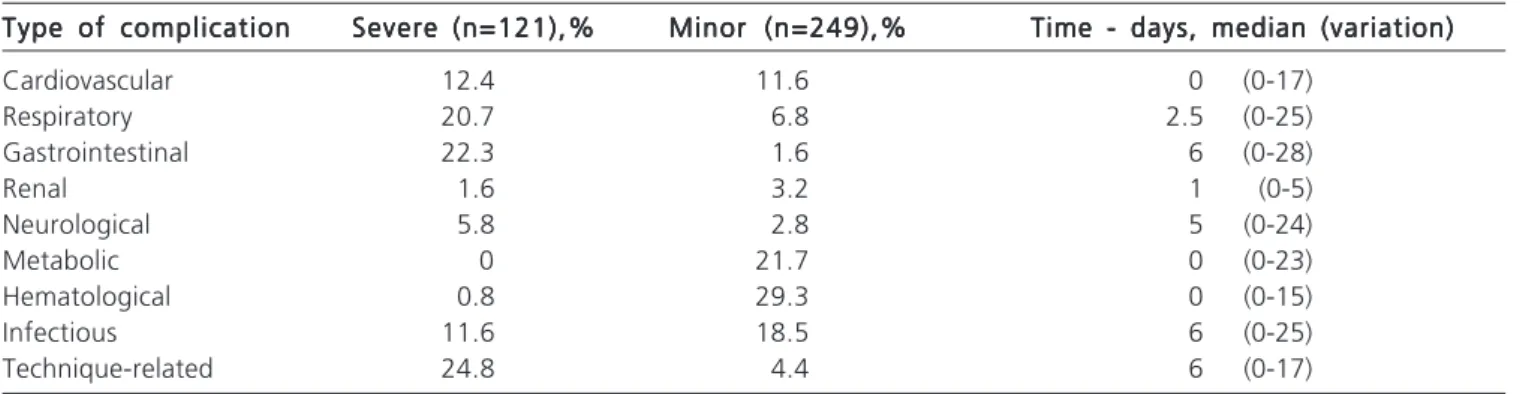
Complications categorized according to the Clavien-Dindo classification are shown in Table 2, and their type and time of occurrence are presented in Table 3. Two thirds of all complications were grade I or II and were mostly hematological, metabolic and infectious. Of the 121 serious complications, 86 required surgical, endoscopic or radiological intervention (grade III), 25 were life-threatening, with severe uni or multi-organ dysfunction (grade IV) and ten resulted in death (grade V). The main complications were predominantly technical (25%), gastrointestinal (22%) and respiratory (21%). Among all postoperative
complications, about half (51%) were identified within 48 hours, 37% between the second and ninth days and the remaining 12% between the tenth and 30th days.
Severe complications of grade V accounted for 45% (10/22) of deaths in the first postoperative 30 days.
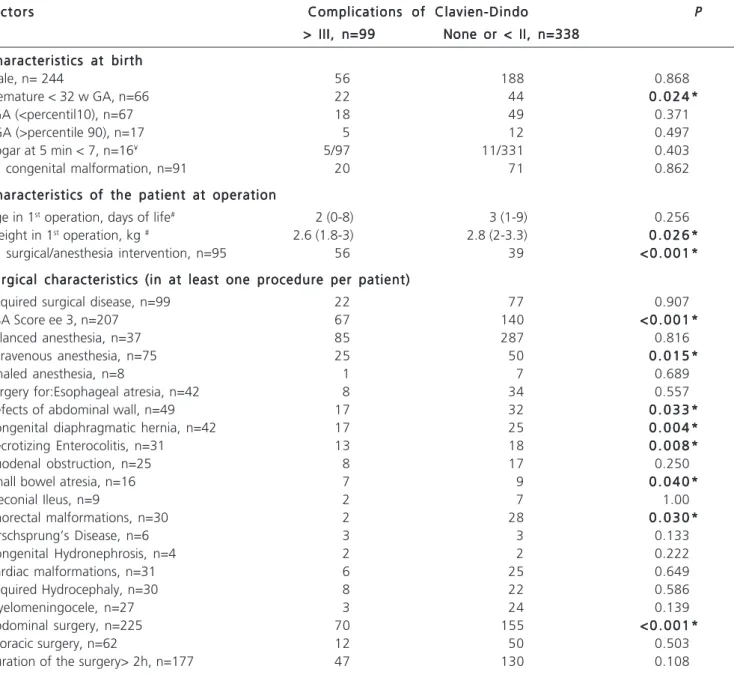
The effect of preoperative and intraoperative variables on the occurrence and severity of postoperative complications are presented in Table 4. The occurrence of serious complications (grade III-V) was significantly associated with preterm birth less than 32 weeks gestational age (p = 0.024) and significantly low weight at the first operation (p = 0.046). Children with more than one anesthetic / surgical intervention (p < 0.001), ASA 3-5 (p < 0.001), intravenous anesthesia (p = 0.013-5), surgical repair of congenital diaphragmatic hernia (p = 0.004), abdominal wall congenital defects (p = 0.033), necrotizing enterocolitis (p = 0.008), atresia of the small intestine (p = 0.040), anorectal malformation (p = 0.03) and abdomi-nal surgery (p < 0.001) were significantly more likely to have severe complications. On the other hand, the remaining variables of Table 4, also tested with univariate analysis, were not significantly associated with serious complications.
Based on univariate analysis, we included the following variables in our multivariate logistic regression
Table 2 Table 2 Table 2 Table 2
Table 2 - Categorization of the 370 complications according to the Clavien-Dindo classification system.
Categorization/Degree Categorization/Degree Categorization/Degree Categorization/Degree
Categorization/Degree n (%)n (%)n (%)n (%)n (%) Minor complications
Degree I 36 (9.7)
Degree II 213 (57.6)
Severe complications
Degree IIIa 22 (5.9)
Degree IIIb 64 (17.3)
Degree IVa 13 (3.5)
Degree IVb 12 (3.2)
Degree V 10 (2.7)
Table 3 Table 3 Table 3 Table 3
Table 3 - Type and time of occurrence of complications.
Type of complication Type of complication Type of complication Type of complication
Type of complication Severe (n=121),%Severe (n=121),%Severe (n=121),%Severe (n=121),%Severe (n=121),% Minor (n=249),%Minor (n=249),%Minor (n=249),%Minor (n=249),%Minor (n=249),% Time - days, median (variation)Time - days, median (variation)Time - days, median (variation)Time - days, median (variation)Time - days, median (variation)
Cardiovascular 12.4 11.6 0 (0-17)
Respiratory 20.7 6.8 2.5 (0-25)
Gastrointestinal 22.3 1.6 6 (0-28)
Renal 1.6 3.2 1 (0-5)
Neurological 5.8 2.8 5 (0-24)
Metabolic 0 21.7 0 (0-23)
Hematological 0.8 29.3 0 (0-15)
Infectious 11.6 18.5 6 (0-25)
model to determine the predictors of severe postoperative complications: preterm birth less than 32 weeks gestation, weight operative in the first surgery, more than one anesthetic / surgical intervention, ASA 3-5, intravenous anesthesia, abdominal surgery and surgery of congenital diaphragmatic hernia, necrotizing enterocolitis, congenital abdominal wall defects (omphalocele / gastroschisis), in-testinal atresia and anorectal malformations. Our model showed good performance and good suitability by Omnibus (c2 = 111.853, p < 0.001) and Hosmer-Lemeshow (c2 = 0.347, p = 0.987) tests, respectively.
Only four factors remained statistically significant in multivariate analysis (Table 5): more than one intervention, surgical repair of congenital diaphragmatic hernia, preterm birth less than 32 weeks gestation and abdominal surgery.
DISCUSSION
DISCUSSION
DISCUSSION
DISCUSSION
DISCUSSION
This study has two main findings. Firstly, neonates with anesthetic / surgical procedures had a high incidence
Table 4 Table 4 Table 4 Table 4
Table 4 - Characteristics of the neonates presenting with severe complications (degrees of Clavien-Dindo ee III) and of the ones with Clavien-Dindo degrees I or II complications, and their association in the univariate analysis.
F a c t o r s F a c t o r sF a c t o r s F a c t o r s
F a c t o r s Complications of Clavien-DindoComplications of Clavien-DindoComplications of Clavien-DindoComplications of Clavien-DindoComplications of Clavien-Dindo PPPPP >
> > >
> III, n=99 III, n=99 III, n=99 III, n=99 III, n=99 None or None or None or <None or None or <<<< II, n=338 II, n=338 II, n=338 II, n=338 II, n=338 Characteristics at birth
Characteristics at birthCharacteristics at birth Characteristics at birth Characteristics at birth
Male, n= 244 56 188 0.868
Premature < 32 w GA, n=66 22 44 0 . 0 2 4 *0 . 0 2 4 *0 . 0 2 4 *0 . 0 2 4 *0 . 0 2 4 *
SGA (<percentil10), n=67 18 49 0.371
BGA (>percentile 90), n=17 5 12 0.497
Apgar at 5 min < 7, n=16¥ 5/97 11/331 0.403
>1 congenital malformation, n=91 20 71 0.862
Characteristics of the patient at operation Characteristics of the patient at operationCharacteristics of the patient at operation Characteristics of the patient at operation Characteristics of the patient at operation
Age in 1st operation, days of life# 2 (0-8) 3 (1-9) 0.256
Weight in 1st operation, kg # 2.6 (1.8-3) 2.8 (2-3.3) 0 . 0 2 6 *0 . 0 2 6 *0 . 0 2 6 *0 . 0 2 6 *0 . 0 2 6 *
>1 surgical/anesthesia intervention, n=95 56 39 < 0 . 0 0 1 *< 0 . 0 0 1 *< 0 . 0 0 1 *< 0 . 0 0 1 *< 0 . 0 0 1 * Surgical characteristics (in at least one procedure per patient)
Surgical characteristics (in at least one procedure per patient)Surgical characteristics (in at least one procedure per patient) Surgical characteristics (in at least one procedure per patient) Surgical characteristics (in at least one procedure per patient)
Acquired surgical disease, n=99 22 77 0.907
ASA Score ee 3, n=207 67 140 < 0 . 0 0 1 *< 0 . 0 0 1 *< 0 . 0 0 1 *< 0 . 0 0 1 *< 0 . 0 0 1 *
Balanced anesthesia, n=37 85 287 0.816
Intravenous anesthesia, n=75 25 50 0 . 0 1 5 *0 . 0 1 5 *0 . 0 1 5 *0 . 0 1 5 *0 . 0 1 5 *
Inhaled anesthesia, n=8 1 7 0.689
Surgery for:Esophageal atresia, n=42 8 34 0.557
Defects of abdominal wall, n=49 17 32 0 . 0 3 3 *0 . 0 3 3 *0 . 0 3 3 *0 . 0 3 3 *0 . 0 3 3 * Congenital diaphragmatic hernia, n=42 17 25 0 . 0 0 4 *0 . 0 0 4 *0 . 0 0 4 *0 . 0 0 4 *0 . 0 0 4 * Necrotizing Enterocolitis, n=31 13 18 0 . 0 0 8 *0 . 0 0 8 *0 . 0 0 8 *0 . 0 0 8 *0 . 0 0 8 *
Duodenal obstruction, n=25 8 17 0.250
Small bowel atresia, n=16 7 9 0 . 0 4 0 *0 . 0 4 0 *0 . 0 4 0 *0 . 0 4 0 *0 . 0 4 0 *
Meconial Ileus, n=9 2 7 1.00
Anorectal malformations, n=30 2 28 0 . 0 3 0 *0 . 0 3 0 *0 . 0 3 0 *0 . 0 3 0 *0 . 0 3 0 *
Hirschsprung’s Disease, n=6 3 3 0.133
Congenital Hydronephrosis, n=4 2 2 0.222
Cardiac malformations, n=31 6 25 0.649
Acquired Hydrocephaly, n=30 8 22 0.586
Myelomeningocele, n=27 3 24 0.139
Abdominal surgery, n=225 70 155 < 0 . 0 0 1 *< 0 . 0 0 1 *< 0 . 0 0 1 *< 0 . 0 0 1 *< 0 . 0 0 1 *
Thoracic surgery, n=62 12 50 0.503
Duration of the surgery> 2h, n=177 47 130 0.108
(23%) of severe postoperative complications (grades III to V according to Clavien-Dindo classification). Secondly, we found four independent risk factors for severe postoperative complications in operated newborns: more than one anesthetic / surgical intervention, congenital diaphragmatic hernia surgery, prematurity less than 32 weeks gestation and abdominal surgery.
The UTIP (Pediatric ICU) of our hospital is a tertiary care regional unit for about 100 newborn patients per year, including all surgical cases. The central region of Portugal is served by two other tertiary perinatal centers affiliated with our medical-surgical UTIP and by a specialized neonatal and pediatric emergency transport service to transfer newborns at risk for other health units within our reference area. At HPC the team of health care providers is highly specialized in the treatment of neonates with life-threatening conditions, including pediatric surgeons and pediatric anesthesiologists. All neonatal surgery specialties are available at this hospital, except for open-heart cardiac surgery, which is performed at an affiliated adults hospital. This study shows that the newborn surgery remains an important cause of severe morbidity, even in a reference center for such operations. One goal of the study was to quantify the incidence of various complications of neonatal anesthetic / surgical procedures, providing the intensive care unit staff, surgeons and anesthetists with the information required to clarify the parents about the risks of neonatal surgery.
This is the first study to determine the rate of severe postoperative complications following a wide variety of surgical procedures in newborns. In addition, it allowed the systematization and categorization by degree of severity through the use of a known classification system for postoperative complications in general surgery. Since 2004 this classification has been used in multiple studies of adults and in several pediatric studies, proving to be a reliable tool to measure health outcomes7,8. However, to our knowledge, although many studies on the subject using this classification have been published recently 7, there are few in Pediatric Surgery 9-11 and none for the neonatal period. An additional dimension of this study was the systematic use of this classification system for characterizing
the severity of complications in a series of neonates operated who shared the common characteristic of having undergone surgery under general anesthesia, for the treatment of a wide variety of clinical neonatal problems, and post-operative stay in the UTIP. Sufficient detail was provided by the Clavien-Dindo classification system, with estimation of 23% of severe complications, including a 2.7% rate of grade V complications. Furthermore, this classification system is easier to use.
Progress in neonatal surgery, with a high degree of success and increasing reports of lower adverse outcomes, was negatively influenced by several demographic factors known to be associated with higher risk of severe postoperative complications, which are very common in this population. Prematurity and low birth weight are examples of these factors 12-16. Besides the usual association of these conditions with a stressful process for the components of the health team in the operating room, even for the most seasoned, these newborns are usually severely ill, creating a hostile environment, with greater propensity for complications.
In agreement with other studies that analyzed the postoperative results in premature babies in specific surgical contexts 12,15, preterm birth less than 32 weeks of gestation significantly influenced in an adverse outcome after neonatal surgery in uni and multivariate statistical analyzes. In the current study, this feature has increased by 2.7 times the likelihood of having a severe postoperative complication.
Among the various clinical problems faced by the neonatal surgical population, neonates undergoing abdominal surgery to treat a variety of conditions were significantly more likely to experience major postoperative complications. Of these, we can specify the surgical treatment for necrotizing enterocolitis 17, a disease known for the risk it poses to, mainly related to immaturity and low birth weight 17-19, and surgical treatment for various congenital diseases 20-23, ie omphalocele / gastroschisis 20 and intestinal atresia21. While all these factors lacked statistical significance in our multivariate model, surgery for the correction of congenital diaphragmatic defect was a strong predictor of severe complications. In our study,
Table 5 Table 5 Table 5 Table 5
-Table 5 - Independent predictive factors of early severe postoperative complications among the surgical neonates admitted to the UTIP.
Factor Factor Factor Factor
Factor Early severe postoperative complicationEarly severe postoperative complicationEarly severe postoperative complicationEarly severe postoperative complicationEarly severe postoperative complication Odds Ratio
Odds Ratio Odds Ratio Odds Ratio
Odds Ratio 9 5 %9 5 %9 5 %9 5 %9 5 % C IC IC IC IC I PPPPP
More than one intervention 12.008 6.795 21.223 <0.001
CDH Repair 3.843 1.732 8.526 0.001
Premature <32 s GA 2.666 1.355 5.245 0.005
Abdominal surgery 2.541 1.462 4.416 0.001
children who required repair of congenital diaphragmatic defects had significantly greater likelihood of postoperative complications. In this and other studies 22-23, the repair of diaphragmatic defects was performed by abdominal or chest access, the abdominal one frequently leading to gastrointestinal complications requiring abdominal reoperation 22.
Despite our efforts, there were some limitations in this study. The design was retrospective and may have introduced biases in the classification. Furthermore, the data refer to a single center, and the study population is limited to patients admitted to our tertiary intensive care unit, not considering, on the one hand, the more specific morbidity of children operated out of our pediatric hospital (open heart procedures) and, on the other, the lower morbidity of newborns operated without critical illness or risk factors serious enough to warrant admission to the intensive care unit. Furthermore, although this study includes a good number of patients, it reports the degree of severity of the complications occurred postoperatively in all neonatal surgery, which is very broad, including congenital diseases and malformations with different prognosis and complications.
These limitations are overcome by the strengths of this study. First, it fills a gap in the literature by specifically
addressing the complications of the neonatal surgical population, doing it in terms of quantification and systematization into categories, and also by establishing associations with risk factors. Secondly, it was based on a very complete database, which included clinical and demographic details of a large sample of neonatal surgical patients from a wide area of our country, collected for more than a decade. The novelty of using the Clavien-Dindo system for neonatal surgery and its apparent usefulness in evaluating the results in this population is, however, offset by the need for further studies to evaluate this classification in relation to the various malformations and disorders of the neonatal period.
In summary, the present study shows, for the first time, a comprehensive systematic analysis of postoperative complications in a variety of neonatal surgical procedures. Moreover, it is the only study we know of that provides information on the incidence and predictors of severe morbidity in surgical neonates. The conditions considered as independent risk factors for severe complications after neonatal surgery can help define the postoperative outcome in neonates with surgical disease and guide interventions to improve results. The recognition of poor prognostic factors allows informed counseling of families and more accurate prediction of possible results.
R E S U M O R E S U M O R E S U M O R E S U M O R E S U M O
Objetivo Objetivo Objetivo Objetivo
Objetivo: investigar a incidência e gravidade das complicações pós-operatórias precoces e identificar fatores de risco para o seu desenvolvimento em recém-nascidos submetidos ao tratamento cirúrgico, sob anestesia geral. MétodosMétodosMétodosMétodosMétodos: análise retrospectiva dos dados de 437 neonatos com doença crítica submetidos à cirurgia neonatal num centro cirúrgico pediátrico terciário, entre janeiro de 2000 e dezembro de 2010. A gravidade das complicações ocorridas nos primeiros 30 dias de pós-operatório foi classificada utilizando o sistema de Clavien-Dindo para complicações cirúrgicas, sendo considerados graves os graus III a V. Por análise estatística uni e multivariada avaliaram-se variáveis pré e intraoperatórias com potencial preditivo de complicações pós-operatórias graves. Resul-Resul-Resul-Resul- Resul-tados
tados tados tados
tados: a incidência de, pelo menos, uma complicação grave foi 23%, com uma mediana de uma complicação por paciente 1:3. Ao todo, ocorreram 121 complicações graves. Destas, 86 necessitaram de intervenção cirúrgica, endoscópica ou radiológica (grau III), 25 puseram em risco a vida, com disfunção uni ou multi-órgão (grau IV) e dez resultaram na morte do paciente (grau V). As principais complicações foram técnicas (25%), gastrointestinais (22%) e respiratórias (21%). Foram identificados quatro fatores de risco independentes para complicações pós-operatórias graves: reoperação, operação por hérnia diafragmática congênita, prematuridade menor que 32 semanas de idade gestacional e cirurgia abdominal. ConclusãoConclusãoConclusãoConclusãoConclusão: a incidência de complicações pós-operatórias graves após cirurgias neonatais, sob anestesia geral, permaneceu elevada. As condições consideradas fatores de risco independentes para complicações graves após a cirurgia neonatal podem ajudar a definir o prognóstico pós-operatório em neonatos com doença cirúrgica e orientar as intervenções para melhoria de resultados.
Descritores: Descritores: Descritores: Descritores:
Descritores: Morbidade. Cirurgia Geral. Índice de gravidade de doença. Avaliação de resultados (cuidados de saúde). Recém-nascido.
REFERENCES
REFERENCES
REFERENCES
REFERENCES
REFERENCES
1. Horbar JD, Carpenter JH, Badger GJ, Kenny MJ, Soll RF, Morrow KA, et al. Mortality and neonatal morbidity among infants 501 to 1500 grams from 2000 to 2009. Pediatrics. 2012;129(6):1019-26. 2. Tomé T, Guimarães H, Bettencourt A, Peixoto JC. Neonatal morbi-mortality in very low birth weight in Europe: the Portuguese experience. J Matern Fetal Neonatal Med. 2009;22 Suppl 3:85-7.
3. Neto MT, Tavares MN, Serelha M, Casella P. A vertente cirúrgica de uma unidade de cuidados intensivos neonatais – 25 anos de experiência. Acta Pediatr Port. 2010;41(6):241-5.
4. Clavien PA, Sanabria JR, Strasberg SM. Proposed classification of complications of surgery with examples of utility in cholecystectomy. Surgery. 1992;111(5):518-26.
6. Olsen IE, Groveman SA, Lawson ML, Clark RH, Zemel BS. New intrauterine growth curves based on United States data. Pediatrics. 2010;125(2):214-24.
7. Clavien PA, Barkun J, de Oliveira ML, Vauthey JN, Dindo D, Schulick RD, et al. The Clavien-Dindo classification of surgical complications: five-year experience. Ann Surg. 2009;250(2):187-96.
8. Slankamenac K, Graf R, Puhan MA, Clavien PA. Perception of surgical complications among patients, nurses and physicians: a prospective cross-sectional survey. Patient Saf Surg. 2011;22;5(1):30.
9. Freilich DA, Cilento BG Jr, Graham D, Zhou J, Retik AB, Nguyen HT. Perioperative risk factors for surgical complications in pediatric urology: a pilot study in preoperative risk assessment in children. Urology. 2010;76(1):3-8.
10. Weinberg AC, Huang L, Jiang H, Tinloy B, Raskas MD, Penna FJ, et al. Perioperative risk factors for major complications in pediatric surgery: a study in surgical risk assessment for children. J Am Coll Surg. 2011;212(5):768-78.
11. Harraz AM, Shokeir AA, Soliman SA, El-Hefnawy AS, Kamal MM, Kamal AI, et al. Toward a standardized system for reporting surgical outcome of pediatric and adolescent live donor renal allotransplantation. J Urol. 2012;187(3):1041-6.
12. Blume ED, Altmann K, Mayer JE, Colan SD, Gauvreau K, Geva T. Evolution of risk factors influencing early mortality of the arterial switch operation. J Am Coll Cardiol. 1999;33(6):1702-9. 13. Tsao K, Allison ND, Harting MT, Lally PA, Lally KP. Congenital
diaphragmatic hernia in the preterm infant. Surgery. 2010;148(2):404-10.
14. Lai HS, Lin WH, Chen HA, Fan SZ, Chou HC. Successful laparotomy in a 432g extremelylow-birth-weight infant with focal intestinal perforations. Int Surg. 2010;95(1):57-9.
15. Knottenbelt G, Costi D, Stephens P, Beringer R, Davidson A. An audit of anesthetic management and complications of tracheo-esophageal fistula and tracheo-esophageal atresia repair. Paediatr Anaesth. 2012;22(3):268-74.
16. Spitz L. Oesophageal atresia. Orphanet J Rare Dis. 2007;11;2:24. 17. Thyoka M, de Coppi P, Eaton S, Khoo K, Hall NJ, Curry J, et al. Advanced necrotizing enterocolitis part 1: mortality. Eur J Pediatr Surg. 2012;22(1):8-12.
18. Gephart SM, McGrath JM, Effken JA, Halpern MD. Necrotizing enterocolitis risk: state of the science. Adv Neonatal Care. 2012;12(2):77-87.
19. Eicher C, Seitz G, Bevot A, Moll M, Goelz R, Arand J, et al. Surgical management of extremely low birth weight infants with neonatal bowel perforation: a single-center experience and a review of the literature. Neonatology. 2012;101(4):285-92.
20. Christison-Lagay ER, Kelleher CM, Langer JC. Neonatal abdominal wall defects. Semin Fetal Neonatal Med. 2011;16(3):164-72. 21. Burjonrappa S, Crete E, Bouchard S. Comparative outcomes in
intestinal atresia: a clinical outcome and pathophysiology analysis. Pediatr Surg Int. 2011;27(4):437-42.
22. St Peter SD, Valusek PA, Tsao K, Holcomb GW 3rd, Ostlie DJ, Snyder CL. Abdominal complications related to type of repair for congenital diaphragmatic hernia. J Surg Res. 2007;140(2):234-6. 23. Safavi A, Synnes AR, O’Brien K, Chiang M, Skarsgard ED, Chiu PP, et al. Multi-institutional follow-up of patients with congenital diaphragmatic hernia reveals severe disability and variations in practice. J Pediatr Surg. 2012;47(5):836-41.
Received on 03/10/2012
Accepted for publication 06/11/2012 Conflict of interest: none
Source of funding: none
How to cite this article: How to cite this article: How to cite this article: How to cite this article: How to cite this article:
Catre D, Lopes MF, Madrigal A, Oliveiros B, Cabrita AS, Viana JS, Neves JF. Predictors of severe postoperative complications in neonatal surgery. Rev Col Bras Cir. [periódico na Internet] 2013;40(5). Disponível em URL: http://www.scielo.br/rcbc
Address correspondence to: Address correspondence to: Address correspondence to: Address correspondence to: Address correspondence to: Maria Francelina Lopes