Correspondence:
Bruna Hinnah Borges Martins de Freitas
Faculdade de Enfermagem – UFMT Av. Fernando Corrêa da Costa, 2367 78060-900 Cuiabá, MT, Brasil E-mail: [email protected]
Received: 15 Dec 2015
Approved: 12 Mar 2016
How to cite: Freitas BHBM, Cortela DCB, Ferreira SMB. Trend of leprosy in individuals under the age of 15 in Mato Grosso (Brazil), 2001-2013. Rev Saude Publica. 2017;51:28.
Copyright: This is an open-access article distributed under the terms of the Creative Commons Attribution License, which permits unrestricted use, distribution, and reproduction in any medium, provided that the original author and source are credited.
http://www.rsp.fsp.usp.br/
Trend of leprosy in individuals under the age
of 15 in Mato Grosso (Brazil), 2001-2013
Bruna Hinnah Borges Martins de FreitasI, Denise da Costa Boamorte CortelaII,
Silvana Margarida Benevides FerreiraIII
I Departamento de Enfermagem. Faculdade de Enfermagem. Universidade Federal de Mato Grosso. Cuiabá, MT, Brasil
II Departamento de Medicina. Faculdade de Medicina. Universidade do Estado de Mato Grosso. Cáceres, MT, Brasil
III Programa de Pós-Graduação. Faculdade de Enfermagem. Universidade de Cuiabá e Universidade Federal de Mato Grosso. Cuiabá, MT, Brasil
ABSTRACT
OBJECTIVE: To identify the historical trend of leprosy epidemiological indicators in individuals under the age of 15 in the state of Mato Grosso.
METHODS: Descriptive study with trend analysis of leprosy indicators in individuals under
the age of ifteen registered in the Mato Grosso’s System for Notiiable Diseases between 2001 and 2013. We used the Prais-Winsten procedure for analyzing generalized linear regression at a signiicance level of 5%. We considered as increasing time series when the annual percent change was positive, decreasing when negative and stationary when there was no signiicant diference between its value and zero.
RESULTS: We analyzed 2455 cases of leprosy and the average detection rate in individuals under the age of ifteen was 22.7 per 100 thousand inhabitants. he trend of the general coeicient of incidence was decreasing, with an average annual rate of -5.5% (95%CI -7.5–-3.5). Increasing trend was observed with an increase of 6.7% (95%CI 2.7–10.8) in the proportion of multibacillary cases, 9.4% (95%CI 4.4–14.7) of cases diagnosed with dimorphic clinical form and 14% (95%CI 7.9–20.4) of cases with physical disability level 2 at the time of diagnosis. here was an increasing trend in the average proportion of examined contacts, with a growth of 4.1% (95%CI 1.2–7.1) and average proportion of healing was precarious (39.7%), with stationary trend.
CONCLUSIONS: he historical trend of leprosy cases in individuals under the age of ifteen proved to be decreasing in the period, however the trends of epidemiological indicators such as the proportion of multibacillary cases, physical disability level 2 and healing, indicate late
diagnosis with stay sources of transmission and consequent worsening of the disease in the state of Mato Grosso.
DESCRIPTORS: Child. Adolescent. Leprosy, epidemiology. Neglected Diseases, prevention
INTRODUCTION
Leprosy predominantly afects the skin and peripheral nerves. he diagnosis is clinical and
epidemiological, performed through anamnesis and dermatologic examination to identify
lesions or skin areas with altered sensitivity and/or peripheral nerves impairment (sensory, motor and/or autonomic)a. Leprosy diagnosis requires careful examination in children, due
to the diiculty of applying and interpreting sensitivity testsa.
According to the World Health Organization (WHO), 210,758 new cases of leprosy occurred in the world in 2015. Brazil ranks second in relation to the number of new cases worldwide, with 26,395 records, of which 7.35% were children under 15 years old26. Polychemotherapy
(PCT) is the main strategy for controlling the disease. hree decades after the treatment started, leprosy cases reduced signiicantly in Brazil and in the world. he disease remains a national public health problemdespite the improvement in the care of assisted leprosy
cases, with a consequent incidence reduction26.
In 2015, Brazil had 14.06 cases/100 thousand inhabitants, with 4.28 cases/100 thousand inhabitants in the population under 15 years old. Leprosy has a heterogeneous distribution and is hyperendemic in some states, such as Mato Grosso, which presented 93 new cases/100 thousand inhabitants and 21.3 new cases/100 thousand inhabitants in children under 15 years old also in 201514,b.
In the last decades, the incidence of registered cases in children maintained or discreetly reduced. An Indian study found that the leprosy incidence in children under 15 years old showed an insigniicant decrease from 2003 to 2012, with more cases between two and
15 years old21. However, other countries indicated a reduction in leprosy cases in this age
group. China (1987-2008) decreased from 186 to 40 cases in absolute number, and Zambia (1991-2009), from 27.3 to 4.3/100 thousand inhabitants11,25. A Brazilian study (Fortaleza,
CE) showed general average growth trend over the course of 13 years (1995-2007), with an average of 95 cases per year1.
he strength of morbidity, magnitude and trend of the endemic of the children population is
considered the main indicator of the disease monitoring, since it suggests intense circulation
of Mycobacterium leprae, active and recent transmission, besides index cases not yet identiied
and not assisted by the health system8,26.
he contact of individuals with leprosy in the bacilliferous form is the main source of disease transmission, mainly in the household environment. In endemic countries, the child population generally has early contact with a bacilliferous patient20. As the risk
of a healthy subject developing leprosy increases ninefold when a family member is afected, performing the household contact examination of all newly diagnosed cases23
is recommended. Collective examination is another essential strategy for controlling the disease. One study added 38.2% of cases to spontaneous demand through active school
search, indicating that this environment is an institutional area for active leprosy control actions in this population5.
Epidemiological indicators, such as the leprosy incidence coeicient in children under
15 years old, the proportion of cure of new cases and the proportion of intradomiciliary contacts of new examined cases, allow us to monitor the extent of disease elimination as
a public health problem. In addition, these indicators support the critical analysis of the results and help in the decision-making process, contribute to the continuous improvement of organizational processes, and enable the comparative analysis of performancea,c.
Studying leprosy indicators in children under 15 years is done to understand the magnitude
and strength of endemic and health system performance in disease surveillance. Data
organization in a time series allows us to analyze the phenomenon, possibly indicating evolution of risks to which people are or have been subjected, providing subsidies for causal
explanations, assisting in health planning and evaluating the impact of interventions17. a Ministério da Saúde (BR).
As such, this study aimed to identify the historical trend of leprosy epidemiological indicators
in individuals under the age of 15 in the state of Mato Grosso.
METHODS
In this descriptive study, we analyzed the historical trend of leprosy indicators in individuals under the age of 15 reported in the state of Mato Grosso, from 2001 to 2013.
The historical series is a sequence of quantitative data relating to specific moments
and studied according to their distribution in time. It had the purpose of detecting and
interpreting the evolution of leprosy indicators during this period17.
We obtained information on children less than 15 years with leprosy through a database of the National Notiication System of Mato Grosso (SINAN/MT), provided by the epidemiological surveillance department of the State Health Department of Mato Grosso (SES/MT, 2014). To select the historical series, we included all the years (2001-2013) available in the SINAN/MT bank until the collection date. A historical series should refer to a period suicient to enable
the researcher to perceive the event trend: whether stationary, ascending or descending.
However, the period is generally determined by the data availability, not by the researcher17.
he historical series analysis included leprosy cases that presented one or more of the following cardinal signs: a) lesion(s) or skin area(s) with altered sensitivity; b) impairment of peripheral nerve(s), with or without thickening, associated with sensory, motor or autonomic alterations; and c) positive intradermal smear microscopya. We excluded the cases considered
diagnostic error in the database, with transfer to another state or country, duplicity and data inconsistency. hose excluded due to data inconsistency were the cases with birth date corresponding to the diagnosis date, making up the zero year of age.
he variables of interest were the indicators that represent the strength of morbidity and magnitude of leprosy (incidence coeicient in children under 15 years) and the quality of actions and services (proportion of healing of new cases and proportion of new contacts of cases). he other variables were temporal characters (years), sex, operational classiication, clinical form, physical disability at diagnosis and way of detection.
Leprosy incidence coeicient in the population was estimated (per 100 thousand inhabitants) and calculated according to the relative population of the 2000 and 2010 censuses, in relation to the age group, according to the demographic data of the Brazilian Institute of Geography and Statistics (IBGE, in Portuguese), counting in 1996 and with intercensal projectionsb.
he incidence coeicients among those younger than 15 years old were classiied as: hyperendemic (≥ 10.00); very high (9.99 to 5.00); high (4.99 to 2.50); mean (2.49 to 0.50); and low (< 0.50). he assessments of the proportion of healing and proportion of intradomiciliary contacts of new cases occurred from 2003 to 2013 due to the need of following-up the cohort according to calculation recommended by the Ministry of Healthc. he reference parameters
for the healing ratio were good (≥ 90%); regular (89.9% to 75%); and precarious (< 75%). he reference parameters for the proportion of intra-household contacts of new leprosy cases were good (≥ 75%); regular (74.9% to 50%); and precarious (< 50%)a.
To characterize temporal trends, we transformed the logarithmic coeicients (Y), as it facilitates
to reduce the heterogeneity of the residual variance of the linear regression analysis, that is,
the values of the diference between the points of the mean line and points of the time series. In addition, this transformation contributes to determine the annual growth rate. We used
the Prais-Winsten procedure for generalized linear regression analysis, since it allows us to
estimate the regression coeicients with correction of the irst-order temporal autocorrelation2.
he regression equation of the time series associates the dependent variable with the year. hus, for each “I” year included in the study period, there is logY(i) = a + bi and logY(i + 1) = a + b(i + 1).
value correspond to the slope of the line, which was estimated by linear regression analysis. herefore, by diference: logY(i + 1) - logY(i)= b(i + 1 - i) = b. hus, we calculated the value of
the coeicient “b” and the standard error “EP” of the regression analysis and calculated the
annual percent change (APC) and conidence interval (95%CI) using the APC = -1 + 10^b
and 95%CI of that rate = -1 + 10^(b ± t * EP), where “t” is the tabulated value of the Student t distribution. When the rate was positive, the time series was considered increasing; when negative, it was considered decreasing; when there was no signiicant diference between its value and zero, it was stationary2. he software Stata 11.1 performed the statistical analysis.
he Research Ethics Committee of the State Health Secretariat of Mato Grosso approved this study, under Opinion 491,444, following all the provisions of Resolution 466/12.
RESULTS
From 2001 to 2013, SINAN/MT reported and recorded 2,567 new leprosy cases in children under 15 years old. Of these, we excluded cases with a diagnosis error (n = 65), with a transfer to another state or country (n = 12) and data inconsistency (n = 16), totaling 2,455 registered cases of leprosy in children less than 15 years old in Mato Grosso, with a mean of 188.8 cases per year. he mean coeicient of disease incidence in this age group was 22.7/100 thousand inhabitants in the period.
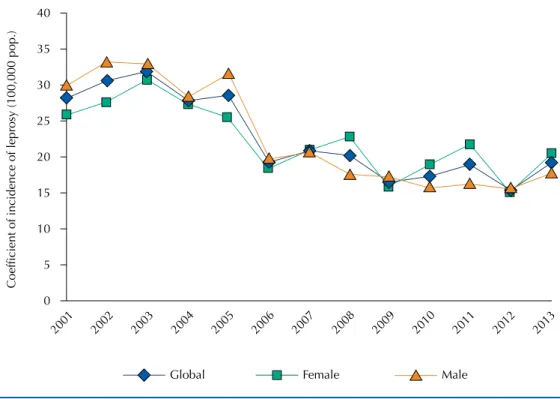
A decrease in the general trend of the disease incidence coeicient occurred, with an APC of -5.5% (95%CI -7.5–-3.5). Males had more pronounced decrease, with an APC of -6.5% (95%CI -8.9–-4.1). However, the overall decrease occurred from 2005 to 2009 (Figure 1). he Table shows the trend and the APC of leprosy cases in children under 15 years old according to operational classiication, clinical form, physical disability and way of detection. We observed increasing trend in cases with multibacillary operational classiication, dimorphic clinical form (D), detection by contact examination and level 2 physical disability at the time of diagnosis. However, the trends for those with absence of physical disability and level 1 physical disability at the time of diagnosis remained stationary (p > 0.05).
Figure 1. Time series of the coefficient of incidence of leprosy in children under the age of 15 in relation to sex. Mato Grosso, Brazil, 2001-2013.
2001
0
Coefficient of incidence of leprosy (100,000 pop.)
5 10 15 20 25 30 35 40
2002 2003 2004 2005 2006 2007 2008 2009 2010 2011 2012 2013
Figures 2 and 3 show, respectively, analyzes regarding the ratio trend of examined contacts and the proportion of healing treatment cases. he proportion of examined, recorded contacts showed an increasing trend, with APC of 4.1% (95%CI 1.2–7.1) in the period. he healing ratio indicator of the new cases showed a stationary trend, with APC of -1.7% (95%CI -3.8–0.4). he mean proportion of contacts examined in the period was 77.1% and the healing proportion was 39.7%.
Figure 2. Time series of the proportion of examined contacts. Mato Grosso, Brazil, 2003-2013. 0
Proportion of examined
contacts (%)
10 20 30 60
50 80 90 100
2003 2004 2005 2006 2007 2008 2009 2010 2011 2012 2013 40
70
Table. Trend and annual percent change (APC) in leprosy cases in children under 15 years old in relation to operational classification, clinical form, physical disability and detection. Mato Grosso, Brazil, 2001-2013.
Variable APC (%) 95%CI Trend
Operational classification
Paucibacillary -4.3 -7.1– -1.5 Decreasing
Multibacillary 6.7 2.7–10.8 Increasing
Clinical form
Indeterminate -3.8 -6.2– -1.3 Decreasing
Tuberculous -3.9 -7.3– -0.3 Decreasing
Dimorphic 9.4 4.4–14.7 Increasing
Lepromatous -6.7 -10.6– -2.7 Decreasing
Ignoreda 16.0 4.1–29.2 Increasing
Physical disability
Level Zero -0.2 0.5–0.8 Stationary
Level 1 4.2 -1.4–10.1 Stationary
Level 2 14.0 7.9–20.4 Increasing
Ignoredb -3.8 -7.3– -0.2 Decreasing
Detection mode
Forwarding -3.3 -6.1– -0.3 Decreasing
Spontaneous demand -1.1 -3.7–1.5 Stationary
Collective Examination -2.9 -7.7–2.1 Stationary
Contacts examination 6.3 3.9–8.7 Increasing
Other forms 1.7 -4.8–8.7 Stationary
Ignoreda 1.0 -6.6–9.1 Stationary
a Ignored or unfilled field.
DISCUSSION
Among the national leprosy control strategies, deining and monitoring of areas with a higher risk of disease detection are necessary. Although the incidence coeicient trend in children
under 15 years old decreased in the studied period in the state of Mato Grosso, it remained
hyperendemic, with an increase in multibacillary cases, especially in the dimorphic clinical form. he cases with level 2 physical disability at the time of diagnosis increased, and it was
precarious in relation to the healing rate of new cases, with a stationary trend during the
analyzed years. hese results indicate the recent endemic transmission and deiciency in the care and follow-up of new diagnosed cases until the completeness of treatment. A study conducted from 1996 to 2007, in Mato Grosso, also described hyperendemicity in
children under 15 years old, with a slight decrease in cases19. For every 100 thousand inhabitants,
there were 33.3 cases in 1996-1999, 33.2 in 2000-2003 and 26.7 in 2004-200719. In those years,
leprosy hyperendemicity in children under 15 years old indicates bacillus persistence and diiculty of the programs to control the disease. Leprosy is potentially disabling when it afects childhood because of the possibility of deformities; this is a period of growth and development, and can inluence school life due to social limitation, discrimination, low self-esteem and stigma. hese individuals experience complex feelings and situations in daily life, their routine changes by the limits dictated by the disease and treatment18,24.
Research in other countries has shown recent decrease in the disease trend in this
population11,13,26, as in this study. However, from 1980 to 2003 the state of Espírito Santo
showed a signiicant increasing trend for the coeicients in children under 15 years old (increase of 7% per year)15.
In Mato Grosso, the decreasing trend in the leprosy incidence may be due to the supply of PCT treatment in the health units. Economic growth, improvements in social areas and reversal of the care model for the family health strategy in the last decades may have contributed to
the reduction of the local endemic disease9.
his decreasing trend was not progressive in the period, concentrating between 2005 and 2009. his probably occurred due to the actions developed by the “Projeto Prioritário Tolerância Zero: Mato Grosso sem hanseníase” (Zero Tolerance Priority Project: Mato Grosso without leprosy) (SES/MT/2001), launched in 2001 with the aim of accelerating activities to achieve the goals of eliminating the disease through inancial incentives. his process initially causes an increase in detection for its active search, but it tends to fall due to the reduction in transmissibility resulting from the treatment and healing of the cases22.
Figure 3. Time series of the proportion of healing of leprosy cases in children under 15 years old. Mato Grosso, Brazil, 2003-2013.
0
Proportion of healing (%)
5 10 15 30
25 40 45 50
2003 2004 2005 2006 2007 2008 2009 2010 2011 2012 2013
In that period, the correction in the calculation of the incidence coeicient by the National Leprosy Control Program (PNCH) also occurred, including as new cases only those present in the SINAN database, at federal level, until January 15 of the following year, instead of March 31, as done previously. his operational change favored the modiication in the structure of the historical series, producing an artiicial fall in the number of new casesd.
Some studies suggest that the increase in cases is due to operational improvements in disease
control, which increases the diagnoses6,19. In the period, control activities were in efect in
the state due to the policy of elimination of the disease, and generated a 105.7% increase in
units for leprosy diagnosis and treatmente.
he historical series of multibacillary cases annually increased in 6.7%. he decreasing trend of paucibacillary cases and increasing multibacillary cases suggests late diagnosis. he paucibacillary cases represent initial leprosy phase, which is desirable to conclude the diagnosis, since the bacillary load is low and lack to act as a source of infection, being relevant for endemic control. However, the identiication of multibacillary cases, characterized as contagious due to the high bacillary load and the high risk of transmissibility, suggests health services failure10.
he increasing trend of cases deined as ignored as to the clinical form suggests impairment of diagnosis or incompleteness of the data due to lack of preparation or lack of professional commitment. Other studies also observed an increase in the number of ields ignored in the Brazilian epidemiological surveillance system, not identifying signiicant advances regarding completeness, which generates deicient and unreliable data, as well as interfere in the knowledge of the health-disease process3,4. Completeness is a guarantee of quality
information, an ideal condition for the objective analysis of the event under study.
he increasing trend of physical disability level 2 at the time of leprosy diagnosis relects the disease evolution time, the low efectiveness of early detection and the hidden prevalence12.
Physical disability level 2 indicates the presence of visible lesion and suggests underreporting; it is used to assess the delay of diagnosis and signals to deiciency of health services in the
early and accurate detection of cases in children under 15 years old, which may negatively
inluence social interaction through the increase of stigma and prejudice18.
he improved global strategy for additional reduction of the 2011-2015 leprosy burden emphasized the importance of implementing disease control actions and strengthening training programs for health professionals. herefore, the improvement of diagnostic activities and the follow-up of leprosy cases, especially in children under 15 years old, favor the reduction of disabilities and inconsistencies in the health information system of the disease16,26.
As new cases in children may indicate those undiagnosed and not assisted by health units,
the trend growth of detecting cases with household contact examination is relevant for
the early diagnosis, contributing to the reduction in the transmission of Hansen’s bacillus. he average proportion of contacts of these new cases was considered good according to the reference standard. he increasing proportion trend suggests an improvement in epidemiological surveillance activities. On the other hand, the trend of healing proportion was stationary in the period, with a precarious average, possibly resulting from unprepared
health services to ensure adherence to treatment until medical discharge or poor quality of
follow-up of cases recorded in the SINAN/MTa, or both.
We consider the possibility of underreporting of cases, which is due to problems in the low of receiving information, possibility of errors during data transfer, and lack of completion of investigation and notiication forms7. his would further increase the size
of the disease in the state.
he study has other limitation, such as the impossibility of correcting typing errors. In addition, some data in the SINAN/MT may be underestimated, as well as the information of the patient’s monitoring by the health units, which would explain the low average of healing rate.
d Ministério da Saúde (BR), Secretaria de Vigilância em Saúde, Departamento de Vigilância Epidemiológica. Programa Nacional de Controle da Hanseníase. Brasília (DF); 2007. (Nota técnica nº 010/2007/ PNCH/DEVEP/SVS/MS).
We concluded that in Mato Grosso the leprosy incidence trend in children less than 15 years old in the studied period decreased, but the average detection rate of cases in children less than 15 years remains hyperendemic, with a trend to increase multibacillary cases, the dimorphic clinical form and with physical disability level 2 to the diagnosis. here are conditions for continuous transmissibility of active cases and late detection, and the healing rate is lower the desired, which may culminate in larger transmission outbreaks and the onset of complications such as disabilities and physical deformities.
REFERENCES
1. Alencar CHM, Barbosa JC, Ramos Jr AN, Alencar MJF, Pontes RJS, Castro CGJ, et al. Hanseníase no município de Fortaleza, CE, Brasil: aspectos epidemiológicos e operacionais em menores de 15 anos (1995-2007). Rev Bras Enferm. 2008;61 Nº Esp:694-700.
https://doi.org/10.1590/S0034-71672008000700007.
2. Antunes JLF, Waldman EA. Trends and spatial distribution of deaths of children aged 12-60 months in São Paulo, Brazil, 1980-98. Bull World Health Organ. 2002;80(5):391-8.
3. Barbosa DA, Barbosa AMF. Avaliação da completitude e consistência do banco de dados das hepatites virais no Estado de Pernambuco, Brasil, no período de 2007 a 2010.
Epidemiol Serv Saude. 2013;22(1):49-58. https://doi.org/10.5123/S1679-49742013000100005.
4. Barbosa JR, Barrado JCS, Zara ALSA, Siqueira Júnior JB. Avaliação da qualidade dos dados, valor preditivo positivo, oportunidade e representatividade do sistema de vigilância epidemiológica da dengue no Brasil, 2005 a 2009. Epidemiol Serv Saude. 2015;24(1):49-58. https://doi.org/10.5123/S1679-49742015000100006.
5. Coriolano-Marinus MWL, Pacheco HF, Lima FT, Vasconcelos EMR, Alencar EN. Saúde do escolar: uma abordagem educativa sobre hanseníase. Saude Transform Soc. 2012;3(1):72-8.
6. Cunha MD, Cavaliere FAM, Hércules FM, Duraes SMB, Oliveira MLW, Matos HJ. Os indicadores da hanseníase e as estratégias de eliminação da doença, em município endêmico do Estado do Rio de Janeiro, Brasil. Cad Saude Publica. 2007;23(5):1187-97. https://doi.org/10.1590/S0102-311X2007000500020.
7. Façanha MC, Pinheiro AC, Lima JRC, Ferreira MLLT, Teixeira GFD, Rouquayrol MZ. Hanseníase: subnotificação de casos em Fortaleza - Ceará, Brasil. An Bras Dermatol. 2006;81(4):329-33. https://doi.org/10.1590/S0365-05962006000400004.
8. Hacker MAVB, Sales AM, Albuquerque ECA, Rangel E, Nery JAC, Duppre NC, et al. Pacientes em centro de referência para hanseníase: Rio de Janeiro e Duque de Caxias, 1986-2008.
Cienc Saude Coletiva. 2012;17(9):2533-41. https://doi.org/10.1590/S1413-81232012000900033.
9. Ignotti E, Paula RC. Situação epidemiológica da hanseníase no Brasil: análise de indicadores selecionados no período de 2001 a 2010. In: Ministério da Saúde (BR), Secretaria de Vigilância em Saúde, Departamento de Análise de Situação em saúde. Saúde Brasil 2010: uma análise da situação de saúde e de evidências selecionadas de impacto de ações de vigilância em saúde. Brasília (DF); 2011. v.2, p.186-202. (Série G. Estatísticas e Informação em Saúde).
10. Imbiriba EB, Hurtado-Guerrero JC, Garnelo L, Levino A, Cunha MG, Pedrosa V. Perfil
epidemiológico da hanseníase em menores de quinze anos de idade, Manaus (AM), 1998-2005.
Rev Saude Publica. 2008;42(6):1021-6. https://doi.org/10.1590/S0034-89102008005000056.
11. Kapata N, Chanda-Kapata P, Grobush MP, O’Grady J, Bates M, Mwaba P, et al. Leprosy trends in Zambia 1991-2009. Trop Med Int Health. 2012;17(10):1289-93. https://doi.org/10.1111/j.1365-3156.2012.03050.x.
12. Lana FCF, Carvalho ACN, Saldanha ANSL, Amaral EP. Diniz LG. Análise de tendência epidemiológica da hanseníase na microrregião de Almenara/Minas Gerais – período: 1998-2004. REMERev Min Enferm. 2006;10(2):107-12.
13. Larrea MR, Carreño MC, Fine PE. Patterns and trends of leprosy in Mexico: 1989-2009.
Lepr Rev. 2012;83(2):184-94.
14. Levantezi M, Moreira T, Sena Neto S, Jesus AL. Leprosy in children under fifteen years in Brazil, 2011. Lepr Rev. 2014;85(2):118-22.
16. Organização Mundial da Saúde. Estratégia global aprimorada para redução adicional da carga da hanseníase: 2011-2015: diretrizes operacionais (atualizadas). Brasília (DF): Organização Pan-Americana da Saúde; 2010.
17. Pereira MG. Variáveis relativas ao tempo. In: Epidemiologia: teoria e prática. Rio de Janeiro (RJ): Guanabara Koogan; 1995; p.245-67.
18. Pires CAA, Malcher CMSR, Abreu Júnior JMC, Albuquerque TG, Corrêa IRS, Daxbacher ELR. Hanseníase em menores de 15 anos: a importância do exame de contato. Rev Paul Pediatr.
2012;30(2):292-5. https://doi.org/10.1590/S0103-05822012000200022.
19. Queiróz ML, Scatena JHG. Distribuição espacial e temporal da hanseníase em Mato Grosso, no período de 1966 a 2007. Cad Saude Coletiva. 2009;17(1):145-61.
20. Romero-Montoya IM, Beltrán-Alzate JC, Ortiz-Marin DC, Diaz-Diaz A, Cardona-Castro N. Leprosy in Colombian children and adolescents. Pediatr Infect Dis J. 2014;33(3):321-2. https://doi.org/10.1097/INF.0000000000000057.
21. Sasidharanpillai S, Binitha MP, Riyaz N, Ambooken B, Mariyath OKR, George B, et al. Children leprosy: a retrospective descriptive study from Government Medical College, Kozhikode, Kerala, India. Lepr Rev. 2014;85(2):100-10.
22. Spinelli MA, Ignotti E. Avaliação do programa de eliminação da hanseníase em Mato Grosso (2001-2003). Espaç Saude. 2007;9(1):25-35.
23. Van Beers SM, Hatta M, Klatser PR. Patient contact is the major determinant in incident leprosy: implications for future control. Int J Lepr Other Mycobact Dis. 1999;67(2):119-28.
24. Vieira MA, Lima RAG. Crianças e adolescentes com doença crônica: convivendo com mudanças. Rev Latino Am Enfermagem. 2002;10(4):552-60. https://doi.org/10.1590/S0104-11692002000400013.
25. World Health Organization. Leprosy control in China: trends in detection of new cases, 1987-2008. Wkly Epidemiol Rec. 2010;85(17):149-56.
26. World Health Organization. Global leprosy update, 2015 :time for action, accountability and inclusion . Wkly Epidemiol Rec. 2016;91(35):405-20.
Funding: Research Program for the Brazilian Uniied Health System (PPSUS, in Portuguese), shared management in health – Ministry of Health (MS), Conselho Nacional de Desenvolvimento Cientíico e Tecnológico (CNPq), Foundation for Research Support of the State of Mato Grosso (FAPEMAT, in Portuguese) and State Secretariat of Health (SES, in Portuguese), n. 002/2013.
Authors’ Contribution: Study design and planning: BHBM, SMBF. Collection, data analysis and interpretation: BHBM, DCBC, SMBF. Preparing or proofreading of the unpublished study: BHBM, DCBC, SMBF. Final version approval: BHBM, DCDC, SMBF. Public responsibility for the content of the article: BHBM, DCDC, SMBF.