© FECAP
Received on March 16, 2014 Approved on December 02, 2015
1.Mario Gilberto Lütkemeyer
Filho
Master in Production Engineering and Systems Unisinos
(Brazil)
2. Guilherme Luís RoeheVaccaro
Doctor in Computer Science UFRGS
(Brazil)
3.Ernani Cesar de Freitas
Doctor in Letters PUCRS
(Brazil)
Review of Business Management
DOI:10.7819/rbgn.v17i58.1946
Identification of customer satisfaction in
services: a study on agribusiness dealers
Mario Gilberto Lütkemeyer Filho, Guilherme Luís RoeheVaccaro
Graduate Program of Production Engineering and Systems, Unisinos, RS, Brazil
Ernani Cesar de Freitas
Social Applied Sciences Institute, Universidade Feevale, RS, Brazil
Responsible editor: João Maurício Gama Boaventura, Dr. Evaluation process: Double Blind Review
ABSTRACT
Objective – his paper presents an analysis of service factors that
impact customer satisfaction with dealers in the sugarcane segment in Sao Paulo state – Brazil.
Design/methodology/approach – he research method is descriptive
quantitative, based on survey. Data is secondary gathered from the tractor-making company’s database, with n = 88. Tools used for multivariate statistical analysis were factor analysis and correspondence analysis.
Findings – he results revealed a reduction in latent variables into
two components: trust and relationship. he correspondence analysis presents association among variables “cost-beneit of spare parts” and “treated fairly and honestly”.
Practical implications – Despite the evidence of a relationship between the results and the information available in the literature, results cannot be generalized, since theory doesn´t fully describes the investigated sector. Future research may advance towards validating if the emerged variables are relevant on the strategic decision making process for this segment.
Keywords – Dealers; Customer satisfaction; Services; Sugarcane
1 INTRODUCTION
The customer-supplier relationship is multidimensional. It involves tangible aspects related to the goods or services that connect customer and supplier, as well as intangible aspects related to the empathy, trust and courtesy dimensions, among others (Fitzsimmons & Fitzsimmons, 2010). Over the years, the development of market relations and competition in some segments, such as automotive, promoted changes in the customer-supplier relationship (Vargo & Lusch, 2004). Those changes are intended to improve the levels of satisfaction, but also to create a favorable atmosphere for new businesses, inluencing intention to repurchase (Eggert & Ulaga, 2002).
Due to dynamic and competitive markets, organizations are gradually changing the product-driven pattern of production rooted in the industrial system, to a service-driven logic of business (Kotler & Keller, 2006). his logic is rooted in focusing on intangibles such as skills, information, knowledge, connectivity (Sheth & Sharma, 2008; Vargo & Lusch, 2004). he efects of that context on capital goods companies include ofering value through services or Product Service Systems (PSS) or Service Infusion (Gebauer & Fleisch, 2007; Grönroos & Helle, 2010; Yee Yeung, & Cheng, 2009). he typical business structure existing in a business-to-business context (B2B) becomes more complex, especially if we consider the relationships between the players in the change process and value perception by customers. his view is supported by Kellar & Preis (2011), who point to the diference whose elements of satisfaction in a B2B relationship difer for organizations high, medium or low technological level. Sugar-energy industry companies fall into low-tech organizations (Organization for Economic Co-operation and Development [OECD], 2011), which made the subject relevant for discussion.
his complexity also occurs in markets or segments in expansion, in which case the sector of machinery and equipment for the sugarcane
industry in Brazil. Investment in production of clean fuels and renewable energy, alternative to the energy matrix based on fossil fuels accounts for 2.65% of Gross Domestic Product (Brazilian Development Bank [BNDES] & Strategic Studies Management Center [CGEE], 2008), with a trend of expansion through a framework of diversiication of sources, such as hydro, solar, wind, nuclear, biofuels and the pre-salt by 2030 (Ministry of Mines and Energy [MME], 2007). Signiicance of the abovementioned industry is increased especially when comparing the representativeness of sugarcane production in the State of São Paulo, equivalent to 61% of local production (Sugarcane Industry Union [Única], 2012).
he industry has been fostered by the Brazilian government by means of programs that encourage academic research and production (Longhi et al., 2013). In addition to the need to develop clean energy, there is a market favorable to wealth creation for the country (Hofsetz & Silva, 2012; Brazilian Institute of Geography and Statistics [IBGE], 2013). herefore, there is a possibility for exploration at enterprise-level, given the opportunities for innovation of production processes and in the service chain, which facilitates interactions between academy and market regarding the transfer of knowledge.
Considering B2B relationship context, a typical relationship between segment customers and dealers is essential for the customer to receive monitoring and quality services, with a view to reducing waste in crops, property costs and increase in competitiveness of companies in the segment. his way, dealers can identify and lead strategic elements that contribute to adapt the service level to the customer’s expectations in order to reach satisfaction, leverage new sales and future demands (Reis & Peña, 2000).
demand investments in agricultural tractors and, consequently, the appropriate workforce level of dealers in order to meet customer needs, from the perspective of services. Based on this perspective, it is possible to establish a guiding question of research that supports the existence of associations between satisfaction construction elements and identiication of new factors that may emerge from the proposed system. This work aimed to investigate and analyze service factors that contribute to customer satisfaction in relation to the dealer network of sugarcane agribusiness segment in the state of São Paulo. Our starting point is the model proposed by Parasuraman, Zeithaml & Berry (1988), Lapierre (2000), Gil-Saura, Frasquet-Deltoro & Cervera-Taulet (2009), and the model developed by he American Customer Satisfaction Index (ACSI) (2012).
As for methodological procedures, is paper is descriptive, documentary and a survey,
with regard to addressing this issue. he data is secondary, derived from the database of an agricultural equipment manufacturer. Data collected seeks to present contributions and elements that explain the context of the work from a confrontation with the theoretical framework studied, progress in understanding the formation of customer satisfaction with the services, but is not intended to exhaust discussion for the academy. As far as business is concerned, the identiication of elements tends to contribute to determining the business strategies with the segment studied, serving as a result of the above, workforce training activities to meet the market demands.
The name of the organization which provided the data for analysis will be kept secret, as it requested. he company is a producer of tractors, ranging in size, power and application. he choice is justiied by the volume of sales and market share in the sugarcane industry in São Paulo represents approximately 40% for power range of 145hp – 165hp. here are also tractors with power ranging from 180hp – 230hp, normally used for soil preparation or
transshipment operations in the segment. Despite the signiicance of these models, they will not be discussed here.
he rest of the article is presented in the following order: in the following section, the theoretical framework supporting the research is described, such as B2B relationship, dealer network and customer satisfaction; then, the research method is presented, followed by the results, discussions and closing remarks.
2 THEORETICAL FRAMEWORK
2.1 Business-to-business (B2B) relationship
he guiding logic of the modern business context is built on relationships. To Gordon (2013), traditional and relationship marketing seeks to identify and meet the needs of customers in alignment with the organization’s objectives. Relationship marketing, however, breaks a guiding paradigm of traditional marketing, by changing the focus from tangible to intangible elements and from the transaction to the long-term oriented relationship, in order to create an atmosphere of trust between the customer and the company (Gordon, 2013; Nickels & Wood, 1999; Vargo & Lusch, 2004). To Ravald and Grönroos (1996) and Eggert, Ulaga & Schultz (2006), the purpose of B2B marketing is to create value to the customer before the moments of truth and throughout the relationship lifecycle. Eggert and Ulaga (2002) complement that the B2B marketing allows the customer to choose from available options, drawing on the elements beneits and sacriices by the provider.
price, package of ofers of competitors and others. he relationship between the customers of the sugarcane ield and agricultural equipment dealers presented as a B2B relationship, as the core of customer management is industrial logic, typically leet of equipment. Similarly to other industries, the delivery of value to customers in the sugarcane segment derived from the exchange process with the dealers may be relected in results that inluence the loyalty to the manufacturer’s brand, given that the customer typically perceives the dealer as a manufacturer extension in the relationship process (Kotler & Keller, 2006; Verhoef, Langerak & Donkers, 2007). In line with the above, Choi, Cho, Lee, Lee and Kim (2004) and Fazlzadeh, Bagherzadeh & Mohamadi (2011) postulate that the perceived value contributes to building the customer satisfaction process and inluence their behavior and future intentions.
Considering this context, we assume, as a irst study assumption, that the customer value is derived from the relationship.
2.2 Dealer network
In the context of agricultural machinery and equipment, the distribution model between producer and customer is established indirectly, so that a manufacturer usually does not sell its products directly to customers. Sales are typically performed by a dealer network also responsible for providing technical assistance and advisory services to the customer. Even when direct sale takes place, the dealer is responsible for carrying out the delivery process and customer support. For all purposes, the dealer is, in customer perception, the representative of a brand. Formally, it is incumbent upon the brand’s representative to sell the items to the end consumer, provide means of inancing, deliver items, provide services and reviews on the product on request, and manage the process of communication with the customer (Fazlzadeh et al., 2011; Silk, 2008).
According to Kotler & Keller (2006), the dealer’s mission is to convert potential buyers in orders, create new markets, cultivate long-term
relationships and maximize the value of the product/service pair to the customer. Verhoef et al. (2007) state that, while there are eforts by manufacturers to improve customer retention rates, the decision to remain loyal to a brand is typically the direct result of trust on the dealer service performance. his argument reinforces what is defended by Yee et al. (2009), who indicate that satisied customers tend to be loyal to their service providers. Accordingly, environmental factors, such as market competitiveness and switching costs do not have such a strong efect between customer satisfaction and loyalty.
Thus, the overall performance of the service is, from the point of view of Truch (2006), crucial to the development of marketing strategies and is related to building customer satisfaction. In seeking competitive advantage in relation to competitors, companies should focus their attention to this element, since that satisfaction, when built, tends to keep a customer base essential for forecasting future revenues, reduced price elasticity, and avoid that customers hesitate to stay with the brand in the event of deiciencies.
he contextual factors associated with dealers support the study assumption that the dealer inluences expectations, service quality, adds value and builds customer satisfaction.
2.3 Service quality, perceived value and
customer satisfaction
here are several approaches on how to build customer satisfaction in services. According to Zeithaml and Bitner (2003), expectations are formed from the comparative performance standards of service performance experienced by customers, past experiences and word-of-mouth recommendations (Fazlzadeh et al., 2011). The American Customer Satisfaction Index (ACSI) (2012), on the other hand, lists three key elements prior to the determination of customer satisfaction, namely: perceived quality, expectations and perceived value.
built from the diference between the expectation of the desired service and service received. Wong, Chan, Ngai & Oswald (2007) point out the perceived service quality as a preceding factor for customer satisfaction and loyalty. Verhoef et al. (2007) point to the positive relationship between customer satisfaction and retention.
Parasuraman et al. (1988) present an approach to measuring service quality, with ive dimensions: trust, responsiveness, security, empathy and tangibility. Berry & Terry (2008) point to the existence of a relationship between evidence on the quality and competence of the service provider. In the same vein, Ramseook-Munhurrun, Naidoo & Lukea-Bhiwajee (2009, p. 51) state that “performance of right services the irst time, providing correct and accurate information, being able to solve problems and provide fast service to answer the request” is an essential element for the construction of service quality.
From situations whose interaction between customer and dealer generates performance lower than expected, Lin & Lin (2011) suggest that frontline staf should be encouraged to promote an empathetic approach, seeking to understand the customers’ position while regulating their own internal emotions. In addition to the empathy and trust factors, sense of justice and solidarity appear as important elements for building satisfaction (Fazlzadeh et al., 2011).
However, for decades, Parasuraman et al. (1988) point to the diiculties of deining and measuring these constructs, given their intangibility and complexity. Caro & García
(2007) and Zacharias, Figueiredo & Almeida (2008) corroborate this claim to argue about the lack of consensus on how to conceptualize the perceived quality of service. Such diiculties, in a sense, are related to limited rationality vision, since people tend to maximize the expected objective utility, and therefore accept the possible solutions to a given moment, but with alternation of demand and perception levels as time passes by (Pidd, 1998). In short, it is argued that the perceived value is a preceding element to customer satisfaction (Eggert & Ulaga, 2002; Gil-Saura et al., 2009).
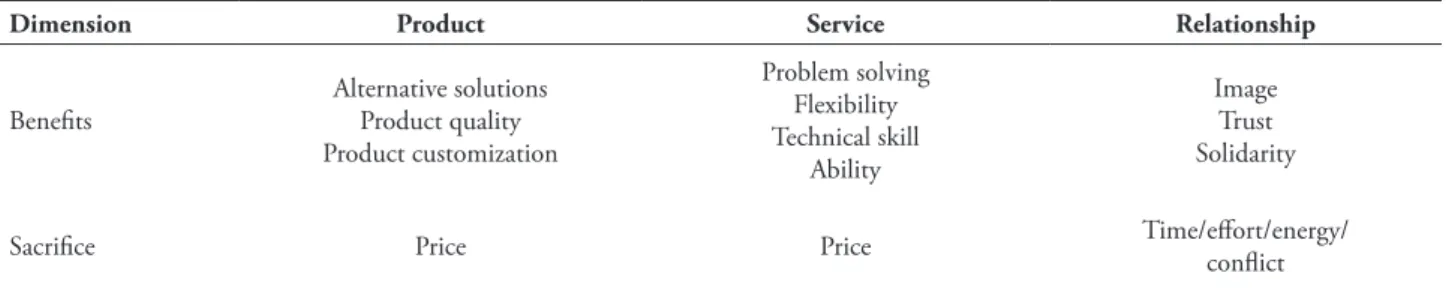
TABLE 1 – Beneit and sacriice characteristics
Dimension Product Service Relationship
Beneits
Alternative solutions Product quality Product customization
Problem solving Flexibility Technical skill
Ability
Image Trust Solidarity
Sacriice Price Price Time/efort/energy/conlict
In order to systematize the concepts presented so far, here is a summary of references addressed, as shown in Table 2:
TABLE 2 – Summary of references
Construct Concept References
B2B relationship Long-term-driven relationship, for purposes of creating a commitment
and trust atmosphere between customer and company, by creating value.
Nickels & Wood, (1999); Vargo & Lusch (2004);
Gordon (2013).
Dealer network
he dealer’s mission is to convert potential buyers in orders, create new markets, cultivate long-term relationships and maximize the value of the
product/service pair to the customer.
he authors indicate that satisied customers tend to be loyal to their service providers.
Kotler & Keller, (2006); Silk (2009); Fazlzadeh; Bagherzadeh & Mohamadi
(2011).
Truch (2006); Yee, Yeung & Cheng (2009).
Service quality
Build based on trust, responsiveness, security, empathy and tangibility. Perceived quality of the service precedes customer satisfaction and
loyalty.
Parasuraman, Zeithaml & Berry (1988). Wong et al. (2007).
Perceived value Perceived value is a multidimensional construct arising from the choice between beneits and sacriices. Ulaga (2002); Ulaga (2003).Lapierre (2000); Eggert &
Customer satisfaction Customer satisfaction is built from the diference between the expectation of the desired service and service received. Lovelock & Wright (2006) and Johnston & Kong (2011).
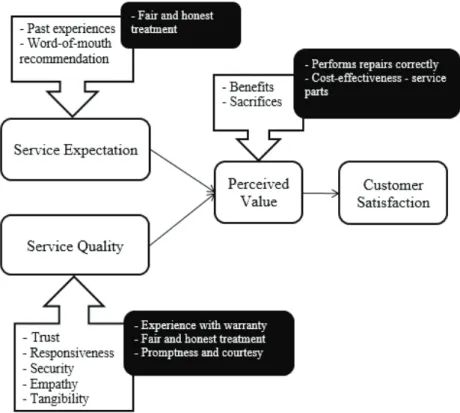
Based on the critical factors presented, a conceptual framework was designed in order to systematize the study and guide research. he framework shown in Figure 1 was based on the model presented by Lapierre (2000) and also on the theory disclosed by Parasuraman et al. (1988), Gil-Saura et al. (2009), and the American Customer Satisfaction Index (ACSI) (2012).
FIGURE 1 – Conceptual framework
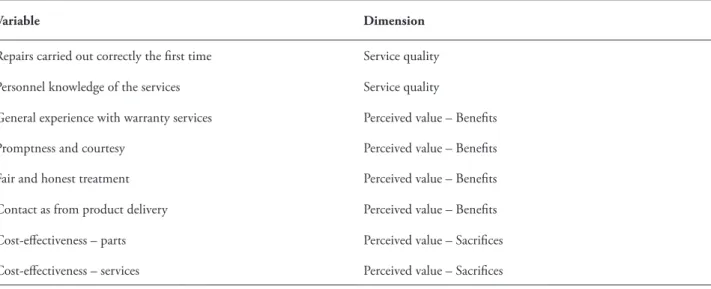
Given the theoretical model described above, we needed to understand and adapt the relationships between the variables used in order to structure a line of reasoning that would allow us to concatenate theory and practice, in accordance
with the established test model presented in Table 3. Exposed elements fall into the context of services and the relationship built between the dealer and the customer, evaluated by means of surveys conducted by the organization.
TABLE 3 – Relationship model between variables and dimensions
Variable Dimension
Repairs carried out correctly the irst time Service quality
Personnel knowledge of the services Service quality
General experience with warranty services Perceived value – Beneits
Promptness and courtesy Perceived value – Beneits
Fair and honest treatment Perceived value – Beneits
Contact as from product delivery Perceived value – Beneits
Cost-efectiveness – parts Perceived value – Sacriices
Cost-efectiveness – services Perceived value – Sacriices
3 METHODOLOGY
his research was conducted as follows: applied research, as to its nature; descriptive research, as to objectives, and documentary survey, as to technical procedures; in addition to quantitative research in regard to addressing this problem.
According to Gil (2008, p. 42), “the main objective of descriptive research is describing the characteristics of a given population or phenomenon, or establishing relationships between variables.” On the other hand, Malhotra (2011) points out that the survey process aims to get speciic information from a population sample and can be used to structured data collection. he application is considered one of the advantages, as, according to the author, it is simple, reduces variability and facilitates the analysis and interpretation of data.
Data obtained for the research comes from the database of a multinational company, a manufacturer of agricultural tractors, which made the collection using a technique called survey, providing this quantitative base (therefore secondary data) for the purposes of this study. For conidentiality reasons, the company will not be identiied. Malhotra (2011) points out advantages related to the use of secondary data, such as lower cost, quick access, better deinition of a problem, formulation of better research and test some hypotheses.
While the data used is secondary, as the documentary research has been performed based on the data collected by the manufacturer of agricultural tractors, the review process was engineered under a process focused on customer satisfaction of the organization subject matter of this study. All customers who buy tractors are eligible for application of the survey, six months after delivery of the product. The company relies on software for random determination of customers to be surveyed, with sampling probabilistic nature. With a view to obtaining the answers, we applied a questionnaire with 15 closed questions during a phone call, among which
we explored questions about the dealer services presented in Table 3. he omitted variables focus on the sales process and general issues which do not fall under the scope of the paper. he research instrument starts from the following question: How do you agree with the statements about the following types of interaction with the dealer (choose one). Each question was presented assertively showing the ideal result. Response alternatives followed a Likert scale of 5 points. his scale is to assign the degree of perception or importance and ranges from 1 (strongly disagree) to 5 (strongly agree). he survey instrument was designed, standardized, pre-tested and approved beforehand by the Market Research Department of the reference company in this research. After conducting the survey, the database can be accessed for analysis determined by the company.
For this study, surveys were conducted with selected customers from November 2008 to November 2011, in the state of São Paulo. In order to deine the target population, we deined the criteria to consider only customers in the cities of São Paulo state for whom the tractor is used only in the sugarcane crop. During the stated period, 350 pieces of equipment that meet this criterion were delivered. Considering the nature of the B2B relationship, the data correspond to 236 customers, and of those, n = 88 (37.3%) customers were interviewed, with valid answers for the study. his ilter is necessary since not all collections made by the company are efectively answered by customers. As previously mentioned, all customers receiving the equipment are eligible to be interviewed, but not all respond to the satisfaction survey by a number of factors: (i) the customer is not located after the requisite number of attempts in the process; (ii) the customer is not willing to answer; and (iii) the customer did not undergo after-sales service experience to exercise judgment about the questions. Note that, regardless of the number of machines received for the same request, only one questionnaire application is conducted.
approximately for purposes of detecting the efects of order medium standard deviation on the average of groups. For purposes of application of factor analysis, analysis technique used, we limited the study to cases by variables in the region of 10, indicating the possibility of analysis of up to eight variables.
Factor analysis, according to Hair, Anderson, Tatham & Black (2009), aims to discover latent dimensions derived from a large set of variables. Features characterized by the ability to analyze the degree of explanation of variables by factors, using data summary and reduction by replacing the original variables. As advantages, the technique enables the process of interpretation and list of complex variables, which is not achieved by univariate and bivariate methods. Among the assumptions analyzed for its implementation, we observed: sample size above 50 events; the existence of significant correlations and above 0.3 between variables; and signiicance in the Bartlett’s sphericity test; and sample adequacy measurement of Kaiser-Meyer-Olkin (KMO or MSA) greater than 0.6 (Hair et al., 2009).
Regarding data normality, data distribution was not normal. While subliminal judgment of data normal distribution to multivariate analyses provides stronger results, non-normal data should not be neglected because, despite the reduction in the degree of variance explanation, valid results can be presented (Tabachnick & Fidell, 2001).
In order to evaluate the association between the response patterns of model variables, we applied the correlation analysis technique. his technique is a compositional approach and consists of determining a perceptual map of variables, based on association of service features or attributes, and is aligned with exploratory data methods (Hair et al., 2009). he technique its in applications in which the researcher aims to understand the relationships between variables of a given topic, develop hypotheses, or even create demands for future research (Malhotra, 2011).
Analyses applied to research variables were conducted with support from IBM SPSS 20 software. he results of research and analysis conducted based on procedures highlighted above are presented in the next section.
4 PRESENTATION AND ANALYSIS OF
FINDINGS
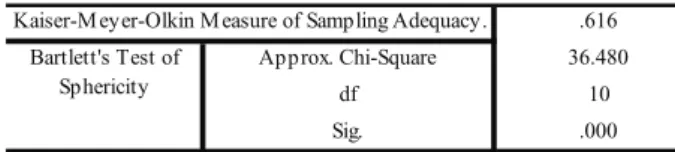
Factor analysis was initially conducted including the eight variables listed in Table 3, which resulted in a value of KMO = 0.472 < 0.6 and, therefore, unsuitable. Analysis of the anti-image measures resulted in systematic removal of variables “service personnel knowledge,” “contact since delivery of product,” and “cost-efectiveness – services.” he remaining variables resulted in KMO = 0.616 > 0.6. Accordingly, the elements considered effectively in the factor analysis were: promptness and courtesy, effectiveness of repairs (performs repairs correctly), fair and honest treatment, cost-efectiveness of parts, and experience with warranty.
The cases/variables relationship was estimated at 17.6 > 10. Signiicant correlations were identiied between variables, result which was also conirmed by means of the Bartlett’s sphericity test, shown in Table 4.
TABLE 4 – KMO result and Bartlett’s sphericity test
.616 Approx. Chi-Square 36.480
df 10
Sig. .000
Kaiser-M eyer-Olkin M easure of Sampling Adequacy. Bartlett's Test of
Sphericity
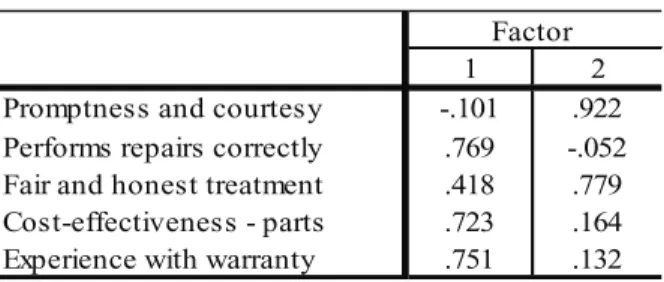
TABLE 5 – Varimax rotated factor matrix
1 2
Promptness and courtesy -.101 .922 Performs repairs correctly .769 -.052 Fair and honest treatment .418 .779 Cost-effectiveness - parts .723 .164 Experience with warranty .751 .132
Factor
Extraction method: Analysis of key components. Rotation method: Varimax with Kaiser´s
normalization.
Factor 1 concentrates loads related to variables: (i) effectiveness of repairs (0.769); (ii) cost-efectiveness of parts (0.723); and (iii) experience with warranty (0.751). Given the characteristics of these factors, latent factor 1 was called “trust.” Regarding latent factor 2, these elements were detected in this order: (i) promptness and courtesy (0.922); and (ii) fair and honest treatment (0.779). As a result, it has been called “relationship.”
he identiied factors are corroborated by the reference on the matter. Latent factor “trust” is supported by the statements of Lovelock & Wright (2006), whose organization not only indicates good reputation and positive image, but also the quality of service that is enhanced by this level of perception. Such associations are related to the reduction of service variability, given its consumption characteristics at the time of delivery, inability to be stored and heterogeneity. It is understood that carrying out repairs correctly is important for the segment customer, as it directly refers to factors such as availability of equipment and is relected on the customer’s production capacity. Experience with warranty refers to the realization of expectations about a moment of truth (Bateson & Hofman, 2001; Lovelock & Wright, 2006). It reiterates the trust dimension, as receiving the warranty service properly is referred to as a reinforcing factor of belief in the brand (Bateson & Hofman, 2001; Lovelock & Wright, 2006). As for cost-efectiveness of parts
price, results show that customers tend to perceive this variable as a member of the trust factor. From that, one can infer that this sacriice, according to Lapierre (2000), is also represented on the service provider’s trust image, to the extent that a disadvantageous cost-efectiveness relationship in parts may relect an unacceptable behavior to the customer. In short, the trust factor indicates that one of the latent dimensions of satisfaction about the after-sales service is associates the ability to make efective repairs, with adequate access to warranty service and a proper cost-efectiveness relationship.
As for latent factor “relationship,” determined among the variables included in the model, it is associated with the statements of Lapierre (2000), given that the author cites some elements tangent to the beneits as essential to perceived value. In this sense, statements of Nickels & Wood (1999) and Vargo & Lusch (2004) corroborate the results, since, according to these authors, the relationship in a B2B context seeks to change business perspective from the moment to the long-term, by means of mutual trust (“fair and honest treatment” variable), which are reinforced by a communication management process, in this case translated by the “promptness and courtesy” variable. As one can see, this element mitigates conlicts and positively induces perception of efort and energy used in the relationship.
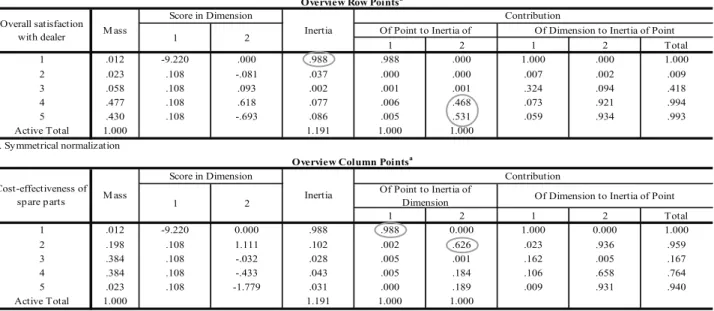
With regard to correspondence analysis, the model variables were analyzed in comparison with the “overall satisfaction with dealer” variable. Of the eight tested variables, we identified moments of signiicant association of overall satisfaction with dealer in relation to: (i) cost-efectiveness of spare parts; and (ii) fair and honest treatment. Other variables showed no signiicant results with respect to this outcome variable.
TABLE 6 – Correspondence analysis of overall satisfaction with dealer vs. cost-efectiveness of spare parts
1 2 1 2 Total
1 .012 -9.220 .000 .988 .988 .000 1.000 .000 1.000
2 .023 .108 -.081 .037 .000 .000 .007 .002 .009
3 .058 .108 .093 .002 .001 .001 .324 .094 .418
4 .477 .108 .618 .077 .006 .468 .073 .921 .994
5 .430 .108 -.693 .086 .005 .531 .059 .934 .993
Active Total 1.000 1.191 1.000 1.000
1 2 1 2 Total
1 .012 -9.220 0.000 .988 .988 0.000 1.000 0.000 1.000
2 .198 .108 1.111 .102 .002 .626 .023 .936 .959
3 .384 .108 -.032 .028 .005 .001 .162 .005 .167
4 .384 .108 -.433 .043 .005 .184 .106 .658 .764
5 .023 .108 -1.779 .031 .000 .189 .009 .931 .940
Active Total 1.000 1.191 1.000 1.000
Overview Row Pointsa
Overall satisfaction with dealer M ass
Score in Dimension
Inertia
Contribution
1 2 Of Point to Inertia of Of Dimension to Inertia of Point
a. Symmetrical normalization
Overview Column Pointsa
Cost-effectiveness of spare parts M ass
Score in Dimension
Inertia
Contribution
1 2
Of Point to Inertia of
Dimension Of Dimension to Inertia of Point
a. Symmetrical normalization
From the analysis of the moments generated among data from respondents for the overall satisfaction with dealer variable and cost-efectiveness of spare parts, we can see that signiicance of 0.000 allows us to point out that there is an association between the observations of the answers for both groups in question.
Similarly, it is possible to assess, for dimension 1 of the inertia point, the existence of an association among respondents who gave a rating of “1” for both satisfaction with dealer and for cost-efectiveness of spare parts. Based on the Likert scale of 5 points, we can see that the low level of agreement allows us to infer that customers are more susceptible to judgment of positive satisfaction.
Regarding dimension 2 of the inertia point, there is an association between respondents who rated the overall satisfaction with dealer in 4 and 5 with respondents who rated 2 to cost-efectiveness of parts.
From a practical point of view, the cost-efectiveness of spare parts is a crucial element
within the sugarcane segment, as customers operating in the industry require high equipment usage rates. herefore, wearing parts are replaced more often, which requires eforts to allocate inancial resources to maintain the operating leet according to the demand. he goal is to minimize downtime, either programmed or corrective maintenance, which means reducing and leveraging machine availability and, as a result, reducing cost of ownership. So, a piece available, with afordable price, is in line with the dealer services and competences, and is an element that adds value to the segment customer. his discussion is supported by Lapierre (2000), Eggert & Ulaga (2002), when it points out the value as the diference between the beneits and sacriices, and Lovelock &Wright (2006) and Johnston & Kong (2011), who state that customer satisfaction is built based on the diference between deliveries and expectations.
FIGURE 2 – Cost-efectiveness of spare parts vs. overall satisfaction with dealer
With regard to the Table 7, the correspondence analysis is performed between variables Overall satisfaction with dealer and Fair and honest treatment.
TABLE 7 – Correspondence analysis between overall satisfaction with dealer vs. fair and honest treatment
1 2 1 2 Total
40 .037 -.098 -.368 .009 .001 .014 .023 .183 .206
60 .056 3.163 -.418 .341 .915 .028 .990 .010 1.000
80 .574 -.080 .501 .052 .006 .415 .043 .957 .999
100 .333 -.379 -.752 .095 .079 .543 .307 .690 .996
Active Total 1.000 .498 1.000 1.000
1 2 1 2 Total
40 .019 5.205 -1.203 .315 .825 .077 .968 .030 .998
60 .185 -.230 .721 .043 .016 .277 .137 .768 .905
80 .389 .282 .384 .042 .051 .165 .449 .476 .925
100 .407 -.401 -.640 .098 .108 .480 .408 .592 1.000
Active Total 1.000 .498 1.000 1.000
Overview Row Pointsa Overall satisfaction
with dealer M ass
Score in Dimension
Inertia
Contribution
1 2 Of Point to Inertia of Of Dimension to Inertia of Point
a. Symmetrical normalization
Overview Column Pointsa Fair and honest
treatment (empathy) M ass
Score in Dimension
Inertia
Contribution
1 2 Of Point to Inertia of Of Dimension to Inertia of Point
a. Symmetrical normalization
From the results, it is clear that there is significance and association between both elements, as α = 0.043. For dimension 1 of the inertia point, we can see adherence among the respondents who attributed rated 2 on Likert scale for overall satisfaction with dealer and 1 for fair and honest treatment. As regards the dimension 2, respondents who rated 4 and 5 for the overall satisfaction with dealer are associated with those who rated 5 for fair and honest treatment.
Within the segment, customers claiming dealer services expect quick responses in order to reduce downtime and equipment maintenance time. Another important point that impacts customer’s perception is that of the dealer who gives priority to customers who buy more machines, have greater fleet or even greater potential for future purchases. In the end, customers, regardless of size of their property and leet, expect equal treatment and build their expectations from those experiences or to the extent they hear word-of-mouth reports.
It is understood that these attributes are related to the level of communication, an element intrinsic to the security and empathy dimension, and in line with Parasuraman et al. (1988). herefore, the proiles of sugarcane segment customers can build their perceptions in diferent ways, according to the contacts provided by the dealer over the product lifecycle. We can also concatenate the results with the indings of Lin & Lin (2011), who highlight the importance of empathy with the customer. Furthermore, Parasuraman et al. (1988) and Lovelock & Wright (2006) show the importance of the variable to serve the customer in a careful and customized fashion, and Wong et al. (2007), who reinforce the need for perceived quality of service and need to provide services whenever requested. he speed tolerated in service is inversely proportional to the impact on the cost, as the machine is stopped due to the unavailability of manpower.
he discussions above can be seen in terms of the conceptual map, as in Figure 3.
FIGURE 3 – Fair and honest treatment vs. Overall satisfaction
with dealer
FIGURE 4 – Framework with dimension adhering the model
After the analyses, we perceived that the dimensions mentioned and discussed above, listed in the shaded rectangles in Figure 4, were the ones adhering to the proposed model. For an analysis within the research context, the dimensions considered for interviews with customers reveal consistent results with theoretical discussions identiied in the literature for variables associated with service expectations (fair and honest treatment), service quality (experience with warranty, fair and honest treatment, and promptness and courtesy) and perceived value (performs repairs properly and cost-efectiveness – parts). However, other variables such as cost-efectiveness of services, contact from the delivery of equipment, and knowledge of service personnel do not adhere to the model, pointing to new elements and assumptions of literature, from the agribusiness context. herefore, we use the contributions of Parasuraman et al. (1988), Lapierre (2000), Berry & Terry (2008) and Gil-Saura et al. (2009) to open up new frontiers for
the segment studied and close the gap pointed out by Kellar & Preis (2011).
5 CONCLUSION
level of the organization providing the service (Kellar & Preis, 2011), making room for research on agents inducing customer satisfaction to continue.
The model established was designed based on the literature, with the use of variables related to customer satisfaction, perceived value, service quality and service expectation, which enabled identiication of two latent factors that can be translated into customer satisfaction in the segment studied, called “trust” and “relationship.” he result is echoed in the references used, which indicates options for managerial decision when competitive strategies for dealers are implemented in order to win new businesses based on the quality of service provided by the dealer.
The limitations with respect to the variables available for analysis, as well as the amount of responses, do not allow us to generalize results, but allow us assume the consistency of the model. We observed that these latent factors explain only 66.37% of total variance associated with the satisfaction of the contacted customers.
While the model has consistency, to this research we can observe that some of the variables highlighted in the literature failed to fully adhere to it. To results found, we assigned the following reasons, to wit: (i) the need for larger sample, (ii) literature does not it in a B2B context, and (iii) unidentiied causal relationships.
Moreover, the results identified in this paper allow the organization to establish competitive strategies for the segment dealers, focusing upon trust and relationship in order to win new businesses, based on the quality of service provided by the dealer.
From this study, a possibility for future studies is to conduct a broader explanatory research, considering the collection of primary data and the stratification of the profiles of customers in the sugarcane industry dealers, including more explanatory variables to identify other relevant latent factors, and measure the impact of and the gaps in services of dealers in the industry. Another study could consider the impact of the customer service quality, and reduction
of customer losses and waste in relation to the dealers, element also associated with customer satisfaction and that we failed to address in this study. In addition, the impact of services in the industry, within the B2B relationship, is a missing element in the literature and which can be addressed.
Finally, understanding customer needs in order to build lasting relationships is an aspect that constitutes a potential for earnings in the segment, because customers need to increase their gains and minimize total cost of ownership, something complex and that requires efective management and monitoring of the customers’ lives. hose who know how to explore these elements will be rewarded in this market, which, despite the structural problems and crises faced in recent years, tends to grow considering future change demands of clean energy matrix in Brazil.
REFERENCES
American Customer Satisfaction Index. (2012).
he science of customer satisfaction. Recuperado de http://www.theacsi.org/index.php?option=com_ content&view=article&id=48:acsi-methodology &catid=16&Itemid=122
Banco Nacional de Desenvolvimento Econômico e Social, & Centro de Gestão de Estudos Estratégicos. Bioetanol de cana-de-açúcar: Energia para o desenvolvimento sustentável. Rio de Janeiro: BNDES, 2008. Recuperado de http://www.iea. sp.gov.br/out/bioenergia/textos/bio_06_2008.pdf
Choi, K. S., Cho, W. H., Lee, S., Lee, H., & Kim, C. (2004). he relationships among quality, value, satisfaction and behavioral intention in health care provider choice: A South Korean study. Journal of Business Research,57(8), 913-921.
Eggert, A., & Ulaga, W. (2002). Customer perceived value: A substitute for satisfaction in business markets? Journal of Business & Industrial Marketing, 17(2/3), 107-118.
Eggert, A., Ulaga, W., & Schultz, F. (2006). Value creation in the relationship life cycle: A quasi-longitudinal analysis. Industrial Marketing Management, 35(1), 20-27.
Fazlzadeh, A., Bagherzadeh, F., & Mohamadi, P. (2011). How after-sales service quality dimensions afect customer satisfaction. African Journal of Business Management, 5(17), 7658-7664.
Fitzsimmons, J. A., & Fitzsimmons, M. J. (2010).
Administração de serviços: Operações, estratégia e tecnologia da informação (6a ed.). Porto Alegre: Bookman.
Gebauer, H., & Fleisch, E. (2007). Managing sustainable service improvements in manufacturing companies. Kybernetes, 36(5-6), 583-595.
Gil, A. C. (2008). Como elaborar projetos de pesquisa (4a. ed). São Paulo: Atlas.
Gil-Saura, G., Frasquet-Deltoro, M., & Cervera-Taulet, A. (2009). he value of B2B relationships.
Industrial Management & Data Systems, 109(5), 593-609.
Gordon, I. H. (2013). Managing the new customer relationship: Strategies to engage the social customer and build lasting value. Mississauga: Willey. Grönroos, C., & Helle, P. (2010). Adopting a service logic in manufacturing: Conceptual foundation and metrics for mutual value creation.
Journal of Service Management, 21(5), 564-590. Hair, J. F., Anderson, R. E., Tatham, R. L., & Black, W. C. (2009). Análise multivariada de dados
(6a ed.). Porto Alegre: Bookman.
Hofsetz, K., & Silva, M. A. (2012). Brazilian sugarcane bagasse: Energy and non-energy consumption. Biomass and Bioenergy, 46, 564-573. Instituto Brasileiro de Geograia e Estatística. (2013). Departamento da Cana de açúcar: Evolução da produtividade da cana de açúcar no Brasil. Recuperado de http://www.ibge.gov.br/ home/estatistica/indicadores/agropecuaria/lspa/ lspa_201301comentarios.pdf
Johnston, R., & Kong, X. (2011). he customer experience: A road‐map for improvement.
Managing Service Quality: An International Journal, 21(1), 5-24.
Kellar, G. M., & Preis, M. W. (2011). Satisfaction and repurchase intention: B2B buyer-seller relationship in medium-technology industries.
Academy of Information & Management Sciences Journal,14(2), 11-26.
Kotler, P., & Keller, K. L. (2006). Administração de marketing: A bíblia do marketing (12a ed.). São Paulo: Pearson Prentice Hall.
Lapierre, J. (2000). Customer-perceived value in industrial contexts. Journal of business & Industrial marketing, 15(2-3), 122-140.
Lin, J. C., & Lin, C. (2011). What makes service employees and customers smile: Antecedents and consequences of the employees’ afective delivery in the service encounter. Journal of Service Management,22(2), 183-201.
Longhi, A., Vaccaro, G., Fleck, T., Roos, K., Azevedo, D., & Moutinho, M. (2013). Analysis of the ethanol production chain in the State of Rio Grande do Sul, Brazil. In: H. Bártolo, P. H. S. Bártolo, N. M. F. Alvez, A. J. Mateus, H. A. Almeida, A. C. S. Lemos, F. Craveiro, . . . J. P. Neves (Eds.). Green design, materials and manufacturing processes (Vol. 1, pp. 353-360). London: CRC Press.
Malhotra, N. (2011). Pesquisa de marketing: Uma orientação aplicada (6a ed.). Porto Alegre: Bookman.
Ministério das Minas e Energia. (2007). Matriz energética 2030. Recuperado de http://www. minaseenergia.gov.br
Nickels, W. G., & Wood, M. B. (1999).
Marketing: Relacionamentos, qualidade, valor. Rio de Janeiro: LTC.
Organisation for Economic Co-operation and Development. (2011). OECD Directorate for Science, Technology and Industry. Recuperado de http://www.oecd.org/sti/ind/48350231.pdf
Parasuraman, A., Zeithaml, V. A., & Berry, L. L. (1988). SERVQUAL: A multiple item scale for measuring consumer perceptions of service quality. Journal of Retailing,64(1), 12-40.
Pidd, M. (1998). Modelagem empresarial: Ferramentas para a tomada de decisão. Porto Alegre: Bookman.
Ramseook-Munhurrun, P., Naidoo, P., & Lukea-Bhiwajee, S. D. (2009). Employee perceptions of service quality in a call centre. Managing Service Quality,19(5) 541-557.
Ravald, A., & Grönroos, C. (1996). he value concept and relationship marketing. European Journal of Marketing,30(2), 19-30.
Reis, D., & Pena, L. (2000). Linking customer satisfaction, quality, and strategic planning.
Revista de Administração de Empresas, 40(1), 42-46.
Sheth, J. N., & Sharma, A. (2008). he impact of the product to service shift in industrial markets and the evolution of the sales organization.
Industrial Marketing Management,37(3), 260-269.
Silk, A. J. (2008). O que é marketing? Porto Alegre: Bookman.
Tabachnick, B. G., & Fidell, L. S. (2001). Using multivariate statistics (4th ed.). Toronto: Pearson. Targanski, R., Tinoco, M. A. C., & Ribeiro, J. L. D. (2012). Modelagem da satisfação e identiicação de atributos de qualidade em serviços odontológicos. Production Journal, 22(4), 751-765.
Truch, E. Lean consumption and its inluence on brand. (2006). Journal of Consumer Behaviour, 5(2), 157-165.
União da Indústria de Cana de Açúcar. (2012). Recuperado de http://unica.com.br/noticias/ show.asp?nwsCode={7A0FB37C-F12B-4DE9-819C-9F0189EA1F05}
União da Indústria de Cana de Açúcar. (2013). Apesar da crise, indústria da cana não parou de investir, diz presidente da UNICA em Londres. Recuperado de http://www.unica.com.br/ noticia/21905362920311168105/apesar-da- crise-por-cento2C-industria-da-cana-nao-parou- de-investir-por-cento2C-diz-presidente-da-unica-em-londres/
Vargo, S. L., & Lusch, R. F. (2004). Evolving to a new dominant logic for marketing. Journal of Marketing,68(1), 1-17.
Verhoef, P. C., Langerak, F., & Donkers, B. (2007). Understanding brand and dealer retention in the new car market: he moderating role of brand tier. Journal of Retailing, 3(1), 97-113. Wong, Y. H., Chan, R. Y. K., Ngai, E. W. T., & Oswald, P. (2007). Is customer loyalty vulnerability-based? An empirical study of a Chinese capital-intensive manufacturing industry.
Zacharias, M. L. B., Figueiredo, K. F., & Almeida, V. M. C. (2008). Determinantes da satisfação dos clientes com serviços bancários. RAE Eletrônica 7(2), 1-23. doi: http://dx.doi.org/10.1590/ S1676-56482008000200002
Zeithalm, V. A., & Bitner, M. J. O. (2003).
Marketing de serviços: A empresa com foco no cliente