© FECAP
RBGN
Received on May 18, 2014 Approved on December 01, 2015
1.Francisco Liébana-Cabanillas
Ph.D. In Business Sciences University of Granada (Spain)
2.Francisco Muñoz-Leiva Ph.D. in Business Sciences University of Granada (Spain)
3.Juan Sánchez-Fernández Ph.D. in Business Sciences University of Granada (Spain)
Review of Business Management
DOI:10.7819/rbgn.v17i58.1989
Influence of age in the adoption of
new mobile payment systems
Francisco Liébana-Cabanillas, Francisco Muñoz-Leiva and
Juan Sánchez-Fernández
Marketing and Market Research, University of Granada, Granada, Spain.
Responsible editor: Guilherme de Farias Shiraishi, Dr. Evaluation process: Double Blind Review
ABStRACt
Objective – he aim of this study is to propose and prove a theoretical integrative model which allows determining the relative importance of a new mobile payment system as well as the analysis of possible moderator efects of the age of its potential users within new electronic environments.
Design/methodology/approach – To carry out this research, a web experiment based on a general population sample was conducted, in order to analyze the proposed model of behavior towards a new mobile payment system.
Findings – Empirical results demonstrate that the suggested behavior pattern has an adequate adjustment showing that the age of users causes signiicant diferences in the proposed connections between subjective rules and the facility of use and conidence, and again this last one in regard to the facility of use and the attitude toward that use.
Practical implications – The conclusions and implications for management provide alternatives to consolidate this new business opportunity under the new technological developments.
Originality/value – his paper is a pioneer study about the acceptance of mobile payment systems.
1 I n t RO D u C t I O n : e L e C t RO n I C C O M M e R C e A n D M O B I L e COMMeRCe
The advances in Information and Communication Technologies (ICT), as well as the developments attained in the ield of smart phones and the proliferation of the access to the Internet, have favored the increase of the individuals accessibility, which in turn impacted productivity, competitiveness, economic growth, and proitability of the companies’ economies, and consequently, of the national economies of some countries (Cotec, 2011).
he use of Internet is more or less intensive according to the industry and the size of the company, but there are certain industries such as inances, tourism, and communication media where the presence of Internet is very important with clear opportunities of generation of value. In those industries, the Internet is regarded as a revolutionary tool that favors the change and the way of doing business. Currently, 44% of Spanish Internet users between 16 and 55 years say they usually purchase online, and the driver for the purchase is the price, which is implied from the results of the I annual Study on e-Commerce in Spain, elaborated by Elogia (2013).
he evolution of the electronic commerce B2C in Spain in the past years led to a growth in absolute terms from 10,917 million Euros in 2011 to 12,383 in 2012, which represents an annual increase of 13.4%, lower than the 19.8% of the previous year, and lower to 17.4% in 2010 (Observatory of Telecommunications and the Information Society - Observatorio de las Telecomunicaciones y la Sociedad de la Información [ONTSI], 2013). herefore, the growing trend of the electronic commerce B2C in Spain is maintained, with a slight slowdown in this last year as the result of the international economic instability.
Kalakota and Whinston (2001) have identiied four reasons for the electronic commerce having evolved until attaining the current levels: he increase in volume of low amount
transactions has obliged many companies to start this kind of activity to reduce costs, 2) he existing competitiveness increases the interest of companies to provide the consumer with better services, 3) Consumers themselves are feeding the competitiveness by demanding more and better services, and 4) he technological advances have favored the increase of transactions with more facility and lower cost to consumers instead of the traditional selling channel.
Despite this, Ruiz (2009) and Liébana-Cabanillas (2012) consider that the current situation is still evolving, since both the activities and their nature are changing from a mono-channel perspective to a multi-channel perspective, where therefore the interconnection formula expand, as well as the sale to the inal client, with highlight to the use of the mobile phone because of its special connection conditions, as well as because of the possibility to perform commercial transactions. It is therefore evidenced the relation between the electronic commerce and the mobile commerce, the later being considered as part of the irst, only being diferent because of the commercial activity application channel that favors the online sale under a broadly extended support (San-Martín Gutiérrez & Carpio, 2012).
On the other hand, according to the International Telecommunication Union (ITU) (2013), the total number of mobile subscriptions reached 7,000 million at the end f 2012, which implies a global penetration of 95% (128% in developed countries, and 89% in developing countries). Actually, the Spanish mobile phone market has 55.9 million mobile lines against 19.3 million ixed telephone lines according to the Annual Report of the Telecommunications Market Commission (Comisión del Mercado de Telecomunicaciones, CMT) (2012). In light of such data, we can say that the mobile phone has become an indispensable tool for the everyday life of companies and individuals, with a high level of integration among consumers (Lopez-Catalán & San-Martín Gutiérrez, 2013).
sale of products, services, or information over the Internet, using mobile phones (Lee, Hu, & Yeh, 2003), and broadly deined as the set of all the activities related to commercial transactions performed through the communication networks that are interconnected with wireless devices (Islam, Khan, Ramayah, & Hossain, 2011), which favors the integration of channels that was mentioned before.
2 t h e M O B I L e P A y M e n t A S evOLutIOn OF the tRADItIOnAL PAyMent SySteMS
he payment systems implemented in commercial activities have changed in the past few years with the recently introduced technologies. Consumers are increasingly using telephones to purchase. According to the recent study on Mobile Life of TNS (Carrión 2012) performed in 58 countries, 15% of Spanish users have recently used their mobile phones to purchase or to search for information prior to the purchase, although this is still much lower than the traditional payment systems.
According to the B2C electronic commerce Report of ONTSI (2013) in Spain the payment with bank card (62.9%) is the main system of online payment. However, the incidence of this payment method is being reduced in detriment of the exclusively electronic payment platforms, used by 14.9% of purchasers, and that is the second in the rank. he payment against reimbursement and the pre-paid card (11.3% and 7.2%, respectively) have also been used more by Internet users. Although this distribution in the used payment system is very diferent according to the reference country, many researchers regard the mobile payment as one of the applications with higher potential in this industry, being regarded as the killer application of the mobile phone system.
he mobile payment will basically consist of the performance of payments and transactions between the parties in a fast, comfortable, safe, and simple way at any time, and from any place by means of a mobile terminal. his payment system has diferent advantages for companies and users over other alternative payment systems in electronic commerce (TPV). For companies and traders: high versatility considering the high number of existing mobile phones, fast transactions, higher comfort and time saving, possibilities of client segmentation customizing the provision of products and services, lower cost (more reduced discount rates), etc. On the other hand, for users it implies more security in the interactions derived from economic transactions thanks to GSM, UMTS, and the SIM card technology of the phone, which allows higher encryption of data handled in transactions, thus improving the reliability, waiting times in the establishments, and reducing the number of errors (San Martín Gutiérrez & Lopez, 2010), among other advantages. In this regard the mobile payment can be deined as any activity of particular or business nature in which there is the intervention of an electronic support that allows the connection to a mobile network to successfully perform an economic transaction.
As mentioned before, the mobile payment system is a recent innovation in the growth stage broadly extended within the society, and thus it is necessary to review the advantages and bottlenecks of such innovation to the users. he more relevant advantages and bottlenecks of the use of this payment system (advantages in regard to the user and of the system itself ) are summarized in Table 1.
tABLe 1 – Advantages and inconveniences of the mobile payment
Advantages
It favors the mobility, ubiquity of payments facilitating the access and immediate nature of them, thus increasing the added value of products and services on the part of companies to their clients and users.
Fast implementation/difusion of new systems and protocols in using the mobile terminal, thanks to the high rate of penetration among people, and the increase of their services.
Personal nature of devices and services. It facilitates the sale of products and services.
Increase of the bond and of the loyalty of clients by means of a higher contact through this new channel. Improved security.
Inconveniences
High costs resulting from the implementation of this technology, and inancial costs. Diversity of services provision, and lack of uniication of the payment systems. Complexity of systems.
High range of terminals which makes diicult to implement homogeneous measures of security, control, and monitoring. Lack of conidence in the transactions resulting from this type of tools.
Lack of maturity of some markets that still don’t accept this type of innovation. Reduced rate of penetration in some hird World and emerging countries.
3 BACKgROunD OF the IntentIOn
tO uSe the MOBILe PAyMent
here are multiple behavioral decision theories and intention models that the scientiic literature has developed to analyze the behavior of individuals before an innovation, most of which are based on studies on social psychology (Pavlou, 2002). From the viewpoint of the consumer’s behavior on the Internet, the literature review done in this work is focused on those models and theories that have gotten a major support in the speciic literature of marketing and Information Technology. According to a recent meta analysis performed by Wei, Xinyan, and Yue (2011) on
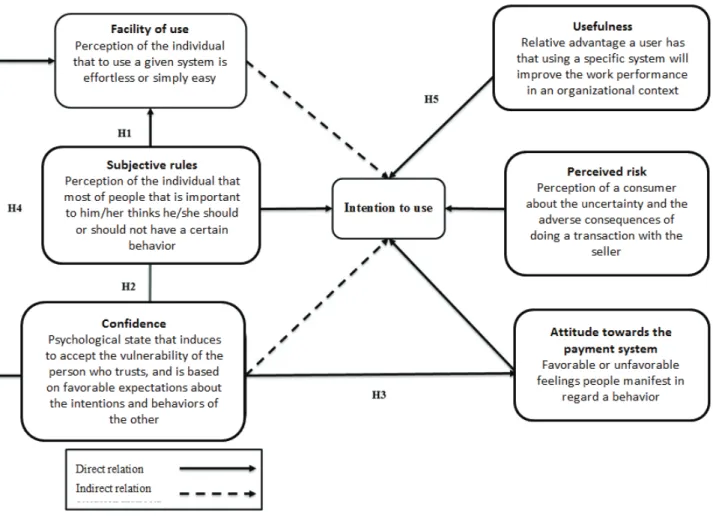
the review of literature about the consumer’s behavior in adopting mobile commercial services, most of the compared studies has precisely used the Technology Acceptance Model (TAM) (Davis, Bagozzi, & Warshaw, 1989) to explain such adoption, and from that we have made the following questions: Are the results of the proposed model similar to the previous ones? Does the age afect the adoption of mobile payment systems? Can we identify some implications for the companies of the industry?
FIguRe 1 – Variables of the model
4 the MODeRAtOR eFFeCt OF Age
To attain the objectives of the investigation, we propose the inclusion of the study of the age variable, with the background analyzed in the scientiic literature from the review of the main classical models. he age of the client/user has an important efect in his/her behavior, thus we will check in our investigation about the adoption of a new payment tool on the Internet if age is also determinant.
Since the irst investigations that have studied the impact of Internet on the society, the diferent authors were capable of deining a common argument line in defense of the moderation of such variable. In this regard, some studies have identiied a positive relation between consumers’ age and the probability of purchasing products online (Staford, Turan, &
Raisinghani, 2004), and on the other hand, others have obtained negative results (Joines, Scherer, & Scheufele, 2003), or simply no relation at all (Dabholkar, Michelle Bobbitt, & Lee, 2003). From our point of view, such divergences might be due to several factors such as the sample selection criteria, the moment of the study elaboration, etc. Several studies have tried to determine whether age can be considered a factor inluencing the attitude and behavior of consumers, analyzing aspects such as auto-scanning, and automatic charging, and online services, Internet use, technologies in self-service, technologies in the retail commerce, instant messaging, and mobile commerce, among others.
constructs of realized risk and conidence, under the name MPTAM (Mobile Payments Technology Acceptance Model).
Firstly, we refer to the moderator efect of the user’s age on the relation between the subjective rules and the facility of use. We started from the idea that those younger users, more prone to accept new technological tools, will perceive a higher facility of use. his statement has been statistically compared to the primary data of surveys on the electronic commerce use, mobile Internet (Accenture, 2011). herefore, older people will require a bigger implication in the service, and will be more afected by the external inluences of the electronic surrounding (Watering, 2005), causing the subjective rule on the facility of use to be higher for those older users (Chung, Park, Wang, Fulk, & McLaughlin, 2010). On the other hand, the conidence in the contacts of the online media makes more credible and reliable the information ofered in the network itself, against possible sources of third party information, which suggests that younger users, for having more experience in this type of surroundings, will show a stronger relation between subjective rules and conidence. For these reasons, the following hypotheses are proposed:
H1: he efect of subjective rules on the facility in using the system is signiicantly higher among those older users.
H2: he efect of subjective rules on the confidence in the proposed payment system is signiicantly higher among those younger users.
On the other hand, it is expected that those younger users guided by a bigger knowledge and access to the technological tools (Accenture, 2011; National Institute of Statistics [Instituto Nacional de Estadística, INE], 2013) will have more conidence and facility of use compared to those older ones that will be more reluctant in regard to the new payment tool [signiicant diferences in the previously mentioned studies].
In this regard, the younger users will manifest more willingness to use new technologies, resulting for more conidence in regard to the smaller efort needed to examine the details of the web service itself, as well as to appraise its quality, thus improving the perceived facility of use and attitude (Liébana-Cabanillas, 2012). In view of such circumstances, the following investigation hypotheses are proposed:
H3: he efect of conidence in the facility of use of the proposed payment system is signiicantly higher among those younger users.
H4: he efect of the perceived conidence of the proposed payment system on the attitude in regard to it is signiicantly stronger among those younger users.
At last, the younger users will grant a higher importance to the extrinsic reward (equivalent to the perceived usefulness), and will have less diiculty to process complex stimuli, which will determine more intention to use the new payment system (Venkatesh, Morris, Davis, & Davis, 2003). Furthermore, those older users will be more inluenced by the opinion of others. For these reasons we propose the following hypothesis:
H5: he efect of the perceived usefulness of the proposed payment system on the intention is higher to younger users.
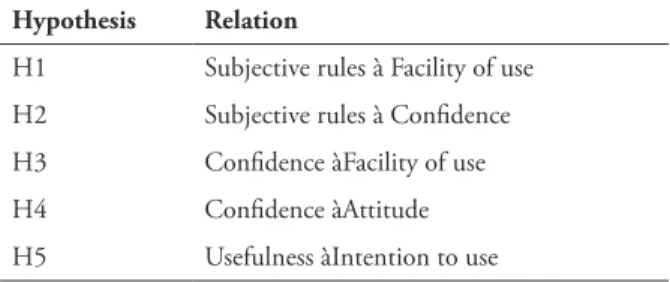
The investigation hypotheses are summarized in Table 2:
tABLe 2 – Summary of hypotheses
hypothesis Relation
5 MethODOLOgICAL ASPeCtS
5.1 Study scope and information collection
Our investigation has used a national panel of Internet users from which the user visualized a video with the explanation of the new proposed payment system. he used payment system is called Zong, which allows to purchase multiple physical and virtual contents using a mobile terminal through a very simple procedure that
allows paying the purchase in diferent formats (Internet, social networks, TV, and also the point of sale itself ). Such payment can be transferred to the telephone bill of the user or to a bank card listed at the moment of the service activation.
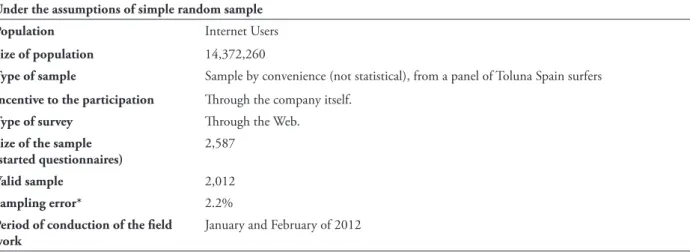
he inal sample size was 2,012 Internet users coming from a panel of surfers, sampled by convenience and reaching a sampling error of 2.2% in the estimation of a proportion. he technical information is summarized in Table 3, and the proile of the sample in Table 4.
tABLe 3 – Technical information and characteristics of the sample
under the assumptions of simple random sample
Population Internet Users
Size of population 14,372,260
type of sample Sample by convenience (not statistical), from a panel of Toluna Spain surfers
Incentive to the participation hrough the company itself.
type of survey hrough the Web.
Size of the sample (started questionnaires)
2,587
valid sample 2,012
Sampling error* 2.2%
Period of conduction of the ield work
January and February of 2012
Note.*In the estimation of a proportion, supposing p=q=0.5, the conidence level of 95% and simple random sample.
tABLe 4 – Proile of the analyzed sample
variable Category n Percentage
gender Man 948 47.12%
Woman 1,064 52.88%
Age
Under 18 years 1 0.05%
18 – 24 192 9.54%
25 – 34 642 31.91%
35 – 44 689 34.24%
45 – 54 382 18.99%
55 – 64 89 4.42%
Over 65 years 17 0.84%
education background
W/o education 22 1.09%
Primary education 110 5.47%
Secondary education 556 27.63%
University students 998 49.60%
Graduate students 316 15.71%
NS/NC 10 0.50%
experience with mobile payment systems
Yes 234 11.63%
No 1,778 88.37%
he questionnaire used to obtain data gathers the adaptation of some of the most recognized scales. To validate such scales, a irst quantitative nature test was conducted with bank professionals with minimum experience of ten years in the industry to ensure the validity of the terms used, and a second pilot test was conducted with a sample of students from the Economic and Business Sciences School.
he data analysis was developed in two stages. Firstly, the scales validity was analyzed, then the multi group analysis was performed to verify the proposed associations in a theoretical manner, both described in the following epigraph.
6 ReSuLtS
6.1 Reliability and validity of the proposed scales
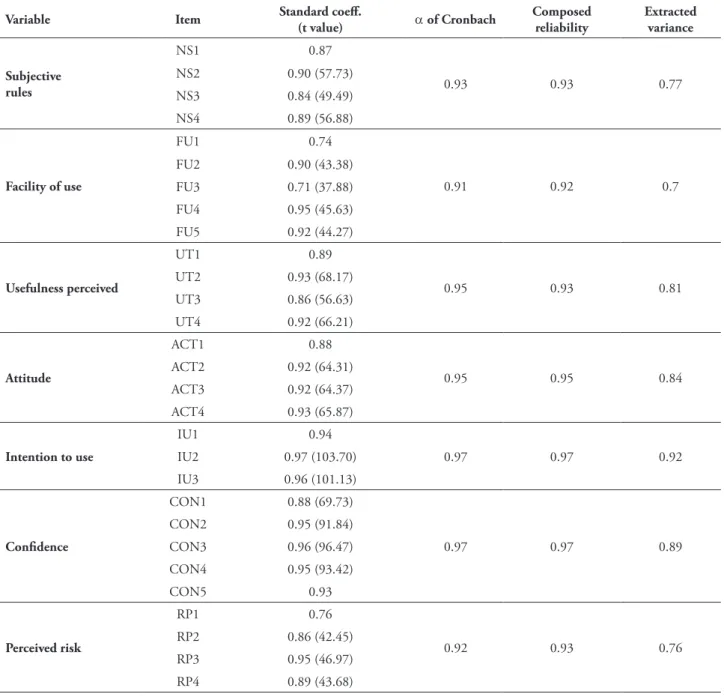
To evidence the suitability of the measurement scales used, diferent analyses of reliability and validity of the exploratory type (to which the SPSS 15.0 program was used), and of the conirmatory type (AMOS 18 software) were used, and are described in Table 5.
Firstly, to measure the reliability of the scales, the indicator alpha of Cronbach was used, considering the reference value 0.6 (Malhotra, 2004). Furthermore, to compare the convergent and divergent validity of the scales, a Conirmatory Factorial Analysis (CFA) was performed.
he convergent validity was evaluated through the factorial loads of the indicators. It was evidenced that the coeicients were signiicantly diferent from zero, and in addition to this that the loads between latent and observed variables were high in all the cases (α> 0.7). herefore, it was possible to conirm that the latent variables properly explained the observed variables.
In regard to the discriminating validity, it was evidenced that the variances were signiicantly different from zero, and that the correlation between each pair of scales was not above 0.9.
tABLe 5 – Reliability and validity of the proposed scales
variable Item Standard coef.
(t value) α of Cronbach
Composed reliability
extracted variance
Subjective rules
NS1 0.87
0.93 0.93 0.77
NS2 0.90 (57.73)
NS3 0.84 (49.49)
NS4 0.89 (56.88)
Facility of use
FU1 0.74
0.91 0.92 0.7
FU2 0.90 (43.38)
FU3 0.71 (37.88)
FU4 0.95 (45.63)
FU5 0.92 (44.27)
usefulness perceived
UT1 0.89
0.95 0.93 0.81
UT2 0.93 (68.17)
UT3 0.86 (56.63)
UT4 0.92 (66.21)
Attitude
ACT1 0.88
0.95 0.95 0.84
ACT2 0.92 (64.31)
ACT3 0.92 (64.37)
ACT4 0.93 (65.87)
Intention to use
IU1 0.94
0.97 0.97 0.92
IU2 0.97 (103.70)
IU3 0.96 (101.13)
Conidence
CON1 0.88 (69.73)
0.97 0.97 0.89
CON2 0.95 (91.84)
CON3 0.96 (96.47)
CON4 0.95 (93.42)
CON5 0.93
Perceived risk
RP1 0.76
0.92 0.93 0.76
RP2 0.86 (42.45)
RP3 0.95 (46.97)
RP4 0.89 (43.68)
he sample was divided into two groups based on the median of the users age distribution. In relation to the values of the sample related to asymmetry and kurtosis, many of them showed problems in a way or another, and thus it was concluded that the sample did not follow a multi variant normal distribution (Mardia Coefficient<=35 years = 400.705, critical ratio – CR–<=35 years = 136.535; Mardia>35 years = 502.131, CR>35 years = 203.133). In this regard, and following the recommendations of Barrio García and Luque Martínez (2012), the estimation method regarded as the most proper was the Method
he adjustment of the multi group model, through absolute, incremental, and parsimony measurements, allowed us to state that the model adjustment was reasonably good (χ2= 4097.508. p=0.00; RMSEA=0.07; IFI= 0.95; TLI=0.94 CFI=0.95; GFI=0.87; AGFI= 0.85).
Once all the proposed quality measurement scales were evaluated, we checked if all the latent constructs together had a discriminating validity, that is, if the several constructs forming the model were significantly different, since the discriminating validity among the dimensions of the same scale does not ensure the discriminating validity that the different latent constructs should have. An AFC was performed to that end, including all the measurement scales to extract the variance of each of them, as well as the correlations between constructs, and their conidence intervals.
In our case, it was evidenced that the correlations between constructs were not too high, no construct had a conidence interval of 1, and the correlations between indicators were below the root of the variance extracted from each of the constructs taken two by two, which allowed us to conclude that globally there was a discriminating validity between the diferent considered latent constructs.
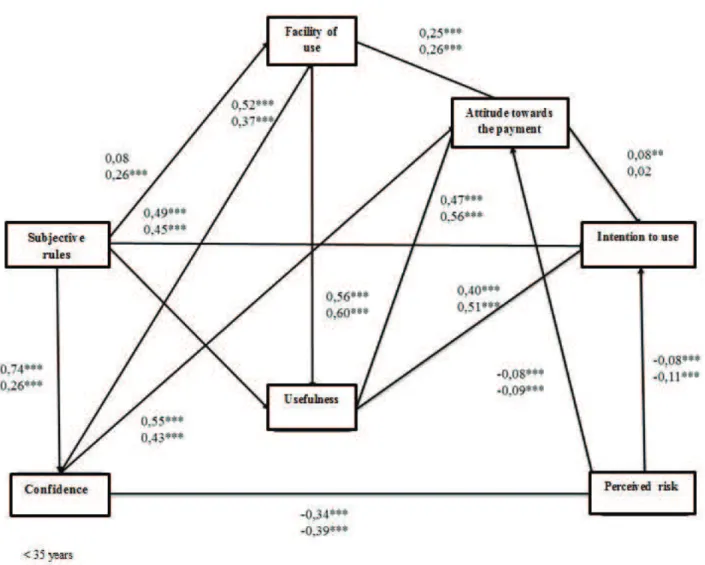
Once veriied the goodness of the model adjustment, the inal result was graphically put together from the standardized coeicients for the behavior model that measures the use of the new mobile payment system according to the user age (Figure 2).
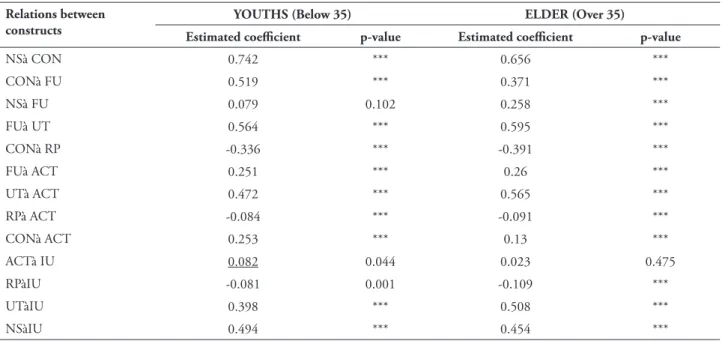
In addition, the statistical signiicance of the structural loads of the model was also analyzed (Table 6).
tABLe 6 – Statistical signiicance of the standardized structural loads
Relations between constructs
yOuthS (Below 35) eLDeR (Over 35)
estimated coeicient p-value estimated coeicient p-value
NSà CON 0.742 *** 0.656 ***
CONà FU 0.519 *** 0.371 ***
NSà FU 0.079 0.102 0.258 ***
FUà UT 0.564 *** 0.595 ***
CONà RP -0.336 *** -0.391 ***
FUà ACT 0.251 *** 0.26 ***
UTà ACT 0.472 *** 0.565 ***
RPà ACT -0.084 *** -0.091 ***
CONà ACT 0.253 *** 0.13 ***
ACTà IU 0.082 0.044 0.023 0.475
RPàIU -0.081 0.001 -0.109 ***
UTàIU 0.398 *** 0.508 ***
NSàIU 0.494 *** 0.454 ***
Note.p-value *** = p-value < 0.001
In the model of users with age under 35 years, all the relations manifested showed to be signiicant, except for the relation between the subjective rules and the facility of use, attaining a percentage of the explanation of the use intention variable of 63.3%. he intention to use in the model of users with age under 35 years maintains a
signiicant positive relation through the subjective rules (β = 0.49), attitude (β = 0.08), and perceived usefulness (β = 0.40), and the risk perceived in the negative direction (β = -0.08).
between attitude and intention, attaining an explanation of the intention to use of 68.2%. In this case, the intention to use was determined by the subjective rules (β = 0.45), usefulness
(β = 0.51), and perceived risk (β = -0.11). herefore, in our model the intention to use in the group of younger users is smaller than in the group of older users.
FIguRe 2 – Results of the multi group model (standardized coeicients). Under 35 / Over 35 years
6.1 Results of the proposed hypotheses
To evaluate the moderator efect of the user age manifested in the questionnaire, the sample was divided into two groups based on the median of the users age distribution. To that
tABLe 7 – Invariance analysis in the multi group model based on the age of users
Model χ2 g.l. Δ χ2 Δ g.l. p-value Invariance
General 4097.508 364 587.198 364 0.000 No
Restricted 4684.706 728
After evidencing the existence of signiicant diferences, and with the aim of verifying the moderator efect of proposed variables, a test was carried out to evidence the regression coeicients or weights between the structural models, considered two by two, using a modiication of the t of Student test for independent samples (Goodman & Blum, 1996). he evaluation was carried out by means of the procedure proposed by Chin (2000), through a multi group analysis in function of the t of Student test (through a parametric analysis using the t test with m + n 2 degrees of freedom) according to the following formulation, where Bi are the estimated
coeicients without standardization, and SEi are the standard errors for each coeicient:
Ho: B1 = B2
he results of the structural equations analysis, as well as the results of the hypothesis are shown in Table 8. As observed, the comparison manifested the existence of signiicant diferences in the H1, H2, H3, and H4 hypotheses.
tABLe 8 – Results of the proposed hypotheses
Age Signiicant
diferences?
hypothesis proved? hyp efect Below 35 years p-value Above 35 years p-value t test
1 NSàFU 0.078 0.102 0.234 0.001 -2.70 Yes Yes
2 NSà CON 0.756 0.001 0.668 0.001 2.10 Yes Yes
3 CONà FU 0.499 0.001 0.331 0.001 2.91 Yes Yes
4 CONà ACT 0.257 0.001 0.132 0.001 2.81 Yes Yes
5 UTàIU 0.394 0.001 0.481 0.001 -1.55 No Yes
7 COnCLuSIOnS AnD IMPLICAtIOnS
7.1 Conclusions
After of a review of the current situation of the electronic commerce and mobile commerce, the objective of our investigation was to model the behavior of Internet users in view of a new SMS mobile payment tool, as well as the analysis of the age in accepting such payment system, and the factors determining this.
In regard to the general results, irstly, it was demonstrated that those younger users are
users who will be more reluctant to improve their level of conidence based on them, and therefore the younger users are more prone to accept new technological tools, while the older users will need a higher implication in the service, being thus more influenced by the subjective rules of the community itself. hirdly, the younger users maintained a stronger relation between conidence and facility of use than the group of older users. Furthermore, the younger users maintained a more intense relation between conidence in the system and attitude in regard to the use, comparing to the older ones. Finally, it was not demonstrated that the intention to use among younger users improves their intention to use, in regard to the older ones, motivated by the electronic environment where the investigation is performed, and in regard to the higher willingness they generate in regard to it.
Regarding the direct efects, irstly, to those younger users the variable with higher inluence on the intention was the subjective rules. his high relation is motivated by the online environment where the user activity is developed, because the network itself is the place where the communication between people occurs, and it is precisely inside the network where the user will form his/her acceptance of the payment tool. As observed, it is precisely this variable that most determines the intention to use, which suggests that it is the very element determining the intention to use a payment system in the virtual environment of younger users. Secondly, the intention to use is determined by the usefulness of the mobile payment system. This second element reinforces the TAM proposals, but it is quantitatively apart from the values of external influences. Thirdly, the attitude manifests a nearly signiicant relation with the intention to use in the case of the younger user. At last, the perceived risk manifests a negative relation with the intention to use because of the uncertainty that the tool supposes to the new user and/or the possible negative consequences of the purchase act. Precisely, the inluence of such efect was broadly veriied in multiple ields, and our results corroborate and reinforce the already stated proposal.
In the case of older users, the intention to use is irstly determined by the usefulness of the payment tool itself in the analyzed medium, which reinforces previous investigations. Secondly, for the subjective rules, which demonstrates that older users prefer a more utilitarian view of the tool opposed to a social view of the tool. hirdly, the perceived risk, corroborating previous investigations that deine older users as users with a higher level of risk aversion. Finally, the attitude is not signiicantly related to intention.
On the other hand, it is empirically evidenced that the client/user age has an important efect on his/her behavior, and on the acceptance of technology. In our experiment, the existence of signiicant diferences between the relations proposed based on the user age was evidenced, actually in the relations between subjective rules and facility of use, subjective rules and conidence, conidence and facility of use, as well as conidence and attitude. Finally, in the relation proposed between usefulness and intention to use, no signiicant diferences were detected based on the age of users.
In regard to the relation between subjective rules and facility of use, it was demonstrated that older users are more prone to use simple and easy tools than younger users, with no doubt motivated by their smaller technological propensity, and higher requirement of the inluence from others. On the other hand, in the relation between subjective rules and conidence, we found the inverse situation, where younger users trust more the comments of their contacts in the network. In both relations, the inluence of the network conditions the results.
On the other hand, the relation between conidence and facility of use and attitude is more intense amongst younger users, suggested by their higher propensity towards new technologies.
7.2 Business implications
the economic and business scenario. Among the most current payment systems, we can highlight the mobile payment because of the importance of wireless devices in the current society, the accessibility supposed by this medium to the users, and the technological improvements continuously developed both in the online world (mainly Internet and social networks) and in the oline world (readers, PoS, etc.).
he results obtained in this investigation propose interesting implications for the difusion of mobile payment systems through the Internet. In actual terms, the knowledge of the virtual payment acceptance process is very useful to deine strategies oriented to the clients of such systems.
In this regard, it is noteworthy the need to realize an effort to make people improve their perception and general opinion about the purchase on the Internet. For this reason, companies should make communication eforts to difuse the advantages of this type of tools. here are surely elements favoring the companies, directly collaborating with them, which is the high percentage of mobile phone penetration, and the increased access to social networks through the mobile Internet. hese trends will allow the access to purchase portals from any place, at any time, overcoming the important advantages of the electronic commerce itself.
Furthermore, and as the result of the context where the investigation was developed, it is observed that Internet surfers are very sensitive to the opinions of their social surrounding regarding their purchase behavior on the Internet, and even more to the social networks themselves. Precisely because of this social inluence and or the number of users taking part of the networks, companies need to position themselves among their clients, and the acquaintances and friends of their clients, to stimulate as much as possible their sales and the payment of such sales by enabling agile and eicient payment systems.
Although the intention to use in our case is very inluenced by external inluences as opposed to attitude, it is important to pay attention to the
user surrounding, because the user behavior will depend on such surrounding, and in concrete terms the eWOM should be favored, since it will inluence the behavior and will improve the intention to use the new tool.
More concretely, due to the segments resulting from the application of the moderator efect of age among users, companies will be in condition to deine strategies adapted to the influence patterns, elaborating differentiated value proposals (segmented marketing), which properly satisfy clients and improve their loyalty, and consequently collaborate in attaining the objectives of the companies themselves. In this regard, the organizations that decide to enter a new market should diferentiate the arguments or proposals on which their advertisement or promotion messages are based. Particularly, if the action is intended to younger users, the arguments should not be based on the usefulness and simplicity of the new payment system, but should focus on security and/or privacy concerns, as a way to improve the conidence, and therefore the attitude towards the service. On the other hand, and based on the importance of external inluences to the groups of surfers, the already mentioned eWOM should be a more interesting tool for those older users less prone to technology and more prone to the inluence of others.
nOte OF the AuthOR
This study is financed with the financial support provided by the project of Investigation and Excellence P10-SEJ-6768 of the Economy and Science Council of the Andalucía Regional Government (Consejería de Economía y Ciencia de la Junta de Andalucía).
ReFeRenCeS
Accenture (2011). Retos y oportunidades del universo digital móvil en España: Más ubicuo, más
social, más personal. Recuperado de www.accenture.
Barrio García, S. del, & Luque Martínez, T. (2012). Análisis de ecuaciones estructurales. En T. Luque Martínez (Coord.), Técnicas de análisis de
datos en investigación de mercados (pp. 489-557).
Barcelona: Pirámide.
Bosque Rodríguez, I. A. R., Herrero Crespo, Á., & Samones Sánchez, M. M. G. (2005). La propensión a innovar en la adopción del comercio electrónico B2C: un análisis sobre la base de la Teoría de Acción Razonada. In Encuentro de Profesores Universitarios de Marketing [Archivo de
ordenador] (pp. 723-738). Madrid: Emark.
Carrión, M. (2012). Una visión del consumidor
móvil a nivel mundial. Recuperado de http://
recursos.anuncios.com/iles/503/13.pdf
Chin, W. W. (2000). Frequently asked questions–
partial least squares and PLS-Graph. Recuperado
de http://disc-nt.cba.uh.edu/chin/plsfaq.htm
Chung, J. E., Park, N., Wang, H., Fulk, J., & McLaughlin, M. (2010). Age differences in perceptions of online community participation among non-users: An extension of the Technology Acceptance Model. Computers in Human
Behavior, 26(6), 1674-1684.
Comisión del Mercado de las Telecomunicaciones. (2012). Informe trimestral de la comisión del mercado de las telecomunicaciones 2011. Recuperado de www.cmt.es
Cotec (2011). Informe Cotec 2011. Recuperado de www.cotec.es/index.php/pagina/publicaciones/ novedades/show/id/945/titulo/informe-cotec-2011--tecnologia-e-innovacion-en-espana
Dabholkar, P. A., Michelle Bobbitt, L., & Lee, E. J. (2003). Understanding consumer motivation and behavior related to self-scanning in retailing: Implications for strategy and research on technology-based self-service. International Journal
of Service Industry Management, 14(1), 59-95.
Davis, F. D., Bagozzi, R. P., & Warshaw, P. R. (1989). User acceptance of computer technology: A comparison of two theoretical models.
Management Science, 35(8), 982-1003.
Elogia. (2013). I Estudio anual eCommerce IAB
Spain. Recuperado de http://www.iabspain.net/
wp-content/uploads/downloads/2013/06/I_estudio_ ecommerce.pdf
Finney, S. J., & DiStefano, C. (2006). Non-normal and categorical data in structural equation modeling. En G. R. Hancock & R. O. Muller (Eds.) Structural equation modeling: A second course
(269-314). Connecticut: IAP.
Goodman, J. S., & Blum, T. C. (1996). Assessing the non-random sampling effects of subject attrition in longitudinal research. Journal of
Management, 22(4), 627-652.
Instituto Nacional de Estadística (2013). Encuesta de uso de TIC y Comercio Electrónico en las
empresas. Recuperado de www.ine.es
International Telecommunication Union (2013).
World Telecommunication/ICT Indicators Database.
Recuperado de www.itu.int/en/ITU-D/Statistics/ Pages/stat/default.aspx
Islam, M. A., Khan, M. A., Ramayah, T., & Hossain, M. M. (2011). he adoption of mobile commerce service among employed mobile phone users in Bangladesh: Self-eicacy as a moderator.
International Business Research, 4(2), 80-89.
Joines, J. L., Scherer, C. W., & Scheufele, D. A. (2003). Exploring motivations for consumer Web use and their implications for e-commerce.
Journal of consumer marketing, 20(2), 90-108.
Kalakota, R., & Robinson, M. (2001). E-business 2.0: Roadmap for success. Indianapolis, IN: Addison-Wesley Professional.
Lee, C. W., Hu, W. C., & Yeh, J. H. (2003, May). A system model for mobile commerce. En
Distributed Computing Systems Workshops, 2003.
Proceedings. 23rd International Conference on (pp.
634-639). IEEE.
Liébana-Cabanillas, F. (2012). El papel de los medios de pago en los nuevos entornos electrónicos
Comercialización e Investigación de Mercados. Universidad de Granada, Granada, Espanha.
Lopez-Catalán, B., & San Martín Gutiérrez, S. (2013). Periles de compradores españoles por teléfono móvil. Universia Business Review, (38), 50-67.
Malhotra, N. K. (2004). Investigación de Mercados: Un enfoque aplicados. México: Pearson Educación.
McKnight, D. H., Choudhury, V., & Kacmar, C. (2002). The impact of initial consumer trust on intentions to transact with a web site: a trust building model. he Journal of Strategic
Information Systems, 11(3), 297-323.
Observatorio de las Telecomunicaciones y la Sociedad de la Información (2013).
Estudio sobre Comercio Electrónico B2C 2012.
Recuperado de http://www.ontsi.red.es/ontsi/ es/estudios-informes/estudio-b2c-2012-edici%C3%B3n-2013
Pavlou, P. A. (2002). A theory of planned behavior perspective to the consumer adoption of electronic commerce. MIS Quarterly,30(1), 115-143.
Pikkarainen, T., Pikkarainen, K., Karjaluoto, H., & Pahnila, S. (2004). Consumer acceptance of online banking: An extension of the technology acceptance model. Internet Research,
14(3), 224-235.
Ruiz, A. (2009). Sistemas y entornos de pago para la adquisición de contenidos y servicios
electrónicos en red (Doctoral dissertation).
Departamento de Ingeniería de la Información y las Comunicaciones, Universidad de Murcia, Murcia, Espanha.
San Martín Gutiérrez, S., & Carpio, M. (2012). La venta por teléfono móvil desde el punto de vista de las empresas españolas. Universia Business
Review, (34), 124-143.
San Martín Gutiérrez, S., & López Catalán, B. (2010). Posibilidades de la compraventa B2C por teléfono móvil en comparación con Internet.
Cuadernos de Gestión, 10(1), 17-34.
Staford, T. F., Turan, A., & Raisinghani, M. S. (2004). International and cross-cultural inluences on online shopping behavior. Journal of Global
Information Technology Management,7(2), 70-87.
Taylor, S., & Todd, P. A. (1995). Understanding information technology usage: A test of competing models. Information Systems Research, 6(2), 144-176.
Venkatesh, V., & Bala, H. (2008). Technology acceptance model 3 and a research agenda on interventions. Decision Sciences, 39(2), 273-315.
Venkatesh, V., Morris, M. G., Davis, G. B., & Davis, F. D. (2003). User acceptance of information technology: Toward a uniied view.
MIS quarterly, 27(3), 425-478.
Watering, M. van (2005). The impact of
computer technology on the elderly. Recuperado
de http://feeling-younger.eu/wp-content/ uploads/2012/11/HCI_Essay_Marek_van_de_ Watering.pdf
Annex 1: MeASuReMent SCALeS uSeD
Scale of subjective rules
People whose opinions I value would approve the use of Zong to purchase a product.
Likert of 7 points 1 = Entirely disagree 7 = Entirely agree
Taylor and Todd (1995), and Bosque Rodríguez, Herrero Crespo, & Samones Sánchez. (2005) Most of people I take into consideration thinks I should use Zong to
purchase a product.
I am expected to use Zong to purchase a product.
People close to me would agree I use Zong to purchase a product.
Scale of facility of use
he interaction with the tool is clear and understandable.
Likert of 7 points 1 = Entirely disagree 7 = Entirely agree
Venkatesh and Bala (2008) he interaction with the tool does not require mental efort.
It seems to me that the tool will easily do what I want it to do.
It seems to me a useful tool to make small purchases on the Internet/ social networks.
In general, the tool is easy to use.
Scale of perceived usefulness
Using Zong can help me doing the purchases I usually do through the Internet/social networks.
Likert of 7 points 1 = Entirely disagree 7 = Entirely agree
Pikkarainen, Pikkarainen, Karjaluoto, & Pahnila (2004) and Muñoz (2008) Using Zong can increase my eicacy when purchasing on the
Internet/social networks
Using Zong in my purchases on the Internet/social networks can increase my productivity.
In general, Zong can be useful to me when purchasing on the Internet/social networks.
Scale of attitude of use
I don’t like - I like
Semantic diferential of 7 points
Del Bosque et al. (2005), and Muñoz (2008)
Absurd - Intelligent Boring - Interesting Unpleasant - Pleasant
Scale of intention to use
Assuming I had access to the Zong payment system, I intended to use is to purchase on the Internet/social networks.
Likert of 7 points 1 = Entirely disagree 7 = Entirely agree
Venkatesh and Bala (2008) If I had access to Zong over the next few months, I consider I will use
it instead of another alternative system.
Assuming I had access to the Zong, I would use it over the next few months.
Scale of conidence towards the use of virtual payment systems
I believe Zong will keep the promises and commitments it makes.
Likert of 7 points 1 = Entirely disagree 7 = Entirely agree
Pavlou (2002 [study 1]), and Muñoz (2008)
Zong is reliable.
I would qualify Zong as honest. I think Zong is responsible.
In general, Zong seems of trust to me.
Other people can get to know information of my online transactions if I use this tool.
Likert of 7 points 1 = Entirely disagree 7 = Entirely agree
McKnight, Choudhury, & Kacmar (2004b), and Muñoz (2008) here is a high potential for money loss if I purchase on the Internet/
social networks through this tool.
here is a major risk when purchasing on the Internet/social networks using this tool.