“There are many references on social capital, social entrepreneurship and system dynamics: in this paper, I do not use direct references and will give only general references about different themes that affect social cooperatives in Italy, qualitative system thinking and the building of social capital.”
Recebido em 11/junho/2012 Aprovado em 23/julho/2012
Sistema de Avaliação: Double Blind Review Editor Cientíico: Nicolau Reinhard
DOI: 10.5700/rausp1049
Claudio Travaglini é Professor Titular em Business Administration do Department of Management do
Alma Mater Studiorum da University of Bologna
(40126 – Bologna, Italy). E-mail: [email protected] Endereço:
Via Capodilucca, 34 40126 – Bologna – Italy
RESUMO
The generation and re-generation of social
capital and enterprises in multi-stakeholders
social cooperative enterprises: a system
dynamic approach
Claudio Travaglini
A construção e reconstrução de capital social em empresas cooperativas sociais de multi-staheholders: uma abordagem dinâmica do sistema
Teorias sobre o capital social e o empreendedorismo social têm dado destaque à iniciativa do capital social em gerar e nutrir boas relações entre o Terceiro Setor e o Setor Público. Neste trabalho, considera- -se o capital social como um ativo do Terceiro Setor; as cooperativas sociais de multi-stakeholders são vistas como fruto do capital social e, ao mesmo tempo, suas criadoras e propagadoras. Para representar essa dinâmica, emprega-se a abordagem sistêmica do ponto de vista qualitativo, associada à análise das redes sociais como ferramentas para reconstrução e modelagem de processos dentro das empresas sociais da comunidade e dos sistemas de negócios conectados. A cooperação entre voluntários, clientes, líderes da comunidade e os empreendimentos locais do Terceiro Setor é fundamental para o esta-belecimento da coniança nas relações entre as autoridades públicas locais e as cooperativas. Essas relações ajudam as cooperativas a manter contratos de longo prazo com as autoridades locais, como fornecedoras de serviços sociais, e possibilitam-lhes trazer inovação aos seus serviços, desenvolvendo experiências, administrando modelos e mantendo um intercâmbio com os servidores públicos. No longo prazo, essas relações unem as empresas cooperativas sociais entre si e ao setor público, ajudando a criar e renovar o capital social. Na sua atividade, as cooperativas acabam convivendo com trabalhadores que permanecem como membros da cooperativa, enquanto outros stake-holders deixam a organização. Mesmo esses que mantem um vínculo mais fraco são fundamentais para fazer de uma cooperativa de traba- lhadores uma autêntica cooperativa social de multi-stakeholders. Para manter a gestão dos multi-stakeholders e as relações com o Terceiro Setor e a sociedade civil, as cooperativas sociais têm que incentivar e fortalecer a participação e o diálogo com a comunidade por meio de um contínuo esforço de inclusão das pessoas. Usando uma abordagem de engenharia reversa, pode-se considerar determinante a criação de capital social e, desse modo, dar apoio à administração que o gera.
1. IntroductIon
Italian social cooperatives represent an interesting innova-tion of entrepreneurial organizainnova-tional forms; they have become, in recent years, market leaders in the provision of local welfare services. Social cooperatives achieved these results thank to innovative elements such as “multi-stakeholdership” (the in-troduction of volunteers, other individuals and service users in
signiicant roles alongside the workers within the association
base) and links with the community.
Deinitions of social enterprise refer to ideal types of
enter-prise where the entrepreneurial adaptation of different interests and values of people and groups involved in the cooperative is realized in the name of the ‘general interest of the community for human promotion and the social integration of citizens’(as per Italian Law n. 381 on Social Cooperatives).
We will discuss multi-stakeholder community social enter-prises in terms of a determinate enterprise pattern. Within the
particular enterprises that deine themselves as community
social enterprises, social capital, whether organizational or relational, is fundamental: a Social Cooperative Enterprise (SCE) is originated by, but also produces and disseminates, social capital. Indeed, a social cooperative is sometimes born from the solidary initiative of people other than the activators of the mutual aid contract (volunteers and people from the lo-cal community) and becomes an entrepreneurial reference for self-help relations in the community. It tries to improve the
building of relational social capital and the reining of helpful
relationships, drawing from other situations that produced these elements and sometimes transferring them into other realities,
where they can continue to play a role (often in non-proit,
horizontally and vertically organized groups, where resources and relations are shared).
We want to investigate the paths of creation, maintenance and dissipation of relational capital that arise during business life, using the tools of system thinking and connecting this with institutional structure, governance and business processes.
To this end, we employ system dynamics from a qualitative point of view and the analysis of social networks as tools for rebuilding and modeling processes within SCEs and connected business systems. We assume a holonic perspective of reality: each SCE is at the same time a component (its business being part of a more complex inter-business system consisting of
other non-proit businesses and of the public sector, the pri
-vate sector and the cooperative enterprises for which and with which it works) and a complex system (mainly comprised of the people who are active in it).
We analyze social capital building and renewal processes within social enterprises and processes of working drift proposed by experience and described in the literature, trying to highlight which are the exogenous variables that condition them. By identifying causative relations between variables
assumed to be signiicant in social capital and other variables,
modeling offers decision-makers the possibility of steering business and service system strategy toward the creation, rather than the destruction, of relational social capital.
This aspect is particularly important because the afirmation
of the importance of relational capital and the social rooting of cooperatives are often joined with mechanisms of partner selection and of contracts that are in line with the regulations and whims of public bodies, which, however, do not take these variables into account. This paper takes social cooperation as its subject of study, social capital as its observation perspective, and system dynamics as its observation tool. The boundaries of the proposed analysis are multiple; they start with the
de-velopment of an elaboration on the intriguing but sandy ield
of surveys that lack the quantitative objectivity derived from
inancial references.
We discuss the value of relations, although we are aware of the lack of a reliable model to evaluate social capital, therefore using proxies and indicators to quantify this value. The paper suggests business-exemplifying paths and generalization
at-tempts to be veriied through the observation of many SCEs
during the course of their development. The variables proposed herein as indicators of the creation and reproduction of social capital (types of relations, volunteers, and the effective par-ticipation of workers) are not ordinarily found in the national
oficial survey on Italian social cooperatives.
A temporal observation of the evolution of relational social capital within ordinary SCEs and those that carry out the characteristic choices of community social enterprises will al-low us to distinguish the boundaries of doctrinal elaborations
and theoretical models, to ind out whether the interpretative
model is effective, and to determine which variables affect relational capital.
Nevertheless, we feel that applying systemic thinking about a conceptual network to the relational capital dynamics of SCEs is a useful analytical perspective for understanding their complex business dynamics, integrating the habitual view
of companies with economic, inancial and asset data analysis.
2. WeAk lInks, connectors And entrepreneurIAl trends In ItAlIAn socIAl cooperAtIve enterprIses – sces
Adopting the systems theory approach, business economists
have, over time, identiied businesses as systems, placing them
within the overall system of the economic-social environment and stressing the complexity determined by the internal pres-ence of subsystems.
In business subjects, enterprise networks and the organ-ization of the enterprise as a network have been the subject of in-depth studies.
to sociological subjects and, in particular, studying in depth the analysis of social networks as the organizational representation of social relations that subtend social capital.
We want to shift the attention from social capital as an ex-ternal and basically independent variable, where the business develops itself, to the action of the business on social capital. We also want to highlight the circularity of the relations between individuals active within the business, of their con-nections, of the business system, of business relations with the outside, and of the resultant social capital catalyzing these relations.
By analyzing links, the role of hubs and the relevance of weak links, we try to interpret the development of relations within a social cooperative. In the relations between the social cooperative and its stakeholders, one must distinguish between the institutional stakeholders (usually members and workers who have primary economic expectations and management powers over the cooperative enterprise) and other stakeholders or social representatives. In a SCE, the latter (e.g. volunteers or, in a different way, users or their representatives) account for capital shares and divide responsibilities and management power, not becoming economic expectation holders other than in a distinctive and collective manner (the participation of these subjects as members and board members determines the multi--stakeholder features of an SCE).
These subjects establish weak links, sometimes importing into the SCE encouragement, sensitivities and innovations from their social, professional and entrepreneurial experiences.
On the other hand, the institutional stakeholders (usually worker-members) establish with the social enterprise strong links, characterized by substantial personal economic depen-dence on the cooperative.
We are now applying the ‘weak social link’ concept of Mark Granovetter to the relations of the cooperative enterprise with outside representatives, through the people who participate in it. The particularity is that the reference to the weak social link is related to SCEs via the people that are holding it – and not directly to the people.
In the history of successful cooperation and social private enterprises, the winning entrepreneurial ideas and innovations are often originated by weak links. The exclusive reference and the dependence of the SCE on the resources and its working people tend to lead to stronger cohesion, but to less innovation.
The network of SCEs and other subjects of the third sector in such a structured society consists of strong link systems (cohe-sive systems of cooperative enterprises that are in close relation with insider institutional stakeholders), connected through weak links that tie some elements (in this case, the SCEs).
Weak links perform a basic function: they capture interests, needs and requirements from the social environment and ac-tivate entrepreneurial innovations. The plurality and the large number of the relations established between members and stakeholders of the SCE and the surrounding community of
reference subjects change the service supply relations of the en-terprise into community welfare, through the broad and frequent participation of business side and possible representatives.
The weak links (of knowledge, innovation, collaborations requests) must be attached to an entrepreneurial base composed of collaborations and ongoing social relations and therefore of strong links.
Hubs or connectors represent another useful concept for understanding relational dynamics (and in our case, SCE dyn-amics) and some processes that we can denote as degenerative. The hubs or connectors are cruxes of a network (or people of the social network) presenting a number of connections and relations, two by two. In the case of SCEs, the hub or connect-or (usually a priest, a well-known practitioner, a charismatic leader, an entrepreneur, or a political-social manager) is in some cases decisive for the initial stages of the undertaking, when this person is able to import and to make personal relations of trustavailable to the emerging SCE, thereby getting the said enterprise to move thanks to this importing.
The organizational dynamics between particularly relevant connectors (charismatic leaders who are able to plan out and lead a democratic and participative business, such as a
coop-erative enterprise or a personal irm), and strong (particularly
relevant and constant relations that connect cooperative enter-prise members) and weak (relations that connect cooperative enterprises and the related strong links to other social
environ-ments) links inluence the development of SCEs.
3. the socIAl cApItAl dImensIon WIthIn development pAth AnAlysIs of socIAl cooperAtIve enterprIses
It is neither possible nor useful to examine, in these circum-stances, the processes of relational social capital and we will therefore offer only a few comments to contextualize the use of social capital to the subject at hand.
Relational social capital is comprised of different kinds of entities and facilitates the action of individual or collective actors within the structure of relations to which they belong. Relational social capital forms are represented both by inter-personal relations based on trust, reciprocity and mutual sup-port, and by more structured forms of cooperation, commercial organizations and voluntary associations.
From business economists’ point of view, one possibility for the analysis of social capital is to consider it as the grounds for business growth or the fertilizer for growing better businesses, without considering that businesses can produce social capital for themselves both as direct producers of help-relations and as catalysts of cooperative relations within the business or between businesses and social subjects.
contri-bute to the development of the businesses, importing from an entrepreneurial point of view help-relations and entrepreneurial opportunities offered by people and by the territory (this is especially true of working integration cooperative enterprises
inding opportunities in interaction with the economic tissue).
In a SCE, we can distinguish between derived social capital (coming from the previous experiences of people that transfer their relations to the SCE, by changing work) and original social capital (originating in the SCE).
The latter can be transferred, at least in part, to different organizations, becoming, in other contexts, derived social capital, through a continuous and recursive process.
The development model of social cooperation based on small dimensions, cooperative enterprises’ gemmation and cooperative aggregation assumes the transfer of the organiza-tional and relaorganiza-tional capital developed by the original coope-rative enterprises to the new ones and the reproduction of new social capital.
A social enterprise is a magnet for sharing and for help-ful relations, an activator of independent relational capital, a breeding ground for derived social capital coming from other situations and an occasional exporter of relational social capital
to other business units and irms in general.
The process of building a community social enterprise tries to internalize in an entrepreneurial model the cooperation
relations among beneiciaries, their families, customer bodies,
social services workers, volunteers and other social private subjects.
This process also modiies organizational relational capital,
fostering its innovation and continuous adaptation processes. The process of converting weak links into organizational skills is fundamental to allow the cooperative enterprise to
supply speciic and unique services to the public bodies for
which it works and to avoid competing only on the basis of price in tenders.
4. the development pAths of socIAl cooperAtIve enterprIses:
multI-stAkeholdershIp, relAtIons WIth publIc bodIes And relAtIonAl cApItAl from A systemIc poInt of vIeW
To discuss the entrepreneurial paths of SCEs, we must
briely refer to systemic thought tools. Every dynamic and
open system can be properly represented by an oriented struc-ture characterized by entering variables and outing variables, respectively entries (causes) and exits (effects).The evolu-tion of such a system is manifested through the variaevolu-tion of a number of measurable attributes (or variables). In addition, businesses – which are, in turn, open and dynamic systems – can be similarly represented by a structure called input-output; every business system interacts with other business realities and establishes a subsystem included in a bigger reality: the
environment of reference. The application of a systemic model calls for the individuation of variables representing the causal phenomena and processes to be connected: while this may
seem relatively easy for balance sheet economic-inancial-asset
dynamics, it becomes complex when applied to a phenomenon such as social capital.
We will consider the involvement of volunteers engaged in the relational enrichment of the social cooperative’s activities as relational capital indicators of the cooperative. We will also consider volunteers active in the management of the cooperat-ive, beyond the cooperation relationships network and different from suppliers and customers.
As measures of organizational social capital, we will adopt management collaborations, and management and service inno-vations, placing the relation between public bodies (which are the main purchasers of social cooperatives’ services) and social
enterprises in the ield of service assignment in addition to the
(relational and organizational) quality of the provided service. To do this, we consider two paths, segments of the life of SCEs, from the relations perspective.
We will examine the initial and entrepreneurial stages,
the evolution of the social base of SCEs, and the deinition of
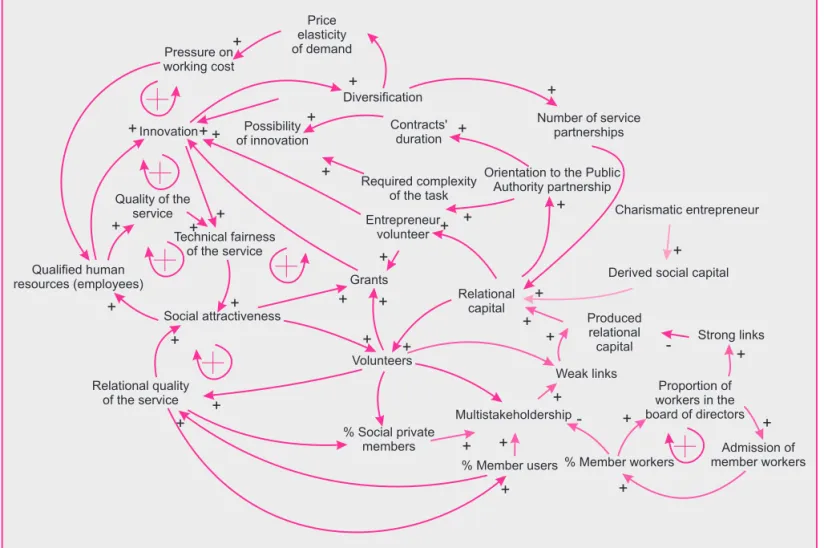
the relations of service provision and partnership with public bodies. In addition, we will try to recognize characters related with the creation, the maintenance and the dissipation of social capital (in support of the analysis, please refer to the cause--effect graph in Figure 1). We stress that the paths considered represent strategic passages in the life of a SCE, where the weak links and the dynamic balance between them and the strong links with different members of the cooperative enterprise cover a particular critical state that we attempt to analyze from the (relational and organizational) social capital perspective.
The irst phase to consider is the moment of the origin
of the SCE, typically through entrepreneurial gemmation of political, united, associative collective experiences or through an initiative of charismatic entrepreneurs or leaders interested in contributing to the social experiences system with their own feature using a social cooperative tool, or through workers’ self-organization.
The origin of SCEs therefore seems to it more easily into
the social tissue characterized by the spread of social, political, and union organizations and diffused entrepreneurship.
The opportunity to use supporting measures for entrepre-neurship and small job orders or innovative support initiatives from public bodies or foundations and cooperative organiza-tions can spur and sustain the origin of SCEs.
This is, however, an allocation of original social capital derived’ from previous experience that grows through the de-velopment of the business and relations (even if characterized by a trusting approach) of the new entity.
The allocation of trust, relations and derived social capital is particularly important, as it accelerates the process of earning trust and recognition from institutions and from the local com-munity of the new entity on the basis of an afidavit provided by the founders.
Ongoing dependence on the commercial, organizational and strategic relations of the founder (whether an individual or an
organization) would limit the SCE merely to relected vitality.
Starting with these relations, but overcoming them, the weak (professional, social, political, personal) links of the SCE members are grafted onto the previous relational capital to pro-duce it again (original and not imported), so that the enterprise becomes progressively independent vis-a-vis its founder, the entering derived social capital being then reproduced.
The limitation of administrative terms and the demand for effective democracy in SCEs prevent the perpetuation of a charismatic leader and dictate that the managers of the
enterprise plan the business from the perspective of new and growing social entrepreneurs.
The prevalence of strong relations of the founder
presum-ably result in the ageing of social capital, leaving insuficient
room for the renewal of social capital that results from the de-velopment (in terms of services, relations and opportunities) of the weak links of the SCE’s social actors other than the founder. A SCE (that is being built, that has reached the next step, and permanently) must acquire, manage and maintain multiple relations with different social groups (users, volunteers, public authorities and foundations) directly or through entities that become bearers of weak links in these relations and that are producers of social capital.
Through the development and maintenance of these weak links, the institutional structure of the SCE is open to the ele-ments of a relation with the environment and maintains (albeit in a dynamic way, with the release of certain subjects and the parallel inclusion of others, the activities of the cooperative enterprise corresponding to evolution) those multi-stakehold-ership characteristics that lend it the entrepreneurial dimension of civil society.
The maintenance of weak relations requires limited speciic
investment in information and communication to enable the involvement of social actors and, above all, it calls for an at-titude of openness regarding the stakeholders whose interests differ from those of the members-workers.
The multi-stakeholdership characteristic of a SCE is not only realized by its presence in the social base, but also by effective participation in the enterprise’s governing bodies.
This includes broader management of agreement and
con-lict, and is consequently more complex, with the internaliza
-tion of negotia-tions regarding targets and the destina-tion of the value produced within the enterprise among the different actors in the SCE.
The opposite phenomenon is working drift, i.e., the short-ening of the period of the presence in the SCE of subjects and interests other than those of workers.
Working drift is determined by the fact that after a SCE’s foundation stage, the contribution of people other than employees fades and they remain only as active workers who have institutional interests and strong links with the enterprise.
The phenomenon is described by a feedback circuit with positive polarity in Figure 2 (a detail of the total cause-effect diagram proposed in Figure 1).
With the weakening of the presence of volunteers, workers
or users during the working drift may show self-suficiency
and lack of acceptance of the types of collaboration offered to the cooperative by volunteers, so leading members other than employees may consider discontinuing their participation in the cooperative enterprise.
This transforms the multi-stakeholder SCE into a working
cooperative enterprise with speciic goals and relationships that
are typical of such enterprises.
To avoid this, one must reactivate the weak links; in other words, the participation of stakeholders other than SCE workers, in order to maintain multi-stakeholdership, i.e., a
continuous maintenance and reactivation of relational and organizational capital, through the maintenance of weak links and new partnerships and alliances with actors from the third sector, public institutions and private-sector enterprises.
Some work integration cooperatives have enterprises as key partners that can take on the role of the purchasers, but can also establish collaborative relations, which are the broadest, in the name of shared values.
In this case, the relationship between cooperative and
client--enterprise exits from the trading operation ield to take on the
features of weak link cooperation, encouragement and support. The composition of the social base and governing bodies and the presence of collaboration relations record the evolution of the process.
For SCEs that operate with public institutions, relations with the public bodies, which are the main or sole purchasers, is of absolute strategic importance.
The relation can develop into a partnership in which the cooperative enterprise is chosen as a provider of services with a high level of professional and relational quality or as a sup-plier of cheap labor with high elasticity.
The latter situation relegates the cooperative to absolute economic dependence on work for the public institution, with-out recognition of its role as an effective manager of social and educational services.
In the presence of a predominantly public market, a certain level of dependence seems inevitable, but it is absolute when the service assignments are short-term and there is no demand for complex services.
The virtuous entrepreneurial path of SCEs involves embrac-ing a growembrac-ing complexity in the services that it provides to the government authority (typically evolving from supplying labor to providing complex services with full professional and entrepreneurial responsibility) while undertaking, in parallel, to exercise its ability to experience innovation and relational quality regarding the service supplied.
The cooperative gradually progresses from taking on the mere supplying of labor as needed, with short-term contracts, to undertaking the management of medium- to long-term contracts of system services, including the management of facilities and buildings, in addition to full organizational and managerial responsibility for the service.
A SCE that manages to create innovative and qualiied
services to offer to public institutions and to the private-sector market is able to attract more motivated and better trained hu-man resources (and thus to build organizational capital) as well as volunteers who agree to collaborate in qualifying the service.
In addition, the implementation of professional and inno-vative services facilitates getting cooperation from the public or private sector institutions interested in improving services in the area.
In this case, the cooperative may be grouped with others to overcome resource price-based competition and thus the
issue of contracts, circumventing price reduction pressures on their services through differentiation and offering innovative services and models to deal with problems other than those proposed by others.
Within this strategic framework, weak links with outsiders are one more element of service differentiation and innovation.
The opposite case offers us an incomplete path that causes the SCE to be unable to offer services of greater complexity,
so that it remains conined to the ancillary role of providing
cheaper labor or simple services, based solely on lowest price criteria, sometimes working for a single purchaser or on a single contract.
To break free from this marginal condition, a SCE must establish a process of professional development and imple-mentation of innovations.
With a simpler process, a SCE is sometimes able to turn on the working drift and in time become a provider of profes-sionalism in the service of public actors.
The breakdown of the turnover of cooperative activities between types of activities and public institution purchasers, the duration of contracts, the cost of labor per unit and the ratio between labor costs, value added and turnover for a SCE’s services and how these parameters evolve over time represent the evolution of its pathway.
5. conclusIons
This paper discusses the formation and regeneration of
social capital in a speciic type of third sector enterprise: the
multi-stakeholder social cooperative, which is at the same time creator and incubator of social capital. In this presentation, we employ a qualitative system dynamic approach in which social capital is measured through proxies.
Participation of volunteers, customers, community lead-ers and third sector local organizations establish social capital through cooperation; long-term relations linking social coop-eratives and public organizations contribute to the creation and renovation of social capital.
To maintain multi-stakeholder governance and relations with third sector and civil society, social cooperatives must reinforce participation and dialogue with society through an ongoing effort to include people that can bring social proposals.
We have represented these processes in a qualitative sys-tem dynamic model and measured the social capital created by social cooperative by means of proxies, such as number of volunteers and strong cooperation with public institutions.
In a reverse-engineering approach, we can individuate the determinants of the creation of social capital and thereby provide support for governance that creates social capital.
ADEMA, W. Revisiting real social spending across countries: a brief note. OECD Economic Studies, Paris, v.30,
p.191-197, 2000.
BARABÁSI, Albert-László. Linked: how everything is connected to everything else and what it means for business, science, and everyday life. New York: Plume, 2002.
BODE, I. Disorganized welfare mixes: voluntary agencies and new governance regimes in Western Europe. Journal of European Social Policy, London, n.16, p.346-359, 2006. BORZAGA, C.; DEFOURNY, J. (Ed.). The emergence of social enterprise. London: Routledge, 2001.
BORZAGA, C.; MITTONE, L. The multi-stakeholders versus the nonproit organization. Discussion Paper n.7. Trento: University of Trento, 1997.
CARBOGNIN, M. (Ed.). Il Campo di Fragole. Milan: FrancoAngeli, 1999.
COLEMAN, J. Foundations of social theory. Cambridge: Harvard University Press, 1990.
COYLE, R.G. System dynamics modelling – a practical approach. London: Chapman & Hall, 1996.
DEFOURNY, J.; FAVREAU, J.; LAVILLE, J.L. (Ed.). The emergence of social enterprises in Europe. Brussels: EMES European Network, 1999.
EUROPEAN FOUNDATION. Active citizenship and community involvement: getting to the roots. Luxembourg: Ofice of Oficial Publications of the European Communities, 1997.
EVERS, A. Part of the welfare mix: the third sector as an intermediate area between the market economy, state, and community. Voluntas, Berlin, v.10, n.4, p.159-182, 1995.
EVERS, A. The signiicance of social capital in the multiple goal and resource structure of social enterprises. In: BORZAGA, C.; DEFOURNY, J. (Ed.). The emergence of social enterprises. London: Routledge, 2001.
FAZZI, L. Quale impresa sociale per quale welfare? Quale welfare per quale impresa sociale? Impresa Sociale, Milan, v.75, n.3, p.207-224, 2006.
FERRERA, M. The “Southern Model” of welfare in social Europe. Journal of European Social Policy, London, v.6, n.1, p.17-37, 1996.
FERRERA, M.; HEMERIJCK, A. Recalibrating Europe’s welfare regimes. In: ZEITLIN, J.; TRUBECK, D. (Ed.). Governing work and welfare in a new economy. Oxford: Oxford University Press, 2003.
FORRESTER, J.W. Industrial dynamics. Cambridge: Productivity Press, 1961.
FORRESTER, J.W. Principi dei sistemi. Milano: Etaslibri, 1974.
FORRESTER, J.W.; SENGE, P. Tests for building
conidence in system dynamics models. In: LEGASTO, A.A.; FORRESTER, J.W.; LYNEIS, J.M. (Ed.). TIMS studies in management science (system dynamics). The Netherlands: North-Holland, 1980. v.14, p.209-228.
GILBERT, N. Transformation of the welfare state. Oxford: Oxford University Press, 2004.
GRANOVETTER, M. The strength of weak ties: a network theory revisited. Sociological Theory, v.1, p.201-233, 1983.
KENNEDY, M. An assessment of the role of system dynamics models in the information systems investment appraisal process in management information system professionals (a cura di Michael Kennedy). London: Pearson, 2005a.
KENNEDY, M. An extended taxonomy of system dynamics models of information systems investment appraisal in management accounting and decision making (a cura di Michael Kennedy). London: Pearson, 2005b.
KIM, D.; SENGE, P. Putting system thinking into practice. In: System Dynamics Review, New York, v.10, n.2-3, p.277-290, 1994. System Dynamics Society.
ISTAT. Le organizzazioni di volontariato in Italia. Anno 2001. Roma: Istat, 2004.
ISTAT. Le cooperative sociali in Italia. Anno 2004. Roma: Istat, 2006.
LAVILLE, J.L. (Ed.). The third sector in Europe. Northhampton: Edward Elgar, 2004.
LAVILLE, J.L. The social enterprise: towards a theoretical socio-economic approach. In: DEFOURNY, J. (Ed.). The emergence of social enterprise. London: Routledge, 2001.
LE GRAND, J.; BARTLETT, W. (Ed.). Quasi markets and social policy. London: MacMillan, 1993.
MAANI, K.E.; CAVANA, R.Y. System thinking and modelling – understanding change and complexity. New Zealand: Pearson Education, 2000.
MATACENA, A.; TRAVAGLINI, C. L’evoluzione della presenza del volontariato nelle cooperative sociali. Impresa Sociale, Milan, v.30, p.45-59, 1996.
MOLLONA, E. Analisi dinamica dei sistemi aziendali. Milano: EGEA, 2000.
OSBORNE, S. Voluntary organisations and innovation in public services. London: Routledge, 1998.
PESTOFF, V.A. Beyond the market and state: social enterprises and civil democracy in a welfare state. Aldershot: Ashgate, 1998.
RICHARDSON, G.P. Feedback thought in social science and system theory. Philadelphia: University of Pennsylvania Press, 1991.
RICHARDSON, G.P.; PUGH, A.L. Introduction to system dynamics modelling with dynamo. Portland: Productivity Press, 1981.
SABATINI, F. The role of social capital in economic development. In: CONFERENCE “SOCIAL CAPITAL, SUSTAINABILITY AND SOCIO-ECONOMIC COHESION”, June 29-30, 2006, London. Proceedings… London: London School of Economics, 2006.
SABATINI, F. Capitale sociale, imprese sociali, spesa pubblica e benessere sociale in Italia. Impresa Sociale, Milan, v.76, n.2, p.192-223, 2007. Numero monograico su "Fiducia, capitale sociale e beni relazionali".
SENGE, P.M. La quinta disciplina – l'arte e la pratica dell'apprendimento organizzativo. Milano: Sperling & Kupfer, 1992.
STERMAN, J.D. Business dynamics – system thinking and modeling for a complex world. USA: McGraw-Hill, 2000. SUPINO, E. Modelli dinamici per il controllo
multidimensionale. Integrazione tra system dynamics e balanced scorecard. Bologna: DuPress, 2008.
SUPINO, E. Elementi di system dynamics per il budget d’impresa. Bologna: DuPress, 2011.
SVENDSEN, G.L.H.; SVENDSEN, G.T. The creation and destruction of social capital, entrepreneurship, co-operative movements and institutions. Northhampton: Edward Elgar, 2005.
TRAVAGLINI, C. Le cooperative sociali tra impresa e solidarietà. Bologna: Clueb, 1997.
TRAVAGLINI, C. Percorsi di sviluppo e coordinazioni nel terzo settore: dalle aziende nonproit ai gruppi misti nel nonproit. Nonproit, Rimini, v.4, p.635-648, 1998.
WARREN, K. The dynamics of strategy. Business Strategy Review, Elsevier, London, v.10, n.3, p.1-16, 1999.
WARREN, K. Competitive strategy dynamics. Chichester: Wiley, 2002.
WOLSTENHOLME, E.F. A methodology for qualitative system dynamics. In: SYSTEM DYNAMICS 1985 INTERNATIONAL SYSTEM DYNAMICS CONFERENCE, 1985, Denver. Proceedings... Operational Research Society, 1985.
WOLSTENHOLME, E.F. System enquiry – a system dynamic approach. Chichester: Wiley, 1990. WOLSTENHOLME, E.F. Qualitative vs quantitative modelling: the evolving balance. The Journal of Operational Research Society, Denver, v.50, n.4, p.422-428, 1999. Operational Research Society.
the generation and re-generation of social capital and enterprises in multi-stakeholders social cooperative enterprises: a system dynamic approach
Theories on social capital and on social entrepreneurship have mainly highlighted the attitude of social capital to generate enterprises and to foster good relations between third sector organizations and the public sector. This
paper considers the social capital in a speciic third sector enterprise; here, multi-stakeholder social cooperatives
are seen, at the same time, as social capital results, creators and incubators. In the particular enterprises that identify themselves as community social enterprises, social capital, both as organizational and relational capital, is fundamental: SCEs arise from but also produce and disseminate social capital. This paper aims to improve the
building of relational social capital and the reining of helpful relations drawn from other arenas, where they were
created and from where they are sometimes transferred to other realities, where their role is carried on further
(of-ten working in non-proit, horizontally and vertically arranged groups, where they share resources and relations).
To represent this perspective, we use a qualitative system dynamic approach in which social capital is measured using proxies. Cooperation of volunteers, customers, community leaders and third sector local organizations is fundamental to establish trust relations between public local authorities and cooperatives. These relations help the latter to maintain long-term contracts with local authorities as providers of social services and enable them to add innovation to their services, by developing experiences and management models and maintaining an interchange with civil servants regarding these matters. The long-term relations and the organizational relations linking SCEs and public organizations help to create and to renovate social capital. Thus, multi-stakeholder cooperatives origin-ated via social capital developed in third sector organizations produce new social capital within the cooperatives themselves and between different cooperatives (entrepreneurial components of the third sector) and the public sector. In their entrepreneurial life, cooperatives have to contrast the “working drift,” as a result of which only workers remain as members of the cooperative, while other stakeholders leave the organization. Those who are not workers in the cooperative are (stake)holders with “weak ties,” who are nevertheless fundamental in making a worker’s cooperative an authentic social multi-stakeholders cooperative. To maintain multi-stakeholder governance and the relations with third sector and civil society, social cooperatives have to reinforce participation and dialogue with civil society through ongoing efforts to include people that provide social proposals. We try to represent these processes in a system dynamic model applied to local cooperatives, measuring the social capital created by the social cooperative through proxies, such as number of volunteers and strong cooperation with public institutions. Using a reverse-engineering approach, we can individuate the determinants of the creation of social capital and thereby give support to governance that creates social capital.
Keywords: social cooperatives, social capital, multi-stakeholder, system dynamic, social entrepreneurship.
la generación y reconstrucción del capital social en empresas cooperativas sociales de
multistakeholders: un enfoque dinámico del sistema
Teorías sobre el capital social y el emprendedurismo social ponen de relieve la iniciativa del capital social en generar y nutrir buenas relaciones entre el sector terciario y el sector público. En este trabajo se considera el capital social como un activo del sector terciario; en él, las cooperativas sociales de multistakeholders son vistas como resultado del capital social y, a la vez, como sus creadoras y difusoras. Para representar esta dinámica, se emplea un enfoque sistémico desde el punto de vista cualitativo asociado al análisis de las redes sociales como herramientas para la reconstrucción y modelado de procesos en las empresas sociales de la comunidad y de los
ABSTRACT
sistemas de negocios relacionados. La colaboración de voluntarios, clientes, líderes de la comunidad y los negocios
locales del sector terciario son fundamentales para establecer la conianza en las relaciones entre las autoridades
públicas locales y las cooperativas. Dichas relaciones ayudan a las cooperativas a mantener contratos a largo plazo con las autoridades locales como proveedoras de servicios sociales y les permite agregar innovación a sus servicios, desarrollando experiencias, administrando modelos y manteniendo un intercambio con los servidores públicos. En el largo plazo esas relaciones unen a las empresas cooperativas sociales entre sí y al sector público, lo que ayuda a crear y renovar el capital social. En su actividad, las cooperativas conviven con trabajadores que permanecen como miembros de la cooperativa, mientras que otros stakeholders dejan la organización. Aun éstos que mantienen un vínculo más débil son fundamentales para convertir una cooperativa de trabajadores en una au-téntica cooperativa social de multistakeholders. Para mantener la gestión de los multistakeholders y las relaciones con el sector terciario y la sociedad civil, las cooperativas sociales tienen que estimular y reforzar la participación y el diálogo con la comunidad por medio de un esfuerzo continuo de inclusión social. Con el uso de un enfoque de ingeniería inversa, se puede considerar determinante la creación del capital social y, por consiguiente, apoyar la administración que lo genera.
Palabras clave: cooperativas sociales, capital social, multistakeholder, sistema dinámico, emprendedurismo social.