Longitudinal behavioral analysis during
dental care of children aged 0 to 3 years
Abstract: “When” and “how” the dentist intervenes have repercussions on children’s physical and emotional patterns. The objective of the pres-ent study was to conduct a longitudinal behavioral analysis during dpres-ental care of babies aged 0 to 3 years. A total of 216 patients seen at the Baby Clinic of the School of Dentistry at Araçatuba, São Paulo State Universi-ty (UNESP), were selected. The selection criterion was attendance at ten dental care sessions at bimonthly intervals for routine procedures such as clinical examination and oral hygiene. There was a predominance of co-operative behavior compared to uncoco-operative behavior when each visit was analyzed separately. The behavior of the patients must have been directly inluenced by their psychomotor development. Constant atten-dance and exposure of the baby to non-stressful dental stimuli are fac-tors that favor a cooperative behavior.
Descriptors: Behavior; Child; Dental care. Robson Frederico Cunha(a)
Ana Carolina Soares Fraga Zaze(b)
Ana Elisa de Mello Vieira(c)
Fabíola Lemos Melhado(d)
Maria Lucia Marçal Mazza Sundefeld(e)
(a) PhD, Professor of Pediatric Dentistry; (b)MSc, Graduate Student in Pediatric Dentistry; (e)PhD, Professor of Statistics – School of Dentistry at Araçatuba, São Paulo State University (UNESP), Araçatuba, SP, Brazil.
(c) PhD, Professor of Pediatric Dentistry, School of Dentistry, Educational Foundation of Santa Fé do Sul, Santa Fé do Sul, SP, Brazil.
(d) PhD, Private practitioner in Araçatuba, SP, Brazil.
Corresponding author:
Robson Frederico Cunha
Rua José Bonifácio, 1193 - Vila Mendonça Araçatuba - SP - Brazil
CEP: 16015-050
E-mail: [email protected]
Introduction
Pediatric dentistry arose from the recognition that children have speciic dental problems. “When” and “how” the dental surgeon intervenes have re-percussions on children’s physical and emotional patterns, since they are in a stage of considerable growth and development.1 These repercussions
may be positive or negative, depending on the con-text. Thus, concern with the psychological aspects involved in dental care has increased. Nowadays, it is widely accepted that the knowledge about the behavior and functioning of the human being im-proved the integration of the professionals involved in dental care. The dentist should focus his interest on the child as a whole, including not only physical but emotional well-being as well.1
Although the behavior of children is more relat-ed to their mental development than to chronologi-cal age, the dental pediatrics literature relates some typical characteristics to different age groups, and more frequently so in the 3 to 12 year age group.2,3,4
Since the 1980s, dental care for babies (0 to 36 months of age) has grown extensively in Brazil, a fact that has led to an increase in the number of professionals that provide dental care to children as early as during their irst year of life. According to Cunha et al.5 (2003), infancy is the best period
to create good habits that will persist throughout adult life. This early care is justiied not only by the maintenance of oral health but also by the pos-sibility to accustom the child to the routine of den-tal procedures. However, little has been published in the past about the infant’s behavior in the dental ofice. Pereira, Freire6 (2004) investigated children’s
behavior during dental attendance and concluded that the behavior depends on the babies’ psychologi-cal development. According to Walter et al.7 (1999),
newborns are docile, easy to handle and require the presence of their mothers since separation will inlu-ence the children’s reactions to new situations. This is an important aspect when providing dental care in this age group. Other variables, such as unfa-miliar environments and interference from persons through physical contact, may affect their behavior.
Percinoto, Cunha8 (2002) reported that
stud-ies are necessary to rule out doubts regarding the
reactions of those babies to stimuli applied in the dental ofice and possible behavioral sequelae that those stimuli may cause in the future, knowing that the patient is in a phase of considerable physical and psychological development. According to Klein9
(1967), the emotional impact of dental treatment on children is still unknown, and the way they inter-nalize their experience with the dentist is believed to be decisive for the formation of attitudes and expec-tations during dental treatment.
Based on the above considerations, the behavior of babies submitted to dental care should be further explored since baby dentistry is a growing area that requires scientiic evidence to offer physical and emotional well-being to the patient. The objective of the present study was, thus, to conduct a longitudi-nal behavioral alongitudi-nalysis during dental care of babies aged 0 to 3 years.
Methods
A total of 216 records of patients aged 0 to 36 months seen at the Baby Clinic of the School of Dentistry at Araçatuba, São Paulo State University (UNESP), Araçatuba, SP, Brazil, were selected. The selection criterion was attendance at ten dental care sessions at bimonthly intervals according to the den-tal care protocol for babies published by Cunha et al.10 (2000). For this study design, it was crucial that
the subjects had received exactly the same experi-ence at each visit. Children presenting restorative care, longer intervals between appointments or men-tal and/or physical disease were not included in the study. This research was reviewed and approved by the appropriate institutional Ethics Committee, and the children’s parents were approached concerning the study.
hold-ing their children’s hands. At each session, the pa-tients were classiied into two categories according to their behavior:
Cooperative patients
• : children who do not cry
and react favorably to the procedures; children who cry when they lie down on the dental chair but do not impair the procedures;
uncooperative patients
• : children who keep their
lips sealed during care, cry and try to impair the procedures with their hands.
The data collected from the babies’ records (date of birth, gender, age of the patient at the irst and tenth session, and behavior shown during the pro-cedures of oral hygiene and clinical examination in each session) were processed and analyzed by the Chi-Square test and Fisher’s exact test for the de-termination of an association between variables. A level of signiicance of 5% was set for all analyses.
Results
The percentage of males and females was simi-lar among the 216 children examined (49.54% and 50.46%, respectively). The mean age of the children was approximately 7 months at the irst visit and 25 months at the tenth visit. A mean period of 20 months for conclusion of the ten visits was observed.
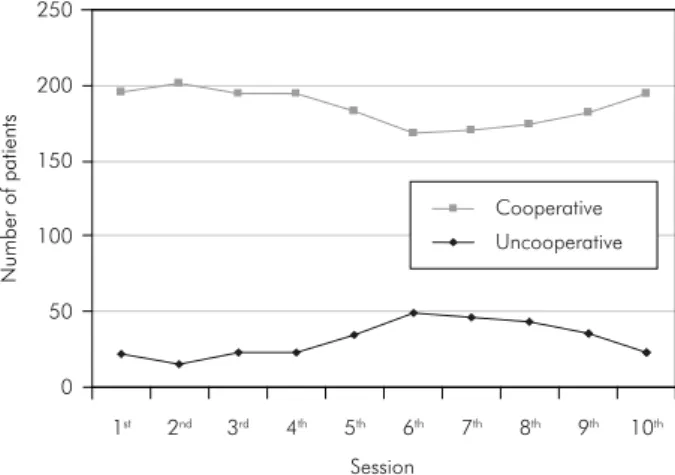
There was a predominance of cooperative behav-ior compared to uncooperative behavior when each visit was analyzed separately (Table 1 and Graph 1). However, a signiicant increase in the number of
uncooperative patients was observed for the sixth,
seventh and eighth sessions compared to the irst session.
No association was observed between the be-havior shown by the babies during dental care and gender (p > 0.05). Table 2 shows a signiicant asso-ciation between the behavior shown by the children and age group during dental care performed at the Baby Clinic for the irst visit. At the tenth appoint-ment, however, there was no signiicant association between those variables (Table 3).
Discussion
One of the objectives of the preventive and edu-cation program developed at the Baby Clinic of the School of Dentistry at Araçatuba, São Paulo State University (UNESP), Araçatuba, SP, Brazil is to
0 50 100 150 200 250
1st 2nd
Session
3rd 4th 5th 6th 7th 8th 9th 10th
N
u
mbe
r
o
f
patients
Cooperative
Uncooperative
Graph 1 - Graphical illustration of the distribution of pa-tients according to session and behavior.
Session Uncooperative Patients Cooperative Patients χ2 p value
1st 21 (9.72%) 195 (90.28%)
2nd 15 (6.94%) 201 (93.06%) 0.7576 0.3841
3rd 22 (10.19%) 194 (89.81%) 0.0002 0.9899
4th 22 (10.19%) 194 (89.81%) 0.0002 0.9899
5th 34 (15.74%) 182 (84.26%) 3.0001 0.0833
6th 48 (22.22%) 168 (77.78%) 11.6594* 0.0006
7th 46 (21.30%) 170 (78.70%) 10.1751* 0.0014
8th 43 (19.91%) 173 (80.09%) 8.0890* 0.0045
9th 35 (16.20%) 181 (83.80%) 3.4673 0.0626
10th 22 (10.19%) 194 (89.81%) 0.0002 0.9899
* Statistical significance (p < 0.05). Table 1 - Distribution of the
demonstrate that dental care can be a pleasant activ-ity, eliminating the stigma and fear of the dentist.10
Since its inception, more than 3,000 infants have been attended. The recall visits for the program, with a usual maximum interval of two months, are encouraged until the patient reaches three years of age. The outcomes10 are excellent: caries-free
chil-dren and parents changing their attitudes toward the roles of prevention and maintenance of oral health.
The present longitudinal study evaluated the be-havior of children from the irst to the third year of life during ten dental visits, with a mean period of 20 months for conclusion of the appointments. In a previous study, Cunha et al.5 (2003) had
exam-ined the behavior of babies during a shorter period of time (4 consecutive appointments).
Ready acceptance of the dental experience by children aged 0 to 3 years is dificult because of their limitation in communication and emotional instability, in addition to their still developing in-dependence, socialization, security and language. A reaction of fear or anxiety in the presence of the unexpected and unknown is common. All of these situations may originate an uncooperative patient
behavior during dental care.
The classiication used in the present study was an adaptation of the behavioral scale elaborated by Walter et al.7 (1999). Other known measures to rate
the behavior of children may not be appropriate for the evaluation of infants due to their complexity. Some of them even require the children’s participa-tion during the evaluaparticipa-tion. Unfortunately little has been published, which makes the comparison of re-sults dificult.
Analysis of the behavior of the patients during ten care sessions at bimonthly intervals showed a
predominance of cooperative behavior, especially for the irst ive and the last two visits. For the inter-mediate visits (sixth, seventh and eighth sessions), a signiicant increase in the number of uncooperative patients was observed; however, that number was lower than the number of cooperative patients (Ta-ble 1). These indings are similar to those reported by Pereira, Freire6 (2004) for children aged 0 to 3
years.
The indings also support the concept that the behavioral reactions of the patients go through a process of maturation during the irst three years of life, which can be divided into three phases. In the irst phase (corresponding to the irst year of life), the patient exhibits a cooperative behav-ior regarding dental procedures. In this phase, the baby strongly manifests one of the types of global response to the complex of stimuli offered by the environment, which is called affectionate reaction. The infant tries to establish a positive adaptation to the environment. Recognizing this concept and also considering a child and a mother who are emotion-ally calm, it is possible to make the infant feel that the dental ofice is a reliable environment and the irst visit will proceed relatively undisturbed.
In the second phase (corresponding to the second year of life) the motor capabilities of the infant ma-ture. That phase corresponds to the sixth, seventh and eighth visits in the present study, when the num-ber of uncooperative patients increased. Therefore, episodes of crying, mouth closing, tongue action and the use of other body parts that have acquired a notion of movement such as the arms may now impair the work of the professional. It is interesting Table 2 - Distribution of the patients evaluated at the first
appointment, according to behavior and age range.
Behavior
Age Uncooperative Cooperative TOTAL
0 – 6 months 3 89 92
7 – 12 months 18 106 124
Total 21 195 216
Statistical significance (p < 0.05); χ2 = 6.3945; p value = 0.011.
Table 3 - Distribution of the patients evaluated at the tenth appointment, according to behavior and age range.
Behavior
Age Uncooperative Cooperative TOTAL
19 – 24 months 10 72 82
25 – 30 months 13 93 106
31 months or older 0 28 28
Total 23 193 216
to emphasize that the stimuli offered to the patients studied were the same. As babies psychologically become more aware of their body, along with their developing motor ability, a greater interaction with the environment happens, which results in opposing manifestations to dental procedures. However, we do not consider these manifestations to be negative reactions.
Finally, in the third phase (corresponding to the third year of the baby’s life), the responses become more favorable with the ongoing visits and the chil-dren start to cooperate with the treatment. The experience obtained during the appointments was fundamental for the progressive decline in unco-operative behaviors since the patients were able to perceive the procedures performed as not stressful. The philosophy of the preventive program to which these patients were submitted is based on continu-ous follow-up so that visits require a lower level of cooperation since they tend to be faster and to in-volve simple procedures that do not cause
discom-fort to the patient and are effective in maintaining oral health.
The behavioral manifestations described above have important repercussions on clinical care, and the professional should be aware of them, i.e., ba-bies who initially show a cooperative behavior will be considered uncooperative after some sessions, but they will eventually exhibit again a cooperative behavior with the ongoing care (Tables 2 and 3). The professional should inform the parents about these reactions so that they may irmly comply with the instructions which promote the oral health of their children.
Conclusion
Based on the results, it was possible to conclude that the behavior shown by patients was directly inluenced by their psychomotor development. Con-stant attendance and exposure of the baby to non-stressful dental stimuli are factors that favor a coop-erative behavior.
References
1. Torriani DD. Análise do comportamento de bebês durante atendimento odontológico: relação entre sexo, idade e dentes irrompidos [Dissertação de Mestrado]. Araçatuba: Faculdade de Odontologia da UNESP; 1999.
2. Klingberg G, Berggren U, Noren JG. Dental fear in an urban Swedish child population: prevalence and concomitant factors. Community Dent Health. 1994;11(4):208-14.
3. Shinohara S, Nomura Y, Shingyouchi K, Takase A, Ide M, Moriyasu K et al. Structural relationship of child behav-ior and its evaluation during dental treatment. J Oral Sci. 2005;47(2):91-6.
4. Yamada MK, Tanabe Y, Sano T, Noda T. Cooperation dur-ing dental treatment: the children’s fear survey schedule in Japanese children. Int J Paediatr Dent. 2002;12(6):404-9. 5. Cunha RF, Delbem ACB, Percinoto C, Melhado FL.
Behav-ioral evaluation during dental care in children ages 0 to 3 years. J Dent Child. 2003;70(2):100-3.
6. Pereira MBB, Freire MCM. An infant oral health programme in Goiânia-GO, Brazil: results after 3 years of establishment. Braz Oral Res. 2004;18(1):12-7.
7. Walter LRF, Ferelle A, Issao M. Odontologia para o Bebê: Odon-topediatria do nascimento aos 3 anos. São Paulo: Artes Médicas; 1999.
8. Percinoto C, Cunha RF. A influência positiva da assistência odontológica para bebês no comportamento futuro do paciente. In: Corrêa MSNP. Sucesso no Atendimento Odontopediátrico: aspectos psicológicos. São Paulo: Santos; 2002. p. 609-15. 9. Klein H. Psychological effects of dental treatment on children
of different ages. J Dent Child. 1967;34(1):30-6.