Vol.56, n.5: pp. 829-836, September-October 2013
ISSN 1516-8913 Printed in Brazil BRAZILIAN ARCHIVES OF
BIOLOGY AND TECHNOLOGY
A N I N T E R N A T I O N A L J O U R N A L
Influence of Integral and Decaffeinated Coffee Brews on
Metabolic Parameters of Rats Fed with Hiperlipidemic Diets
Júlia Ariana de Souza Gomes
1, Bruno Generoso Faria
1, Viviam de Oliveira Silva
1, Márcio
Gilberto Zangerônimo
1, José Rafael Miranda
1, Adriene Ribeiro de Lima
2, Rosemary
Gualberto Fonseca Alvarenga Pereira
2and Luciano José Pereira
1*1
Departamento de Medicina Veterinária; Setor de Fisiologia e Farmacologia; Universidade Federal de Lavras;
Lavras - MG - Brasil. 2Departamento de Ciência dos Alimentos; Universidade Federal de Lavras;Lavras - MG -
Brasil
ABSTRACT
The objective of this study was to evaluate the influence of integral and decaffeinated coffee brews (Coffea arabica L and C. canephora Pierre) on the metabolic parameters of rats fed with hyperlipidemic diet. Thirty male Wistar rats (initial weight of 270 g ± 20 g) were used in the study, which were divided into six groups five each. The treatments were normal diet, hyperlipidemic diet, hyperlipidemic diet associated with integral coffee arabica or canephora brews (7.2 mL/kg/day) and hyperlipidemic diet associated to decaffeinated arabica, or canephora brews, using the same dosage. After 41 days, performance analyses were conducted.The rats were then euthanized and the carcasses were used for the analysis of dried ether extract and crude protein. Fractions of adipose tissue were processed for histological analysis. There was a reduction in weight gain and accumulation of lipids in the carcasses, lower diameter of adipocytes and a lower relative weight of the liver and kidneys of rats fed with hyperlipidemic diet associated with integral coffee brew. Integral coffee brew reduced the obesity in the rats receiving hyperlipidemic diet, but the same effect did not occur with the decaffeinated types.
Key words: Lipids, Adipocytes, Hyperlipidemia, Caffeine, Decaffeination
*Author for correspondence: [email protected]
INTRODUCTION
Coffee is one of the most valuable products of the global economy, and the varieties Arabica (Coffea
arabica L.) and Robusta (Coffea canephora
Pierre) are considered as the most important because they correspond to more than 90% of world production (Briandet et al. 1996; Ky et al. 2001). Coffee has received significant scientific attention due to various epidemiological and experimental studies that point to its therapeutic effects (Azam et al. 2003; Jonhston et al. 2003; Wirdefeldt et al. 2011). Moreover, the market for decaffeinated coffee has grown over the years,
adding more economic value to the product (ABIC 2010).
al. 2010). Other studies have also reported the effect of caffeine on weight reduction (Shin et al. 2010) due to increased thermogenesis, increasing the rate of lipolysis and fat oxidation (Greenberg et al. 2006) and speed up the metabolism energy and reduce lipogenesis (Murase et al. 2011). However, caffeine also has some adverse effects involving the cardiovascular system (Papamichael et al. 2005), association with the occurrence of spontaneous abortion and stillbirth (Bech et al. 2005) and withdrawal effects, such as sleep problems and fatigue (Phillips-Bute and Lane 1997). These factors have contributed to increase the consumption of decaffeinated coffee.
In this sense, studies relating the influence of decaffeination and coffee varieties on the metabolism may contribute significantly to health professionals, and especially with the coffee drinkers. Thus, the aim of this study was to evaluate the influence of decaffeination and the varieties Coffea arabica L. and C. canephora
Pierre on weight gain, relative weight of kidneys, liver, heart and adipose tissue and also on protein and lipid deposition on the carcasse of rats fed with hiperlipidemic diet.
MATERIALS AND METHODS
The study was approved by the Ethics Committee for Animal Research at the Federal University of Lavras (CEUA), protocol number 027/2010.
Collection and sample preparation
The samples of coffee (Coffea arabica L. and C.
canephora Pierre) were donated by the
COCAMAR Catanduva - SP, which were roasted (Probat electric grinder) and then the beans were ground into fine-grained (70% retention sieve 20), packaged in polyethylene / aluminum, sealed and stored at -20°C until the use.
Preparation of feed for induction of
hyperlipidemia
The hyperlipidemic diet was prepared from the commercial diet added with cholesterol and cholic acid. The feed was ground in industrial blender, mixed with the other components in the proportion of 10 g of cholesterol and 2 g cholic acid per kilogram of feed (Ramos et al. 2008) and subsequently hydrated and repelleted.
Coffee Brewing
The coffee brewing was performed immediately prior to the administration. For this, 10 g of coffee
powder was placed on a filter paper (Whatman no 3) and then 100 mL of deionized water at 90°C was poured over the powder (Nicoli et al. 1997).
Experimental Procedure
A total of 30 male Wistar rats, initially weighing 270 g ± 20g, were used in this study, which were obtained from the Vivarium of the Federal University of Lavras (UFLA - MG). The rats were acclimated for one week prior to the experiment, kept in polyethylene boxes at 23°C with light-dark period of 12 h, receiving water and food ad libitum. Subsequently, the rats were divided into six groups of five each distributed in a completely randomized factorial scheme 2x2 +2 (two types - arabica and robusta and two coffee varieties – integral and decaffeinated - and two additional control treatments with five replicates of one animal per plot. The experimental period lasted 41 days.
The treatments were normal diet (negative control), hyperlipidemic diet (positive control), hyperlipidemic diet associated with brews of coffee Arabica integral (AI) and canephora (RI) and decaffeinated arabica brews (AD) and canephora (RD) associated with the hyperlipidemic diet. The coffee brews were provided to the rats daily by gavage, on volume of 7.2 mL/kg of body weight. Control groups received the same volume of distilled water.
Laboratory Analysis
At the end of the experiment, the rats were euthanized by exsanguination after anesthesia with thiopental (35 mg / kg) intraperitoneally. Then the skin was dissected and the viscera were removed. The carcasses of the rats were weighed and dried for the analysis of ether extract and crude protein. Weight gain was calculated as the difference between the initial and final weight of the rats. The relative weights of liver, kidneys and heart as well as the fatty tissue of the epididymal region (Page et al. 2004) and carcass were obtained by the ratio of absolute weight: live weight at the time of euthanasia. The percentage of fat in the carcass were obtained by the Soxhlet method and protein by Kjedahl method (AOAC 2000).
Histological analysis
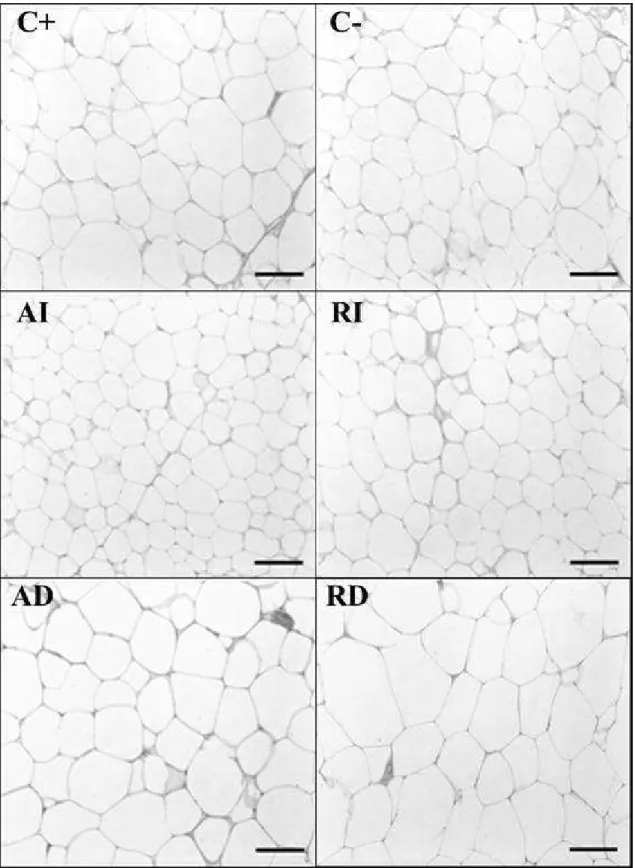
subjected to routine techniques for paraffin embedding. Sections of 5mm thickness were obtained and stained with hematoxylin-eosin. Digital images were obtained using a capture system and image analysis, consisting of trinocular Olympus CX31 microscope (Olympus Optical do Brazil Ltda, São Paulo, SP) and camera (SC30 Color CMOS Camera for Light Microscopy, Olympus Optical Ltd. Brazil, São Paulo, SP). About 120 adipocytes per animal were randomly analyzed in ImageJ software (NIH). The following parameters were evaluated (1) diameter, measuring from the longest distance between the two ends of the cell (Velasco et al. 2008), (2) area, from its delimitation, and (3) density, using a square of known area superimposed on certain fields of the captured images. For the analysis of the density of adipocytes (number of adipocytes per unit area of tissue) (NA), two edges of the square were disregarded. Hence, adipocytes was counted entirely within the square, or overlapped by at least one of its two remaining edges. Approximately 15 areas were evaluated for each rat and the calculation of NA followed the formula described by Howard and Reed (1998): NA = ΣN (adipocytes): [α.Σ P (tissue)], where ΣN (adipocytes ) is the total number of adipocytes counted in all fields examined, α is the area of the square used, and ΣP (tissue) is the number of fields analyzed.
Statistical Analysis
The data were subjected to the analysis of covariance (initial weight). Firstly, a global analysis of variance was carried out to calculate the overall error. Then, the analysis considering only the factorial design to deployment was carried out. In this case, means were compared by F test, considering the global error calculated initially. To compare each control with the other treatments, Dunnett's test was used to 5%. All the tests were performed using the statistical program SISVAR (Ferreira 2010).
RESULTS AND DISCUSSION
Comparing the hyperlipidemic diets with normal diets, it was observed that the former resulted (P <0.05) in higher weight gain, but did not affect (P> 0.05) the carcass yield and the percentage of protein in the carcass (Table 1). On the other hand,
considering the factorial arrangement of treatments, it was observed that all the rats receiving hyperlipidemic diets associated with integral coffee brews, regardless of the variety used, showed (P <0.05) lower weight gain and a lower percentage of lipids in housing in relation to decaffeinated brew, but the same effect was not observed (P> 0.05) in the yield and protein percentage in the carcass.
Several studies performed with caffeine, a substance present in the integral coffee have shown similar results to the present study reducing the weight gain (Tanaka et al. 2009; Swithers et al. 2010) and inhibition of the deposition of adipose tissue in rodents (Inoue et al. 2006; Tanaka et al. 2009; Franco et al. 2011),despite its association with hyperlipidemic diets. Coffee brew did not influence the protein deposition and carcass yield of the rats. These data were similar to the study of Franco et al. (2011), who found no difference between the percentages of protein in the rats that received caffeine and control groups.
These effects could be related to the inhibition of lipogenesis and increased lipolysis (Tanaka et al. 2009). Caffeine is known to inhibit the activity of the phosphodiesterase, increasing the serum levels of cAMP and reducing the activity of lipase, which leads to an increased rate of lipolysis (Butcher et al. 1968). According to a study conducted with the rodents, which received caffeine and hyperlipidemic diet (Kobaiashi-Hattori et al. 2005), caffeine led to increased serum levels of catecholamines (epinephrine, norepinephrine and dopamine). In addition, caffeine intake can increase the free fatty acids mobilization(Acheson et al. 2004; Greenway et al. 2004), not using muscle glycogen (Hespel et al. 2002), which possibly results in less weight gain.
epididymal adipose tissue of the animals fed with hyperlipidemic diet and coffee brew had smaller
diameter and higher density for the lower amount of intracellular lipid.
Table 1 - Final weight, weight gain, carcass yield and percentage of lipid and protein in the carcass of rats fed hiperlipidemic diet and brews of different types and varieties of coffee.
Type Varietys
C. arabica C. canephora Average
- Weight gain (g /day) -
Integral 39.00 b# 41.67 b# 40.34 b
Descafeinated 52.50 a# 60.00 a# 56.25 a
Average 45.75 50.84
Positive control 83.75 Negative control 54.00
CV (%) 22.31
- Carcass yield (%) -
Integral 83.67 82.80 83.23
Descafeinated 82.88 79.69* 81.28
Average 83.28 81.25
Positive control 81.79 Negative control 83.35
CV (%) 2.75
- Percentage of lipids (%) -
Integral 7.55# 8.30 7.93 b
Descafeinated 9.88 10.55* 10.21 a
Average 8.72 9.43
Positive control 10.10 Negative control 7.76
CV (%) 14.74
-Percentage of protein (%)
-Integral 20.19 19.44 19.82
Descafeinated 19.82 19.37 19.59
Average 20.01 19.41
Positive control 19.62 Negative control 20.09
CV (%) 835
Means followed by different lowercase and uppercase letters in the column on the line differ by the F test #Differs from the positive control by Dunnett's test (P <0.05) * Differs from the negative control by Dunnett's test (P <0.05).
Table 2 - Histology of the retroperitoneal adipose tissue of rats fed hiperlipidemic diet and brews of different types and varieties of coffee.
Type Varietys
C. arabica C. canephora Average
- Adipocytes Diameter -
Integral 72.52 81.08 76.80 a
Decaffeinated 82.47 99.57*# 91.02 b
Average 77.49 A 90.33 B
Positive control 80.76
Negative control 82.19
CV (%) 11.13
Adipocytes Density
-Integral 293 242 267 a
Decaffeinated 225 199 212 b
Average 259 221
Positive control 275
Negative control 231
CV (%) 17.79
The amount of lipid in the diet and coffee brews had no effect (P> 0.05) relative to heart weight (Table 3). The data for heart weight coincided with the study of Inoue et al. (2006), who found no difference in the weight of this organ among the animals that received caffeine and control groups,
possibly because caffeine did not act directly on heart muscle tissue, only in skeletal muscle, where it increased the transmission of neural stimulation in neuromuscular junction (Kalmar and Cafarelli 2004).
Table 3 - Relative weight (%) of the heart, kidneys, liver and epididymal adipose tissue of rats fed hiperlipidemic diet and brews of different types and varieties of coffee.
Type Varietys
C. arabica C. canephora Average
- Heart (%)
-Integral 0.228 0.225 0.227
Decaffeinated 0.218 0.221 0.219
Average 0.223 0.223
Positive control 0.228 Negative control 0.274
CV (%) 9.83
- Kidney (%) -
Integral 0.554 * 0.523 * 0.539
Decaffeinated 0.505 * 0.508* 0.506
Average 0.529 0.509
Positive control 0.544 Negative control 0.716
CV (%) 6.69
- Liver (%)
-Integral 2.870*# 2.747*# 2.809 b
Decaffeinated 3.084* 3.208* 3.146 a
Average 2.977 2.978
Positive control 3.181 Negative control 2.338
CV (%) 4.51
- Epididymal adipose tissue (%) -
Integral 0.765# 0.807# 0.786
Decaffeinated 0.873# 0.828# 0.851
Average 0.819 0.818
Positive control 1.225 Negative control 0.880
CV (%) 10.19
Means followed by different lowercase and uppercase letters in the column on the line differ by the F test # Differs from the positive control by Dunnett's test (P <0.05) * differs from the negative control by Dunnett's test (P <0.05).
There was a reduction (P <0.05) in the relative weight of kidneys in all the rats receiving hyperlipidemic diets associated with coffee brews in relation to normal diet. There was no effect (P> 0.05) of coffee brews on the rats fed hiperlipidemic diets in the relative weight of the kidneys. Mühlfeld et al. (2004), assessing the effect of hyperlipidemic diet on kidney function, also found a reduction in kidney mass and an increase in proteinuria and serum urea nitrogen in the rats treated with hyperlipidemic diet. According to the author, the effect of declining kidney function due to the increase of glomerular
cells in the array, increased the proliferation of tubular epithelial cells and macrophage infiltration.
in the integral form showed lower liver weight, suggesting a reduction in the process of fat deposition in the liver induced by caffeine. Yamauchi et al. (2010) reported that the reduction in the level of liver fat was a consequence of decreased gene expression related to fatty acid synthesis in the liver. Another study found that coffee consumption had a protective effect on liver damage caused the fatty diet, mediated by a reduction in hepatic fat accumulation by increasing beta-oxidation of fatty acids (Vitaglione et al. 2010).
In analyzing the effect of coffee brew on the relative weight of epididymal adipose tissue in the rats fed with hyperlipidemic diets, it was observed that there was a reduction (P <0.05) regardless of the type and variety used. It was observed that the relative amount of adipose tissue in the rats fed with hyperlipidemic diets associated with coffee brews was similar (P> 0.05) to that presented by the rats receiving normal diets. There was no difference (P> 0.05) between the coffee brews.
CONCLUSIONS
In conclusion, the decaffeination process seemed to influence negatively the effectiveness of coffee in suppressing fat accumulation for both arabica and robusta varieties. Moreover, the reduction in weight gain accompanied by a lower percentage of lipids in the carcass and smaller diameter of adipocytes, suggested the protective action of caffeine on the rats subjected to hyperlipidemic diet.
ACKNOWLEDGEMENTS
The researchers thank the Fundação de Pesquisa do Estado de Minas Gerais (FAPEMIG) and the Conselho Nacional de Desenvolvimento Científico e Tecnológico (CNPq).
REFERENCES
ABIC, Associação Brasileira de café [Internet]. 2010 [updated 2010; cited 2011 nov. 12]. Available from: http://www.abic.com.br/publique/media/EST_PESQT endenciasConsumo2010.pdf.
Acheson KJ, Gremaud G, Meirim I, Montigon F, Krebs Y, Fay LB, Gay LJ, Schneiter P, Schindler C and Tappy L. Metabolic effects of caffeine in humans: lipid oxidation or futile cycling? Am J Clin Nut. 2004; 79 (1): 40-46.
Association of Official Analytical Chemists International. Official Methods of Analysis of AOAC International. 17th ed. Gaithersburg: MD; 2000. Azam S, Hadi N, Khan NU and Hadi SM. Antioxidant
and prooxidant properties of caffeine, theobromine and xanthine. Med Sci Monit. 2003; 9 (9): 325-330. Bech BH, Nohr EA, Vaeth M, Henriksen TB and Olsen
J. Coffee and Fetal Death: A Cohort Study with Prospective Data. Am J Epidemiol. 2005; 162 (10): 983-990.
Bolignano D, Coppolino G, Barillà A, Campo S, Criseo M, Tripodo D and Buemi M. Caffeine and the Kidney: What Evidence Right Now? J Ren Nutr. 2007; 17 (4): 225-234.
Briandet R, Kemsley EK and Wilson RH. Discrimination of Arabica and Robusta in Instant Coffee by Fourier Transform Infrared Spectroscopy and Chemometrics. Agric Food Chem. 1996; 44 (1): 170-174.
Butcher RW, Baird CE and Sutherland EW. Effects of lipolytic and antilipolytic substances on adenosine 3’,5’-monophosphate levels in isolated fat cells. J Biol Chem. 1968; 243 (8): 1705-1712.
Ferreira DF. Sistema de Análise de variância para dados balanceados - SISVAR 4.1; 2010.
Franco FSC, Costa NMB, Ferreira SA, Carneiro-Júnior MA and Natali AJ. The effects of a high dosage of creatine and caffeine supplementation on the lean body mass composition of rats submitted to vertical jumping training. J Int Soc Sports Nutr. 2011; 8 (3): 1-8.
Greenberg JA, Boozer CN and Gelietbter A. Coffee, diabetes, and weight control. Am J Clin Nutr. 2006; 84 (4): 682-693.
Greenway FL, De Jonge L, Blanchard D, Frisard M and Smith SR. Effect of a dietary herbal supplement containing caffeine and ephedra on weight, metabolic rate, and body composition. Obes Res. 2004; 12 (7): 1152-1157.
Hespel P, Op’t Eijnde B, Van Leemputte M. Opposite actions of caffeine and creatine on muscle relaxation time in humans. J Appl Physiol. 2002; 92 (2): 513-518.
Howard CV and Reed MG. Unbiased stereology three-dimensional measurement in microscopy. Oxford: Bios Scientific Publishers; 1998.
Inoue H, Kobayashi-Hattori K, Horiuchi Y, Oishi Y, Arai S and Takita T. Regulation of the body fat percentage in developmental-stage rats by methylxanthine derivates in a high-fat diet. Biosci
Biotechnol Biochem. 2006; 70 (5):1134-1139.
Jonhston KL, Clifford MN and Morgan LM. Coffee acutely modifies gastrointestinal hormone secretion and glucose tolerance in humans: glycemic effects of chlorogenic acid and caffeine. Am J Clin Nutr. 2003; 78 (4): 728-733.
Kalmar JM and Cafarelli E. Central fatigue and transcranial magnetic stimulation: effect of caffeine and the confound of peripheral transmission failure. J
Neurosci Methods. 2004; 138: 15-26.
Kobayashi-Hattori K, Mogi A, Matsumoto Y and Takita T. Effect of caffeine on the body fat and lipid metabolism of rats fed on a high-fat diet. Biosc
Biotechnol Biochem. 2005; 69 (11): 2219-2223.
Ky CL, Louarn, J, Dussrt S, Guyot B, Hamon S and Noirot M. Caffeine, trigonelline, chlorogenic acids and sucrose diversity in wild Coffea arabica L. and C. canephora P. accessions. Food Chem. 2001; 75 (2): 223-230.
Lv X, Chen Z, Li J, Zhang L, Liu H, Huang C and Zhu P. Caffeine protects against alcoholic liver injury by attenuating inflammatory response and oxidative stress. Inflamm Res. 2010; 59 (8) :635-645.
Muhlfeld AS, Spencer MW, Hudkins KL, Kirk E, Leboeuf RC and Alpers CE. Hyperlipidemia aggravates renal disease in B6.ROP Os/+ mice.
Kidney Int. 2004; 66 (4): 1393–1402.
Murase T, Misawa K, Minegishi Y, Aoki M, Ominami H, Suzuki Y, Shibuya Y and Hase T. Coffee polyphenols suppress diet-induced body fat accumulation by downregulating SREBP-1c and related molecules in C57BL/6J mice. Am J Physiol
Endocrinol Metab. 2011; 300 (1): 122-133.
Muriel P and Arauz J. Coffee and liver diseases.
Fitoterapia. 2010; 81: 297-305.
Nakabayashi H, Hashimot T, Ashida H, Nishiumi S and Kanazawa K. Inhibitory effects of caffeine and its metabolites on intracellular lipid accumulation in murine 3T3-L1 adipocytes. BioFactors. 2008; 34 (4): 293-302.
Nicoli MC, Anese M, Manzocco L and Lerice CR. Antioxidant properties of coffee brews in relation to the roasting degree. Lebensm Wiss Technol. 1997; 30 (3): 292-297.
Page KA, Hartzell DL, Li C, Westby LA, Fera MAD, Azai MJ, Pringle TD and Bile CA. Adrenergic receptor agonists increase apoptosis of adipose tissue in mice. Domest Anim Endocrin. 2004; 26 (1): 23–31.
Papamichael CM, Aznaouridis KA, Karatzis EN, Karatzi KN, Stamatelopoulos KS, Vamvakou G, Lekakis JP and Mavrikakis ME. Effect of coffee on endothelial function in healthy subjects: the role of caffeine. Clin Sci. 2005; 109 (1): 55-60.
Phillips-Bute BG and Lane JD. Caffeine withdrawal symptoms following brief caffeine deprivation.
Physiol Behav. 1997; 63 (1): 35-39.
Ramos S, Moulay L, Serrano ABG, Vilanova O, Muguerza B, Goya L and Bravo L. Hypolipidemic effect in cholesterol-fed rats of a soluble fiber-rich product obtained from cocoa husks. J Agric Food Chem. 2008; 56 (16): 6985-6993.
Shin JW, Wang JH, Kang JK and Son CG. Experimental evidence for the protective effects of coffee against liver fibrosis in SD rats. J Sci Food Agric. 2010; 90 (3): 450-455.
Swithers SE, Martin AA, Clark KM, Loboy AF and Davison TL, Body weight gain in rats consuming sweetened liquids. Effects of caffeine diet composition. Apetite. 2010; 55 (3): 528-533.
Tanaka K, Nishizono S, Tamaru S, Kondo M, Shimoda H, Tanaka J and Okada T. Anti-obesity and hypotriglyceridemic properties of coffee bean extract in SD rats. Food Sci Technol Res. 2009; 15 (2): 147-152.
Velasco MVR, Tano CTN, Machado-Santelli GM, Consiglieri VO, Kaneko TM and Baby AR. Effects of caffeine and siloxanetriol alginate caffeine, as anticellulite agents, on fatty tissue: histological evaluation. J Cosmet Dermatol. 2008; 7 (1): 23-29. Vitaglione P, Morisco F, Mazzone G, Amoruso DC,
Ribecco MT, Romano A, Fogliano V, Caporaso N and D’Argenio G. Coffee Reduces Liver Damage in a Rat Model of Steatohepatitis: The Underlying Mechanisms and the Role of Polyphenols and Melanoidins. Hepatology. 2010; 52 (5): 1652-1661. Yamauchi R, Kobayashi M, Matsuda Y, Ojika M,
Shigeoka S, Yamamoto Y, Tou Y, Inoue T, Katagiri T, Murai A and Horio F. Coffee and Caffeine Ameliorate Hyperglycemia, Fatty Liver, and Inflammatory Adipocytokine Expression in Spontaneously Diabetic KK-Ay Mice. Agric Food Chem. 2010; 58 (9): 5597-5603.
Wirdefeldt K, Adami HO, Cole P, Trichopoulos D and Mandel J. Epidemiology and etiology of parkinson’s disease: a review of the evidence. Eur J Epidemiol. 2011; 26: 1-58.