Prevalence of minor psychiatric disorders in socio-educational
agents in the state of Rio Grande do Sul
Patrícia Bitencourt Toscani Greco
I, Tânia Solange Bosi de Souza Magnago
I,
Janete de Souza Urbanetto
II, Emanuelli Mancio Ferreira da Luz
I, Andrea Prochnow
II Universidade Federal de Santa Maria, Post-graduate Program in Nursing. Santa Maria-RS, Brazil.
II Universidade Católica do Rio Grande do Sul, School of Nursing, Physiotherapy and Nutrition. Porto Alegre-RS, Brazil.
Submitted: 06-01-2015 Approved: 07-02-2015
ABSTRACT
Objective: to determine the prevalence and factors associated with minor psychiatric disorders (MPD) in socio-educational
agents. Method: it is a cross-sectional study with 381 socio-educational agents the Centers for Socio-Educational Services in the State of Rio Grande do Sul, Brazil. The Brazilian versions of the Scale of Demand-control-social support at work and the Self Reporting Questionnaire-20 have been applied. Results: the results showed a prevalence of suspicion MPD of 50.1%. They showed to be related to suspicion of MPD : being female (55.7%), having age up to 44 years old (58.5%), no physical activity (57.4%), do not have time for leisure (75%), make use of medication (61.4%), require medical attention (56.9%) and psychological counseling (72.7%), not being satisfi ed with the workplace (61.7%) and need for time off from work (65.6%).
Conclusion: the study provides important data about the mental health of agents, showing the need for the involvement of
managers and of the health service of worker’s health in planning actions to promote health of these workers.
Key words: Nursing; Working Conditions; Mental Disorders; Occupational Health.
INTRODUCTION
Work is an integrating part of human life. The produc-tion of psychic meanings and construcproduc-tion of social rela-tions happen at work, with mediation between psychic and social. In this relationship, depending on how work is orga-nized and carried out, it may or may not be harmful to the mental health of workers. In Rio Grande do Sul (RS), mental disorders are the second leading cause of occupational dis-ease notification(1). Thus, it is important to make efforts in
order to establish connections between work and mental illnesses.
Among mental illnesses, the Minor Psychiatric Disorders (MPD) include symptoms such as fatigue, forgetfulness, ir-ritability, insomnia, difficulty concentrating and complaints of somatic order. These manifestations are a rupture in the ‘normal’ functioning of the individual, but do not consti-tute a disease in the International Classification of Diseas-es (ICD-10) nor in the Diagnostic and Statistical Manual (DSM)(2).
In Brazil, studies have shown a high prevalence of MPD in nursing workers(3), physicians(4), teachers(5), detention
offi-cers(6), and workers in the urban area(7). However, in a search
in the databases of LILACS, MEDLINE, and SCIELO using the descriptor mental disorders, no studies on MPD with socio-educational agents were found.
In Rio Grande do Sul, this group of workers is linked to the Socio-Educational Foundation of Rio Grande do Sul (FASE – Fundação de Atendimento Socioeducativo), and they carry out their activities in the Socio-Educational Ser-vice Centers (CASEs - Centros de Atendimento Socioeduca-tivo) located in the capital and in the countryside. Educa-tional measures issued by the judiciary for teenagers who committed offenses are carried out in the CASEs(8). The role
of agents is to monitor and accompany teenagers in all daily activities. Considering they monitor the adolescents closely, these workers are likely to be targets of threats, assaults, in-timidation, and of becoming hostages in cases of riot.
In this sense, the work process of socio-educator agents is permeated by a fast-paced environment in constant state of alert, unpredictability, time pressure, task overload, risks of physical and verbal aggression and threats. Some of these features were identified in a study(9) on workloads in
CAS-Es. The psychic load stood out, due to the constant state of alert, as well as the physiological load identified in the immobilization of teenagers, lack of chairs to rest and long working hours(9). In this same study, the agents mentioned
anxiety for vacation and reported that the idea of returning to work generates anxiety and discomfort, showing signs of psychological distress in the workplace(9).
Given the above, and considering that nursing has an important role in epidemiological surveillance activities, particularly in identifying the links between work and the illnesses of workers in general, this study aimed to identify the prevalence and associated factors to minor psychiatric disorders (MPD) in socio-educational agents of Socio-Edu-cational Services Centers (CASEs) in Rio Grande do Sul.
METHOD
This is an epidemiological study conducted in CASEs/RS. The CASEs are located in the capital of the state of RS (six units inside the complex of Socio-Educational Foundation of Rio Grande do Sul) and in seven municipalities in the interior of state.
The study population was composed of 819 socio-educa-tional agents of the CASEs/RS. The sample consisted of 381 socio-educational agents, considering a sampling error of 3.68%, estimated proportion of 50% and 5% significance level. The sample selection was random by CASE unit.
Socio-educational agents of both genders who work in CASEs units were included in the study. The agents return-ing from vacation or on any other leave were included after 30 days of return to work, given the criterion of the Self-Re-porting Questionnaire-20 (SRQ-20). Socio-educational agents who were on leave for healthcare or any other reason during the data collection period were excluded. The recruitment of research participants was carried out individually in the work-place, by providing information on the objectives, purpose, risks and benefits of the study. After agreeing and signing the Informed Consent Form (CIF), they received the survey ques-tionnaire to fill out.
Certified research assistants were responsible for the data collection that took place from March to August 2011. The instruments used were the following: a questionnaire with questions related to sociodemographic characteristics (gender, age, race, education, marital status, number of children), labor (time working in the institution and as an agent, work shift, working time in the shift, weekly hours, another job, work scale, satisfaction with the workplace, training), habits (to-bacco use, suspicion for alcoholism/CAGE questionnaire(10),
physical activity practice, leisure time) and health status (med-ication use, need for medical and psychological care, work leave); the short version of the Job Content Questionnaire, the Job Stress Scale - JSS(11) and the SRQ-20(12), validated in Brazil
for investigation of occupational stress and MPDs respectively. The Job Stress Scale(11), also known as Swedish Scale for
Demand-Control- Social Support (DCS), contains 17 ques-tions; five evaluate the psychological demand, six the con-trol demand, and six the social support. The JSS translation guidelines were followed to obtain the total scores of each of these variables (demand, control and social support)(10). For
the dichotomy of psychological and control demands, the av-erage was used as cutoff point. From these two dimensions dichotomized into ‘high’ and ‘low’, were established four cat-egories: low strain (high control and low demand - reference category), active work (high control and high demand), pas-sive work (low control and low demand) and high strain (low control and high demand - highest exposure category). Social support was also dichotomized in high and low social support by the average of points.
The MPDs were evaluated according to scores on the SRQ-20 validated in Brazil in the 1980s(12). The cutoff point used for
group of symptoms: Depressed-anxious mood, Somatic symp-toms, Decreased vital energy and Depressive thoughts(13).
The Epi-info®, version 6.4, was used in entering data
(dou-ble entered independently). After checking for errors and in-consistencies, the PASW Statistics® (Predictive Analytics
Soft-ware, SPSS Inc., Chicago, USA) 18.0 for Windows was used for data analysis.
The internal consistency of the JSS and the SRQ-20 was as-sessed by Cronbach’s Alpha coefficient. The chi-square test or Fisher’s exact test was used to check whether the associations showed statistical significance (p<0.05).
The study was approved by FASE/RS and the Research Eth-ics Committee (REC) of the Universidade Federal de Santa Maria, under number 23081.019161/2010-08, and Pre-sentation Certificate for Ethical Assessment (CAAE) number 0333.0.243.000-10, on 14 December, 2010. The study is in agreement with Resolution 196/96 of the National Health Council (current resolution at the time of the study).
RESULTS
The value of general internal consistency of the JSS and SRQ-20 items was 0.62 and 0.86, respectively. The preva-lence of suspicion for MPD in socio-educational agents of CASEs/RS was 50.1%.
The SRQ-20 questions with a higher proportion of affirma-tive responses were: feels nervous, tense or worried (68.5%), of the Depressive-anxious mood symptoms group; sleeps badly (55.6%) of the Somatic symptoms group; gets tired easily (51.4%) and finds it difficult to perform daily activities with satisfaction (50.4%), of the Decreased vital energy symptoms group. The av-erage of affirmative responses to the SRQ-20 was 6.86 (±4.28).
Table 2 shows significantly higher frequencies of suspicion for MPD among female socio-educational agents (55.7%) and those aged up to 44 years (58.5%). For the other variables, no significant differences were observed between the evaluated groups and suspicion for MPD (p>0.05).
Table 1 – Distribution of socio-educational agents in Rio Grande do Sul, according to the group of symptoms and affirmative
answers to the Self-Reporting Questionnaire-20 (SRQ-20), RS, 2011 (n=381)
Group of symptoms Questions SRQ-20* YES
%
Depressive-anxious mood Do you feel nervous, tense or worried? 261 68.5
Are you easily frightened? 114 29.9
Have you felt sad lately? 169 44.4
Have you cried more than usual? 80 21.0
Somatic symptoms Do you have frequent headaches? 182 47.8
Do you sleep badly? 250 55.6
Do you have uncomfortable feelings in the stomach? 170 44.6
Is your digestion poor? 166 43.6
Is your appetite poor? 54 14.2
Do your hands shake? 65 17.1
Decreased vital energy Do you get tired easily? 196 51.4
Do you find it difficult to make decisions? 82 21.5
Do you find it difficult to enjoy your daily activities? 192 50.4
Do you have difficulties at work (your job is painful, causes suffering)? 170 44.6
Do you feel tired all the time? 169 44.4
Do you have trouble thinking clearly? 101 26.5
Depressive thoughts Are you unable to play a useful part in your life? 33 8.7
Have you lost interest in things? 115 30.2
Have you had the thought of ending your life? 25 6.6
Do you feel that you are a useless, worthless person? 21 5.5
Table 2 – Prevalence of Minor Psychiatric Disorders (MPD) in socio-educa-tional agents according to sociodemographic variables, RS, 2011
Sociodemographic variables
DPM
No Yes
p*
n % n %
Gender (N= 380)
Male 95 56.5 73 43.5 0.018
Female 94 44.3 118 55.7
Age group (N=372)
Up to 44 years 80 41.5 113 58.5 0.001
≥ 45 years 105 58.7 74 41.3
Race (N=380)
White 136 47.6 150 52.4 0.137
Others 53 56.4 41 43.6
Education (N=363)
Secondary school 86 51.8 80 48.2 0.558
Tertiary education 75 48.4 80 51.6
Post-graduation 18 42.9 24 57.1
Marital status (N=379)
Married/with partner 122 50.0 122 50.0 0.945
Single/no partner 67 49.6 68 50.4
Number of children (N=380)
No child 40 52.6 36 47.4 0.900
1 child 62 50.8 60 49.2
2 children 55 47.8 60 52.2
3 or more children 32 47.8 35 52.2
* Chi-square test
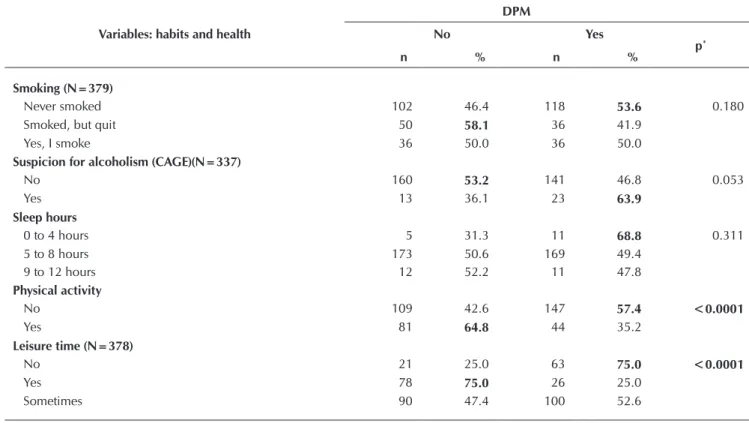
Table 3 – Prevalence of Minor Psychiatric Disorders (MPD) in socio-educational agents according to variables of habits and
health, RS, 2011
Variables: habits and health
DPM
No Yes
p*
n % n %
Smoking (N=379)
Never smoked 102 46.4 118 53.6 0.180
Smoked, but quit 50 58.1 36 41.9
Yes, I smoke 36 50.0 36 50.0
Suspicion for alcoholism (CAGE)(N=337)
No 160 53.2 141 46.8 0.053
Yes 13 36.1 23 63.9
Sleep hours
0 to 4 hours 5 31.3 11 68.8 0.311
5 to 8 hours 173 50.6 169 49.4
9 to 12 hours 12 52.2 11 47.8
Physical activity
No 109 42.6 147 57.4 <0.0001
Yes 81 64.8 44 35.2
Leisure time (N=378)
No 21 25.0 63 75.0 <0.0001
Yes 78 75.0 26 25.0
Sometimes 90 47.4 100 52.6
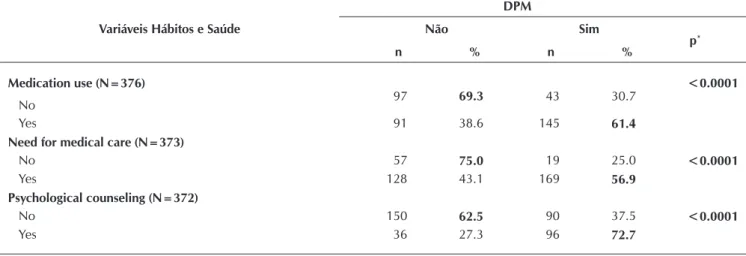
Regarding habits and health, there was a statistically significant difference of sus-picion for MPD among socio-educational agents who did not practice physical activ-ity (57.4%), those who did not have time for leisure (75%), those using medication (61.4%) and those who needed medical care (56.9%) or psychological counsel-ing (72.7%). There was also a tendency to present suspicion for MPD (63.9%; p = 0.053) among agents who used alcoholic beverages. The other variables did not differ significantly between the evaluated groups and MPD.
Table 4 shows a statistically significant difference of suspicion for MPD among socio-educational agents who were not satisfied with the workplace (61.7%) and those who required between 25 and 99 days of work leave for health problems (65.6%). There was also a tendency to present suspicion for MPD (53.3%; p = 0.051) among agents with up to 12 years in the position. The other variables did not differ significantly between the evalu-ated groups and MPD (p> 0.05).
Table 5 shows that despite the higher percentages of suspicion for MPD among socio-educational agents classified in high
Table 4 – Prevalence of Minor Psychiatric Disorders (MPD) in socio-educational agents according to labor variables, RS, 2011
Labor variables
DPM
No Yes
p*
N % N %
Working time in the institution
Up to 10 years 96 45.7 114 54.3 0.072
More than 10 years 94 55.0 77 45.0
Working time as an agent
Up to 12 years 126 46.7 144 53.3 0.051
More than 12 years 64 57.7 47 42.3
Work shift
Day 89 46.1 104 53.9 0.137
Night 101 53.7 87 46.3
Working time in the shift (N= 380)
Up to 8 years 102 50.0 102 50.0 >0.999
More than 8 years 88 50.0 88 50.0
Weekly working hours
Up to 40 hours 125 48.6 132 51.4 0.489
More than 40 hours 65 52.4 59 47.6
Other employment
No 173 50.0 173 50.0 0.872
Yes 17 48.6 18 51.4
Work hours in the other job (N=35)
Up to 20 hours 13 52.0 12 48.0 0.521†
More than 20 hours 4 40.0 6 60.0
Working time in the other job (N=35)
Up to 6 years 11 57.9 8 42.1 0.229
More than 6 years 6 37.5 10 62.5
Workers in the work schedule (N=366)
Sufficient 41 56.9 31 43.1 0.156
Insufficient 140 47.6 154 52.4
Satisfaction with the workplace (N=369)
No 74 38.3 119 61.7 <0.0001
Yes 112 63.6 64 36.4
Variáveis Hábitos e Saúde
DPM
Não Sim
p*
n % n %
Medication use (N=376)
No 97 69.3 43 30.7
<0.0001
Yes 91 38.6 145 61.4
Need for medical care (N=373)
No 57 75.0 19 25.0 <0.0001
Yes 128 43.1 169 56.9
Psychological counseling (N=372)
No 150 62.5 90 37.5 <0.0001
Yes 36 27.3 96 72.7
*Teste Qui-quadrado
strain quadrant and with low social support, there was no sig-nificant statistical difference when compared to the group of workers with high social support (p>0.05).
DISCUSSION
The overall prevalence of MPD among socio-educational agents was 50.1%. It was higher than the prevalence found in a study with correctional officers (30.7%)(7), with network
health workers of Botucatu/SP (42.6%)(14), and with workers in
the urban area of Feira de Santana/BA (25.2%)(7).
However, a study with teachers in the municipal network of Vitória da Conquista(6) showed higher prevalence of MPD
among them (55.9%) than among socio-educational agents. The similarity of percentages in these two studies may be
related with the actions of agents and teachers with the ado-lescent population, and also with the fact that socio-educa-tional agents have pedagogical(8) and reference roles for the
adolescents in the institution.
According to the Program for Execution of Socio-Educational Measures (PEMSEIS - Programa de Execução de Medidas Socio-educativas), the agents participate in pedagogical and therapeu-tic actions through suggestions and actions aimed at their effec-tiveness(8). In this sense, these workers are committed to protect
adolescents, ensure their safety and participate in their educa-tional process, providing opportunities for their life in society.
When assessed individually, the following SRQ-20 ques-tions presented higher frequency of affirmative responses: “feels nervous, tense or worried”; “sleeps badly”; “gets tired easily”; “finds it difficult to enjoy daily activities”. These are
Table 5 – Distribution of socio-educational agents according to social support. quadrants of the Control-Demand Model
(CDM) and suspicion for Minor Psychiatric Disorders (MPD). RS. 2011
Social Support CDM
DPM
p*
No Yes
n(%) n(%)
Low social support CDM Low strain 16 (53.3) 14(46.7) 0.145
Passive work 16(40.0) 24(60.0)
Active work 20(31.7) 43(68.3)
High strain 15(30.0) 35(70.0)
Total 67(36.6) 116(63.4)
High social support CDM Low strain 60(70.6) 25(29.4) 0.079
Passive work 25(62.5) 15(37.5)
Active work 28(56.0) 22(44.0)
High strain 10(43.5) 13(56.5)
Total 123(62.1) 75(37.9)
* Chi-square test
Labor variables
DPM
No Yes
p*
N % N %
Receive training (N=362)
No 101 50.8 98 49.2 0.204
Yes 9 69.2 4 30.8
Sometimes 68 45.3 82 54.7
Days on leave (N= 374)
None 74 61.7 46 38.3 0.011
Up to 9 days 67 49.6 68 50.4
10 to 24 days 25 40.3 37 59.7
25 to 99 days 11 34.4 21 65.6
100 to 365 days 10 40.0 15 60.0
also noteworthy: “has felt sad lately”, “has had difficulties at work (the job is painful, causes suffering)”, “has lost interest in things”, “feels tired all the time” and “has uncomfortable feel-ings in the stomach”. These issues were presented similarly in a study with teachers in the city of Vitória da Conquista(6).
Workers can suffer the impact of work (work overload, long working hours, changes of work organization process) in their health, which in turn, favors the emergence of various diseas-es, including mental disorders ranging from mild to disabling disorders, depending on how the individual reacts to situa-tions experienced at work(7). The work can either strengthen
mental health, as lead to disorders that can be expressed indi-vidually and collectively through psychosomatic or psychiat-ric manifestations(15).
Therefore, it is important to consider the percentage of 6.6% (n = 25) of agents who answered affirmatively to the SRQ-20 question “Have you had the thought of ending your life?”. This data shows the degree of suffering of these work-ers and especially the reflection on the urgency to think of strategies to minimize this suffering. To identify signs of pos-sible suicide attempts and promote the maintenance of agents’ lives, the institution must propose moments of sensitive lis-tening, in which agents can express their feelings, needs and desires. Thus, in addition to minimize suffering, the space can provide welfare, and help with workers’ conflict resolution.
In Brazil, few studies on work-related suicides have been published, although they are present in our society. Preventive measures are urgently needed to overcome perverse forms of management, which are revealed as the main responsible for fatal events(15).
Features such as being female (55.7%) and in the age group
of up to 44 years (58.5%) appeared as significant for suspicion for MPD among socio-educational agents. The higher preva-lence of suspicion for MPD in women is also observed in stud-ies with employees in nursing (33.3%)(4) and the emergency
department (27.5%)(16).
In the present study, was observed a higher percentage of women developing the role of socio-educational agents in CAS-Es/RS. A study(7) highlights that for cultural reasons, women are
more vulnerable to job stress in prison, which reflects a lesser capacity to respond to this tension. In addition, is reported the imperative need of maintaining the authority, which can be highly stressful for them(7). Such type of stress occurs in
pris-ons, but the CASEs maintain a very similar structure to a prison. Women who work there need to impose authority and often physical strength, too. All the addressed situations indicate the different aspects of women’s work in CASEs that may or may not favor the development of psychic disorders.
The suspicion for MPD was associated with lack of physi-cal activity and leisure time. Regarding not practicing physical activity, the results corroborate other studies(5,7). The
associa-tion between MPD, unavailability of leisure time, and lack of physical activity practice can reveal the importance of these activities in reducing tensions arising from the work environ-ment(7). Or the contrary, those who do not engage in leisure
activities have MPD, which leads to isolation, symptoms of depression, anxiety and sadness.
The agents who used medication, required medical care
and psychological counseling last year, showed statistically significant difference in the occurrence of MPD, compared with those who did not need any of these resources. As the most used drugs by agents were antidepressants (n = 63) and anxiolytics (n = 29), their use is related to MPD and the need to restore individuals’ mental conditions.
Psychological care may result from the need for a space where workers can express their anguish, fears and anxieties related both to work and their private lives. For this reason, they seek support in a psychologist to minimize the potential triggers of these symptoms.
Moreover, the need for medication use and medical and psy-chological care may be related to workloads and high level of psychological distress in the workplace. This occurs due to per-ceiving the institution undervalues the development of health policies at work, the working conditions are poor and there are lacks of infrastructure, which were aspects identified in a study with socio-educational agents on the mental burden(9).
Satisfaction with the workplace showed significant rela-tionship with suspicion for MPD. Socio-educational agents unsatisfied with their workplace showed a higher percentage of MPD (61.7%). The job dissatisfaction can lead to conse-quences such as absenteeism, reduced income and com-plaints, besides having a negative effect on the mental and physical health of workers.
With regard to absenteeism, work leave due to health prob-lems was associated with suspicion for MPD. In this sense, the World Health Organization warns that mental illnesses ac-count for five of the ten leading causes of absence from work in Brazil, the first of which is depression. Work-related muscu-loskeletal disorders and mental disorders are among the most frequent causes of work absenteeism among Brazilians(2), just
as occurs with the number of notifications of work-related dis-eases in Rio Grande do Sul(1).
Importantly, in this study, the agents with suspicion for alcoholism (CAGE) had the highest percentage (63.9%; p = 0.053) of MPD. The abuse of alcohol and drugs is a serious public health problem, and directly related to production of accidents and violence. The interaction alcohol/work has raised concerns due to the direct effect on the central and pe-ripheral nervous systems, producing alterations of important cognition functions, particularly in activities requiring a high degree of attention, concentration and reasoning for its good performance(17), as is the case of socio-educational agents.
The presence of social support has been linked to improved health, because high levels of support act as a protective factor against the risks of diseases caused by stress, for example(18).
Hence, the fact of workers having social support in the work-place becomes a protective factor for the physical and mental health of individuals, including MPDs. Supportive relation-ships at work, both by colleagues and bosses favor problem resolution, contribute to the reduction of stress and favor the workers’ well-being and health. Thus, it is a mutually benefi-cial relationship of support.
It was found that 70% of agents classified in the high strain
quadrant and with low social support had suspicion for MPD. On the other hand, another important finding from this study was that 56.5% of agents classified in high strain showed sus-picion for MPD, even though they referred high social support. A study with socio-educational agents found that interper-sonal relationships among these workers were problematic. The agents revealed difficulties in teamwork, in addition to the human resources deficit(9). These conflicting interpersonal
relationships hinder supportive relationships at work, and consequently favor the disease.
CONCLUSIONS
The prevalence of suspicion for DPM in socio-educational agents in CASEs of Rio Grande do Sul was 50.1%. Among participants, 55.6% slept badly, 68.5% felt nervous, tense or worried, 50.4% found difficulty in performing daily activities with satisfaction and 51.4% got tired easily. The aspects asso-ciated with suspicion for MPD were: female gender, age up to 44 years, no practice of physical activity, no time for leisure,
makes use of medication, needs medical care and psychologi-cal counseling, unsatisfied with the workplace and need for 25-99 days off work.
The work environment can be considered a privileged space for workers and managers planning and putting into practice actions aimed at promoting and protecting health. This initiative provides shared accountability among coordi-nators, managers and employees.
Health promotion should be articulated within the security and health worker services in order to provide the treatment of diseases arising from work and actions to promote the bio-psychosocial well-being of workers. The Occupational Health Service should have multidisciplinary activities, and the nurs-ing plays a major role in promotnurs-ing the health and welfare of these workers. Nurses involved in this area, should maintain continuous and systematic surveillance in order to detect, un-derstand, research and analyze the determinant and condi-tioning factors of workers’ health problems. They also have to be alert and vigilant to the conditions and environment of work, to carry out interventions that provide the health, well-being and quality of life of workers.
REFERENCES
1. Nussbaumer L, Dapper V, Kalil F. Agravos relaciona-dos ao trabalho notificarelaciona-dos no Sistema de Informações em Saúde do Trabalhador no Rio Grande do Sul. Bol Epidemiol [Internet]. 2010 [acesso em 20 de maio de 2014];11(1):1-8. Disponível em: http://www1.saude.rs.gov. br/dados/1326723037366v.%2011,%20n.%201,%20 ed.%20especial,%202009.pdf
2. Goldberg D, Huxley P. Common mental disorders: a bio-social model. London (UK): Tavistock/Routledge; 1993.
3. Araújo TM, Aquino E, Menezes G, Santos CO, Aguiar L. Aspectos psicossociais do trabalho e distúrbios psíquicos entre trabalhadoras de enfermagem. Rev Saúde Pública. 2003;37(4):424-33.
4. Nascimento Sobrinho CL, Carvalho FM, Bonfim TAS, Ci-rino CAS, Ferreira IS. Work conditions and mental health among doctors from Salvador, Bahia, Brazil. Cad Saúde Pública. 2006;22(1):131-40.
5. Reis EJFB, Carvalho FM, Araújo TM, Porto LA, Neto AMS. Trabalho e distúrbios psíquicos em professores da rede municipal de Vitória da Conquista, Bahia, Brasil. Cad Saúde Pública. 2005;2(5):1480-90.
6. Fernandes RCP, Silvany Neto AM, Sena GM, Leal AS, Carneiro CAP, Costa FPM. Trabalho e cárcere: um estudo com agentes penitenciários da Região Metropolitana de Salvador, Brasil. Cad Saúde Pública. 2002;8(3):807-16.
7. Farias MD, Araújo TM. Transtornos mentais comuns en-tre trabalhadores da zona urbana de Feira de Santana-BA. Rev Bras Saúde Ocup [Internet]. 2011 [acesso em 20 de maio de 2014];36(123):25-39. Disponível em: http:// www.scielo.br/pdf/rbso/v36n123/a04v36n123.pdf
8. Rio Grande do Sul (BR). Programa de execução de medidas socioeducativas de internação e de semiliberdade do Rio
Grande do Sul (PEMSEIS) [Internet]. Porto Alegre; Secretaria da justiça e do Desenvolvimento Social; 2010 [acesso em 05 de fevereiro de 2010]. Disponível em: http://www.mprs. mp.br/areas/infancia/arquivos/minuta_pemseis_2010.pdf
9. Grando MK, Kirchhof ALC, Beck CLC, Trindade LL. As cargas de trabalho em um Centro de Apoio Sócio- Educa-tivo. Online Braz J Nurs [Internet]. 2006 [acesso em 05 de fevereiro de 2010];5(1)101. Disponível em: http://www. objnursing.uff.br//index.php/nursing/article/view/198/47
10. Castells MA, Furlanetto LM. Validity of the CAGE ques-tionnaire for screening alcohol-dependent inpatients on hospital wards. Rev Bras Psiquiatri [Internet]. 2005 [cited 2010 February 05];27(1):54-7. Available from: http:// www.ncbi.nlm.nih.gov/pubmed/15867984
11. Mari JJ, Williams P. A validity study of a psychiatric screening questionnaire (SQR-20) in primary care in the city of São Paulo. Br J Psychol. 1986;148:23-6.
12. Alves MGM, Chor D, Faerstein E, Lopes CS, Werneck GL. Short version of the “job stress scale”: a portuguese-lan-guage adaptation. Rev Saúde Pública. 2004;38(2):164-71.
13. Santos KOB, Araújo TM, Oliveira NF. Estrutura fatorial e con-sistência interna do Self-Reporting Questionnaire (SRQ-20) em população urbana. Cad Saúde Pública. 2009;25(1):214-22.
14. Braga LC, Carvalho LR, Binder MCP. Working conditions and common mental disorder among primary health care workers from Botucatu, São Paulo State. Ciênc Saúde Co-letiva. 2010;15(Suppl. 1):1585-96.
15. Seligmann-Silva E. Trabalho e desgaste mental: o direito de ser dono de si mesmo. Rio de Janeiro: Editora Cortez; 2011.
Rev Enferm UERJ [Internet]. 2007 [acesso em 20 de maio de 2014];15(3):329-36. Disponível em: http://www.fa-cenf.uerj.br/v15n3/v15n3a02.pdf
17. Lacerda ACF. Vulnerabilidades, consumo de álcool e cri-me em policiais condenados no Rio de Janeiro. 2011. In: Anais do Congresso Internacional da ISMA-BR; 2011;
Porto Alegre, RS. Porto Alegre; ISMA; 2011. CD-ROM.